
15 May 2019 How ANSP business model developments

15 May 2019
How ANSP business model developments can contribute to the defragmentation of the European ANS landscape S. Buyle*, W. Dewulf, F. Kupfer, E. Onghena, H. Meersman, E. Van de Voorde FABEC & FAB CE Research Workshop, Budapest, 14 th – 15 th May 2019 15 May 2019

Outline 1. 2. 3. 4. 5. Introduction Methodology Business model variables Results Conclusions Introduction Methodology Variables FABEC & FAB CE Research Workshop, Budapest, 14 th-15 th May 2019 3 Results Conclusions

Challenges § IFR movements in Europe predicted to grow by 15% in next seven years in the base scenario (EUROCONTROL seven-year forecast, Feb. 2019) § EUROCONTROL predicts that 190 thousand flights cannot be accommodated by 2022 due to capacity constraints (EUROCONTROL seven-year forecast, Feb. 2016) § Sector reforms initiated by SES and SESAR initiatives § § § Introduction Increased competition Increased pressure on cost structures Increased incentives for innovation Methodology Variables FABEC & FAB CE Research Workshop, Budapest, 14 th-15 th May 2019 4 Results Conclusions

Questions What are the strategic options for ANSPs? Which are the current business models observed? How fragmented is the European ANS landscape in terms of business models? Introduction Methodology Variables FABEC & FAB CE Research Workshop, Budapest, 14 th-15 th May 2019 5 Results Conclusions
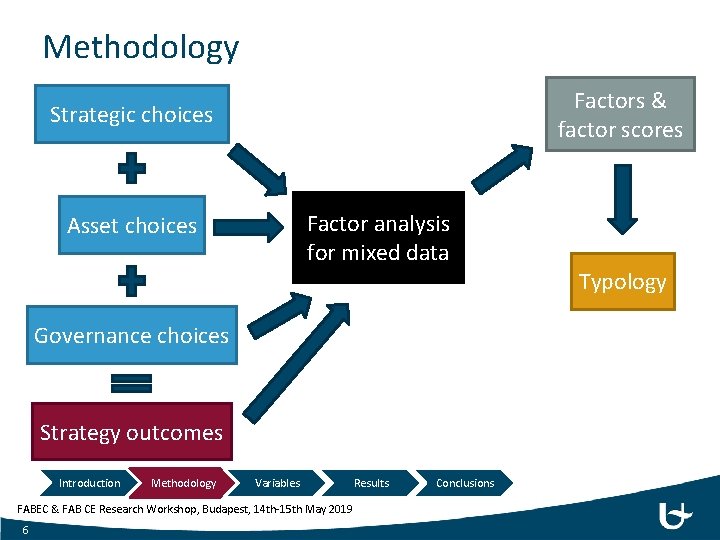
Methodology Factors & factor scores Strategic choices Factor analysis for mixed data Asset choices Typology Governance choices Strategy outcomes Introduction Methodology Variables FABEC & FAB CE Research Workshop, Budapest, 14 th-15 th May 2019 6 Results Conclusions

Business model variables (1/2) Operational scope § § § Factor inputs Marketable service offer Military ANS integration International ANS service offer Collaboration forms § § Number of alliances by type Number of joint-ventures by type Innovation strategy § § Number of Horizon 2020 projects Remote tower operations Introduction Methodology Variables FABEC & FAB CE Research Workshop, Budapest, 14 th-15 th May 2019 7 § Labour to capital ratio Make-or-buy choices § Outsourcing MET services Ownership structure § § Percentage of government owned shares Percentage of private owned shares Corporate structure § Results Government department / Airport operator / Independent entity Conclusions
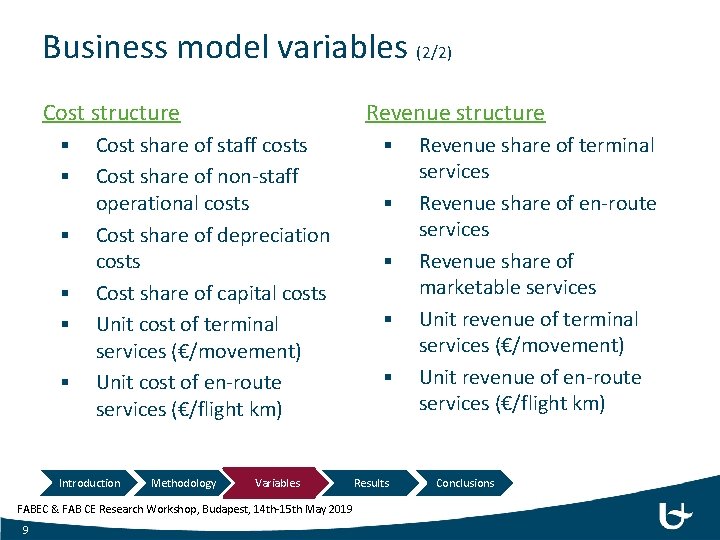
Business model variables (2/2) Cost structure § § § Revenue structure Cost share of staff costs Cost share of non-staff operational costs Cost share of depreciation costs Cost share of capital costs Unit cost of terminal services (€/movement) Unit cost of en-route services (€/flight km) Introduction Methodology Variables FABEC & FAB CE Research Workshop, Budapest, 14 th-15 th May 2019 9 § § § Results Revenue share of terminal services Revenue share of en-route services Revenue share of marketable services Unit revenue of terminal services (€/movement) Unit revenue of en-route services (€/flight km) Conclusions
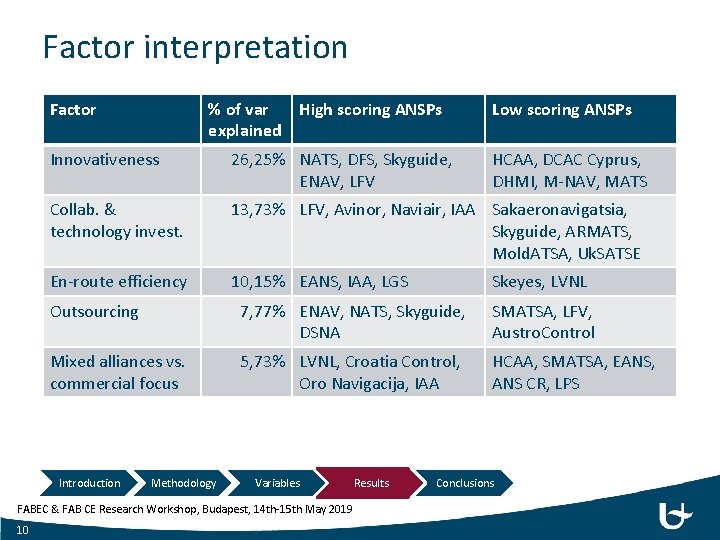
Factor interpretation Factor % of var High scoring ANSPs explained Innovativeness 26, 25% NATS, DFS, Skyguide, ENAV, LFV Collab. & technology invest. 13, 73% LFV, Avinor, Naviair, IAA Sakaeronavigatsia, Skyguide, ARMATS, Mold. ATSA, Uk. SATSE En-route efficiency 10, 15% EANS, IAA, LGS HCAA, DCAC Cyprus, DHMI, M-NAV, MATS Skeyes, LVNL Outsourcing 7, 77% ENAV, NATS, Skyguide, DSNA SMATSA, LFV, Austro. Control Mixed alliances vs. commercial focus 5, 73% LVNL, Croatia Control, Oro Navigacija, IAA HCAA, SMATSA, EANS, ANS CR, LPS Introduction Methodology Variables FABEC & FAB CE Research Workshop, Budapest, 14 th-15 th May 2019 10 Low scoring ANSPs Results Conclusions
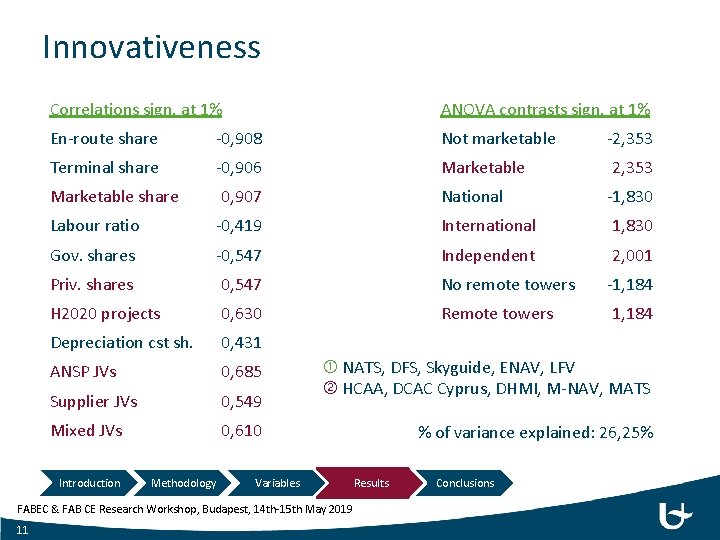
Innovativeness Correlations sign. at 1% ANOVA contrasts sign. at 1% En-route share -0, 908 Not marketable Terminal share -0, 906 Marketable share 0, 907 National 2, 353 -1, 830 Labour ratio -0, 419 International 1, 830 Gov. shares -0, 547 Independent 2, 001 Priv. shares 0, 547 No remote towers H 2020 projects 0, 630 Remote towers Depreciation cst sh. 0, 431 ANSP JVs 0, 685 Supplier JVs 0, 549 Mixed JVs 0, 610 Introduction Methodology -1, 184 NATS, DFS, Skyguide, ENAV, LFV HCAA, DCAC Cyprus, DHMI, M-NAV, MATS Variables FABEC & FAB CE Research Workshop, Budapest, 14 th-15 th May 2019 11 -2, 353 % of variance explained: 26, 25% Results Conclusions
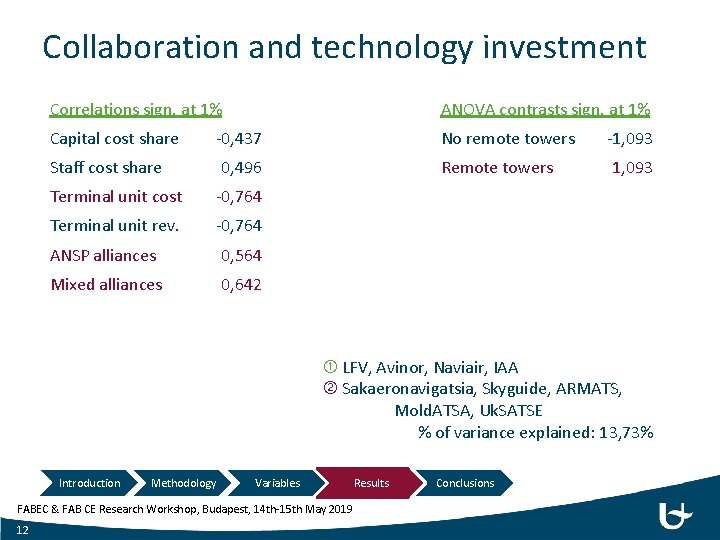
Collaboration and technology investment Correlations sign. at 1% ANOVA contrasts sign. at 1% Capital cost share No remote towers -0, 437 Staff cost share 0, 496 Terminal unit cost -0, 764 Terminal unit rev. -0, 764 ANSP alliances 0, 564 Mixed alliances 0, 642 Remote towers -1, 093 LFV, Avinor, Naviair, IAA Sakaeronavigatsia, Skyguide, ARMATS, Mold. ATSA, Uk. SATSE % of variance explained: 13, 73% Introduction Methodology Variables FABEC & FAB CE Research Workshop, Budapest, 14 th-15 th May 2019 12 Results Conclusions
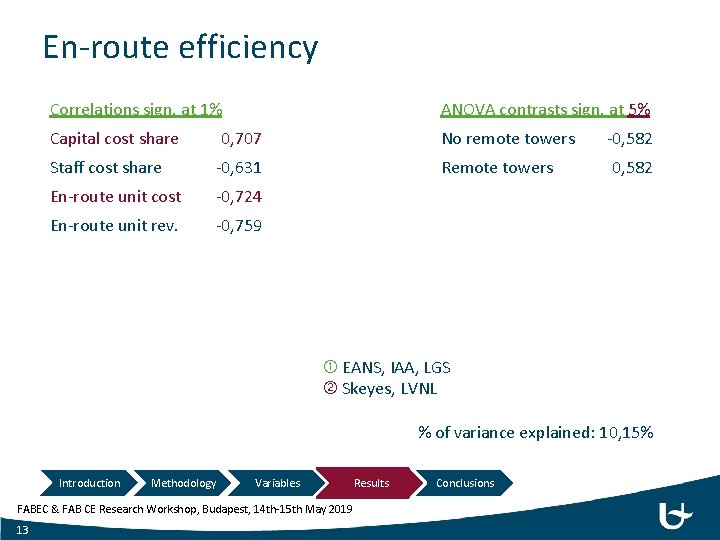
En-route efficiency Correlations sign. at 1% ANOVA contrasts sign. at 5% Capital cost share No remote towers 0, 707 Staff cost share -0, 631 En-route unit cost -0, 724 En-route unit rev. -0, 759 Remote towers -0, 582 EANS, IAA, LGS Skeyes, LVNL % of variance explained: 10, 15% Introduction Methodology Variables FABEC & FAB CE Research Workshop, Budapest, 14 th-15 th May 2019 13 Results Conclusions
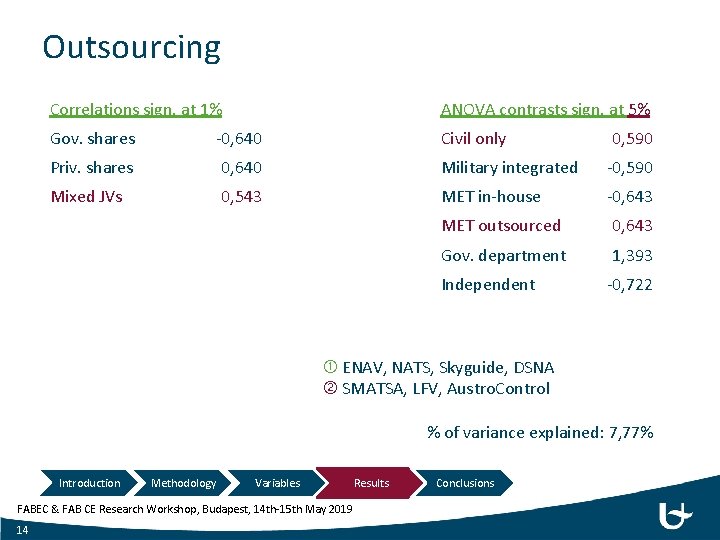
Outsourcing Correlations sign. at 1% ANOVA contrasts sign. at 5% Gov. shares -0, 640 Civil only Priv. shares 0, 640 Military integrated -0, 590 Mixed JVs 0, 543 MET in-house -0, 643 0, 590 MET outsourced 0, 643 Gov. department 1, 393 Independent -0, 722 ENAV, NATS, Skyguide, DSNA SMATSA, LFV, Austro. Control % of variance explained: 7, 77% Introduction Methodology Variables FABEC & FAB CE Research Workshop, Budapest, 14 th-15 th May 2019 14 Results Conclusions
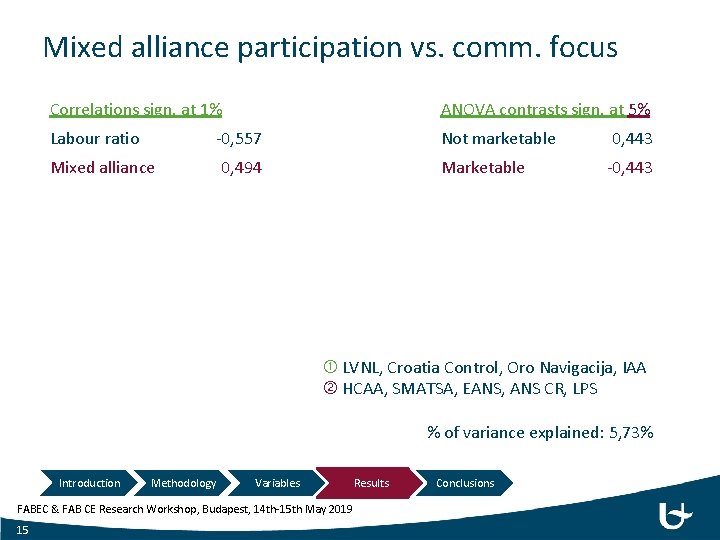
Mixed alliance participation vs. comm. focus Correlations sign. at 1% ANOVA contrasts sign. at 5% Labour ratio Not marketable -0, 557 Mixed alliance 0, 494 Marketable 0, 443 -0, 443 LVNL, Croatia Control, Oro Navigacija, IAA HCAA, SMATSA, EANS, ANS CR, LPS % of variance explained: 5, 73% Introduction Methodology Variables FABEC & FAB CE Research Workshop, Budapest, 14 th-15 th May 2019 15 Results Conclusions
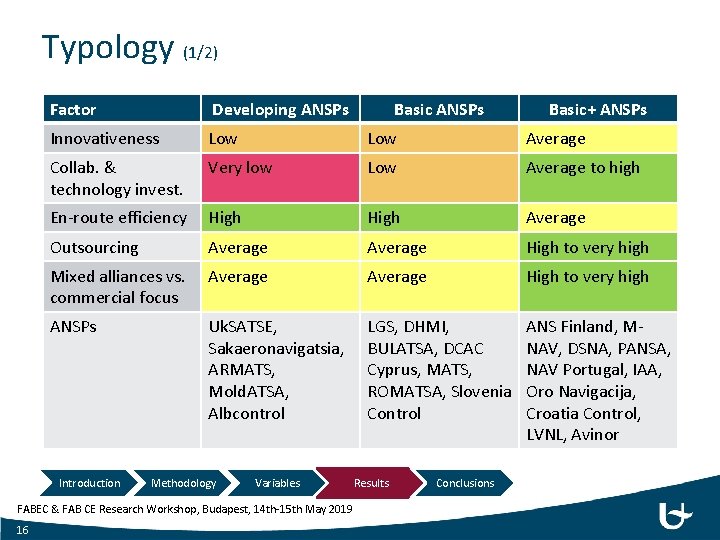
Typology (1/2) Factor Developing ANSPs Innovativeness Low Average Collab. & technology invest. Very low Low Average to high En-route efficiency High Average Outsourcing Average High to very high Mixed alliances vs. commercial focus Average High to very high ANSPs Uk. SATSE, Sakaeronavigatsia, ARMATS, Mold. ATSA, Albcontrol LGS, DHMI, BULATSA, DCAC Cyprus, MATS, ROMATSA, Slovenia Control ANS Finland, MNAV, DSNA, PANSA, NAV Portugal, IAA, Oro Navigacija, Croatia Control, LVNL, Avinor Introduction Methodology Variables FABEC & FAB CE Research Workshop, Budapest, 14 th-15 th May 2019 16 Basic ANSPs Results Conclusions Basic+ ANSPs
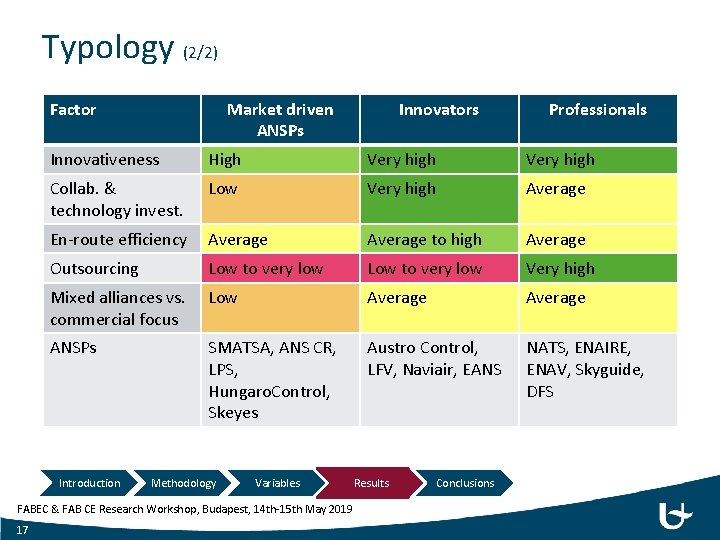
Typology (2/2) Factor Market driven ANSPs Professionals Innovativeness High Very high Collab. & technology invest. Low Very high Average En-route efficiency Average to high Average Outsourcing Low to very low Very high Mixed alliances vs. commercial focus Low Average ANSPs SMATSA, ANS CR, LPS, Hungaro. Control, Skeyes Austro Control, LFV, Naviair, EANS NATS, ENAIRE, ENAV, Skyguide, DFS Introduction Methodology Variables FABEC & FAB CE Research Workshop, Budapest, 14 th-15 th May 2019 17 Innovators Results Conclusions
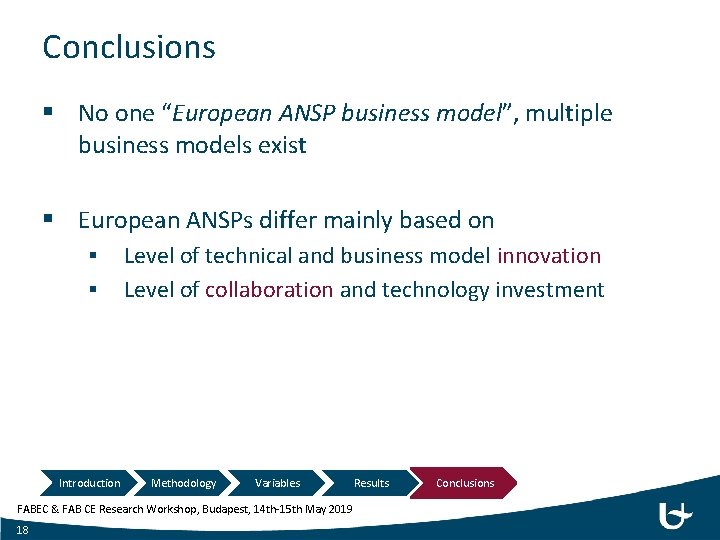
Conclusions § No one “European ANSP business model”, multiple business models exist § European ANSPs differ mainly based on § § Introduction Level of technical and business model innovation Level of collaboration and technology investment Methodology Variables FABEC & FAB CE Research Workshop, Budapest, 14 th-15 th May 2019 18 Results Conclusions
Drs. Sven Buyle Faculty of Business and Economics, Department of Transport and Regional Economics sven. buyle@uantwerpen. be
- Slides: 18