
15 March 10 DRILL 1 Bring your protractor
15 March 10 DRILL 1. Bring your protractor and compass to class Monday (you should always bring them to class) 2. Study for Wednesday Quiz on fossil fuels IOT 3 -3 POLY ENGINEERING
QUIZ REVIEW Topic 1 Energy Sources – Fuels 1. 2. 3. 4. 5. 6. 7. What are the fossil fuels? What makes them non-renewable? Explain the formation of Coal, Natural Gas, and Petroleum. What are the methods of extraction for fossil fuels? What are three locations of natural gas? What are hydrocarbons? What is methane formula? What is mercaptan and why is it used? IOT 3 -3 POLY ENGINEERING
QUIZ REVIEW Topic 1 Energy Sources – Fuels 8. 9. 10. 11. 12. 13. Explain the operation of a seismic survey. Who are world top producers of natural gas? How are oil and natural gas transported? Why are fossil fuels processed prior to use? How is natural gas used in the home? What’s the difference between petroleum reservoirs and reserves? 14. What geographic region has largest oil reserves? IOT 3 -3 POLY ENGINEERING
QUIZ REVIEW Topic 1 Energy Sources – Fuels 15. 16. 17. 18. 19. 20. What 2 countries have the largest oil reserves? How many gallons are in a barrel of oil? How is a barrel of oil broken down in terms of end use? Is crude oil always same color/viscosity? What is distillation? Which fossil fuel is processed by it? Continent consuming greatest per capita oil? IOT 3 -3 POLY ENGINEERING
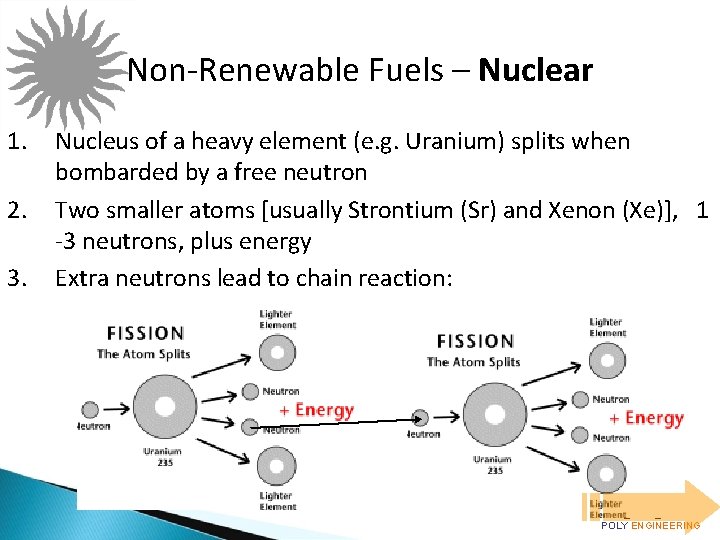
Non-Renewable Fuels – Nuclear 1. 2. 3. Nucleus of a heavy element (e. g. Uranium) splits when bombarded by a free neutron Two smaller atoms [usually Strontium (Sr) and Xenon (Xe)], 1 -3 neutrons, plus energy Extra neutrons lead to chain reaction: IOT 3 -3 POLY ENGINEERING
Non-Renewable Fuels – Nuclear Fuel Cycle Like coal, natural gas, and petroleum, Uranium (U) is an energy source that must be processed before use. • • • Front End: preparing the fuel Service Period: using fuel in reactor Back End: safely manage, contain, reprocess/dispose of spent fuel IOT 3 -3 POLY ENGINEERING
Non-Renewable Fuels – Nuclear Fuel Cycle – Front End 1. Exploration: 1) U is 500 times more abundant than gold 2) Traces can be found everywhere – all rocks and soils, rivers and oceans, food and human tissue 2. Mining and Milling: 1) Mining – surface (strip) or underground mining 2) Milling – grind up ore, use sulfuric acid to separate U from waste rock – “yellow cake” U 3 O 8 3. Conversion: U must be converted into a gas before it can be enriched (uranium hexafluoride – UF 6 )
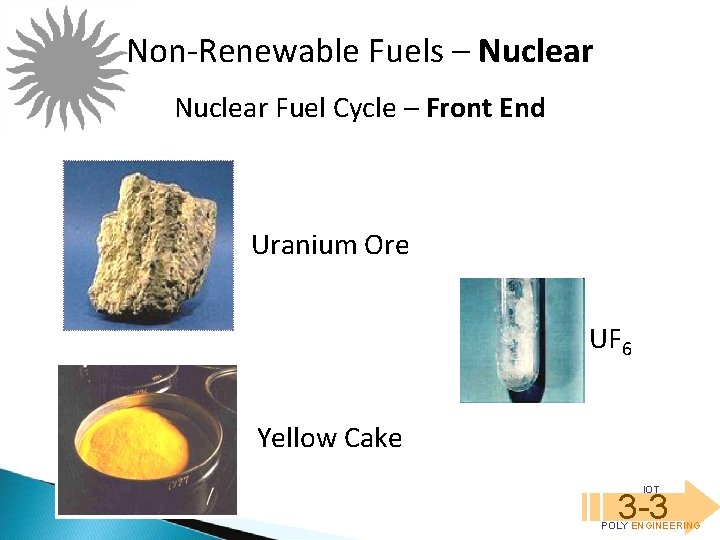
Non-Renewable Fuels – Nuclear Fuel Cycle – Front End Uranium Ore UF 6 Yellow Cake IOT 3 -3 POLY ENGINEERING
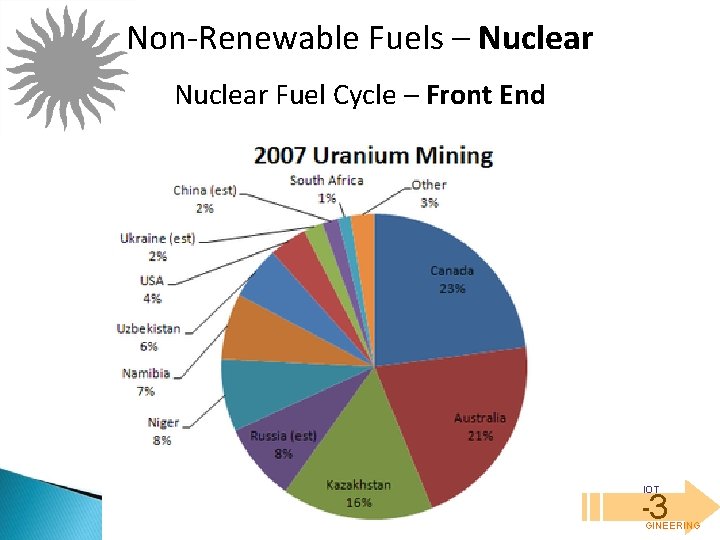
Non-Renewable Fuels – Nuclear Fuel Cycle – Front End IOT 3 -3 POLY ENGINEERING
Non-Renewable Fuels – Nuclear Fuel Cycle – Front End • • • Background Chemistry The number of protons are the atomic number. Uranium’s atomic number is 92 Atoms with different numbers of neutrons are called isotopes – “same place” Isotope U-235 is the only fissile isotope found in nature IOT 3 -3 POLY ENGINEERING
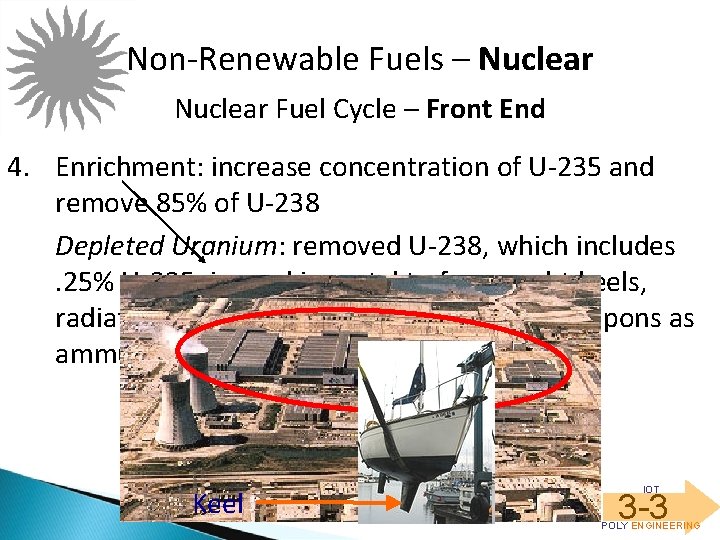
Non-Renewable Fuels – Nuclear Fuel Cycle – Front End 4. Enrichment: increase concentration of U-235 and remove 85% of U-238 Depleted Uranium: removed U-238, which includes. 25% U-235, is used in metal to form yacht keels, radiation shielding, and (controversially) weapons as ammunition. Keel IOT 3 -3 POLY ENGINEERING
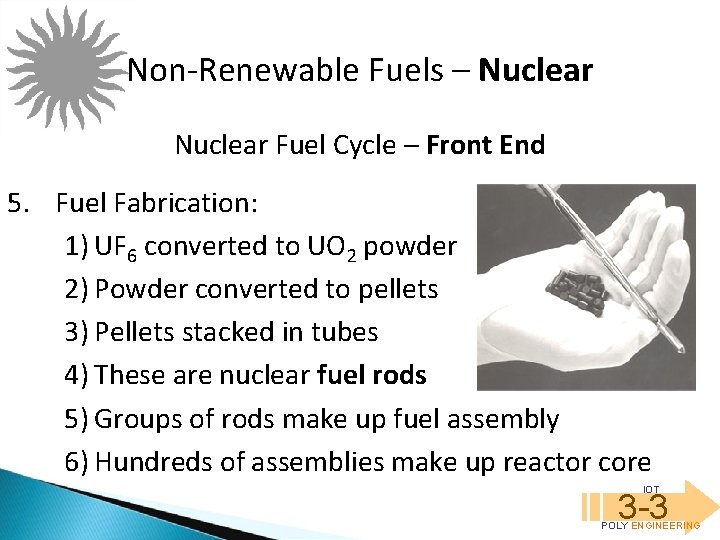
Non-Renewable Fuels – Nuclear Fuel Cycle – Front End 5. Fuel Fabrication: 1) UF 6 converted to UO 2 powder 2) Powder converted to pellets 3) Pellets stacked in tubes 4) These are nuclear fuel rods 5) Groups of rods make up fuel assembly 6) Hundreds of assemblies make up reactor core IOT 3 -3 POLY ENGINEERING
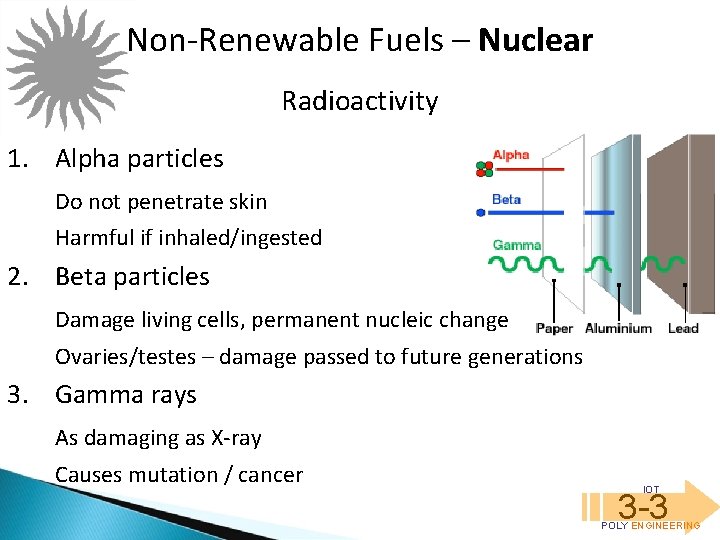
Non-Renewable Fuels – Nuclear Radioactivity 1. Alpha particles Do not penetrate skin Harmful if inhaled/ingested 2. Beta particles Damage living cells, permanent nucleic change Ovaries/testes – damage passed to future generations 3. Gamma rays As damaging as X-ray Causes mutation / cancer IOT 3 -3 POLY ENGINEERING
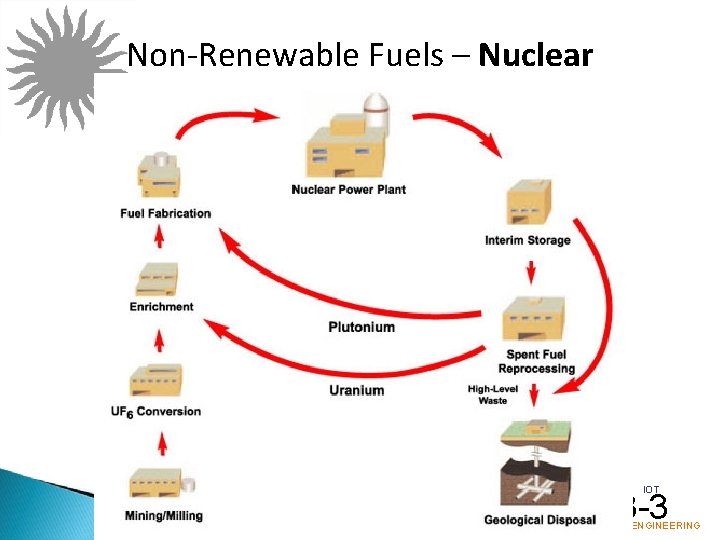
Non-Renewable Fuels – Nuclear Fuel Cycle • Front End: preparing the fuel 1. 2. 3. 4. 5. • • Exploration Mining and Milling Conversion Enrichment Fabrication Service Period: using fuel in reactor Back End: safely manage, contain, reprocess/dispose of spent fuel IOT 3 -3 POLY ENGINEERING
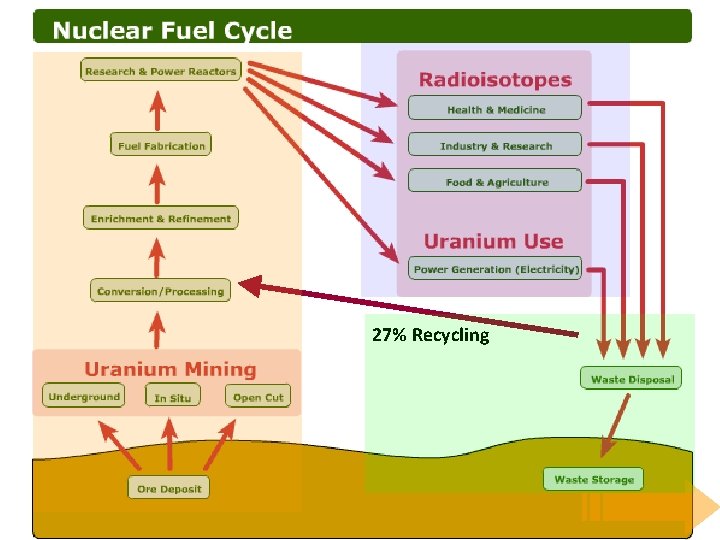
Non-Renewable Fuels – Nuclear Fuel Cycle – Service Period 27% Recycling
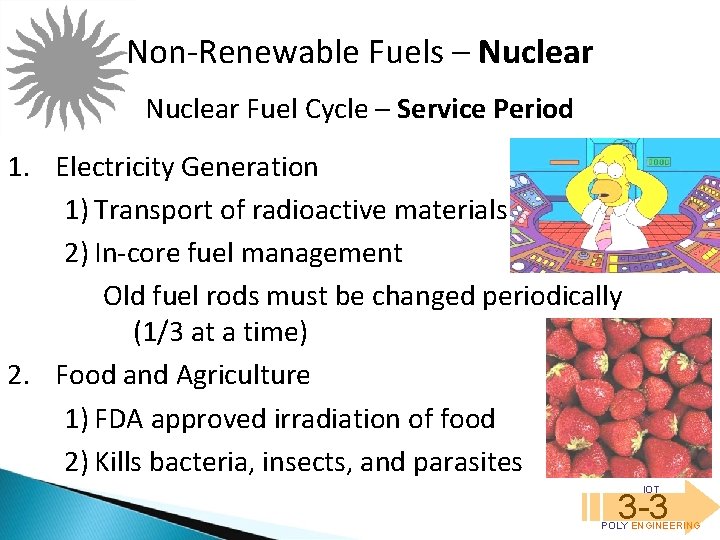
Non-Renewable Fuels – Nuclear Fuel Cycle – Service Period 1. Electricity Generation 1) Transport of radioactive materials 2) In-core fuel management Old fuel rods must be changed periodically (1/3 at a time) 2. Food and Agriculture 1) FDA approved irradiation of food 2) Kills bacteria, insects, and parasites IOT 3 -3 POLY ENGINEERING
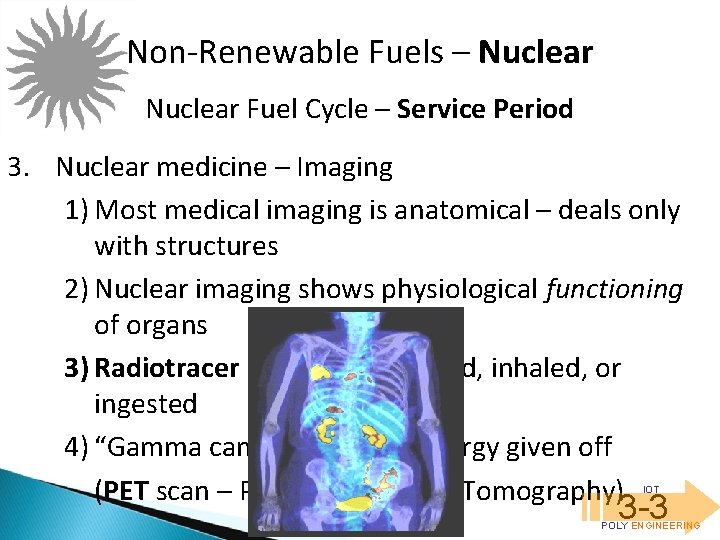
Non-Renewable Fuels – Nuclear Fuel Cycle – Service Period 3. Nuclear medicine – Imaging 1) Most medical imaging is anatomical – deals only with structures 2) Nuclear imaging shows physiological functioning of organs 3) Radiotracer injected into blood, inhaled, or ingested 4) “Gamma camera” detects energy given off (PET scan – Positron Emission Tomography) IOT 3 -3 POLY ENGINEERING
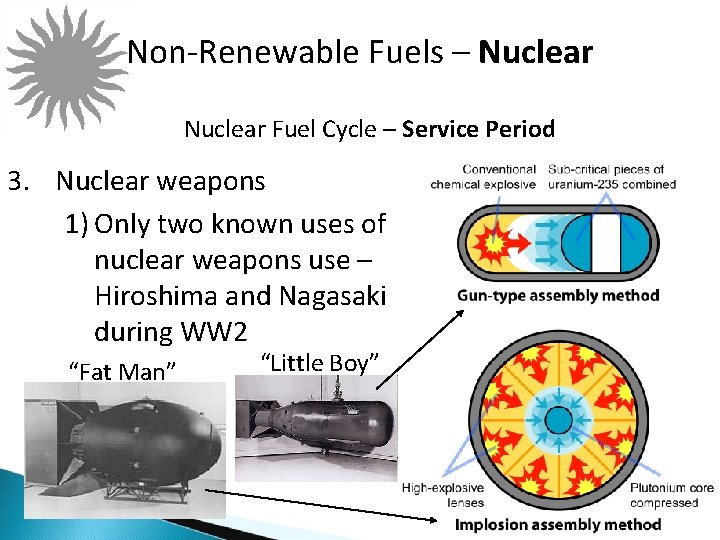
Non-Renewable Fuels – Nuclear Fuel Cycle – Service Period 3. Nuclear weapons 1) Only two known uses of nuclear weapons use – Hiroshima and Nagasaki during WW 2 “Fat Man” “Little Boy” IOT 3 -3 POLY ENGINEERING
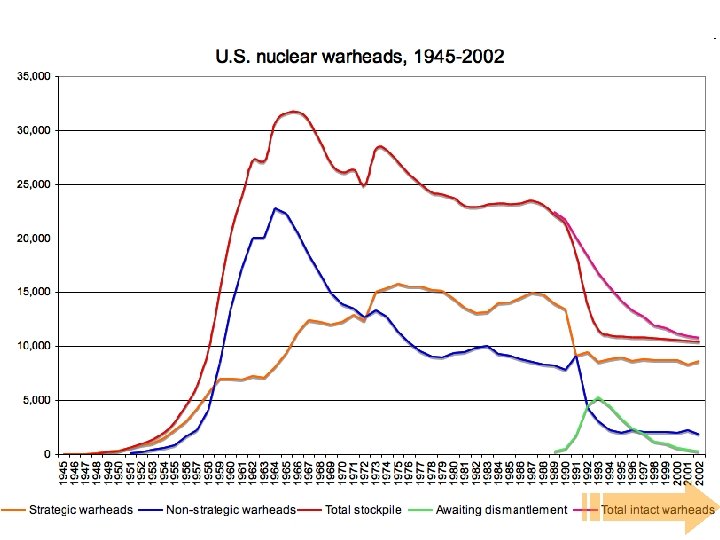
Nuclear Fuel Cycle – Service Period
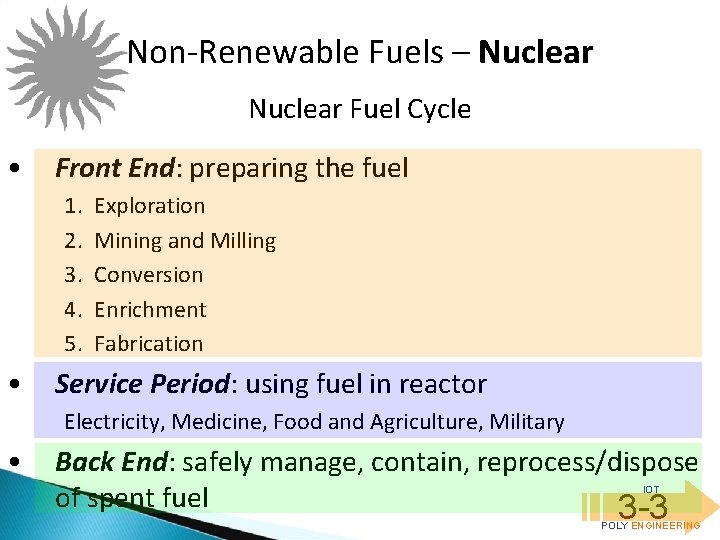
Non-Renewable Fuels – Nuclear Fuel Cycle • Front End: preparing the fuel 1. 2. 3. 4. 5. • Exploration Mining and Milling Conversion Enrichment Fabrication Service Period: using fuel in reactor Electricity, Medicine, Food and Agriculture, Military • Back End: safely manage, contain, reprocess/dispose of spent fuel 3 -3 IOT POLY ENGINEERING
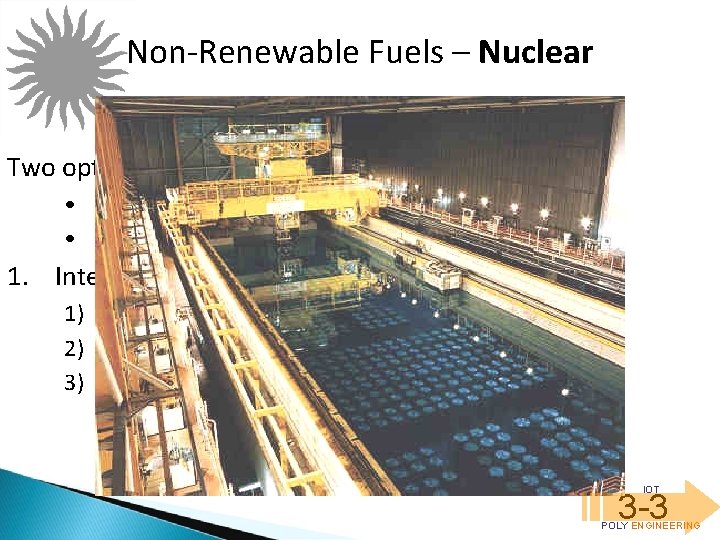
Non-Renewable Fuels – Nuclear Fuel Cycle – Back End Two options for spent fuel: • Interim storage and final disposal • Reprocessing to recover usable portion 1. Interim Storage: 1) Used fuel assemblies: hot and highly radioactive 2) Stored in special ponds usually near reactor site 3) Water is radiation barrier and cools fuel IOT 3 -3 POLY ENGINEERING
Non-Renewable Fuels – Nuclear Fuel Cycle – Back End 2. Reprocessing separates U and Pu from waste products – chop up fuel rods and dissolve them in acid to separate materials 1) U enrichment a) Spent fuel contains ~96% of original U b) U-235 reduced to 1% c) Therefore, send back to enrichment 2) Plutonium (Pu) a) Spent fuel contains ~1% radioactive Pu b) Can be blended with enriched U for new fuel c) One of the most highly toxic elements known IOT 3 -3 POLY ENGINEERING
Non-Renewable Fuels – Nuclear Fuel Cycle – Back End Waste 1. 2. Low-level waste – radioactive isotopes decay 10 -50 years 1. Material used to handle highly radioactive parts of reactor Cooling water pipes, radiation suits 2. Waste from medical uses 3. Processing nuclear fuel generates depleted uranium (DU) DU used as heavy metal High-level waste – radioactive isotopes decay >100, 000 years Material from core of reactor/decommissioned weapons IOT 3 -3 POLY ENGINEERING
Non-Renewable Fuels – Nuclear Fuel Cycle – Back End Waste Disposal 1. 2. Low-level waste – radioactive isotopes decay 10 -50 years 1. Temporary storage 2. Standard disposal methods or reuse (heavy metal) High-level waste – radioactive isotopes decay >100, 000 years 1. Currently only short-term storage exists 2. Geologic disposal. Requires: 1. Absolutely stable geological formations 2. Unprecedented stability of human institutions IOT 3 -3 POLY ENGINEERING
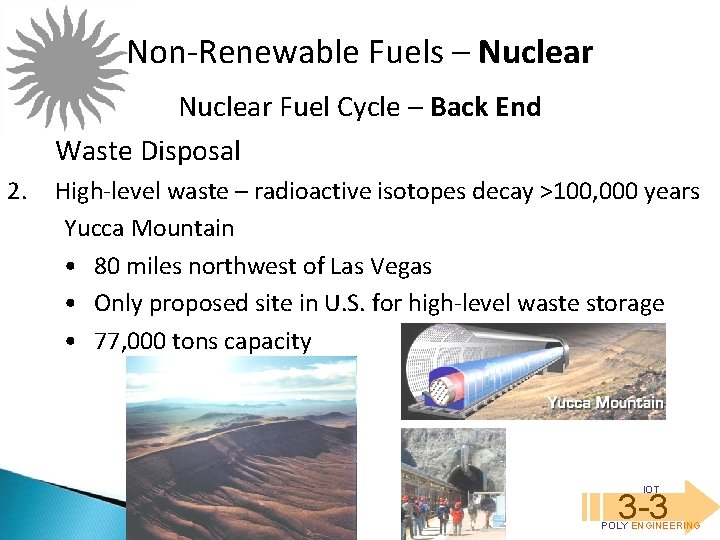
Non-Renewable Fuels – Nuclear Fuel Cycle – Back End Waste Disposal 2. High-level waste – radioactive isotopes decay >100, 000 years Yucca Mountain • 80 miles northwest of Las Vegas • Only proposed site in U. S. for high-level waste storage • 77, 000 tons capacity IOT 3 -3 POLY ENGINEERING
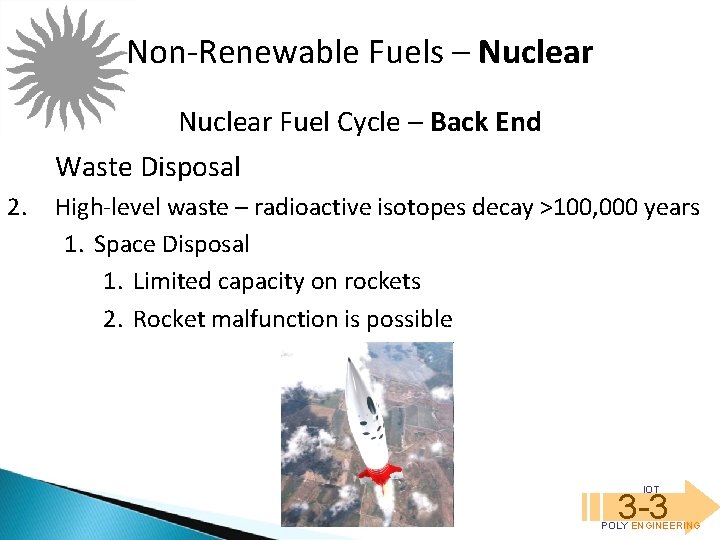
Non-Renewable Fuels – Nuclear Fuel Cycle – Back End Waste Disposal 2. High-level waste – radioactive isotopes decay >100, 000 years 1. Space Disposal 1. Limited capacity on rockets 2. Rocket malfunction is possible IOT 3 -3 POLY ENGINEERING
Non-Renewable Fuels – Nuclear IOT 3 -3 POLY ENGINEERING
- Slides: 27