
15 Managing International Operations Copyright 2014 Pearson Education
- Slides: 35
15 Managing International Operations Copyright © 2014 Pearson Education, Inc.
Chapter Objectives Identify the elements that are important to consider when formulating production strategies Identify key considerations when acquiring physical resources Identify several production matters that are of special concern to managers Describe three potential sources of financing and the main financial instruments of each Copyright © 2014 Pearson Education, Inc. 15 - 2
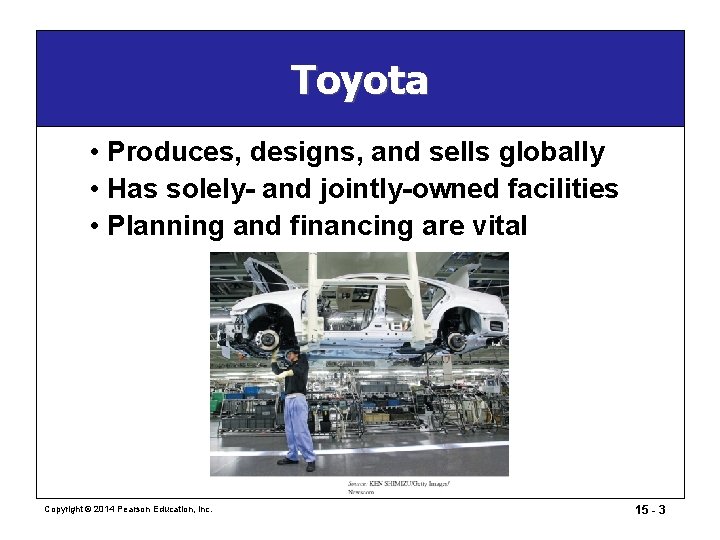
Toyota • Produces, designs, and sells globally • Has solely- and jointly-owned facilities • Planning and financing are vital Copyright © 2014 Pearson Education, Inc. 15 - 3
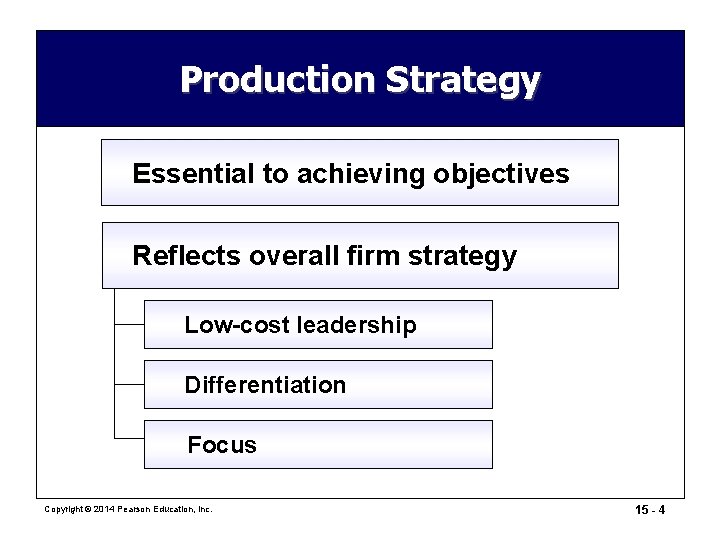
Production Strategy Essential to achieving objectives Reflects overall firm strategy Low-cost leadership Differentiation Focus Copyright © 2014 Pearson Education, Inc. 15 - 4
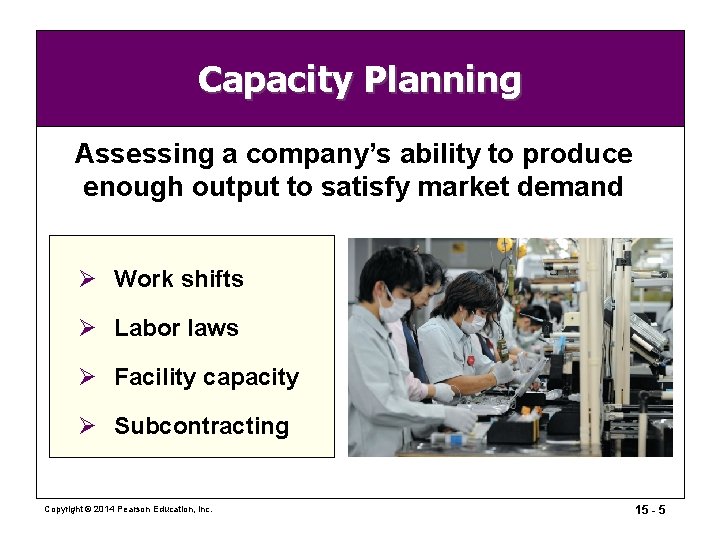
Capacity Planning Assessing a company’s ability to produce enough output to satisfy market demand Ø Work shifts Ø Labor laws Ø Facility capacity Ø Subcontracting Copyright © 2014 Pearson Education, Inc. 15 - 5
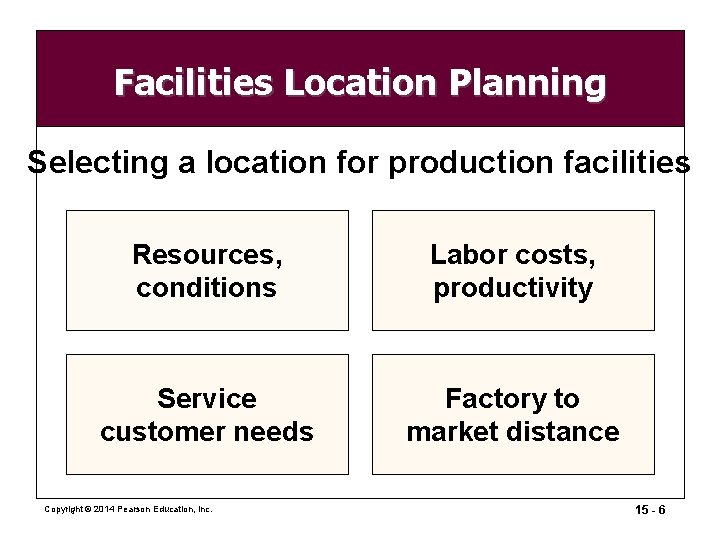
Facilities Location Planning Selecting a location for production facilities Resources, conditions Labor costs, productivity Service customer needs Factory to market distance Copyright © 2014 Pearson Education, Inc. 15 - 6
Location Economies Economic benefits derived from locating production activities in optimal locations Key: Each production activity generates more value in a particular location than could be generated elsewhere Copyright © 2014 Pearson Education, Inc. 15 - 7
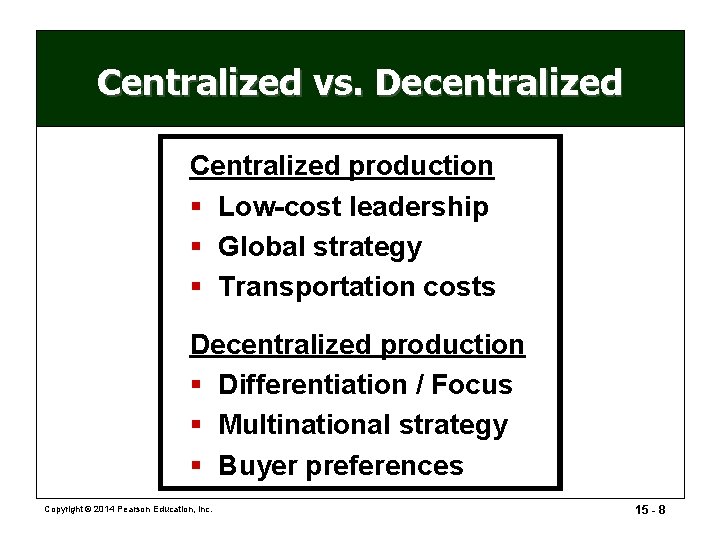
Centralized vs. Decentralized Centralized production § Low-cost leadership § Global strategy § Transportation costs Decentralized production § Differentiation / Focus § Multinational strategy § Buyer preferences Copyright © 2014 Pearson Education, Inc. 15 - 8
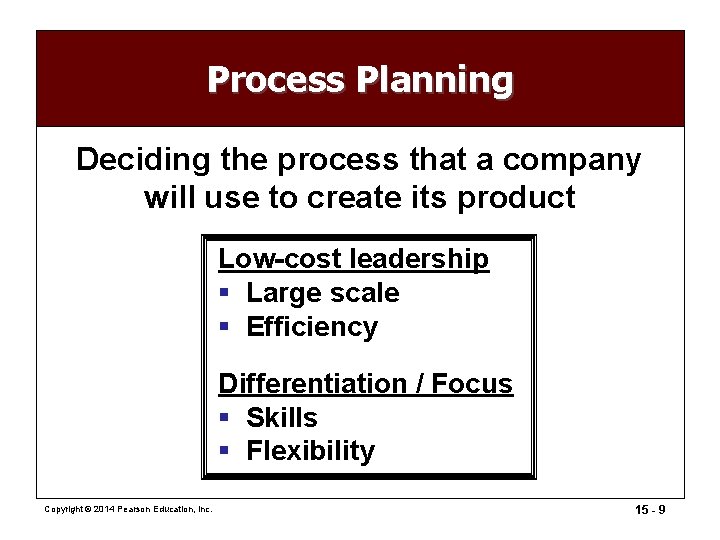
Process Planning Deciding the process that a company will use to create its product Low-cost leadership § Large scale § Efficiency Differentiation / Focus § Skills § Flexibility Copyright © 2014 Pearson Education, Inc. 15 - 9
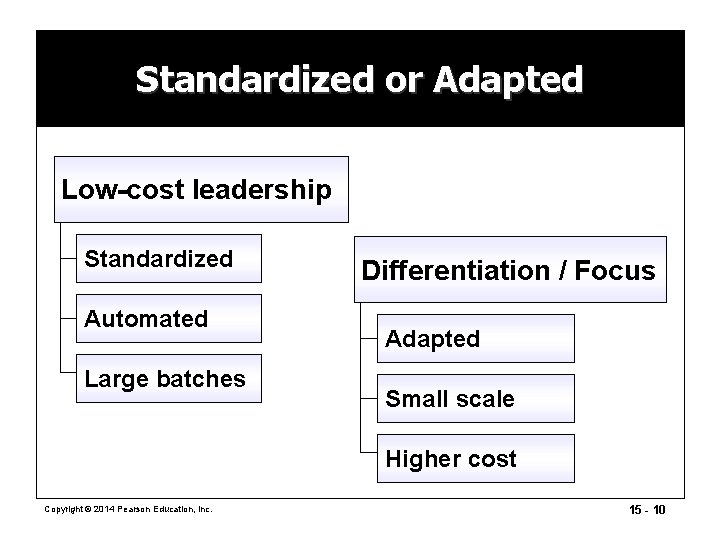
Standardized or Adapted Low-cost leadership Standardized Automated Large batches Differentiation / Focus Adapted Small scale Higher cost Copyright © 2014 Pearson Education, Inc. 15 - 10
Facilities Layout Planning Deciding the spatial arrangement of production processes within facilities Ø Reflects business strateg Ø Geography may be a facto Copyright © 2014 Pearson Education, Inc. 15 - 11
Discussion Question What is the concept of location economies and how important is it to facilities location planning? Copyright © 2014 Pearson Education, Inc. 15 - 12
Answer to Discussion Question Location economies are the economic benefits derived from locating production activities in optimal locations. In other words, each production activity generates more value in a particular location than could be generated anywhere else. Location economies are essential to location planning because of their strategic importance for the long-term success of a firm’s operations. Copyright © 2014 Pearson Education, Inc. 15 - 13
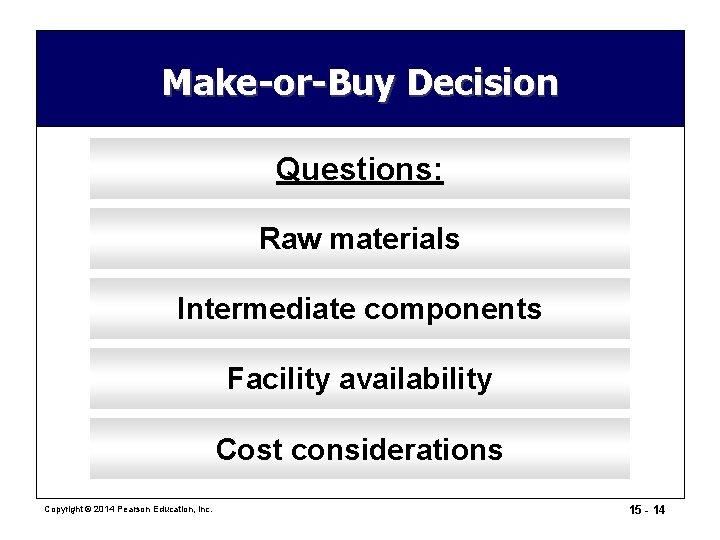
Make-or-Buy Decision Questions: Raw materials Intermediate components Facility availability Cost considerations Copyright © 2014 Pearson Education, Inc. 15 - 14
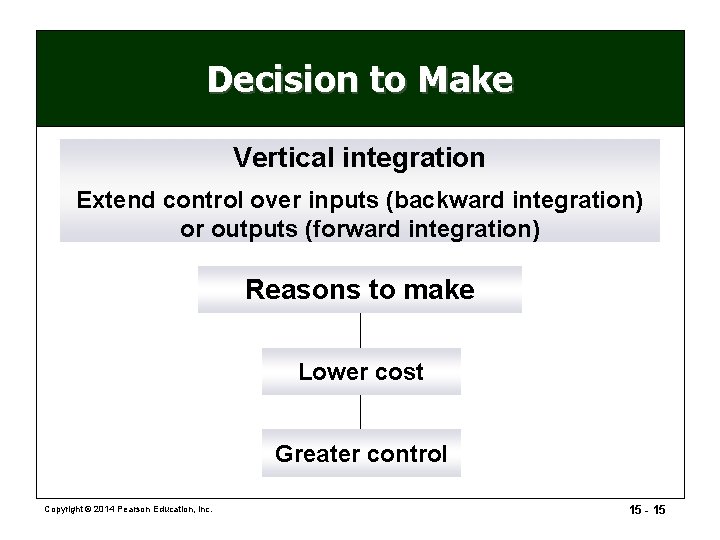
Decision to Make Vertical integration Extend control over inputs (backward integration) or outputs (forward integration) Reasons to make Lower cost Greater control Copyright © 2014 Pearson Education, Inc. 15 - 15
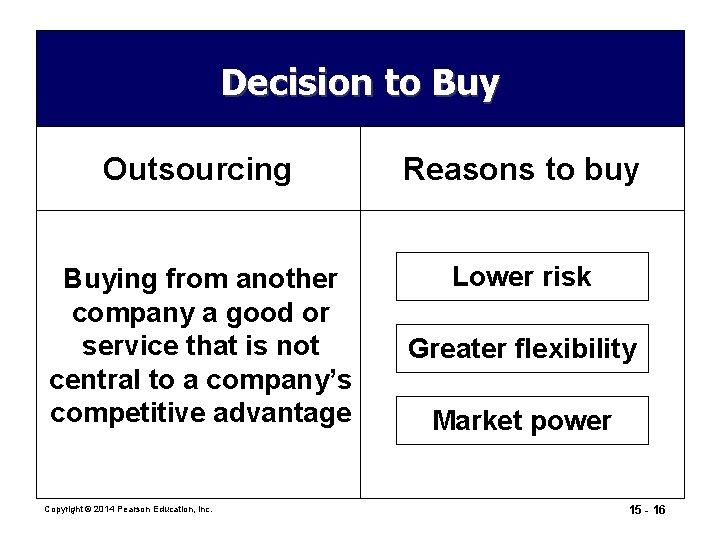
Decision to Buy Outsourcing Reasons to buy Buying from another company a good or service that is not central to a company’s competitive advantage Lower risk Copyright © 2014 Pearson Education, Inc. Greater flexibility Market power 15 - 16
Materials and Assets Raw materials ü Quality ü Quantity Fixed assets ü Existing Facility ü Greenfield Copyright © 2014 Pearson Education, Inc. 15 - 17
Discussion Question When a company extends control over additional stages of production, either inputs or outputs, it undertakes _____. a. Outsourcing b. Capacity planning c. Vertical integration Copyright © 2014 Pearson Education, Inc. 15 - 18
Answer to Discussion Question When a company extends control over additional stages of production, either inputs or outputs, it undertakes _____. a. Outsourcing b. Capacity planning c. Vertical integration Copyright © 2014 Pearson Education, Inc. 15 - 19
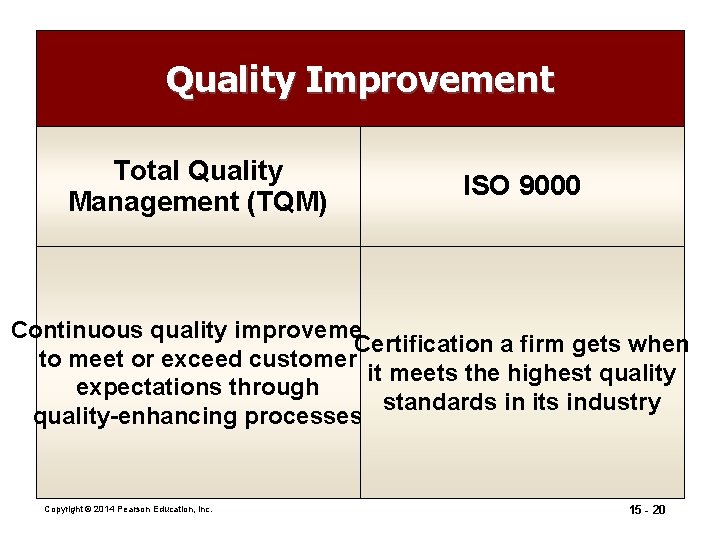
Quality Improvement Total Quality Management (TQM) ISO 9000 Continuous quality improvement Certification a firm gets when to meet or exceed customer it meets the highest quality expectations through standards in its industry quality-enhancing processes Copyright © 2014 Pearson Education, Inc. 15 - 20
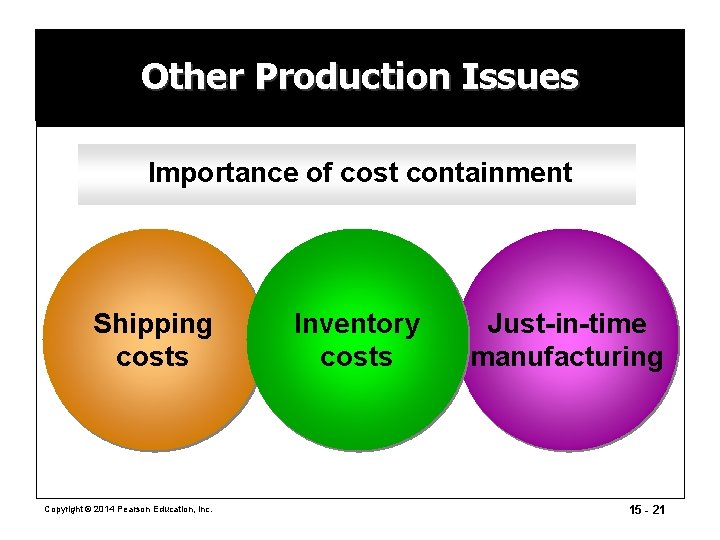
Other Production Issues Importance of cost containment Shipping costs Copyright © 2014 Pearson Education, Inc. Inventory costs Just-in-time manufacturing 15 - 21
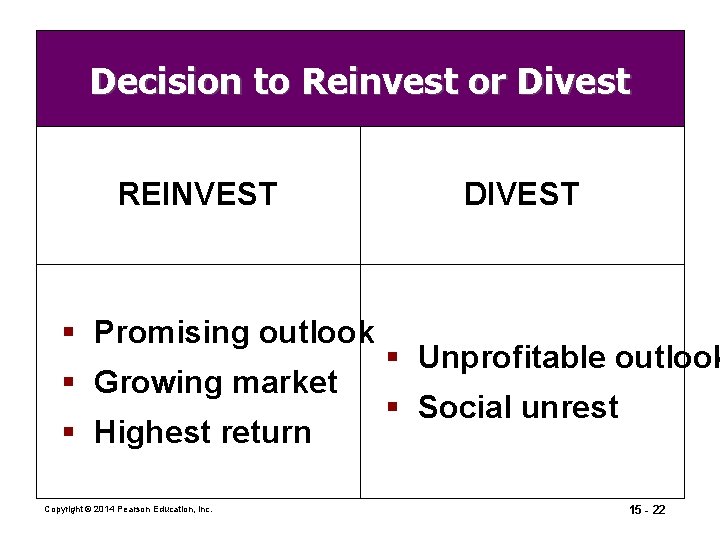
Decision to Reinvest or Divest REINVEST § Promising outlook § Growing market § Highest return Copyright © 2014 Pearson Education, Inc. DIVEST § Unprofitable outlook § Social unrest 15 - 22
Discussion Question What are some of the considerations that underlie the reinvest-versusdivest decision? Copyright © 2014 Pearson Education, Inc. 15 - 23
Answer to Discussion Question A firm reinvests when it wishes to: (1) reinvest in a market with a long payback period, (2) maintain its market share and competitive position, (3) reinvest in a market growing rapidly, and (4) reduce its international competition. A firm divests when it wishes to: (1) avoid a low return on investment, (2) avoid high country risk, and (3) invest in more profitable opportunities elsewhere. Copyright © 2014 Pearson Education, Inc. 15 - 24
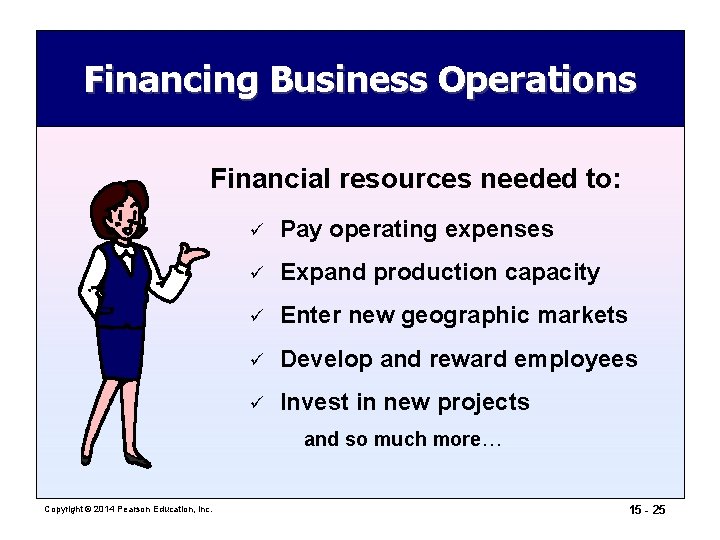
Financing Business Operations Financial resources needed to: ü Pay operating expenses ü Expand production capacity ü Enter new geographic markets ü Develop and reward employees ü Invest in new projects and so much more… Copyright © 2014 Pearson Education, Inc. 15 - 25
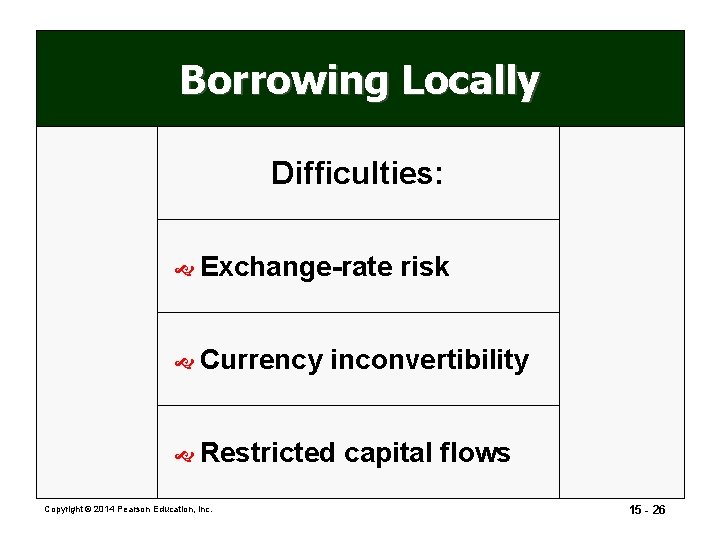
Borrowing Locally Difficulties: Exchange-rate Currency inconvertibility Restricted Copyright © 2014 Pearson Education, Inc. risk capital flows 15 - 26
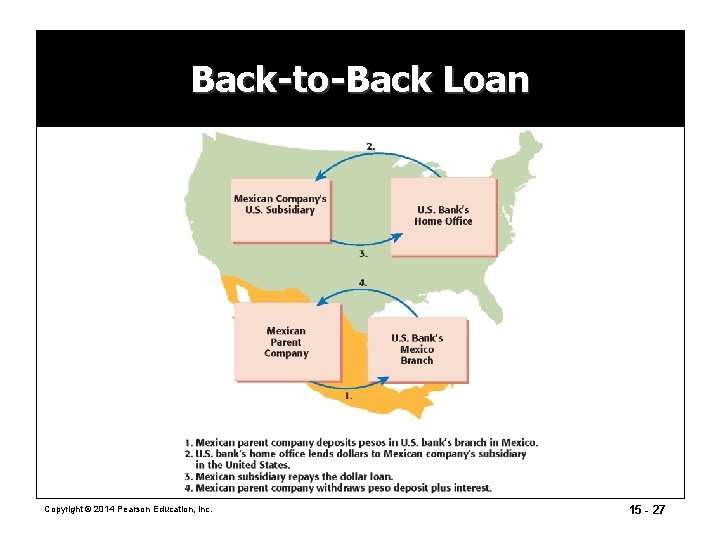
Back-to-Back Loan Copyright © 2014 Pearson Education, Inc. 15 - 27
American Depository Receipts Certificates traded in the U. S. that represent a specific number of shares in a non-U. S. company Ø No currency-conversion Copyright © 2014 Pearson Education, Inc. fees Ø No minimum purchase amounts Ø Attractive to U. S. mutual 15 - 28
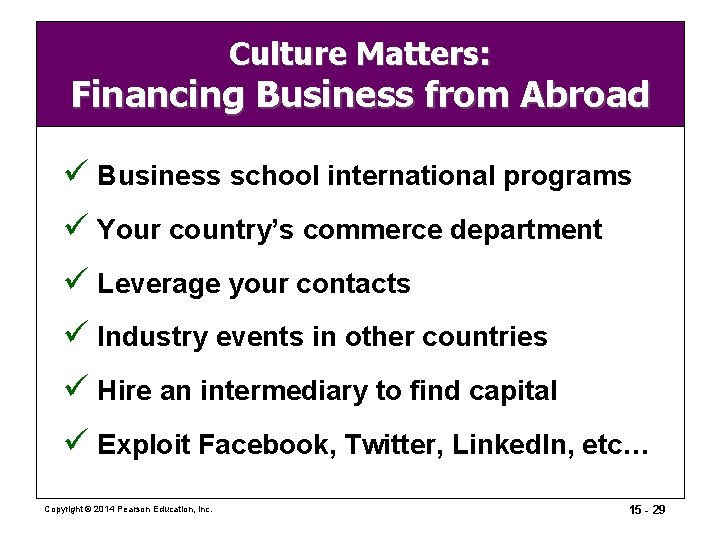
Culture Matters: Financing Business from Abroad ü Business school international programs ü Your country’s commerce department ü Leverage your contacts ü Industry events in other countries ü Hire an intermediary to find capital ü Exploit Facebook, Twitter, Linked. In, etc… Copyright © 2014 Pearson Education, Inc. 15 - 29
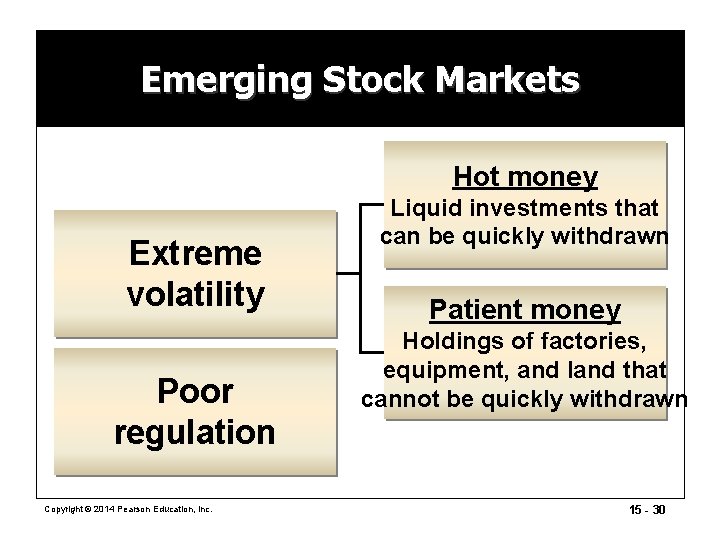
Emerging Stock Markets Hot money Extreme volatility Poor regulation Copyright © 2014 Pearson Education, Inc. Liquid investments that can be quickly withdrawn Patient money Holdings of factories, equipment, and land that cannot be quickly withdrawn 15 - 30
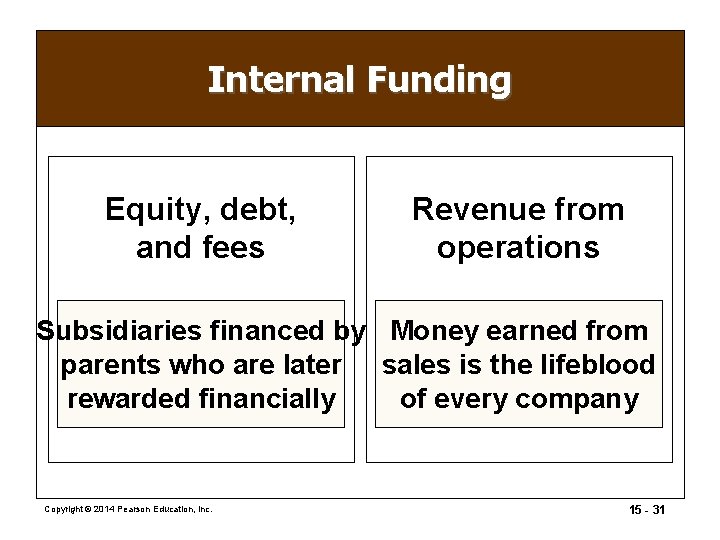
Internal Funding Equity, debt, and fees Revenue from operations Subsidiaries financed by Money earned from parents who are later sales is the lifeblood rewarded financially of every company Copyright © 2014 Pearson Education, Inc. 15 - 31
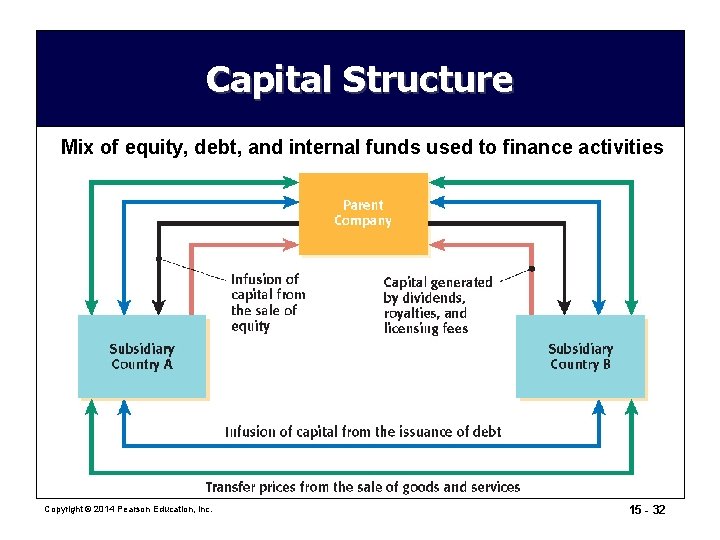
Capital Structure Mix of equity, debt, and internal funds used to finance activities Copyright © 2014 Pearson Education, Inc. 15 - 32
Discussion Question A certificate that trades in the United States and represents a specific number of shares in a non-U. S. company is called a(n) _____. a. Back-to-back loan b. Foreign Capital Receipt c. American Depository Receipt Copyright © 2014 Pearson Education, Inc. 15 - 33
Answer to Discussion Question A certificate that trades in the United States and represents a specific number of shares in a non-U. S. company is called a(n) _____. a. Back-to-back loan b. Foreign Capital Receipt c. American Depository Receipt Copyright © 2014 Pearson Education, Inc. 15 - 34
All rights reserved. No part of this publication may be reproduced, stored in a retrieval system, or transmitted, in any form or by any means, electronic, mechanical, photocopying, recording, or otherwise, without the prior written permission of the publisher. Printed in the United States of America. Copyright © 2014 Pearson Education, Inc. 15 - 35