
15 Lifetime Fitness and Wellness Cengage Learning 2015
- Slides: 27
15 Lifetime Fitness and Wellness © Cengage Learning 2015
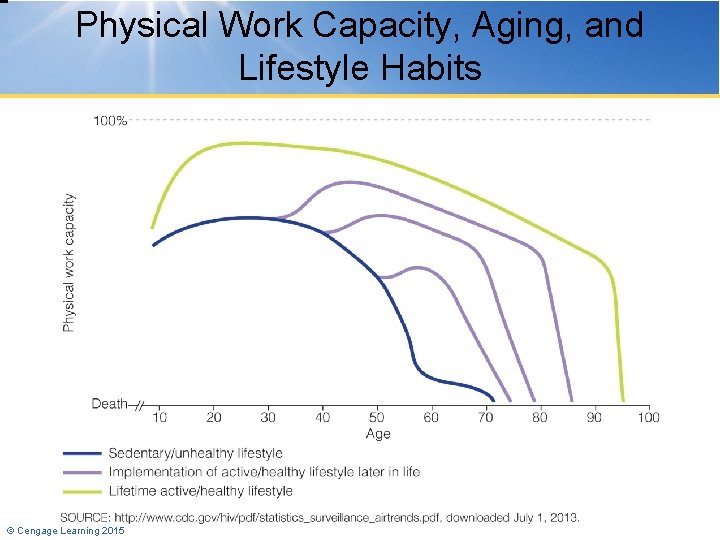
Lifetime Fitness and Wellness • Lack of physical activity decreases functional capacity more than the effects of aging – Functional capacity: ability to perform the ordinary and unusual demands of daily living without limitations or excessive fatigue or injury • Unhealthy behaviors precipitate premature aging • A healthy lifestyle can allow people to live a longer, functionally independent life © Cengage Learning 2015
Physical Work Capacity, Aging, and Lifestyle Habits © Cengage Learning 2015
Physiological Age • An individual’s physiological age may be older or younger than their chronological age – Physiological age: biological and functional capacity of the body in relation to the person’s maximal potential at any given age in the lifespan – Chronological age: calendar age • The rate at which you age depends on a combination of genetics and lifestyle factors • Lifestyle behaviors have greater impact on longevity and health © Cengage Learning 2015
Life Expectancy • Life expectancy is the number of years a person is expected to live • By looking at 46 critical genetic and lifestyle factors, you will be able to estimate your life expectancy and your real physiological age • Most of these factors are under your control © Cengage Learning 2015
Conventional Western Medicine • Conventional Western medicine – Traditional medical practice based on methods that are tested through rigorous scientific trials; also called allopathic medicine – Practitioners include primary care physicians, osteopaths, dentists, oral surgeons, orthodontists, ophthalmologists, optometrists, physician assistants, and nurses © Cengage Learning 2015
Complementary and Alternative Medicine (CAM) • Group of diverse medical and health care systems, practices, and products not presently considered to be part of conventional medicine • Also called unconventional, nonallopathic, or integrative medicine © Cengage Learning 2015
Complementary and Alternative Medicine (CAM) (cont’d. ) • Common reasons for using CAM: – Lack of progress – Frustration and dissatisfaction – Lack of personal attention – Rising cost of health-care – Belief that body, mind, and spirit all contribute to good health © Cengage Learning 2015
Three Categories of CAM Therapies • Natural products including use of a variety of herbal medicines (botanicals), vitamins, minerals, and other “natural products” • Mind–body medicine focusing on interactions among the brain, mind, body, and behavior • Manipulative and body-based practices such as spinal manipulation and massage therapy © Cengage Learning 2015
Complementary and Alternative Medicine (CAM) (cont’d. ) • CAM includes a wide range of approaches: – Acupuncture – Chiropractics – Herbal medicine – Homeopathy and naturopathic medicine – Ayurveda – Magnetic therapy – Massage therapy © Cengage Learning 2015
Complementary and Alternative Medicine (CAM) (cont’d. ) • Shortcomings of CAM: – Practitioners may not be well educated – Some practices are devoid of science – Many CAM practices are not regulated – Natural and herbal products are not regulated – Combining prescription and CAM drugs can yield undesirable side effects © Cengage Learning 2015
Complementary and Alternative Medicine (CAM) (cont’d. ) • Herbal medicines – Potency is not always adequately controlled – Some have undesirable side effects • Be an informed consumer – Disclose all conventional and unconventional treatments to all health care providers – Visit nccam. nih. gov © Cengage Learning 2015
Integrative Medicine • Integrative medicine is the combination of practices and methods of alternative medicine with conventional western medicine • Encompasses all aspects of the individual’s lifestyle – the ultimate goal is to treat the body, mind, and spirit © Cengage Learning 2015
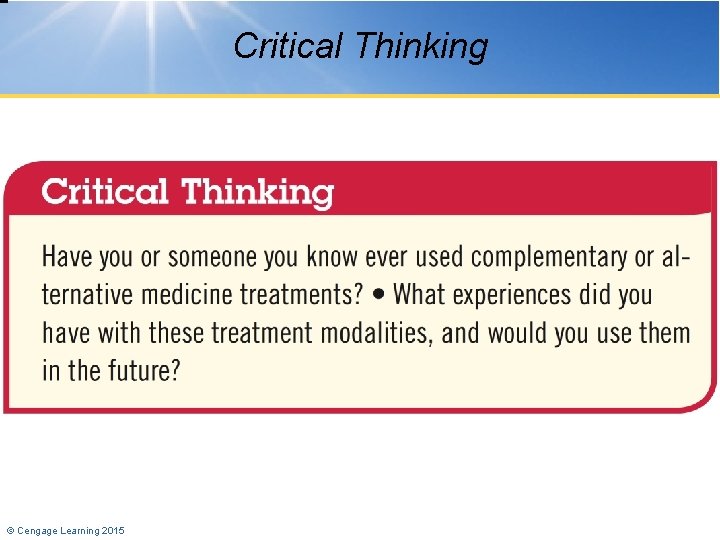
Critical Thinking © Cengage Learning 2015
Quackery and Fraud • Advertisements based on unproven claims, secret research, half-truths, and quick-fixes • When seeking advice on the Internet: – Look for credentials and note contact info – Check appearance and last update – Be cautious if a site tries to sell you something – Compare content to other credible sources – Beware of sites that are critical of regulation – Beware of vague, pseudo-medical jargon © Cengage Learning 2015
Quackery and Fraud (cont’d. ) • Report consumer fraud to the National Council against Health Fraud (NCAHF) • Be informed before you make a purchase – Seek advice from reputable professionals – Verify qualifications, degrees, and experience – If sounds to good to be true, it probably is © Cengage Learning 2015
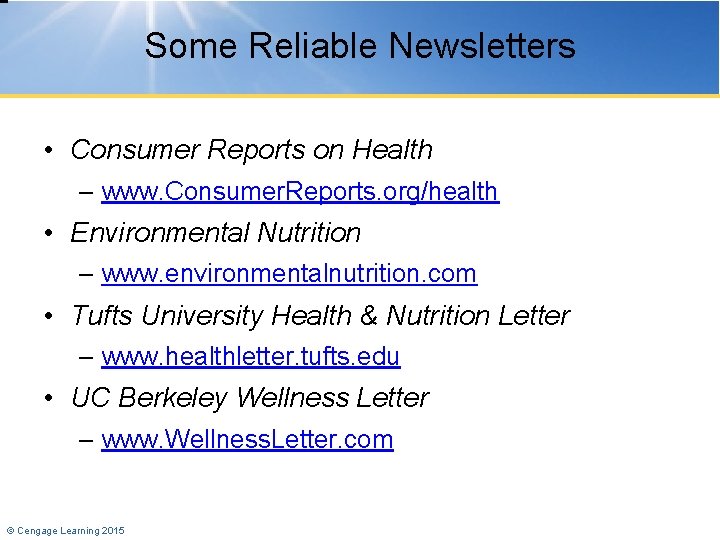
Some Reliable Newsletters • Consumer Reports on Health – www. Consumer. Reports. org/health • Environmental Nutrition – www. environmentalnutrition. com • Tufts University Health & Nutrition Letter – www. healthletter. tufts. edu • UC Berkeley Wellness Letter – www. Wellness. Letter. com © Cengage Learning 2015
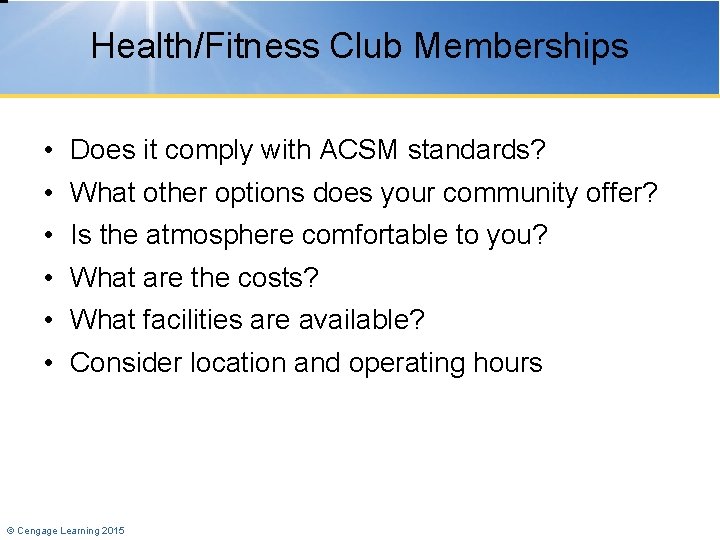
Health/Fitness Club Memberships • • • Does it comply with ACSM standards? What other options does your community offer? Is the atmosphere comfortable to you? What are the costs? What facilities are available? Consider location and operating hours © Cengage Learning 2015
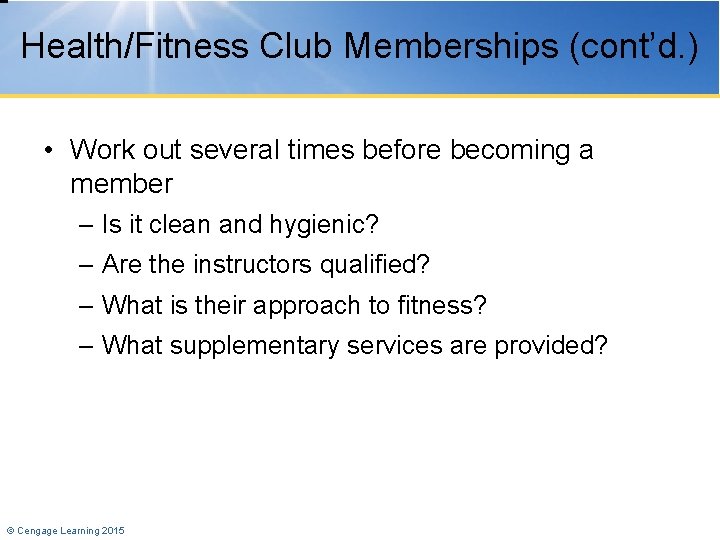
Health/Fitness Club Memberships (cont’d. ) • Work out several times before becoming a member – Is it clean and hygienic? – Are the instructors qualified? – What is their approach to fitness? – What supplementary services are provided? © Cengage Learning 2015
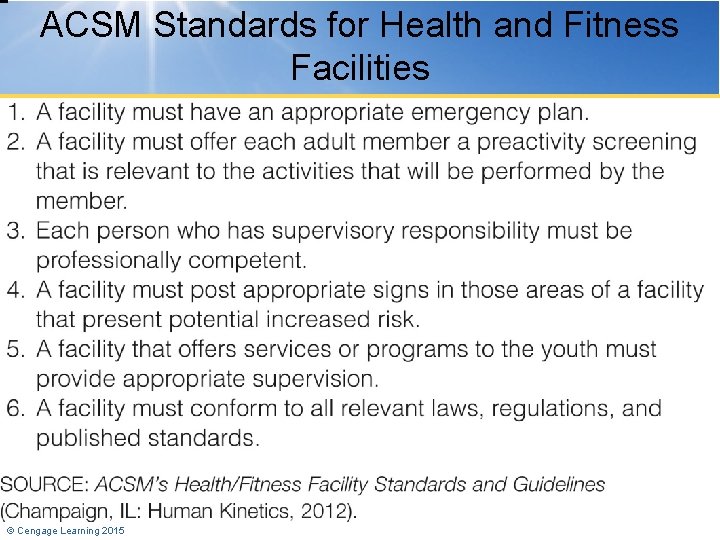
ACSM Standards for Health and Fitness Facilities © Cengage Learning 2015
Personal Trainers • A personal trainer is a health/fitness professional who evaluates, motivates, educates, and trains clients to help them meet individualized healthy lifestyle goals • Must have experience and ability to design safe and effective programs based on current fitness level, and health status © Cengage Learning 2015
Personal Trainers (cont’d. ) • No licensing body oversees personal trainers • At minimum, trainers should have an undergraduate degree and certification from ACSM, ACE, NSCA, or NASM • Set program goals before selecting a trainer © Cengage Learning 2015
Purchasing Exercise Equipment • Many people buy expensive equipment but do not use it regularly • Recommendations for purchasing equipment – Try before you buy – Look for quality – Ask for references – Watch out for expensive gadgets © Cengage Learning 2015
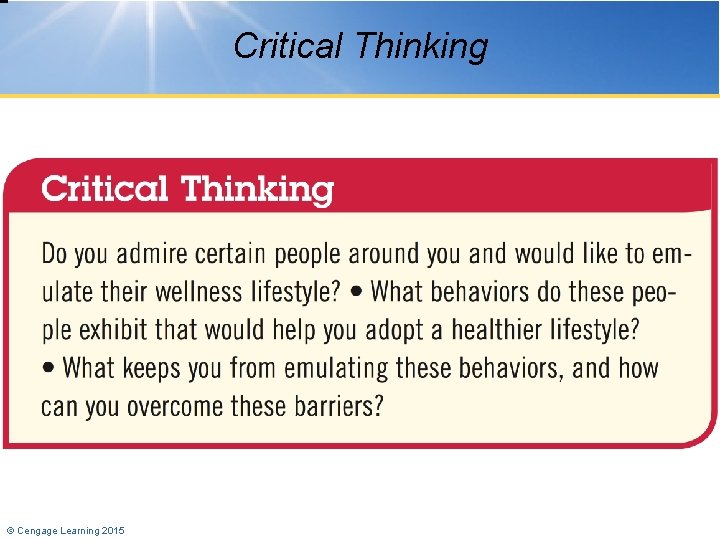
Critical Thinking © Cengage Learning 2015
Self-Evaluation and Behavioral Goals for the Future • Most people who engage in a personal fitness and wellness program experience a new quality of life after only a few weeks • Evaluate how well you have achieved your own goals, and reassess the health-related components of physical fitness © Cengage Learning 2015
The Fitness/Wellness Experience and a Challenge for the Future • Fitness and wellness is a process – you need to put forth a constant and deliberate effort to achieve and maintain a higher quality of life • Improving the quality of your life, and most likely your longevity, is in your hands © Cengage Learning 2015
Assess Yourself • Has your level of activity increased compared with the beginning of the term? Is your diet healthier now compared with a few weeks ago? • Do you understand the following concepts? – The effects of healthy living on longevity – Physiological vs. chronological age – Complementary/alternative medicine practices – How to prevent of consumer fraud – Factors to consider when choosing a fitness club © Cengage Learning 2015