
15 Investment Underwriting Prepared by Michel Paquet SAIT

15 Investment Underwriting Prepared by: Michel Paquet SAIT Polytechnic 1 of 19 © 2009 Mc. Graw-Hill Ryerson Limited
Chapter 15 - Outline • • Description of Investment Dealing Functions of Investment Dealer The Distribution Process The Securities Industry and Underwriting Activity in Canada • Public Versus Private Financing • Summary and Conclusions 2 of 19 © 2009 Mc. Graw-Hill Ryerson Limited
Learning Objectives 1. Describe investment dealers as intermediaries between corporations and governments in need of funds and the investing public. (LO 1) 2. Identify the various roles of investment dealers. (LO 2) 3. Outline the distribution process, the allocation of securities amongst syndicate participants and the calculation of the spread as cost or a return. (LO 3) 3 of 19 © 2009 Mc. Graw-Hill Ryerson Limited
Learning Objectives 4. Describe the dealer’s role in pricing corporate securities. Evaluate the influence of issued securities on earnings per share and market share price. (LO 4) 5. Discuss the pros and cons of going public versus going private when raising funds. (LO 5) 6. Describe a leverage buyout. (LO 6) 4 of 19 © 2009 Mc. Graw-Hill Ryerson Limited
LO 1 Investment Dealing • Investment dealing deals with primary offerings of new securities. • A securities corporation performing this function is referred to as an investment dealer. • An investment dealer serves as the intermediary or link between the corporation issuing securities and the investors. • An investment dealer is also called an investment house, or a securities house, or a brokerage, because it plays other roles. 5 of 19 © 2009 Mc. Graw-Hill Ryerson Limited
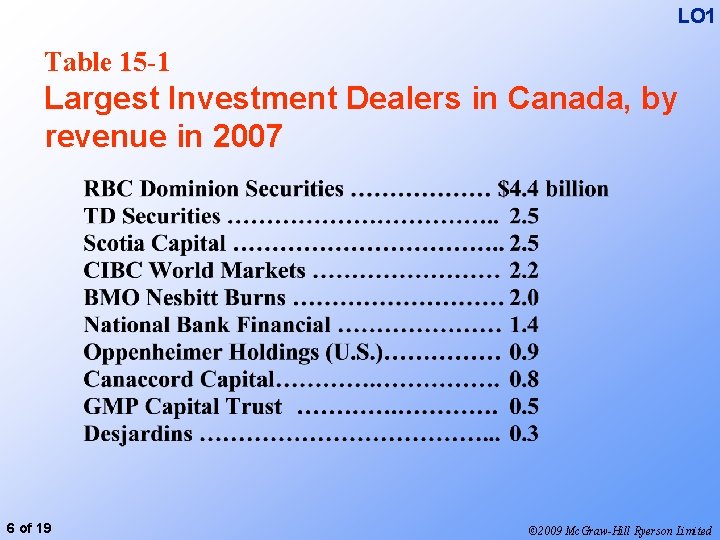
LO 1 Table 15 -1 Largest Investment Dealers in Canada, by revenue in 2007 6 of 19 © 2009 Mc. Graw-Hill Ryerson Limited
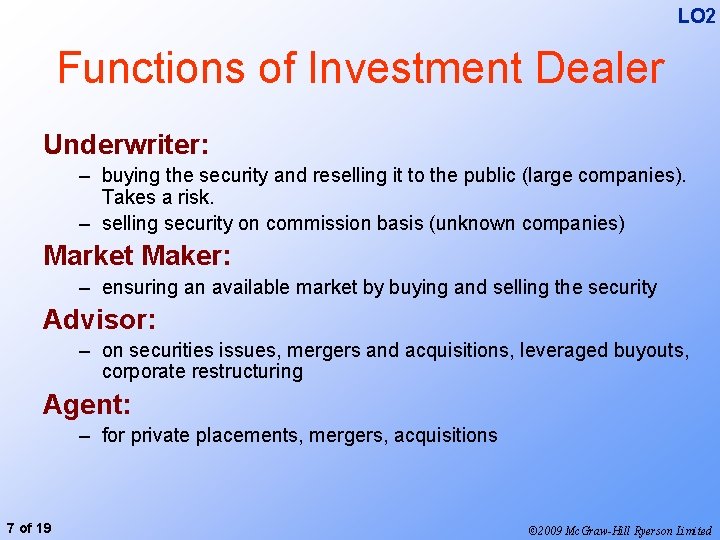
LO 2 Functions of Investment Dealer Underwriter: – buying the security and reselling it to the public (large companies). Takes a risk. – selling security on commission basis (unknown companies) Market Maker: – ensuring an available market by buying and selling the security Advisor: – on securities issues, mergers and acquisitions, leveraged buyouts, corporate restructuring Agent: – for private placements, mergers, acquisitions 7 of 19 © 2009 Mc. Graw-Hill Ryerson Limited
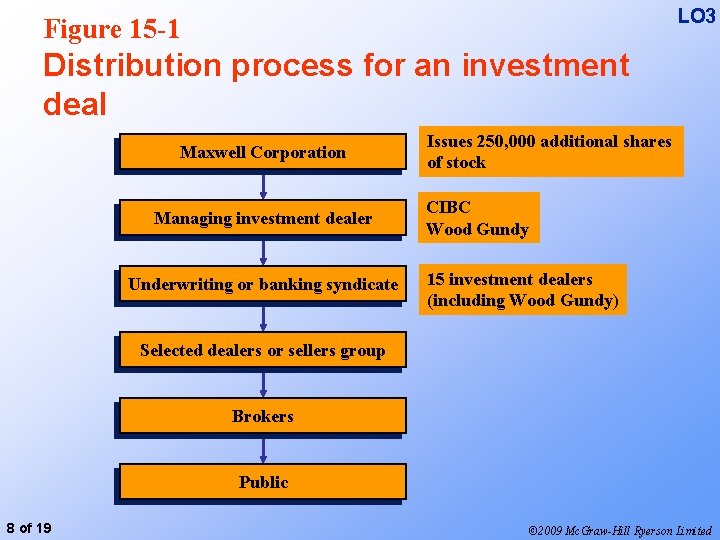
LO 3 Figure 15 -1 Distribution process for an investment deal Maxwell Corporation Managing investment dealer Underwriting or banking syndicate Issues 250, 000 additional shares of stock CIBC Wood Gundy 15 investment dealers (including Wood Gundy) Selected dealers or sellers group Brokers Public 8 of 19 © 2009 Mc. Graw-Hill Ryerson Limited
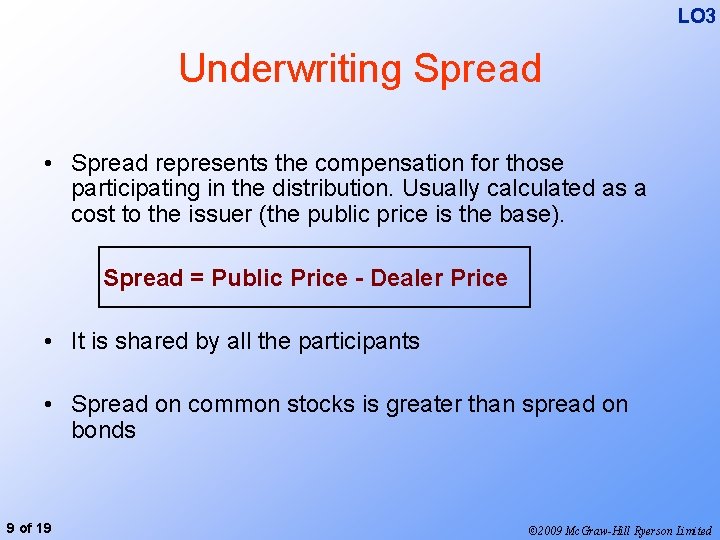
LO 3 Underwriting Spread • Spread represents the compensation for those participating in the distribution. Usually calculated as a cost to the issuer (the public price is the base). Spread = Public Price - Dealer Price • It is shared by all the participants • Spread on common stocks is greater than spread on bonds 9 of 19 © 2009 Mc. Graw-Hill Ryerson Limited
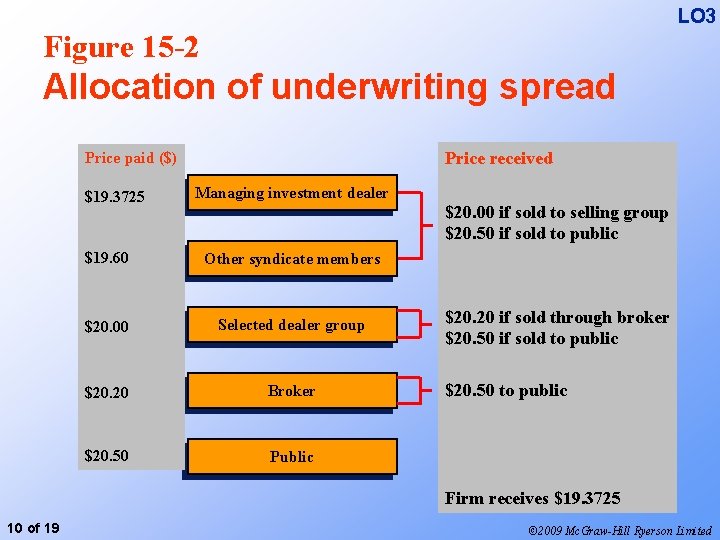
LO 3 Figure 15 -2 Allocation of underwriting spread Price received Price paid ($) $19. 3725 Managing investment dealer $19. 60 Other syndicate members $20. 00 Selected dealer group $20. 20 Broker $20. 50 Public $20. 00 if sold to selling group $20. 50 if sold to public $20. 20 if sold through broker $20. 50 if sold to public $20. 50 to public Firm receives $19. 3725 10 of 19 © 2009 Mc. Graw-Hill Ryerson Limited
Services Provided by Investment Dealer LO 4 • Pricing the security - applying the appropriate valuation techniques (Chapter 10) - taking the anticipated public demand for the new issue into consideration - considering the general market condition - dilution of earnings per share (e. p. s. ) is initially a result of new issues • Market stabilization - providing support to new securities by repurchasing them if the market price falls 11 of 19 © 2009 Mc. Graw-Hill Ryerson Limited
The Securities Industry and Underwriting Activity in Canada LO 4 • Dramatic changes in this industry have occurred due to § the deregulation of the industry in the 1980 s § the internationalization of the capital markets and from technological advances • Besides the underwriting function, the investment firms have expanded: § corporate finance, merger/acquisition advisory service, derivatives, and bond trading activities. 12 of 19 © 2009 Mc. Graw-Hill Ryerson Limited
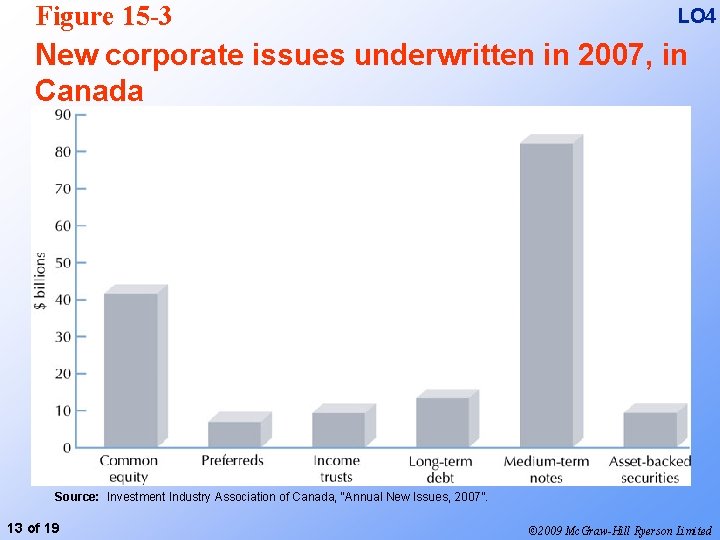
Figure 15 -3 LO 4 New corporate issues underwritten in 2007, in Canada Source: Investment Industry Association of Canada, “Annual New Issues, 2007”. 13 of 19 © 2009 Mc. Graw-Hill Ryerson Limited
LO 5 Public vs. Private Financing Publicly financed company: – when shares of a company are offered to the public – anyone can buy shares of the stock Privately financed company: – privately owned or held by an individual or family – securities not available to the general public – additional funds may be raised by private placement 14 of 19 © 2009 Mc. Graw-Hill Ryerson Limited
LO 5 Advantages and Disadvantages of Being Public Advantages: – greater availability of funds (easier to grow and raise money) – prestige Disadvantages: – company information must be made available to the public (opening the company up to public scrutiny and criticism) – high costs of going public (expensive) 15 of 19 © 2009 Mc. Graw-Hill Ryerson Limited
LO 6 Initial Public Offering (IPO), Private Placement and Leveraged Buyout (LBO) Initial Public Offering (IPO): – when a company sells its stock to the public for the first time – the company becomes publicly traded Private Placement: – selling securities directly to institutional and individual investors Leveraged Buyout (LBO): – money is borrowed to repurchase all the shares of the company resulting in a great deal of debt – when a company “goes private”, converting a publicly financed company into a privately financed one 16 of 19 © 2009 Mc. Graw-Hill Ryerson Limited
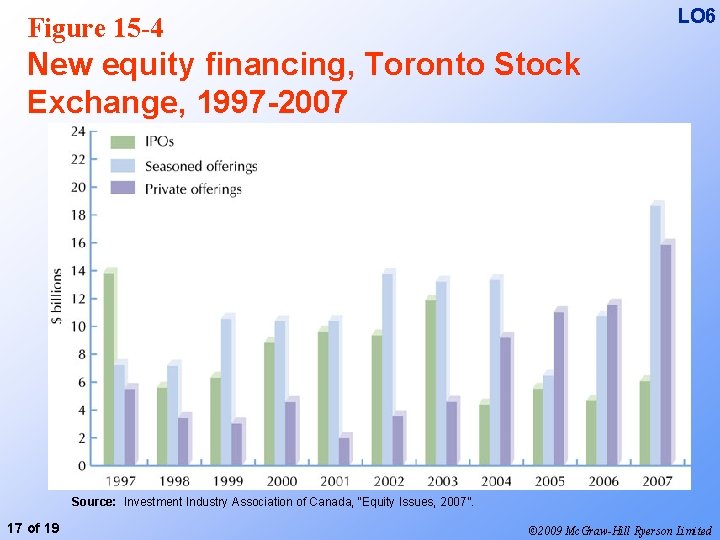
LO 6 Figure 15 -4 New equity financing, Toronto Stock Exchange, 1997 -2007 Source: Investment Industry Association of Canada, “Equity Issues, 2007”. 17 of 19 © 2009 Mc. Graw-Hill Ryerson Limited
Summary and Conclusions • The investment dealer and the securities industry are important to Canadian economy as they help corporations raise capital to finance their operations. • The investment dealer may act as underwriter, market maker, advisor and an agent. • Underwriting refers to an investment dealer and its syndicate buying and reselling securities issued by corporations. • Investment dealers are compensated in the form of underwriting spread, which is the difference between the buying and reselling prices. 18 of 19 © 2009 Mc. Graw-Hill Ryerson Limited
Summary and Conclusions • Going public may give the corporation and major shareholders greater access to funds as well as additional prestige. • Corporations go public through Initial Public Offering (IPO), which is the first time for a privately financed company to sell its shares to the public. • To avoid the rigors of public scrutiny and save money, a publicly financed company may become “private”. • Private placement is an alternative to public offerings. 19 of 19 © 2009 Mc. Graw-Hill Ryerson Limited
- Slides: 19