
15 Grammar Goofs that make you look silly
- Slides: 12
15 Grammar Goofs that make you look silly!
Your/You’re Your • “Your” is a possessive pronoun as in “your car” or “your blog. ” You're • “You’re” is a contraction of “you are, ” as in: “You’re messing up your writing by using ‘your’ when you mean ‘you are. ’”
It’s/Its It’s “It’s” is a contraction of “it is” or “it has. ” It’s an apple! Its • “Its” is a possessive pronoun as in : “This infographic has got its groove on, ” Say your sentence out loud using “it is” instead. If that sounds goofy, “its” is likely correct.
There/Their/They’re There/Their • Always do the “That’s ours!" test. Are you taking about more than one person and something they possess? If so, “their” will get you there. That’s ours! They’re • “They’re” is a contraction of “they are, ” so talk it out to be sure
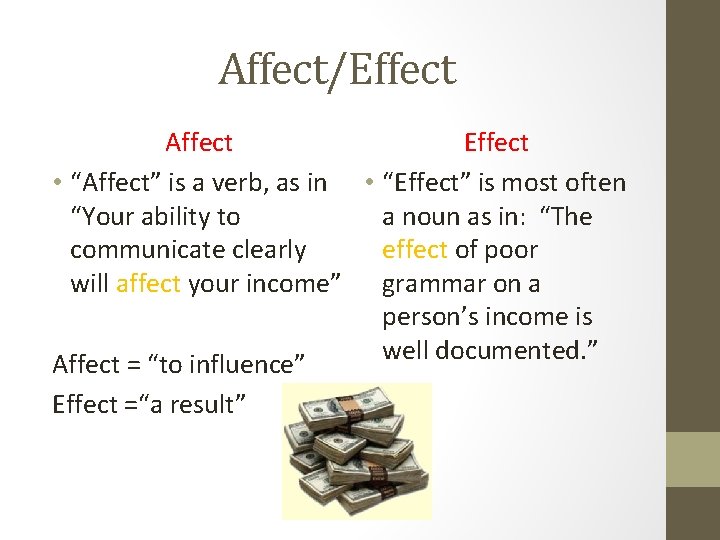
Affect/Effect Affect Effect • “Affect” is a verb, as in • “Effect” is most often “Your ability to a noun as in: “The communicate clearly effect of poor will affect your income” grammar on a person’s income is well documented. ” Affect = “to influence” Effect =“a result”
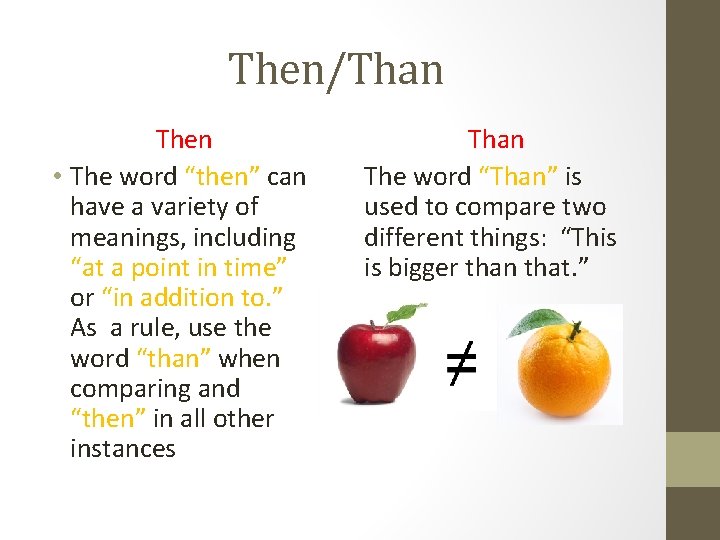
Then/Than Then • The word “then” can have a variety of meanings, including “at a point in time” or “in addition to. ” As a rule, use the word “than” when comparing and “then” in all other instances Than The word “Than” is used to compare two different things: “This is bigger than that. ”
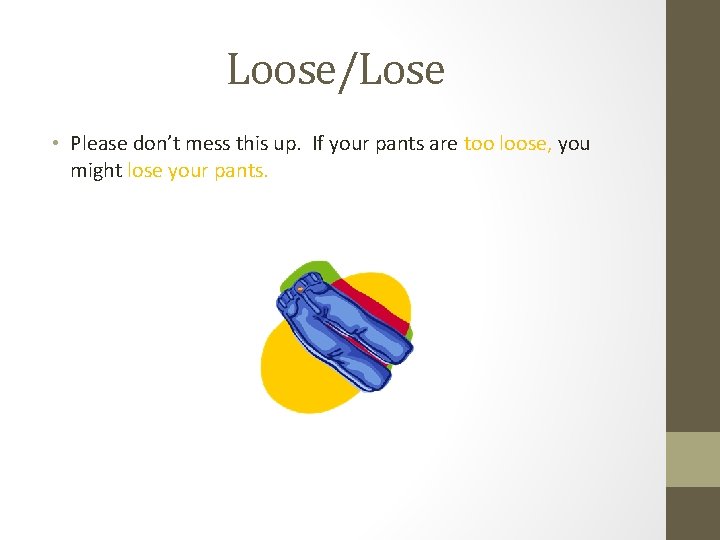
Loose/Lose • Please don’t mess this up. If your pants are too loose, you might lose your pants.
Me, Myself, and I Me/I • Choose between “me” and “I” by removing the other person from the sentence and using what doesn’t sound silly. Come to lunch with Jill and (me/I). Take out Jill. Which one sounds right? Myself • “Myself” is only proper two ways, both used here: • “Many despise asparagus, but I myself tolerate it. I thought to myself, “Why? ”
Improper use of the apostrophe You need an apostrophe in two cases: • For contractions (“don’t” for “do not forget the apostrophe”? And to show possession (“Frank’s apostrophe means the apostrophe belongs to Frank”)
Could’ve, would’ve, should’ve • “Could’ve, ” “would’ve, ” and “should’ve” are legitimate verb contractions, but when spoken they sound like they end in “of” (wrong) instead of “have” (correct) “could of, ” “would of, ” and “should of” all make you look silly.
Complement/Compliment Complement • “Complement” is something that adds to or supplements something else, or the act of doing so Compliment • “Compliment” is something nice someone says about you.
Too/To/Two Too • Too is a synonym for also or indicates excessiveness before a verb. • "I am going to the mall, too. " • "I had too many tacos for lunch. " To/Two • to is a preposition before a noun or as an infinitive before a verb. 1. "Please take me to the dance" 2. "We don't need to buy that right now. " • Two = the number 2 1. I have two hands and two feet