
15 February 2022 Local maximum and minimum points
15 February 2022 Local maximum and minimum points LO: Identify if a point is a local maximum or minimum. www. mathssupport. org
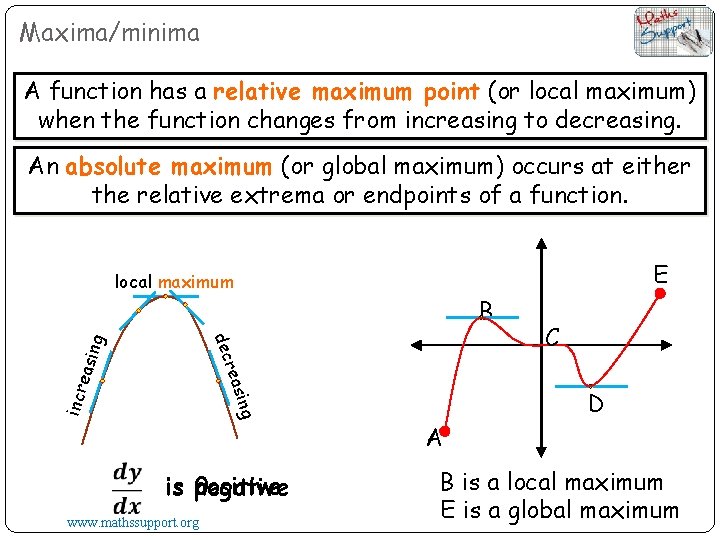
Maxima/minima A function has a relative maximum point (or local maximum) when the function changes from increasing to decreasing. An absolute maximum (or global maximum) occurs at either the relative extrema or endpoints of a function. E local maximum B ing reas incr easi ng dec positive is 0 negative www. mathssupport. org C D A B is a local maximum E is a global maximum
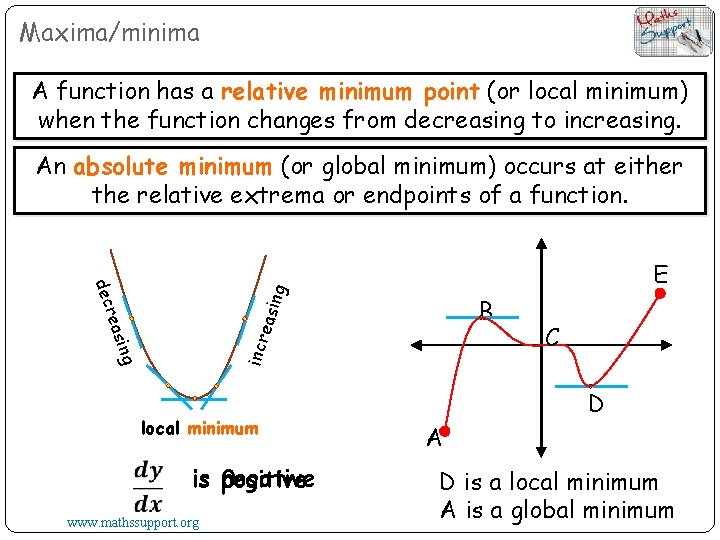
Maxima/minima A function has a relative minimum point (or local minimum) when the function changes from decreasing to increasing. An absolute minimum (or global minimum) occurs at either the relative extrema or endpoints of a function. ng dec E ing reas incr easi B local minimum is negative 0 positive www. mathssupport. org C D A D is a local minimum A is a global minimum
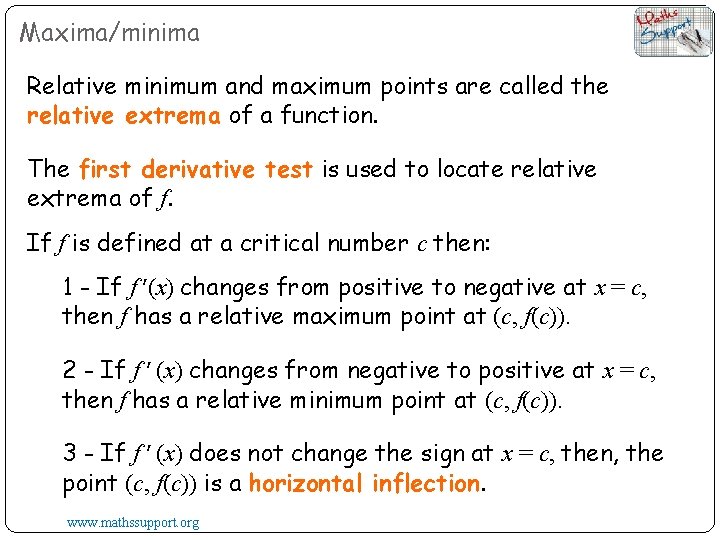
Maxima/minima Relative minimum and maximum points are called the relative extrema of a function. The first derivative test is used to locate relative extrema of f. If f is defined at a critical number c then: 1 - If f ’(x) changes from positive to negative at x = c, then f has a relative maximum point at (c, f(c)). 2 - If f ’ (x) changes from negative to positive at x = c, then f has a relative minimum point at (c, f(c)). 3 - If f ’ (x) does not change the sign at x = c, then, the point (c, f(c)) is a horizontal inflection. www. mathssupport. org
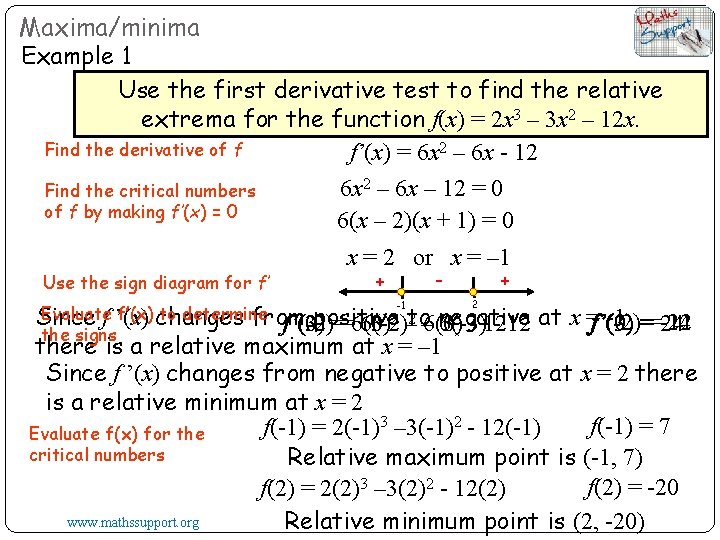
Maxima/minima Example 1 Use the first derivative test to find the relative extrema for the function f(x) = 2 x 3 – 3 x 2 – 12 x. Find the derivative of f f’(x) = 6 x 2 – 6 x - 12 6 x 2 – 6 x – 12 = 0 Find the critical numbers of f by making f’(x) = 0 6(x – 2)(x + 1) = 0 x = 2 or x = – 1 Use the sign diagram for f’ - + -1 + 2 Evaluate f’(x) changes to determine 2– 2– Since f ’(x) from positive to negative f’(-2) = 6(-2) 6(-3) - 12 f’(0) 6(0) f’(3) = 6(3) - 12 the signs at x =f’(-2) -1 ==24 f’(0) -12 24 f’(3) there is a relative maximum at x = – 1 Since f ’(x) changes from negative to positive at x = 2 there is a relative minimum at x = 2 f(-1) = 7 f(-1) = 2(-1)3 – 3(-1)2 - 12(-1) Evaluate f(x) for the critical numbers Relative maximum point is (-1, 7) f(2) = -20 f(2) = 2(2)3 – 3(2)2 - 12(2) www. mathssupport. org Relative minimum point is (2, -20)
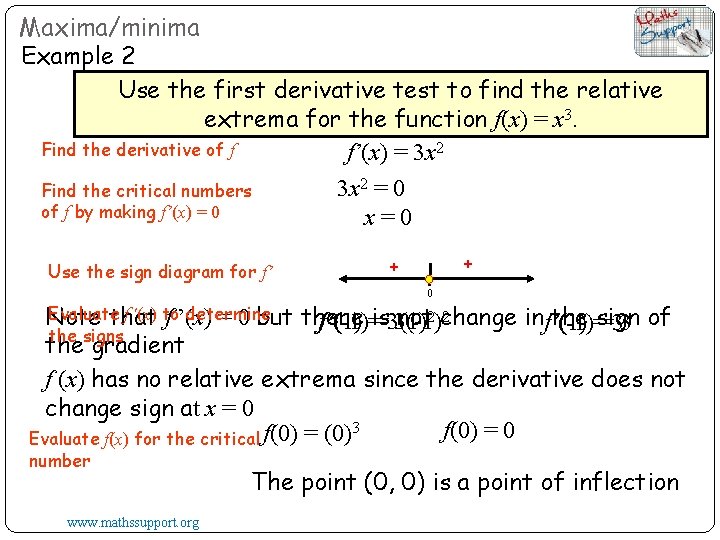
Maxima/minima Example 2 Use the first derivative test to find the relative extrema for the function f(x) = x 3. Find the derivative of f f’(x) = 3 x 2 = 0 Find the critical numbers of f by making f’(x) = 0 x=0 Use the sign diagram for f’ + + 0 Evaluate f ’(x) to determine 2 Note that f ’(x) = 0 but there not 2 change inf’(-1) the =sign f’(-1) =3(1) 3(-1) f’(1) =is f’(1) =33 of the signs the gradient f (x) has no relative extrema since the derivative does not change sign at x = 0 3 f(0) = 0 Evaluate f(x) for the critical f(0) = (0) number www. mathssupport. org The point (0, 0) is a point of inflection
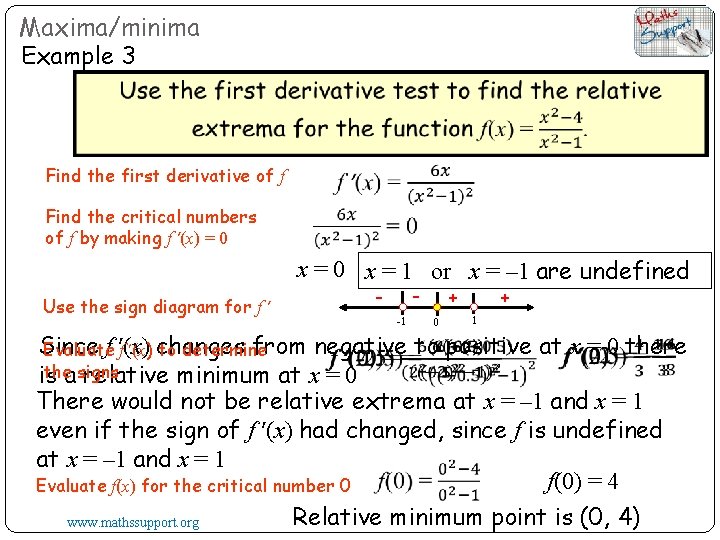
Maxima/minima Example 3 Find the first derivative of f Find the critical numbers of f by making f ’(x) = 0 x = 1 or x = – 1 are undefined Use the sign diagram for f ’ - - -1 + 0 + 1 Since f ’(x) from negative to positive at x = 0 there Evaluate f ’(x) changes to determine thea signs is relative minimum at x = 0 There would not be relative extrema at x = – 1 and x = 1 even if the sign of f ’(x) had changed, since f is undefined at x = – 1 and x = 1 f(0) = 4 Evaluate f(x) for the critical number 0 www. mathssupport. org Relative minimum point is (0, 4)

Maxima/minima Example 4 Identify each labelled point as an absolute maximum or minimum, a relative maximum or minimum or neither A is an absolute minimum Since the value of the function of A is the least value of the function over its entire domain. C D B is a relative minimum Cannot be an absolute minimum since there are values of the function less than the value of the function at B C is an absolute maximum and relative maximum A B Since the value of the function of C is the greatest value of the function over its entire domain. D is a neither The points on the graph above the blue line have values greater than the value of the function at D and those below the blue line have values less than the value of the function at D www. mathssupport. org
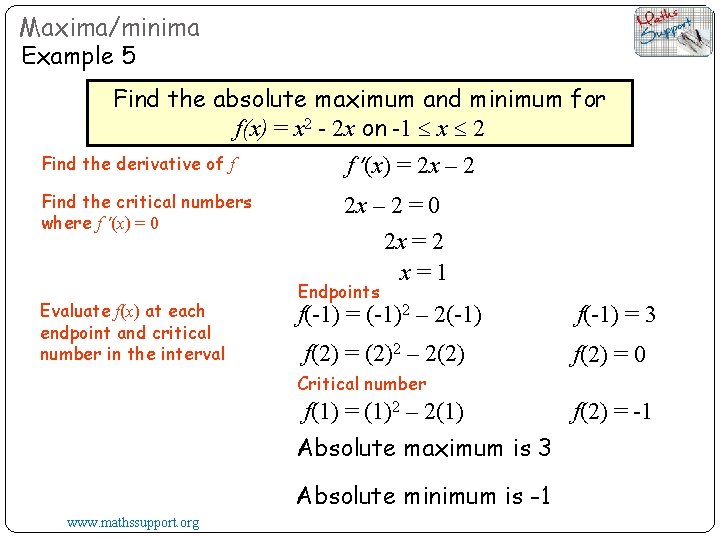
Maxima/minima Example 5 Find the absolute maximum and minimum for f(x) = x 2 - 2 x on -1 x 2 Find the derivative of f f ’(x) = 2 x – 2 Find the critical numbers where f ’(x) = 0 2 x – 2 = 0 Evaluate f(x) at each endpoint and critical number in the interval Endpoints 2 x = 2 x=1 f(-1) = (-1)2 – 2(-1) f(-1) = 3 f(2) = (2)2 – 2(2) f(2) = 0 Critical number f(1) = (1)2 – 2(1) Absolute maximum is 3 Absolute minimum is -1 www. mathssupport. org f(2) = -1

Thank you for using resources from For more resources visit our website https: //www. mathssupport. org If you have a special request, drop us an email info@mathssupport. org www. mathssupport. org
- Slides: 10