
15 December 2021 The cosine rule LO Using
15 December 2021 The cosine rule LO: Using the cosine rule to solve non-rightangled triangles www. mathssupport. org
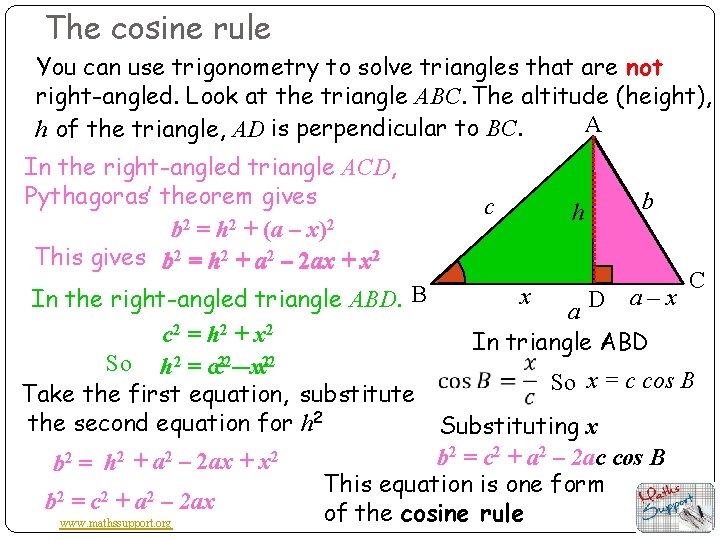
The cosine rule You can use trigonometry to solve triangles that are not right-angled. Look at the triangle ABC. The altitude (height), A h of the triangle, AD is perpendicular to BC. In the right-angled triangle ACD, Pythagoras’ theorem gives b 2 = h 2 + (a – x)2 This gives b 2 = h 2 + a 2 – 2 ax + x 2 c h b C B x D a–x In the right-angled triangle ABD. a c 2 = h 2 + x 2 In triangle ABD So h 2 = cc 22––xx 22 So x = c cos B Take the first equation, substitute the second equation for h 2 Substituting x b 2 = c 2 + a 2 – 2 ac cos B b 2 = h 2 + a 2 – 2 ax + x 2 This equation is one form 2 2 2 b = c + a – 2 ax of the cosine rule www. mathssupport. org
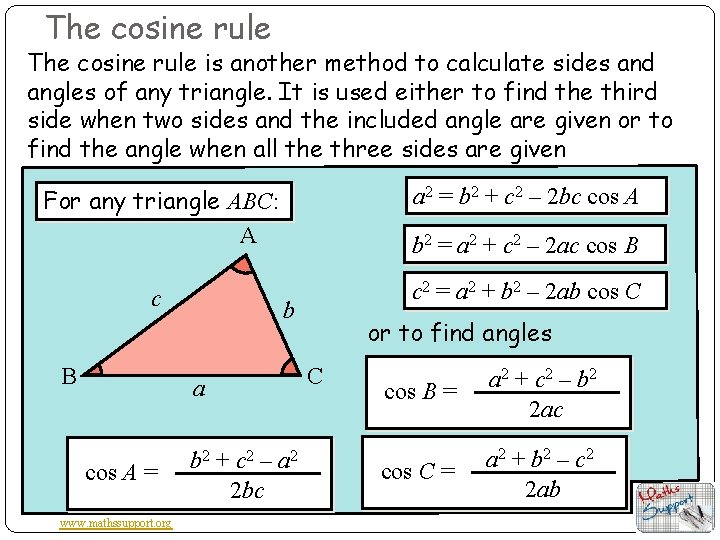
The cosine rule is another method to calculate sides and angles of any triangle. It is used either to find the third side when two sides and the included angle are given or to find the angle when all the three sides are given For any triangle ABC: A b 2 = a 2 + c 2 – 2 ac cos B c c 2 = a 2 + b 2 – 2 ab cos C B a 2 = b 2 + c 2 – 2 bc cos A b a cos A = www. mathssupport. org b 2 + c 2 – a 2 2 bc or to find angles C cos B = a 2 + c 2 – b 2 2 ac cos C = a 2 + b 2 – c 2 2 ab
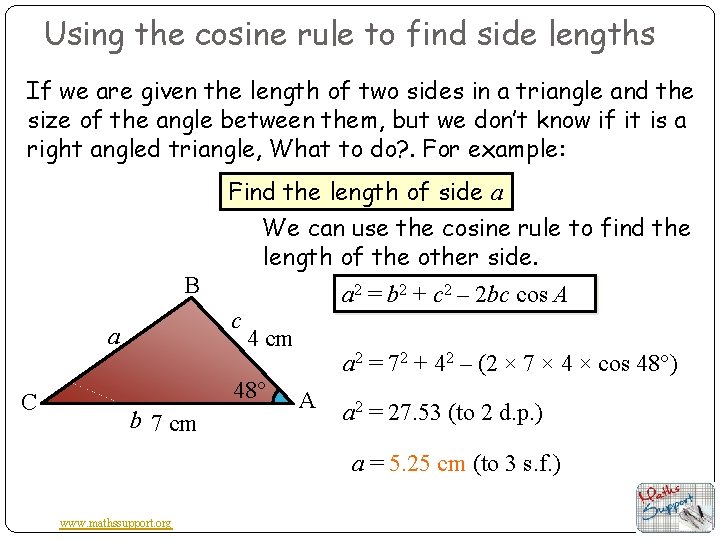
Using the cosine rule to find side lengths If we are given the length of two sides in a triangle and the size of the angle between them, but we don’t know if it is a right angled triangle, What to do? . For example: Find the length of side a We can use the cosine rule to find the length of the other side. B c a C a 2 = b 2 + c 2 – 2 bc cos A 4 cm 48° b 7 cm a 2 = 72 + 42 – (2 × 7 × 4 × cos 48°) A a 2 = 27. 53 (to 2 d. p. ) a = 5. 25 cm (to 3 s. f. ) www. mathssupport. org
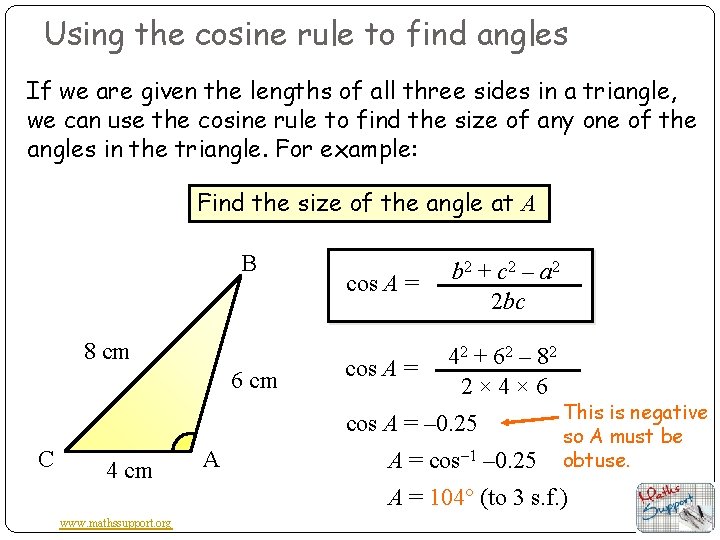
Using the cosine rule to find angles If we are given the lengths of all three sides in a triangle, we can use the cosine rule to find the size of any one of the angles in the triangle. For example: Find the size of the angle at A B 8 cm 6 cm cos A = b 2 + c 2 – a 2 2 bc cos A = 42 + 62 – 82 2× 4× 6 cos A = – 0. 25 C 4 cm www. mathssupport. org A A = cos– 1 – 0. 25 This is negative so A must be obtuse. A = 104° (to 3 s. f. )
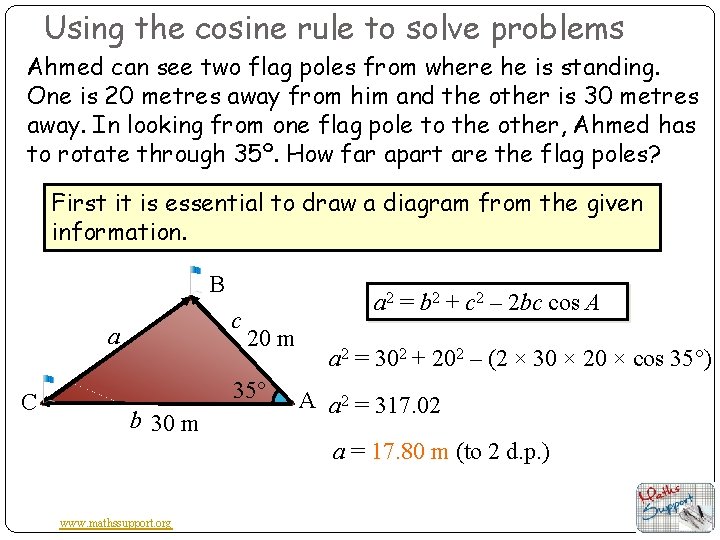
Using the cosine rule to solve problems Ahmed can see two flag poles from where he is standing. One is 20 metres away from him and the other is 30 metres away. In looking from one flag pole to the other, Ahmed has to rotate through 35º. How far apart are the flag poles? First it is essential to draw a diagram from the given information. B c a C a 2 = b 2 + c 2 – 2 bc cos A 20 m 35° b 30 m a 2 = 302 + 202 – (2 × 30 × 20 × cos 35°) A a 2 = 317. 02 a = 17. 80 m (to 2 d. p. ) www. mathssupport. org

Thank you for using resources from For more resources visit our website https: //www. mathssupport. org If you have a special request, drop us an email info@mathssupport. org www. mathssupport. org
- Slides: 7