
15 Classroom Management Objective Analyze and evaluate the
15 Classroom Management
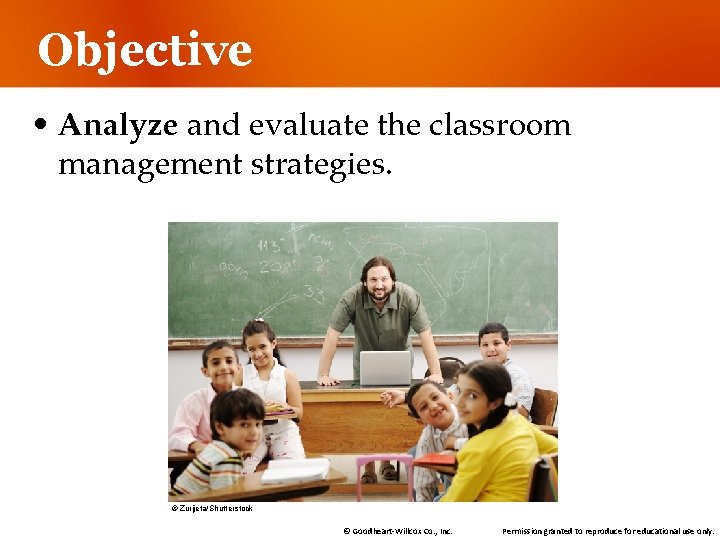
Objective • Analyze and evaluate the classroom management strategies. © Zurijeta/Shutterstock © Goodheart-Willcox Co. , Inc. Permission granted to reproduce for educational use only.
Classroom Management • Teachers need management skills for classroom management – Organize the classroom – Engage students in learning – Minimize disruptive behaviors © Goodheart-Willcox Co. , Inc. Permission granted to reproduce for educational use only.
Creating the Classroom Environment • Arrange the space • Develop a stimulating learning environment • Build a sense of community © Goodheart-Willcox Co. , Inc. Permission granted to reproduce for educational use only.
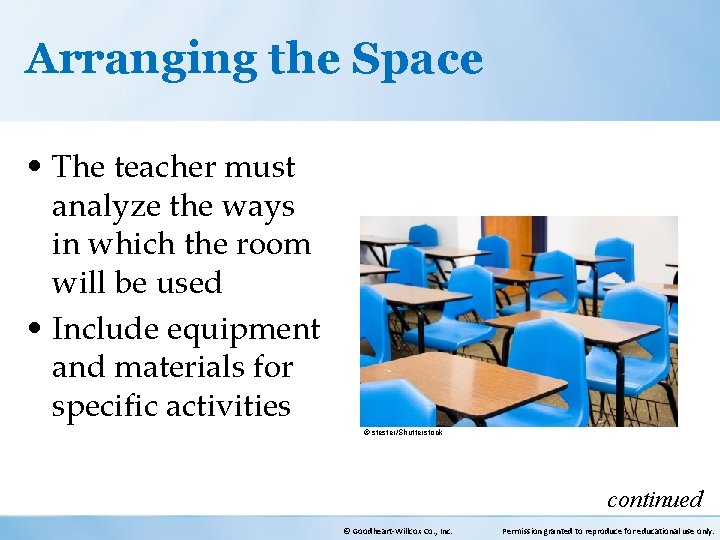
Arranging the Space • The teacher must analyze the ways in which the room will be used • Include equipment and materials for specific activities © stester/Shutterstock continued © Goodheart-Willcox Co. , Inc. Permission granted to reproduce for educational use only.
Arranging the Space • General guidelines include arranging for – ease of student use—practical, allow access to instruction, include adequate storage – ease of teaching—best accommodate the teacher’s individual style – ease of supervision—to gauge student understanding and minimize problem behavior © Goodheart-Willcox Co. , Inc. Permission granted to reproduce for educational use only.
For Discussion • How does the arrangement of space in your current classroom affect your learning? © Michael D. Brown/Shutterstock © Goodheart-Willcox Co. , Inc. Permission granted to reproduce for educational use only.
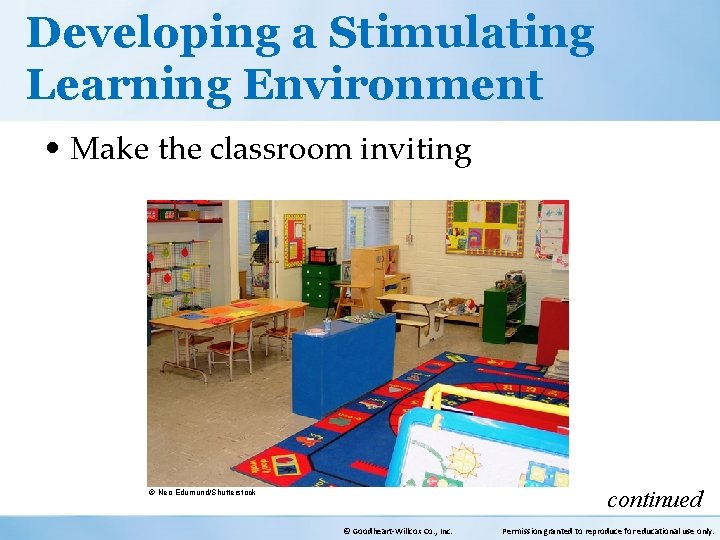
Developing a Stimulating Learning Environment • Make the classroom inviting continued © Neo Edumund/Shutterstock © Goodheart-Willcox Co. , Inc. Permission granted to reproduce for educational use only.
Developing a Stimulating Learning Environment • Use bright colors for stimulation • Display students’ work for interest • Avoid distracting disorganization • Change elements periodically to generate new interest © Goodheart-Willcox Co. , Inc. Permission granted to reproduce for educational use only.
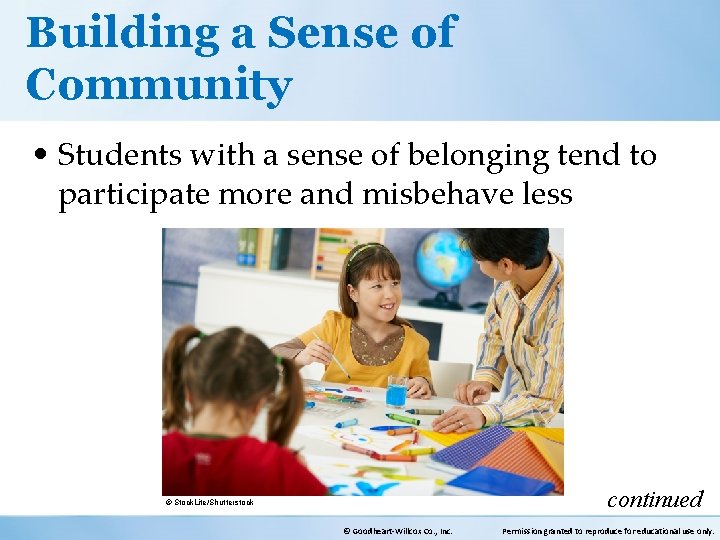
Building a Sense of Community • Students with a sense of belonging tend to participate more and misbehave less continued © Stock. Lite/Shutterstock © Goodheart-Willcox Co. , Inc. Permission granted to reproduce for educational use only.
Building a Sense of Community • Key areas: – Positive relationships—set the tone by taking interest in students, balancing authority with friendliness – Respect—do not tolerate disrespect among students; encourage them to learn about one another continued © Goodheart-Willcox Co. , Inc. Permission granted to reproduce for educational use only.
Building a Sense of Community • Key areas: – Student involvement—helps students develop a sense of responsibility and bond with the class – Class identity—connections that encourage the cohesiveness of a team © Goodheart-Willcox Co. , Inc. Permission granted to reproduce for educational use only.
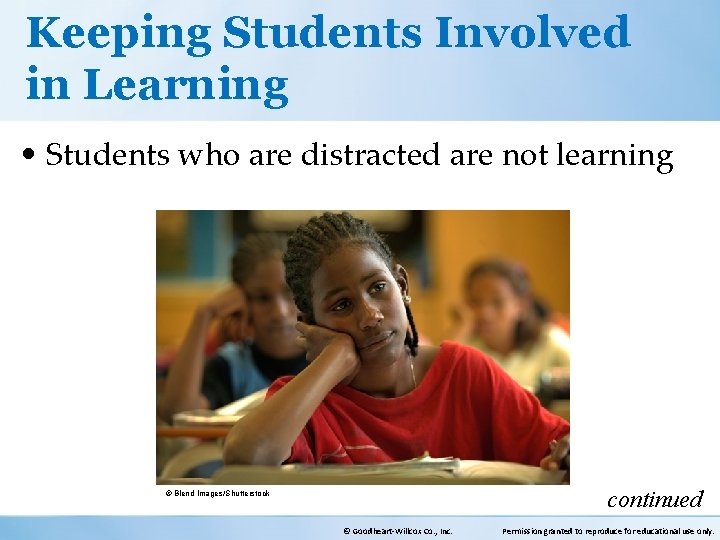
Keeping Students Involved in Learning • Students who are distracted are not learning continued © Blend Images/Shutterstock © Goodheart-Willcox Co. , Inc. Permission granted to reproduce for educational use only.
Keeping Students Involved in Learning • To keep students’ attention, – present engaging lessons – manage transitions – note success © Goodheart-Willcox Co. , Inc. Permission granted to reproduce for educational use only.
For Reflection • What are some teaching techniques that keep you attentive during class? © Archipoch/Shutterstock © Goodheart-Willcox Co. , Inc. Permission granted to reproduce for educational use only.
Presenting Engaging Lessons • Students involved in learning are less likely to misbehave • Lessons are more appealing when they relate to students’ lives • Using a variety of teaching techniques helps keep students interested © Goodheart-Willcox Co. , Inc. Permission granted to reproduce for educational use only.
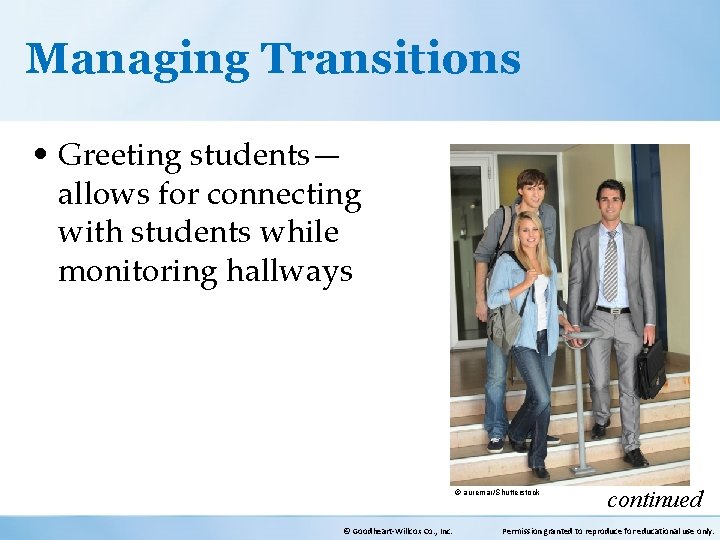
Managing Transitions • Greeting students— allows for connecting with students while monitoring hallways © auremar/Shutterstock © Goodheart-Willcox Co. , Inc. continued Permission granted to reproduce for educational use only.
Managing Transitions • Class start-up assignment—gives the teacher time to take attendance, gets the class off to a smooth start • Students who finish early—encourage activities that discourage distracting behaviors continued © Goodheart-Willcox Co. , Inc. Permission granted to reproduce for educational use only.
Managing Transitions • Transition to small groups—familiarize students with procedures • Lesson ends early—keep short, optional activities on hand © Goodheart-Willcox Co. , Inc. Permission granted to reproduce for educational use only.
For Reflection • Do you ever notice teachers managing transitions? Is this management effective? © Archipoch/Shutterstock © Goodheart-Willcox Co. , Inc. Permission granted to reproduce for educational use only.
Noting Success • Give positive feedback to encourage students to repeat behavior • To help break the cycle of failure, – comment on good behavior more than bad – praise real effort and following of rules © Goodheart-Willcox Co. , Inc. Permission granted to reproduce for educational use only.
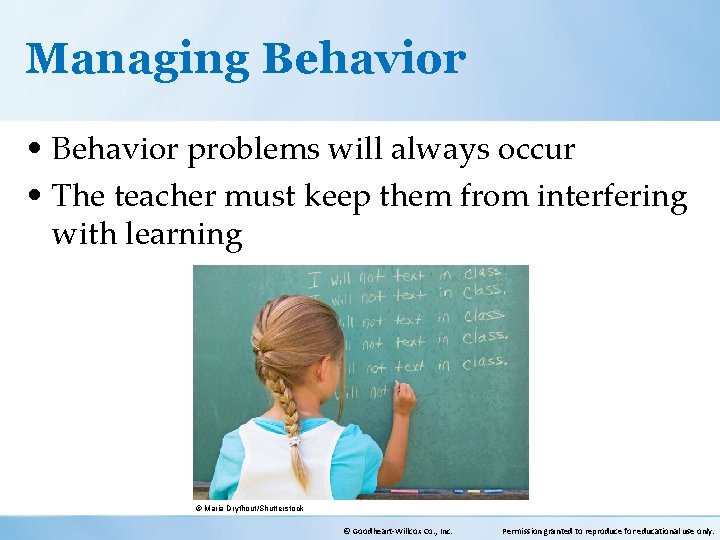
Managing Behavior • Behavior problems will always occur • The teacher must keep them from interfering with learning © Maria Dryfhout/Shutterstock © Goodheart-Willcox Co. , Inc. Permission granted to reproduce for educational use only.
Understanding Teachers’ Management Styles • Authoritarian style—seeks to control behavior through rules, procedures, and consequences • Permissive style—sets few expectations and rules and enforces them inconsistently • Authoritative style—sets high expectations and applies consequences consistently © Goodheart-Willcox Co. , Inc. Permission granted to reproduce for educational use only.
For Discussion • In your opinion, which management style is most effective? Why? © Michael D. Brown/Shutterstock © Goodheart-Willcox Co. , Inc. Permission granted to reproduce for educational use only.
Developing a Personal Behavior Management Plan • Some schools require a plan answering the following questions: – What realistic expectations for student behavior should you set? – How will you reward students for appropriate behavior? – What steps will you take when inappropriate behavior occurs? continued © Goodheart-Willcox Co. , Inc. Permission granted to reproduce for educational use only.
Developing a Personal Behavior Management Plan • Expectations and rewards for appropriate behavior vary by age • Consequences for misbehavior depend on age and the severity of the problem © Goodheart-Willcox Co. , Inc. Permission granted to reproduce for educational use only.
Objective • Develop a set of class rules to enhance the learning environment. © Thirteen/Shutterstock © Goodheart-Willcox Co. , Inc. Permission granted to reproduce for educational use only.
Establishing Classroom Rules and Procedures • School policies are the same for all students (attendance, dress code) • Class rules are expected behaviors and attitudes specific to a class or teacher • Classroom procedures translate class rules into expected concrete actions continued © Goodheart-Willcox Co. , Inc. Permission granted to reproduce for educational use only.
Establishing Classroom Rules and Procedures • Establish class rules during the first few days of class • Involve students in setting rules/procedures • Keep the rule list short • State rules/procedures in positive terms • Define the terms • Adjust rules/procedures that are not working well © Goodheart-Willcox Co. , Inc. Permission granted to reproduce for educational use only.
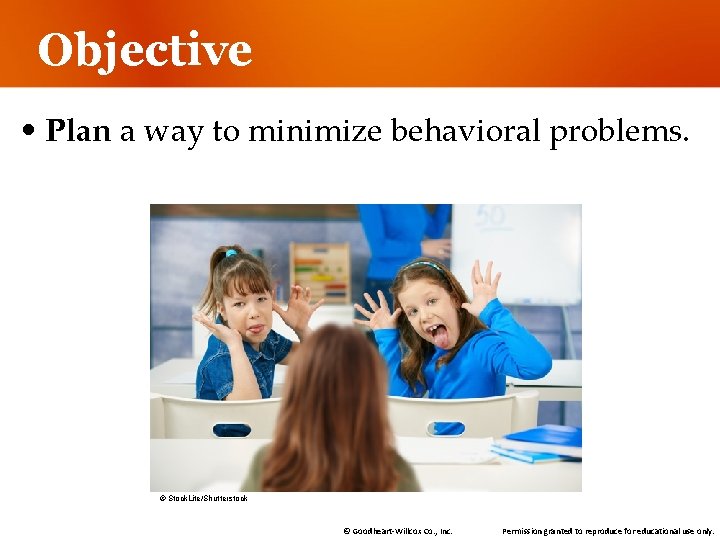
Objective • Plan a way to minimize behavioral problems. © Stock. Lite/Shutterstock © Goodheart-Willcox Co. , Inc. Permission granted to reproduce for educational use only.
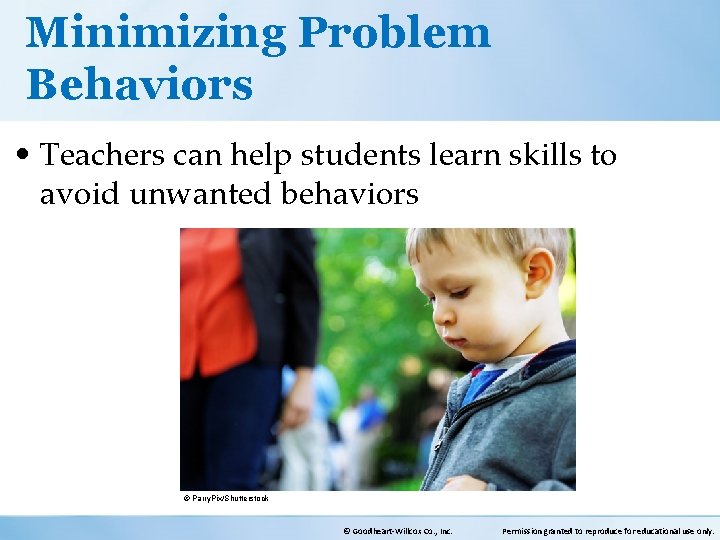
Minimizing Problem Behaviors • Teachers can help students learn skills to avoid unwanted behaviors © Parry. Pix/Shutterstock © Goodheart-Willcox Co. , Inc. Permission granted to reproduce for educational use only.
Developing Personal Responsibility • Teachers help students – make appropriate choices – take responsibility for their behavior – develop self-discipline – accept consequences of misbehavior © Goodheart-Willcox Co. , Inc. Permission granted to reproduce for educational use only.
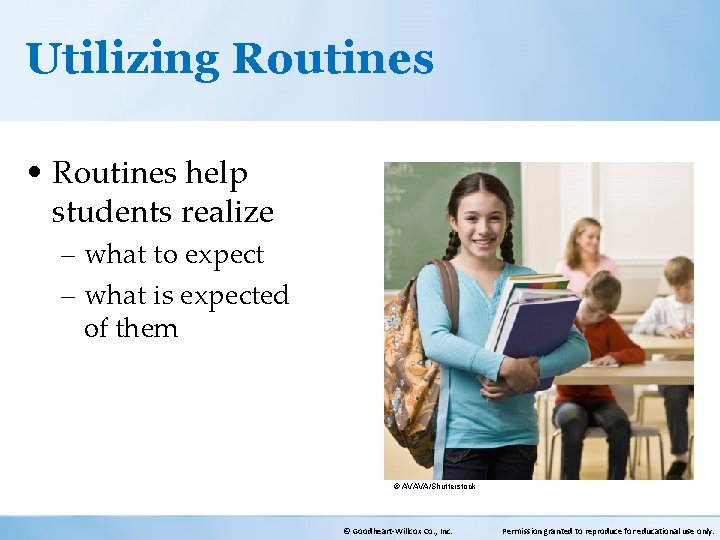
Utilizing Routines • Routines help students realize – what to expect – what is expected of them © AVAVA/Shutterstock © Goodheart-Willcox Co. , Inc. Permission granted to reproduce for educational use only.
Assigning Seats • Helps substitutes and teacher aids • Teachers learn students’ names and behaviors quickly • Students can be placed – in the location where they learn best – away from distractions © Goodheart-Willcox Co. , Inc. Permission granted to reproduce for educational use only.
For Discussion • As a student, do you prefer having assigned seats or choosing your own seat? Why? © Michael D. Brown/Shutterstock © Goodheart-Willcox Co. , Inc. Permission granted to reproduce for educational use only.
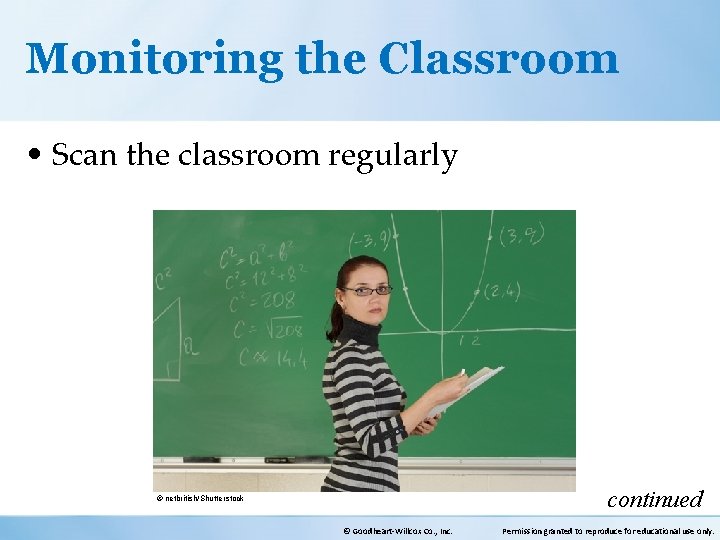
Monitoring the Classroom • Scan the classroom regularly continued © netbritish/Shutterstock © Goodheart-Willcox Co. , Inc. Permission granted to reproduce for educational use only.
Monitoring the Classroom • Stop minor misbehaviors before they continue • Move around the room to deter inappropriate behavior © Goodheart-Willcox Co. , Inc. Permission granted to reproduce for educational use only.
Using Nonverbal Cues • Nonverbal cues include – eye contact – body language – gestures – physical closeness • Today, touch may be misinterpreted © Goodheart-Willcox Co. , Inc. Permission granted to reproduce for educational use only.
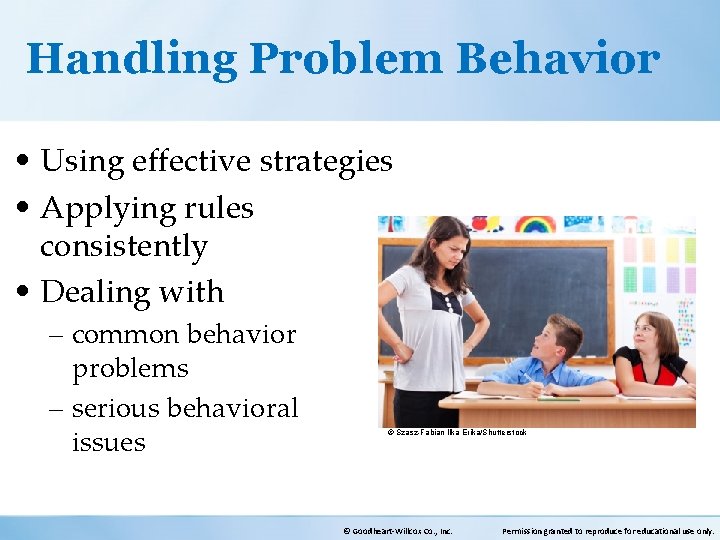
Handling Problem Behavior • Using effective strategies • Applying rules consistently • Dealing with – common behavior problems – serious behavioral issues © Szasz-Fabian Ilka Erika/Shutterstock © Goodheart-Willcox Co. , Inc. Permission granted to reproduce for educational use only.
Using Effective Strategies • Stay calm and project confidence • Avoid responses such as anger, humiliation, and putdowns • Keep responses low-key and matter-of-fact © Goodheart-Willcox Co. , Inc. Permission granted to reproduce for educational use only.
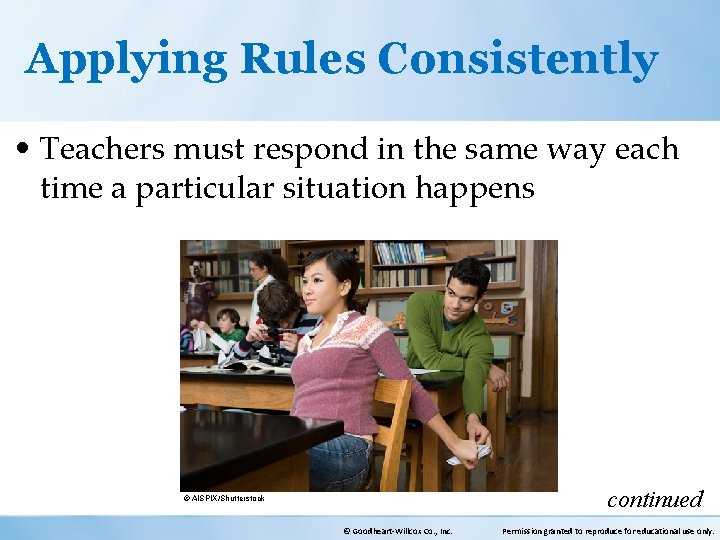
Applying Rules Consistently • Teachers must respond in the same way each time a particular situation happens continued © AISPIX/Shutterstock © Goodheart-Willcox Co. , Inc. Permission granted to reproduce for educational use only.
Applying Rules Consistently • Students know the teacher will follow through on the consequences • Students gain respect for the teacher’s fairness © Goodheart-Willcox Co. , Inc. Permission granted to reproduce for educational use only.
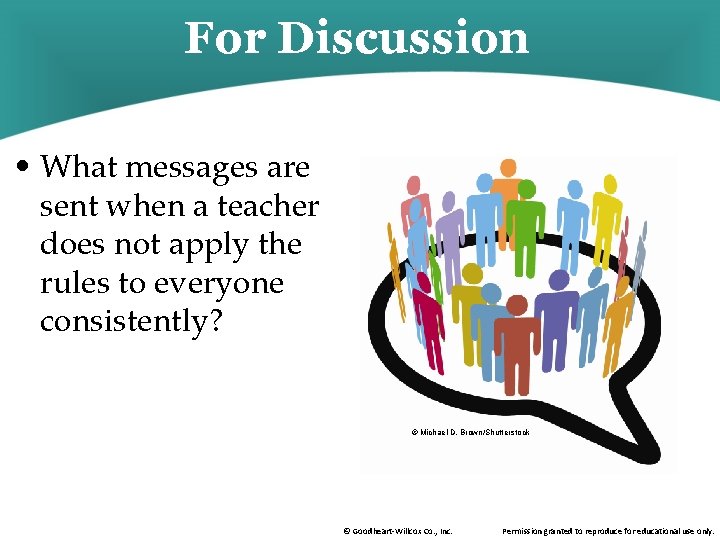
For Discussion • What messages are sent when a teacher does not apply the rules to everyone consistently? © Michael D. Brown/Shutterstock © Goodheart-Willcox Co. , Inc. Permission granted to reproduce for educational use only.
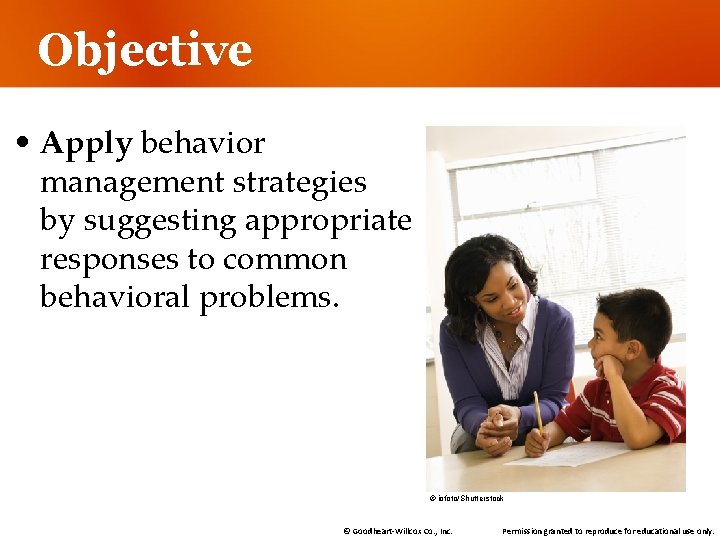
Objective • Apply behavior management strategies by suggesting appropriate responses to common behavioral problems. © iofoto/Shutterstock © Goodheart-Willcox Co. , Inc. Permission granted to reproduce for educational use only.
Dealing with Common Behavioral Problems • Forgetting homework • Talking during class • Not participating • Swift, consistent response results in minimum impact on learning continued © Goodheart-Willcox Co. , Inc. Permission granted to reproduce for educational use only.
Dealing with Common Behavioral Problems • Methods include – nonverbal cues – asking questions related to the lesson – inserting the student’s name into the lesson – simply and clearly stating what the student should do, then walk away – discussing the situation after class © Goodheart-Willcox Co. , Inc. Permission granted to reproduce for educational use only.
Dealing with Serious Behavioral Issues • Serious behavioral problems include – attempts to undermine teacher authority – physical violence – bullying – serious threats – harassment – drug or alcohol use continued © Goodheart-Willcox Co. , Inc. Permission granted to reproduce for educational use only.
Dealing with Serious Behavioral Issues • Pause and react calmly • Analyze the problem or behavior • Keep records • Involve parents or guardians • Utilize school resources © Goodheart-Willcox Co. , Inc. Permission granted to reproduce for educational use only.
For Reflection • Do you think you are prepared to deal with serious behavioral issues, such as bullying? How do you know? © Archipoch/Shutterstock © Goodheart-Willcox Co. , Inc. Permission granted to reproduce for educational use only.
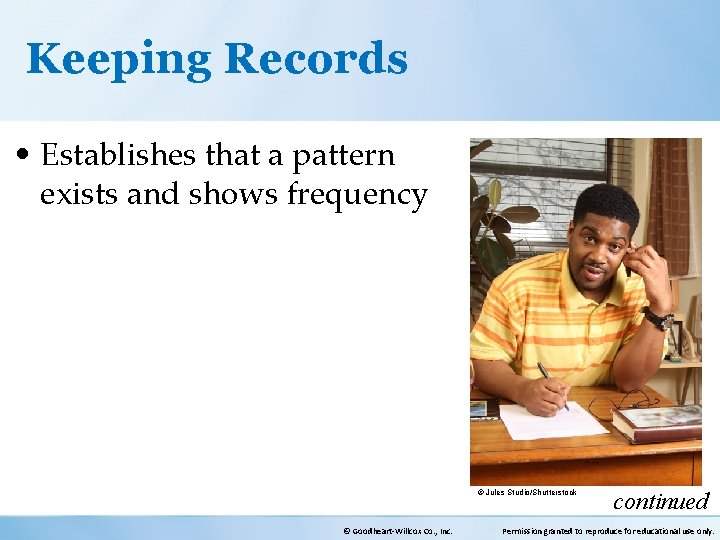
Keeping Records • Establishes that a pattern exists and shows frequency © Jules Studio/Shutterstock © Goodheart-Willcox Co. , Inc. continued Permission granted to reproduce for educational use only.
Keeping Records • Helps the teacher remain objective and identify emotional triggers • Helps in analyzing the problem and effectiveness of the teacher’s responses • Provides a basis for gauging improvement © Goodheart-Willcox Co. , Inc. Permission granted to reproduce for educational use only.
Involving Parents or Guardians • Depends on the – severity of the problem – success or lack of success of dealing with it in the classroom • Easier to contact parents about behavioral issues if regular communication has been established © Goodheart-Willcox Co. , Inc. Permission granted to reproduce for educational use only.
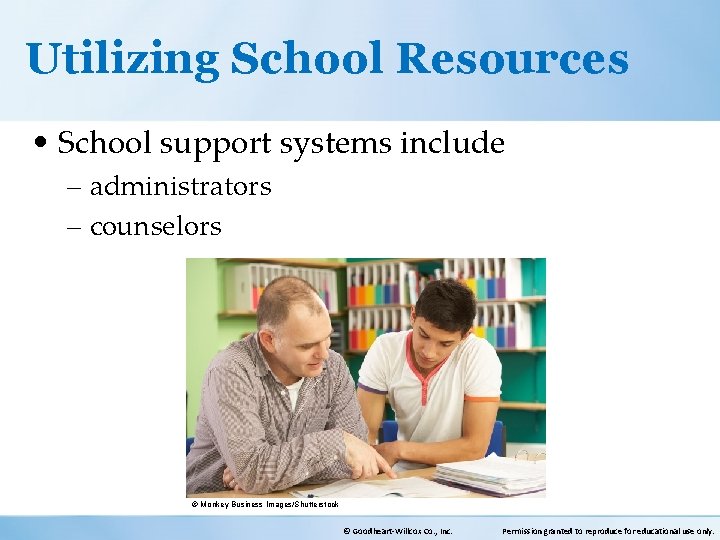
Utilizing School Resources • School support systems include – administrators – counselors © Monkey Business Images/Shutterstock © Goodheart-Willcox Co. , Inc. Permission granted to reproduce for educational use only.
Key Points • Management skills help keep students involved in learning • The space, environment, and classroom relationships affect behavior • Planning, clear rules and procedures, and consistency help minimize problems © Goodheart-Willcox Co. , Inc. Permission granted to reproduce for educational use only.
Review • What are three general guidelines for arranging space? Ø ease of student use, teaching, and supervision • The ____ style of management has regulations for everything and consequences for every infraction. Ø authoritarian continued © Goodheart-Willcox Co. , Inc. Permission granted to reproduce for educational use only.
Review • What is the relationship between class rules and classroom procedures? Ø Classroom procedures translate class rules into concrete actions expected of students. • Name some examples of nonverbal cues. Ø eye contact, body language, gestures, physical closeness © Goodheart-Willcox Co. , Inc. Permission granted to reproduce for educational use only.
- Slides: 57