
15 Benzene and Aromaticity Based on Mc Murrys
15. Benzene and Aromaticity Based on Mc. Murry’s Organic Chemistry, 6 th edition © 2003 Ronald Kluger Department of Chemistry University of Toronto Mc. Murry Organic Chemistry 6 th edition Ch 15 (c) 2003
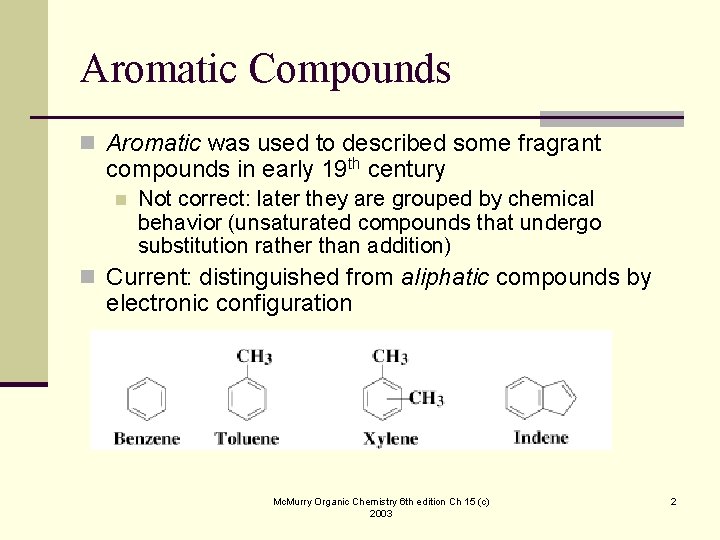
Aromatic Compounds n Aromatic was used to described some fragrant compounds in early 19 th century n Not correct: later they are grouped by chemical behavior (unsaturated compounds that undergo substitution rather than addition) n Current: distinguished from aliphatic compounds by electronic configuration Mc. Murry Organic Chemistry 6 th edition Ch 15 (c) 2003 2
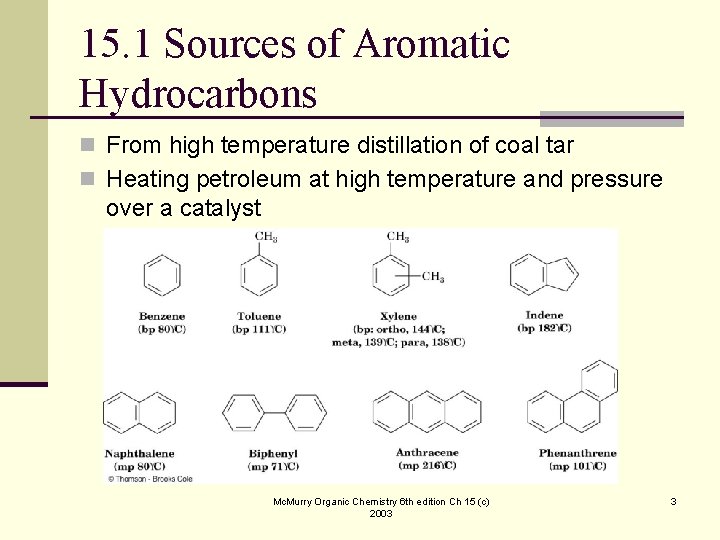
15. 1 Sources of Aromatic Hydrocarbons n From high temperature distillation of coal tar n Heating petroleum at high temperature and pressure over a catalyst Mc. Murry Organic Chemistry 6 th edition Ch 15 (c) 2003 3

15. 2 Naming Aromatic Compounds n Many common names (toluene = methylbenzene; aniline = aminobenzene) n Monosubstituted benzenes systematic names as hydrocarbons with –benzene n n C 6 H 5 Br = bromobenzene C 6 H 5 NO 2 = nitrobenzene, and C 6 H 5 CH 2 CH 3 is propylbenzene Mc. Murry Organic Chemistry 6 th edition Ch 15 (c) 2003 4
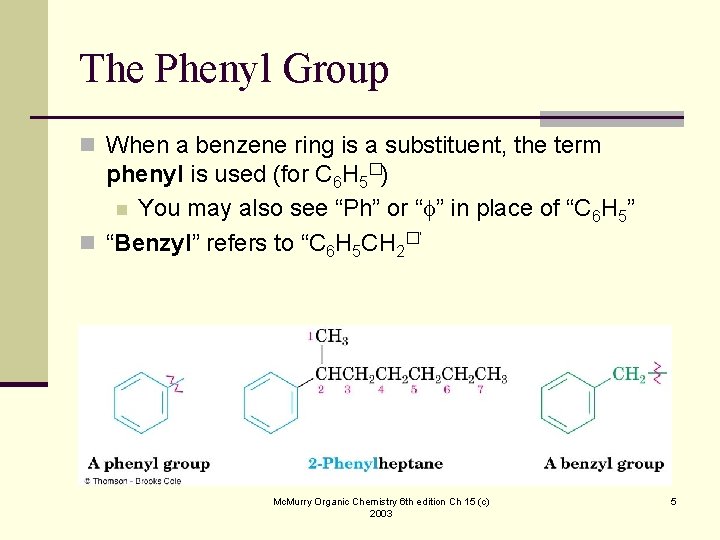
The Phenyl Group n When a benzene ring is a substituent, the term phenyl is used (for C 6 H 5�) n You may also see “Ph” or “f” in place of “C 6 H 5” n “Benzyl” refers to “C 6 H 5 CH 2�” Mc. Murry Organic Chemistry 6 th edition Ch 15 (c) 2003 5

Disubstituted Benzenes n Relative positions on a benzene ring ortho- (o) on adjacent carbons (1, 2) n meta- (m) separated by one carbon (1, 3) n para- (p) separated by two carbons (1, 4) n Describes reaction patterns (“occurs at the para position”) n Mc. Murry Organic Chemistry 6 th edition Ch 15 (c) 2003 6
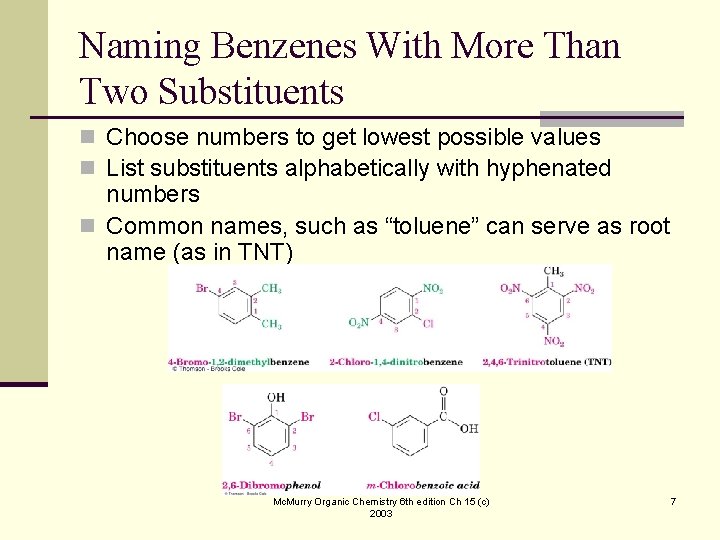
Naming Benzenes With More Than Two Substituents n Choose numbers to get lowest possible values n List substituents alphabetically with hyphenated numbers n Common names, such as “toluene” can serve as root name (as in TNT) Mc. Murry Organic Chemistry 6 th edition Ch 15 (c) 2003 7
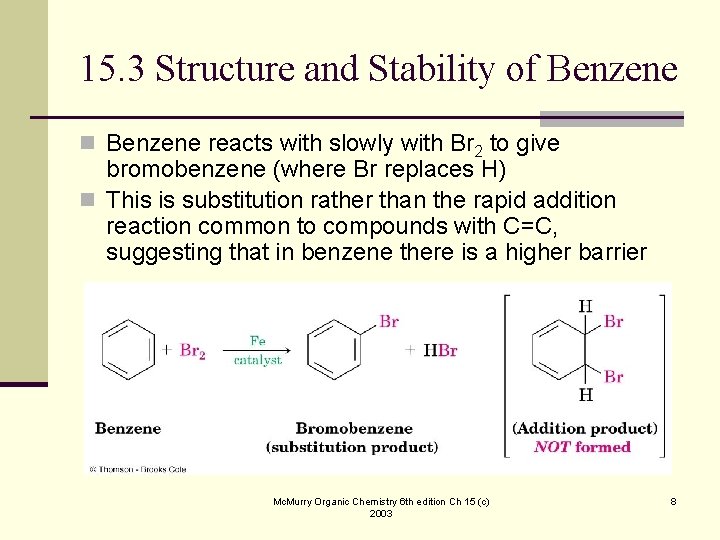
15. 3 Structure and Stability of Benzene n Benzene reacts with slowly with Br 2 to give bromobenzene (where Br replaces H) n This is substitution rather than the rapid addition reaction common to compounds with C=C, suggesting that in benzene there is a higher barrier Mc. Murry Organic Chemistry 6 th edition Ch 15 (c) 2003 8
Heats of Hydrogenation as Indicators of Stability n The addition of H 2 to C=C normally gives off about 118 k. J/mol – 3 double bonds would give off 356 k. J/mol n Two conjugated double bonds in cyclohexadiene add 2 H 2 to n Benzene has 3 unsaturations but gives off only 150 k. J/mol on reacting with 3 H 2 molecules n Therefore it has about 150 k. J more “stability” than an isolated set of three double bonds (See Figure 15 -2) Mc. Murry Organic Chemistry 6 th edition Ch 15 (c) 2003 9
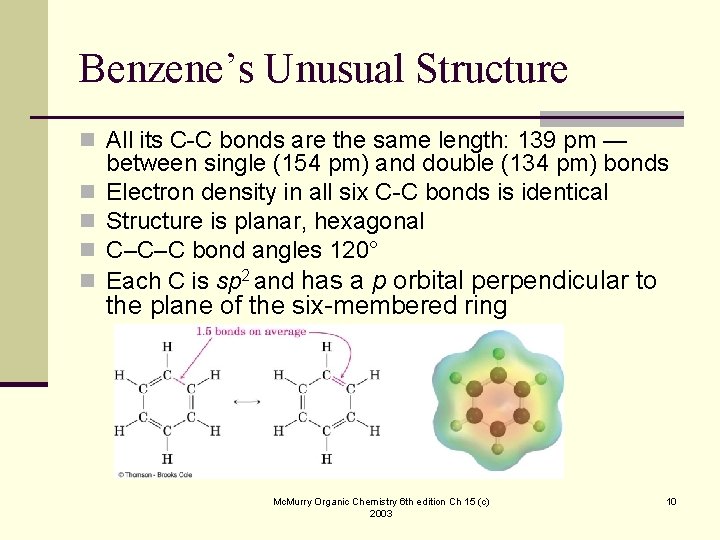
Benzene’s Unusual Structure n All its C-C bonds are the same length: 139 pm — n n between single (154 pm) and double (134 pm) bonds Electron density in all six C-C bonds is identical Structure is planar, hexagonal C–C–C bond angles 120° Each C is sp 2 and has a p orbital perpendicular to the plane of the six-membered ring Mc. Murry Organic Chemistry 6 th edition Ch 15 (c) 2003 10
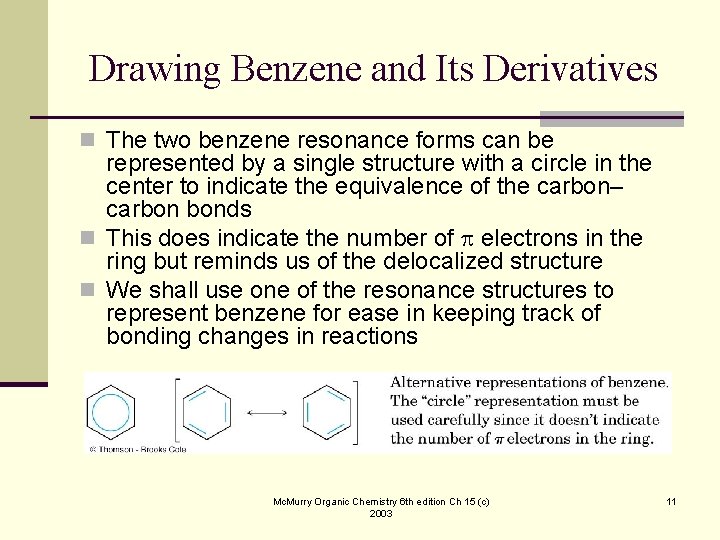
Drawing Benzene and Its Derivatives n The two benzene resonance forms can be represented by a single structure with a circle in the center to indicate the equivalence of the carbon– carbon bonds n This does indicate the number of electrons in the ring but reminds us of the delocalized structure n We shall use one of the resonance structures to represent benzene for ease in keeping track of bonding changes in reactions Mc. Murry Organic Chemistry 6 th edition Ch 15 (c) 2003 11
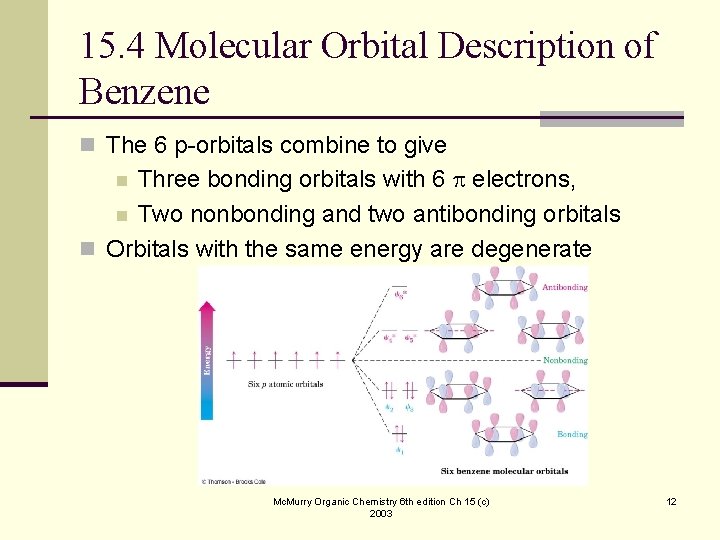
15. 4 Molecular Orbital Description of Benzene n The 6 p-orbitals combine to give Three bonding orbitals with 6 electrons, n Two nonbonding and two antibonding orbitals n Orbitals with the same energy are degenerate n Mc. Murry Organic Chemistry 6 th edition Ch 15 (c) 2003 12
Recall: Key Ideas on Benzene n Unusually stable - heat of hydrogenation 150 k. J/mol n n less negative than a cyclic triene Planar hexagon: bond angles are 120°, carbon– carbon bond lengths 139 pm Undergoes substitution rather than electrophilic addition Resonance hybrid with structure between two linebond structures One more important factor is the number of electrons in the cyclic orbital Mc. Murry Organic Chemistry 6 th edition Ch 15 (c) 2003 13
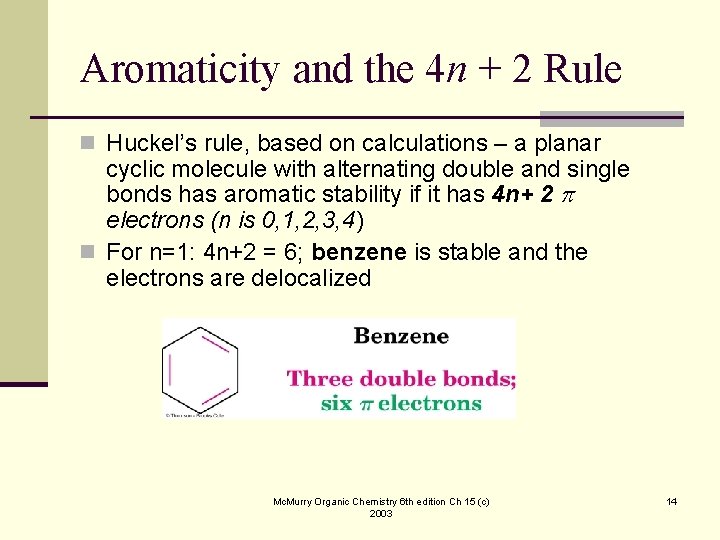
Aromaticity and the 4 n + 2 Rule n Huckel’s rule, based on calculations – a planar cyclic molecule with alternating double and single bonds has aromatic stability if it has 4 n+ 2 electrons (n is 0, 1, 2, 3, 4) n For n=1: 4 n+2 = 6; benzene is stable and the electrons are delocalized Mc. Murry Organic Chemistry 6 th edition Ch 15 (c) 2003 14
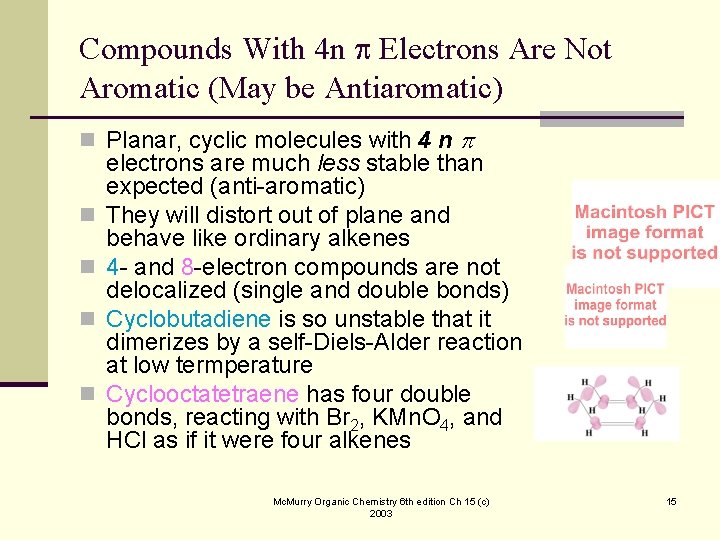
Compounds With 4 n Electrons Are Not Aromatic (May be Antiaromatic) n Planar, cyclic molecules with 4 n n n electrons are much less stable than expected (anti-aromatic) They will distort out of plane and behave like ordinary alkenes 4 - and 8 -electron compounds are not delocalized (single and double bonds) Cyclobutadiene is so unstable that it dimerizes by a self-Diels-Alder reaction at low termperature Cyclooctatetraene has four double bonds, reacting with Br 2, KMn. O 4, and HCl as if it were four alkenes Mc. Murry Organic Chemistry 6 th edition Ch 15 (c) 2003 15
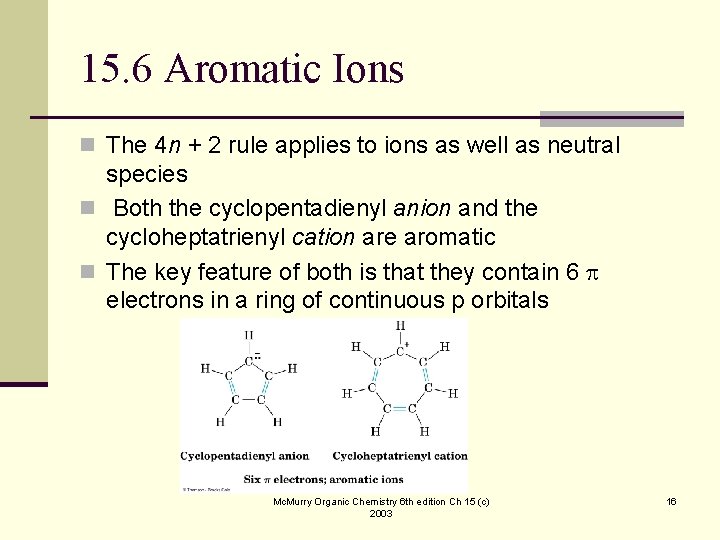
15. 6 Aromatic Ions n The 4 n + 2 rule applies to ions as well as neutral species n Both the cyclopentadienyl anion and the cycloheptatrienyl cation are aromatic n The key feature of both is that they contain 6 electrons in a ring of continuous p orbitals Mc. Murry Organic Chemistry 6 th edition Ch 15 (c) 2003 16
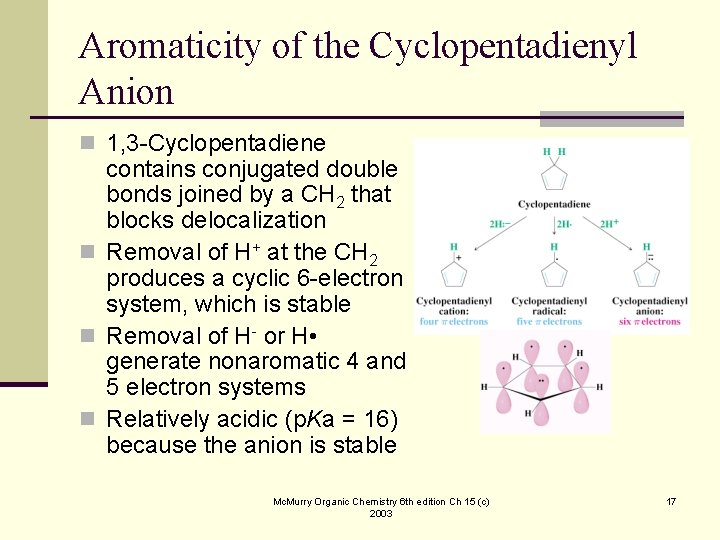
Aromaticity of the Cyclopentadienyl Anion n 1, 3 -Cyclopentadiene contains conjugated double bonds joined by a CH 2 that blocks delocalization n Removal of H+ at the CH 2 produces a cyclic 6 -electron system, which is stable n Removal of H- or H • generate nonaromatic 4 and 5 electron systems n Relatively acidic (p. Ka = 16) because the anion is stable Mc. Murry Organic Chemistry 6 th edition Ch 15 (c) 2003 17
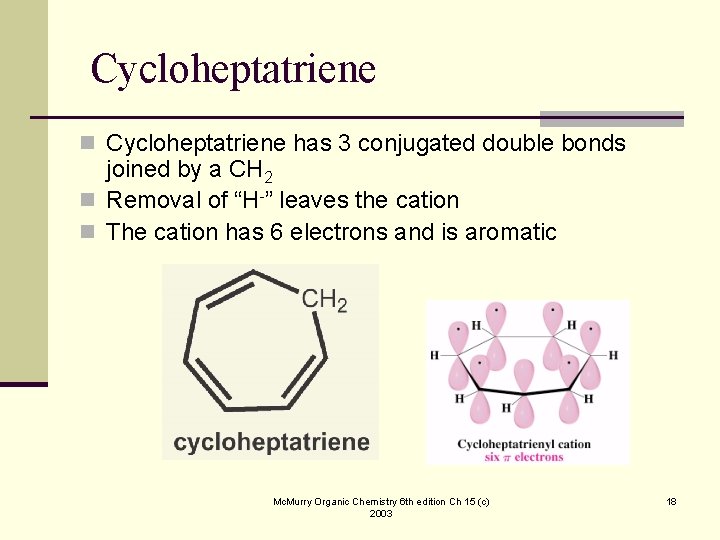
Cycloheptatriene n Cycloheptatriene has 3 conjugated double bonds joined by a CH 2 n Removal of “H-” leaves the cation n The cation has 6 electrons and is aromatic Mc. Murry Organic Chemistry 6 th edition Ch 15 (c) 2003 18
15. 7 Aromatic Heterocycles: Pyridine and Pyrrole n Heterocyclic compounds contain elements other n n than carbon in a ring, such as N, S, O, P Aromatic compounds can have elements other than carbon in the ring There are many heterocyclic aromatic compounds and many are very common Cyclic compounds that contain only carbon are called carbocycles (not homocycles) Nomenclature is specialized Mc. Murry Organic Chemistry 6 th edition Ch 15 (c) 2003 19
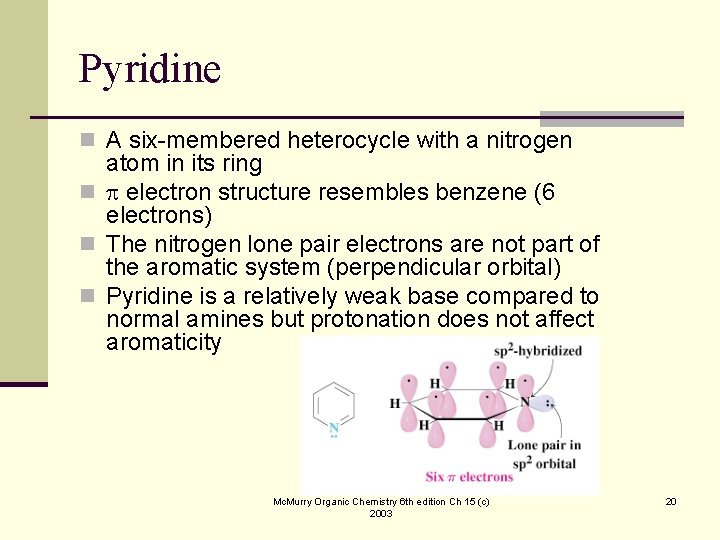
Pyridine n A six-membered heterocycle with a nitrogen atom in its ring n electron structure resembles benzene (6 electrons) n The nitrogen lone pair electrons are not part of the aromatic system (perpendicular orbital) n Pyridine is a relatively weak base compared to normal amines but protonation does not affect aromaticity Mc. Murry Organic Chemistry 6 th edition Ch 15 (c) 2003 20
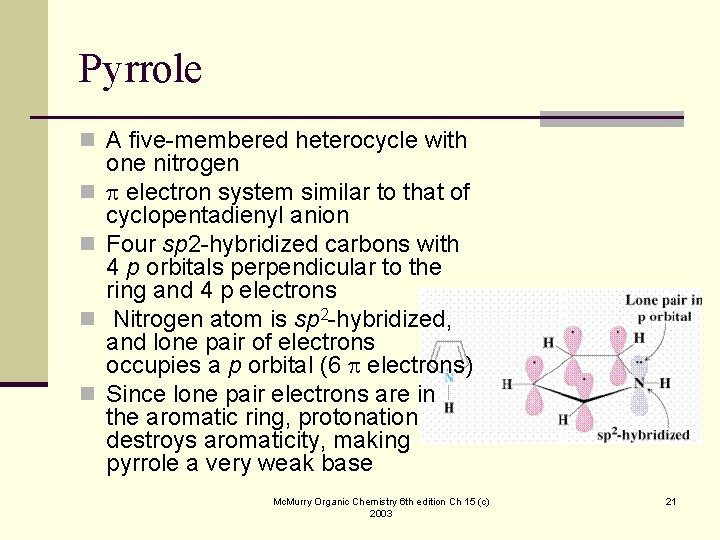
Pyrrole n A five-membered heterocycle with n n one nitrogen electron system similar to that of cyclopentadienyl anion Four sp 2 -hybridized carbons with 4 p orbitals perpendicular to the ring and 4 p electrons Nitrogen atom is sp 2 -hybridized, and lone pair of electrons occupies a p orbital (6 electrons) Since lone pair electrons are in the aromatic ring, protonation destroys aromaticity, making pyrrole a very weak base Mc. Murry Organic Chemistry 6 th edition Ch 15 (c) 2003 21
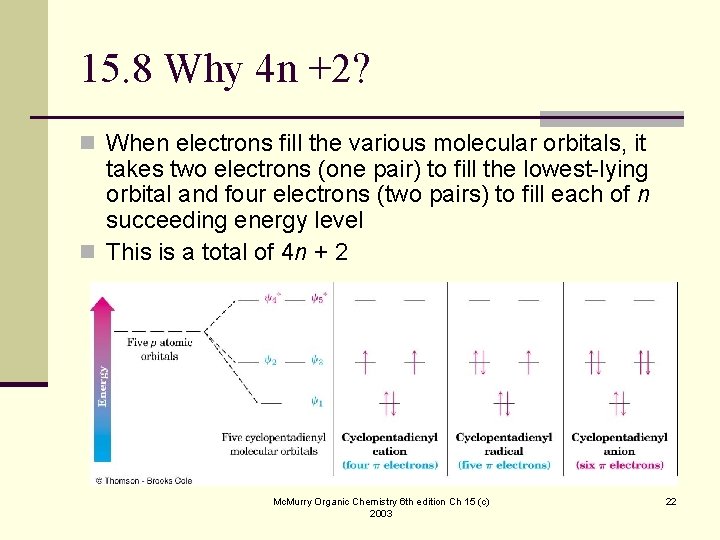
15. 8 Why 4 n +2? n When electrons fill the various molecular orbitals, it takes two electrons (one pair) to fill the lowest-lying orbital and four electrons (two pairs) to fill each of n succeeding energy level n This is a total of 4 n + 2 Mc. Murry Organic Chemistry 6 th edition Ch 15 (c) 2003 22
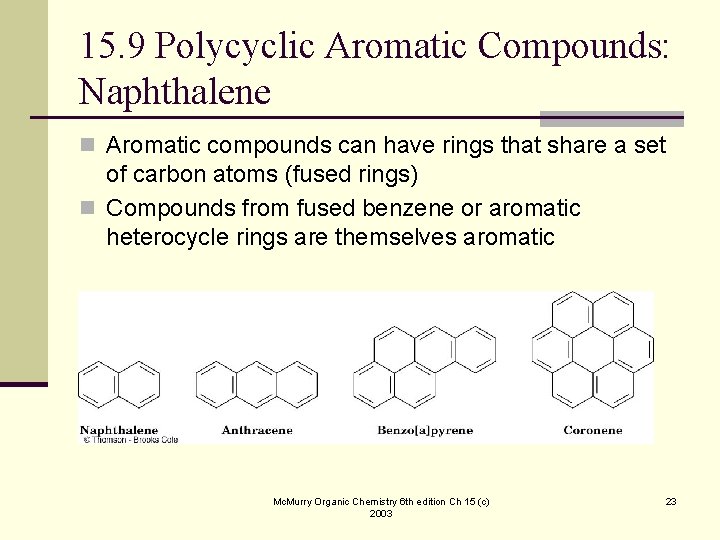
15. 9 Polycyclic Aromatic Compounds: Naphthalene n Aromatic compounds can have rings that share a set of carbon atoms (fused rings) n Compounds from fused benzene or aromatic heterocycle rings are themselves aromatic Mc. Murry Organic Chemistry 6 th edition Ch 15 (c) 2003 23
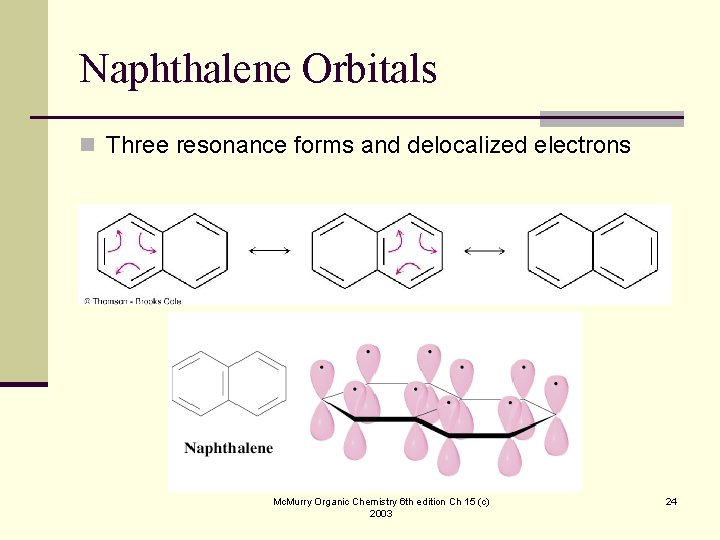
Naphthalene Orbitals n Three resonance forms and delocalized electrons Mc. Murry Organic Chemistry 6 th edition Ch 15 (c) 2003 24
15. 10 Spectroscopy of Aromatic Compounds n IR: Aromatic ring C–H stretching at 3030 cm 1 and peaks 1450 to 1600 cm 1(See Figure 15 -13) n UV: Peak near 205 nm and a less intense peak in 255 -275 nm range n 1 H NMR: Aromatic H’s strongly deshielded by ring and absorb between 6. 5 and 8. 0 n Peak pattern is characteristic positions of substituents Mc. Murry Organic Chemistry 6 th edition Ch 15 (c) 2003 25
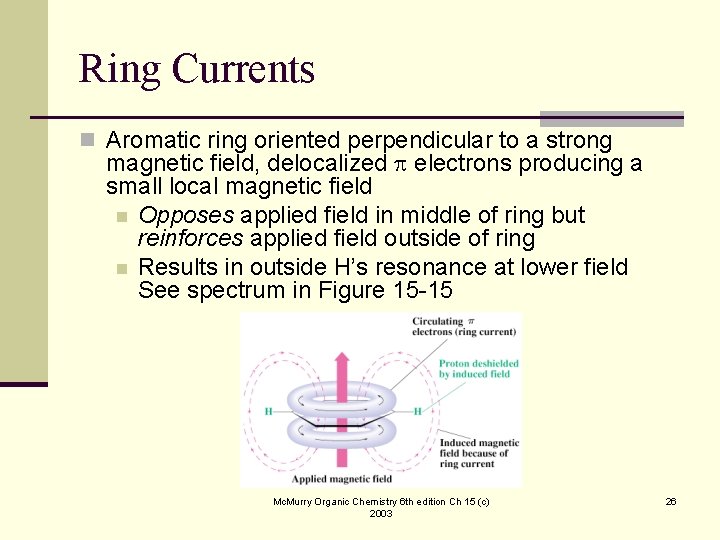
Ring Currents n Aromatic ring oriented perpendicular to a strong magnetic field, delocalized electrons producing a small local magnetic field n Opposes applied field in middle of ring but reinforces applied field outside of ring n Results in outside H’s resonance at lower field See spectrum in Figure 15 -15 Mc. Murry Organic Chemistry 6 th edition Ch 15 (c) 2003 26
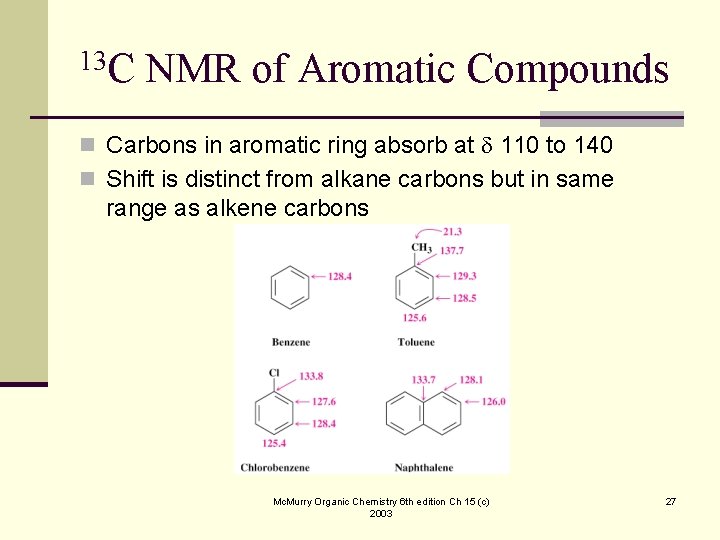
13 C NMR of Aromatic Compounds n Carbons in aromatic ring absorb at 110 to 140 n Shift is distinct from alkane carbons but in same range as alkene carbons Mc. Murry Organic Chemistry 6 th edition Ch 15 (c) 2003 27
- Slides: 27