
15 AU 013 Two Three Wheelers By SUDHIR
15 AU 013 - Two & Three Wheelers By SUDHIR KUMAR. V AP/AUTO
Unit 1 Introduction • • § • • History of two & three wheeler vehicles, Classification & layouts of two wheelers “mopeds, motorcycles, scooters, Classification & layouts of three wheelers “passenger and goods auto rickshaws, two wheeler frames, main frame and types, three wheeler frame and body, Mono construction and composite construction.

Introduction of Two Wheelers • The advancement of two wheelers in this field of personal transport is a major rebellion. • The quantity of two wheelers is about 70% of total vehicle sale. • Two wheelers are fast, safe and easy way of transportation as well as fuel efficient machines. • It combines the exceptionally low operating costs along with the comfort and style. • They can be used for daily commuting, for long journeys and racing also.

HISTORY OF MOPEDS - Cyclomotors • The name “moped” derived from the early motorcycles which were equipped with pedals. • Basically, mopeds were designed to provide low powered, economic and easily drivable vehicles. • Early mopeds were using pedalless starting system in which rider had to run the vehicle for starting. • These mopeds were known as cyclemotors because engines were able to produce very less power and only for few miles. • Engines were located at various locations on frame and the drive was provided to front wheel.

HISTORY OF MOPEDS - Douglas • • • The very first moped with pedaling system was “Douglas” launched in 1912. Invention of pedaling system was a great enhancement in moped design; it helped riders to use the vehicle as bicycle also. Motorcycles and mopeds both were equipped with pedals till 1915. The capacity of engine, maximum speed and ease of operation were some fundamental differences observed between motorcycles and mopeds. By 1918, advancement in design of transmission, clutches and engine performance obligatory caused elimination of pedals from motorcycles. But designers were intended to continue with the pedal system on mopeds for their original functions.
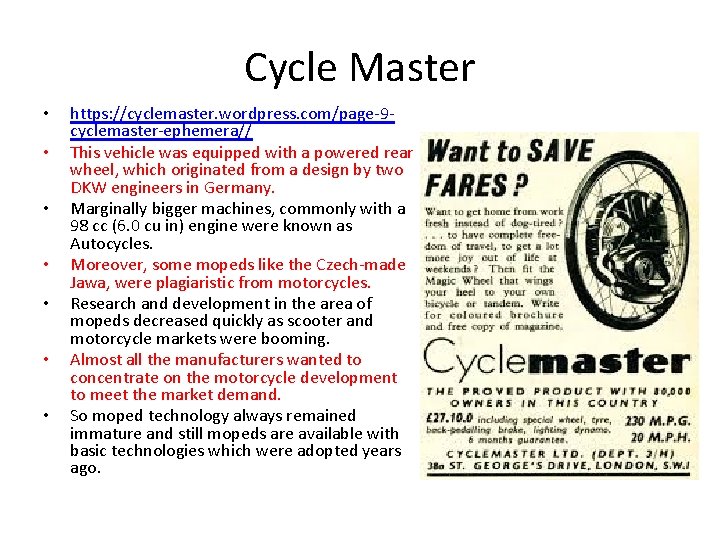
Cycle Master • • https: //cyclemaster. wordpress. com/page-9 cyclemaster-ephemera// This vehicle was equipped with a powered rear wheel, which originated from a design by two DKW engineers in Germany. Marginally bigger machines, commonly with a 98 cc (6. 0 cu in) engine were known as Autocycles. Moreover, some mopeds like the Czech-made Jawa, were plagiaristic from motorcycles. Research and development in the area of mopeds decreased quickly as scooter and motorcycle markets were booming. Almost all the manufacturers wanted to concentrate on the motorcycle development to meet the market demand. So moped technology always remained immature and still mopeds are available with basic technologies which were adopted years ago.
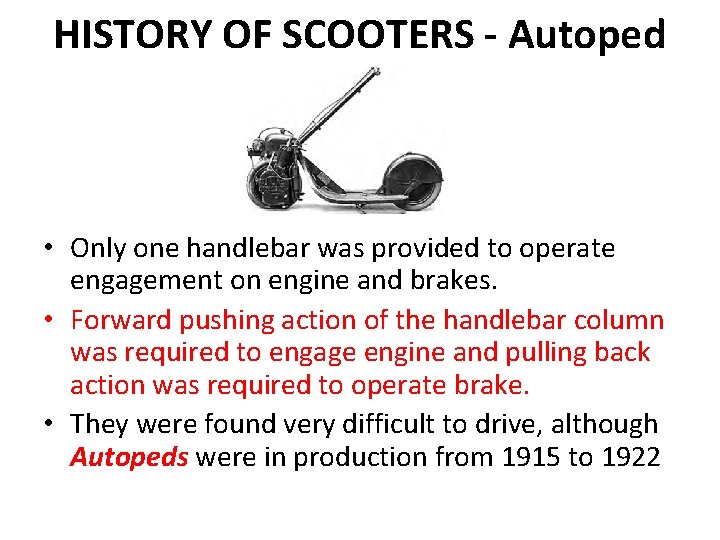
HISTORY OF SCOOTERS - Autoped • Only one handlebar was provided to operate engagement on engine and brakes. • Forward pushing action of the handlebar column was required to engage engine and pulling back action was required to operate brake. • They were found very difficult to drive, although Autopeds were in production from 1915 to 1922
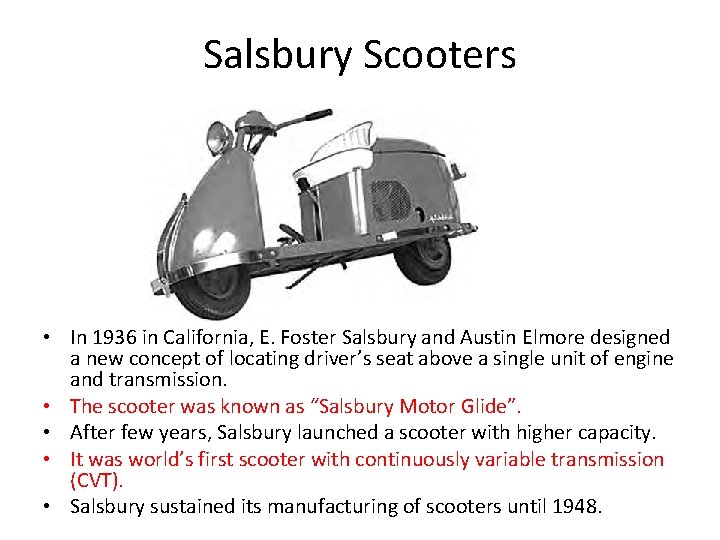
Salsbury Scooters • In 1936 in California, E. Foster Salsbury and Austin Elmore designed a new concept of locating driver’s seat above a single unit of engine and transmission. • The scooter was known as “Salsbury Motor Glide”. • After few years, Salsbury launched a scooter with higher capacity. • It was world’s first scooter with continuously variable transmission (CVT). • Salsbury sustained its manufacturing of scooters until 1948.
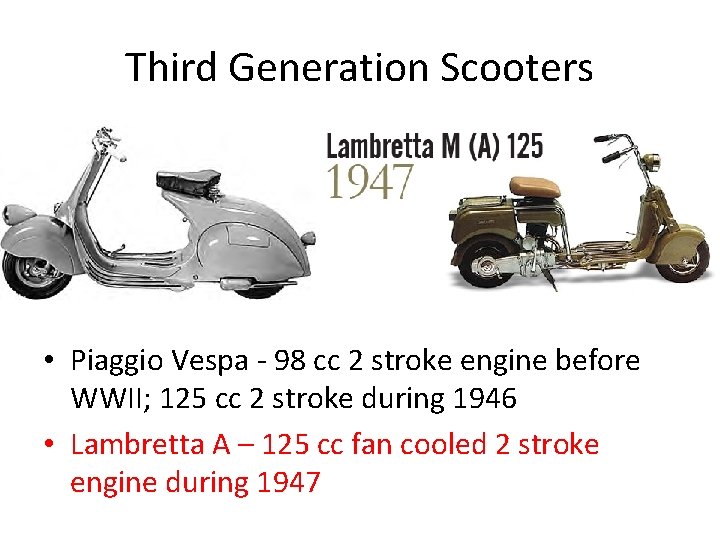
Third Generation Scooters • Piaggio Vespa - 98 cc 2 stroke engine before WWII; 125 cc 2 stroke during 1946 • Lambretta A – 125 cc fan cooled 2 stroke engine during 1947
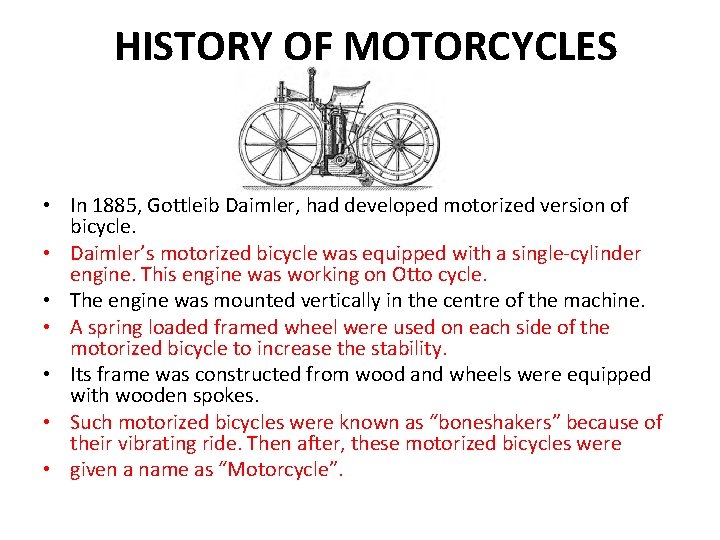
HISTORY OF MOTORCYCLES • In 1885, Gottleib Daimler, had developed motorized version of bicycle. • Daimler’s motorized bicycle was equipped with a single-cylinder engine. This engine was working on Otto cycle. • The engine was mounted vertically in the centre of the machine. • A spring loaded framed wheel were used on each side of the motorized bicycle to increase the stability. • Its frame was constructed from wood and wheels were equipped with wooden spokes. • Such motorized bicycles were known as “boneshakers” because of their vibrating ride. Then after, these motorized bicycles were • given a name as “Motorcycle”.
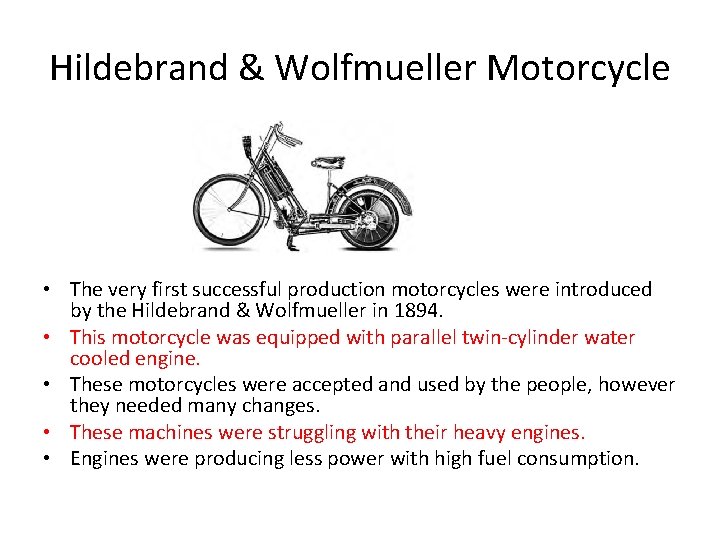
Hildebrand & Wolfmueller Motorcycle • The very first successful production motorcycles were introduced by the Hildebrand & Wolfmueller in 1894. • This motorcycle was equipped with parallel twin-cylinder water cooled engine. • These motorcycles were accepted and used by the people, however they needed many changes. • These machines were struggling with their heavy engines. • Engines were producing less power with high fuel consumption.
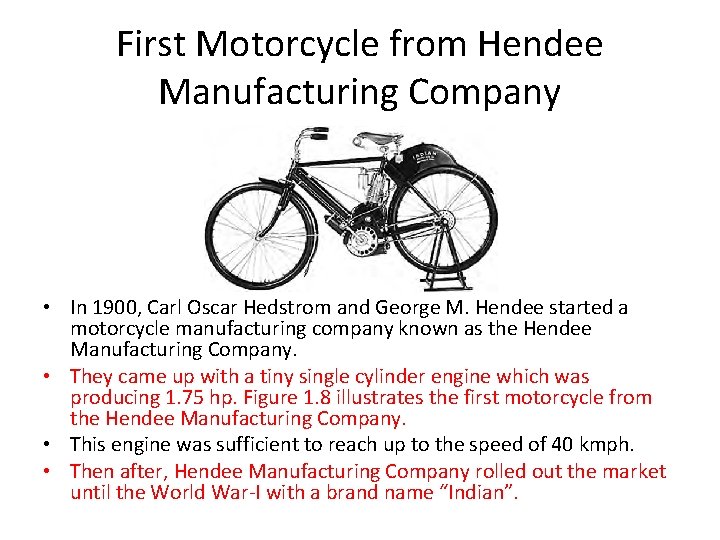
First Motorcycle from Hendee Manufacturing Company • In 1900, Carl Oscar Hedstrom and George M. Hendee started a motorcycle manufacturing company known as the Hendee Manufacturing Company. • They came up with a tiny single cylinder engine which was producing 1. 75 hp. Figure 1. 8 illustrates the first motorcycle from the Hendee Manufacturing Company. • This engine was sufficient to reach up to the speed of 40 kmph. • Then after, Hendee Manufacturing Company rolled out the market until the World War-I with a brand name “Indian”.
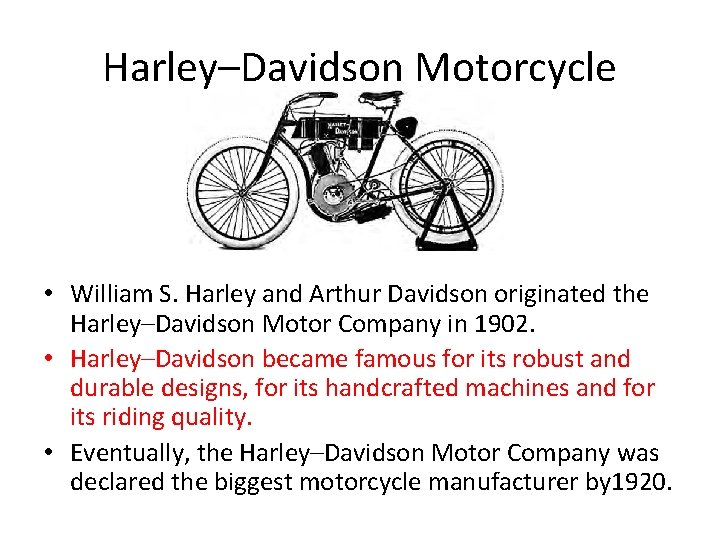
Harley–Davidson Motorcycle • William S. Harley and Arthur Davidson originated the Harley–Davidson Motor Company in 1902. • Harley–Davidson became famous for its robust and durable designs, for its handcrafted machines and for its riding quality. • Eventually, the Harley–Davidson Motor Company was declared the biggest motorcycle manufacturer by 1920.
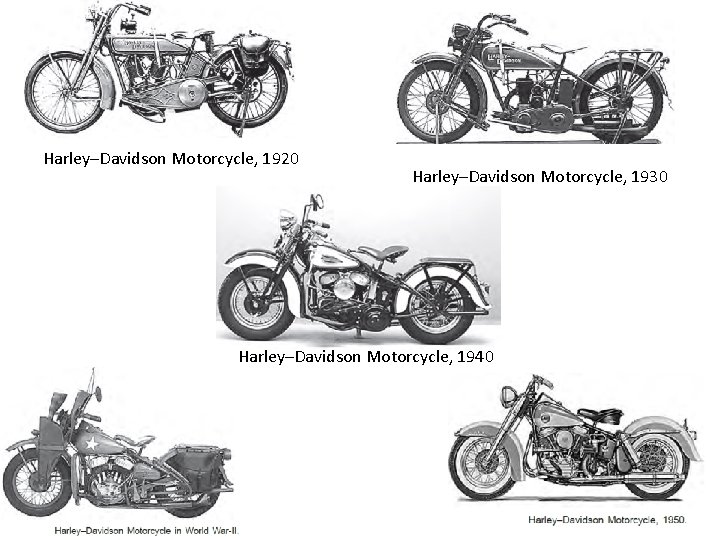
Harley–Davidson Motorcycle, 1920 Harley–Davidson Motorcycle, 1930 Harley–Davidson Motorcycle, 1940
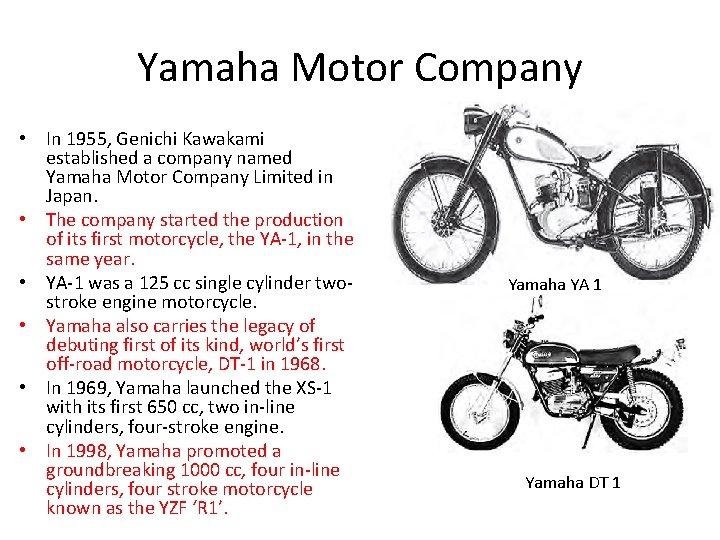
Yamaha Motor Company • In 1955, Genichi Kawakami established a company named Yamaha Motor Company Limited in Japan. • The company started the production of its first motorcycle, the YA-1, in the same year. • YA-1 was a 125 cc single cylinder twostroke engine motorcycle. • Yamaha also carries the legacy of debuting first of its kind, world’s first off-road motorcycle, DT-1 in 1968. • In 1969, Yamaha launched the XS-1 with its first 650 cc, two in-line cylinders, four-stroke engine. • In 1998, Yamaha promoted a groundbreaking 1000 cc, four in-line cylinders, four stroke motorcycle known as the YZF ‘R 1’. Yamaha YA 1 Yamaha DT 1
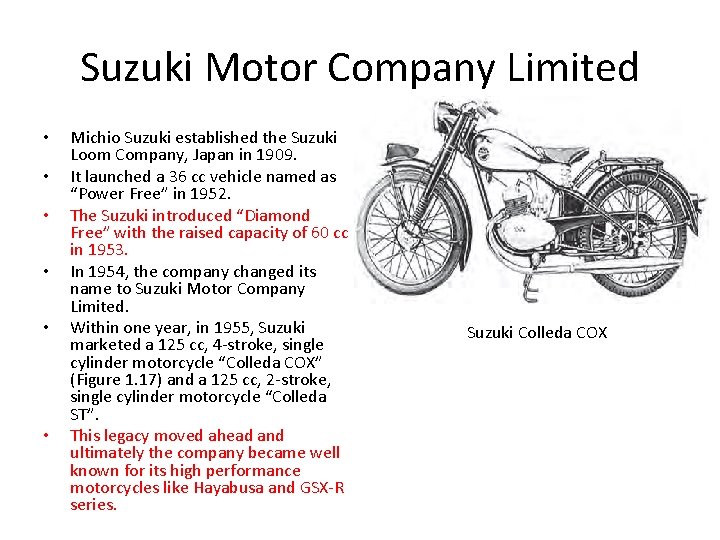
Suzuki Motor Company Limited • • • Michio Suzuki established the Suzuki Loom Company, Japan in 1909. It launched a 36 cc vehicle named as “Power Free” in 1952. The Suzuki introduced “Diamond Free” with the raised capacity of 60 cc in 1953. In 1954, the company changed its name to Suzuki Motor Company Limited. Within one year, in 1955, Suzuki marketed a 125 cc, 4 -stroke, single cylinder motorcycle “Colleda COX” (Figure 1. 17) and a 125 cc, 2 -stroke, single cylinder motorcycle “Colleda ST”. This legacy moved ahead and ultimately the company became well known for its high performance motorcycles like Hayabusa and GSX-R series. Suzuki Colleda COX
Other Motor Bikes Companies • Honda was established in Japan which announced a new motorcycle “CB 750” with Single Over Head Cam shaft, inline four-cylinder engine in 1969. • It was equipped with innovatively cross mounted four-cylinder engine configured to develop huge power and performance. CB 750 was economical and fast because of which it was instantly accepted in the market. • The advantage of multi cylinder four-stroke engine in motorcycle sports was proven by Kawasaki with the launch of the KZ 900. • Thus, the indubitable quality of Japanese motorcycles caused sagged sales of many Italian motorcycle manufacturers in western markets. • Many of them either stopped manufacturing or somehow succeeded to persist their economy. • The same Japanese competition was encountered by 1920’s biggest motorcycle manufacturer, Harley–Davidson, in the US. • Harley–Davidson survived because of their exclusively manufactured motorcycle range and American tariff laws. • BMW was the first motorcycle manufacturer to present Anti-lock braking system (ABS) in motorcycles, K 100 RS-SE and K 1, in 1988.
CLASSIFICATION OF TWO WHEELERS 1. With respect to use (a) Auto cycle, Mopeds and Moppets (b) Scooters (c) Motor cycles 2. With respect to cubic capacity (a) 50 cc (d) 150 cc (b) 100 cc (e) 200 cc (c) 125 cc (f) 250 cc 3. With respect to make (a) Auto cycle: Luna, TVS 50, Hero Majestic, Bajaj-M 50, Hitodi (b) Scooters: Bajaj Vespa, Priya, Chetak, Super, Lambretta, Pushpak, LML Vespa, Kinetic Honda (c) Motorcycle: Hero Honda, Bajaj, Yamaha, Suzuki, Royal Enfield, Honda 4. With respect to fuel used (a) Petrol vehicle (b) Diesel vehicle (c) Electric vehicle
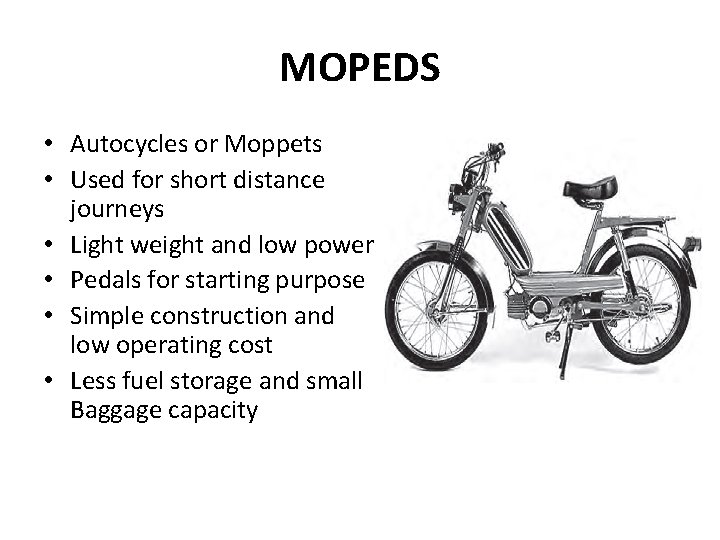
MOPEDS • Autocycles or Moppets • Used for short distance journeys • Light weight and low power • Pedals for starting purpose • Simple construction and low operating cost • Less fuel storage and small Baggage capacity
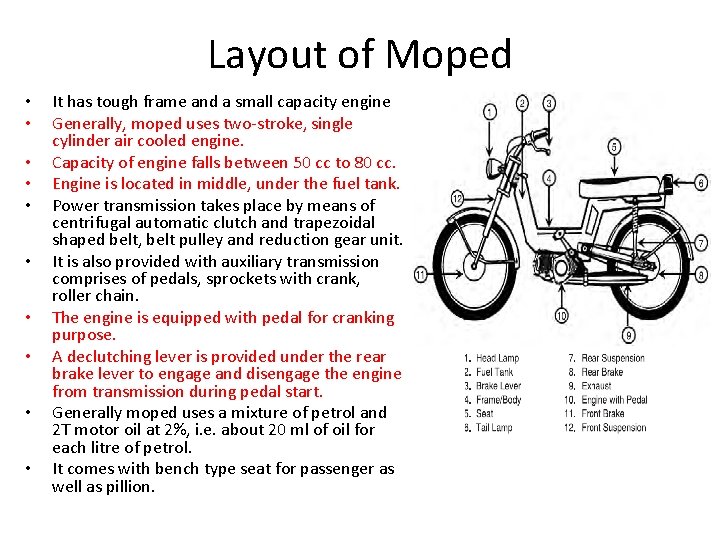
Layout of Moped • • • It has tough frame and a small capacity engine Generally, moped uses two-stroke, single cylinder air cooled engine. Capacity of engine falls between 50 cc to 80 cc. Engine is located in middle, under the fuel tank. Power transmission takes place by means of centrifugal automatic clutch and trapezoidal shaped belt, belt pulley and reduction gear unit. It is also provided with auxiliary transmission comprises of pedals, sprockets with crank, roller chain. The engine is equipped with pedal for cranking purpose. A declutching lever is provided under the rear brake lever to engage and disengage the engine from transmission during pedal start. Generally moped uses a mixture of petrol and 2 T motor oil at 2%, i. e. about 20 ml of oil for each litre of petrol. It comes with bench type seat for passenger as well as pillion.
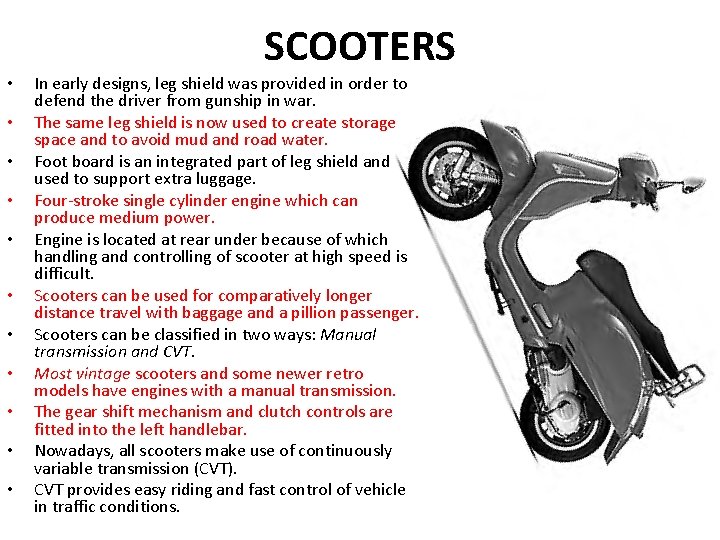
SCOOTERS • • • In early designs, leg shield was provided in order to defend the driver from gunship in war. The same leg shield is now used to create storage space and to avoid mud and road water. Foot board is an integrated part of leg shield and used to support extra luggage. Four-stroke single cylinder engine which can produce medium power. Engine is located at rear under because of which handling and controlling of scooter at high speed is difficult. Scooters can be used for comparatively longer distance travel with baggage and a pillion passenger. Scooters can be classified in two ways: Manual transmission and CVT. Most vintage scooters and some newer retro models have engines with a manual transmission. The gear shift mechanism and clutch controls are fitted into the left handlebar. Nowadays, all scooters make use of continuously variable transmission (CVT). CVT provides easy riding and fast control of vehicle in traffic conditions.
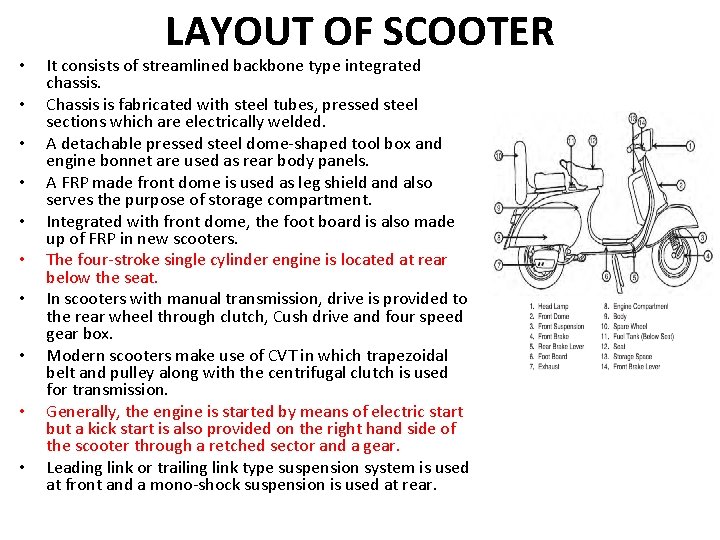
• • • LAYOUT OF SCOOTER It consists of streamlined backbone type integrated chassis. Chassis is fabricated with steel tubes, pressed steel sections which are electrically welded. A detachable pressed steel dome-shaped tool box and engine bonnet are used as rear body panels. A FRP made front dome is used as leg shield and also serves the purpose of storage compartment. Integrated with front dome, the foot board is also made up of FRP in new scooters. The four-stroke single cylinder engine is located at rear below the seat. In scooters with manual transmission, drive is provided to the rear wheel through clutch, Cush drive and four speed gear box. Modern scooters make use of CVT in which trapezoidal belt and pulley along with the centrifugal clutch is used for transmission. Generally, the engine is started by means of electric start but a kick start is also provided on the right hand side of the scooter through a retched sector and a gear. Leading link or trailing link type suspension system is used at front and a mono-shock suspension is used at rear.
MOTORCYCLES • A motorcycle is also called a motorbike, or simply bike. • Motorcycles vary significantly depending on the task for which they are designed, such as traversing congested urban traffic, travelling, sport and racing, or cross-country conditions. • Motorcycles are fitted out with the medium to high powered engines and mainly designed for long journeys on any kind of roads with luggage and a pillion passenger. • As engine is located in middle of vehicle, controlling and handling the motorcycle is easy. Mainly, motorcycles can be classified in following ways: 1. STREET COMMUTER BIKE 2. ENDURE BIKE 3. CRUISER BIKE 4. SPORTS BIKE
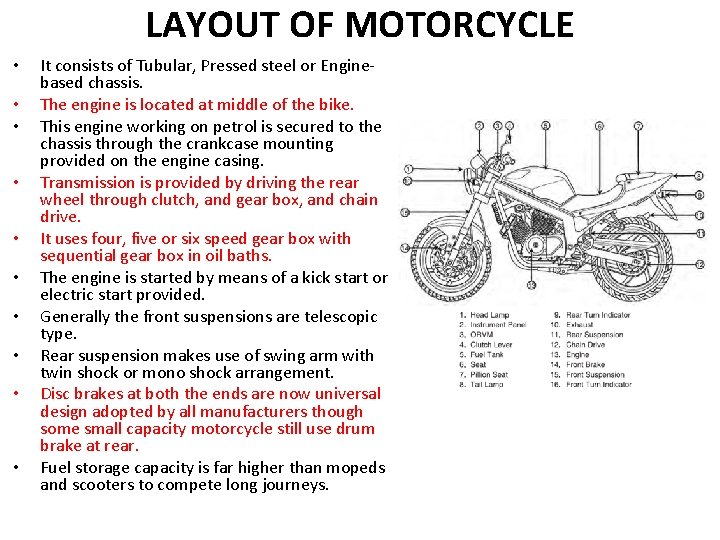
LAYOUT OF MOTORCYCLE • • • It consists of Tubular, Pressed steel or Enginebased chassis. The engine is located at middle of the bike. This engine working on petrol is secured to the chassis through the crankcase mounting provided on the engine casing. Transmission is provided by driving the rear wheel through clutch, and gear box, and chain drive. It uses four, five or six speed gear box with sequential gear box in oil baths. The engine is started by means of a kick start or electric start provided. Generally the front suspensions are telescopic type. Rear suspension makes use of swing arm with twin shock or mono shock arrangement. Disc brakes at both the ends are now universal design adopted by all manufacturers though some small capacity motorcycle still use drum brake at rear. Fuel storage capacity is far higher than mopeds and scooters to compete long journeys.
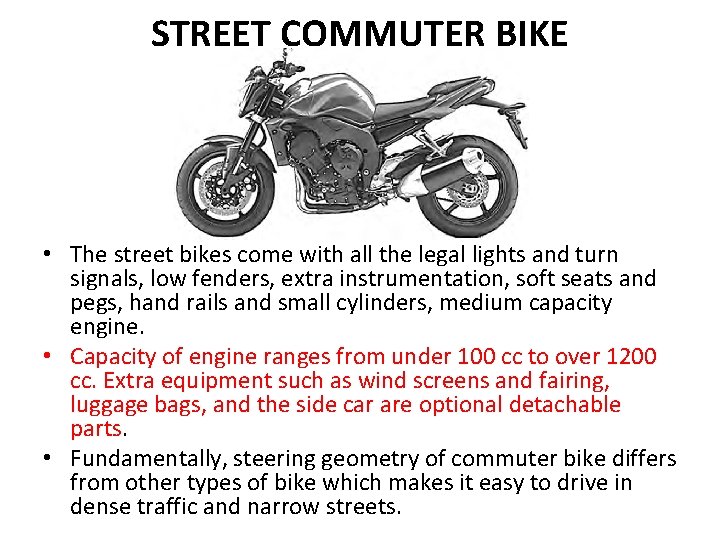
STREET COMMUTER BIKE • The street bikes come with all the legal lights and turn signals, low fenders, extra instrumentation, soft seats and pegs, hand rails and small cylinders, medium capacity engine. • Capacity of engine ranges from under 100 cc to over 1200 cc. Extra equipment such as wind screens and fairing, luggage bags, and the side car are optional detachable parts. • Fundamentally, steering geometry of commuter bike differs from other types of bike which makes it easy to drive in dense traffic and narrow streets.
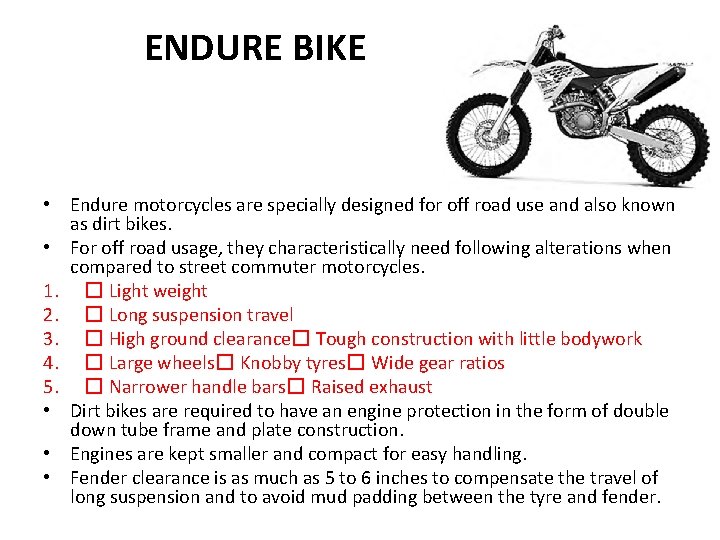
ENDURE BIKE • Endure motorcycles are specially designed for off road use and also known as dirt bikes. • For off road usage, they characteristically need following alterations when compared to street commuter motorcycles. 1. � Light weight 2. � Long suspension travel 3. � High ground clearance� Tough construction with little bodywork 4. � Large wheels� Knobby tyres� Wide gear ratios 5. � Narrower handle bars� Raised exhaust • Dirt bikes are required to have an engine protection in the form of double down tube frame and plate construction. • Engines are kept smaller and compact for easy handling. • Fender clearance is as much as 5 to 6 inches to compensate the travel of long suspension and to avoid mud padding between the tyre and fender.
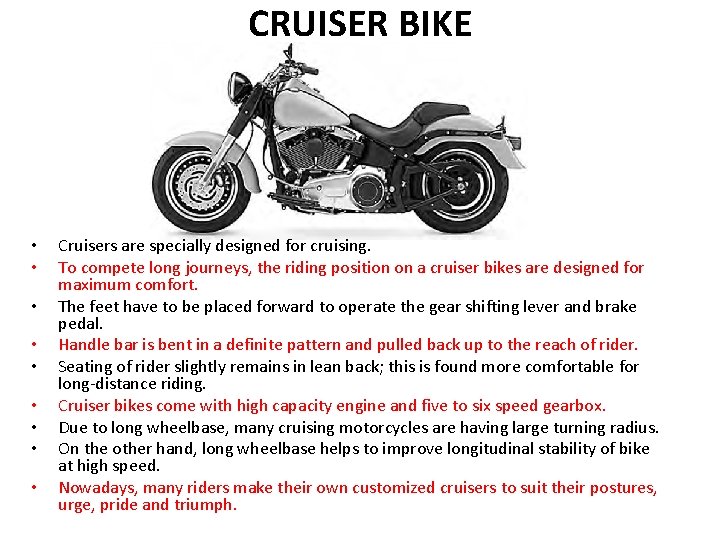
CRUISER BIKE • • • Cruisers are specially designed for cruising. To compete long journeys, the riding position on a cruiser bikes are designed for maximum comfort. The feet have to be placed forward to operate the gear shifting lever and brake pedal. Handle bar is bent in a definite pattern and pulled back up to the reach of rider. Seating of rider slightly remains in lean back; this is found more comfortable for long-distance riding. Cruiser bikes come with high capacity engine and five to six speed gearbox. Due to long wheelbase, many cruising motorcycles are having large turning radius. On the other hand, long wheelbase helps to improve longitudinal stability of bike at high speed. Nowadays, many riders make their own customized cruisers to suit their postures, urge, pride and triumph.
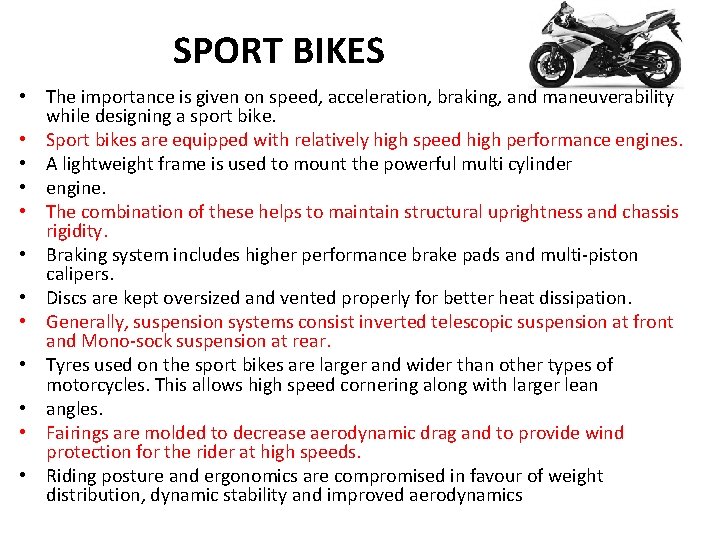
SPORT BIKES • The importance is given on speed, acceleration, braking, and maneuverability while designing a sport bike. • Sport bikes are equipped with relatively high speed high performance engines. • A lightweight frame is used to mount the powerful multi cylinder • engine. • The combination of these helps to maintain structural uprightness and chassis rigidity. • Braking system includes higher performance brake pads and multi-piston calipers. • Discs are kept oversized and vented properly for better heat dissipation. • Generally, suspension systems consist inverted telescopic suspension at front and Mono-sock suspension at rear. • Tyres used on the sport bikes are larger and wider than other types of motorcycles. This allows high speed cornering along with larger lean • angles. • Fairings are molded to decrease aerodynamic drag and to provide wind protection for the rider at high speeds. • Riding posture and ergonomics are compromised in favour of weight distribution, dynamic stability and improved aerodynamics
CLASSIFICATION OF THREE WHEELERS 1. With respect to use (a) Passenger Auto Rickshaw (b) Commercial Loading Auto Rickshaw (c) Special Purpose Three Wheeler 2. With respect to make (a) Passenger Auto Rickshaw: Bajaj, TVS, Piaggio, Mahindra etc. (b) Loading Auto Rickshaw: Bajaj, TVS, Piaggio, Mahindra etc. (c) Special Purpose: Harley Davidson motorbikes, ATVs etc. 3. With respect to fuel used (a) Petrol vehicle (b) CNG vehicle (c) Diesel vehicle (d) Electric vehicle 4. With respect to wheel configuration (a) Single front, dual rear wheels (Tadpole) (b) Dual front, single rear wheels (Delta) 5. With respect to steering configuration (a) Front wheel(s) steered vehicles (b) Rear wheel(s) steered vehicles
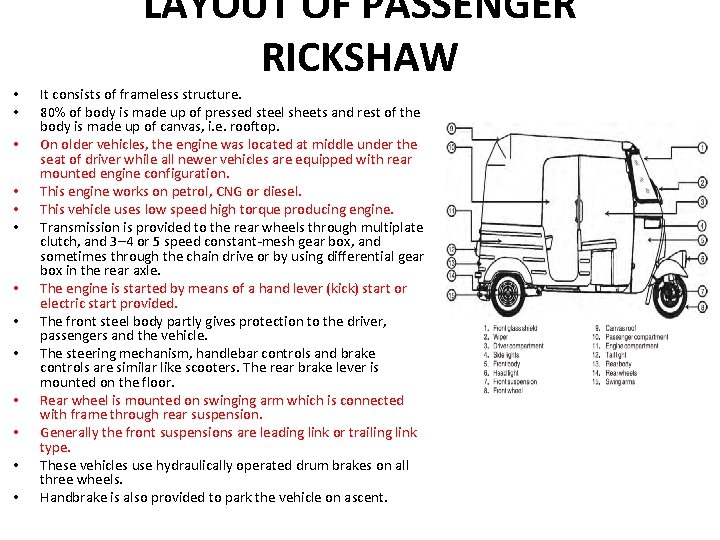
LAYOUT OF PASSENGER RICKSHAW • • • • It consists of frameless structure. 80% of body is made up of pressed steel sheets and rest of the body is made up of canvas, i. e. rooftop. On older vehicles, the engine was located at middle under the seat of driver while all newer vehicles are equipped with rear mounted engine configuration. This engine works on petrol, CNG or diesel. This vehicle uses low speed high torque producing engine. Transmission is provided to the rear wheels through multiplate clutch, and 3– 4 or 5 speed constant-mesh gear box, and sometimes through the chain drive or by using differential gear box in the rear axle. The engine is started by means of a hand lever (kick) start or electric start provided. The front steel body partly gives protection to the driver, passengers and the vehicle. The steering mechanism, handlebar controls and brake controls are similar like scooters. The rear brake lever is mounted on the floor. Rear wheel is mounted on swinging arm which is connected with frame through rear suspension. Generally the front suspensions are leading link or trailing link type. These vehicles use hydraulically operated drum brakes on all three wheels. Handbrake is also provided to park the vehicle on ascent.
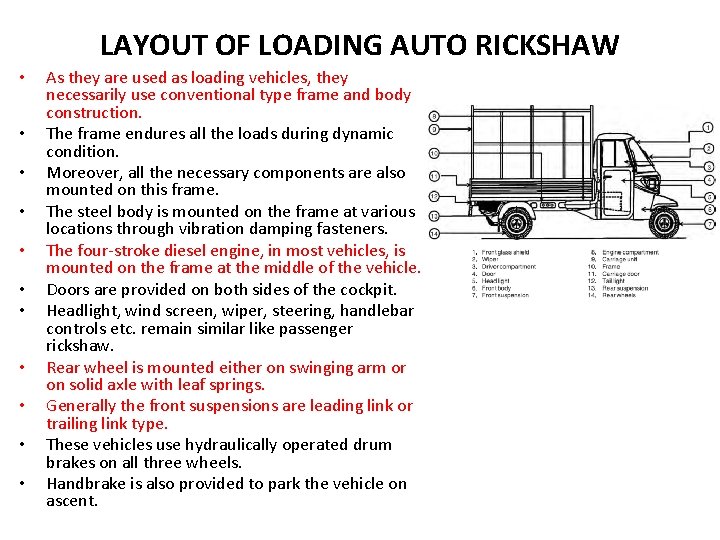
LAYOUT OF LOADING AUTO RICKSHAW • • • As they are used as loading vehicles, they necessarily use conventional type frame and body construction. The frame endures all the loads during dynamic condition. Moreover, all the necessary components are also mounted on this frame. The steel body is mounted on the frame at various locations through vibration damping fasteners. The four-stroke diesel engine, in most vehicles, is mounted on the frame at the middle of the vehicle. Doors are provided on both sides of the cockpit. Headlight, wind screen, wiper, steering, handlebar controls etc. remain similar like passenger rickshaw. Rear wheel is mounted either on swinging arm or on solid axle with leaf springs. Generally the front suspensions are leading link or trailing link type. These vehicles use hydraulically operated drum brakes on all three wheels. Handbrake is also provided to park the vehicle on ascent.
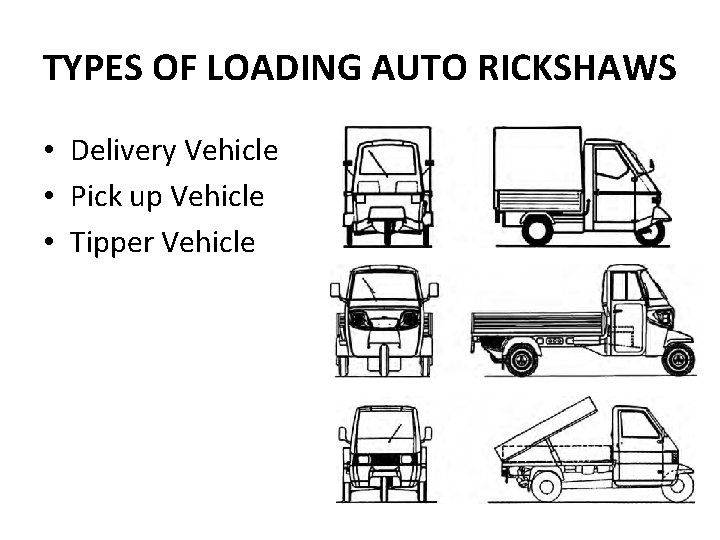
TYPES OF LOADING AUTO RICKSHAWS • Delivery Vehicle • Pick up Vehicle • Tipper Vehicle
Frame and Body Importance of the Frame • • • Frame provides a strong, rigid structure on which all the systems and components are attached. The size, weight, type and geometry of frame determine the vehicle’s handling characteristics. A light weight frame helps to achieve better overall balancing of the vehicle and improves the mileage. Also, the type of construction is a critical factor affecting frame stability and rigidity. The frame rigidly holds the wheels in straight line and also allows relative motion as and when required. Above all, the frame holds the power plant which generated maximum vibration on the vehicle. Moreover, the engine is also retained aligned to the power transmitting train. The shocks coming from the road surface is finally taken and damped by the frame. The lateral forces due to cornering and air resistance are also not exception from this fact. Therefore, the frame is likely to be robust and lightweight at the same time. Failure of frame rarely results from the normal operating loads. Rather it is due to either excessive loading (such as a crash, which may result in breakage and/or permanent deformation) or fatigue, which ultimately leads to breakage. If frame is subjected only to normal operating loads, fatigue will be the most likely cause of failure.
LOAD ON THE FRAME • Weight of the vehicle and the rider, which causes vertical bending of the frame. Pillion passenger or luggage also adds up in this force. • �Vertical loads when the vehicle comes across a bump or hollow, which results in longitudinal torsion due to one wheel lifted with other wheel at the usual road level. • �Loads due to road camber, side wind, cornering force while taking turn, which result in lateral bending of the frame. • �Load due to wheel impact with road obstacles may cause that particular wheel to remain obstructed while other wheel tends to move forward, distorting the frame in longitudinal direction. • �Engine torque and braking torque to bend the frame in vertical plane. • �Sudden impact loads during collision, which may result in a general collapse.
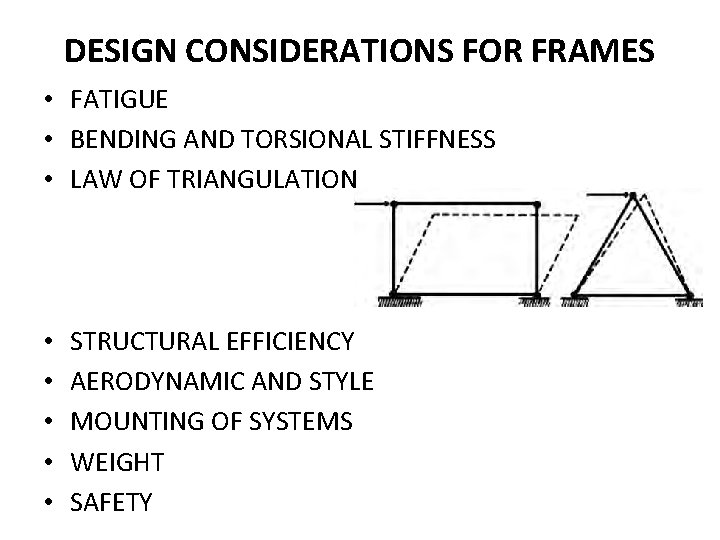
DESIGN CONSIDERATIONS FOR FRAMES • FATIGUE • BENDING AND TORSIONAL STIFFNESS • LAW OF TRIANGULATION • • • STRUCTURAL EFFICIENCY AERODYNAMIC AND STYLE MOUNTING OF SYSTEMS WEIGHT SAFETY
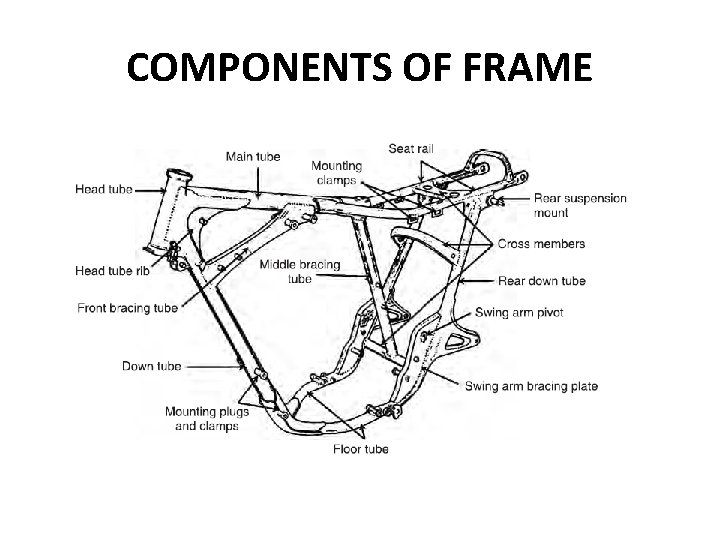
COMPONENTS OF FRAME
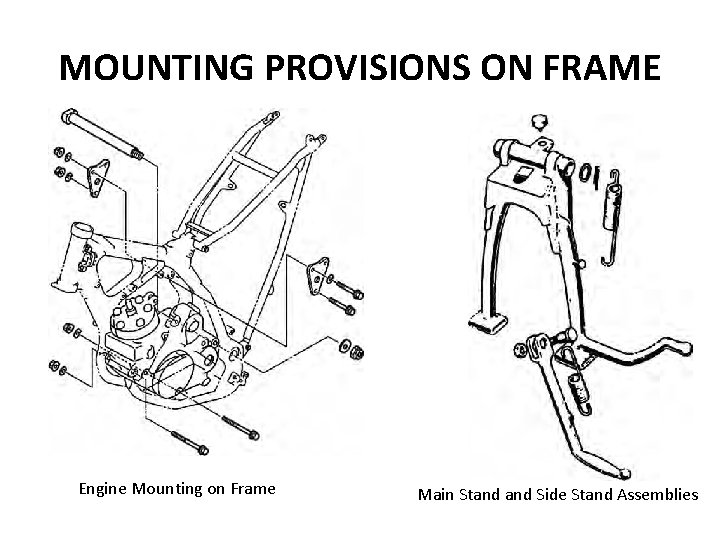
MOUNTING PROVISIONS ON FRAME Engine Mounting on Frame Main Stand Side Stand Assemblies
TUBULAR FRAME 1. BACKBONE TYPE FRAME 2. DOUBLE BEAM TYPE FRAME 3. SINGLE CRADLE FRAME 4. DOUBLE CRADLE FRAME 5. TRELLIS FRAME 6. STEP-THROUGH FRAME
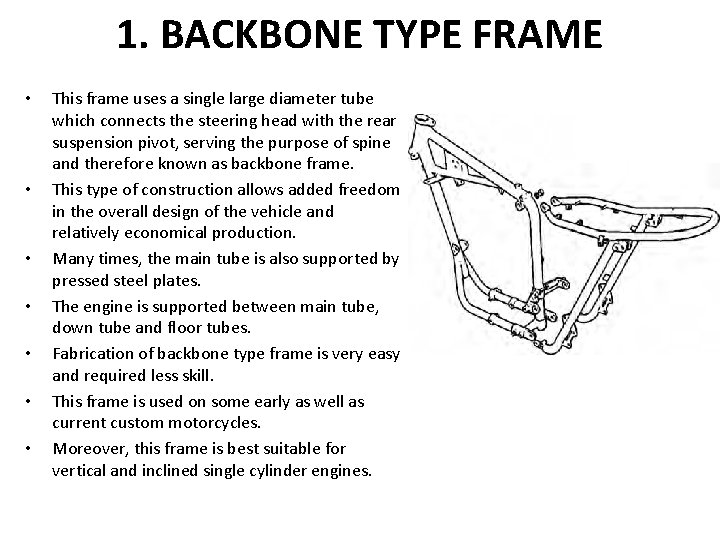
1. BACKBONE TYPE FRAME • • This frame uses a single large diameter tube which connects the steering head with the rear suspension pivot, serving the purpose of spine and therefore known as backbone frame. This type of construction allows added freedom in the overall design of the vehicle and relatively economical production. Many times, the main tube is also supported by pressed steel plates. The engine is supported between main tube, down tube and floor tubes. Fabrication of backbone type frame is very easy and required less skill. This frame is used on some early as well as current custom motorcycles. Moreover, this frame is best suitable for vertical and inclined single cylinder engines.
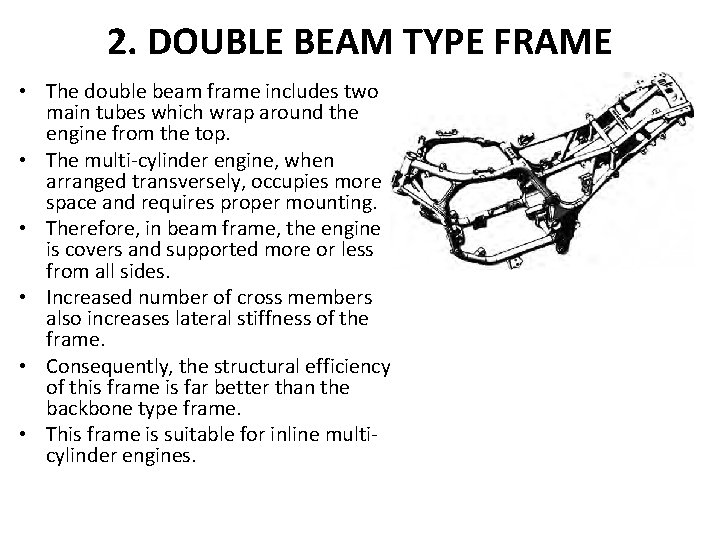
2. DOUBLE BEAM TYPE FRAME • The double beam frame includes two main tubes which wrap around the engine from the top. • The multi-cylinder engine, when arranged transversely, occupies more space and requires proper mounting. • Therefore, in beam frame, the engine is covers and supported more or less from all sides. • Increased number of cross members also increases lateral stiffness of the frame. • Consequently, the structural efficiency of this frame is far better than the backbone type frame. • This frame is suitable for inline multicylinder engines.
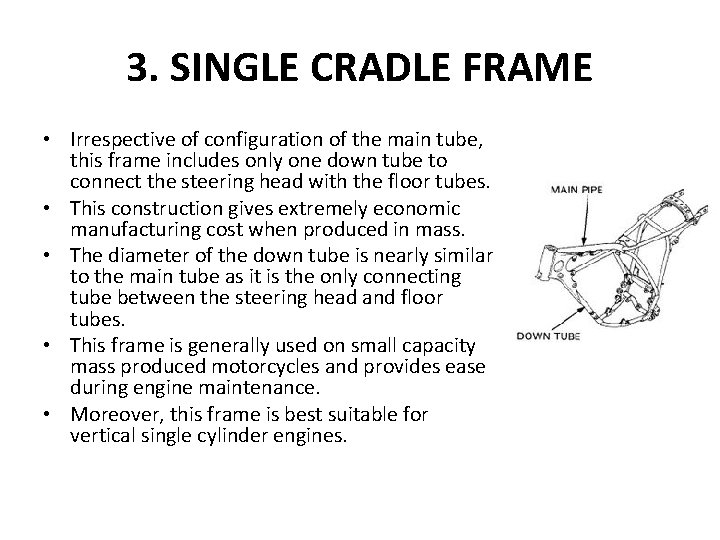
3. SINGLE CRADLE FRAME • Irrespective of configuration of the main tube, this frame includes only one down tube to connect the steering head with the floor tubes. • This construction gives extremely economic manufacturing cost when produced in mass. • The diameter of the down tube is nearly similar to the main tube as it is the only connecting tube between the steering head and floor tubes. • This frame is generally used on small capacity mass produced motorcycles and provides ease during engine maintenance. • Moreover, this frame is best suitable for vertical single cylinder engines.
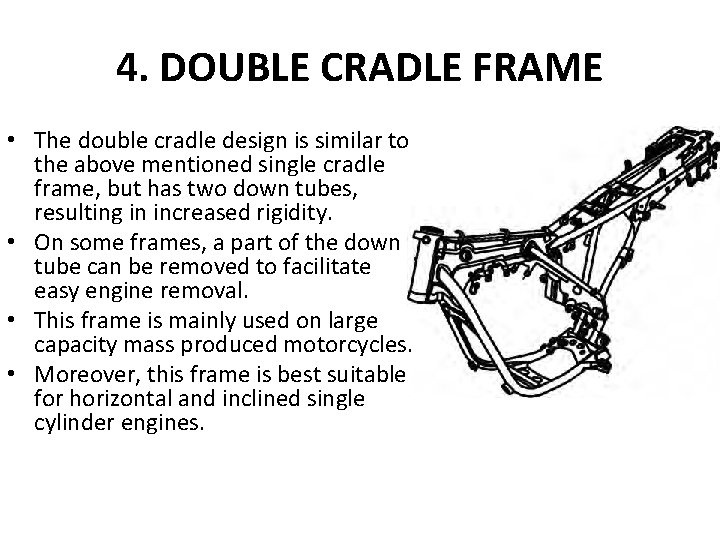
4. DOUBLE CRADLE FRAME • The double cradle design is similar to the above mentioned single cradle frame, but has two down tubes, resulting in increased rigidity. • On some frames, a part of the down tube can be removed to facilitate easy engine removal. • This frame is mainly used on large capacity mass produced motorcycles. • Moreover, this frame is best suitable for horizontal and inclined single cylinder engines.
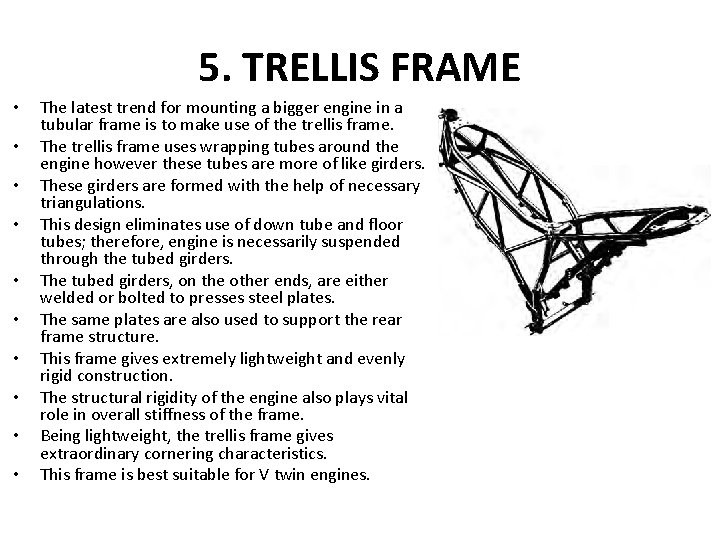
5. TRELLIS FRAME • • • The latest trend for mounting a bigger engine in a tubular frame is to make use of the trellis frame. The trellis frame uses wrapping tubes around the engine however these tubes are more of like girders. These girders are formed with the help of necessary triangulations. This design eliminates use of down tube and floor tubes; therefore, engine is necessarily suspended through the tubed girders. The tubed girders, on the other ends, are either welded or bolted to presses steel plates. The same plates are also used to support the rear frame structure. This frame gives extremely lightweight and evenly rigid construction. The structural rigidity of the engine also plays vital role in overall stiffness of the frame. Being lightweight, the trellis frame gives extraordinary cornering characteristics. This frame is best suitable for V twin engines.
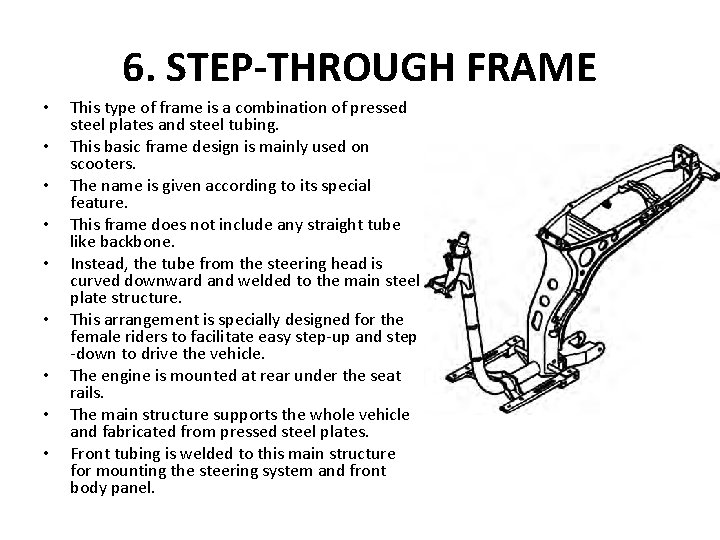
6. STEP-THROUGH FRAME • • • This type of frame is a combination of pressed steel plates and steel tubing. This basic frame design is mainly used on scooters. The name is given according to its special feature. This frame does not include any straight tube like backbone. Instead, the tube from the steering head is curved downward and welded to the main steel plate structure. This arrangement is specially designed for the female riders to facilitate easy step-up and step -down to drive the vehicle. The engine is mounted at rear under the seat rails. The main structure supports the whole vehicle and fabricated from pressed steel plates. Front tubing is welded to this main structure for mounting the steering system and front body panel.
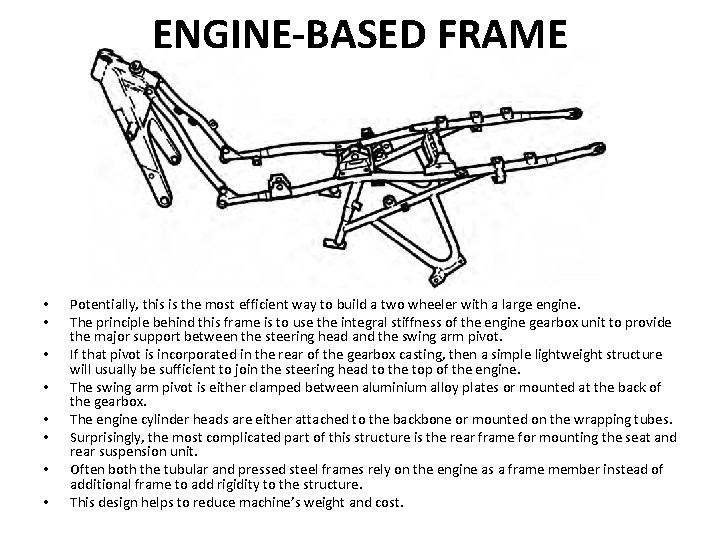
ENGINE-BASED FRAME • • Potentially, this is the most efficient way to build a two wheeler with a large engine. The principle behind this frame is to use the integral stiffness of the engine gearbox unit to provide the major support between the steering head and the swing arm pivot. If that pivot is incorporated in the rear of the gearbox casting, then a simple lightweight structure will usually be sufficient to join the steering head to the top of the engine. The swing arm pivot is either clamped between aluminium alloy plates or mounted at the back of the gearbox. The engine cylinder heads are either attached to the backbone or mounted on the wrapping tubes. Surprisingly, the most complicated part of this structure is the rear frame for mounting the seat and rear suspension unit. Often both the tubular and pressed steel frames rely on the engine as a frame member instead of additional frame to add rigidity to the structure. This design helps to reduce machine’s weight and cost.
TWIN-SPAR FRAME • Modern large engines and their huge air boxes present a great challenge to the frame designer and the twin-spar offers considerable packaging advantages. • It comprises of two beams running each side of the engine and gearbox unit, joining the steering head to the swing arm pivot mountings. • These side beams may be extruded tubes, fabricated from steel or casted with aluminium alloys. • Castings of aluminium alloys have often been used for the head stock area and the swing arm and rear engine mounting plates. • These castings are welded to the side spars. • The rear frame is usually bolted to the front frame, which is either made of steel tube or casted from the aluminium alloys. • This type of frame allows much easier access to work on the engine, in particular, removal and replacement of carburetors or FI system and access to spark plugs. • The elimination of down tubes and the lower cradle also facilitates space in the area needed by exhaust and cooling systems.
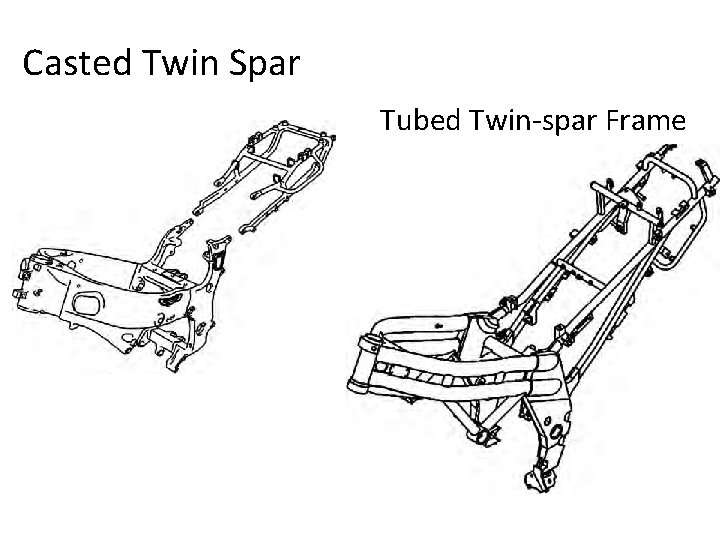
Casted Twin Spar Tubed Twin-spar Frame
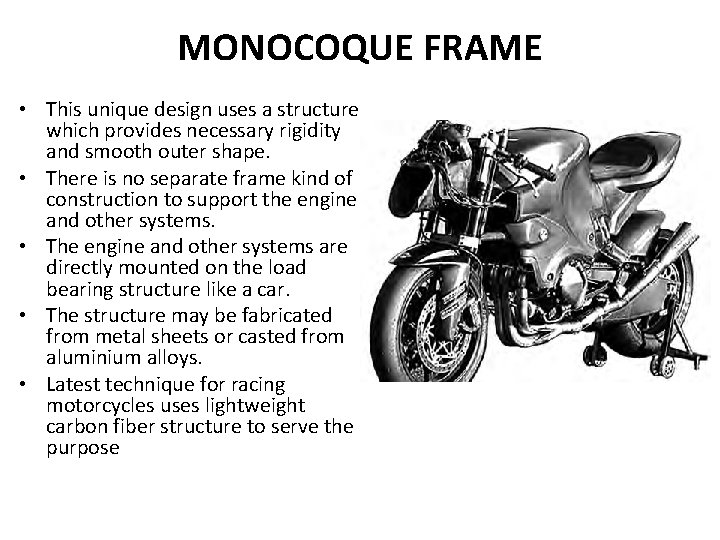
MONOCOQUE FRAME • This unique design uses a structure which provides necessary rigidity and smooth outer shape. • There is no separate frame kind of construction to support the engine and other systems. • The engine and other systems are directly mounted on the load bearing structure like a car. • The structure may be fabricated from metal sheets or casted from aluminium alloys. • Latest technique for racing motorcycles uses lightweight carbon fiber structure to serve the purpose
- Slides: 48