
15 853 Algorithms in the Real World Computational
- Slides: 66
15 -853: Algorithms in the Real World Computational Biology V – Sequencing the “Genome” Thanks to: Dannie Durand for some of the slides. Various figures borrowed from the web. 15 -853 1
Tools of the Trade Cutting: Arber, Nathans, and Smith, Nobel Prize in Medicine (1978) for “the discovery of restriction enzymes and their application to problems of molecular genetics". Copying: Mullis, Nobel Prize in Chemistry (1993) for “his invention of the polymerase chain reaction (PCR) method” Reading: (sequencing) Gilbert and Sanger, Nobel Prize in Chemistry (1980) for “contributions concerning the determination of base sequences in nucleic acids" 15 -853 2
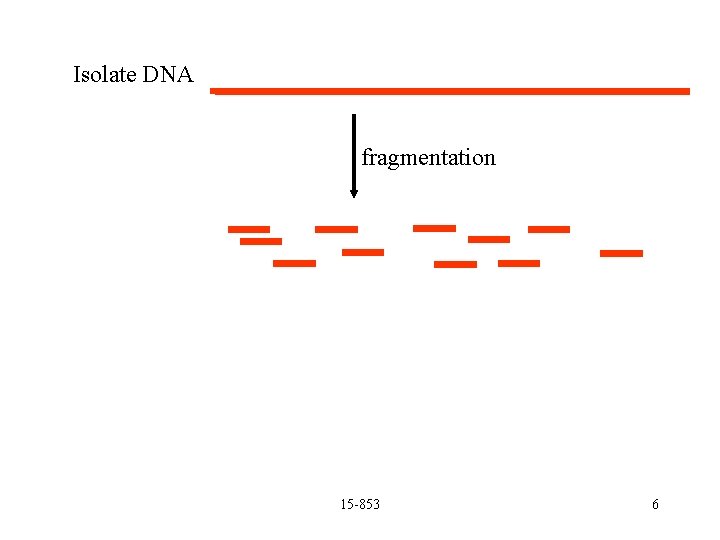
Cutting: – Restriction Enzines: Cut at particular sites, e. g. ACTTCTAGAT – Chemical, physical or radiation cuts Cut at random locations 15 -853 3
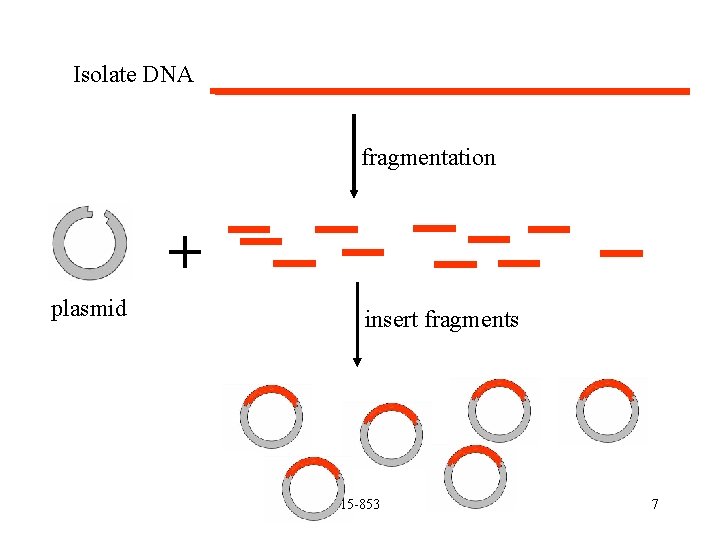
Copying: Cloning a strand of DNA – Cosmids: clones sequences up to 40 K bps – BAC, PAC: up to about 200 K bps – YAC (yeast artificial chromosones): up to 1 M Copying between two specific sites – PCR (polymerase chain reaction): 500 bps 15 -853 4
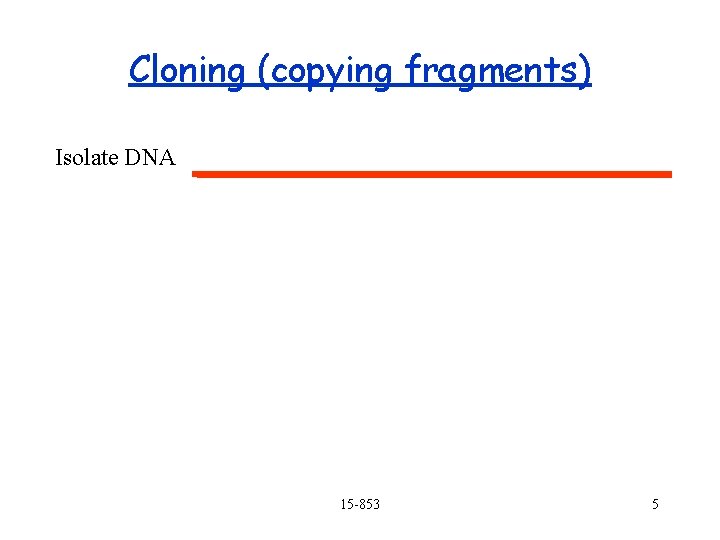
Cloning (copying fragments) Isolate DNA 15 -853 5
Isolate DNA fragmentation 15 -853 6
Isolate DNA fragmentation + plasmid insert fragments 15 -853 7
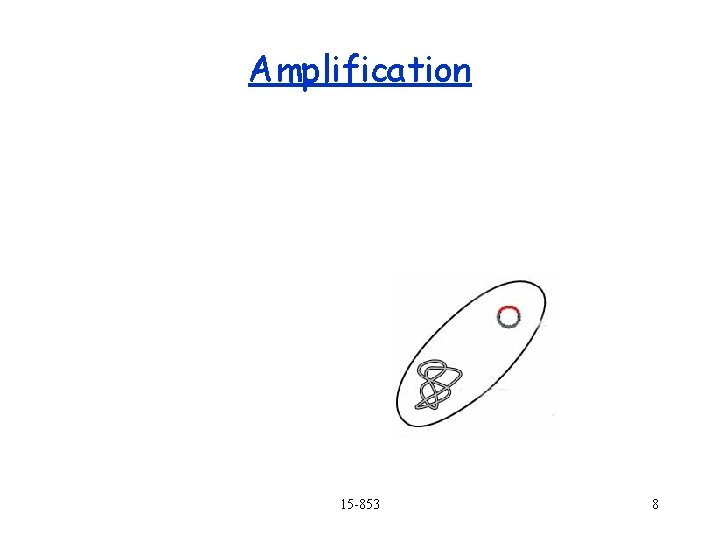
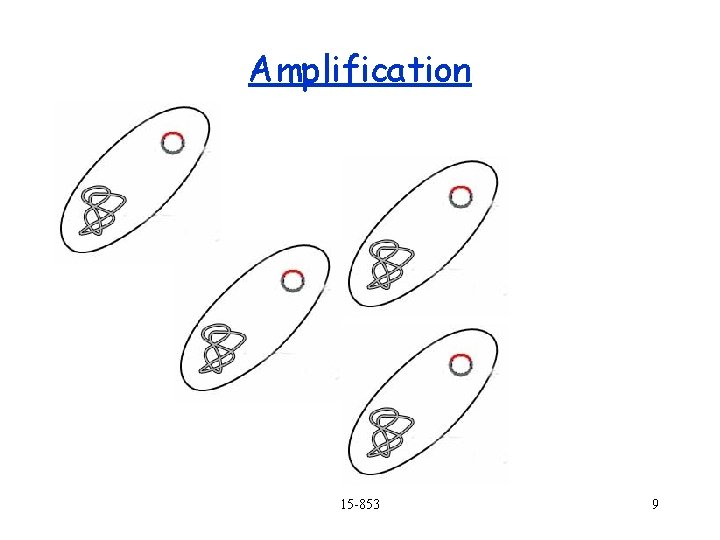
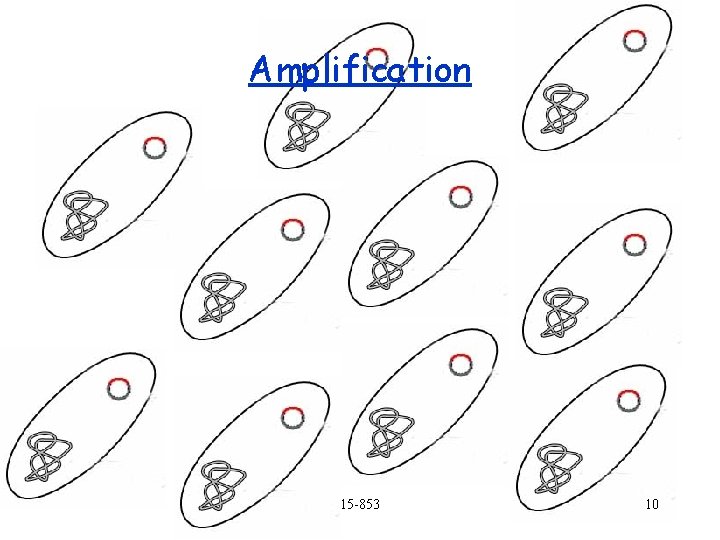
Amplification 15 -853 8
Amplification 15 -853 9
Amplification 15 -853 10
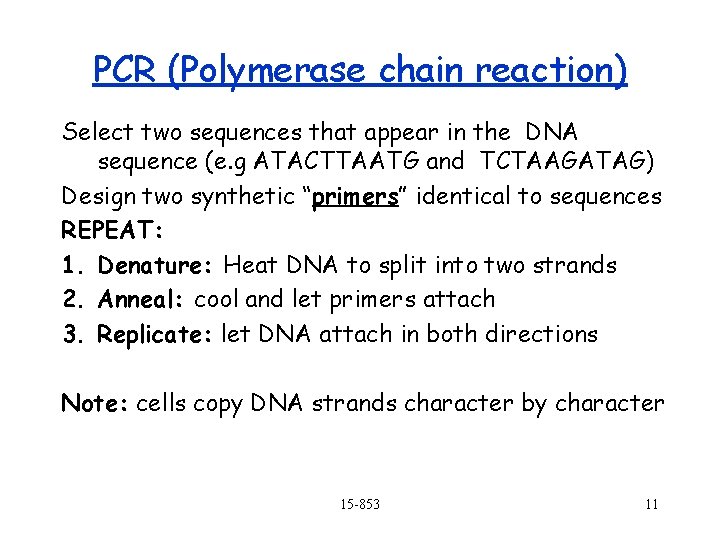
PCR (Polymerase chain reaction) Select two sequences that appear in the DNA sequence (e. g ATACTTAATG and TCTAAGATAG) Design two synthetic “primers” identical to sequences REPEAT: 1. Denature: Heat DNA to split into two strands 2. Anneal: cool and let primers attach 3. Replicate: let DNA attach in both directions Note: cells copy DNA strands character by character 15 -853 11
PCR (Polymerase chain reaction) 15 -853 12
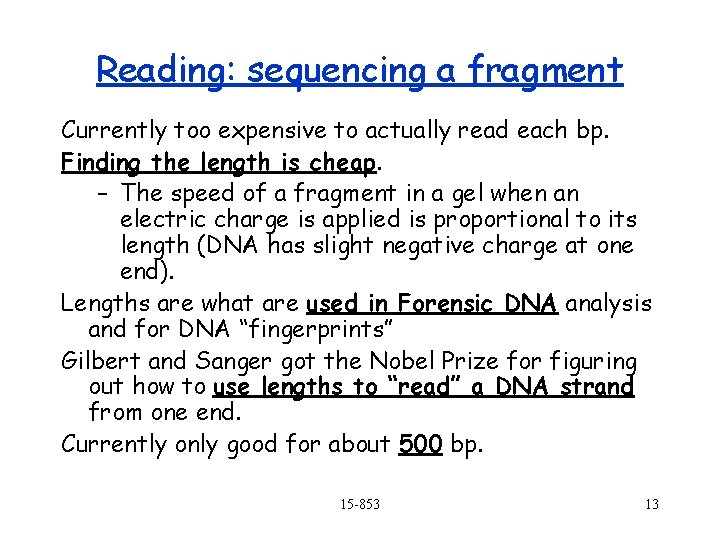
Reading: sequencing a fragment Currently too expensive to actually read each bp. Finding the length is cheap. – The speed of a fragment in a gel when an electric charge is applied is proportional to its length (DNA has slight negative charge at one end). Lengths are what are used in Forensic DNA analysis and for DNA “fingerprints” Gilbert and Sanger got the Nobel Prize for figuring out how to use lengths to “read” a DNA strand from one end. Currently only good for about 500 bp. 15 -853 13
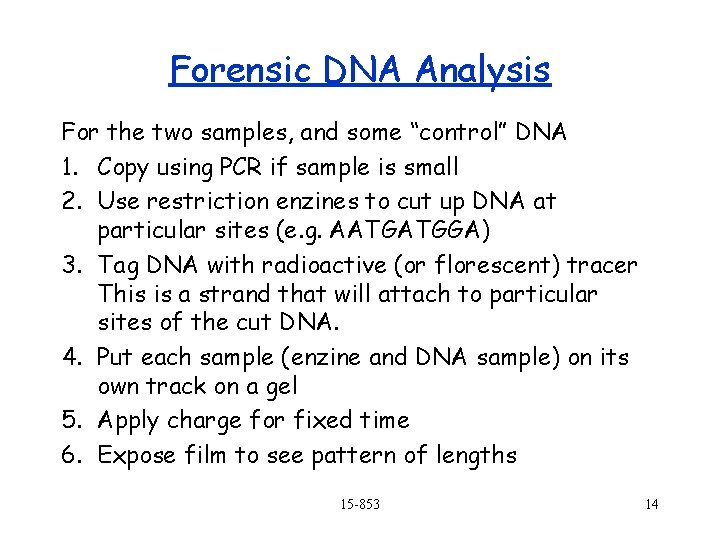
Forensic DNA Analysis For the two samples, and some “control” DNA 1. Copy using PCR if sample is small 2. Use restriction enzines to cut up DNA at particular sites (e. g. AATGATGGA) 3. Tag DNA with radioactive (or florescent) tracer This is a strand that will attach to particular sites of the cut DNA. 4. Put each sample (enzine and DNA sample) on its own track on a gel 5. Apply charge for fixed time 6. Expose film to see pattern of lengths 15 -853 14
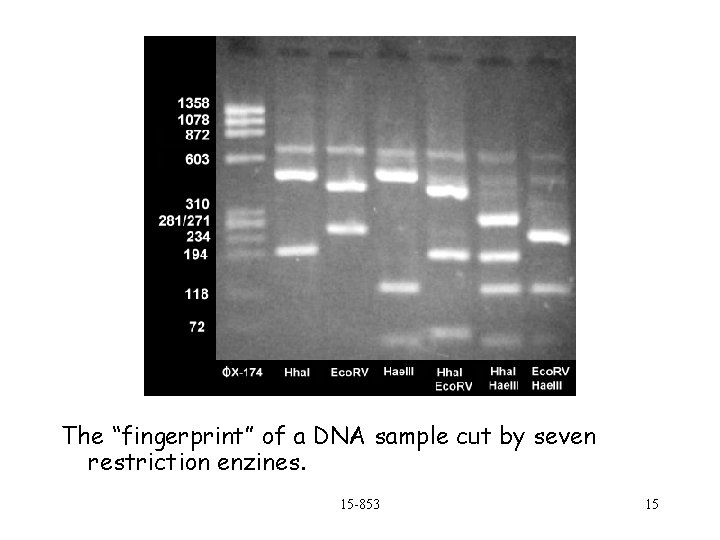
The “fingerprint” of a DNA sample cut by seven restriction enzines. 15 -853 15
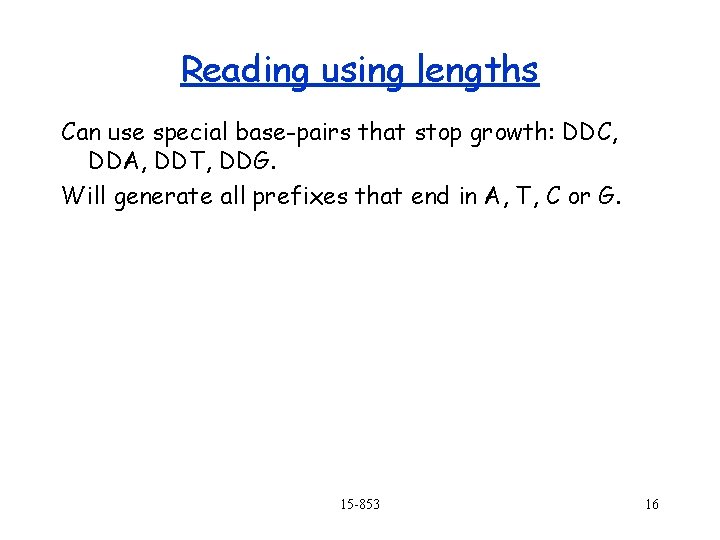
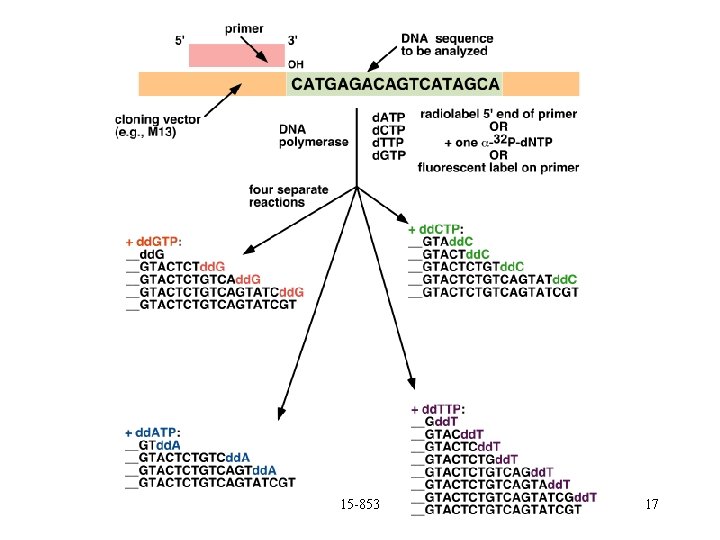
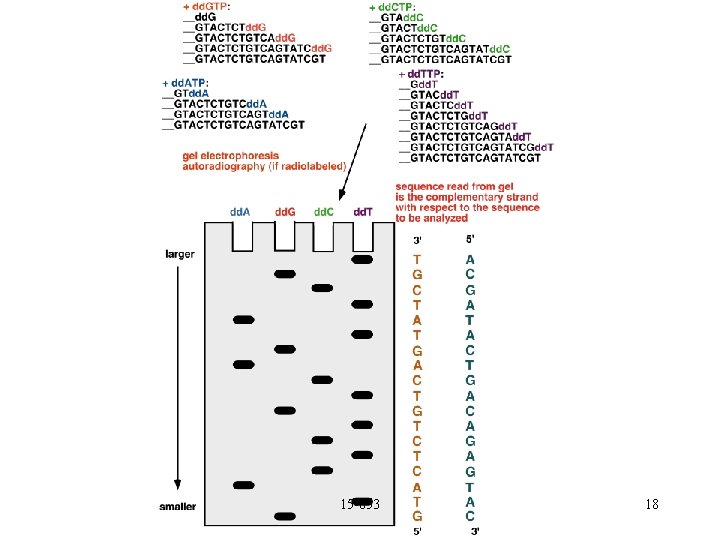
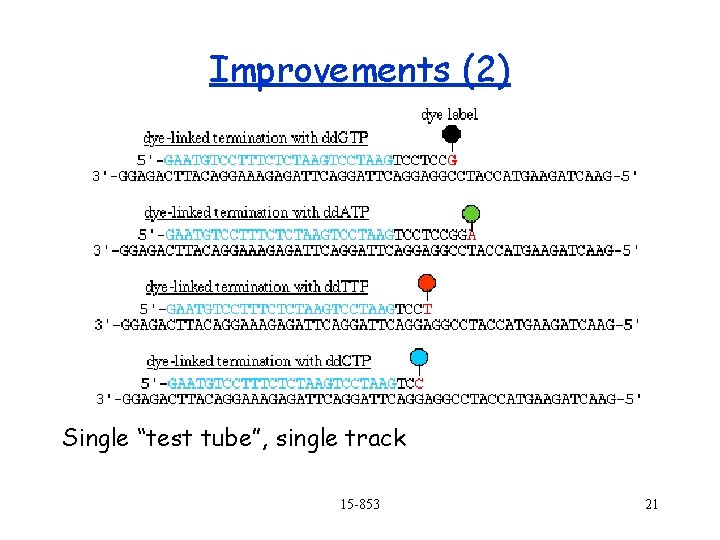
Reading using lengths Can use special base-pairs that stop growth: DDC, DDA, DDT, DDG. Will generate all prefixes that end in A, T, C or G. 15 -853 16
15 -853 17
15 -853 18
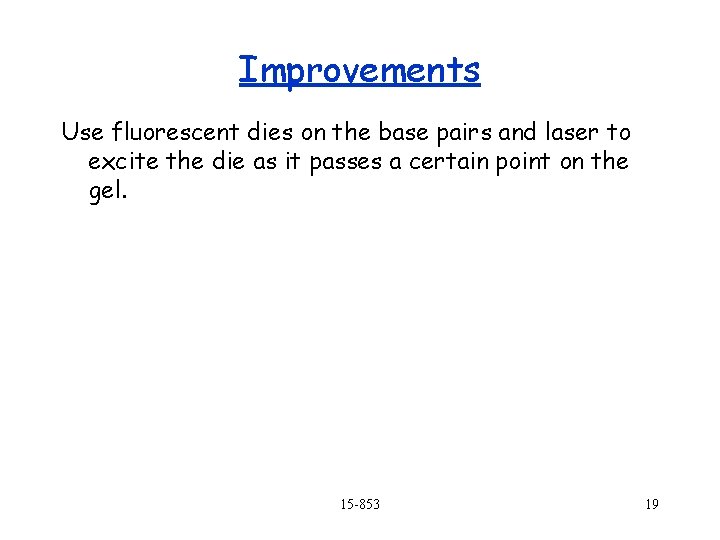
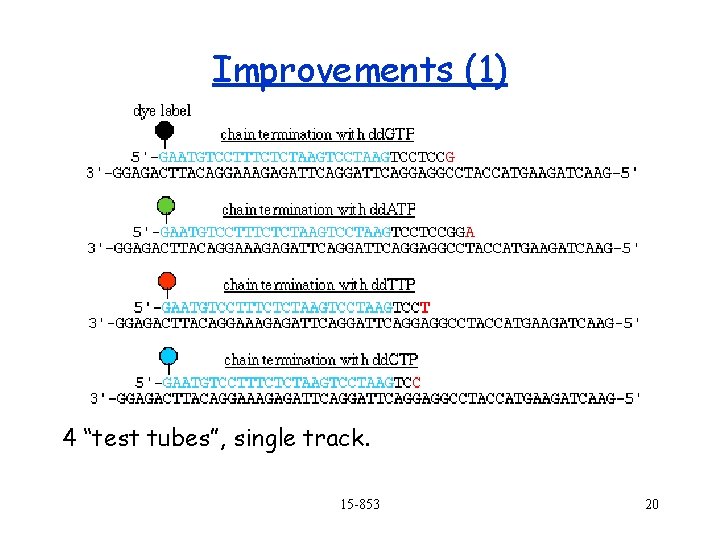
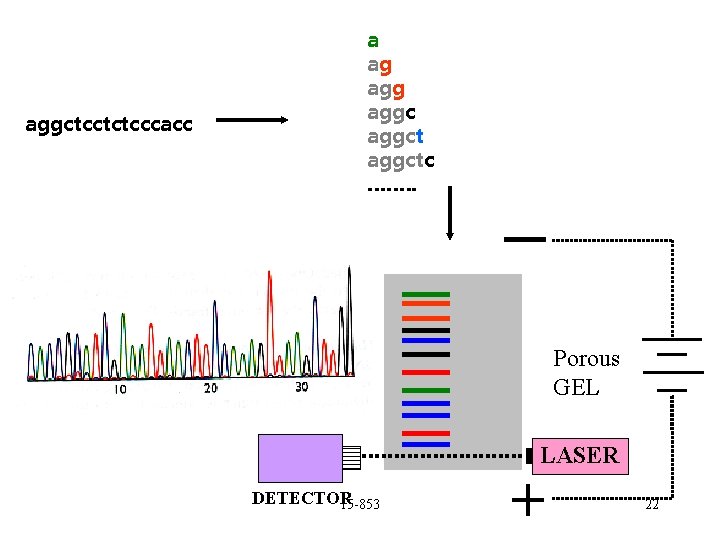
Improvements Use fluorescent dies on the base pairs and laser to excite the die as it passes a certain point on the gel. 15 -853 19
Improvements (1) 4 “test tubes”, single track. 15 -853 20
Improvements (2) Single “test tube”, single track 15 -853 21
aggctcctctcccacc a ag aggctc ……. . _ Porous GEL LASER DETECTOR 15 -853 + 22
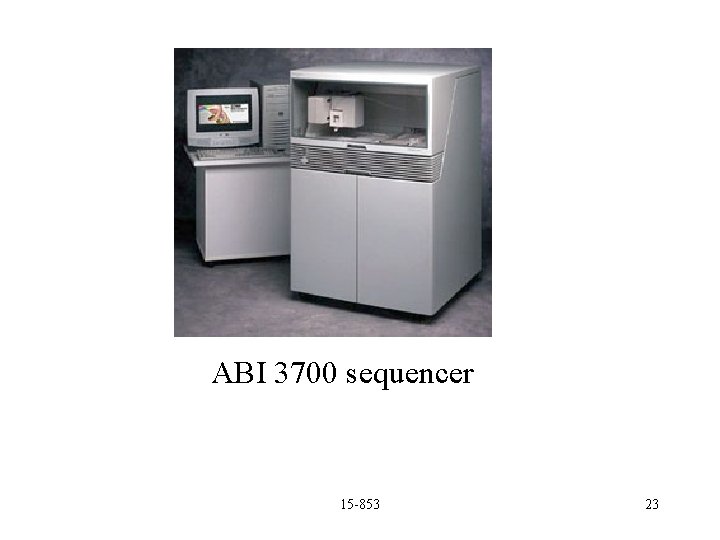
ABI 3700 sequencer 15 -853 23
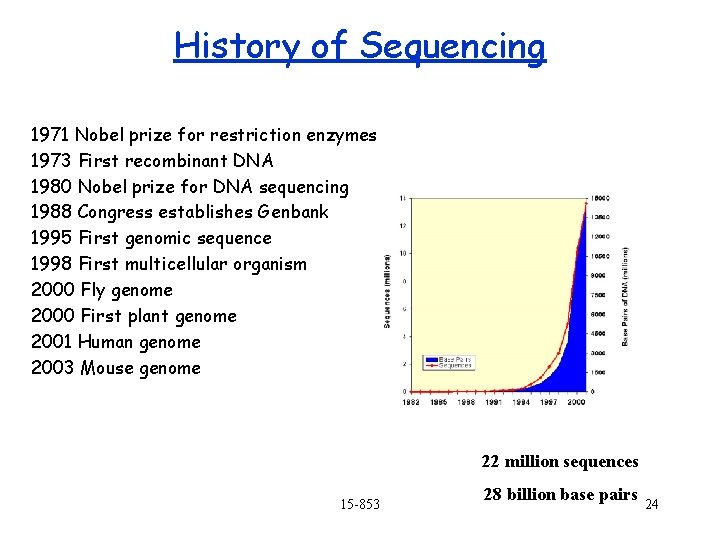
History of Sequencing 1971 Nobel prize for restriction enzymes 1973 First recombinant DNA 1980 Nobel prize for DNA sequencing 1988 Congress establishes Genbank 1995 First genomic sequence 1998 First multicellular organism 2000 Fly genome 2000 First plant genome 2001 Human genome 2003 Mouse genome 22 million sequences 15 -853 28 billion base pairs 24
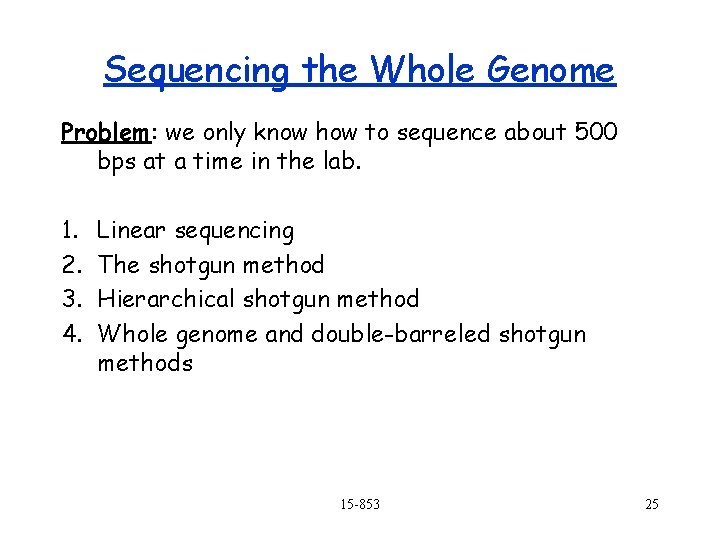
Sequencing the Whole Genome Problem: we only know how to sequence about 500 bps at a time in the lab. 1. 2. 3. 4. Linear sequencing The shotgun method Hierarchical shotgun method Whole genome and double-barreled shotgun methods 15 -853 25
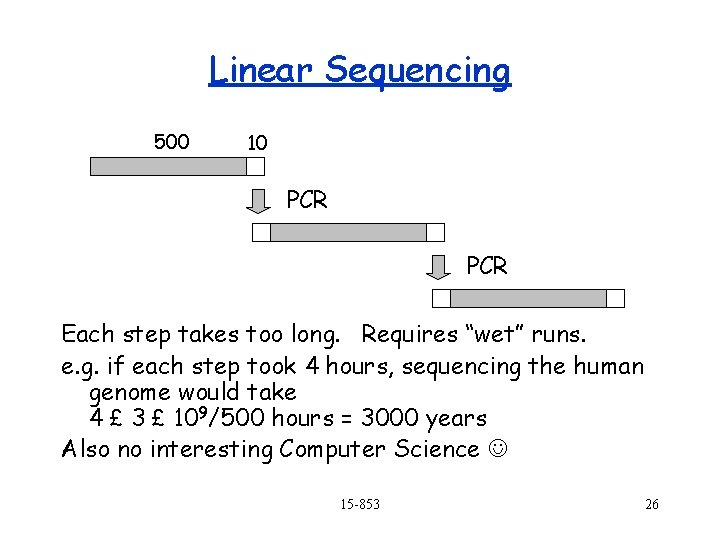
Linear Sequencing 500 10 PCR Each step takes too long. Requires “wet” runs. e. g. if each step took 4 hours, sequencing the human genome would take 4 £ 3 £ 109/500 hours = 3000 years Also no interesting Computer Science 15 -853 26
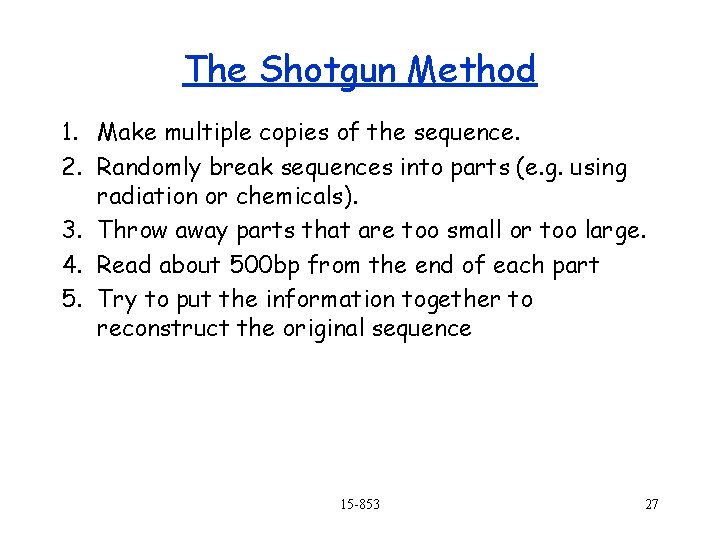
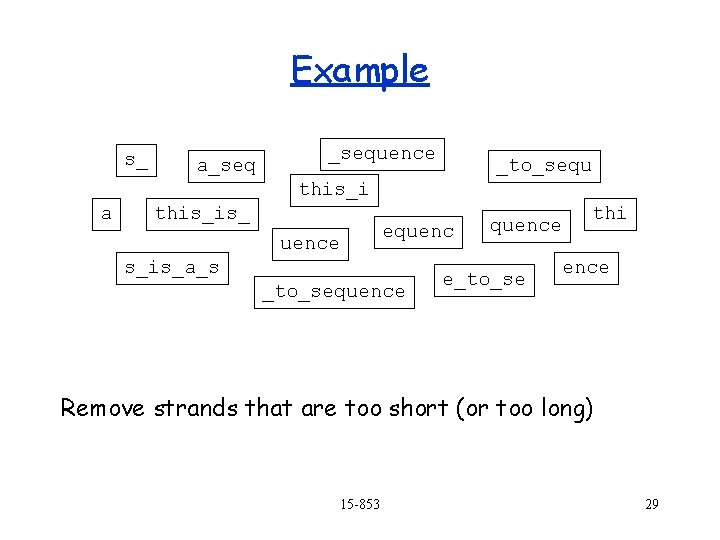
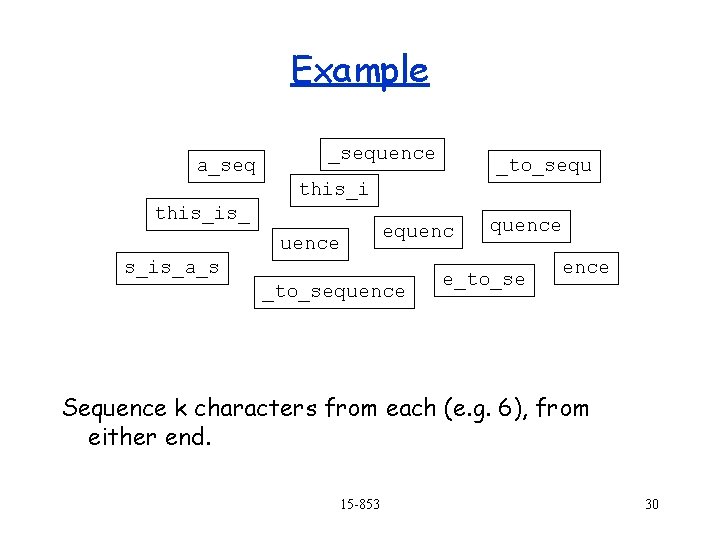
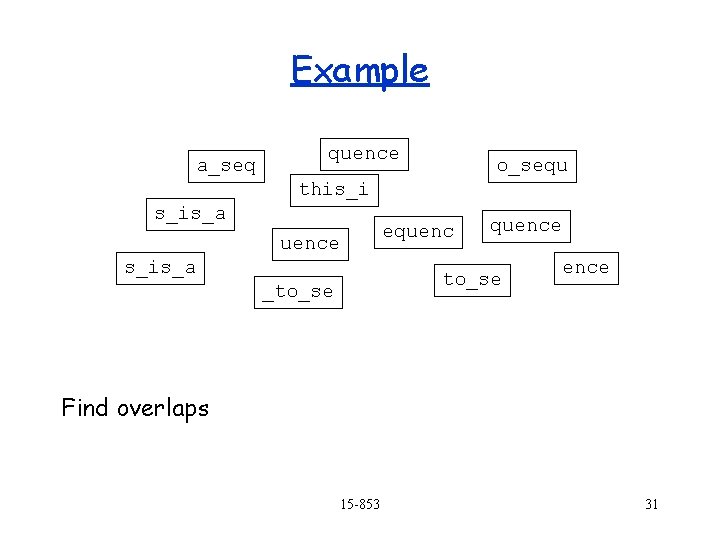
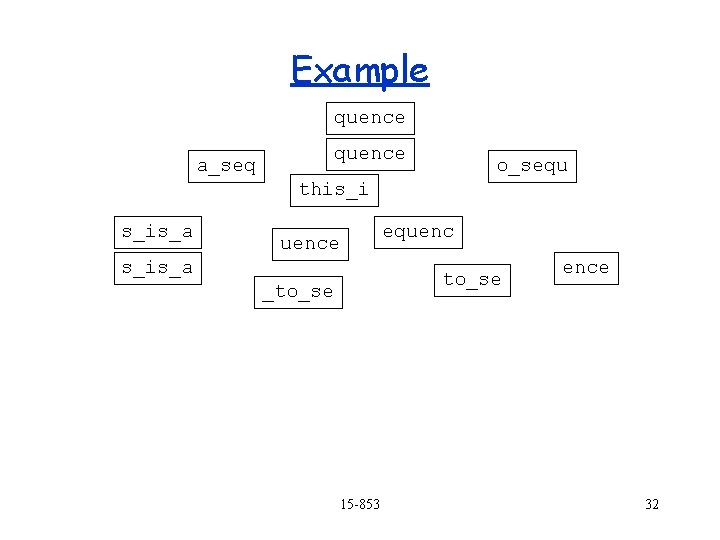
The Shotgun Method 1. Make multiple copies of the sequence. 2. Randomly break sequences into parts (e. g. using radiation or chemicals). 3. Throw away parts that are too small or too large. 4. Read about 500 bp from the end of each part 5. Try to put the information together to reconstruct the original sequence 15 -853 27
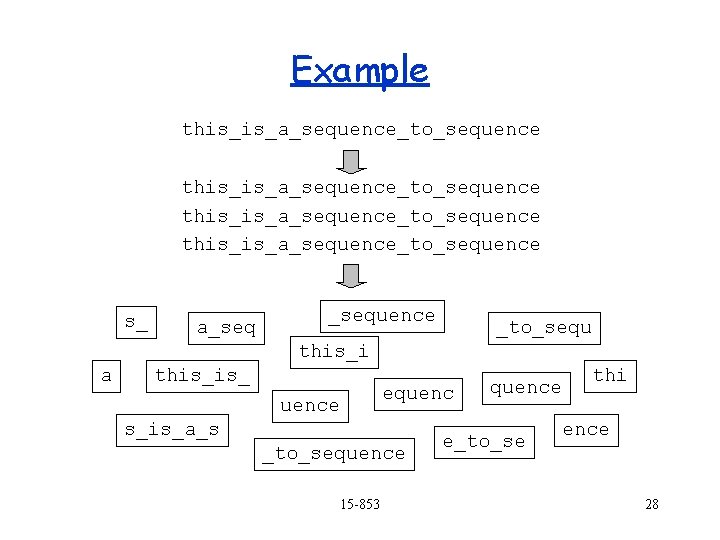
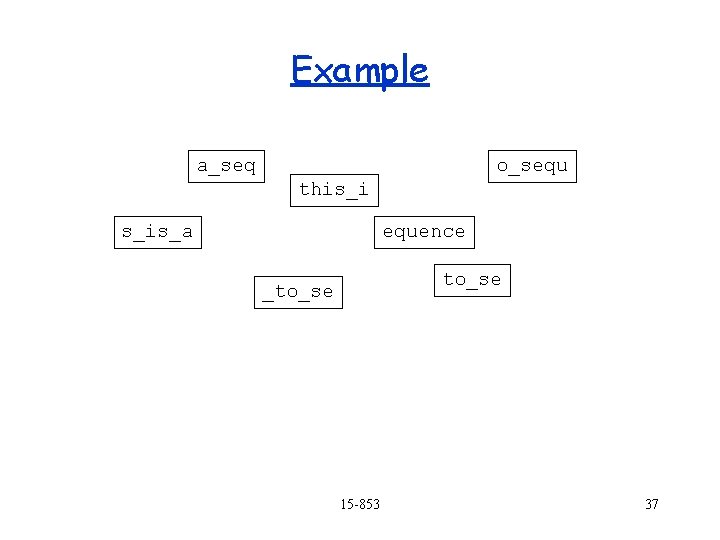
Example this_is_a_sequence_to_sequence s_ a_sequence _to_sequ this_i a this_is_ equence s_is_a_s _to_sequence 15 -853 thi quence e_to_se ence 28
Example s_ a_sequence _to_sequ this_i a this_is_ equence s_is_a_s _to_sequence thi quence e_to_se ence Remove strands that are too short (or too long) 15 -853 29
Example a_sequence _to_sequ this_is_ equence s_is_a_s _to_sequence e_to_se ence Sequence k characters from each (e. g. 6), from either end. 15 -853 30
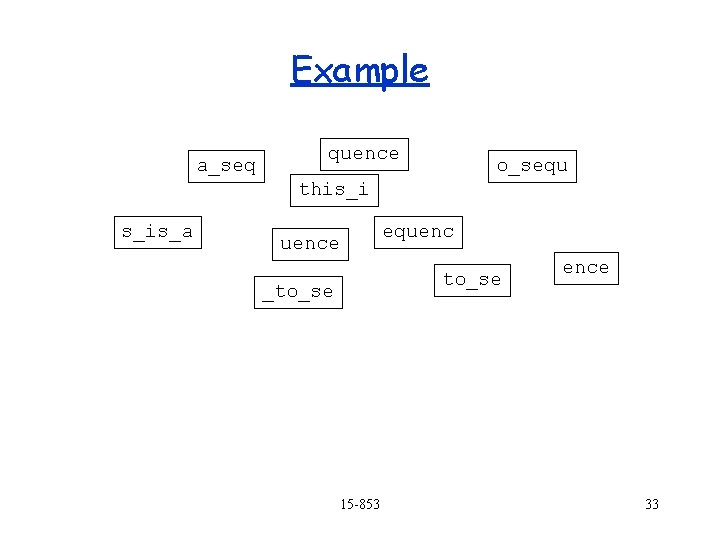
Example a_seq quence o_sequ this_i s_is_a equence s_is_a quence to_se _to_se ence Find overlaps 15 -853 31
Example quence a_seq o_sequ this_i s_is_a equence s_is_a to_se _to_se 15 -853 ence 32
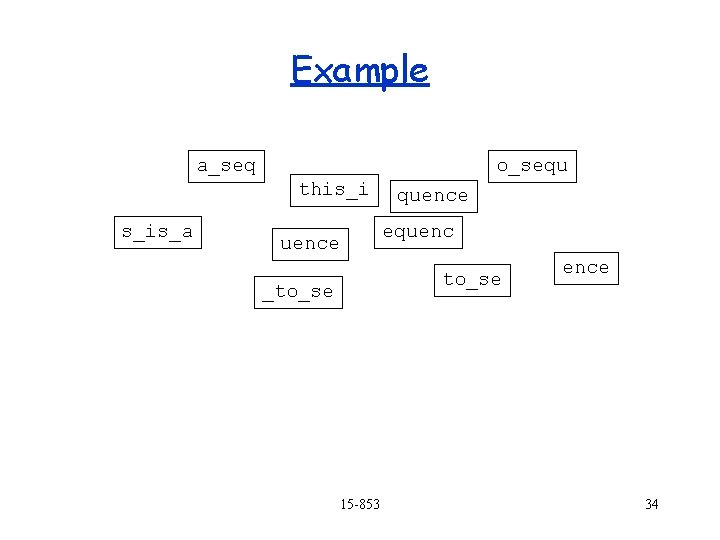
Example a_seq quence o_sequ this_i s_is_a equence to_se _to_se 15 -853 ence 33
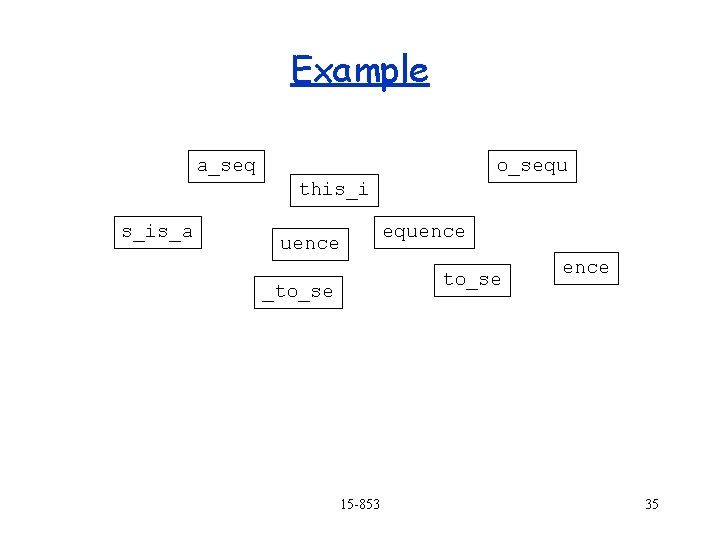
Example a_seq o_sequ this_i s_is_a quence equence to_se _to_se 15 -853 ence 34
Example a_seq o_sequ this_i s_is_a equence to_se _to_se 15 -853 ence 35
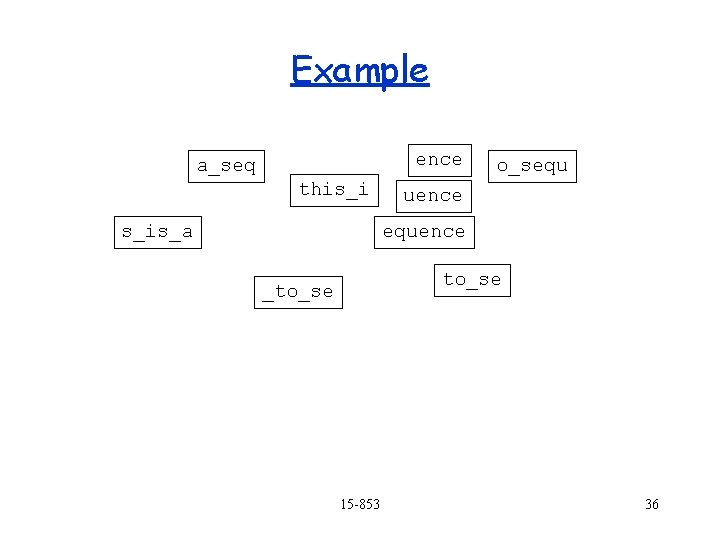
Example ence a_seq this_i s_is_a o_sequ uence equence to_se _to_se 15 -853 36
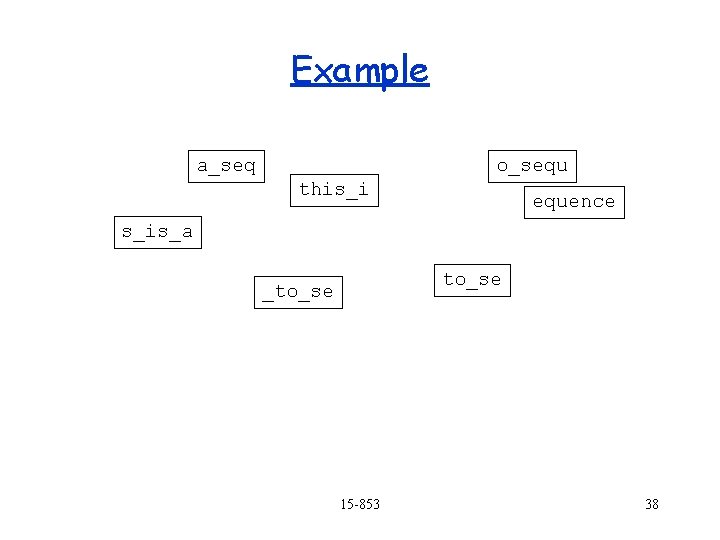
Example a_seq o_sequ this_i s_is_a equence to_se _to_se 15 -853 37
Example a_seq o_sequ this_i equence s_is_a to_se _to_se 15 -853 38
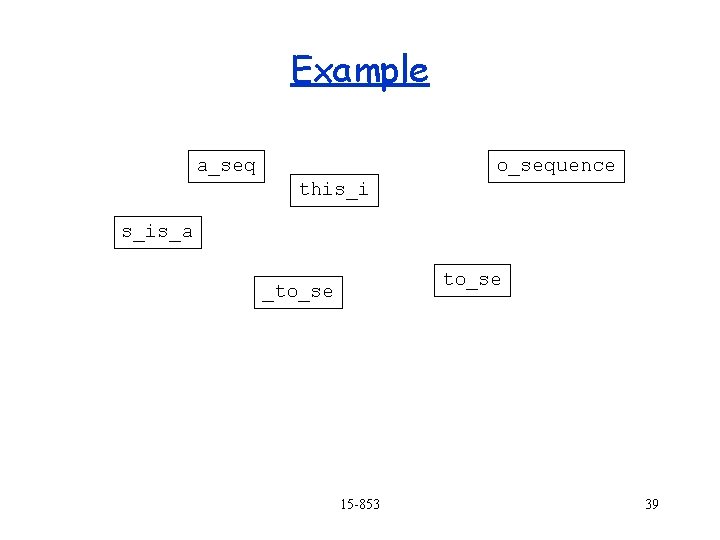
Example a_seq o_sequence this_i s_is_a to_se _to_se 15 -853 39
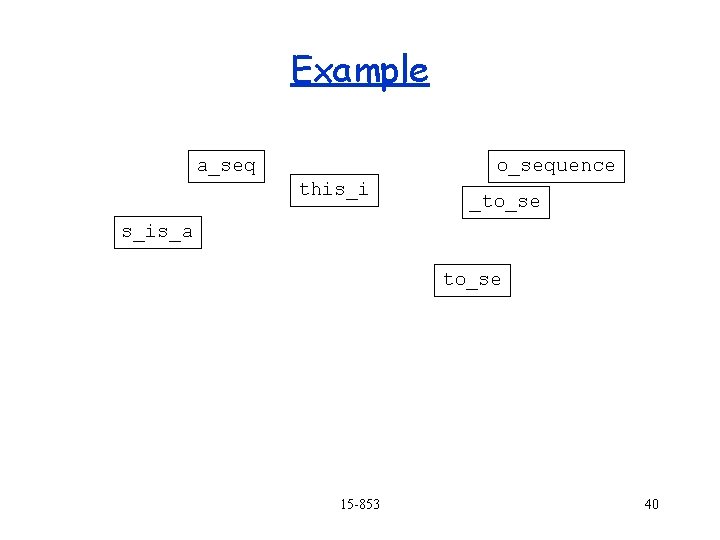
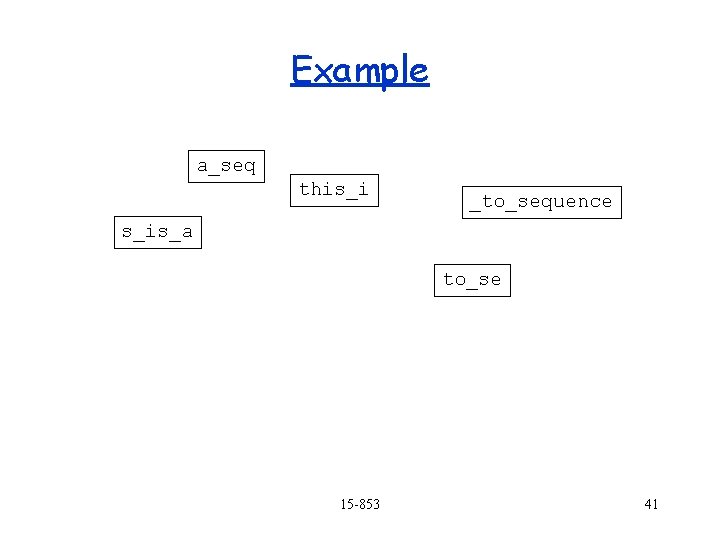
Example a_seq o_sequence this_i _to_se s_is_a to_se 15 -853 40
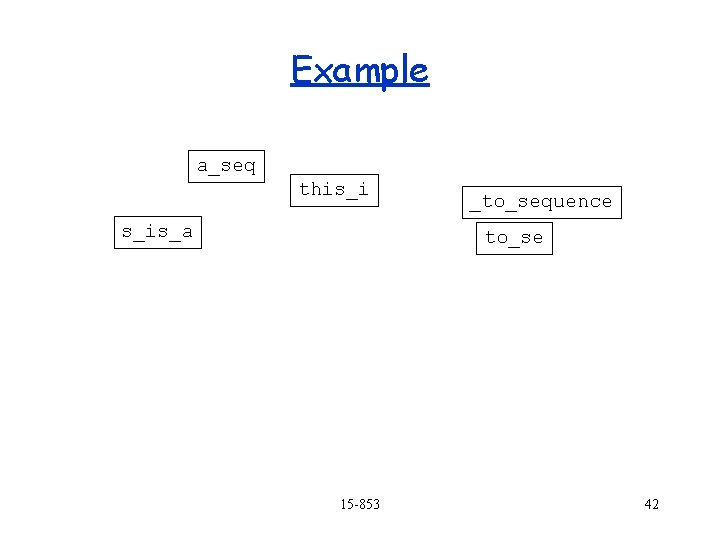
Example a_seq this_i _to_sequence s_is_a to_se 15 -853 41
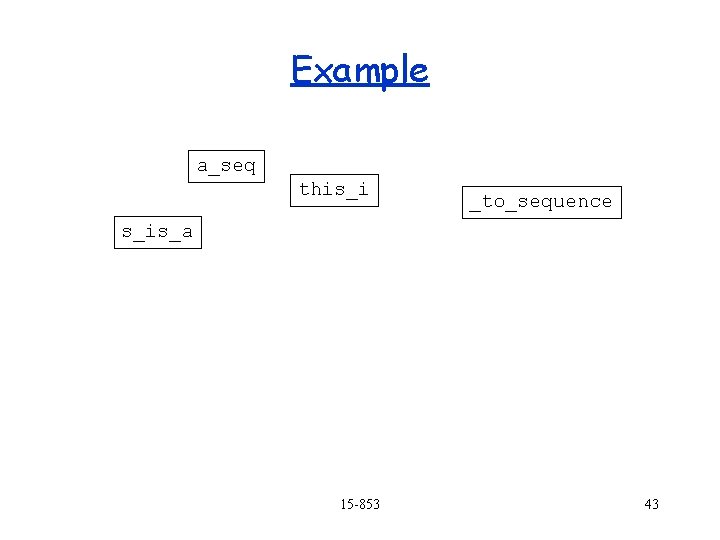
Example a_seq this_i s_is_a _to_sequence to_se 15 -853 42
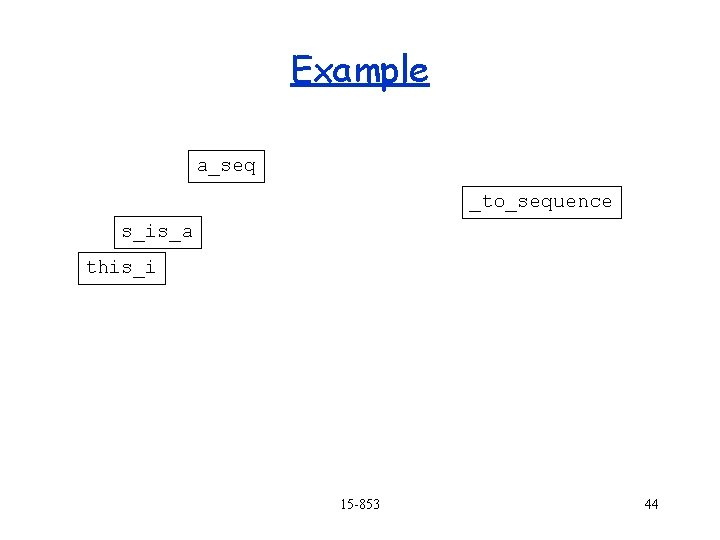
Example a_seq this_i _to_sequence s_is_a 15 -853 43
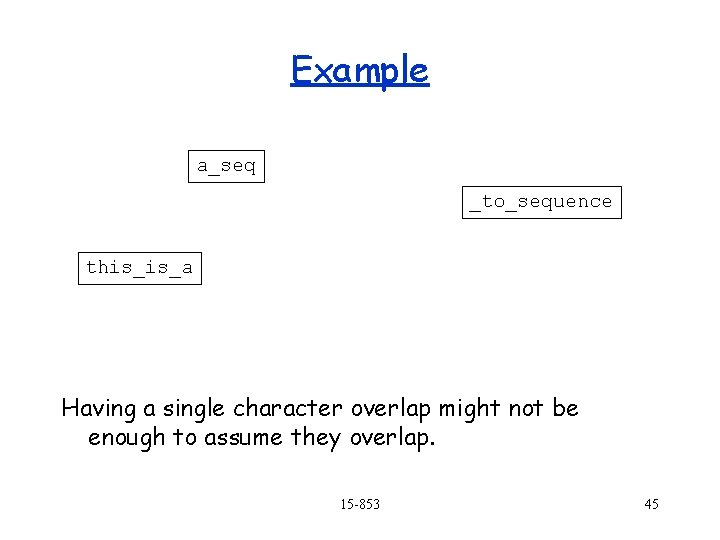
Example a_seq _to_sequence s_is_a this_i 15 -853 44
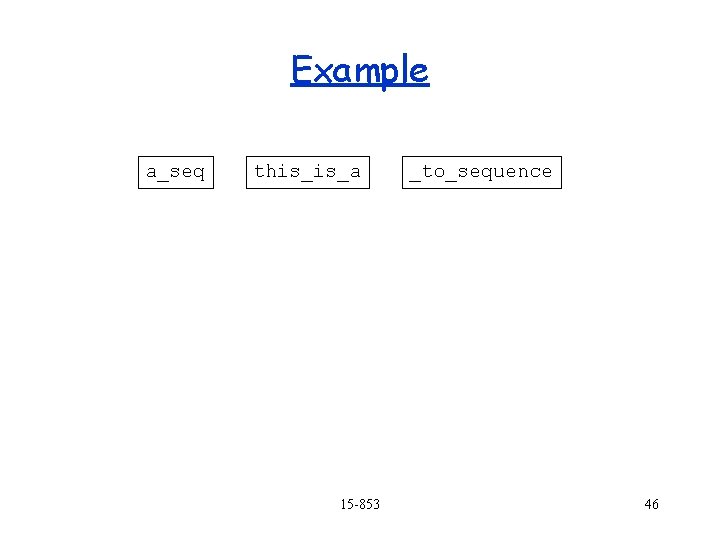
Example a_seq _to_sequence this_is_a Having a single character overlap might not be enough to assume they overlap. 15 -853 45
Example a_seq this_is_a 15 -853 _to_sequence 46
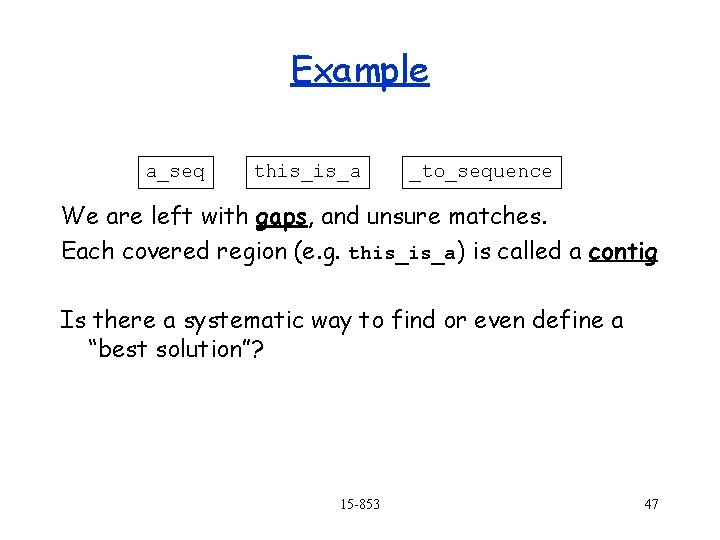
Example a_seq this_is_a _to_sequence We are left with gaps, and unsure matches. Each covered region (e. g. this_is_a) is called a contig Is there a systematic way to find or even define a “best solution”? 15 -853 47
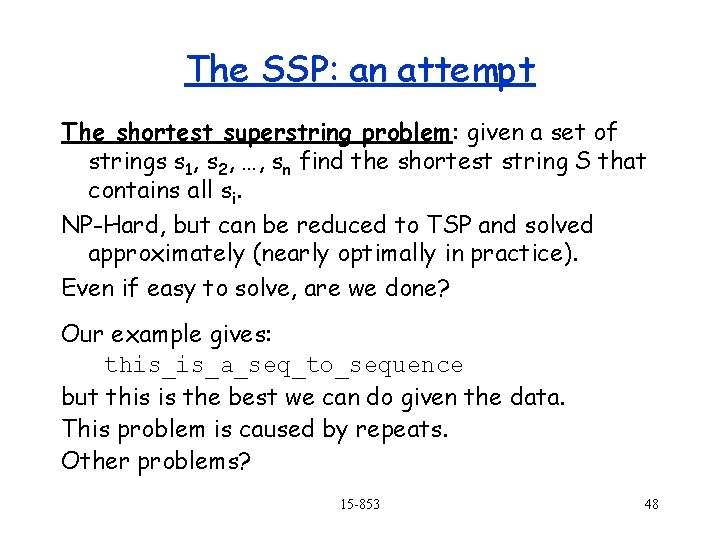
The SSP: an attempt The shortest superstring problem: given a set of strings s 1, s 2, …, sn find the shortest string S that contains all si. NP-Hard, but can be reduced to TSP and solved approximately (nearly optimally in practice). Even if easy to solve, are we done? Our example gives: this_is_a_seq_to_sequence but this is the best we can do given the data. This problem is caused by repeats. Other problems? 15 -853 48
Problems In practice the data is noisy. – Reads have up to a 1% error rate – Samples could have contaminants – Fragments can sometimes join up The reads could be in either direction (front-to-back or back-to-front). Cannot distinguish. 15 -853 49
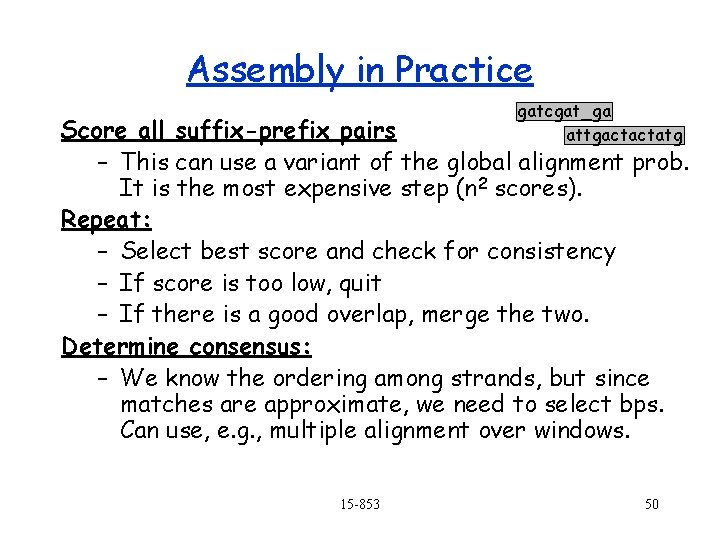
Assembly in Practice gatcgat_ga attgactactatg Score all suffix-prefix pairs – This can use a variant of the global alignment prob. It is the most expensive step (n 2 scores). Repeat: – Select best score and check for consistency – If score is too low, quit – If there is a good overlap, merge the two. Determine consensus: – We know the ordering among strands, but since matches are approximate, we need to select bps. Can use, e. g. , multiple alignment over windows. 15 -853 50
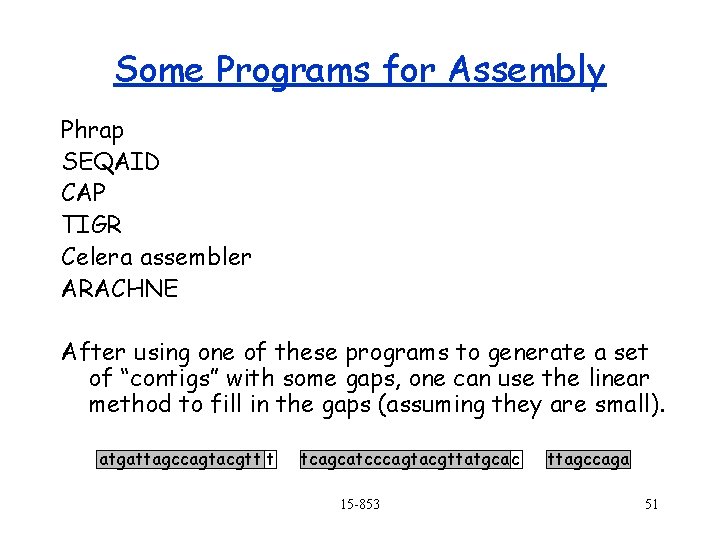
Some Programs for Assembly Phrap SEQAID CAP TIGR Celera assembler ARACHNE After using one of these programs to generate a set of “contigs” with some gaps, one can use the linear method to fill in the gaps (assuming they are small). atgattagccagtacgtt t tcagcatcccagtacgttatgca c 15 -853 ttagccaga 51
Suquencing the Whole Genome Problem: we only know how to sequence about 500 bps at a time in the lab. 1. 2. 3. 4. Linear sequencing The shotgun method Hierarchical shotgun method Whole genome and double-barreled shotgun methods 15 -853 52
Shotgun on the Whole Genome? Problems: – Computationally very expensive – 50% of genome consist of repeats. Causes major problems. – Hard to partition work among multiple labs. 15 -853 53
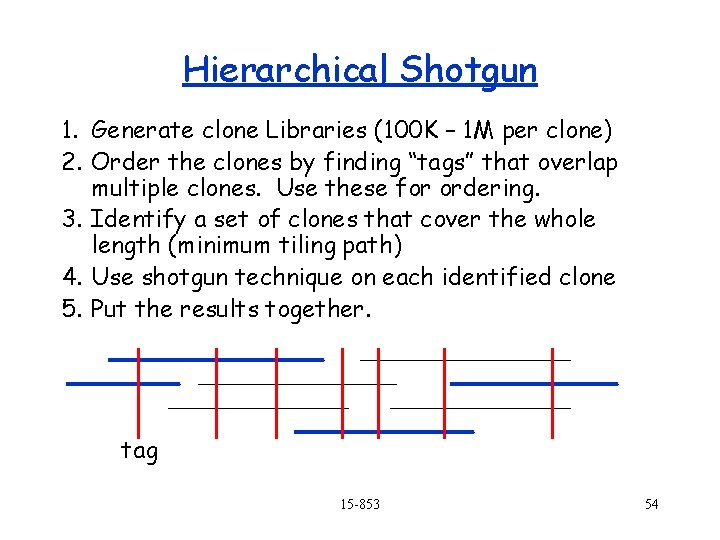
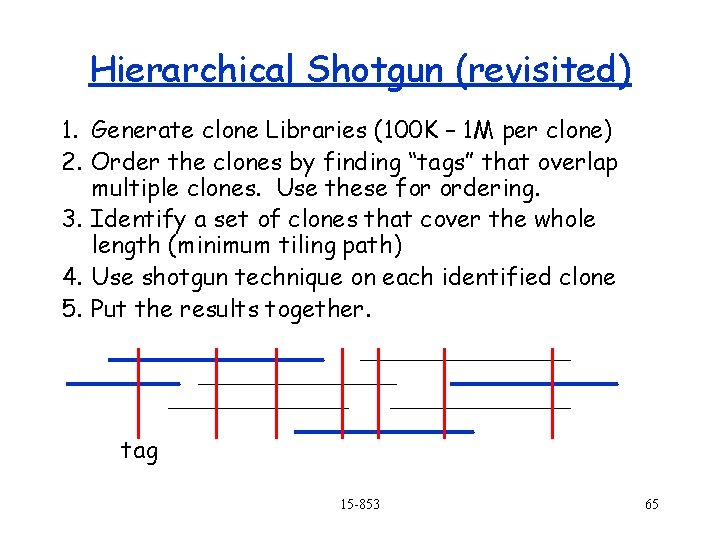
Hierarchical Shotgun 1. Generate clone Libraries (100 K – 1 M per clone) 2. Order the clones by finding “tags” that overlap multiple clones. Use these for ordering. 3. Identify a set of clones that cover the whole length (minimum tiling path) 4. Use shotgun technique on each identified clone 5. Put the results together. tag 15 -853 54
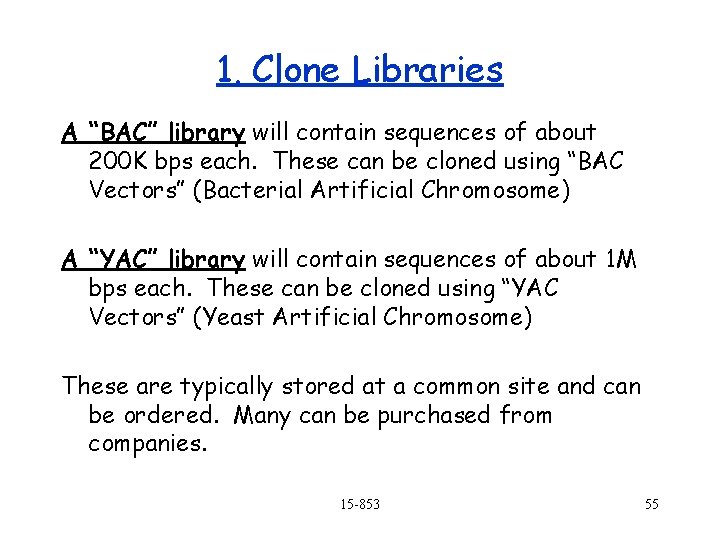
1. Clone Libraries A “BAC” library will contain sequences of about 200 K bps each. These can be cloned using “BAC Vectors” (Bacterial Artificial Chromosome) A “YAC” library will contain sequences of about 1 M bps each. These can be cloned using “YAC Vectors” (Yeast Artificial Chromosome) These are typically stored at a common site and can be ordered. Many can be purchased from companies. 15 -853 55
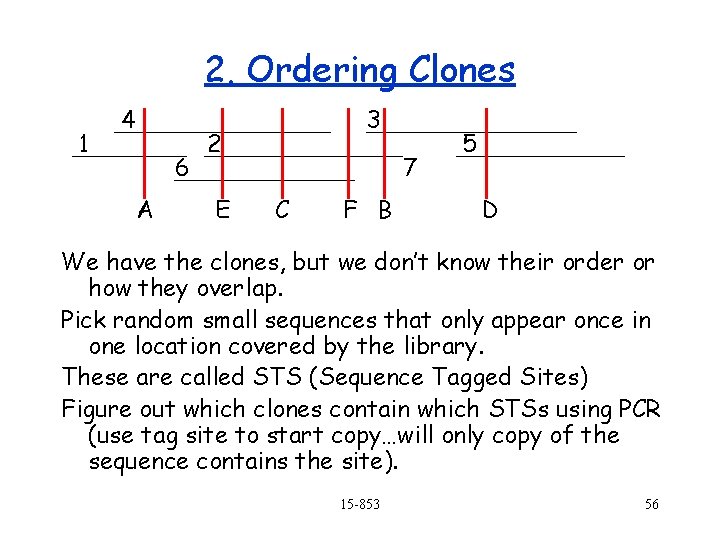
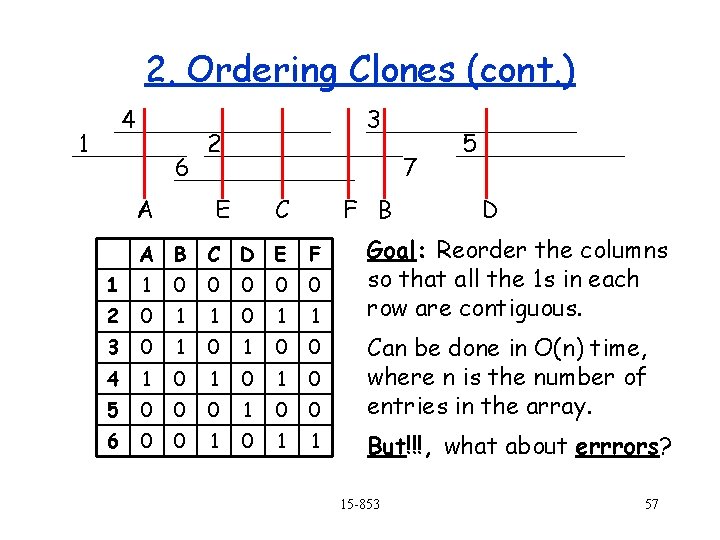
2. Ordering Clones 1 4 6 A 3 2 E 7 C F B 5 D We have the clones, but we don’t know their order or how they overlap. Pick random small sequences that only appear once in one location covered by the library. These are called STS (Sequence Tagged Sites) Figure out which clones contain which STSs using PCR (use tag site to start copy…will only copy of the sequence contains the site). 15 -853 56
2. Ordering Clones (cont. ) 4 1 6 A 3 2 7 E C F B 5 D Goal: Reorder the columns so that all the 1 s in each row are contiguous. A B C D E F 1 1 0 0 0 2 0 1 1 3 0 1 0 0 4 1 0 1 0 5 0 0 0 1 0 0 Can be done in O(n) time, where n is the number of entries in the array. 6 0 0 1 1 But!!!, what about errrors? 15 -853 57
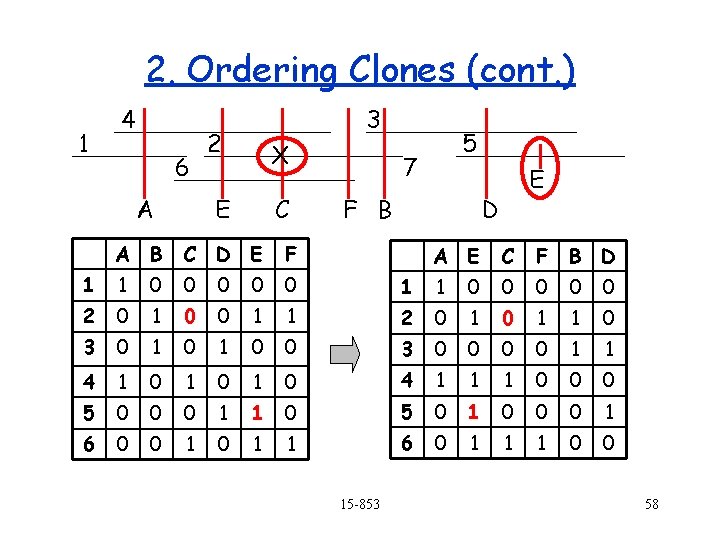
2. Ordering Clones (cont. ) 1 4 6 A 3 2 X E C A B C D E F 1 1 0 0 0 2 0 1 0 0 1 3 0 1 4 1 0 1 5 0 0 6 0 0 5 7 F B E D A E C F B D 1 1 0 0 0 1 2 0 1 1 0 0 0 3 0 0 1 1 0 4 1 1 1 0 0 1 1 0 5 0 1 0 0 0 1 1 6 0 1 1 1 0 0 15 -853 58
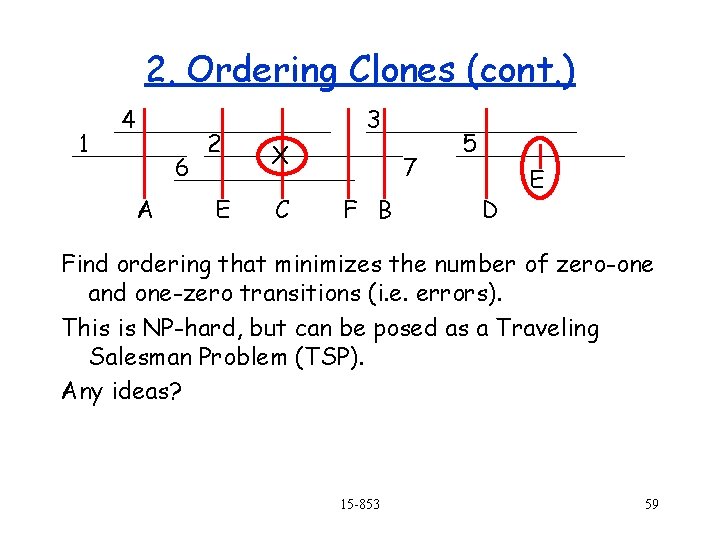
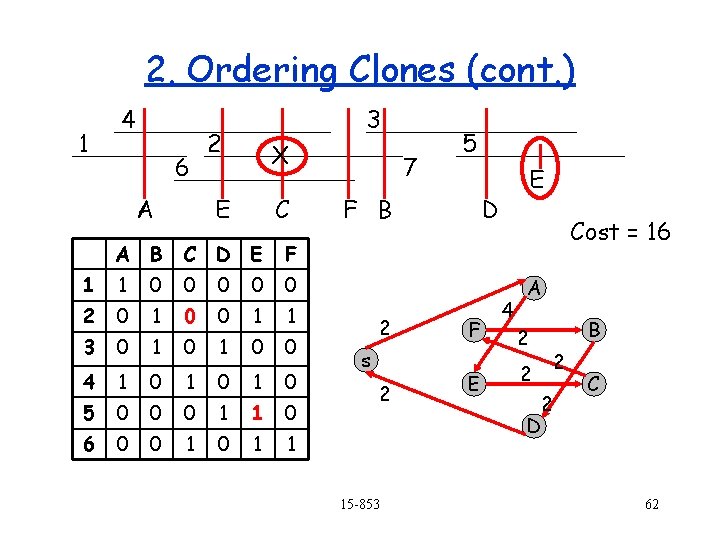
2. Ordering Clones (cont. ) 1 4 6 A 2 E 3 X C 7 F B 5 D E Find ordering that minimizes the number of zero-one and one-zero transitions (i. e. errors). This is NP-hard, but can be posed as a Traveling Salesman Problem (TSP). Any ideas? 15 -853 59
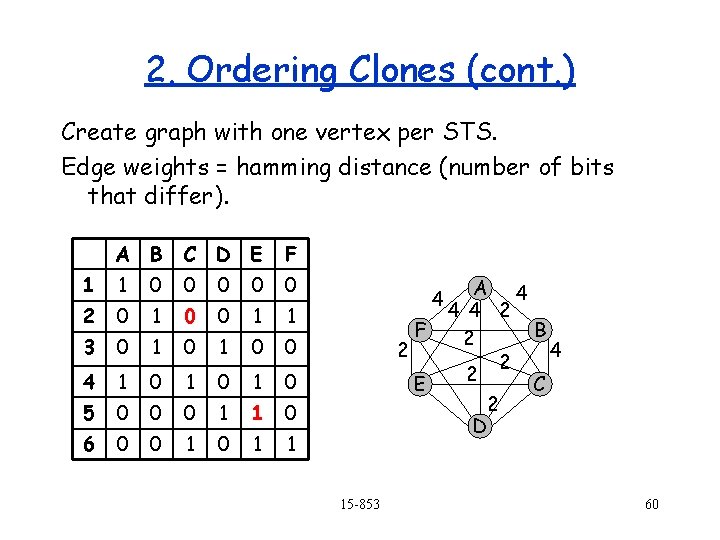
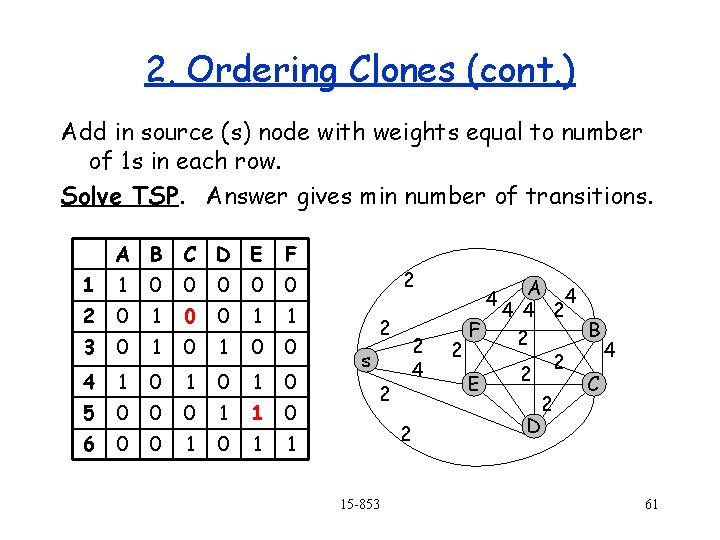
2. Ordering Clones (cont. ) Create graph with one vertex per STS. Edge weights = hamming distance (number of bits that differ). A B C D E F 1 1 0 0 0 2 0 1 0 0 1 1 3 0 1 0 0 4 1 0 1 0 5 0 0 0 1 1 0 6 0 0 1 1 4 2 F E 15 -853 A 4 4 4 2 B 2 4 2 2 C 2 D 60
2. Ordering Clones (cont. ) Add in source (s) node with weights equal to number of 1 s in each row. Solve TSP. Answer gives min number of transitions. A B C D E F 1 1 0 0 0 2 0 1 0 0 1 1 3 0 1 0 0 4 1 0 1 0 5 0 0 0 1 1 0 6 0 0 1 1 2 2 s 2 2 4 2 15 -853 4 2 F E A 4 4 4 2 B 2 4 2 2 C 2 D 61
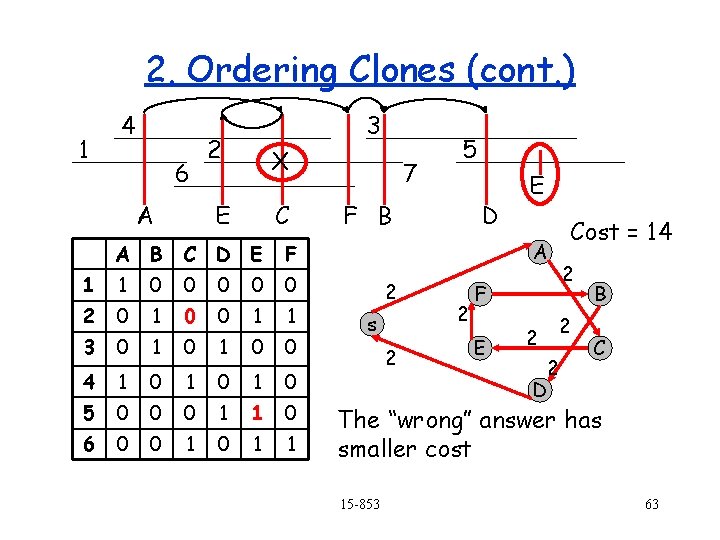
2. Ordering Clones (cont. ) 1 4 6 A 3 2 X E C A B C D E F 1 1 0 0 0 2 0 1 0 0 1 1 3 0 1 0 0 4 1 0 1 0 5 0 0 0 1 1 0 6 0 0 1 1 7 5 F B 2 s 2 15 -853 E D F E Cost = 16 4 A 2 2 B 2 2 D C 62
2. Ordering Clones (cont. ) 1 4 6 A 3 2 X E C A B C D E F 1 1 0 0 0 2 0 1 0 0 1 1 3 0 1 0 0 4 1 0 1 0 5 0 0 0 1 1 0 6 0 0 1 1 7 5 F B D E Cost = 14 A 2 s 2 2 2 F E 2 2 2 D B C The “wrong” answer has smaller cost 15 -853 63
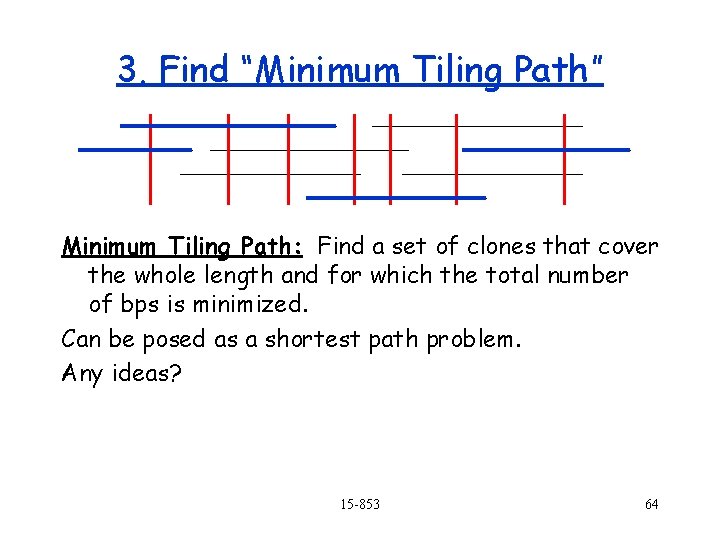
3. Find “Minimum Tiling Path” Minimum Tiling Path: Find a set of clones that cover the whole length and for which the total number of bps is minimized. Can be posed as a shortest path problem. Any ideas? 15 -853 64
Hierarchical Shotgun (revisited) 1. Generate clone Libraries (100 K – 1 M per clone) 2. Order the clones by finding “tags” that overlap multiple clones. Use these for ordering. 3. Identify a set of clones that cover the whole length (minimum tiling path) 4. Use shotgun technique on each identified clone 5. Put the results together. tag 15 -853 65
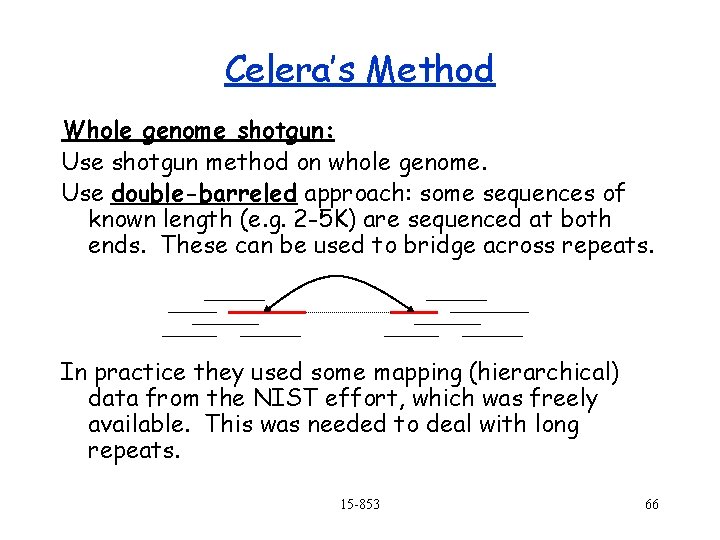
Celera’s Method Whole genome shotgun: Use shotgun method on whole genome. Use double-barreled approach: some sequences of known length (e. g. 2 -5 K) are sequenced at both ends. These can be used to bridge across repeats. In practice they used some mapping (hierarchical) data from the NIST effort, which was freely available. This was needed to deal with long repeats. 15 -853 66