
15 834 Marketing Strategy Cases and lectures Letter
- Slides: 62
15. 834 Marketing Strategy • Cases and lectures • Letter of Complaint 15. 834 Marketing Strategy
Objectives • Identify, evaluate, and develop marketing strategies • Evaluate a firm’s opportunities • Anticipate competitive dynamics • Evaluate the sustainability of competitive advantages 15. 834 Marketing Strategy
Target Audience • Consultants • Investment Analysts • Entrepreneurs • Product Managers 15. 834 Marketing Strategy
I What Is Marketing Strategy? What is Marketing Strategy? Finding Profit Opportunities Creating Competitive Advantage Challenging Competitive Advantage Creating Corporate Advantage 15. 834 Marketing Strategy
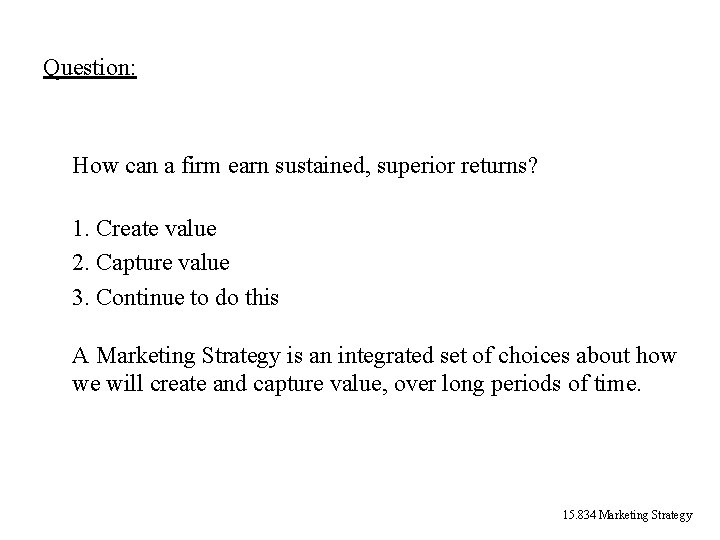
Question: How can a firm earn sustained, superior returns? 1. Create value 2. Capture value 3. Continue to do this A Marketing Strategy is an integrated set of choices about how we will create and capture value, over long periods of time. 15. 834 Marketing Strategy
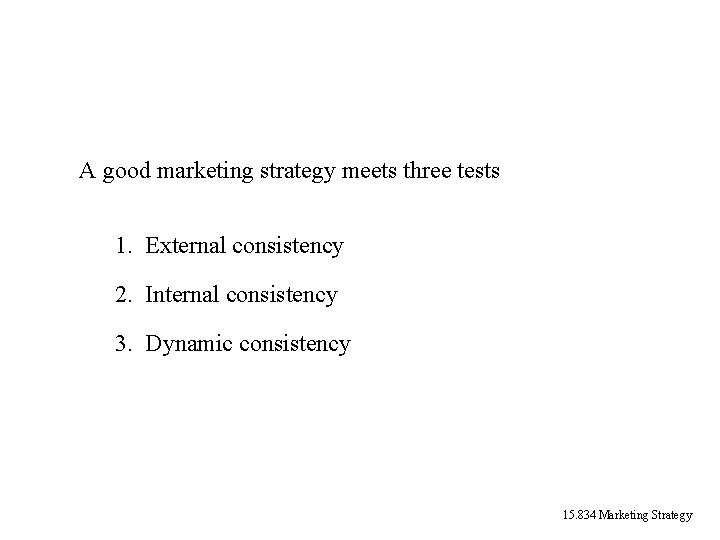
A good marketing strategy meets three tests 1. External consistency 2. Internal consistency 3. Dynamic consistency 15. 834 Marketing Strategy
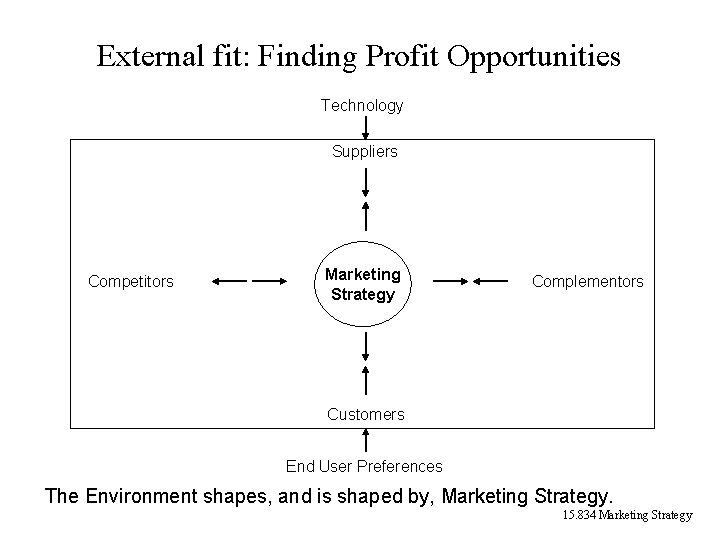
External fit: Finding Profit Opportunities Technology Suppliers Competitors Marketing Strategy Complementors Customers End User Preferences The Environment shapes, and is shaped by, Marketing Strategy. 15. 834 Marketing Strategy
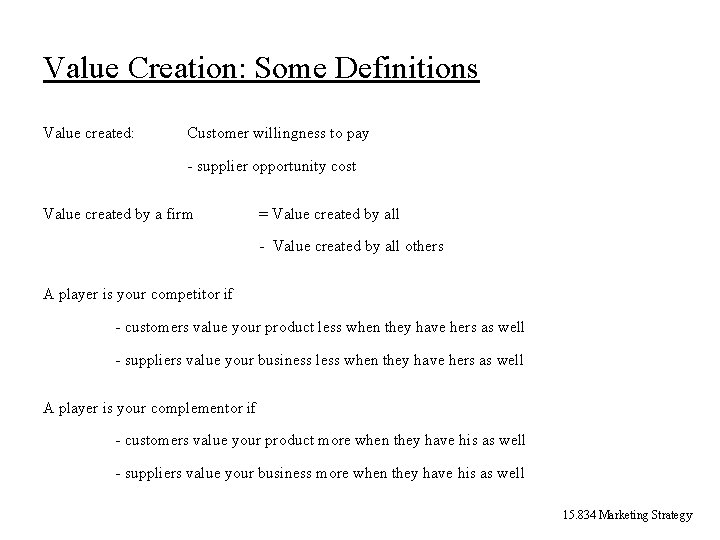
Value Creation: Some Definitions Value created: Customer willingness to pay - supplier opportunity cost Value created by a firm = Value created by all - Value created by all others A player is your competitor if - customers value your product less when they have hers as well - suppliers value your business less when they have hers as well A player is your complementor if - customers value your product more when they have his as well - suppliers value your business more when they have his as well 15. 834 Marketing Strategy
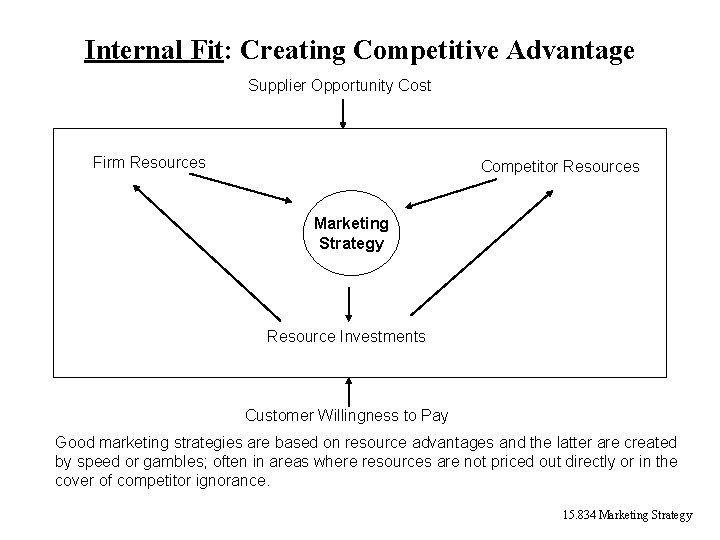
Internal Fit: Creating Competitive Advantage Supplier Opportunity Cost Firm Resources Competitor Resources Marketing Strategy Resource Investments Customer Willingness to Pay Good marketing strategies are based on resource advantages and the latter are created by speed or gambles; often in areas where resources are not priced out directly or in the cover of competitor ignorance. 15. 834 Marketing Strategy
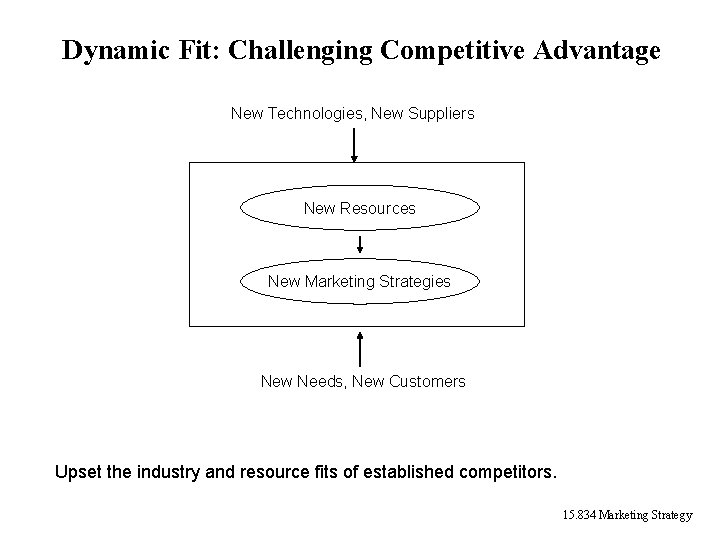
Dynamic Fit: Challenging Competitive Advantage New Technologies, New Suppliers New Resources New Marketing Strategies New Needs, New Customers Upset the industry and resource fits of established competitors. 15. 834 Marketing Strategy
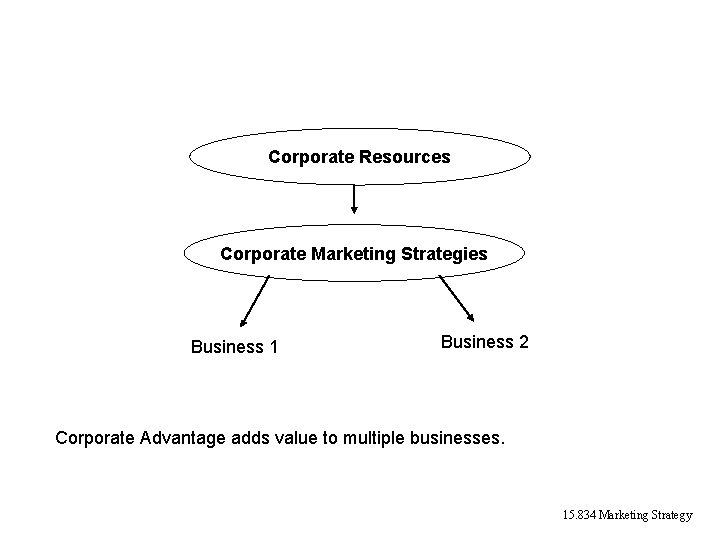
Corporate Resources Corporate Marketing Strategies Business 1 Business 2 Corporate Advantage adds value to multiple businesses. 15. 834 Marketing Strategy
II Finding Profit Opportunities What is Marketing Strategy? Finding Profit Opportunities Creating Competitive Advantage Challenging Competitive Advantage Creating Corporate Advantage Lobsters Disney Computer games Browsers 15. 834 Marketing Strategy
To craft an effective marketing strategy, you must take account of the environment • • to decide on entry/exit to assess the effect of a major change to position your firm to succeed in a given environment to shape the environment But the environment is enormously complex You need structured ways of thinking about it – to capture the richness – but separate signal from noise 15. 834 Marketing Strategy
Some Complementary Approaches • Classical Economics (Supply and Demand) • “Old” Industrial Organization Economics (5 forces) • Non cooperative Game Theory (Oligopoly equilibrium) • Cooperative Game Theory (Value net) 15. 834 Marketing Strategy
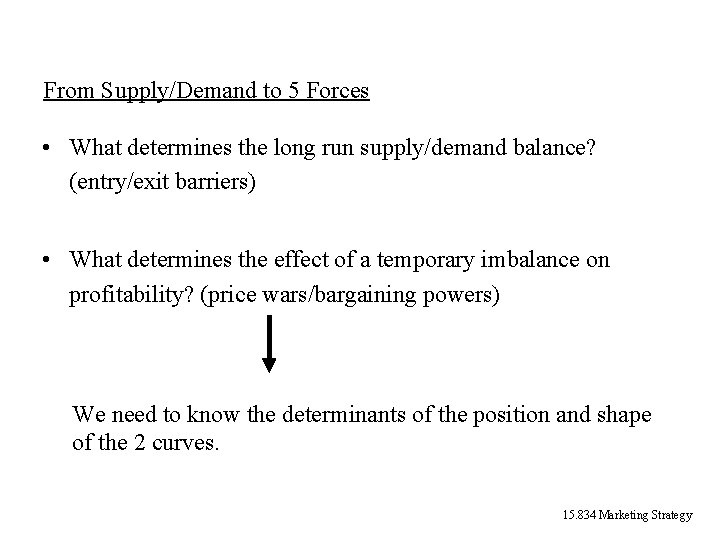
From Supply/Demand to 5 Forces • What determines the long run supply/demand balance? (entry/exit barriers) • What determines the effect of a temporary imbalance on profitability? (price wars/bargaining powers) We need to know the determinants of the position and shape of the 2 curves. 15. 834 Marketing Strategy
Using the 5 Forces • Identify long-run industry profitability • Identify pressures on profits • Identify ways to alter industry structure • Identify attractive positions 15. 834 Marketing Strategy
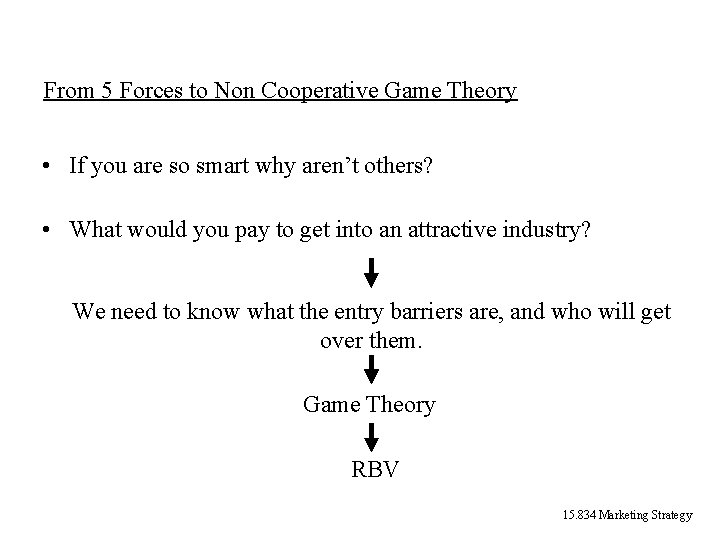
From 5 Forces to Non Cooperative Game Theory • If you are so smart why aren’t others? • What would you pay to get into an attractive industry? We need to know what the entry barriers are, and who will get over them. Game Theory RBV 15. 834 Marketing Strategy
Using Non-Cooperative Game Theory • Forecast industry evolution • Decide on entry/exit • Identify critical competitors • Decide which game you want to play 15. 834 Marketing Strategy
Horizontal Trading Relationships: Forecasting Industry Evolution with Increasing Returns • Increasing returns are the tendency for that which is ahead to get further ahead, and for that which loses advantage to lose further advantage • small differences in initial conditions can cause large differences in long-run outcomes ex: Network effects can dwarf product effects. “Better” products can lose out to products that “fit better”. 15. 834 Marketing Strategy
For Vertical Trading Relationships: From Non-Cooperative to Cooperative Game Theory • Which game do we all want to play? • How can we avoid killing each other? In the long run we would expect the most efficient industry structure -that which creates most value in total. Splitting the pie is another question. 15. 834 Marketing Strategy
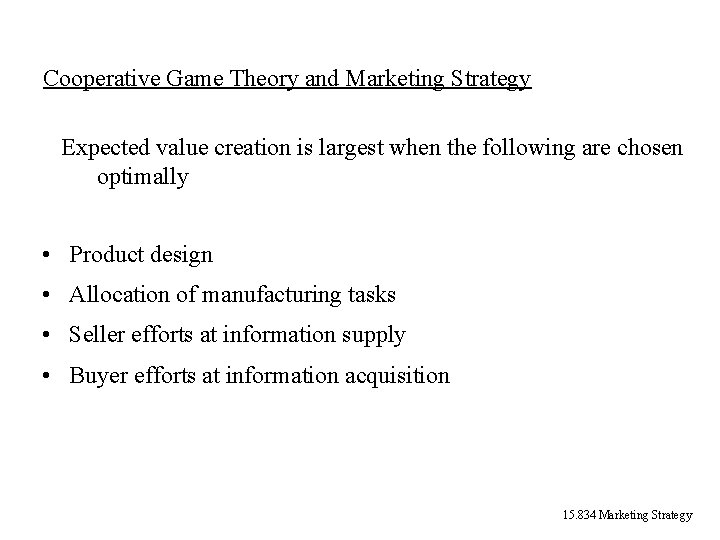
Cooperative Game Theory and Marketing Strategy Expected value creation is largest when the following are chosen optimally • Product design • Allocation of manufacturing tasks • Seller efforts at information supply • Buyer efforts at information acquisition 15. 834 Marketing Strategy
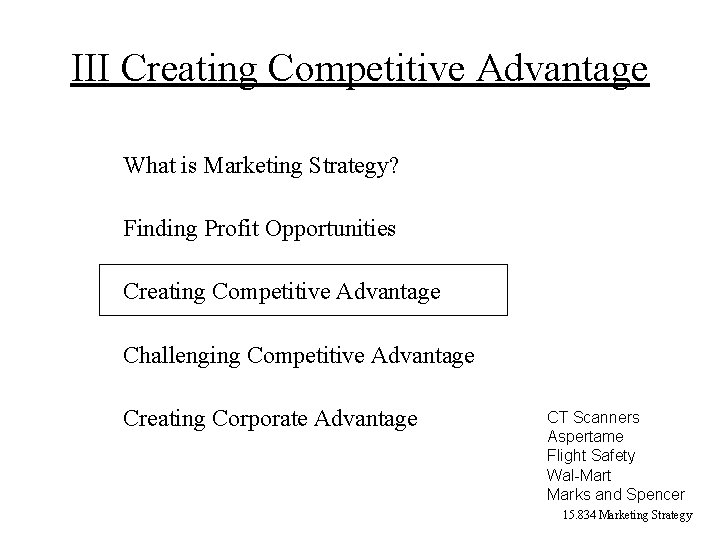
III Creating Competitive Advantage What is Marketing Strategy? Finding Profit Opportunities Creating Competitive Advantage Challenging Competitive Advantage Creating Corporate Advantage CT Scanners Aspertame Flight Safety Wal-Mart Marks and Spencer 15. 834 Marketing Strategy
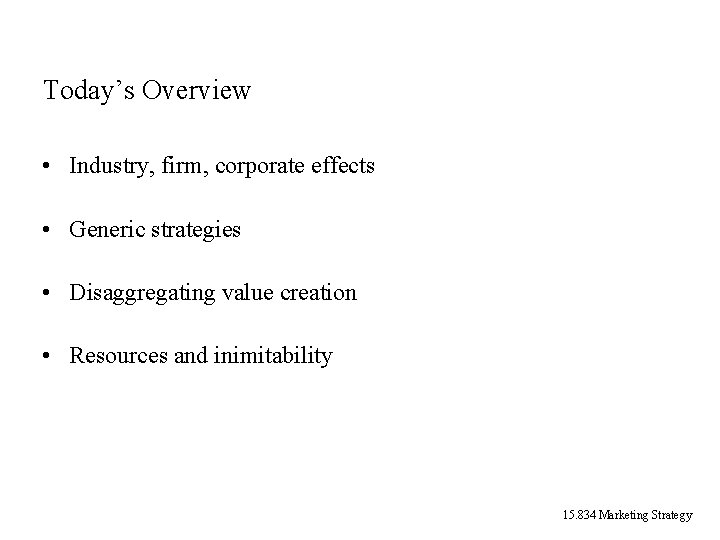
Today’s Overview • Industry, firm, corporate effects • Generic strategies • Disaggregating value creation • Resources and inimitability 15. 834 Marketing Strategy
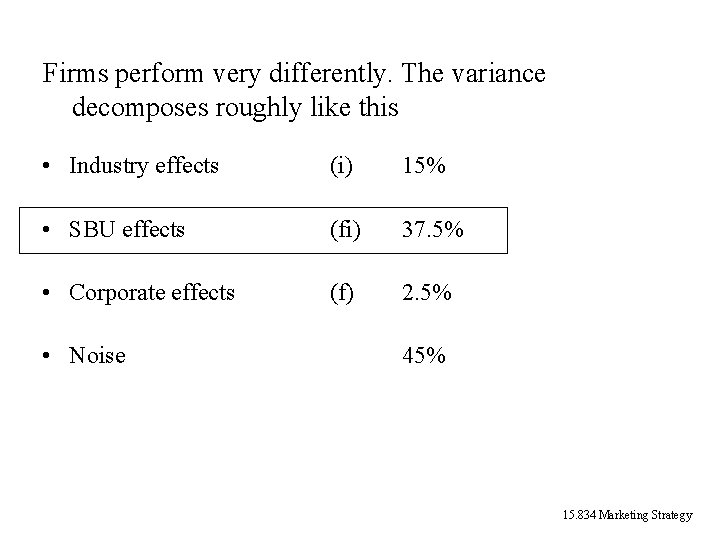
Firms perform very differently. The variance decomposes roughly like this • Industry effects (i) 15% • SBU effects (fi) 37. 5% • Corporate effects (f) 2. 5% • Noise 45% 15. 834 Marketing Strategy
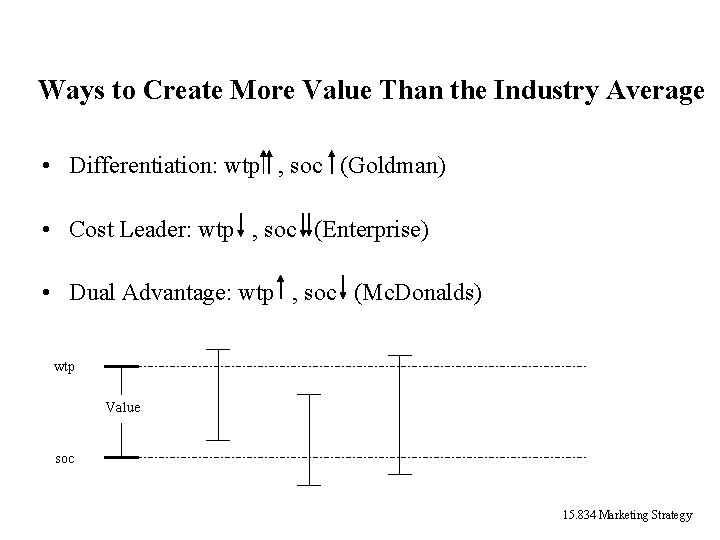
Ways to Create More Value Than the Industry Average • Differentiation: wtp , soc (Goldman) • Cost Leader: wtp , soc (Enterprise) • Dual Advantage: wtp , soc (Mc. Donalds) wtp Value soc 15. 834 Marketing Strategy
Two Simple, But Critical, Points • your strategy should be based on the strengths that differentiate you from competitors, your resources. • to decide on a strategy, you therefore need to identify those resources. • It may not be necessary to worry about creating more, or new, resources. 15. 834 Marketing Strategy
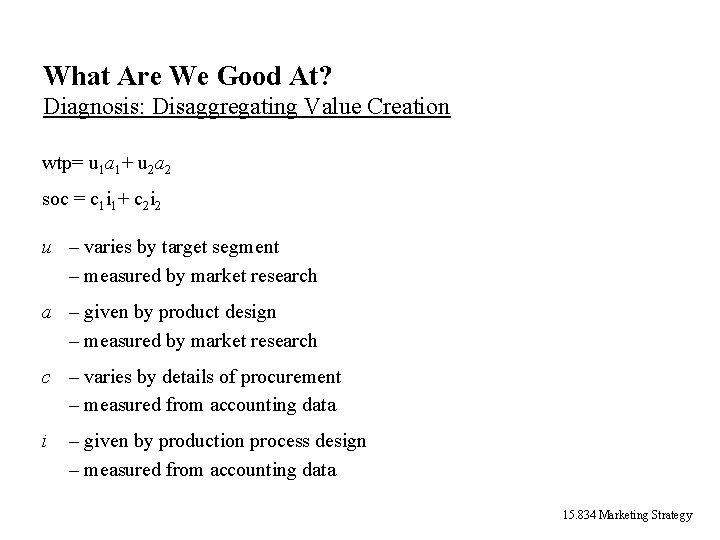
What Are We Good At? Diagnosis: Disaggregating Value Creation wtp= u 1 a 1+ u 2 a 2 soc = c 1 i 1+ c 2 i 2 u – varies by target segment – measured by market research a – given by product design – measured by market research c – varies by details of procurement – measured from accounting data i – given by production process design – measured from accounting data 15. 834 Marketing Strategy
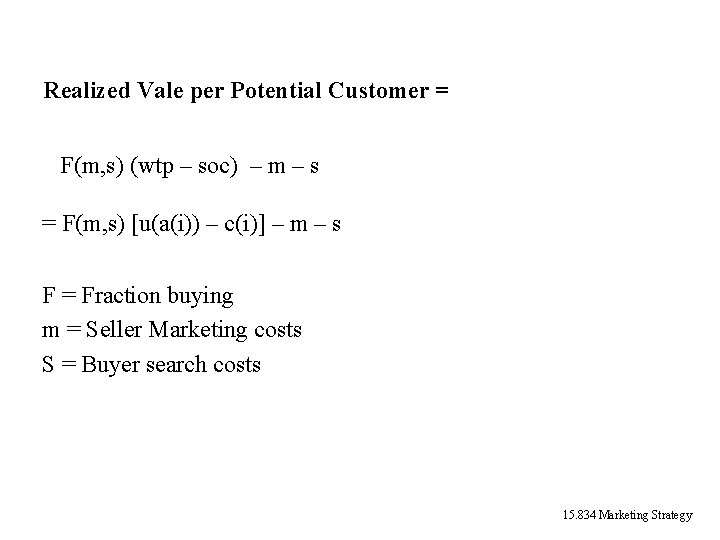
Realized Vale per Potential Customer = F(m, s) (wtp – soc) – m – s = F(m, s) [u(a(i)) – c(i)] – m – s F = Fraction buying m = Seller Marketing costs S = Buyer search costs 15. 834 Marketing Strategy
You create value when you do what no one else can do In most cases other players can pick segments (u), product designs (a), suppliers (c), and inputs (i) from the same menu as you can. Most differences are in the a(i) and F(m) functions. 15. 834 Marketing Strategy
Reasons for Competitive Advantage • Why would it be cheaper for P&G to launch a new product? – Reputation with retailers – Leverage brand names • Why would it be cheaper for P&G to design a new product? – Established set of routines – Already have designed similar products • Why would P&G have lower manufacturing costs? – They have a patent – They can gain economics of scope in transport 15. 834 Marketing Strategy
Resources Why competitors can’t/won’t get them • Unique and owned by you » patent • Unique and can’t be sold » Smith and Jones • Not clear how to create it » culture • Not clear what it is » good at X • Preemptive first mover advantages » awareness • Dynamic return to scale » experience 15. 834 Marketing Strategy
From Leveraging to Building Competitive Advantage • If several identical competitors have symmetric information, the expected return to investments in resources is zero (ex ante). Resources are created in three ways 1) based on existing resource asymmetries 2) as results of lucky outcomes 3) by taking advantage of slow or sleeping competitors 15. 834 Marketing Strategy
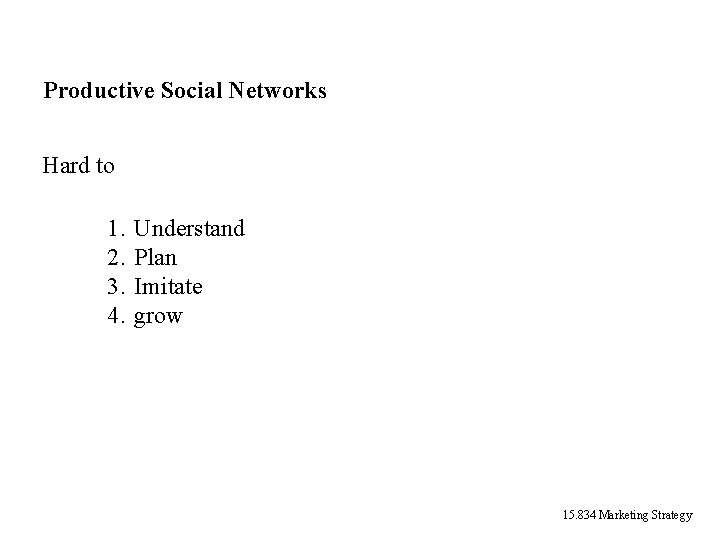
Productive Social Networks Hard to 1. 2. 3. 4. Understand Plan Imitate grow 15. 834 Marketing Strategy
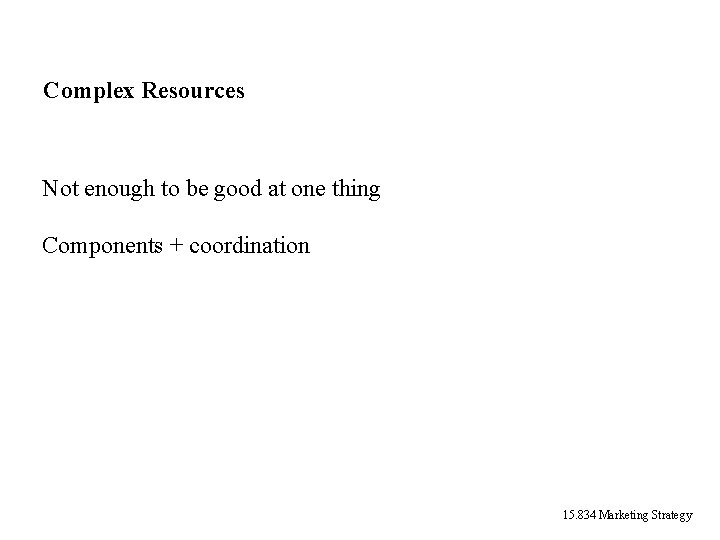
Complex Resources Not enough to be good at one thing Components + coordination 15. 834 Marketing Strategy
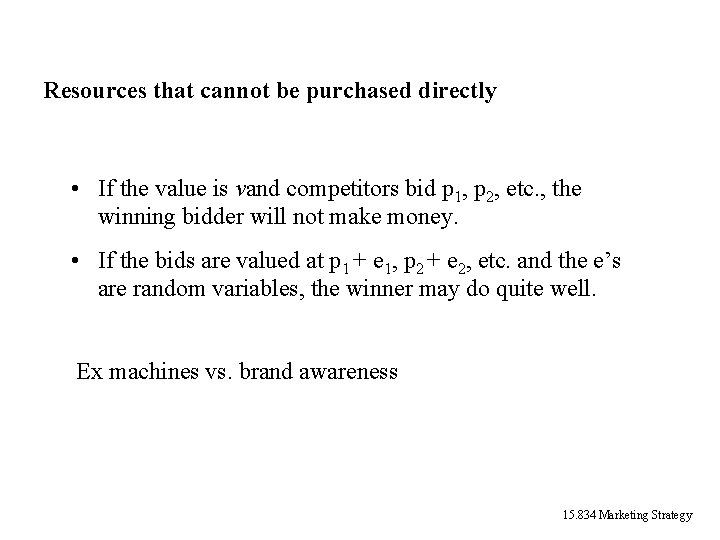
Resources that cannot be purchased directly • If the value is vand competitors bid p 1, p 2, etc. , the winning bidder will not make money. • If the bids are valued at p 1 + e 1, p 2 + e 2, etc. and the e’s are random variables, the winner may do quite well. Ex machines vs. brand awareness 15. 834 Marketing Strategy
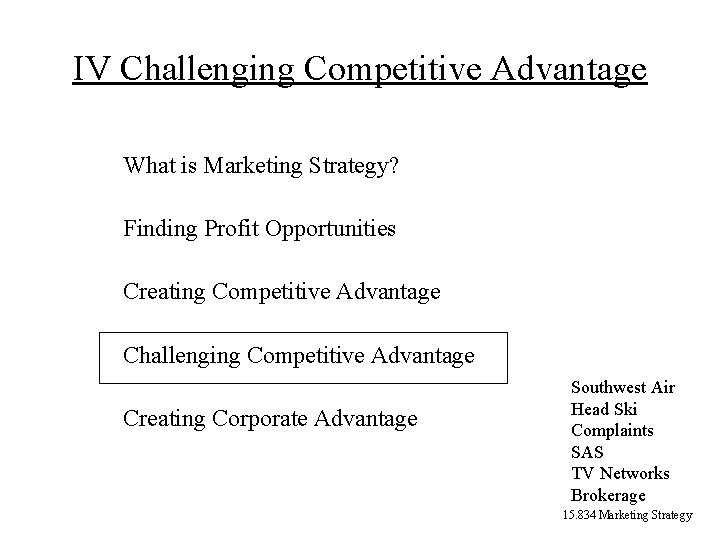
IV Challenging Competitive Advantage What is Marketing Strategy? Finding Profit Opportunities Creating Competitive Advantage Challenging Competitive Advantage Creating Corporate Advantage Southwest Air Head Ski Complaints SAS TV Networks Brokerage 15. 834 Marketing Strategy
A start-up needs to use its initial resources to build a new set of resources that • can be leveraged • are sustainable 15. 834 Marketing Strategy
Resources of start-ups • Small social networks • Ideas • Management skills 15. 834 Marketing Strategy
Today’s Overview • Ways to Attack • Times to Attack • Vulnerability of Incumbents 15. 834 Marketing Strategy
The Two Principal Ways to Challenge Competitive Advantage Are • Resource Imitation • Resource Substitution 15. 834 Marketing Strategy
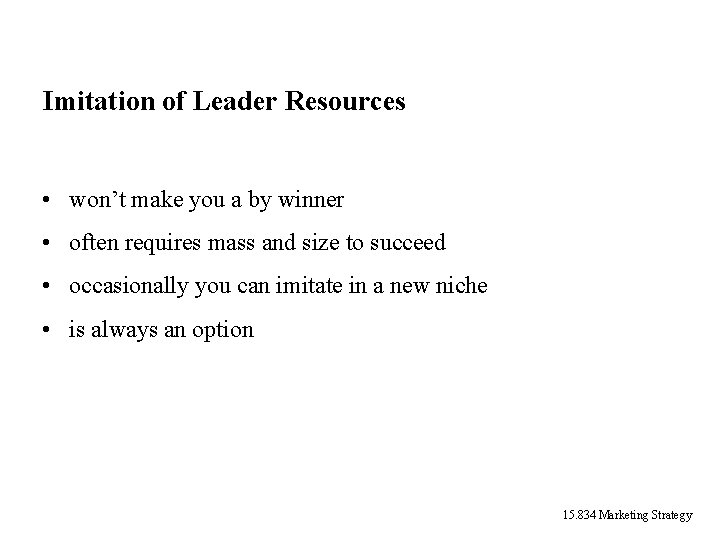
Imitation of Leader Resources • won’t make you a by winner • often requires mass and size to succeed • occasionally you can imitate in a new niche • is always an option 15. 834 Marketing Strategy
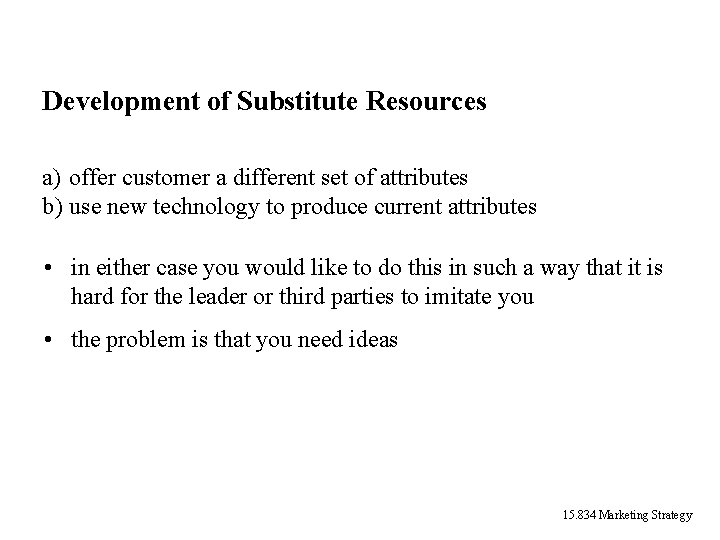
Development of Substitute Resources a) offer customer a different set of attributes b) use new technology to produce current attributes • in either case you would like to do this in such a way that it is hard for the leader or third parties to imitate you • the problem is that you need ideas 15. 834 Marketing Strategy
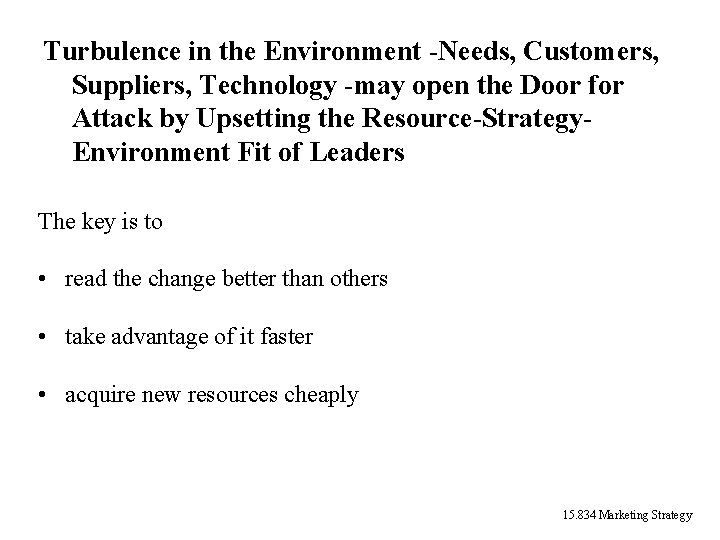
Turbulence in the Environment -Needs, Customers, Suppliers, Technology -may open the Door for Attack by Upsetting the Resource-Strategy. Environment Fit of Leaders The key is to • read the change better than others • take advantage of it faster • acquire new resources cheaply 15. 834 Marketing Strategy
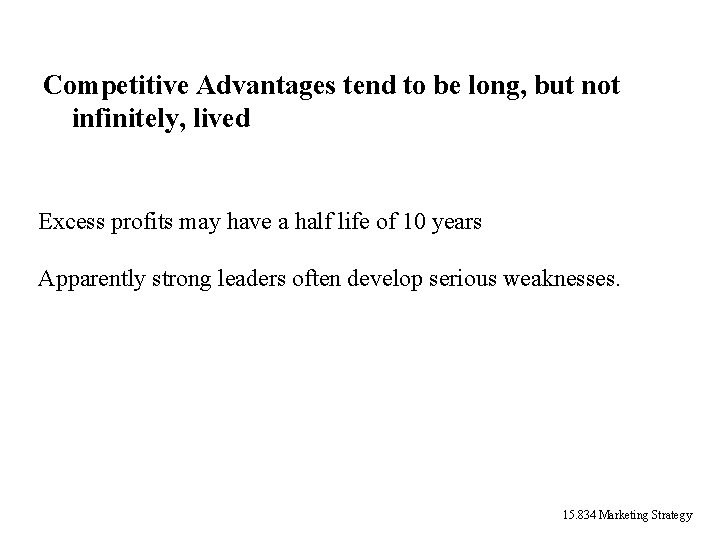
Competitive Advantages tend to be long, but not infinitely, lived Excess profits may have a half life of 10 years Apparently strong leaders often develop serious weaknesses. 15. 834 Marketing Strategy
Ceterus Paribus, One would prefer Resources that have more flexible Applications • can select best use • may be able to put to more uses • robust to changes in environment 15. 834 Marketing Strategy
In practice, many resources can only create value under a narrow set of circumstances. • Such resources are cheaper to create • fewer competitors have a chance to develop such resources less competition • commitment and preemption requires narrowness 15. 834 Marketing Strategy
When the environment changes, some resources turn into handicaps • • • Explicit contracts Implicit contracts Culture Reputation Brand names Leader may be fat and lazy 15. 834 Marketing Strategy
NO ONE IS IMMUNE FROM ATTACK IT IS A QUESTION OF TIMING 15. 834 Marketing Strategy
V Creating Corporate Advantage What is Marketing Strategy? Finding Profit Opportunities Creating Competitive Advantage Challenging Competitive Advantage Creating Corporate Advantage Costco Newell 15. 834 Marketing Strategy
Today’s Overview • Basic questions and facts • Value and diversity • Costs of making it happen • What does corporate strategy mean for marketing strategy 15. 834 Marketing Strategy
Questions • What is the appropriate scope of this firm? • How does the corporation create value through its multimarket activities? • How should the company be organized to make this happen? 15. 834 Marketing Strategy
Stylized Facts There are very few single product firms. Firms that are very diversified have lower average returns on capital. Most companies share very general resources: legal, control systems, capital budgeting systems, etc. More specific resources are rarely shared across industries. More diversified companies most often participate in “simple” industries 15. 834 Marketing Strategy
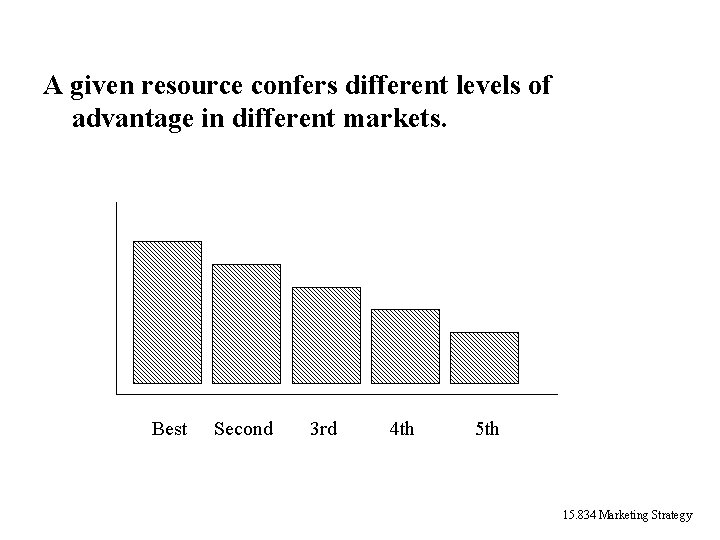
A given resource confers different levels of advantage in different markets. Best Second 3 rd 4 th 5 th 15. 834 Marketing Strategy
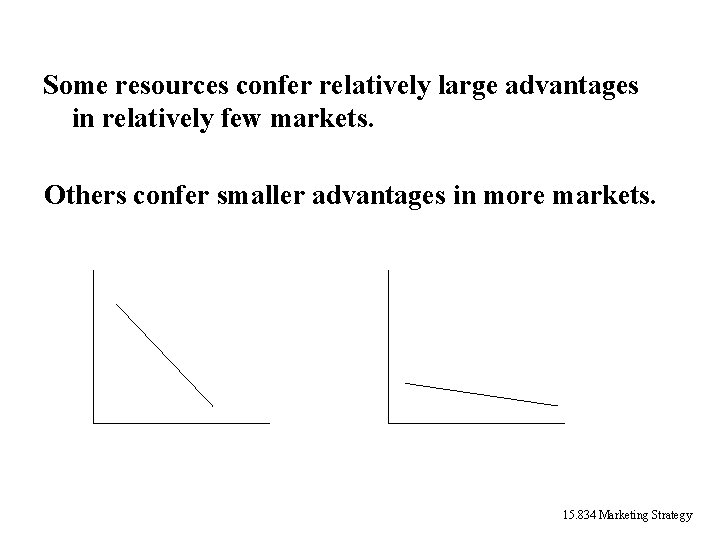
Some resources confer relatively large advantages in relatively few markets. Others confer smaller advantages in more markets. 15. 834 Marketing Strategy
There administrative costs associated with sharing or transferring of resources. The size of headquarters reflect part of these costs. If the resource confers small advantages, it has to be cheap to transfer. 15. 834 Marketing Strategy
Corporate Marketing Strategy In most large companies, there is significant corporate involvement in marketing strategy • • • umbrella branding, logos other reputation with buyers logistics -sharing trucks cross-selling -sharing sales forces information about customers process skills, e. g. npd. 15. 834 Marketing Strategy
Making It Happen It is important to be very clear about • what each resource is • how it is benefiting each business • how the application is implemented 15. 834 Marketing Strategy
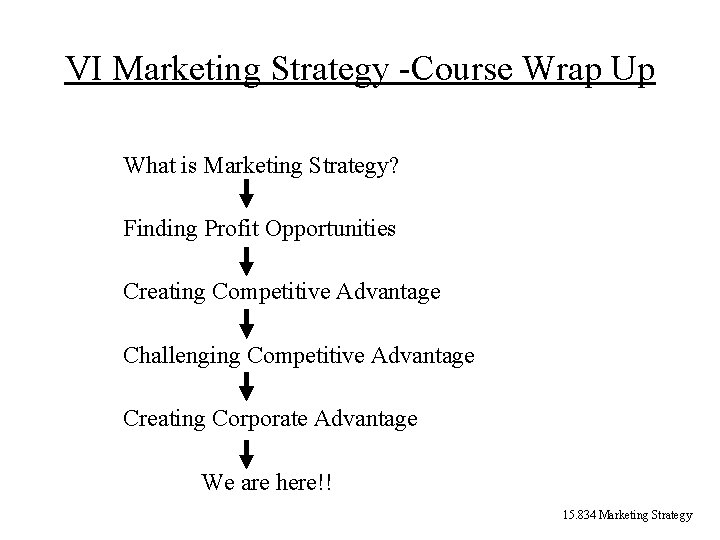
VI Marketing Strategy -Course Wrap Up What is Marketing Strategy? Finding Profit Opportunities Creating Competitive Advantage Challenging Competitive Advantage Creating Corporate Advantage We are here!! 15. 834 Marketing Strategy
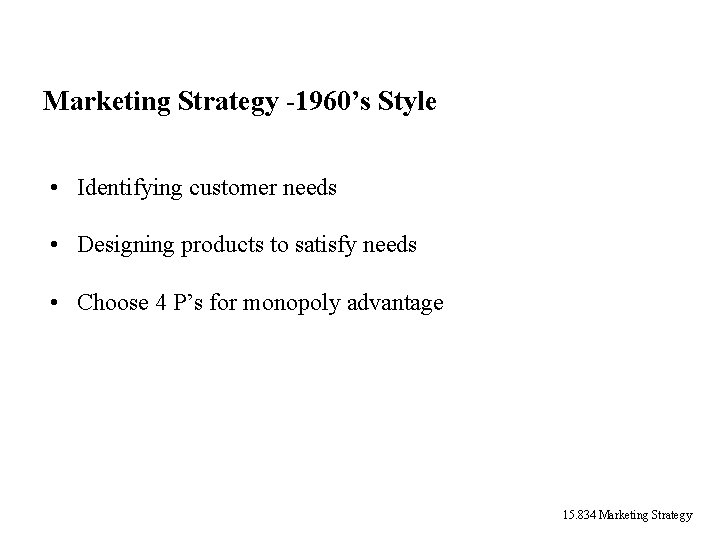
Marketing Strategy -1960’s Style • Identifying customer needs • Designing products to satisfy needs • Choose 4 P’s for monopoly advantage 15. 834 Marketing Strategy
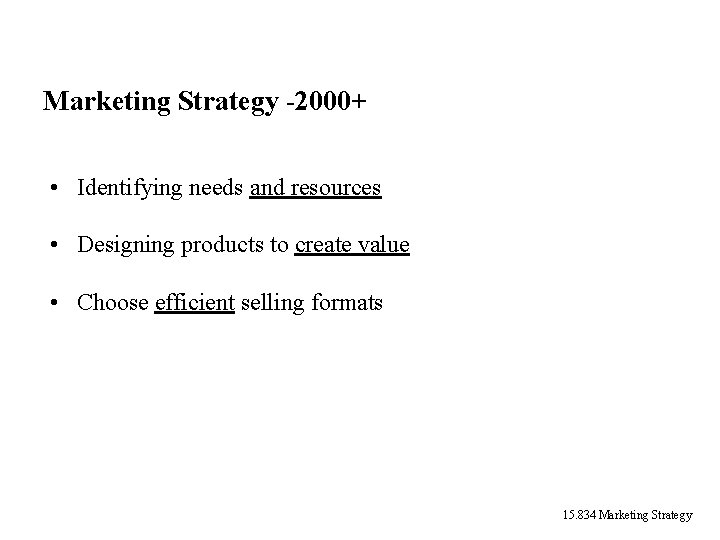
Marketing Strategy -2000+ • Identifying needs and resources • Designing products to create value • Choose efficient selling formats 15. 834 Marketing Strategy
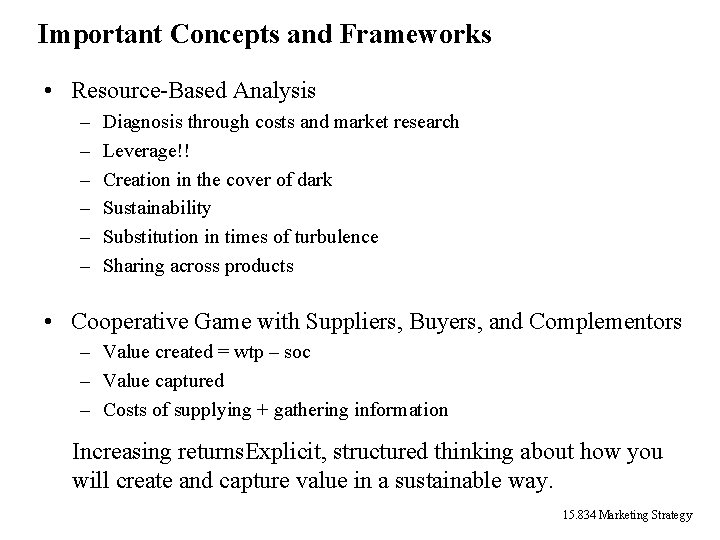
Important Concepts and Frameworks • Resource-Based Analysis – – – Diagnosis through costs and market research Leverage!! Creation in the cover of dark Sustainability Substitution in times of turbulence Sharing across products • Cooperative Game with Suppliers, Buyers, and Complementors – Value created = wtp – soc – Value captured – Costs of supplying + gathering information Increasing returns. Explicit, structured thinking about how you will create and capture value in a sustainable way. 15. 834 Marketing Strategy
Becoming. If you ask young men what they want to accomplish by the time they are 40, the answers you get fall into two distinct categories. There are those -the great majority -who will respond in terms of what they want to have. This is especially true of graduate students of business administration. There are some men, however, who will answer in terms of the kind of men they hope to be. These are the only ones who have a clear idea of where they are going. The same is true of companies. For far too many companies, what little thinking goes on about the future is done primarily in money terms. There is nothing wrong with financial planning. Most companies should do more ofit. But there is a basic fallacy in confusing a financial plan with thinking about the kind of company you want yours to become. It is like saying, “When I’m 40, I’m going to be rich. ” It leaves too many basic questions unanswered. Rich in whatway? Rich doing what? Source: Seymour. Tilles, ”How to Evaluate Corporate Strategy, ” Harvard Business Review, July-August 1963, p. 112 15. 834 Marketing Strategy