
15 826 Multimedia Databases and Data Mining Lecture5
15 -826: Multimedia Databases and Data Mining Lecture#5: Multi-key and Spatial Access Methods – II – z-ordering C. Faloutsos
Must-read material • MM-Textbook, Chapter 5. 1 • Ramakrinshan+Gehrke, Chapter 28. 4 • J. Orenstein, Spatial Query Processing in an Object-Oriented Database System, Proc. ACM SIGMOD, May, 1986, pp. 326 -336, Washington D. C. 15 -826 Copyright: C. Faloutsos (2019) 2
Outline Goal: ‘Find similar / interesting things’ • Intro to DB • Indexing - similarity search • Data Mining 15 -826 Copyright: C. Faloutsos (2019) 3
Indexing - Detailed outline • primary key indexing • secondary key / multi-key indexing • spatial access methods – problem dfn – z-ordering – R-trees –. . . • text • . . . 15 -826 Copyright: C. Faloutsos (2019) 4
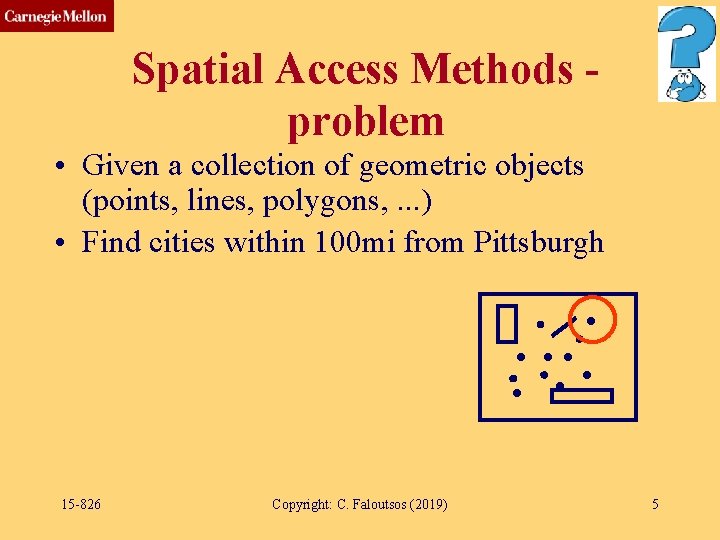
Spatial Access Methods problem • Given a collection of geometric objects (points, lines, polygons, . . . ) • Find cities within 100 mi from Pittsburgh 15 -826 Copyright: C. Faloutsos (2019) 5
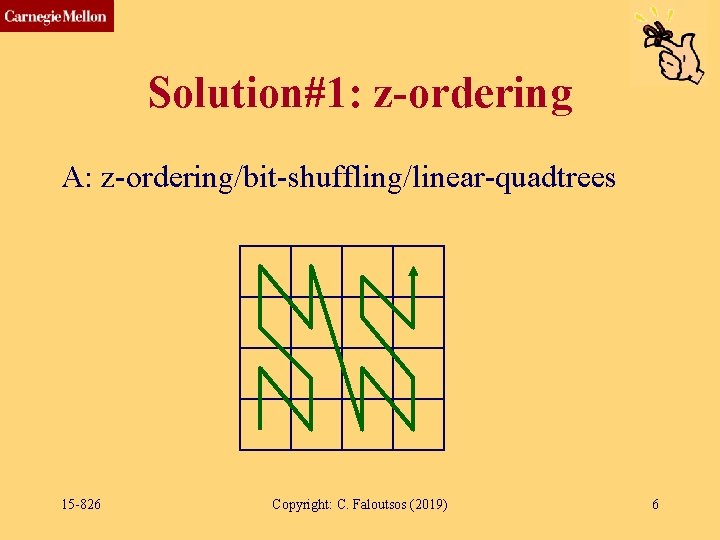
Solution#1: z-ordering A: z-ordering/bit-shuffling/linear-quadtrees 15 -826 Copyright: C. Faloutsos (2019) 6
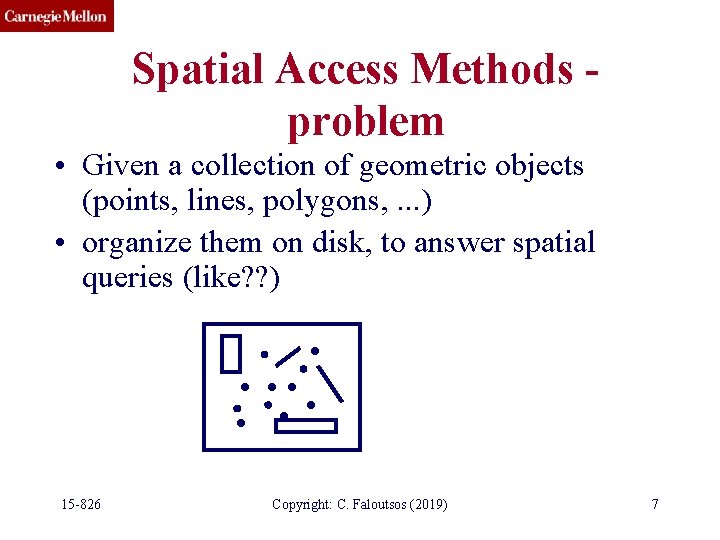
Spatial Access Methods problem • Given a collection of geometric objects (points, lines, polygons, . . . ) • organize them on disk, to answer spatial queries (like? ? ) 15 -826 Copyright: C. Faloutsos (2019) 7
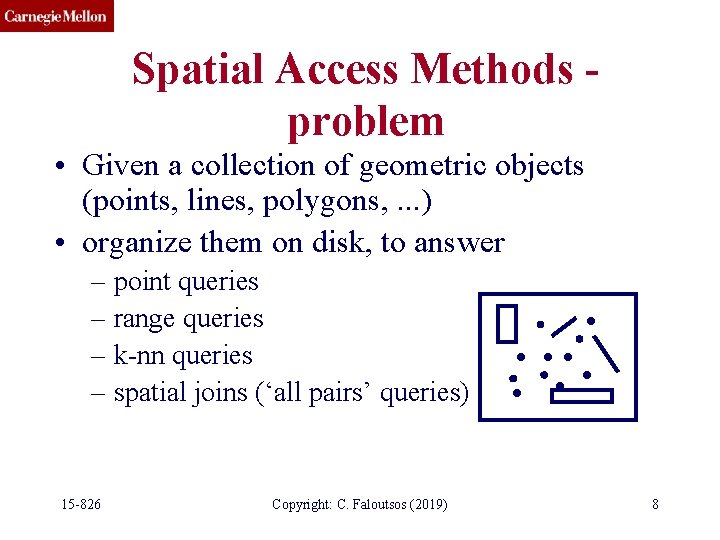
Spatial Access Methods problem • Given a collection of geometric objects (points, lines, polygons, . . . ) • organize them on disk, to answer – point queries – range queries – k-nn queries – spatial joins (‘all pairs’ queries) 15 -826 Copyright: C. Faloutsos (2019) 8
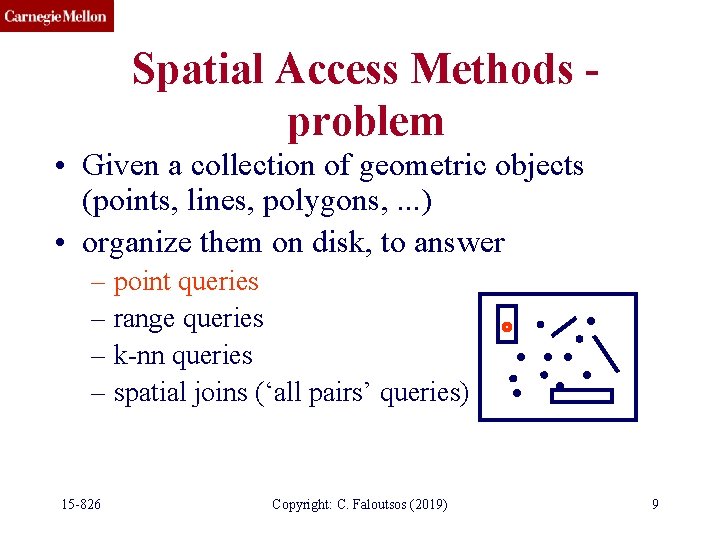
Spatial Access Methods problem • Given a collection of geometric objects (points, lines, polygons, . . . ) • organize them on disk, to answer – point queries – range queries – k-nn queries – spatial joins (‘all pairs’ queries) 15 -826 Copyright: C. Faloutsos (2019) 9
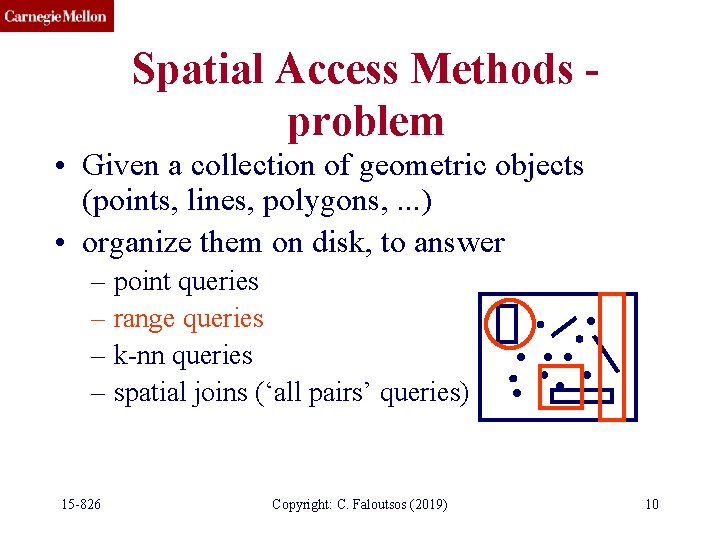
Spatial Access Methods problem • Given a collection of geometric objects (points, lines, polygons, . . . ) • organize them on disk, to answer – point queries – range queries – k-nn queries – spatial joins (‘all pairs’ queries) 15 -826 Copyright: C. Faloutsos (2019) 10
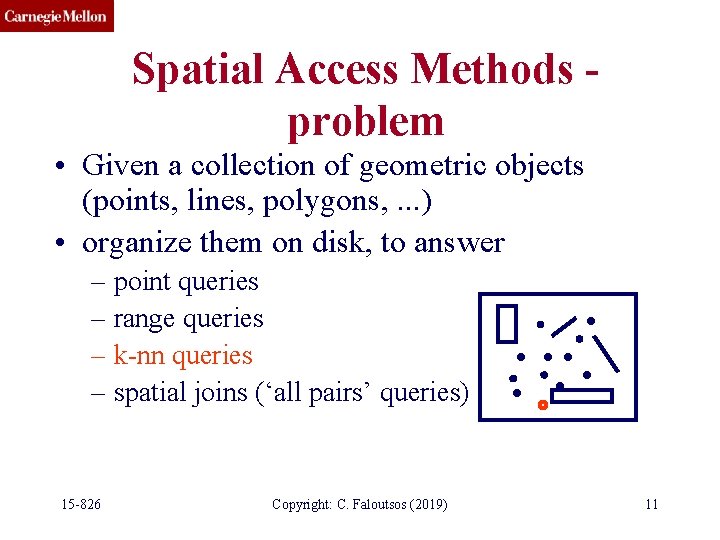
Spatial Access Methods problem • Given a collection of geometric objects (points, lines, polygons, . . . ) • organize them on disk, to answer – point queries – range queries – k-nn queries – spatial joins (‘all pairs’ queries) 15 -826 Copyright: C. Faloutsos (2019) 11
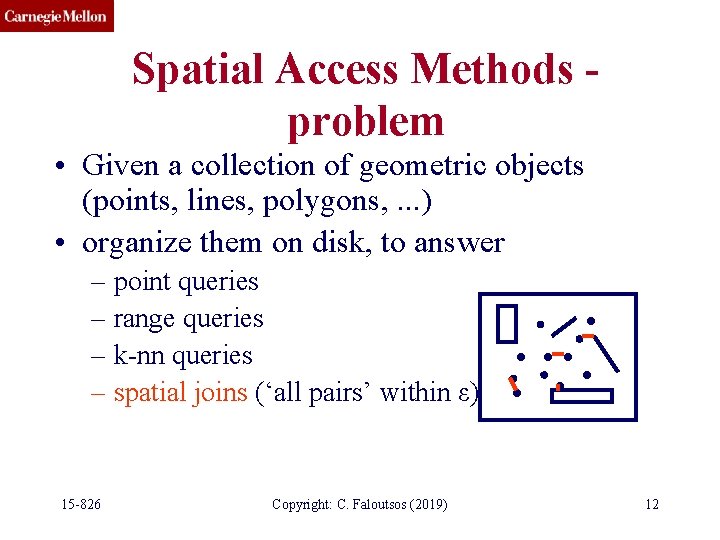
Spatial Access Methods problem • Given a collection of geometric objects (points, lines, polygons, . . . ) • organize them on disk, to answer – point queries – range queries – k-nn queries – spatial joins (‘all pairs’ within ε) 15 -826 Copyright: C. Faloutsos (2019) 12
SAMs - motivation • Q: applications? 15 -826 Copyright: C. Faloutsos (2019) 13
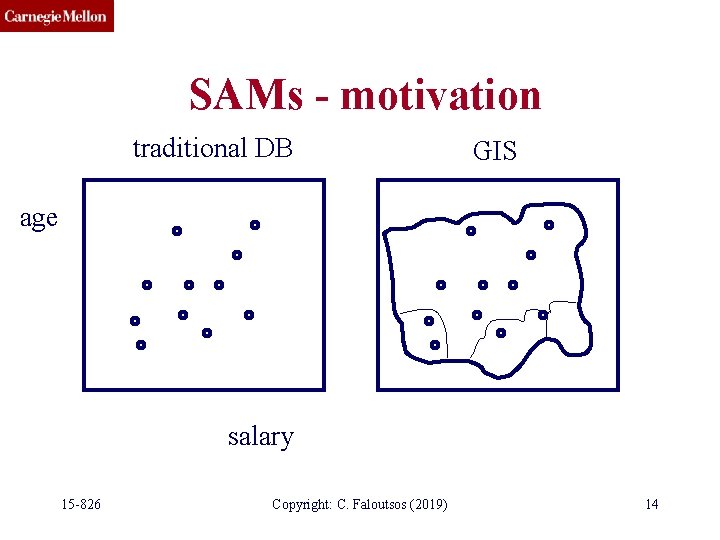
SAMs - motivation traditional DB GIS age salary 15 -826 Copyright: C. Faloutsos (2019) 14
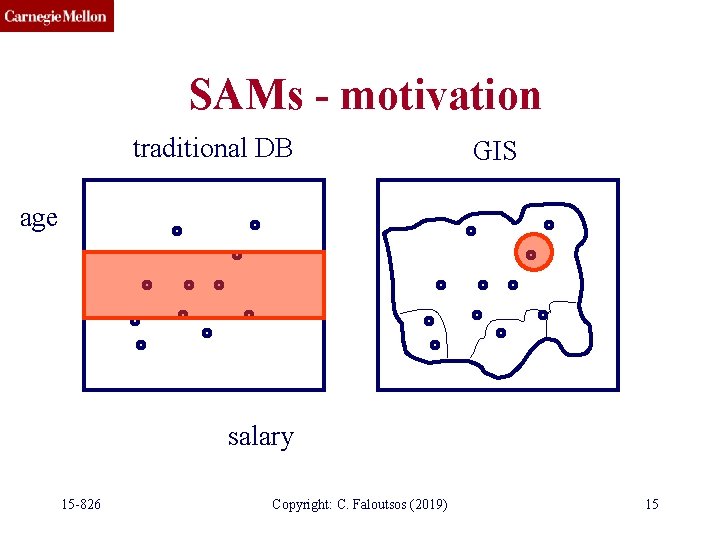
SAMs - motivation traditional DB GIS age salary 15 -826 Copyright: C. Faloutsos (2019) 15

SAMs - motivation CAD/CAM find elements too close to each other 15 -826 Copyright: C. Faloutsos (2019) 16

SAMs - motivation CAD/CAM 15 -826 Copyright: C. Faloutsos (2019) 17
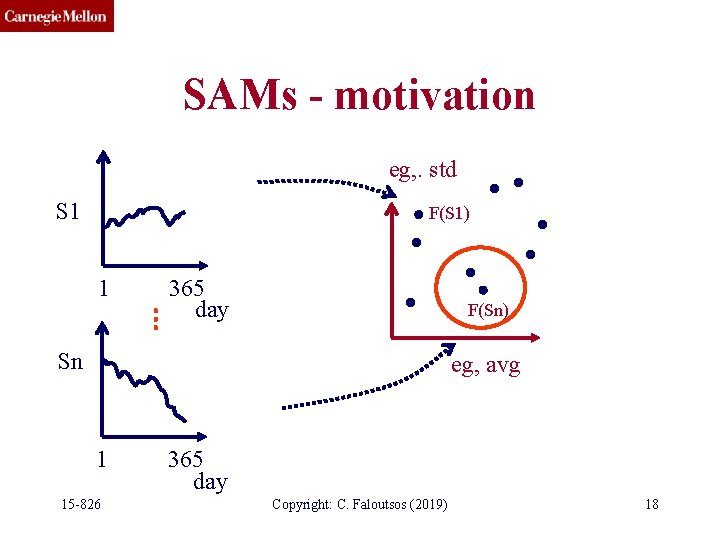
SAMs - motivation eg, . std S 1 F(S 1) 1 365 day F(Sn) Sn eg, avg 1 15 -826 365 day Copyright: C. Faloutsos (2019) 18
Indexing - Detailed outline • primary key indexing • secondary key / multi-key indexing • spatial access methods – problem dfn – z-ordering – R-trees –. . . • text • . . . 15 -826 Copyright: C. Faloutsos (2019) 19
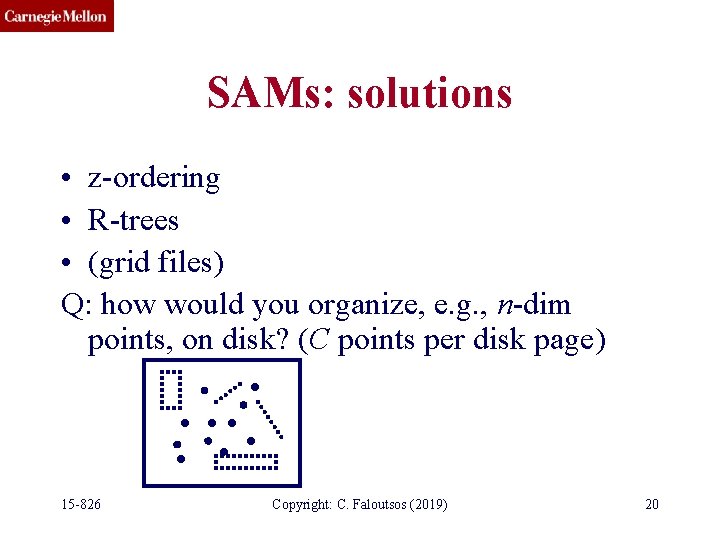
SAMs: solutions • z-ordering • R-trees • (grid files) Q: how would you organize, e. g. , n-dim points, on disk? (C points per disk page) 15 -826 Copyright: C. Faloutsos (2019) 20
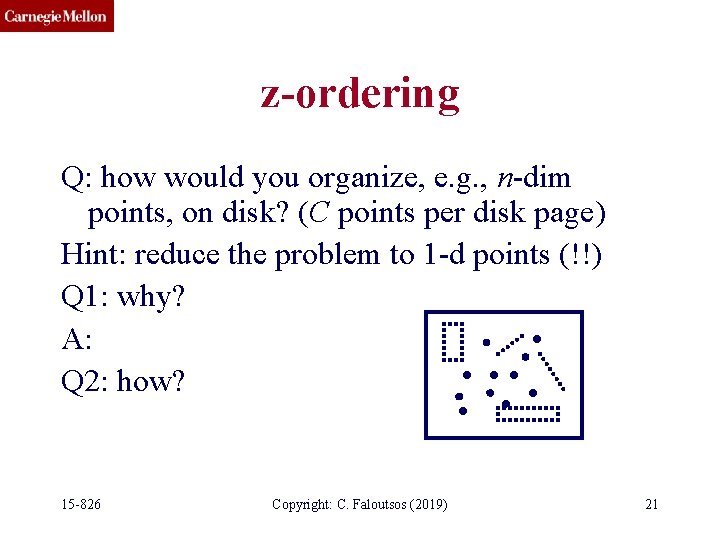
z-ordering Q: how would you organize, e. g. , n-dim points, on disk? (C points per disk page) Hint: reduce the problem to 1 -d points (!!) Q 1: why? A: Q 2: how? 15 -826 Copyright: C. Faloutsos (2019) 21
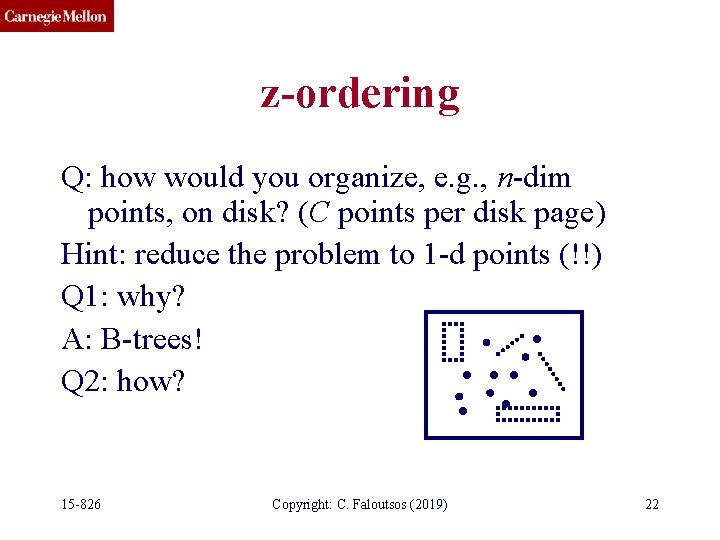
z-ordering Q: how would you organize, e. g. , n-dim points, on disk? (C points per disk page) Hint: reduce the problem to 1 -d points (!!) Q 1: why? A: B-trees! Q 2: how? 15 -826 Copyright: C. Faloutsos (2019) 22
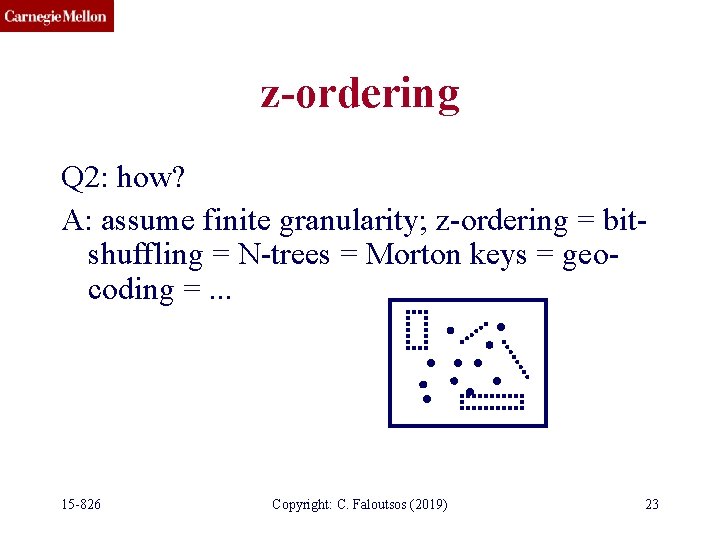
z-ordering Q 2: how? A: assume finite granularity; z-ordering = bitshuffling = N-trees = Morton keys = geocoding =. . . 15 -826 Copyright: C. Faloutsos (2019) 23
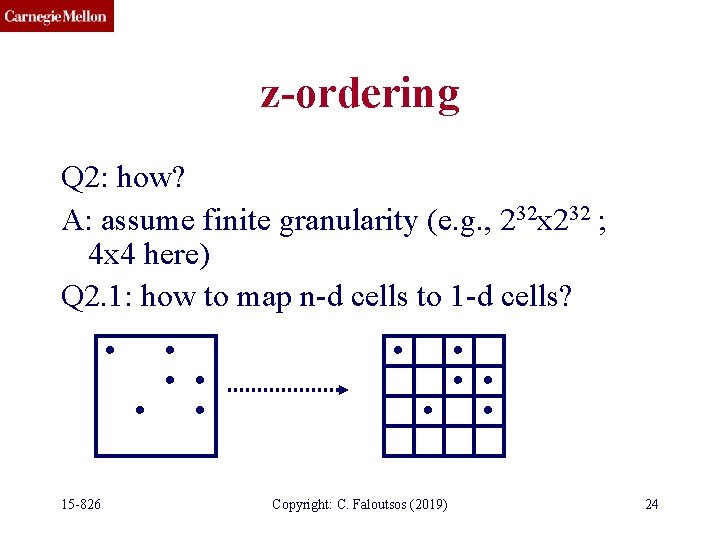
z-ordering Q 2: how? A: assume finite granularity (e. g. , 232 x 232 ; 4 x 4 here) Q 2. 1: how to map n-d cells to 1 -d cells? 15 -826 Copyright: C. Faloutsos (2019) 24
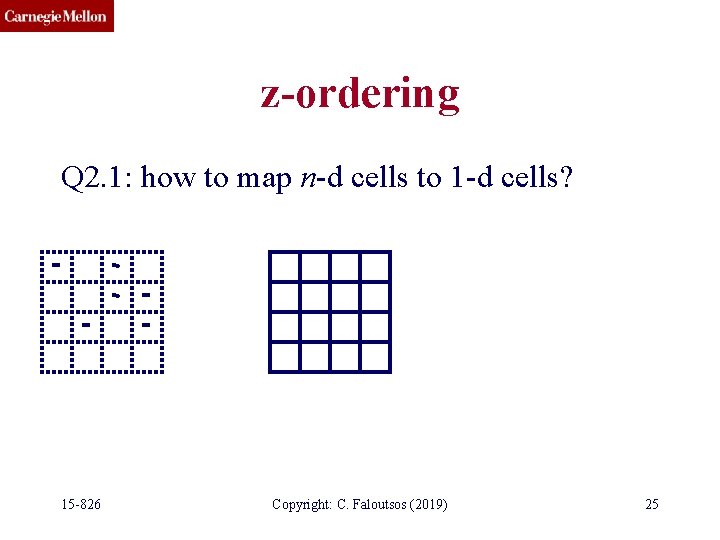
z-ordering Q 2. 1: how to map n-d cells to 1 -d cells? 15 -826 Copyright: C. Faloutsos (2019) 25
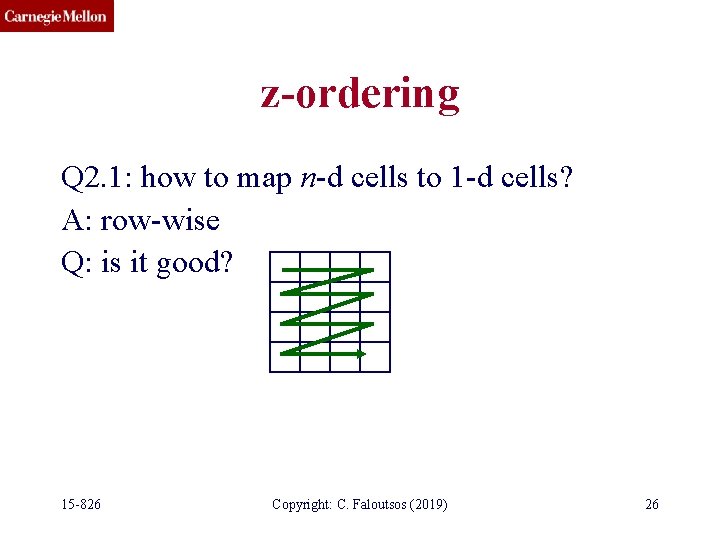
z-ordering Q 2. 1: how to map n-d cells to 1 -d cells? A: row-wise Q: is it good? 15 -826 Copyright: C. Faloutsos (2019) 26
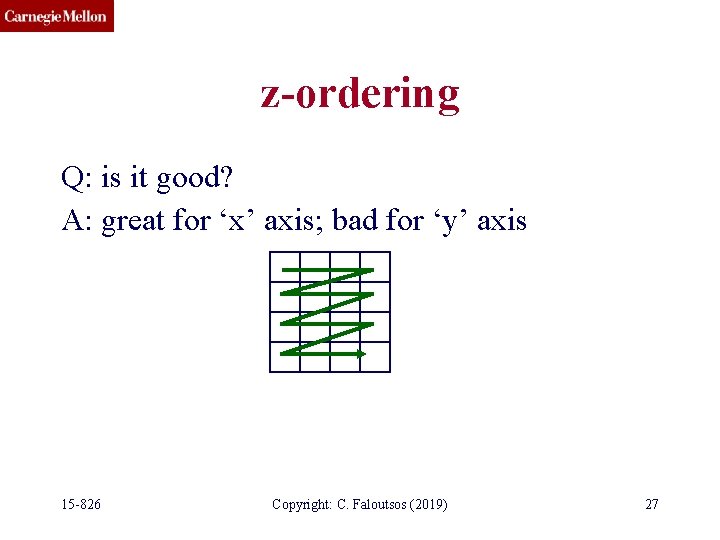
z-ordering Q: is it good? A: great for ‘x’ axis; bad for ‘y’ axis 15 -826 Copyright: C. Faloutsos (2019) 27
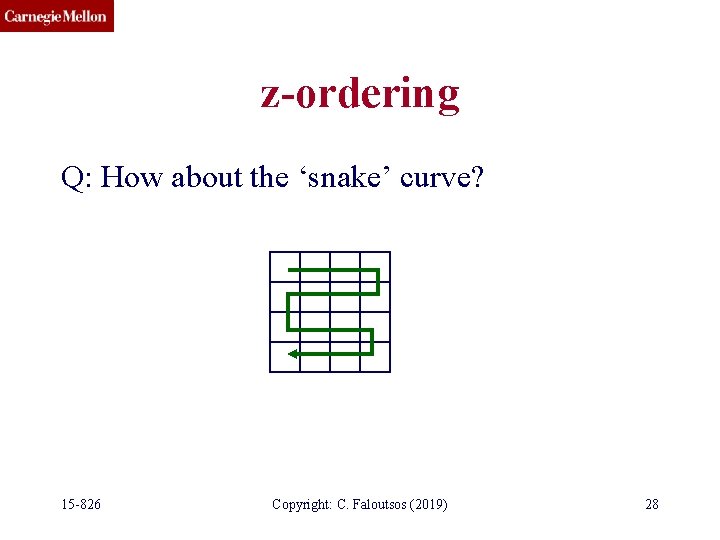
z-ordering Q: How about the ‘snake’ curve? 15 -826 Copyright: C. Faloutsos (2019) 28
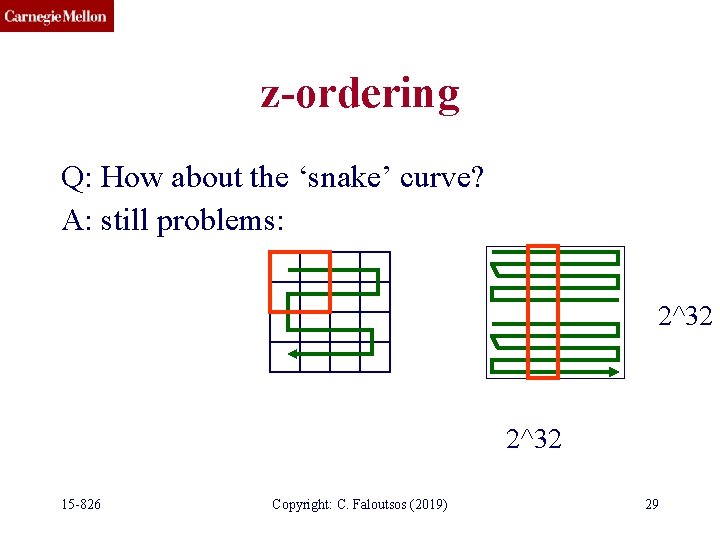
z-ordering Q: How about the ‘snake’ curve? A: still problems: 2^32 15 -826 Copyright: C. Faloutsos (2019) 29
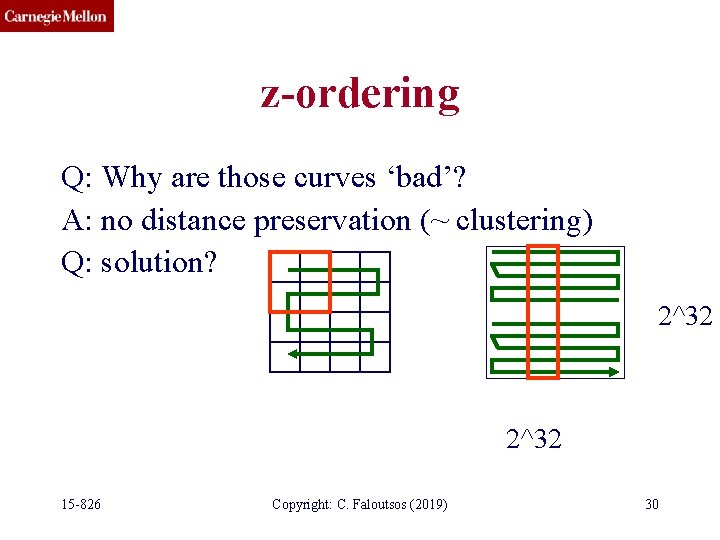
z-ordering Q: Why are those curves ‘bad’? A: no distance preservation (~ clustering) Q: solution? 2^32 15 -826 Copyright: C. Faloutsos (2019) 30
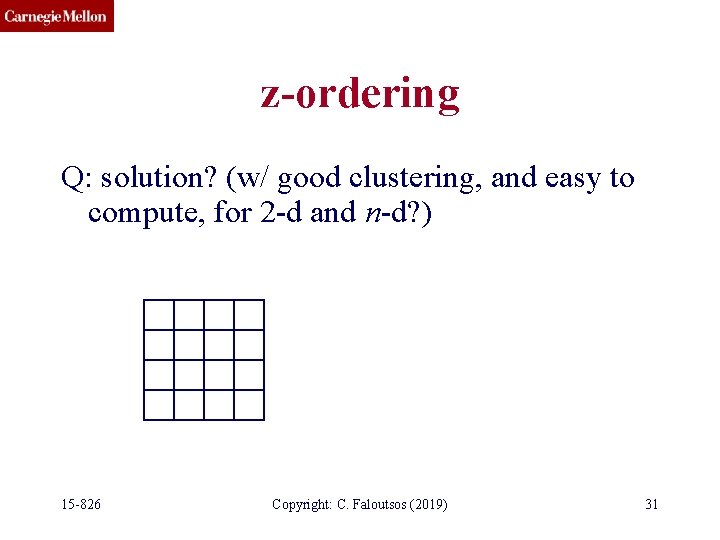
z-ordering Q: solution? (w/ good clustering, and easy to compute, for 2 -d and n-d? ) 15 -826 Copyright: C. Faloutsos (2019) 31
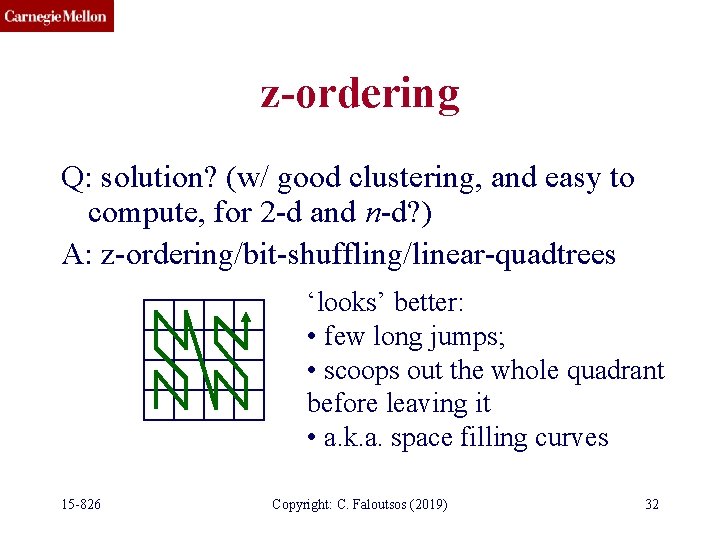
z-ordering Q: solution? (w/ good clustering, and easy to compute, for 2 -d and n-d? ) A: z-ordering/bit-shuffling/linear-quadtrees ‘looks’ better: • few long jumps; • scoops out the whole quadrant before leaving it • a. k. a. space filling curves 15 -826 Copyright: C. Faloutsos (2019) 32
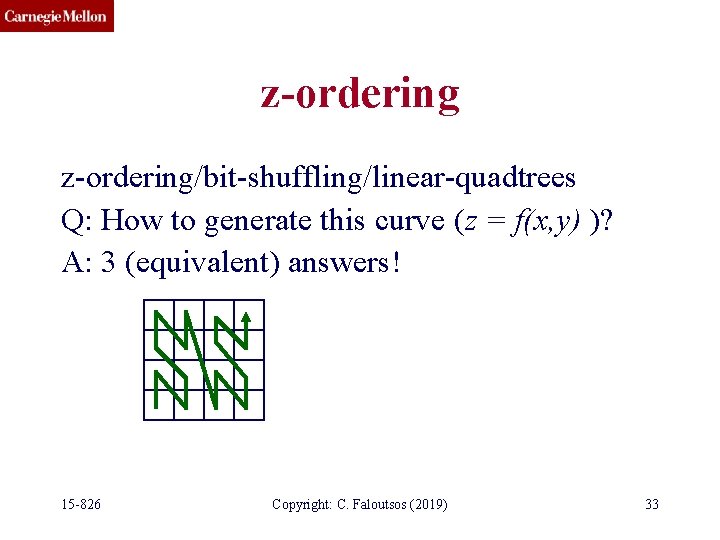
z-ordering/bit-shuffling/linear-quadtrees Q: How to generate this curve (z = f(x, y) )? A: 3 (equivalent) answers! 15 -826 Copyright: C. Faloutsos (2019) 33
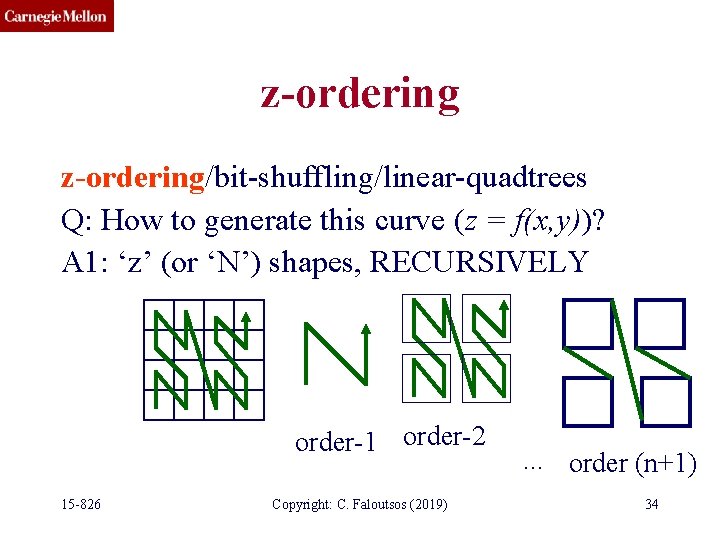
z-ordering/bit-shuffling/linear-quadtrees Q: How to generate this curve (z = f(x, y))? A 1: ‘z’ (or ‘N’) shapes, RECURSIVELY order-1 order-2 15 -826 Copyright: C. Faloutsos (2019) . . . order (n+1) 34
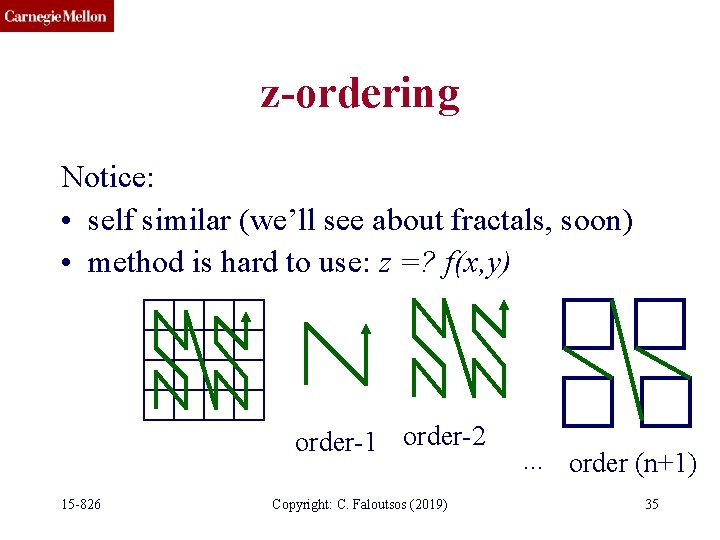
z-ordering Notice: • self similar (we’ll see about fractals, soon) • method is hard to use: z =? f(x, y) order-1 order-2 15 -826 Copyright: C. Faloutsos (2019) . . . order (n+1) 35
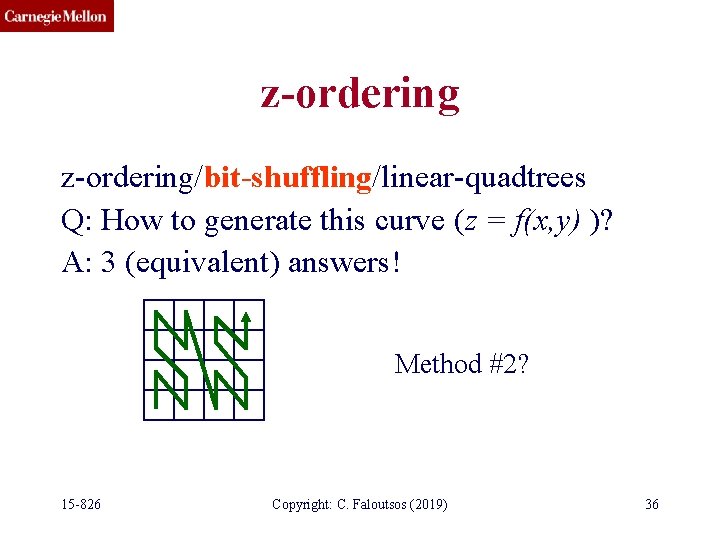
z-ordering/bit-shuffling/linear-quadtrees Q: How to generate this curve (z = f(x, y) )? A: 3 (equivalent) answers! Method #2? 15 -826 Copyright: C. Faloutsos (2019) 36
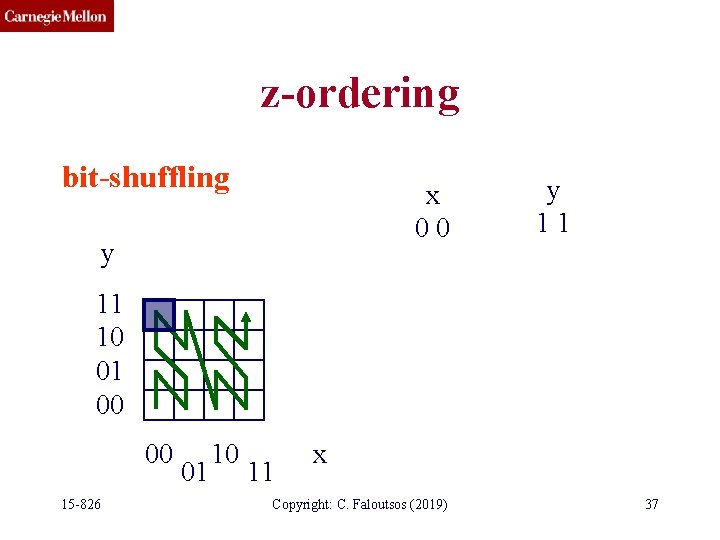
z-ordering bit-shuffling x 00 y y 11 11 10 01 00 00 15 -826 01 10 11 x Copyright: C. Faloutsos (2019) 37
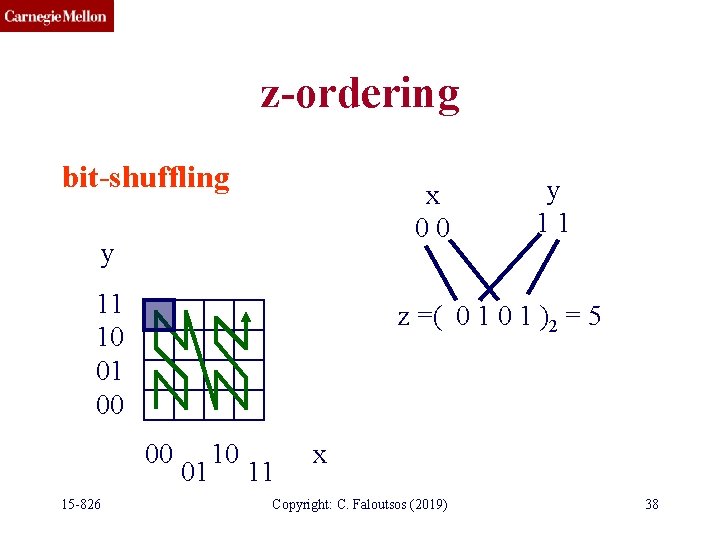
z-ordering bit-shuffling x 00 y 11 10 01 00 z =( 0 1 )2 = 5 00 15 -826 y 11 01 10 11 x Copyright: C. Faloutsos (2019) 38
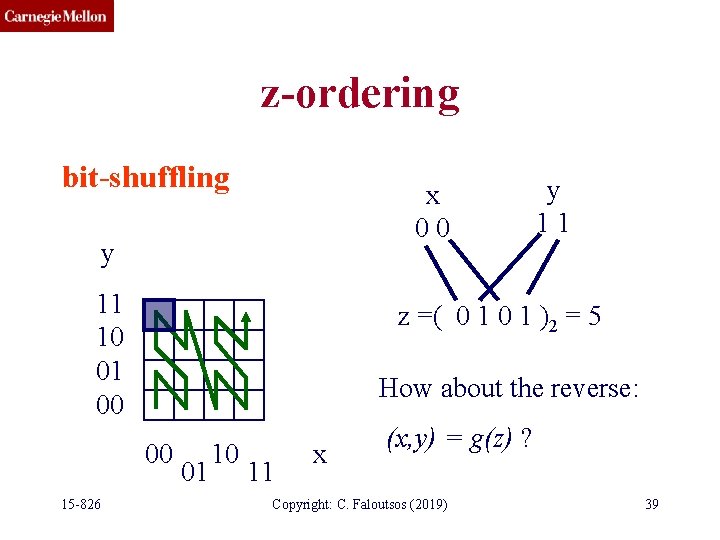
z-ordering bit-shuffling x 00 y 11 10 01 00 z =( 0 1 )2 = 5 How about the reverse: 00 15 -826 y 11 01 10 11 x (x, y) = g(z) ? Copyright: C. Faloutsos (2019) 39
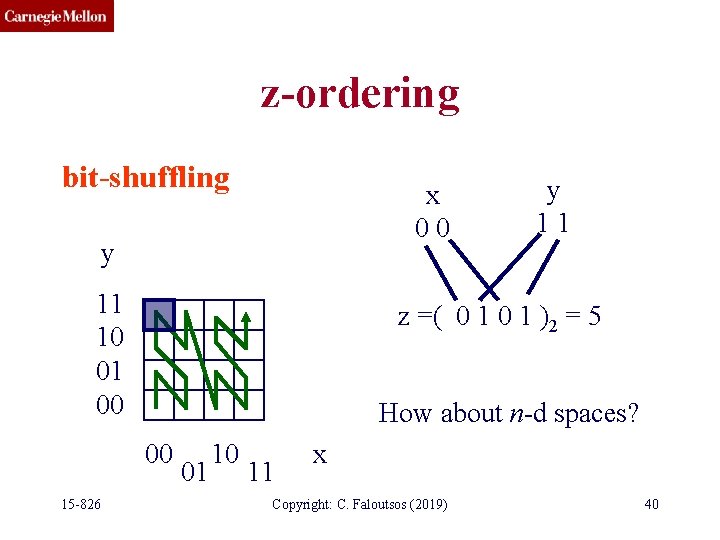
z-ordering bit-shuffling x 00 y 11 10 01 00 z =( 0 1 )2 = 5 How about n-d spaces? 00 15 -826 y 11 01 10 11 x Copyright: C. Faloutsos (2019) 40
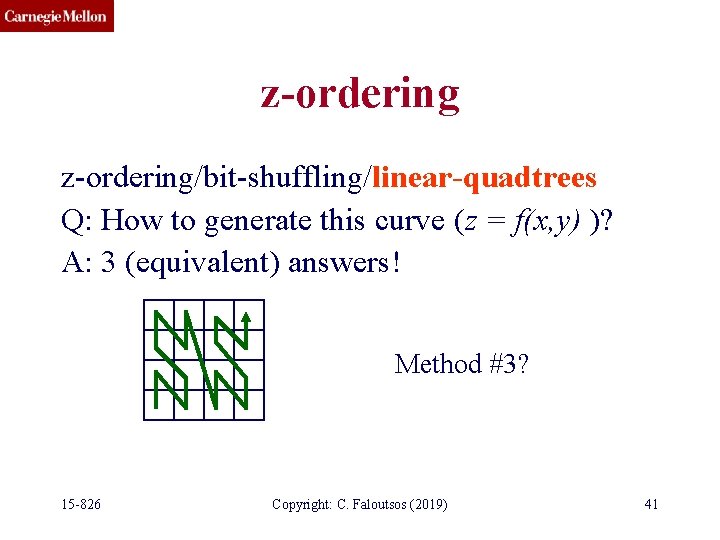
z-ordering/bit-shuffling/linear-quadtrees Q: How to generate this curve (z = f(x, y) )? A: 3 (equivalent) answers! Method #3? 15 -826 Copyright: C. Faloutsos (2019) 41
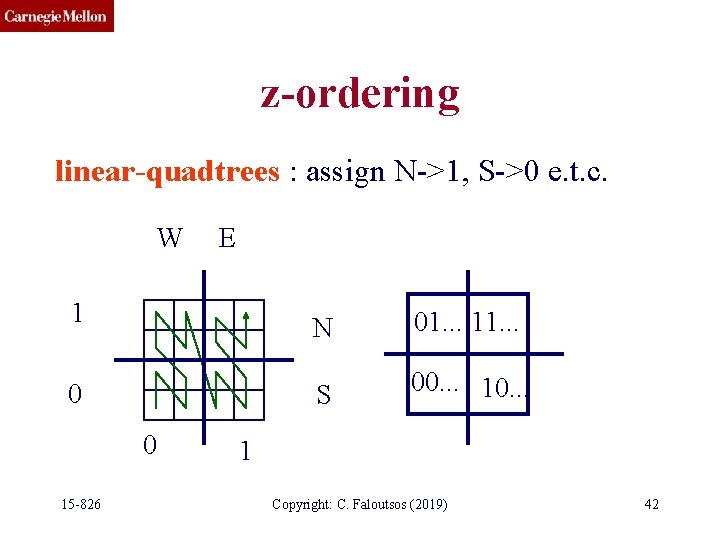
z-ordering linear-quadtrees : assign N->1, S->0 e. t. c. W E 1 0 0 15 -826 N 01. . . 11. . . S 00. . . 10. . . 1 Copyright: C. Faloutsos (2019) 42
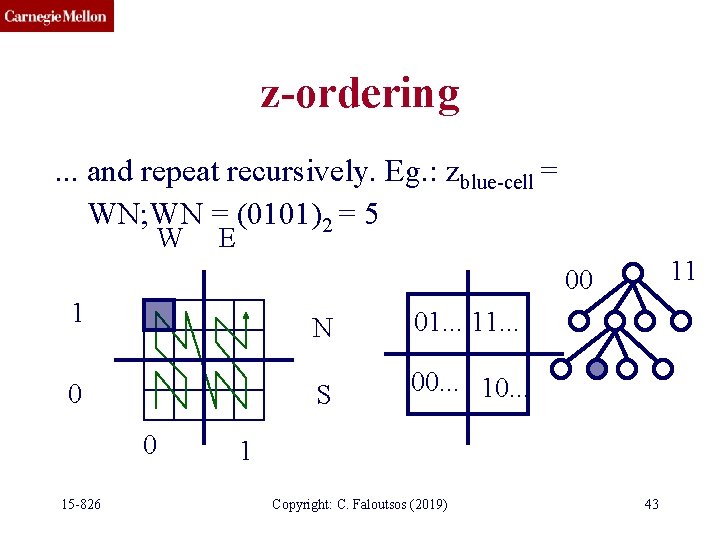
z-ordering. . . and repeat recursively. Eg. : zblue-cell = WN; WN = (0101)2 = 5 W E 11 00 1 0 0 15 -826 N 01. . . 11. . . S 00. . . 10. . . 1 Copyright: C. Faloutsos (2019) 43
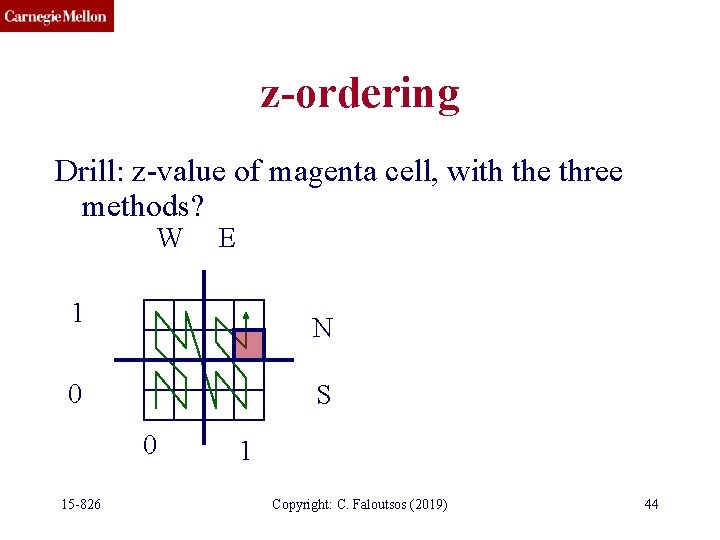
z-ordering Drill: z-value of magenta cell, with the three methods? W E 1 N 0 S 0 15 -826 1 Copyright: C. Faloutsos (2019) 44
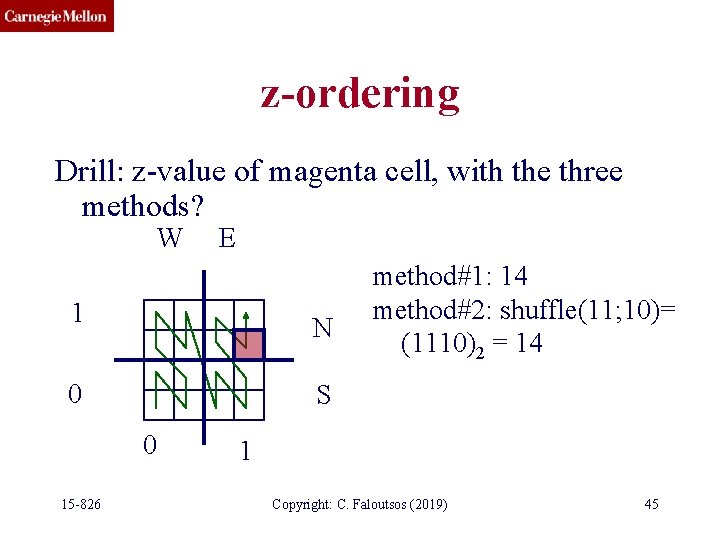
z-ordering Drill: z-value of magenta cell, with the three methods? W E 1 N 0 S 0 15 -826 method#1: 14 method#2: shuffle(11; 10)= (1110)2 = 14 1 Copyright: C. Faloutsos (2019) 45
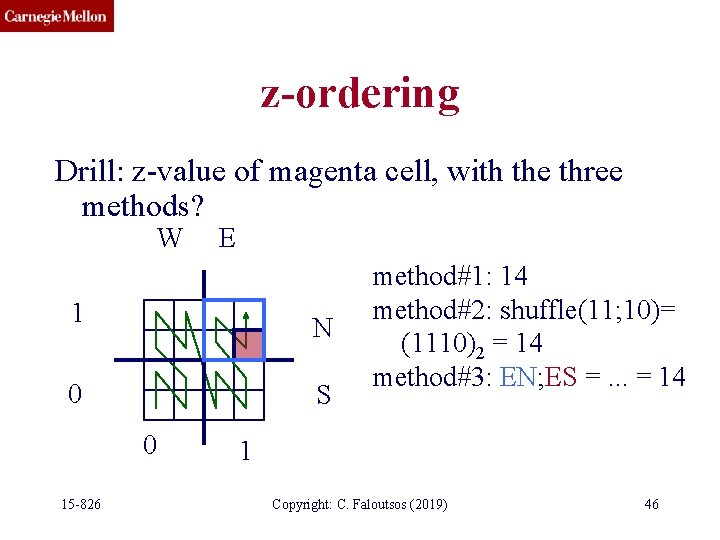
z-ordering Drill: z-value of magenta cell, with the three methods? W E 1 N 0 S 0 15 -826 method#1: 14 method#2: shuffle(11; 10)= (1110)2 = 14 method#3: EN; ES =. . . = 14 1 Copyright: C. Faloutsos (2019) 46
z-ordering - Detailed outline • spatial access methods – z-ordering • • main idea - 3 methods use w/ B-trees; algorithms (range, knn queries. . . ) non-point (eg. , region) data analysis; variations – R-trees –. . . 15 -826 Copyright: C. Faloutsos (2019) 47
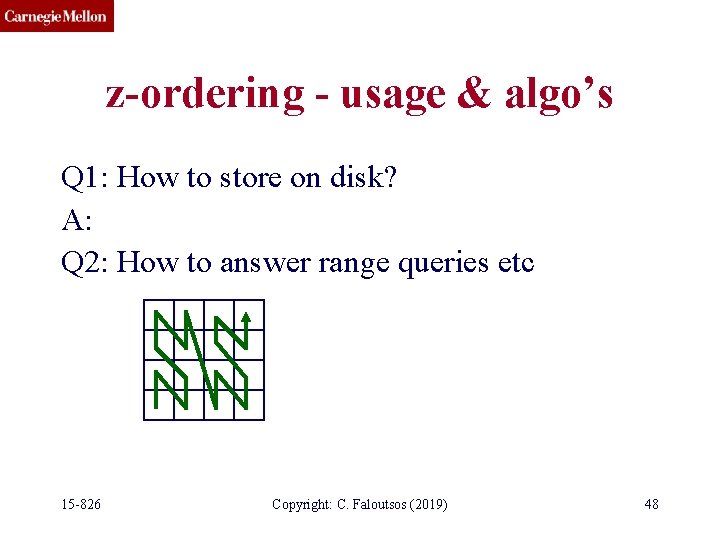
z-ordering - usage & algo’s Q 1: How to store on disk? A: Q 2: How to answer range queries etc 15 -826 Copyright: C. Faloutsos (2019) 48
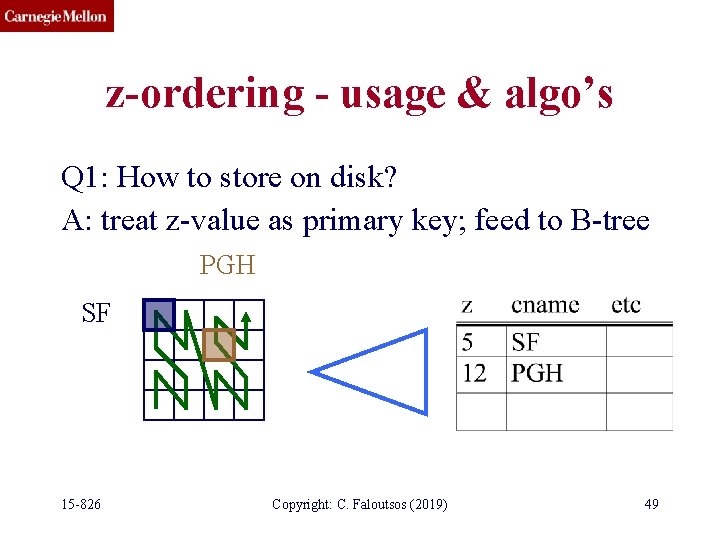
z-ordering - usage & algo’s Q 1: How to store on disk? A: treat z-value as primary key; feed to B-tree PGH SF 15 -826 Copyright: C. Faloutsos (2019) 49
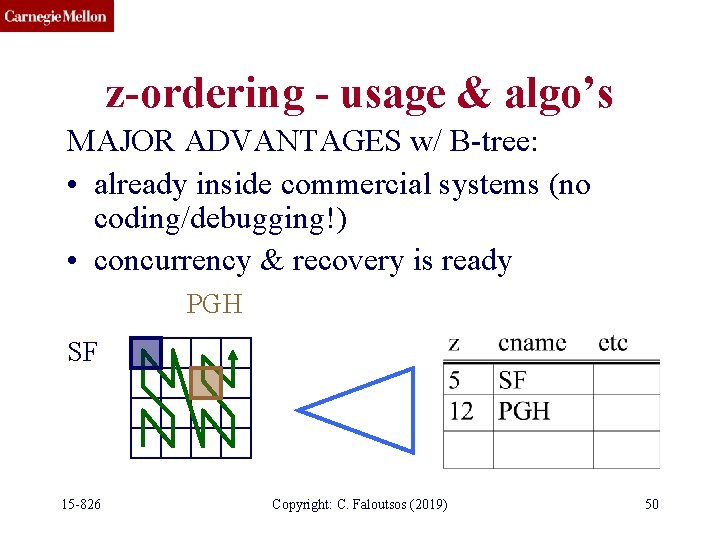
z-ordering - usage & algo’s MAJOR ADVANTAGES w/ B-tree: • already inside commercial systems (no coding/debugging!) • concurrency & recovery is ready PGH SF 15 -826 Copyright: C. Faloutsos (2019) 50
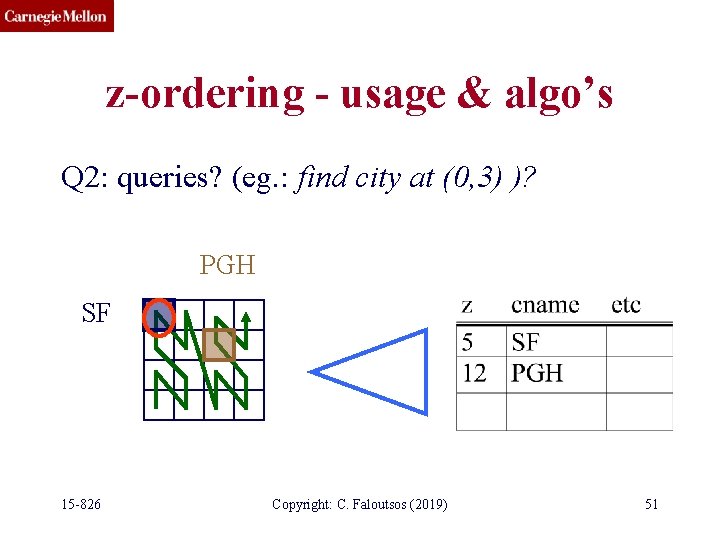
z-ordering - usage & algo’s Q 2: queries? (eg. : find city at (0, 3) )? PGH SF 15 -826 Copyright: C. Faloutsos (2019) 51
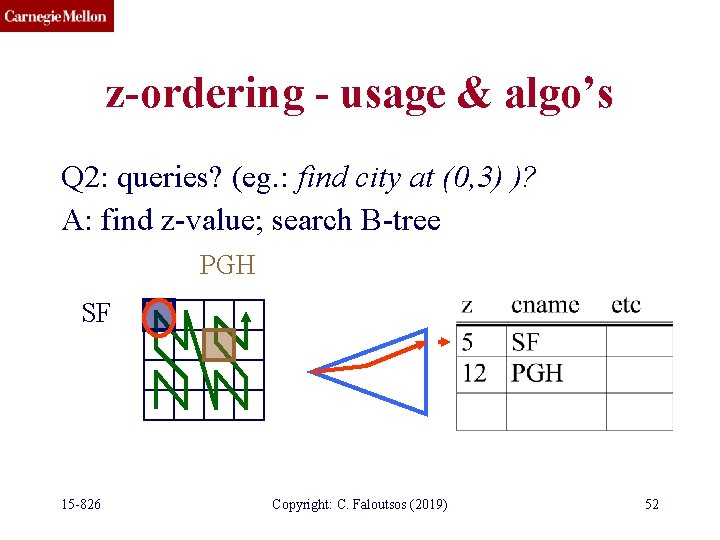
z-ordering - usage & algo’s Q 2: queries? (eg. : find city at (0, 3) )? A: find z-value; search B-tree PGH SF 15 -826 Copyright: C. Faloutsos (2019) 52
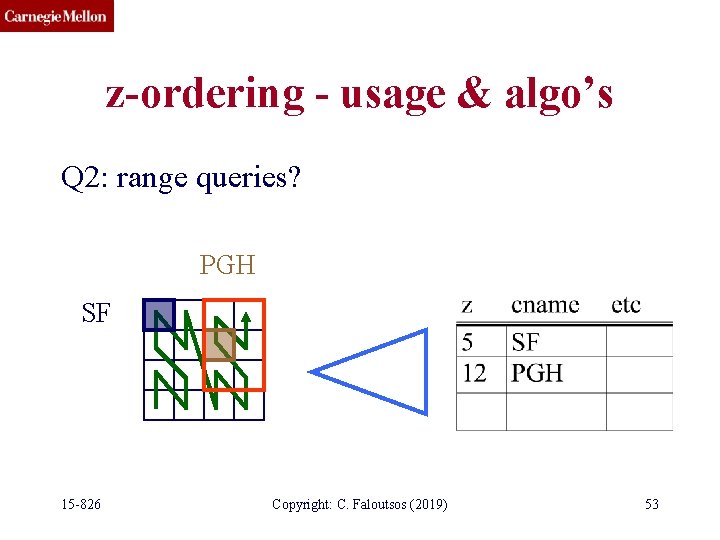
z-ordering - usage & algo’s Q 2: range queries? PGH SF 15 -826 Copyright: C. Faloutsos (2019) 53
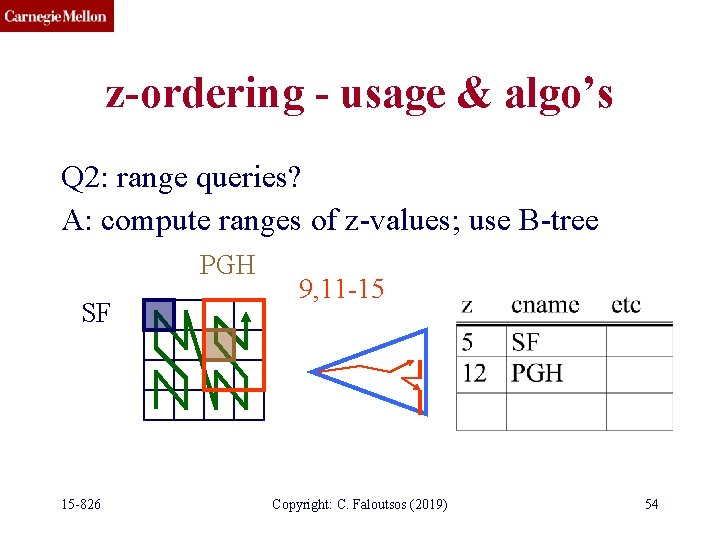
z-ordering - usage & algo’s Q 2: range queries? A: compute ranges of z-values; use B-tree PGH SF 15 -826 9, 11 -15 Copyright: C. Faloutsos (2019) 54
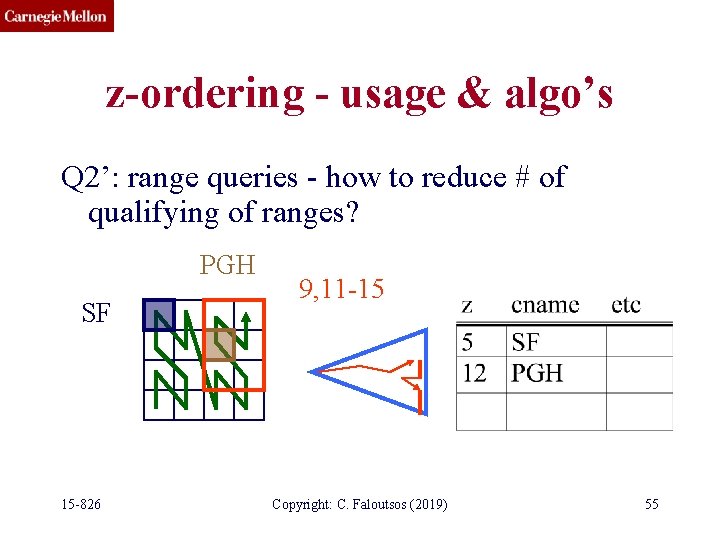
z-ordering - usage & algo’s Q 2’: range queries - how to reduce # of qualifying of ranges? PGH SF 15 -826 9, 11 -15 Copyright: C. Faloutsos (2019) 55
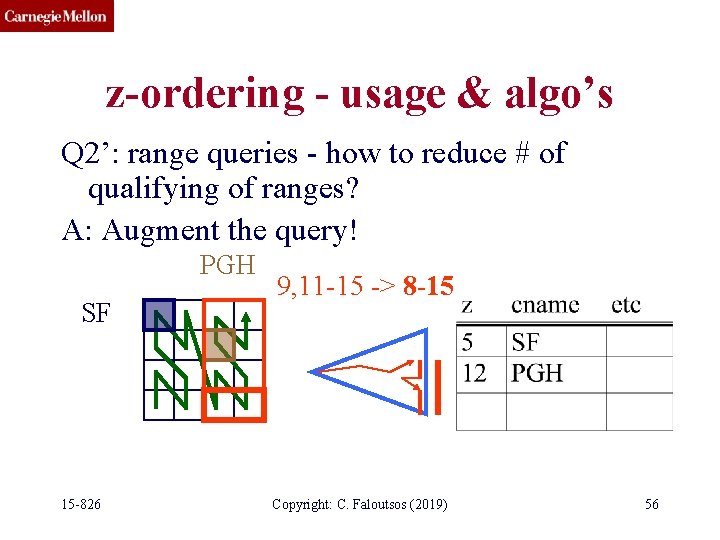
z-ordering - usage & algo’s Q 2’: range queries - how to reduce # of qualifying of ranges? A: Augment the query! PGH SF 15 -826 9, 11 -15 -> 8 -15 Copyright: C. Faloutsos (2019) 56
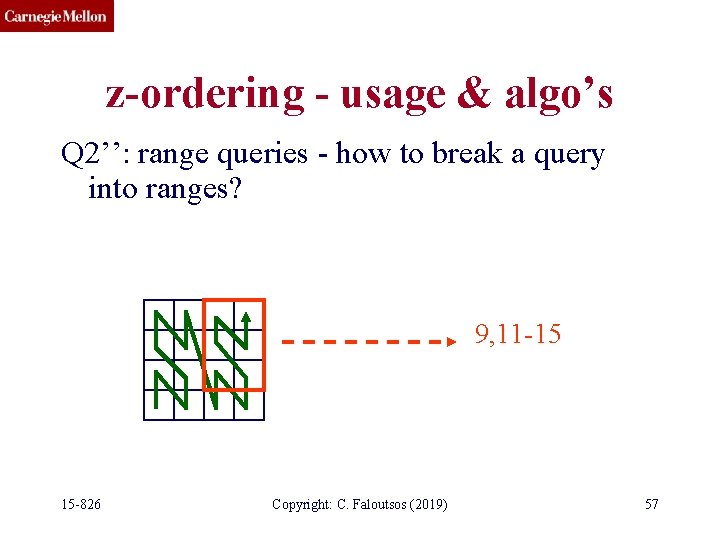
z-ordering - usage & algo’s Q 2’’: range queries - how to break a query into ranges? 9, 11 -15 15 -826 Copyright: C. Faloutsos (2019) 57
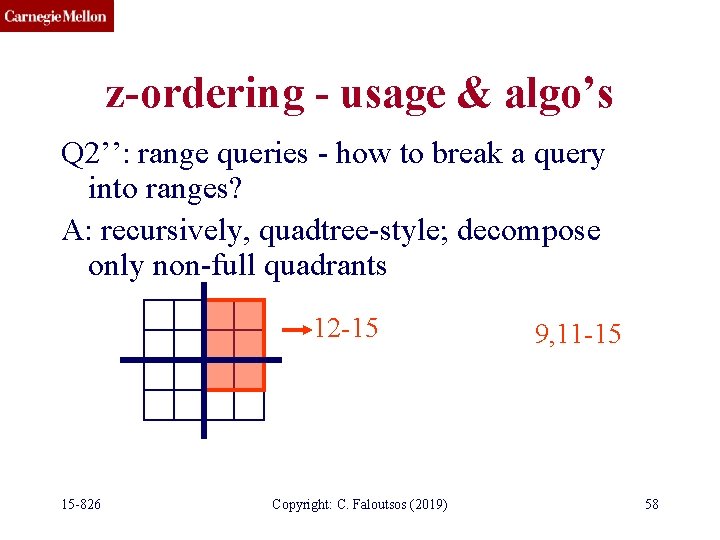
z-ordering - usage & algo’s Q 2’’: range queries - how to break a query into ranges? A: recursively, quadtree-style; decompose only non-full quadrants 12 -15 15 -826 Copyright: C. Faloutsos (2019) 9, 11 -15 58
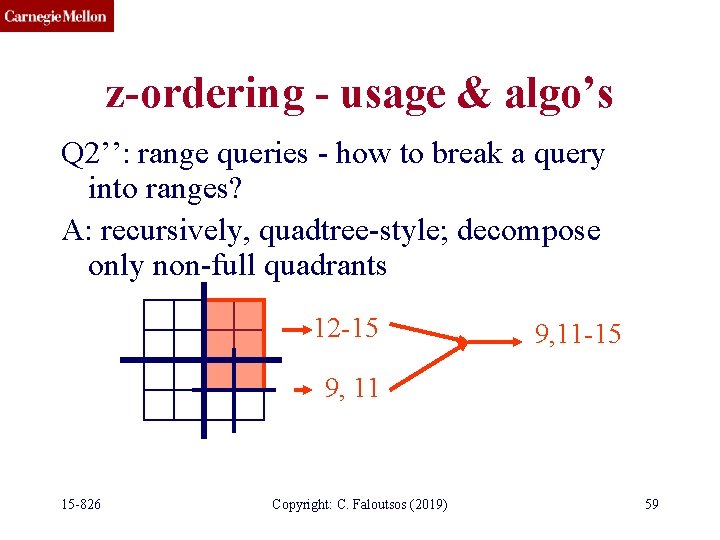
z-ordering - usage & algo’s Q 2’’: range queries - how to break a query into ranges? A: recursively, quadtree-style; decompose only non-full quadrants 12 -15 9, 11 15 -826 Copyright: C. Faloutsos (2019) 59
z-ordering - Detailed outline • spatial access methods – z-ordering • • main idea - 3 methods use w/ B-trees; algorithms (range, knn queries. . . ) non-point (eg. , region) data analysis; variations – R-trees –. . . 15 -826 Copyright: C. Faloutsos (2019) 60
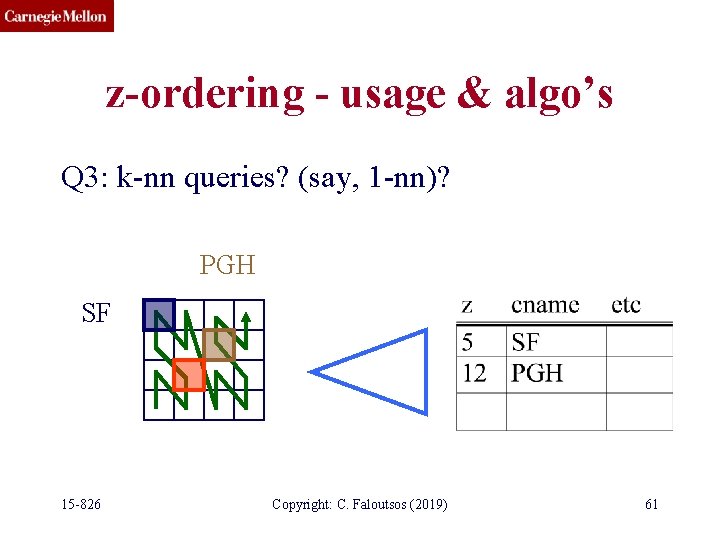
z-ordering - usage & algo’s Q 3: k-nn queries? (say, 1 -nn)? PGH SF 15 -826 Copyright: C. Faloutsos (2019) 61
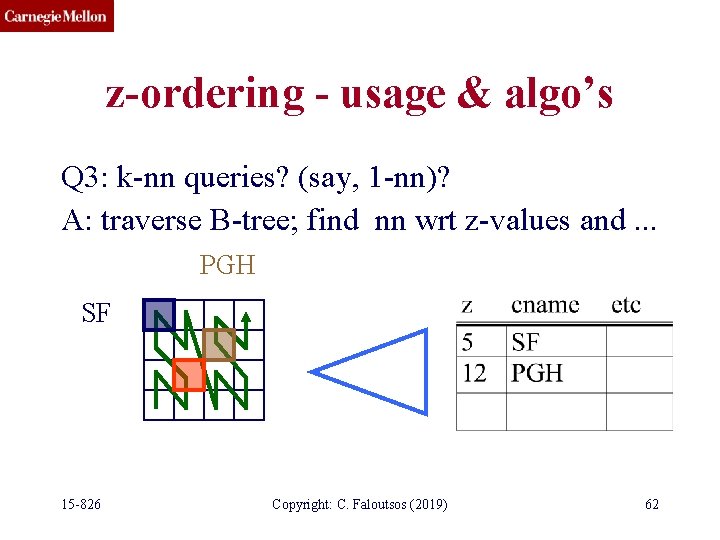
z-ordering - usage & algo’s Q 3: k-nn queries? (say, 1 -nn)? A: traverse B-tree; find nn wrt z-values and. . . PGH SF 15 -826 Copyright: C. Faloutsos (2019) 62
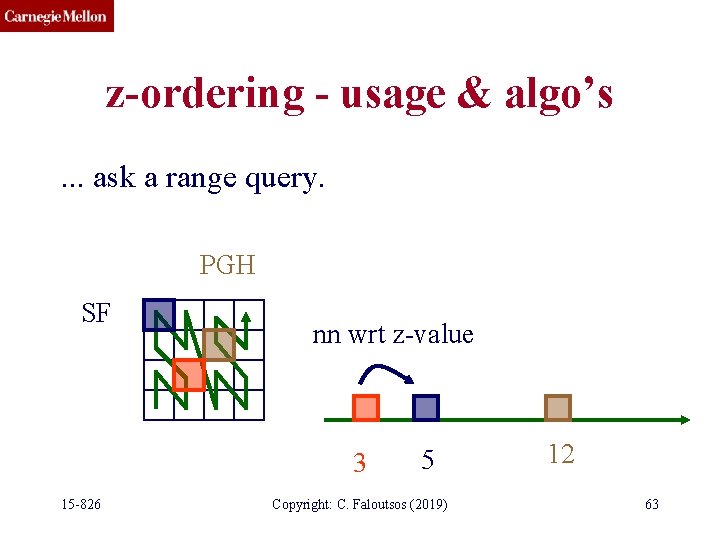
z-ordering - usage & algo’s. . . ask a range query. PGH SF nn wrt z-value 3 15 -826 5 Copyright: C. Faloutsos (2019) 12 63
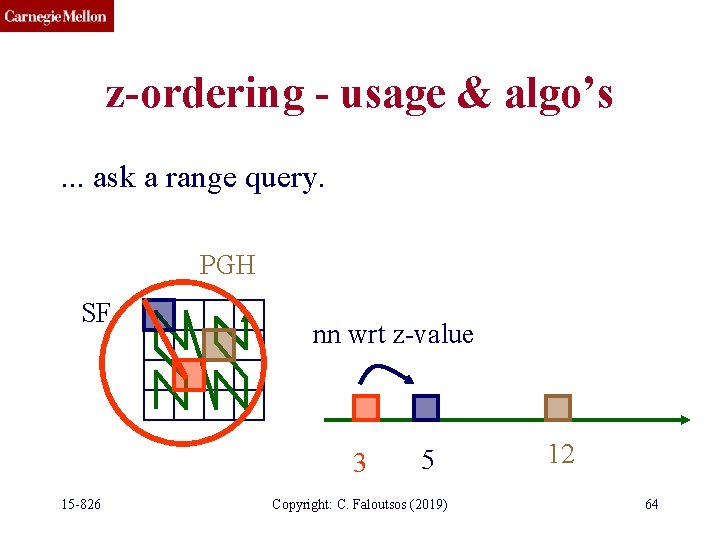
z-ordering - usage & algo’s. . . ask a range query. PGH SF nn wrt z-value 3 15 -826 5 Copyright: C. Faloutsos (2019) 12 64
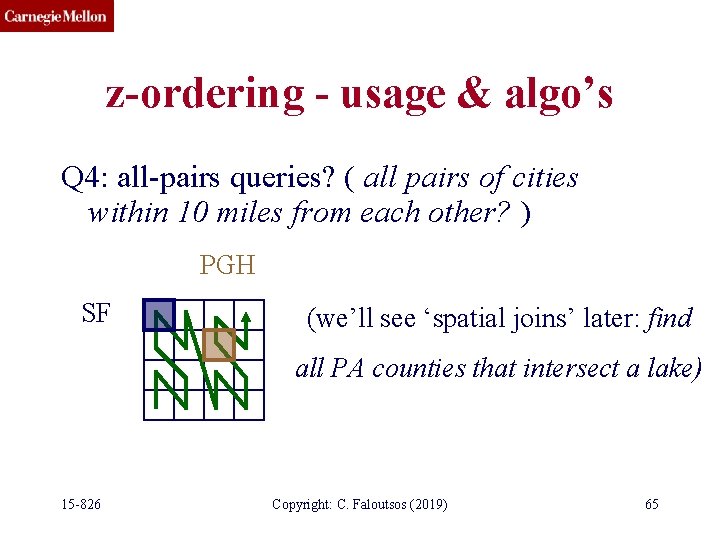
z-ordering - usage & algo’s Q 4: all-pairs queries? ( all pairs of cities within 10 miles from each other? ) PGH SF (we’ll see ‘spatial joins’ later: find all PA counties that intersect a lake) 15 -826 Copyright: C. Faloutsos (2019) 65
z-ordering - Detailed outline • spatial access methods – z-ordering • • main idea - 3 methods use w/ B-trees; algorithms (range, knn queries. . . ) non-point (eg. , region) data analysis; variations – R-trees –. . . 15 -826 Copyright: C. Faloutsos (2019) 66
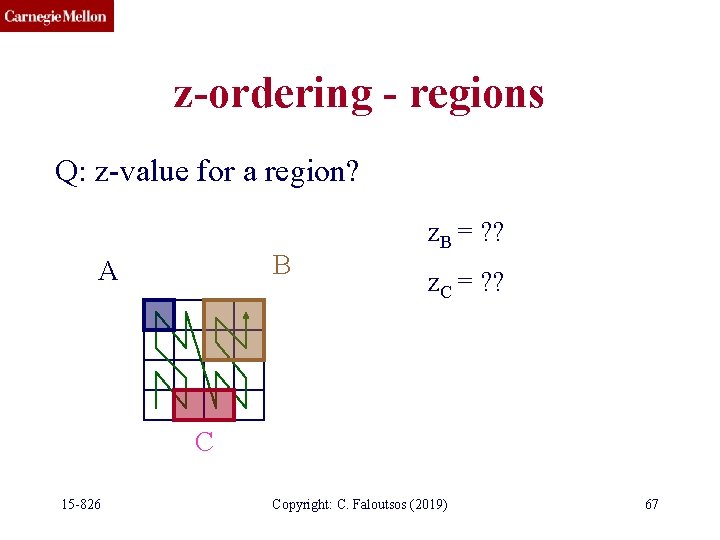
z-ordering - regions Q: z-value for a region? B A z. B = ? ? z. C = ? ? C 15 -826 Copyright: C. Faloutsos (2019) 67
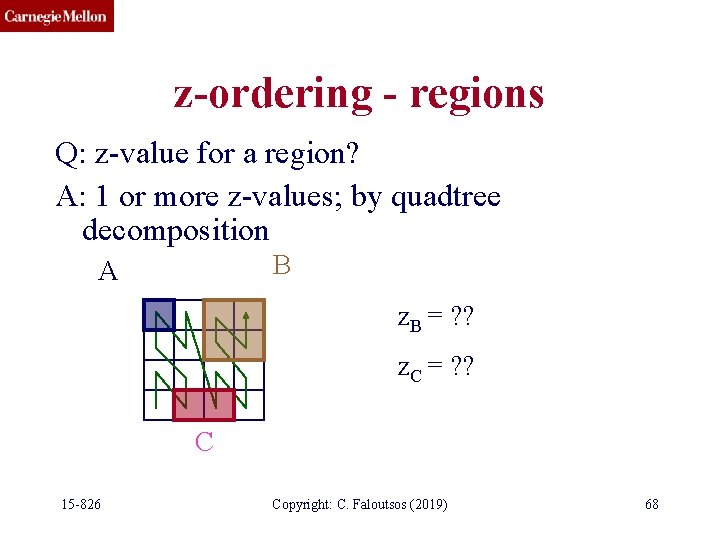
z-ordering - regions Q: z-value for a region? A: 1 or more z-values; by quadtree decomposition B A z. B = ? ? z. C = ? ? C 15 -826 Copyright: C. Faloutsos (2019) 68
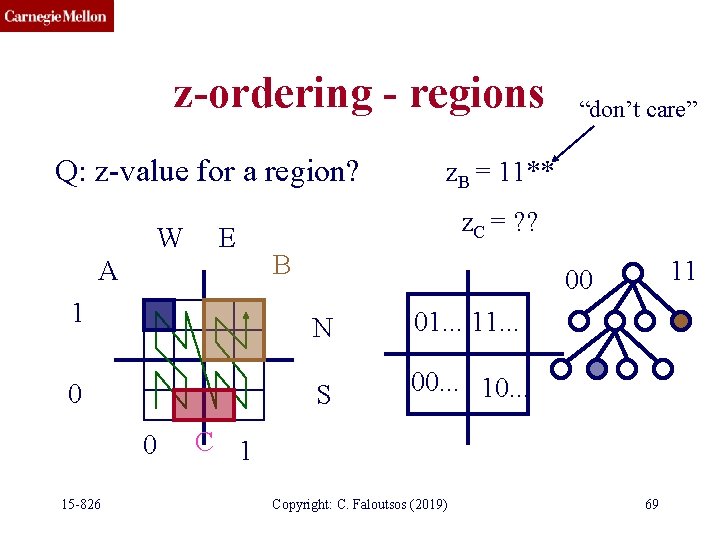
z-ordering - regions Q: z-value for a region? W E A 1 0 0 15 -826 “don’t care” z. B = 11** z. C = ? ? B 11 00 N 01. . . 11. . . S 00. . . 10. . . C 1 Copyright: C. Faloutsos (2019) 69
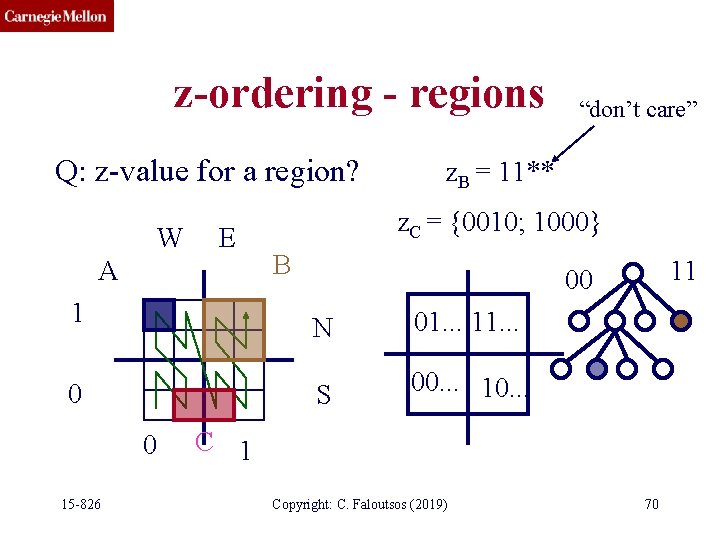
z-ordering - regions Q: z-value for a region? W E A 1 0 0 15 -826 “don’t care” z. B = 11** z. C = {0010; 1000} B 11 00 N 01. . . 11. . . S 00. . . 10. . . C 1 Copyright: C. Faloutsos (2019) 70
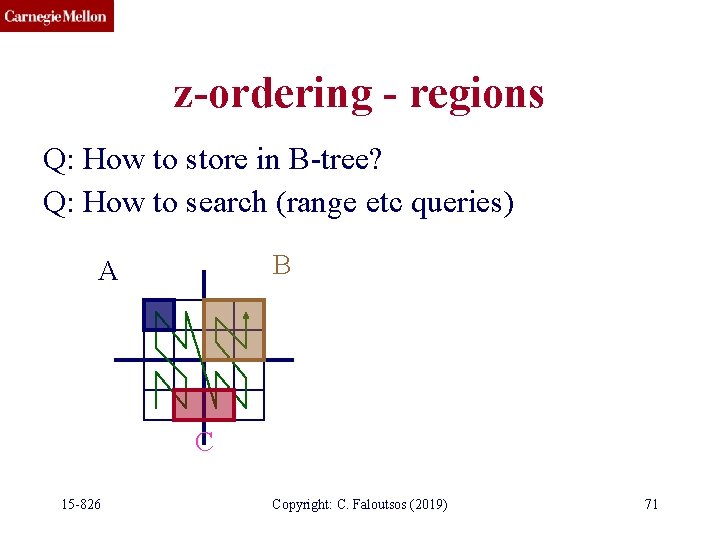
z-ordering - regions Q: How to store in B-tree? Q: How to search (range etc queries) B A C 15 -826 Copyright: C. Faloutsos (2019) 71
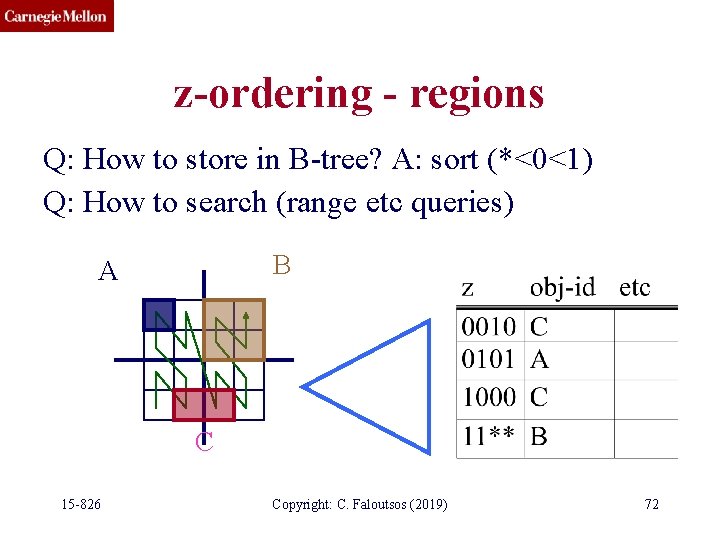
z-ordering - regions Q: How to store in B-tree? A: sort (*<0<1) Q: How to search (range etc queries) B A C 15 -826 Copyright: C. Faloutsos (2019) 72
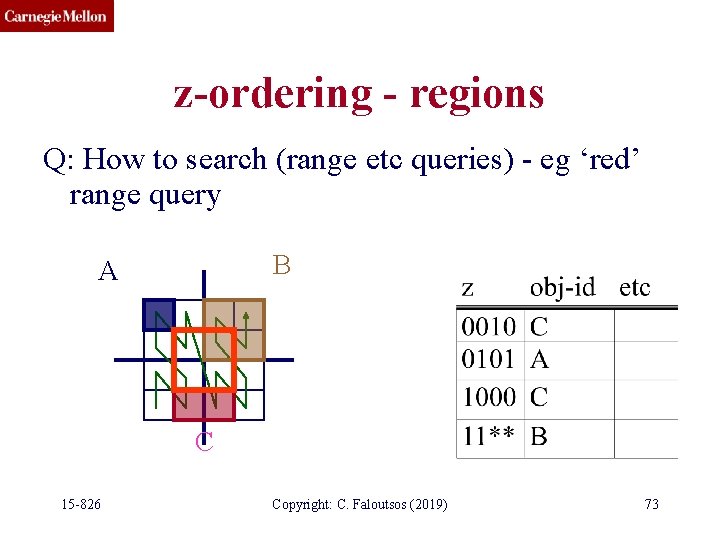
z-ordering - regions Q: How to search (range etc queries) - eg ‘red’ range query B A C 15 -826 Copyright: C. Faloutsos (2019) 73
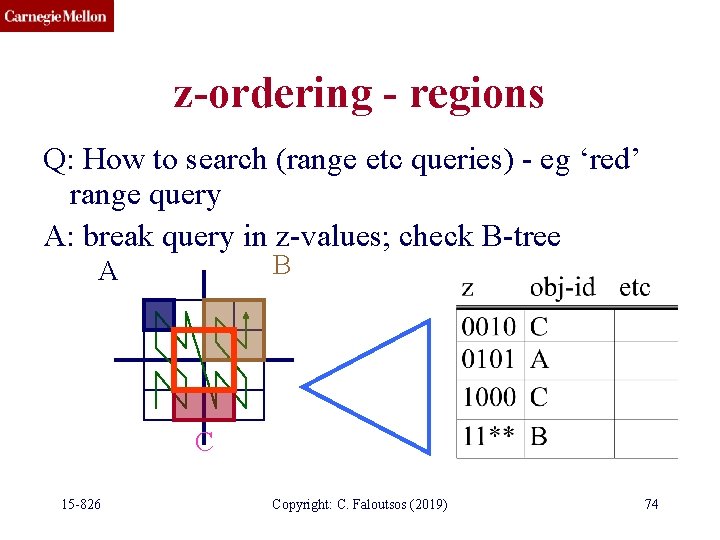
z-ordering - regions Q: How to search (range etc queries) - eg ‘red’ range query A: break query in z-values; check B-tree B A C 15 -826 Copyright: C. Faloutsos (2019) 74
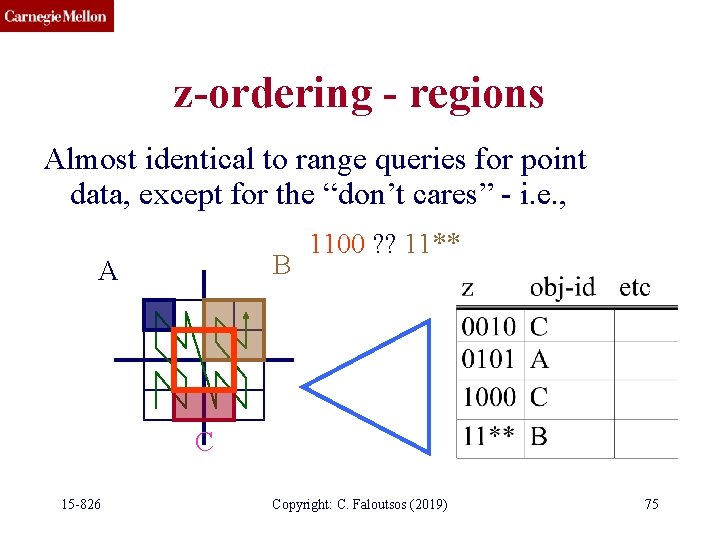
z-ordering - regions Almost identical to range queries for point data, except for the “don’t cares” - i. e. , B A 1100 ? ? 11** C 15 -826 Copyright: C. Faloutsos (2019) 75
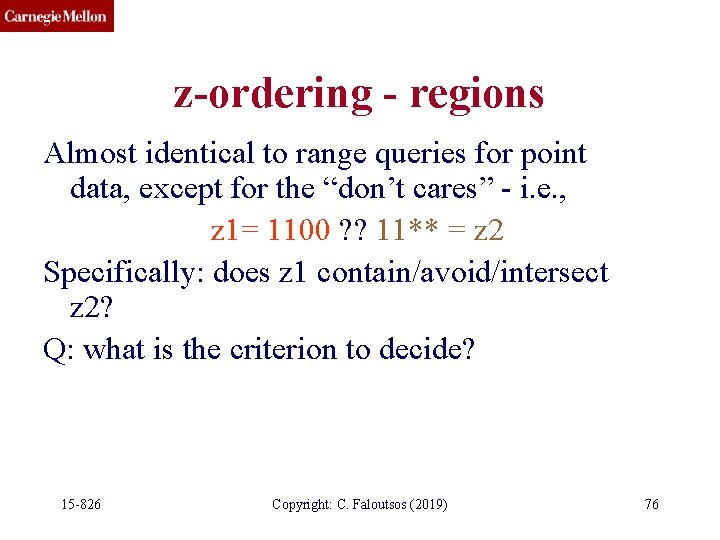
z-ordering - regions Almost identical to range queries for point data, except for the “don’t cares” - i. e. , z 1= 1100 ? ? 11** = z 2 Specifically: does z 1 contain/avoid/intersect z 2? Q: what is the criterion to decide? 15 -826 Copyright: C. Faloutsos (2019) 76
z-ordering - regions z 1= 1100 ? ? 11** = z 2 Specifically: does z 1 contain/avoid/intersect z 2? Q: what is the criterion to decide? A: Prefix property: let r 1, r 2 be the corresponding regions, and let r 1 be the smallest (=> z 1 has fewest ‘*’s). Then: 15 -826 Copyright: C. Faloutsos (2019) 77
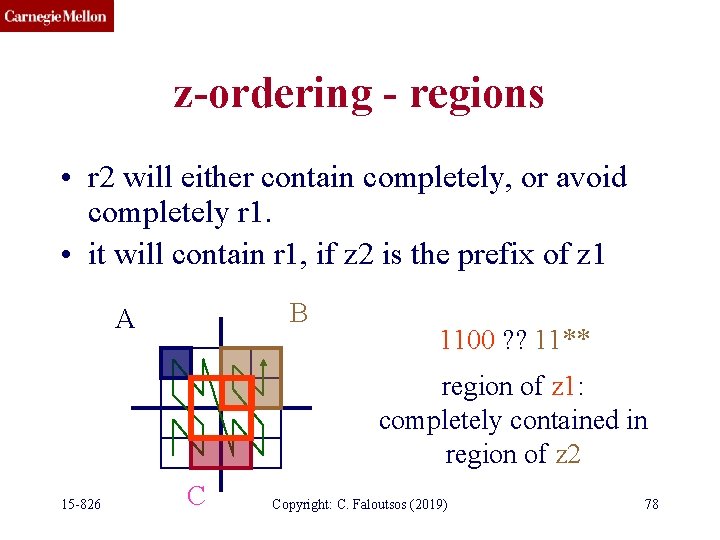
z-ordering - regions • r 2 will either contain completely, or avoid completely r 1. • it will contain r 1, if z 2 is the prefix of z 1 B A 1100 ? ? 11** region of z 1: completely contained in region of z 2 15 -826 C Copyright: C. Faloutsos (2019) 78
z-ordering - regions Drill (True/False). Given: • z 1= 011001** • z 2= 01****** • z 3= 0100**** T/F r 2 contains r 1 T/F r 3 contains r 2 15 -826 Copyright: C. Faloutsos (2019) 79
z-ordering - regions Drill (True/False). Given: • z 1= 011001** • z 2= 01****** • z 3= 0100**** T/F r 2 contains r 1 - TRUE (prefix property) T/F r 3 contains r 1 - FALSE (disjoint) T/F r 3 contains r 2 - FALSE (r 2 contains r 3) 15 -826 Copyright: C. Faloutsos (2019) 80
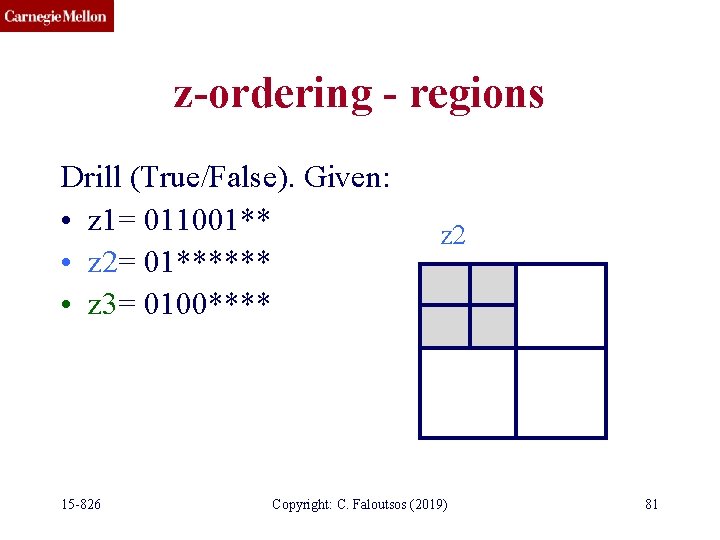
z-ordering - regions Drill (True/False). Given: • z 1= 011001** • z 2= 01****** • z 3= 0100**** 15 -826 z 2 Copyright: C. Faloutsos (2019) 81
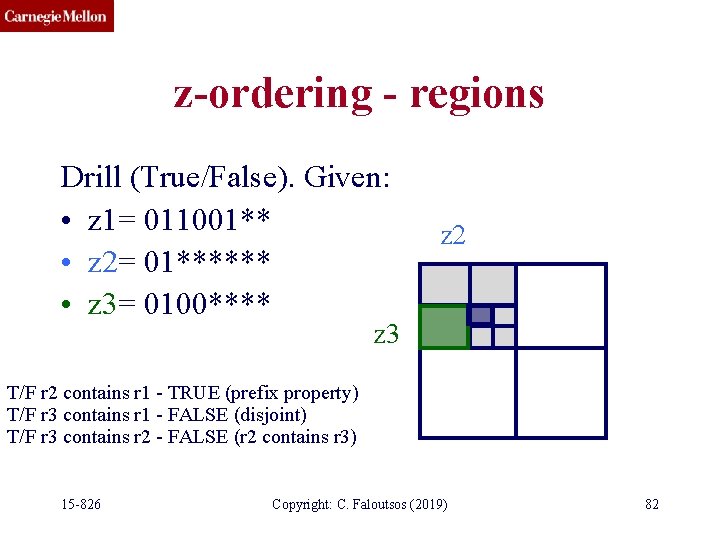
z-ordering - regions Drill (True/False). Given: • z 1= 011001** • z 2= 01****** • z 3= 0100**** z 2 z 3 T/F r 2 contains r 1 - TRUE (prefix property) T/F r 3 contains r 1 - FALSE (disjoint) T/F r 3 contains r 2 - FALSE (r 2 contains r 3) 15 -826 Copyright: C. Faloutsos (2019) 82
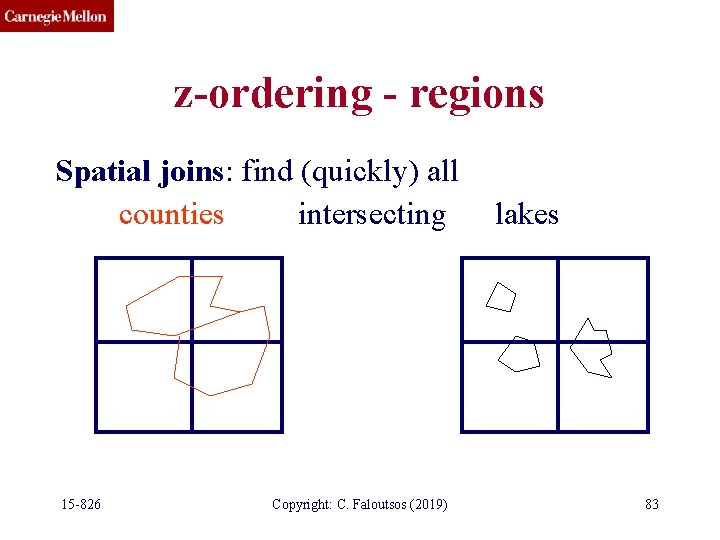
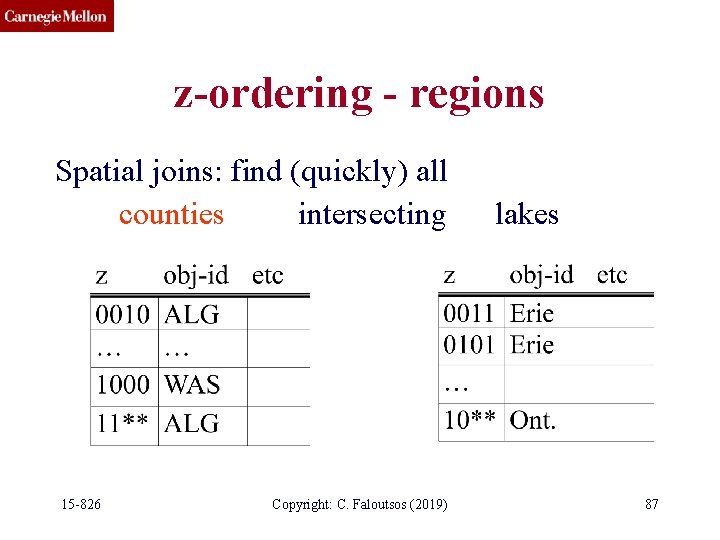
z-ordering - regions Spatial joins: find (quickly) all counties intersecting 15 -826 Copyright: C. Faloutsos (2019) lakes 83
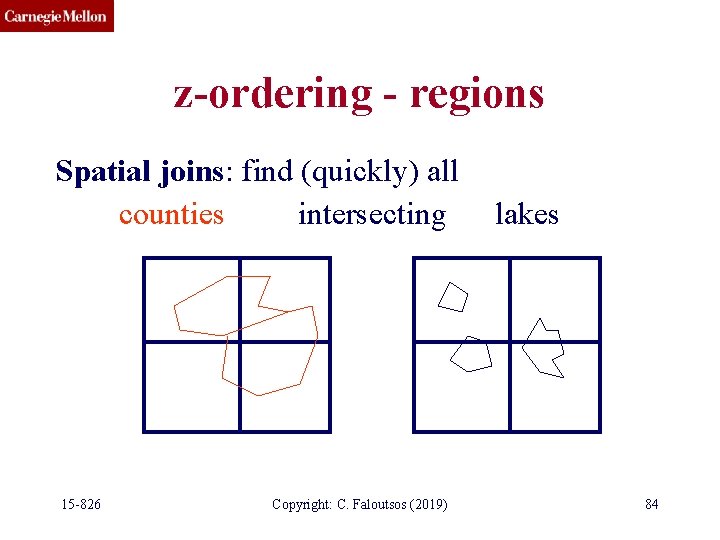
z-ordering - regions Spatial joins: find (quickly) all counties intersecting 15 -826 Copyright: C. Faloutsos (2019) lakes 84
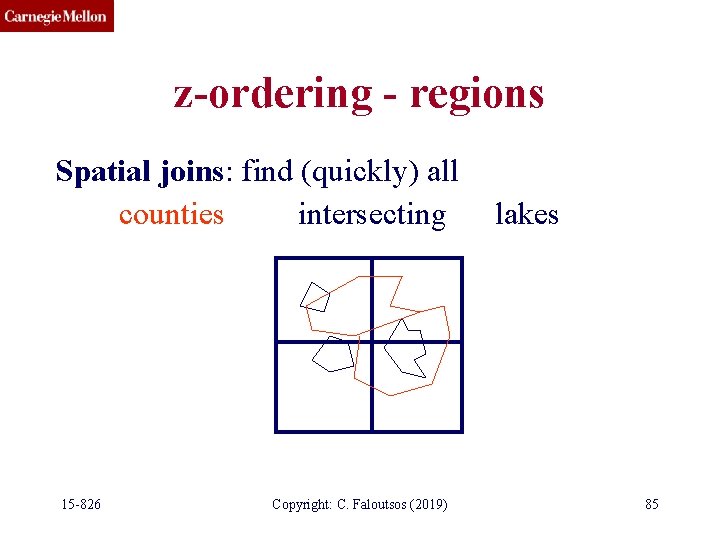
z-ordering - regions Spatial joins: find (quickly) all counties intersecting 15 -826 Copyright: C. Faloutsos (2019) lakes 85
z-ordering - regions Spatial joins: find (quickly) all counties intersecting lakes Naive algorithm: O( N * M) Something faster? 15 -826 Copyright: C. Faloutsos (2019) 86
z-ordering - regions Spatial joins: find (quickly) all counties intersecting 15 -826 Copyright: C. Faloutsos (2019) lakes 87
z-ordering - regions Spatial joins: find (quickly) all counties intersecting lakes Solution: merge the lists of (sorted) z-values, looking for the prefix property footnote#1: ‘*’ needs careful treatment footnote#2: need dup. elimination 15 -826 Copyright: C. Faloutsos (2019) 88
z-ordering - Detailed outline • spatial access methods – z-ordering • • main idea - 3 methods use w/ B-trees; algorithms (range, knn queries. . . ) non-point (eg. , region) data analysis; variations – R-trees –. . . 15 -826 Copyright: C. Faloutsos (2019) 89
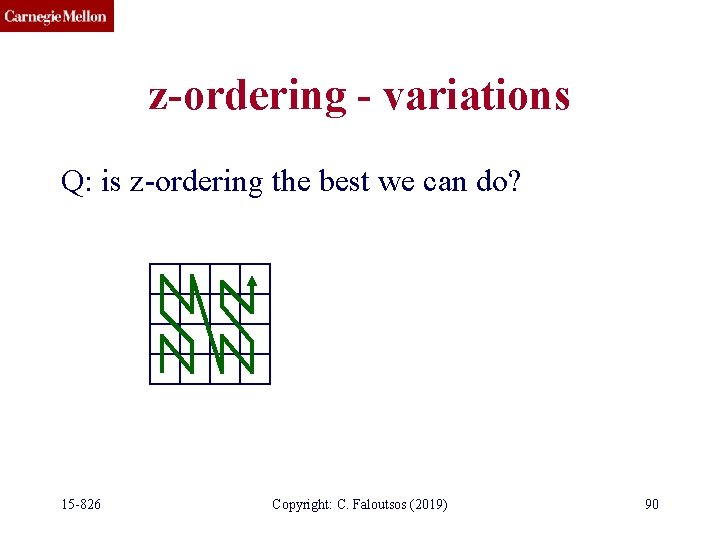
z-ordering - variations Q: is z-ordering the best we can do? 15 -826 Copyright: C. Faloutsos (2019) 90
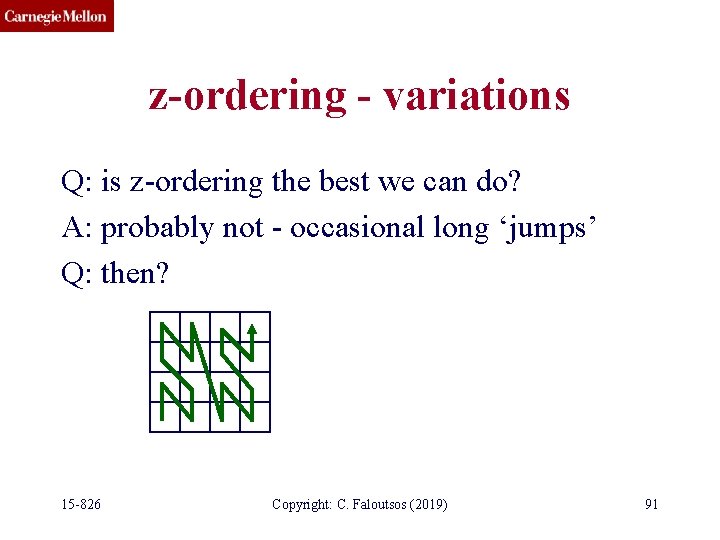
z-ordering - variations Q: is z-ordering the best we can do? A: probably not - occasional long ‘jumps’ Q: then? 15 -826 Copyright: C. Faloutsos (2019) 91
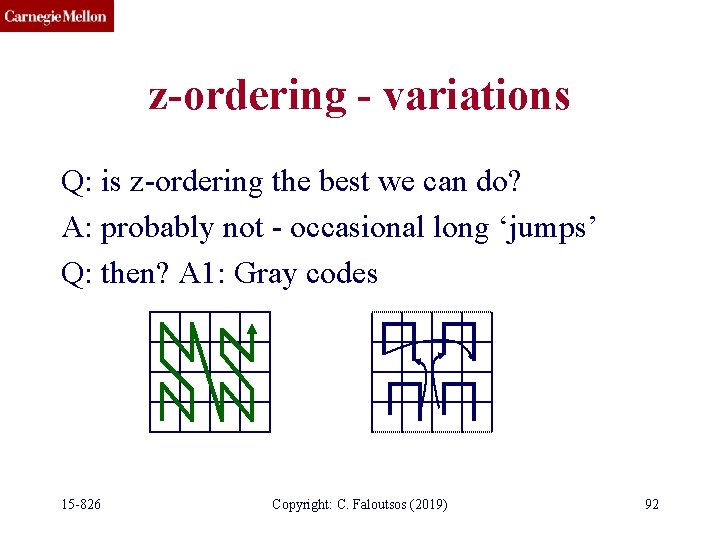
z-ordering - variations Q: is z-ordering the best we can do? A: probably not - occasional long ‘jumps’ Q: then? A 1: Gray codes 15 -826 Copyright: C. Faloutsos (2019) 92
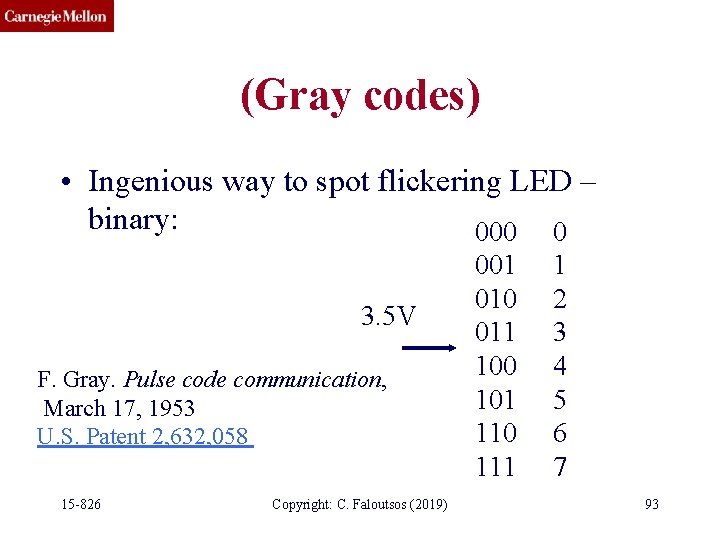
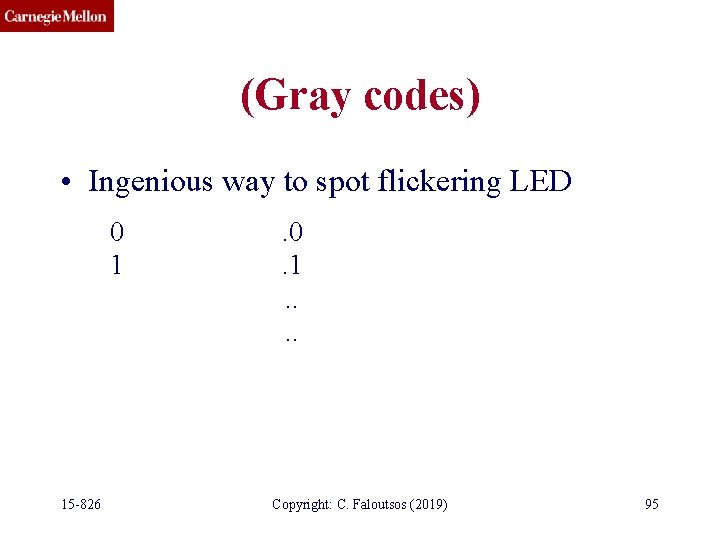
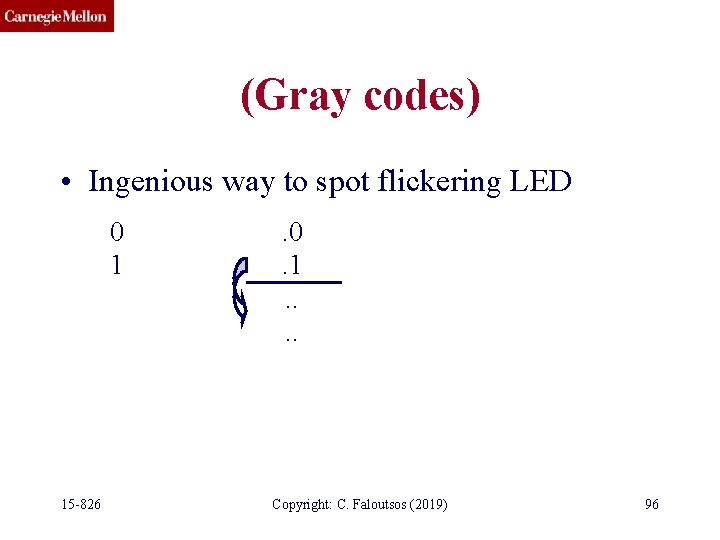
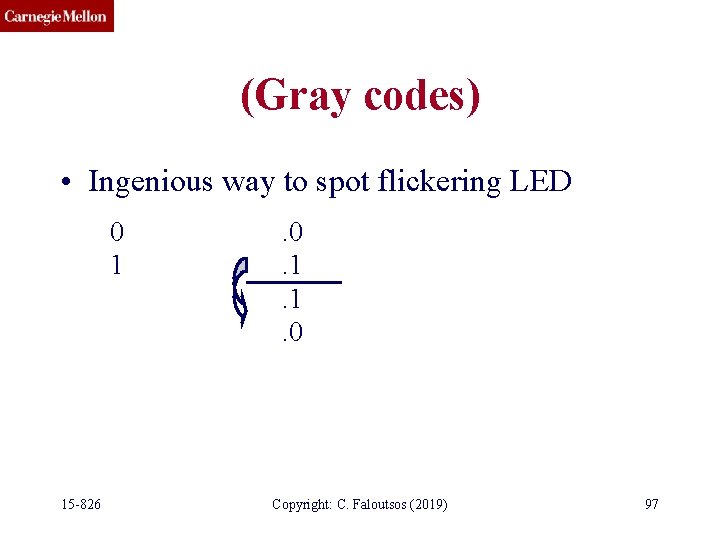
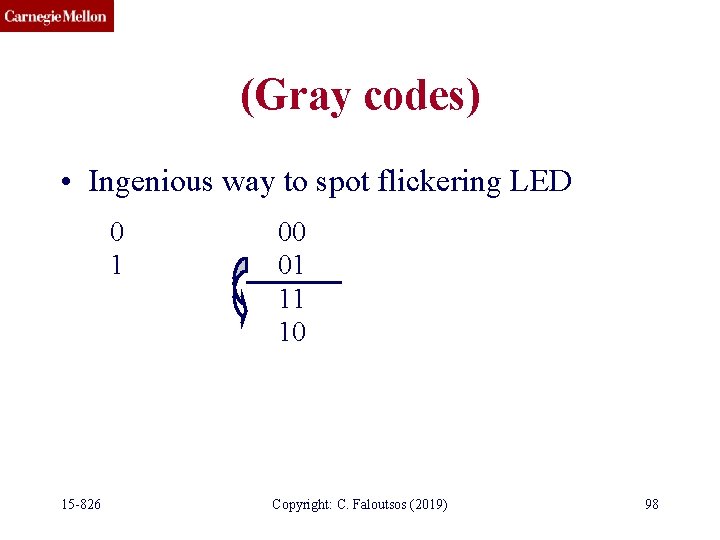
(Gray codes) • Ingenious way to spot flickering LED – binary: 000 0 3. 5 V F. Gray. Pulse code communication, March 17, 1953 U. S. Patent 2, 632, 058 15 -826 Copyright: C. Faloutsos (2019) 001 010 011 100 101 110 111 1 2 3 4 5 6 7 93
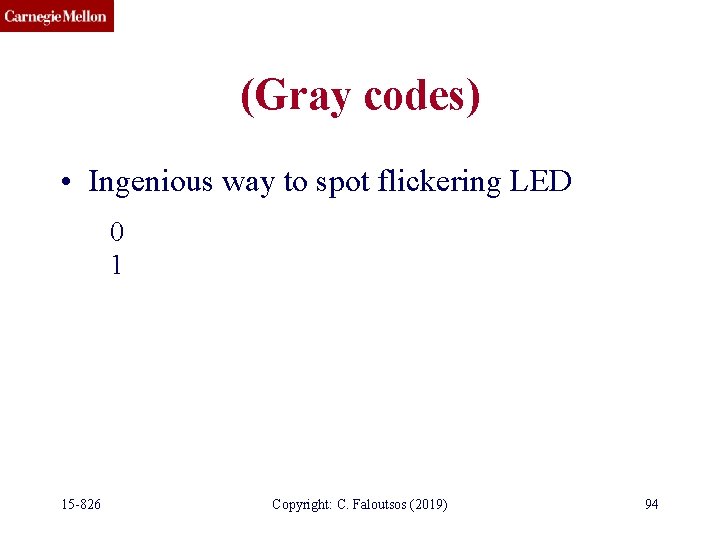
(Gray codes) • Ingenious way to spot flickering LED 0 1 15 -826 Copyright: C. Faloutsos (2019) 94
(Gray codes) • Ingenious way to spot flickering LED 0 1 15 -826 . 0. 1. . Copyright: C. Faloutsos (2019) 95
(Gray codes) • Ingenious way to spot flickering LED 0 1 15 -826 . 0. 1. . Copyright: C. Faloutsos (2019) 96
(Gray codes) • Ingenious way to spot flickering LED 0 1 15 -826 . 0. 1. 1. 0 Copyright: C. Faloutsos (2019) 97
(Gray codes) • Ingenious way to spot flickering LED 0 1 15 -826 00 01 11 10 Copyright: C. Faloutsos (2019) 98
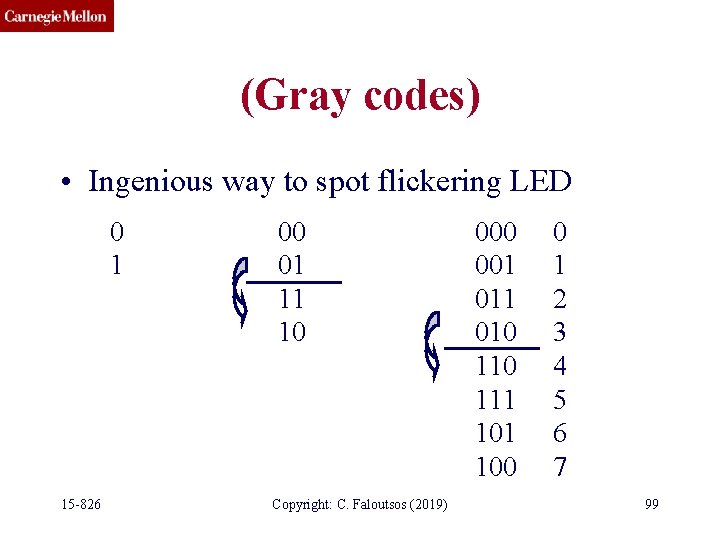
(Gray codes) • Ingenious way to spot flickering LED 0 1 15 -826 00 01 11 10 Copyright: C. Faloutsos (2019) 000 001 010 111 100 0 1 2 3 4 5 6 7 99
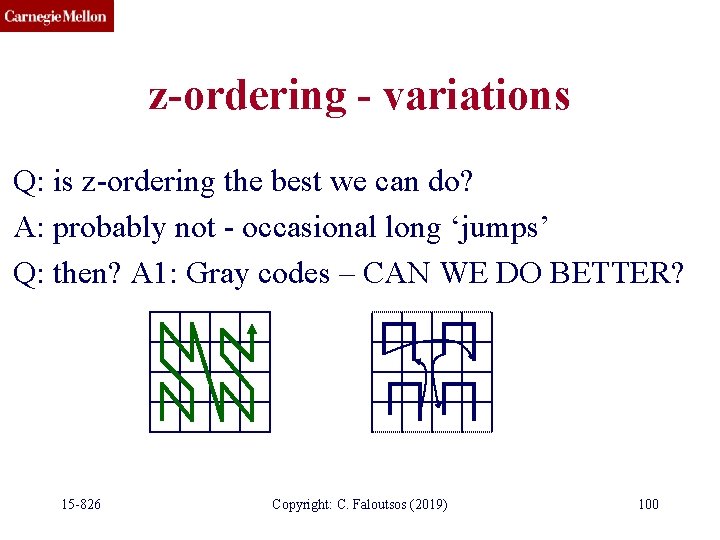
z-ordering - variations Q: is z-ordering the best we can do? A: probably not - occasional long ‘jumps’ Q: then? A 1: Gray codes – CAN WE DO BETTER? 15 -826 Copyright: C. Faloutsos (2019) 100
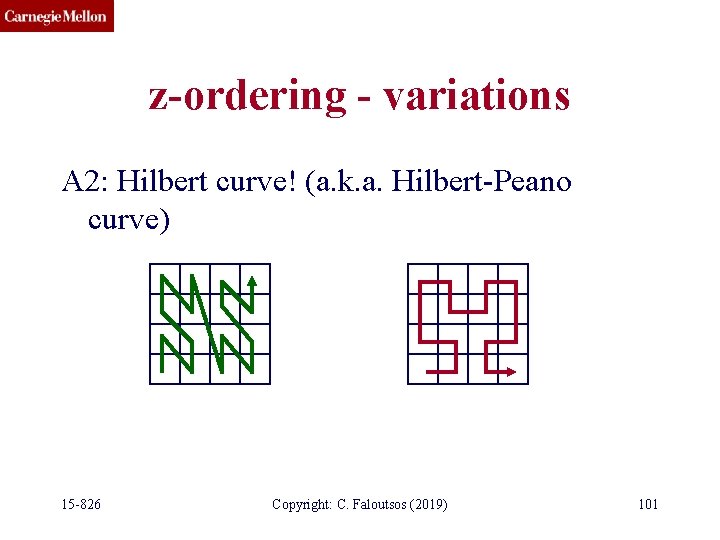
z-ordering - variations A 2: Hilbert curve! (a. k. a. Hilbert-Peano curve) 15 -826 Copyright: C. Faloutsos (2019) 101
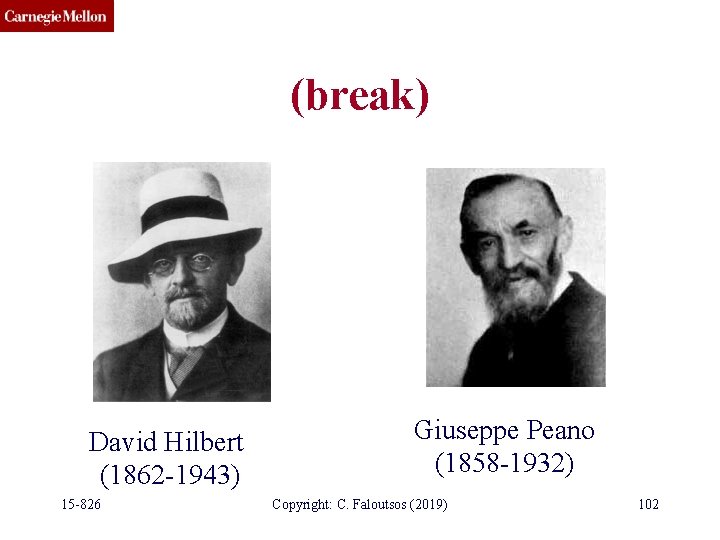
(break) David Hilbert (1862 -1943) 15 -826 Giuseppe Peano (1858 -1932) Copyright: C. Faloutsos (2019) 102
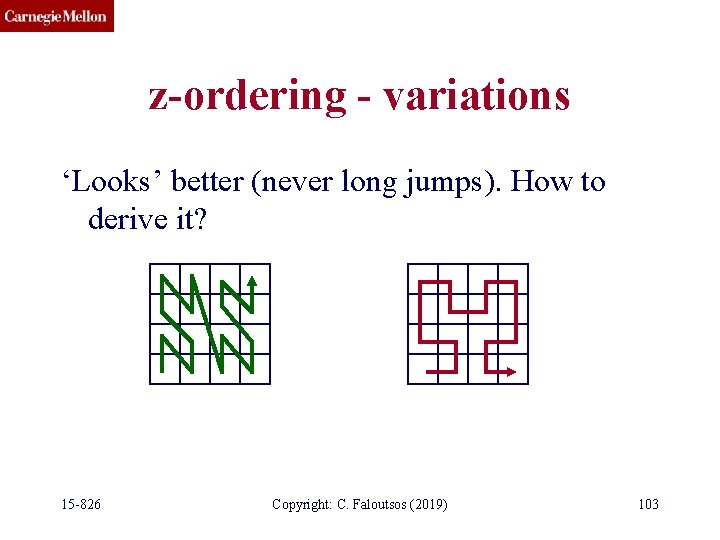
z-ordering - variations ‘Looks’ better (never long jumps). How to derive it? 15 -826 Copyright: C. Faloutsos (2019) 103
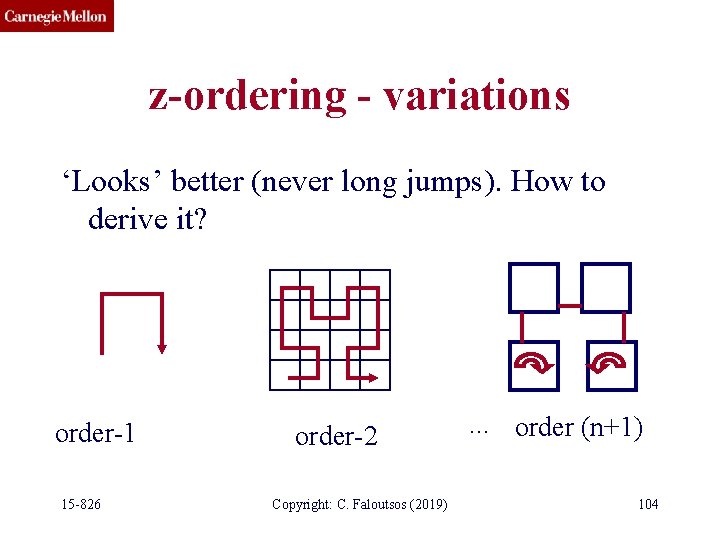
z-ordering - variations ‘Looks’ better (never long jumps). How to derive it? order-1 15 -826 order-2 Copyright: C. Faloutsos (2019) . . . order (n+1) 104
z-ordering - variations Q: function for the Hilbert curve ( h = f(x, y) )? A: bit-shuffling, followed by post-processing, to account for rotations. Linear on # bits. See textbook, for pointers to code/algorithms (eg. , [Jagadish, 90]) 15 -826 Copyright: C. Faloutsos (2019) 105
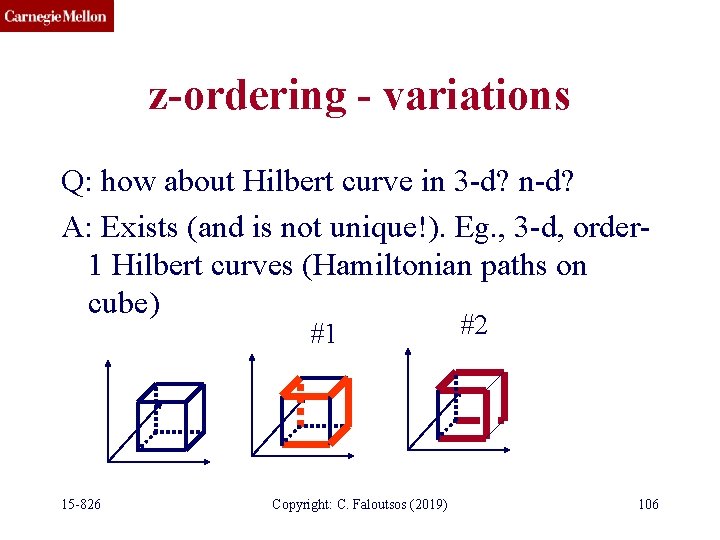
z-ordering - variations Q: how about Hilbert curve in 3 -d? n-d? A: Exists (and is not unique!). Eg. , 3 -d, order 1 Hilbert curves (Hamiltonian paths on cube) #1 15 -826 Copyright: C. Faloutsos (2019) #2 106
z-ordering - Detailed outline • spatial access methods – z-ordering • • main idea - 3 methods use w/ B-trees; algorithms (range, knn queries. . . ) non-point (eg. , region) data analysis; variations – R-trees –. . . 15 -826 Copyright: C. Faloutsos (2019) 107
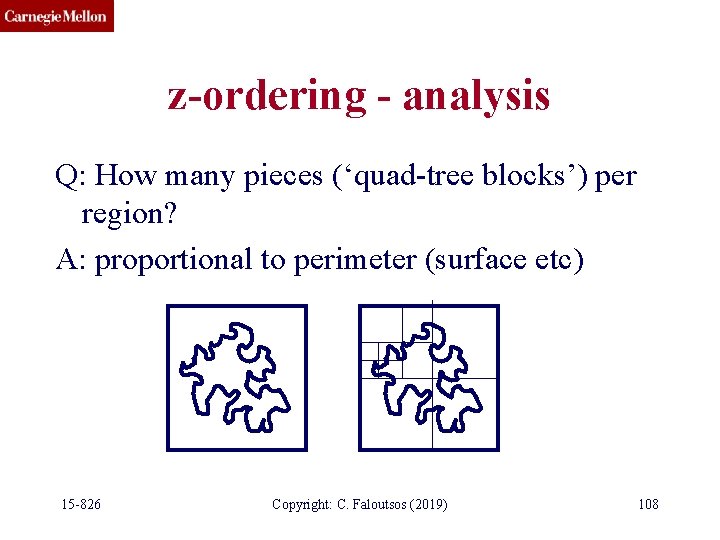
z-ordering - analysis Q: How many pieces (‘quad-tree blocks’) per region? A: proportional to perimeter (surface etc) 15 -826 Copyright: C. Faloutsos (2019) 108
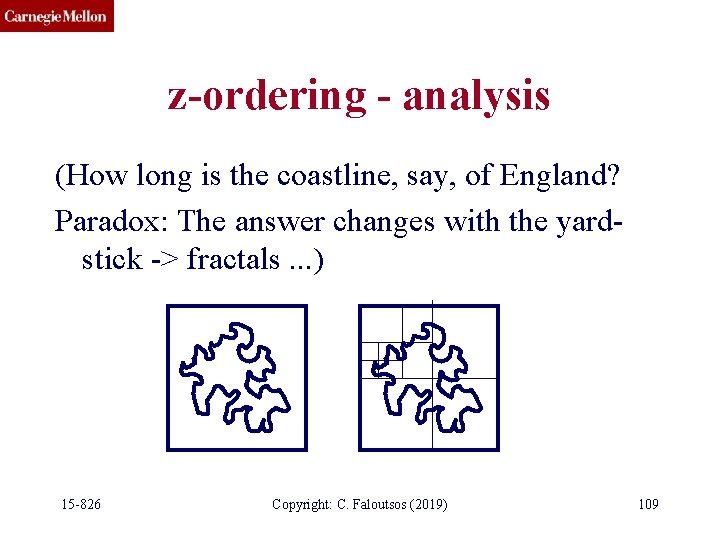
z-ordering - analysis (How long is the coastline, say, of England? Paradox: The answer changes with the yardstick -> fractals. . . ) 15 -826 Copyright: C. Faloutsos (2019) 109
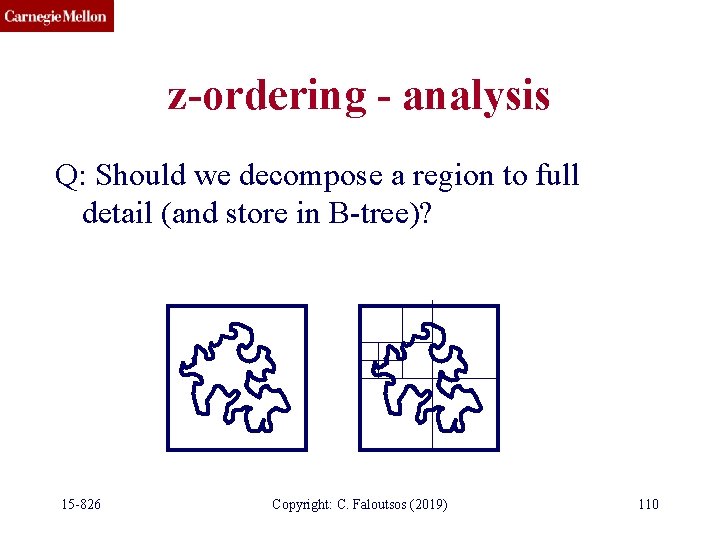
z-ordering - analysis Q: Should we decompose a region to full detail (and store in B-tree)? 15 -826 Copyright: C. Faloutsos (2019) 110
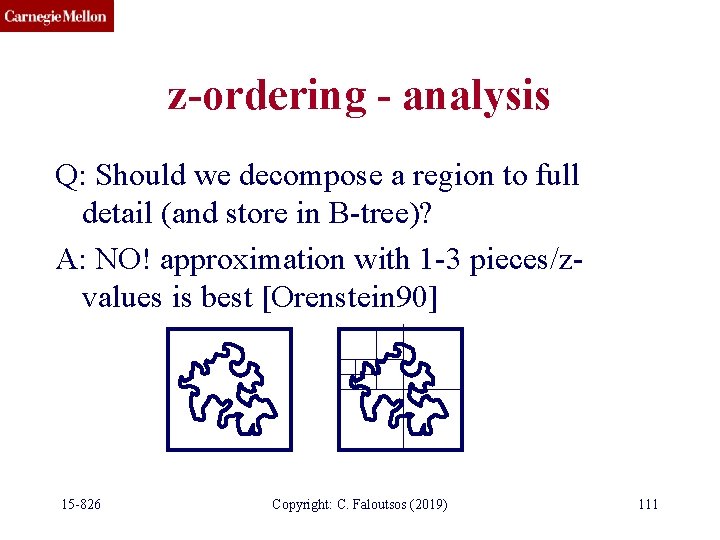
z-ordering - analysis Q: Should we decompose a region to full detail (and store in B-tree)? A: NO! approximation with 1 -3 pieces/zvalues is best [Orenstein 90] 15 -826 Copyright: C. Faloutsos (2019) 111
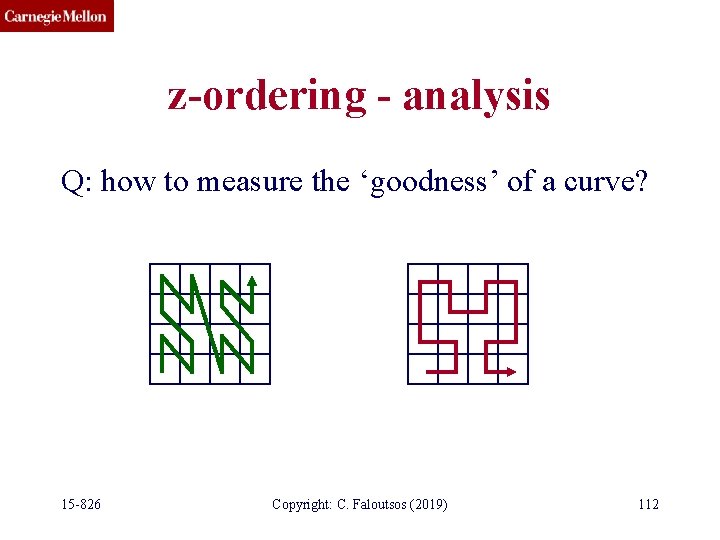
z-ordering - analysis Q: how to measure the ‘goodness’ of a curve? 15 -826 Copyright: C. Faloutsos (2019) 112
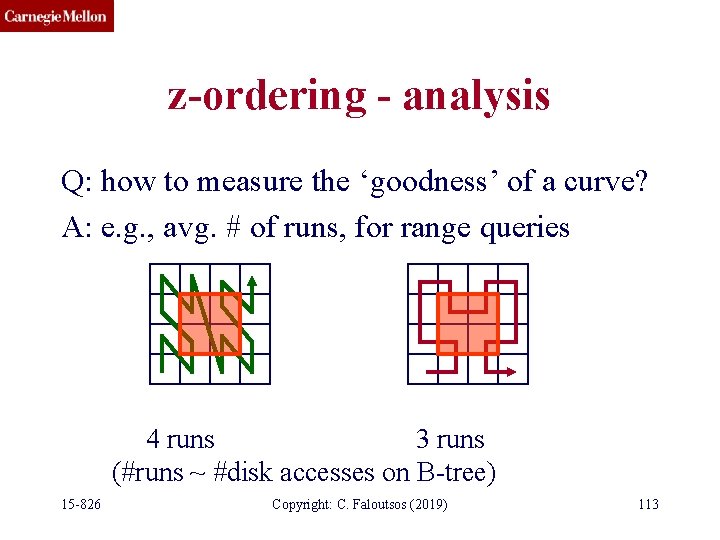
z-ordering - analysis Q: how to measure the ‘goodness’ of a curve? A: e. g. , avg. # of runs, for range queries 4 runs 3 runs (#runs ~ #disk accesses on B-tree) 15 -826 Copyright: C. Faloutsos (2019) 113
z-ordering - analysis Q: So, is Hilbert really better? A: 27% fewer runs, for 2 -d (similar for 3 -d) Q: are there formulas for #runs, #of quadtree blocks etc? A: Yes ([Jagadish; Moon+ etc] see textbook) 15 -826 Copyright: C. Faloutsos (2019) 114
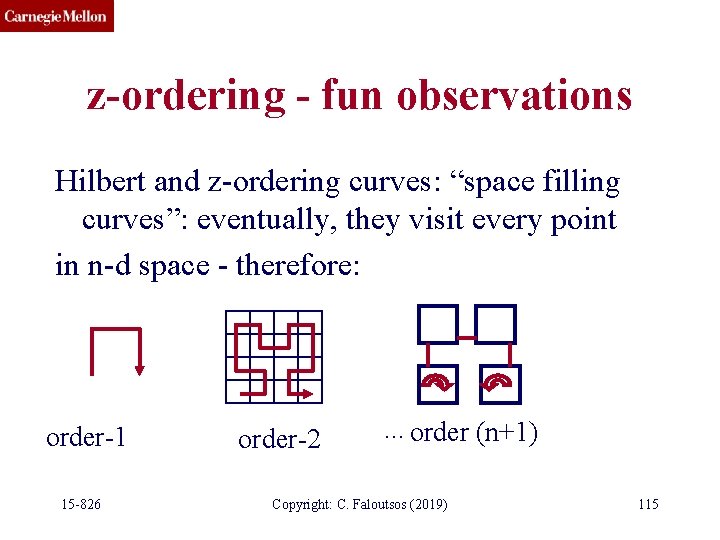
z-ordering - fun observations Hilbert and z-ordering curves: “space filling curves”: eventually, they visit every point in n-d space - therefore: order-1 15 -826 order-2 . . . order (n+1) Copyright: C. Faloutsos (2019) 115
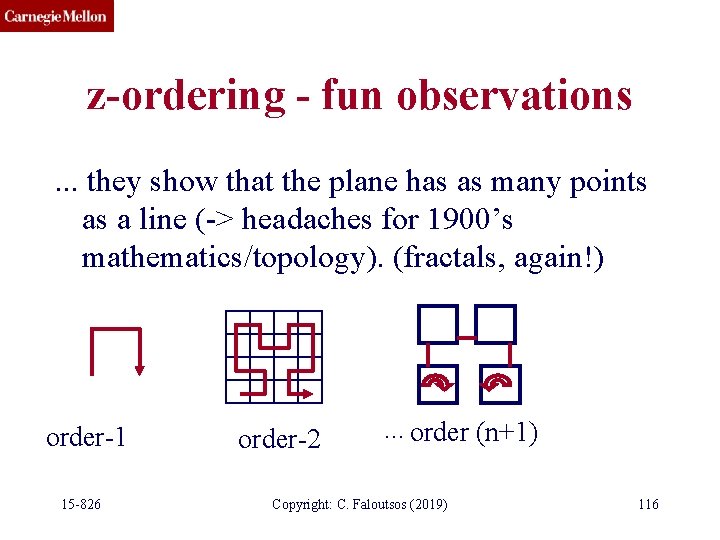
z-ordering - fun observations. . . they show that the plane has as many points as a line (-> headaches for 1900’s mathematics/topology). (fractals, again!) order-1 15 -826 order-2 . . . order (n+1) Copyright: C. Faloutsos (2019) 116
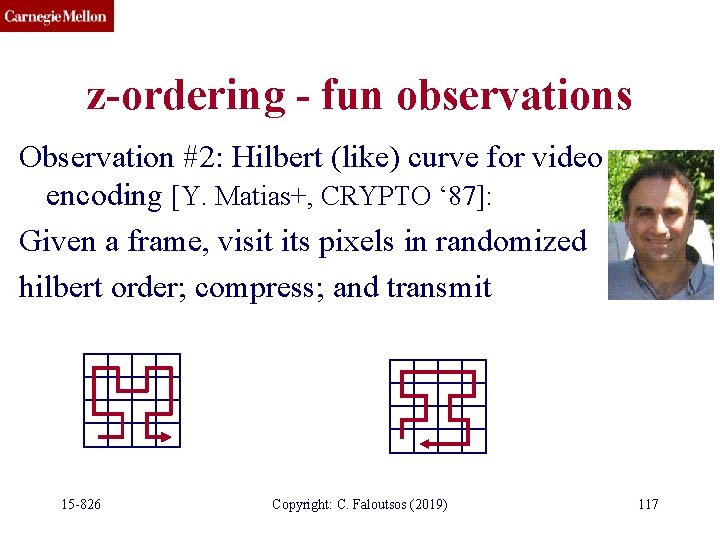
z-ordering - fun observations Observation #2: Hilbert (like) curve for video encoding [Y. Matias+, CRYPTO ‘ 87]: Given a frame, visit its pixels in randomized hilbert order; compress; and transmit 15 -826 Copyright: C. Faloutsos (2019) 117
z-ordering - fun observations In general, Hilbert curve is great for preserving distances, clustering, vector quantization etc 15 -826 Copyright: C. Faloutsos (2019) 118
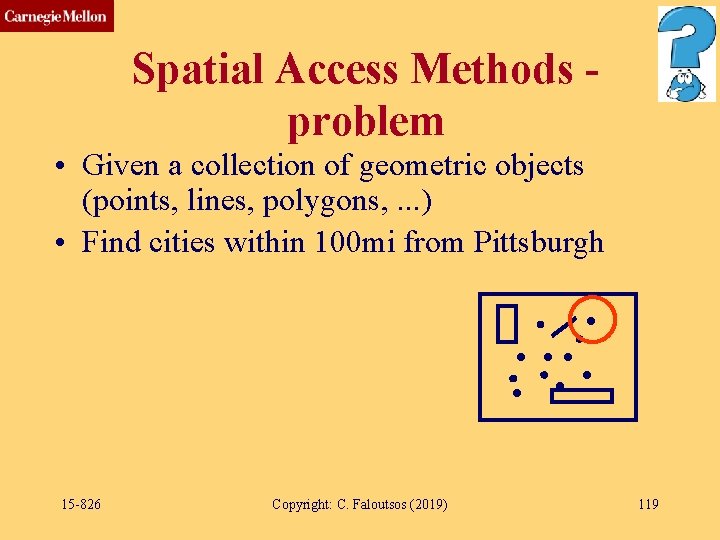
Spatial Access Methods problem • Given a collection of geometric objects (points, lines, polygons, . . . ) • Find cities within 100 mi from Pittsburgh 15 -826 Copyright: C. Faloutsos (2019) 119
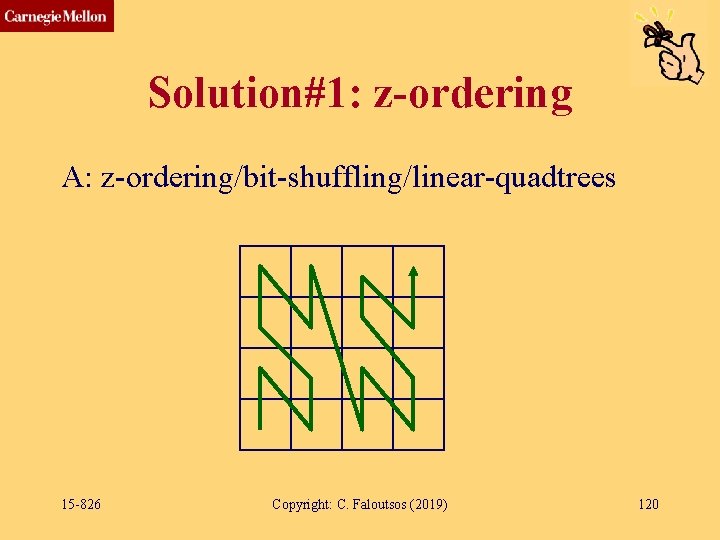
Solution#1: z-ordering A: z-ordering/bit-shuffling/linear-quadtrees 15 -826 Copyright: C. Faloutsos (2019) 120
Conclusions • z-ordering is a great idea (n-d points -> 1 -d points; feed to B-trees) • used by TIGER system http: //www. census. gov/geo/www/tiger/ • and (most probably) by other GIS products • works great with low-dim points 15 -826 Copyright: C. Faloutsos (2019) 121
- Slides: 121