
15 583 Algorithms in the Real World Data
![Theory behind LZ 77 Sliding Window LZ is Asymptotically Optimal [Wyner-Ziv, 94] Will compress](https://slidetodoc.com/presentation_image_h/caca64b57db98e1c7509bfb0704a238f/image-8.jpg "Theory behind LZ 77 Sliding Window LZ is Asymptotically Optimal [Wyner-Ziv, 94] Will compress")
![LZW (Lempel-Ziv-Welch) [Welch 84] Don’t send extra character c, but still add Sc to](https://slidetodoc.com/presentation_image_h/caca64b57db98e1c7509bfb0704a238f/image-12.jpg "LZW (Lempel-Ziv-Welch) [Welch 84] Don’t send extra character c, but still add Sc to")
- Slides: 25
15 -583: Algorithms in the Real World Data Compression III Lempel-Ziv algorithms Burrows-Wheeler Introduction to Lossy Compression 15 -853 1
Lempel-Ziv Algorithms LZ 77 (Sliding Window) • Variants: LZSS (Lempel-Ziv-Storer-Szymanski) • Applications: gzip, Squeeze, LHA, PKZIP, ZOO LZ 78 (Dictionary Based) • Variants: LZW (Lempel-Ziv-Welch), LZC (Lempel-Ziv-Compress) • Applications: compress, GIF, CCITT (modems), ARC, PAK Traditionally LZ 77 was better but slower, but the gzip version is almost as fast as any LZ 78. 15 -853 2
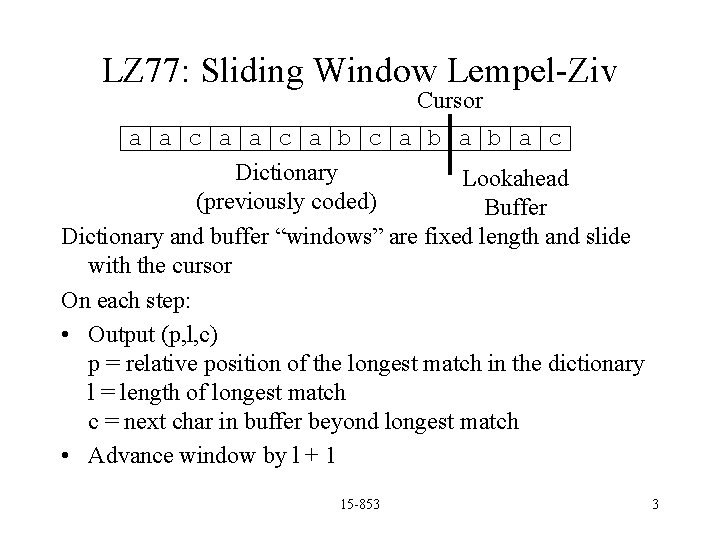
LZ 77: Sliding Window Lempel-Ziv Cursor a a c a b a c Dictionary Lookahead (previously coded) Buffer Dictionary and buffer “windows” are fixed length and slide with the cursor On each step: • Output (p, l, c) p = relative position of the longest match in the dictionary l = length of longest match c = next char in buffer beyond longest match • Advance window by l + 1 15 -853 3
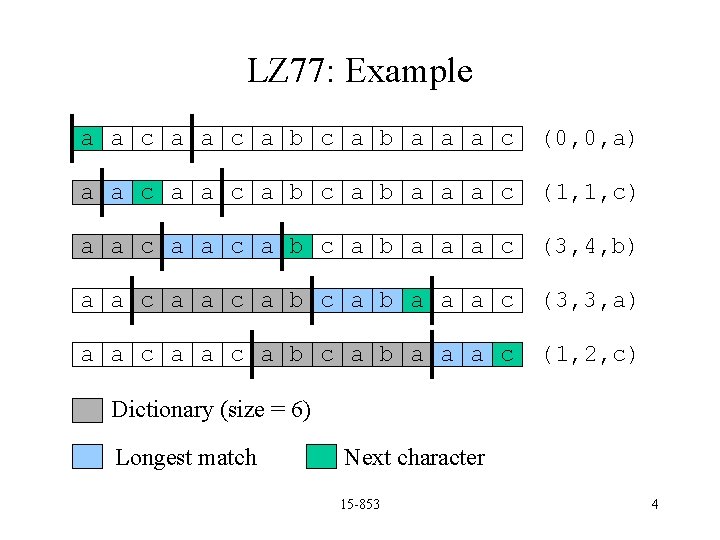
LZ 77: Example a a c a b a a a c (0, 0, a) a a c a b a a a c (1, 1, c) a a c a b a a a c (3, 4, b) a a c a b a a a c (3, 3, a) a a c a b a a a c (1, 2, c) Dictionary (size = 6) Longest match Next character 15 -853 4
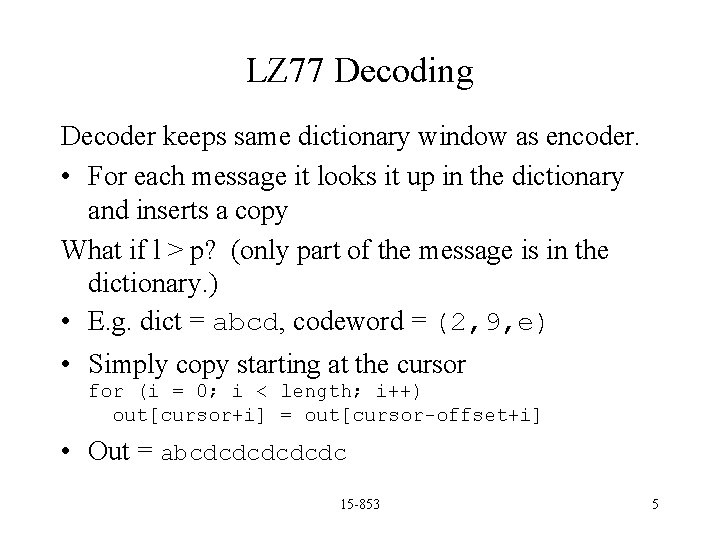
LZ 77 Decoding Decoder keeps same dictionary window as encoder. • For each message it looks it up in the dictionary and inserts a copy What if l > p? (only part of the message is in the dictionary. ) • E. g. dict = abcd, codeword = (2, 9, e) • Simply copy starting at the cursor for (i = 0; i < length; i++) out[cursor+i] = out[cursor-offset+i] • Out = abcdcdcdc 15 -853 5
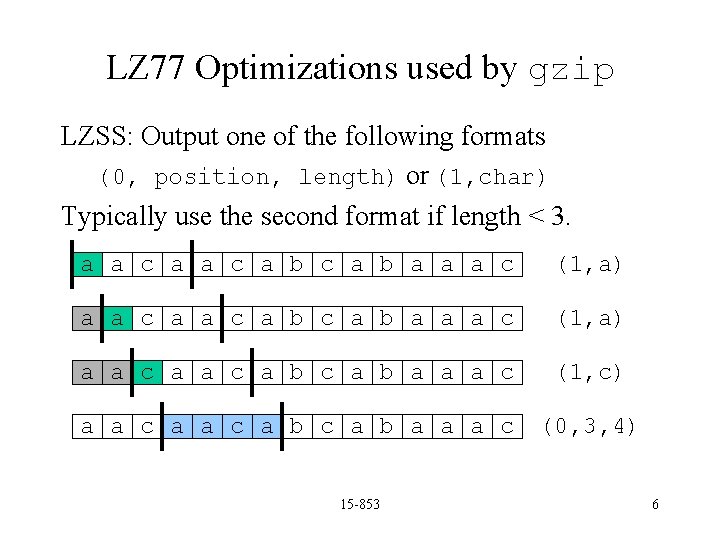
LZ 77 Optimizations used by gzip LZSS: Output one of the following formats (0, position, length) or (1, char) Typically use the second format if length < 3. a a c a b c a b a a a c (1, a) a a c a b a a a c (1, c) a a c a b a a a c (0, 3, 4) 15 -853 6
Optimizations used by gzip (cont. ) • Huffman code the positions, lengths and chars • Non greedy: possibly use shorter match so that next match is better • Use hash table to store dictionary. – Hash is based on strings of length 3. – Find the longest match within the correct hash bucket. – Limit on length of search. – Store within bucket in order of position 15 -853 7
Theory behind LZ 77 Sliding Window LZ is Asymptotically Optimal [Wyner-Ziv, 94] Will compress long enough strings to the source entropy as the window size goes to infinity. Uses logarithmic code for position. Problem: “long enough” is really long. 15 -853 8
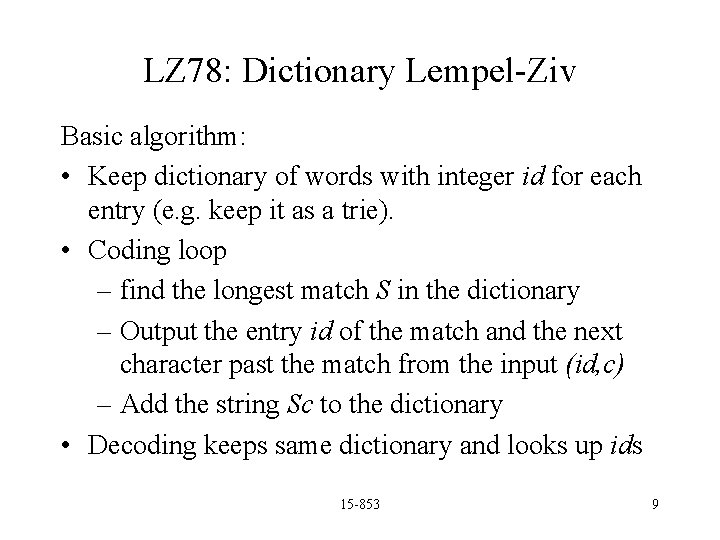
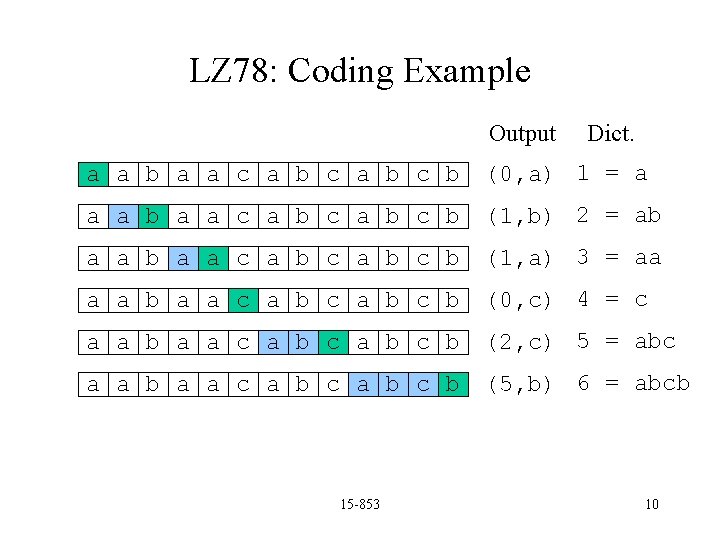
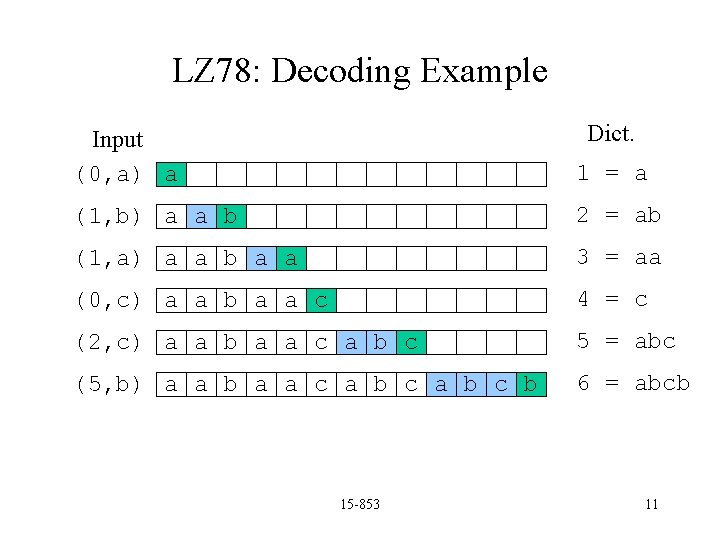
LZ 78: Dictionary Lempel-Ziv Basic algorithm: • Keep dictionary of words with integer id for each entry (e. g. keep it as a trie). • Coding loop – find the longest match S in the dictionary – Output the entry id of the match and the next character past the match from the input (id, c) – Add the string Sc to the dictionary • Decoding keeps same dictionary and looks up ids 15 -853 9
LZ 78: Coding Example Output Dict. a a b a a c a b c b (0, a) 1 = a a a b a a c a b c b (1, b) 2 = ab a a c a b c b (1, a) 3 = aa a a b a a c a b c b (0, c) 4 = c a a b a a c a b c b (2, c) 5 = abc a a b a a c a b c b (5, b) 6 = abcb 15 -853 10
LZ 78: Decoding Example Dict. Input (0, a) a 1 = a (1, b) a a b 2 = ab (1, a) a a b a a 3 = aa (0, c) a a b a a c 4 = c (2, c) a a b a a c a b c 5 = abc (5, b) a a b a a c a b c b 6 = abcb 15 -853 11
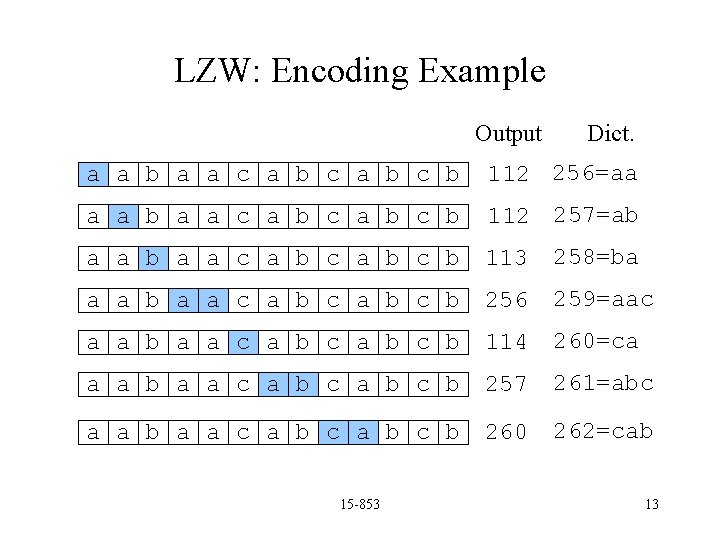
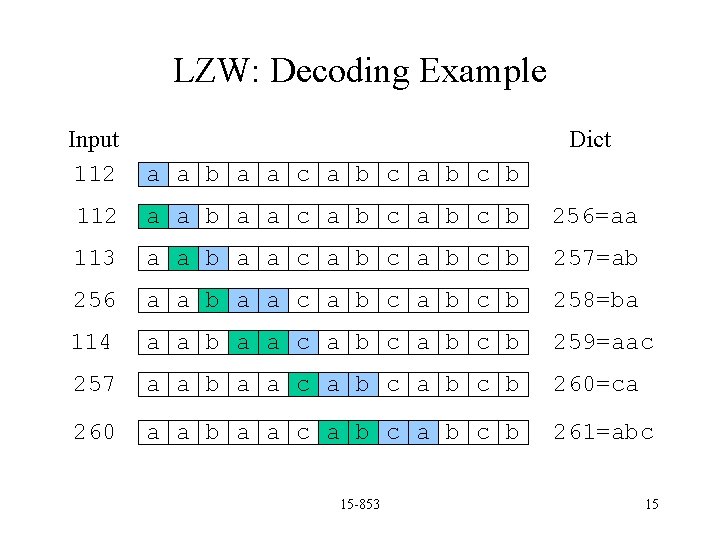
LZW (Lempel-Ziv-Welch) [Welch 84] Don’t send extra character c, but still add Sc to the dictionary. The dictionary is initialized with byte values being the first 256 entries (e. g. a = 112, ascii), otherwise there is no way to start it up. The decoder is one step behind the coder since it does not know c • Only an issue for strings of the form SSc where S[0] = c, and these are handled specially 15 -853 12
LZW: Encoding Example Output Dict. a a b a a c a b c b 112 256=aa a a b a a c a b c b 112 257=ab a a c a b c b 113 258=ba a a b a a c a b c b 256 259=aac a a b a a c a b c b 114 260=ca a a b a a c a b c b 257 261=abc a a b a a c a b c b 260 262=cab 15 -853 13
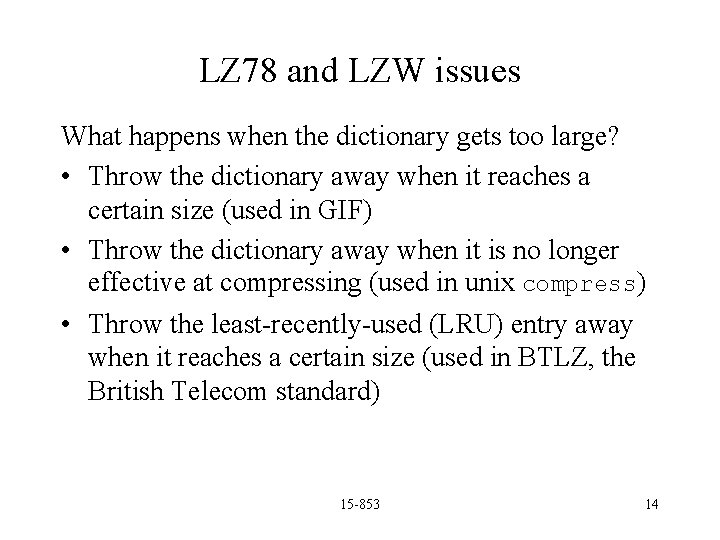
LZ 78 and LZW issues What happens when the dictionary gets too large? • Throw the dictionary away when it reaches a certain size (used in GIF) • Throw the dictionary away when it is no longer effective at compressing (used in unix compress) • Throw the least-recently-used (LRU) entry away when it reaches a certain size (used in BTLZ, the British Telecom standard) 15 -853 14
LZW: Decoding Example Input 112 Dict a a b a a c a b c b 112 a a b a a c a b c b 256=aa 113 a a b a a c a b c b 257=ab 256 a a b a a c a b c b 258=ba 114 a a b a a c a b c b 259=aac 257 a a b a a c a b c b 260=ca 260 a a b a a c a b c b 261=abc 15 -853 15
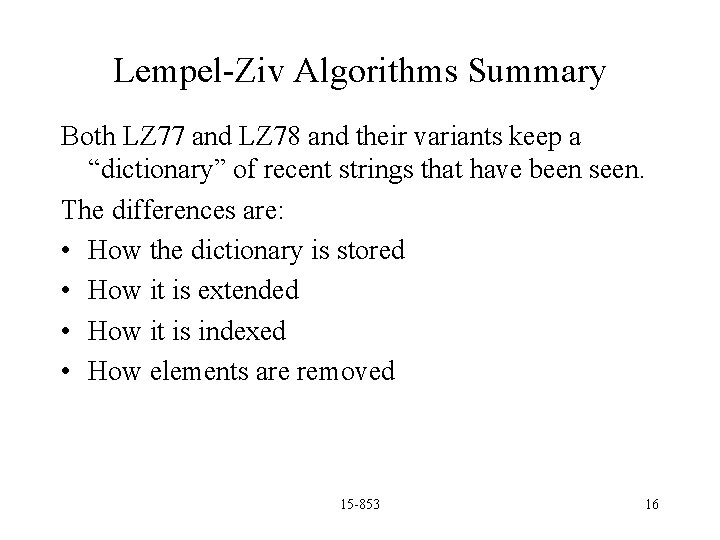
Lempel-Ziv Algorithms Summary Both LZ 77 and LZ 78 and their variants keep a “dictionary” of recent strings that have been seen. The differences are: • How the dictionary is stored • How it is extended • How it is indexed • How elements are removed 15 -853 16
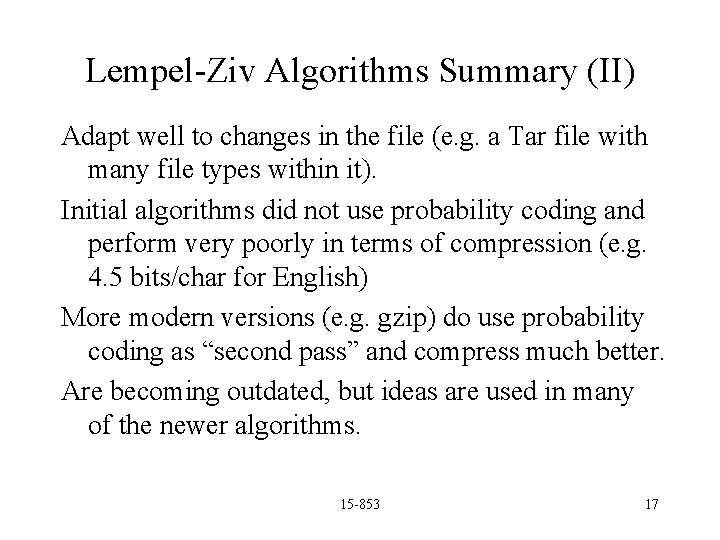
Lempel-Ziv Algorithms Summary (II) Adapt well to changes in the file (e. g. a Tar file with many file types within it). Initial algorithms did not use probability coding and perform very poorly in terms of compression (e. g. 4. 5 bits/char for English) More modern versions (e. g. gzip) do use probability coding as “second pass” and compress much better. Are becoming outdated, but ideas are used in many of the newer algorithms. 15 -853 17
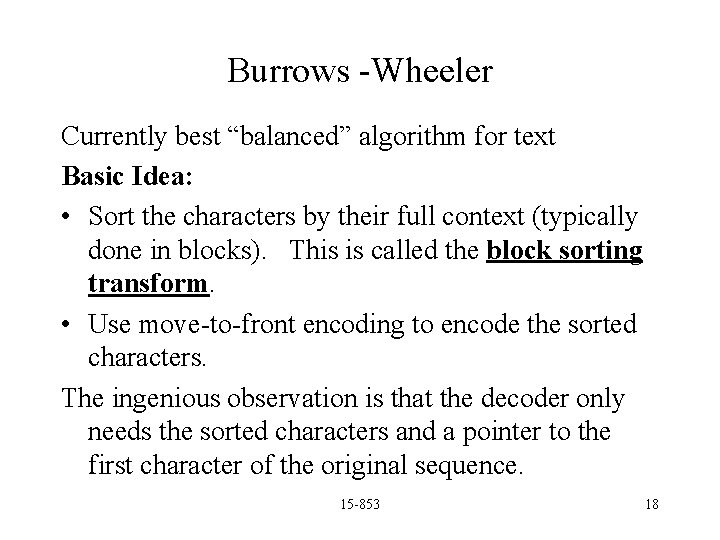
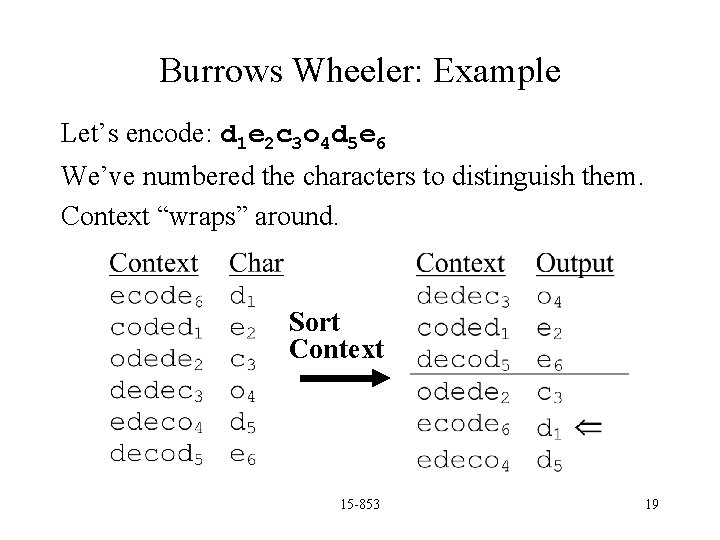
Burrows -Wheeler Currently best “balanced” algorithm for text Basic Idea: • Sort the characters by their full context (typically done in blocks). This is called the block sorting transform. • Use move-to-front encoding to encode the sorted characters. The ingenious observation is that the decoder only needs the sorted characters and a pointer to the first character of the original sequence. 15 -853 18
Burrows Wheeler: Example Let’s encode: d 1 e 2 c 3 o 4 d 5 e 6 We’ve numbered the characters to distinguish them. Context “wraps” around. Sort Context 15 -853 19
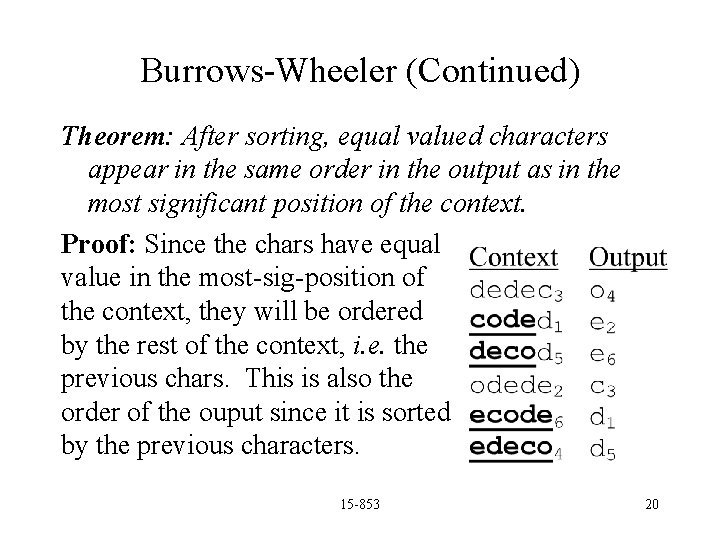
Burrows-Wheeler (Continued) Theorem: After sorting, equal valued characters appear in the same order in the output as in the most significant position of the context. Proof: Since the chars have equal value in the most-sig-position of the context, they will be ordered by the rest of the context, i. e. the previous chars. This is also the order of the ouput since it is sorted by the previous characters. 15 -853 20
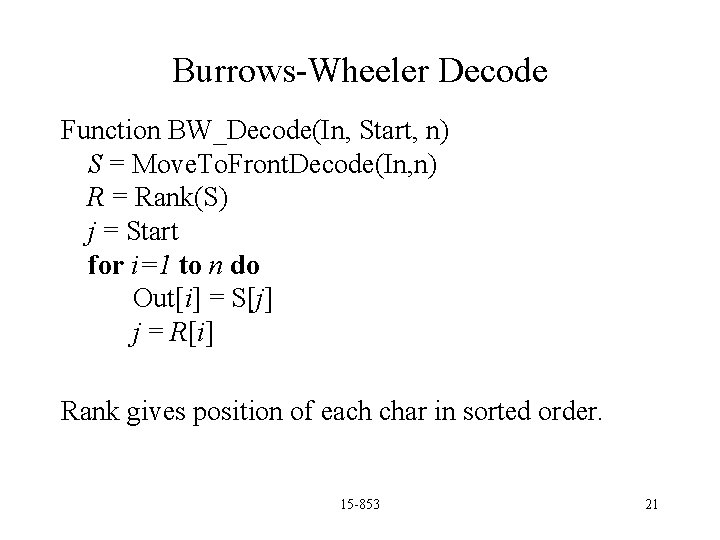
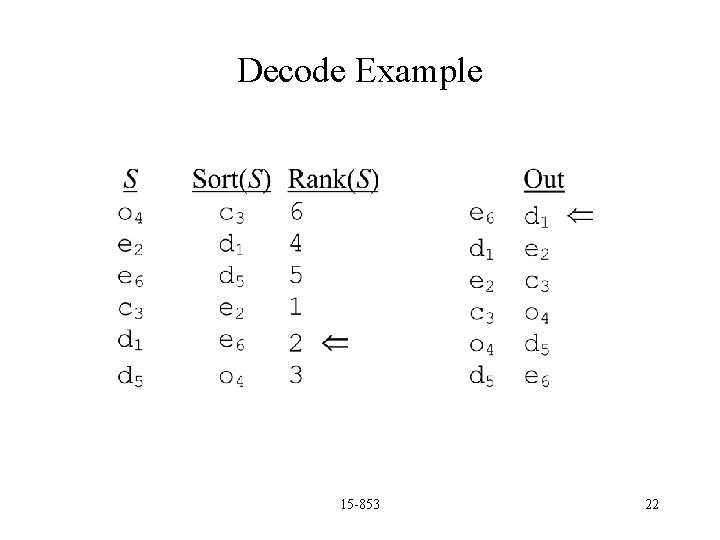
Burrows-Wheeler Decode Function BW_Decode(In, Start, n) S = Move. To. Front. Decode(In, n) R = Rank(S) j = Start for i=1 to n do Out[i] = S[j] j = R[i] Rank gives position of each char in sorted order. 15 -853 21
Decode Example 15 -853 22
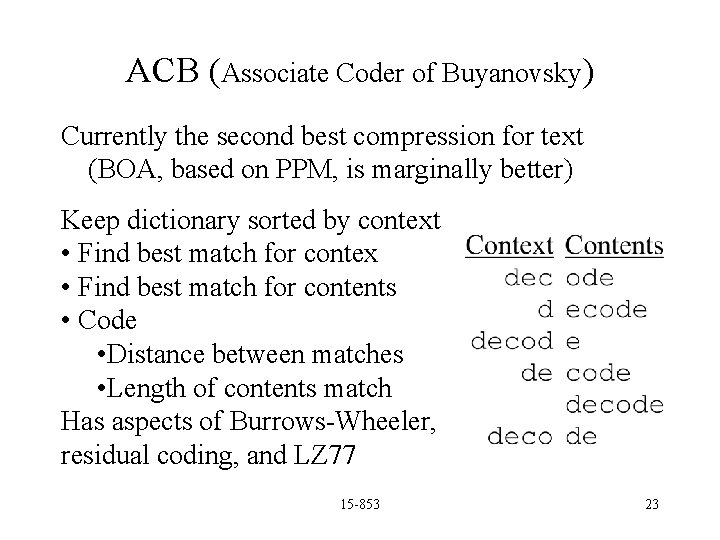
ACB (Associate Coder of Buyanovsky) Currently the second best compression for text (BOA, based on PPM, is marginally better) Keep dictionary sorted by context • Find best match for contex • Find best match for contents • Code • Distance between matches • Length of contents match Has aspects of Burrows-Wheeler, residual coding, and LZ 77 15 -853 23
Other Ideas? 15 -853 24
More Ideas? 15 -853 25