
15 453 FORMAL LANGUAGES AUTOMATA AND COMPUTABILITY CONTEXTFREE
15 -453 FORMAL LANGUAGES, AUTOMATA AND COMPUTABILITY
CONTEXT-FREE GRAMMARS AND PUSH-DOWN AUTOMATA
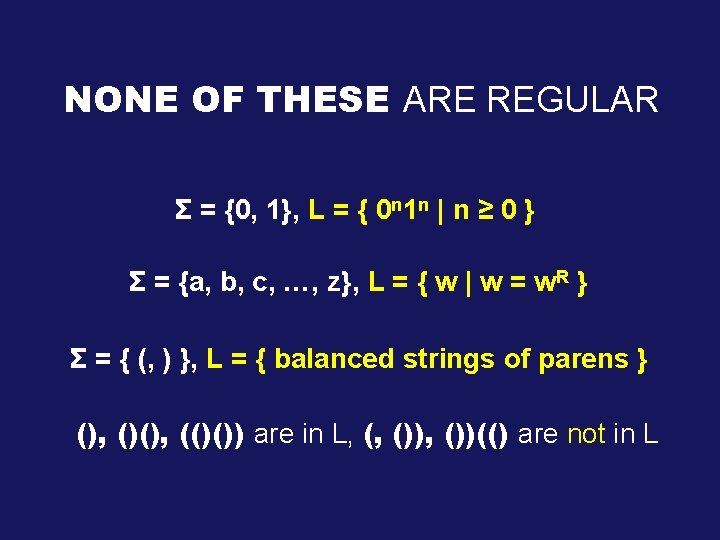
NONE OF THESE ARE REGULAR Σ = {0, 1}, L = { 0 n 1 n | n ≥ 0 } Σ = {a, b, c, …, z}, L = { w | w = w. R } Σ = { (, ) }, L = { balanced strings of parens } (), ()(), (()()) are in L, (, ())(() are not in L
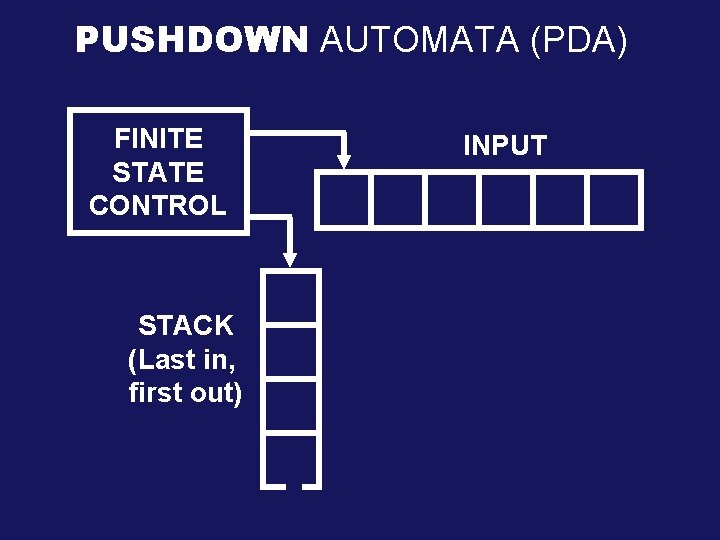
PUSHDOWN AUTOMATA (PDA) FINITE STATE CONTROL STACK (Last in, first out) INPUT
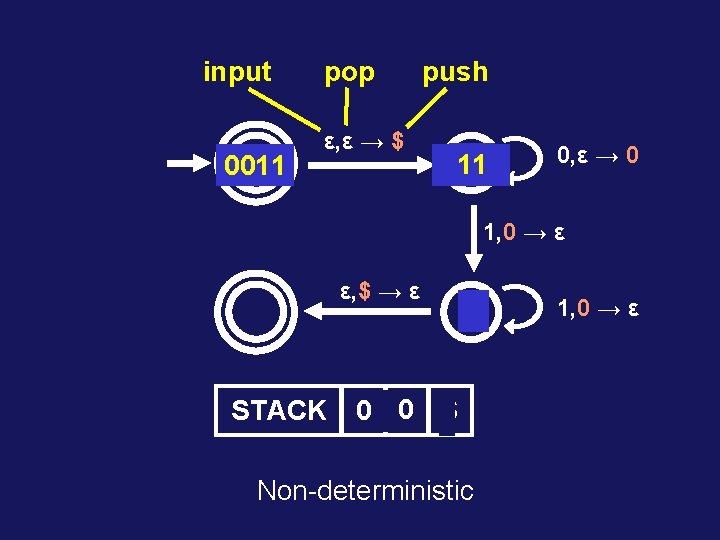
input 0011 pop ε, ε → $ push 11 0011 0, ε → 0 1, 0 → ε ε, $ → ε 1 STACK $ $ $ 0 0 Non-deterministic 1, 0 → ε
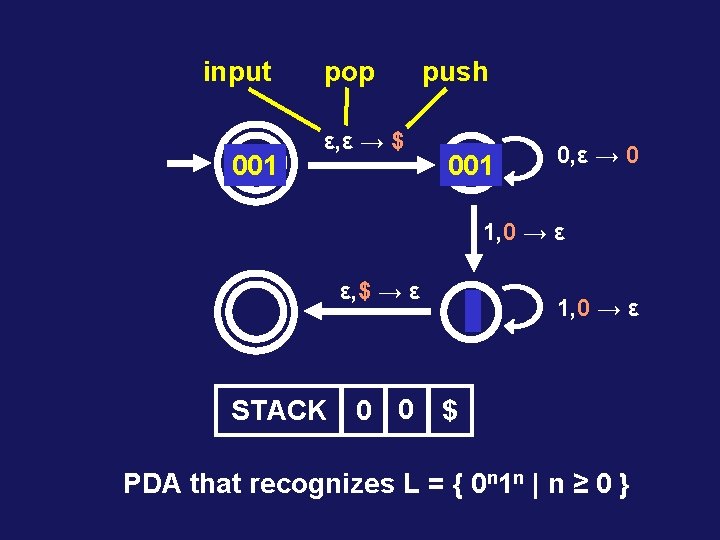
input 001 pop ε, ε → $ push 1 001 01 0, ε → 0 1, 0 → ε ε, $ → ε 1, 0 → ε STACK $ $ $ 0 0 PDA that recognizes L = { 0 n 1 n | n ≥ 0 }
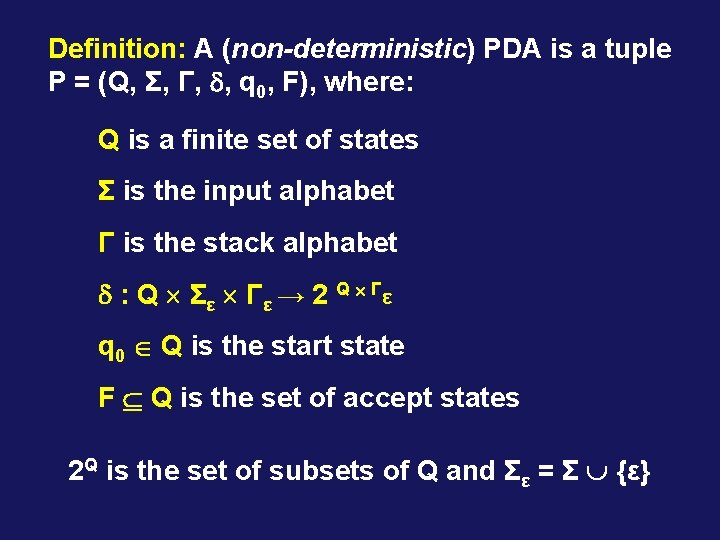
Definition: A (non-deterministic) PDA is a tuple P = (Q, Σ, Γ, , q 0, F), where: Q is a finite set of states Σ is the input alphabet Γ is the stack alphabet : Q Σ ε Γ ε → 2 Q Γε q 0 Q is the start state F Q is the set of accept states 2 Q is the set of subsets of Q and Σε = Σ {ε}
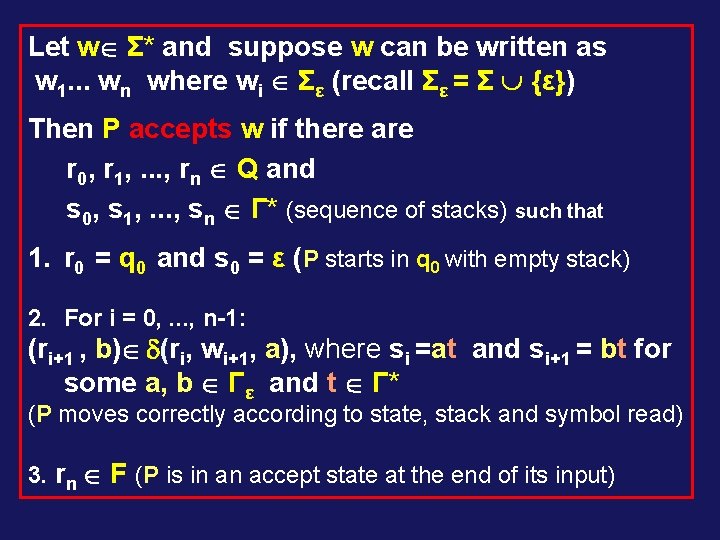
Let w Σ* and suppose w can be written as w 1. . . wn where wi Σε (recall Σε = Σ {ε}) Then P accepts w if there are r 0, r 1, . . . , rn Q and s 0, s 1, . . . , sn Γ* (sequence of stacks) such that 1. r 0 = q 0 and s 0 = ε (P starts in q 0 with empty stack) 2. For i = 0, . . . , n-1: (ri+1 , b) (ri, wi+1, a), where si =at and si+1 = bt for some a, b Γε and t Γ* (P moves correctly according to state, stack and symbol read) 3. rn F (P is in an accept state at the end of its input)


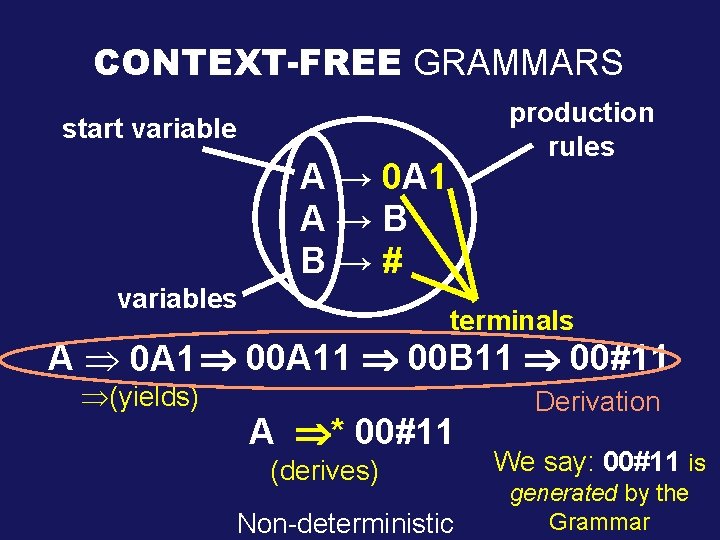
CONTEXT-FREE GRAMMARS production rules start variable A → 0 A 1 A→B B→# variables terminals A Þ 0 A 1 00 A 11 00 B 11 00#11 Þ(yields) A * 00#11 (derives) Non-deterministic Derivation We say: 00#11 is generated by the Grammar
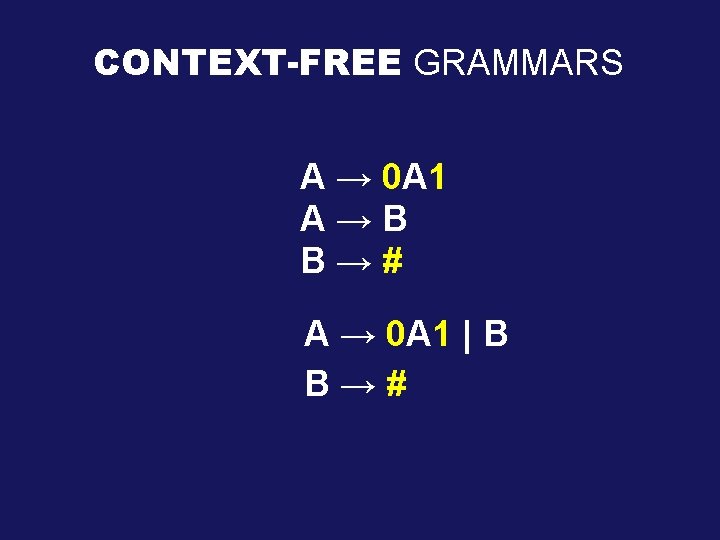
CONTEXT-FREE GRAMMARS A → 0 A 1 A→B B→# A → 0 A 1 | B B→#
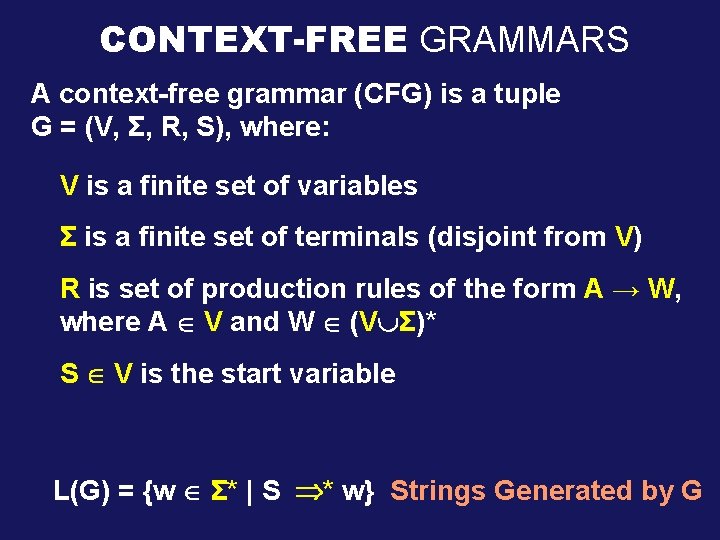
CONTEXT-FREE GRAMMARS A context-free grammar (CFG) is a tuple G = (V, Σ, R, S), where: V is a finite set of variables Σ is a finite set of terminals (disjoint from V) R is set of production rules of the form A → W, where A V and W (V Σ)* S V is the start variable L(G) = {w Σ* | S * w} Strings Generated by G
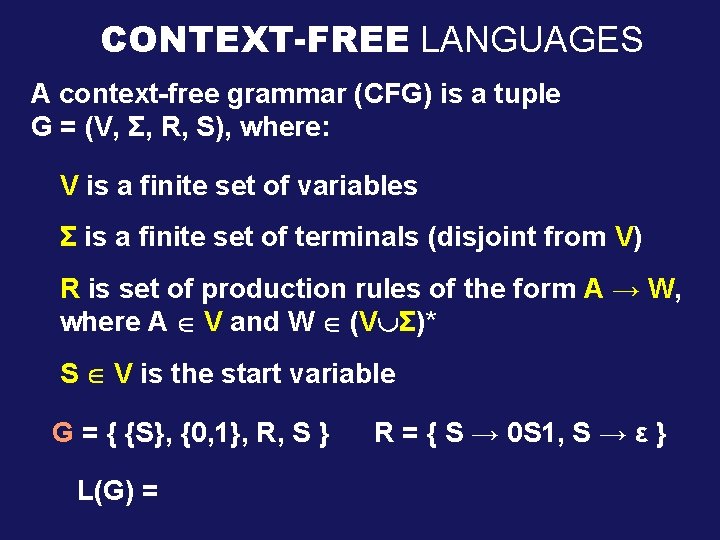
CONTEXT-FREE LANGUAGES A context-free grammar (CFG) is a tuple G = (V, Σ, R, S), where: V is a finite set of variables Σ is a finite set of terminals (disjoint from V) R is set of production rules of the form A → W, where A V and W (V Σ)* S V is the start variable G = { {S}, {0, 1}, R, S } L(G) = R = { S → 0 S 1, S → ε }
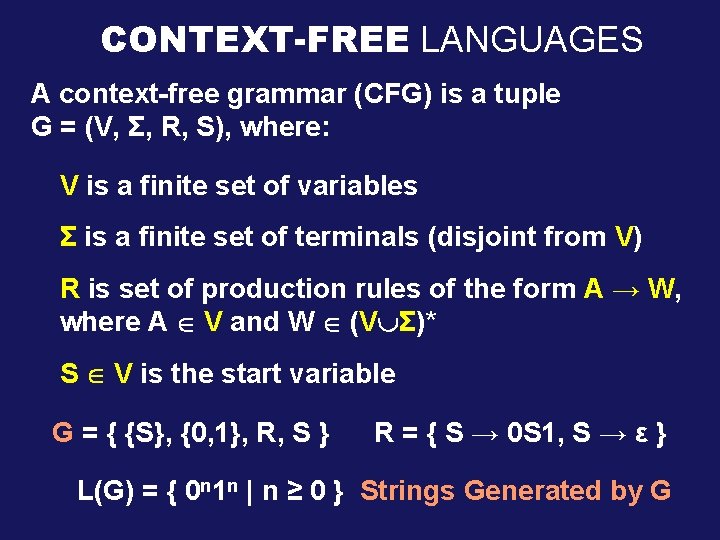
CONTEXT-FREE LANGUAGES A context-free grammar (CFG) is a tuple G = (V, Σ, R, S), where: V is a finite set of variables Σ is a finite set of terminals (disjoint from V) R is set of production rules of the form A → W, where A V and W (V Σ)* S V is the start variable G = { {S}, {0, 1}, R, S } R = { S → 0 S 1, S → ε } L(G) = { 0 n 1 n | n ≥ 0 } Strings Generated by G
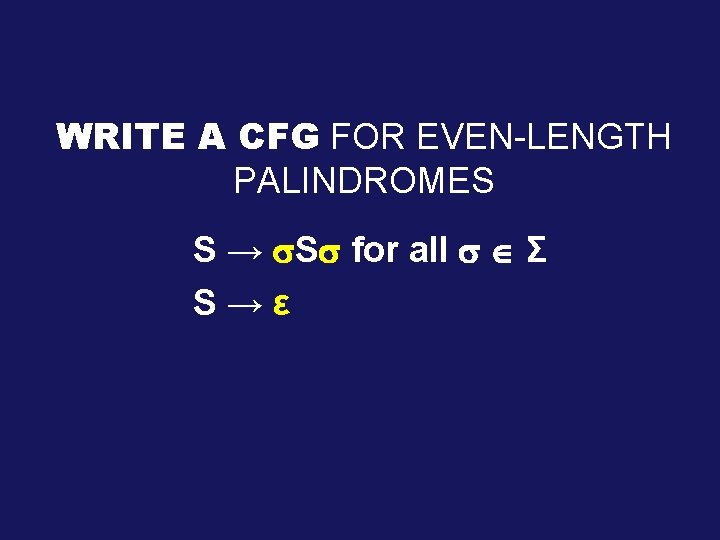
WRITE A CFG FOR EVEN-LENGTH PALINDROMES S → S for all Σ S→ε
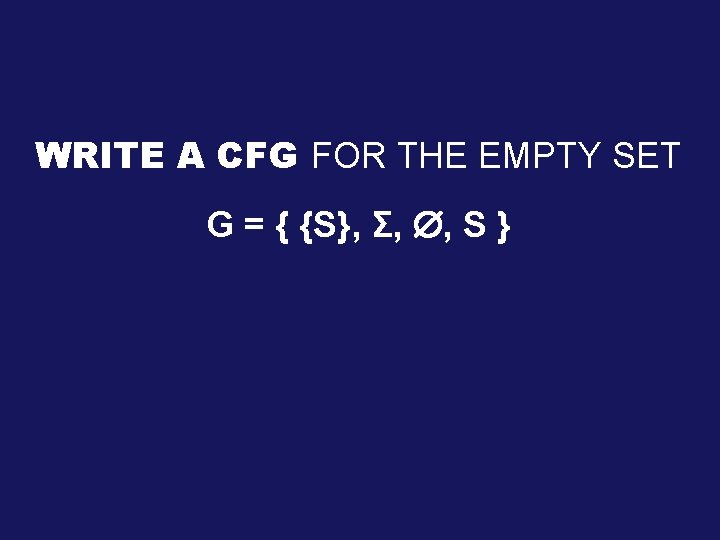
WRITE A CFG FOR THE EMPTY SET G = { {S}, Σ, , S }
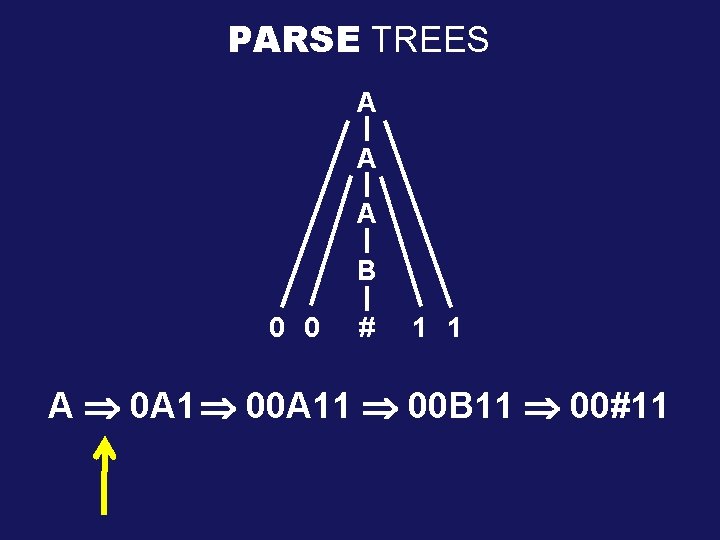
PARSE TREES A A A B 0 0 # 1 1 A 0 A 1 00 A 11 00 B 11 00#11
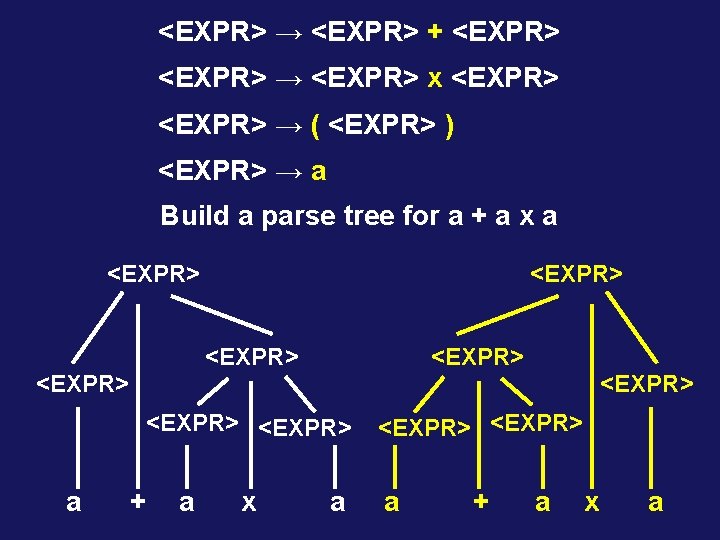
<EXPR> → <EXPR> + <EXPR> → <EXPR> x <EXPR> → ( <EXPR> ) <EXPR> → a Build a parse tree for a + a x a <EXPR> <EXPR> a + a x a <EXPR> a + a x a
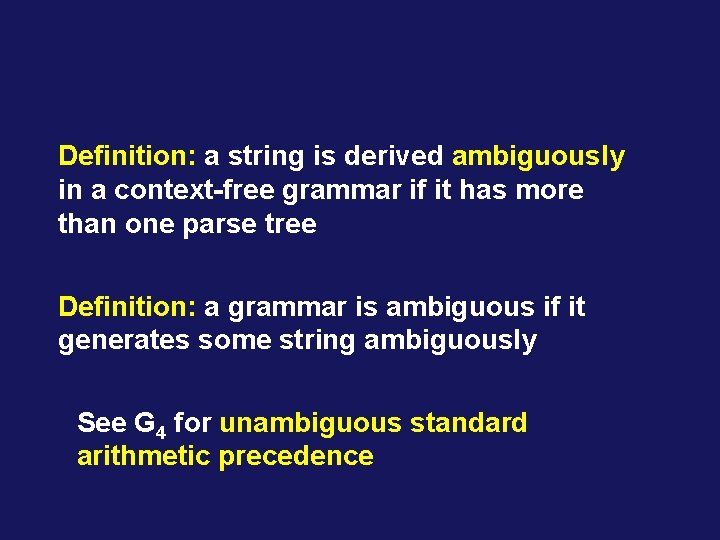
Definition: a string is derived ambiguously in a context-free grammar if it has more than one parse tree Definition: a grammar is ambiguous if it generates some string ambiguously See G 4 for unambiguous standard arithmetic precedence
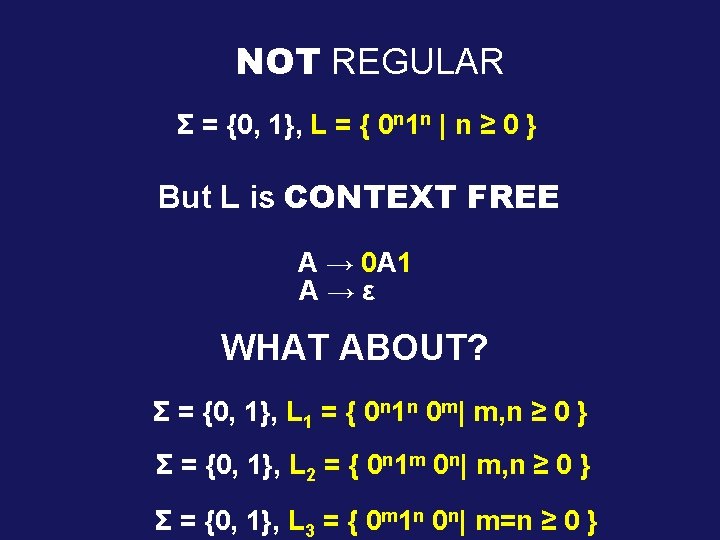
NOT REGULAR Σ = {0, 1}, L = { 0 n 1 n | n ≥ 0 } But L is CONTEXT FREE A → 0 A 1 A→ε WHAT ABOUT? Σ = {0, 1}, L 1 = { 0 n 1 n 0 m| m, n ≥ 0 } Σ = {0, 1}, L 2 = { 0 n 1 m 0 n| m, n ≥ 0 } Σ = {0, 1}, L 3 = { 0 m 1 n 0 n| m=n ≥ 0 }
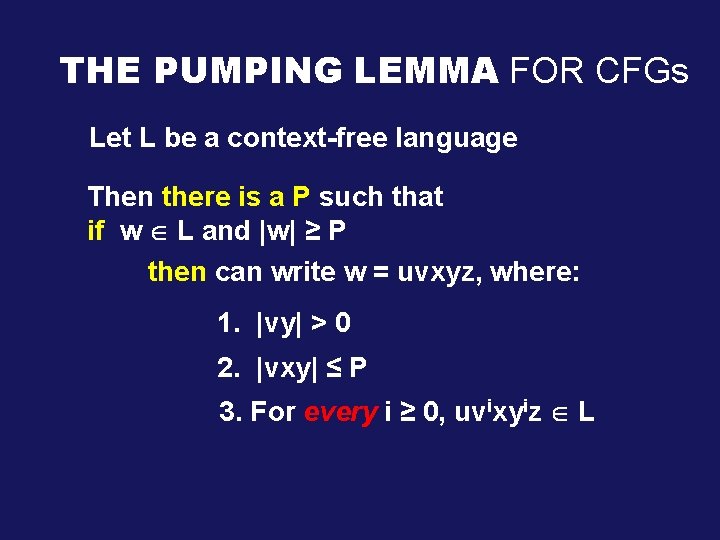
THE PUMPING LEMMA FOR CFGs Let L be a context-free language Then there is a P such that if w L and |w| ≥ P then can write w = uvxyz, where: 1. |vy| > 0 2. |vxy| ≤ P 3. For every i ≥ 0, uvixyiz L
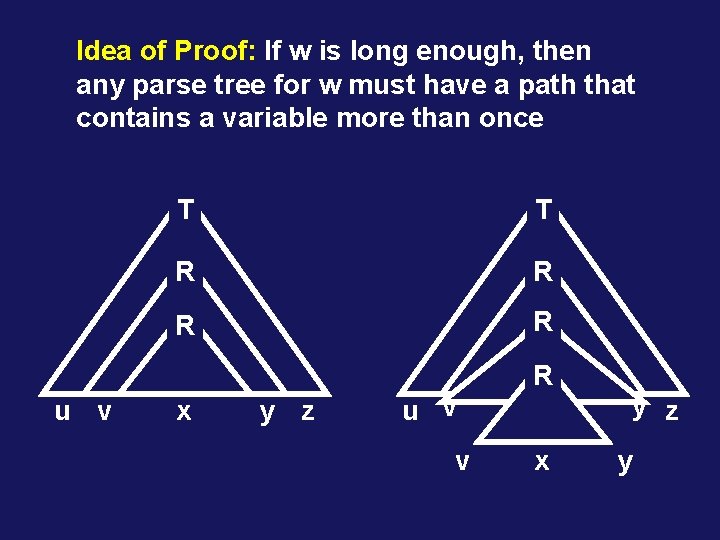
Idea of Proof: If w is long enough, then any parse tree for w must have a path that contains a variable more than once u v T T R R x y z u v v R x y z y
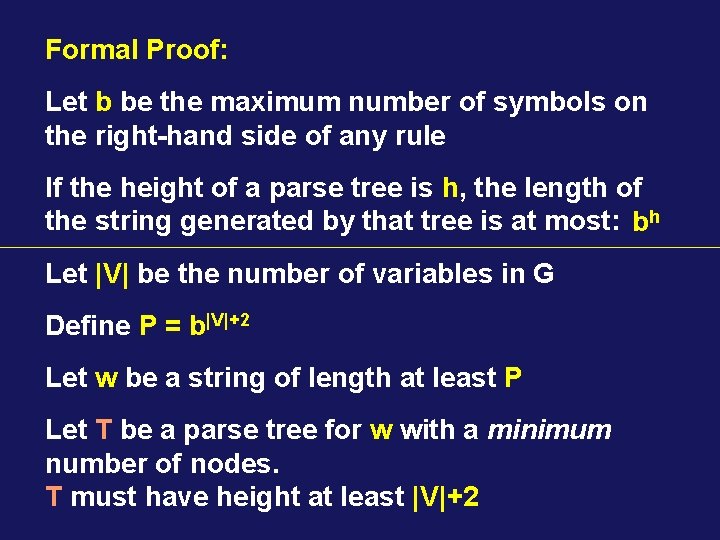
Formal Proof: Let b be the maximum number of symbols on the right-hand side of any rule If the height of a parse tree is h, the length of the string generated by that tree is at most: bh Let |V| be the number of variables in G Define P = b|V|+2 Let w be a string of length at least P Let T be a parse tree for w with a minimum number of nodes. T must have height at least |V|+2
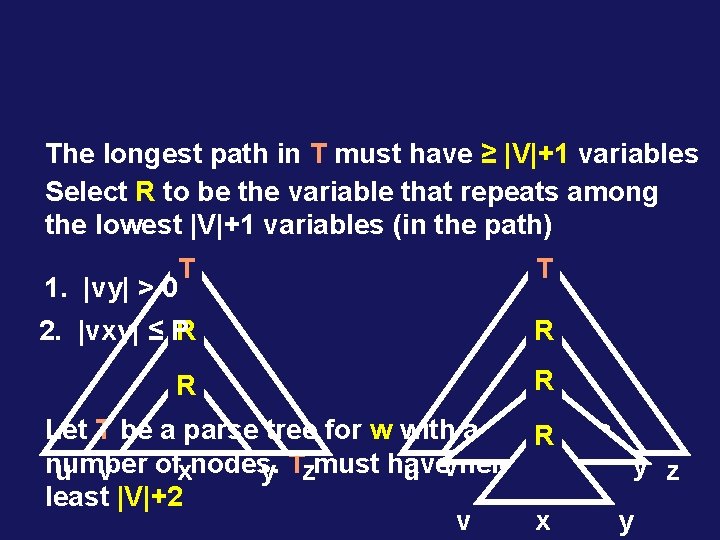
The longest path in T must have ≥ |V|+1 variables Select R to be the variable that repeats among the lowest |V|+1 variables (in the path) T T 2. |vxy| ≤ PR R 1. |vy| > 0 Let T be a parse tree for w with a minimum R number ofxnodes. y z u v y Tzmust have u vheight at least |V|+2 v x y
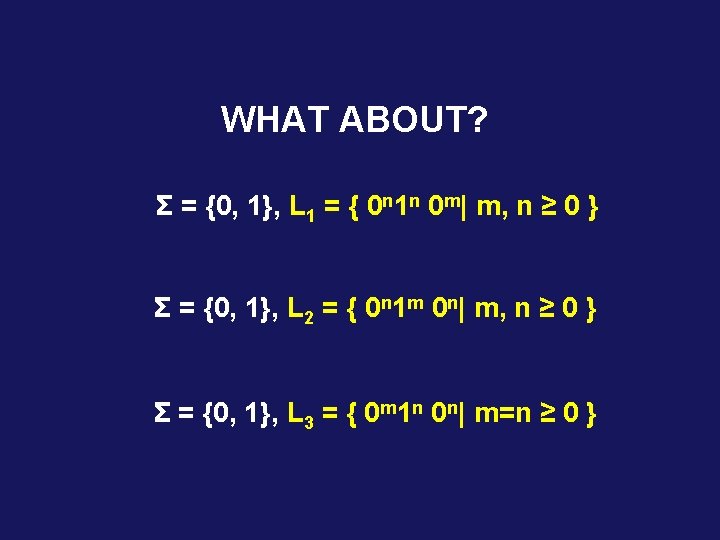
WHAT ABOUT? Σ = {0, 1}, L 1 = { 0 n 1 n 0 m| m, n ≥ 0 } Σ = {0, 1}, L 2 = { 0 n 1 m 0 n| m, n ≥ 0 } Σ = {0, 1}, L 3 = { 0 m 1 n 0 n| m=n ≥ 0 }
EQUIVALENCE OF CFGs and PDAs A Language L is generated by a CFG L is recognized by a PDA
Read the rest of Chapter 2 for next time
- Slides: 29