
15 453 FLAC Lecture 19 Turing Machines and


- Slides: 29
15 -453 FLAC Lecture 19 Turing Machines and Real Life * Reductions Mihai Budiu March 3, 2000 03/03/2000 FLAC: Reductions
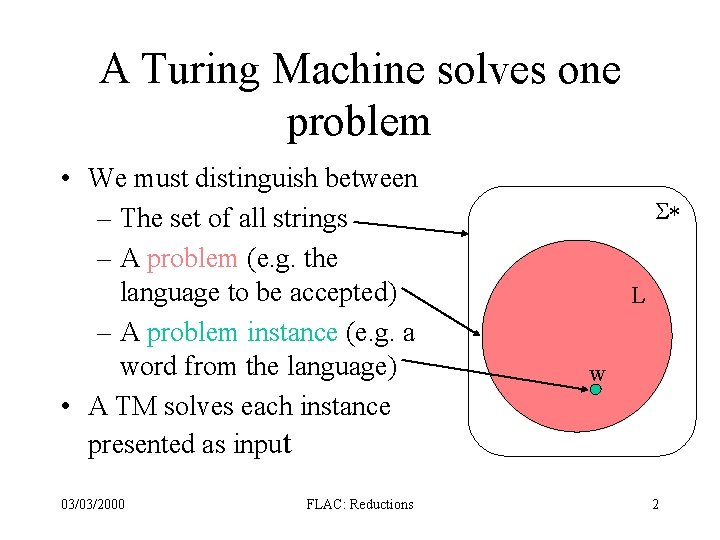
A Turing Machine solves one problem • We must distinguish between – The set of all strings – A problem (e. g. the language to be accepted) – A problem instance (e. g. a word from the language) • A TM solves each instance presented as input 03/03/2000 FLAC: Reductions S* L w 2
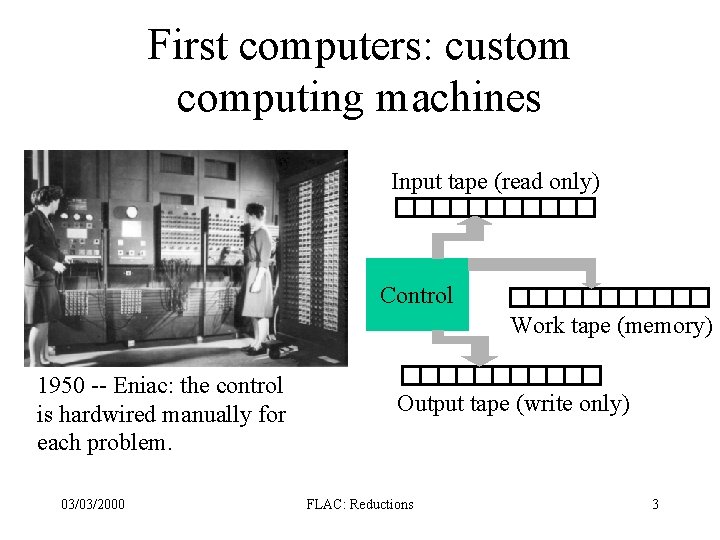
First computers: custom computing machines Input tape (read only) Control Work tape (memory) 1950 -- Eniac: the control is hardwired manually for each problem. 03/03/2000 Output tape (write only) FLAC: Reductions 3
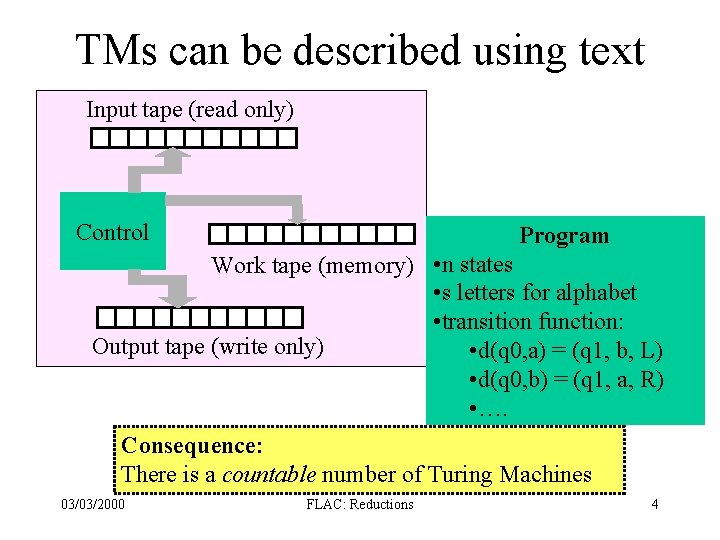
TMs can be described using text Input tape (read only) Control Program Work tape (memory) • n states • s letters for alphabet • transition function: Output tape (write only) • d(q 0, a) = (q 1, b, L) • d(q 0, b) = (q 1, a, R) • …. Consequence: There is a countable number of Turing Machines 03/03/2000 FLAC: Reductions 4
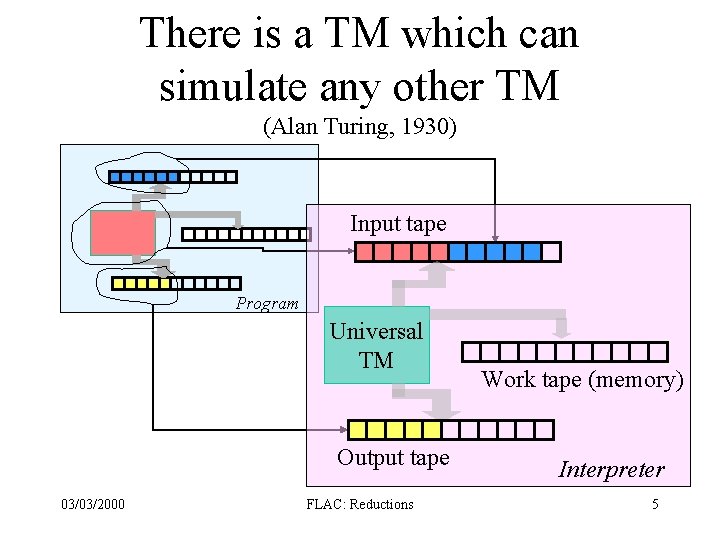
There is a TM which can simulate any other TM (Alan Turing, 1930) Input tape Program Universal TM Output tape 03/03/2000 FLAC: Reductions Work tape (memory) Interpreter 5
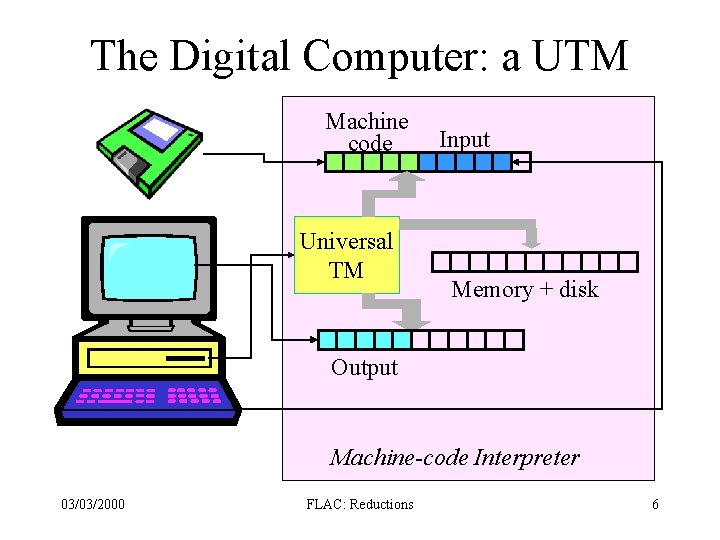
The Digital Computer: a UTM Machine code Universal TM Input Memory + disk Output Machine-code Interpreter 03/03/2000 FLAC: Reductions 6
Row access Random Access Memories x Sequential access tape x Column access Address 03/03/2000 FLAC: Reductions 7
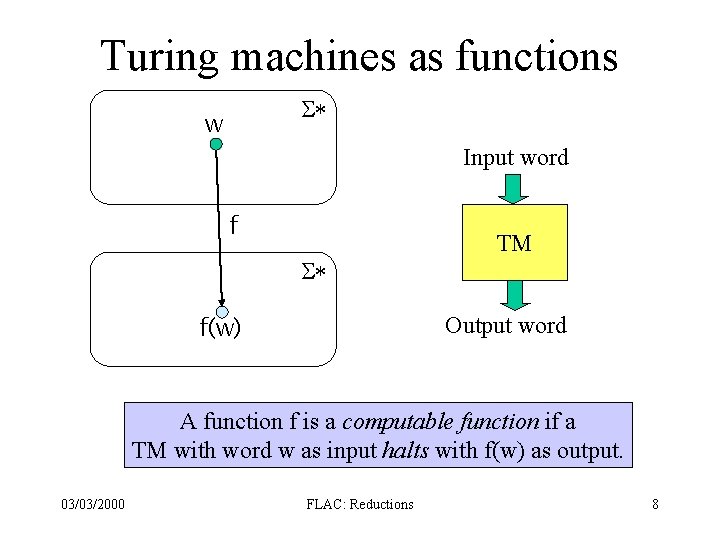
Turing machines as functions S* w Input word f S* f(w) TM Output word A function f is a computable function if a TM with word w as input halts with f(w) as output. 03/03/2000 FLAC: Reductions 8
Computable functions • Many functions encountered in everyday life are computable: – Addition : binary strings * binary strings -> binary strings – Sort : sequence of strings -> sequence of strings – Roots : polynomial -> sequence of integer roots [pg 144] • A TM which decides a language computes a function from the set of all words to {y, n} • There are many uncomputable functions: – |funs : N -> N| = uncountable – |TMs| = countable 03/03/2000 FLAC: Reductions 9
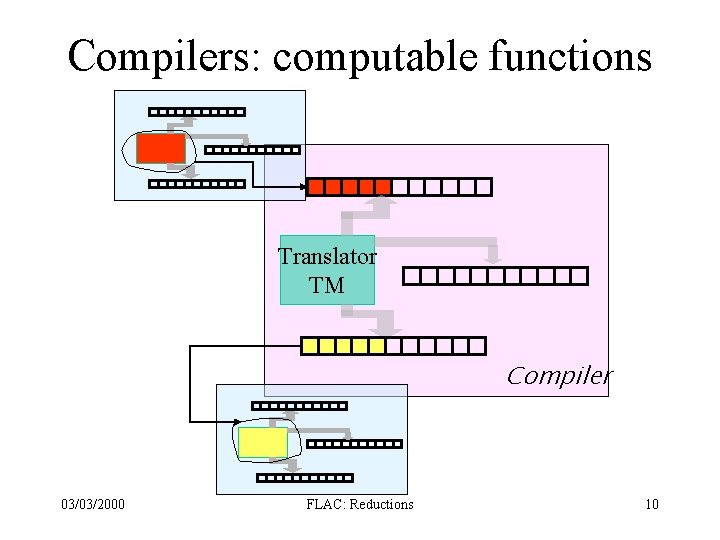
Compilers: computable functions Translator TM Compiler 03/03/2000 FLAC: Reductions 10
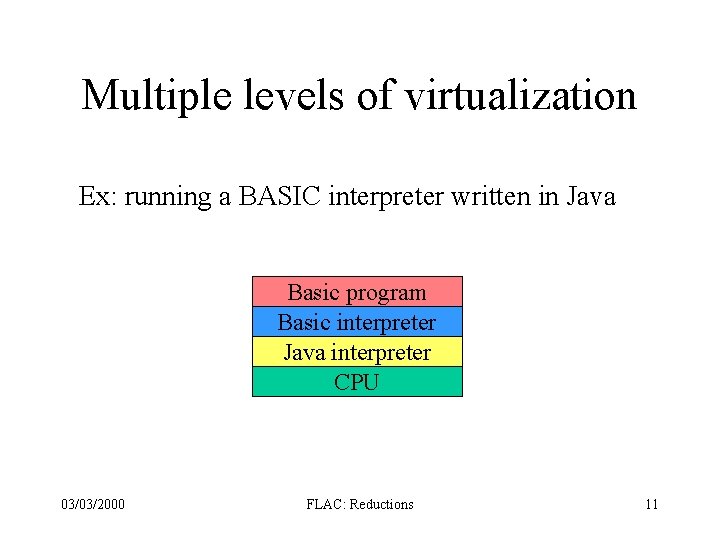
Multiple levels of virtualization Ex: running a BASIC interpreter written in Java Basic program Basic interpreter Java interpreter CPU 03/03/2000 FLAC: Reductions 11
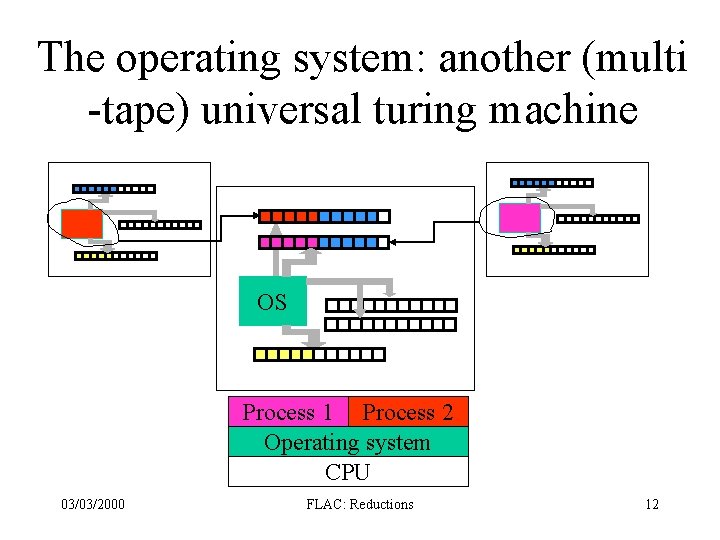
The operating system: another (multi -tape) universal turing machine OS Process 1 Process 2 Operating system CPU 03/03/2000 FLAC: Reductions 12
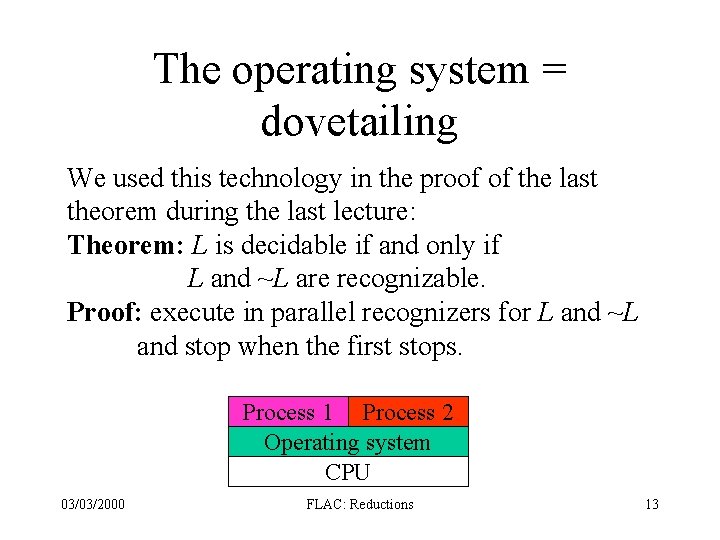
The operating system = dovetailing We used this technology in the proof of the last theorem during the last lecture: Theorem: L is decidable if and only if L and ~L are recognizable. Proof: execute in parallel recognizers for L and ~L and stop when the first stops. Process 1 Process 2 Operating system CPU 03/03/2000 FLAC: Reductions 13
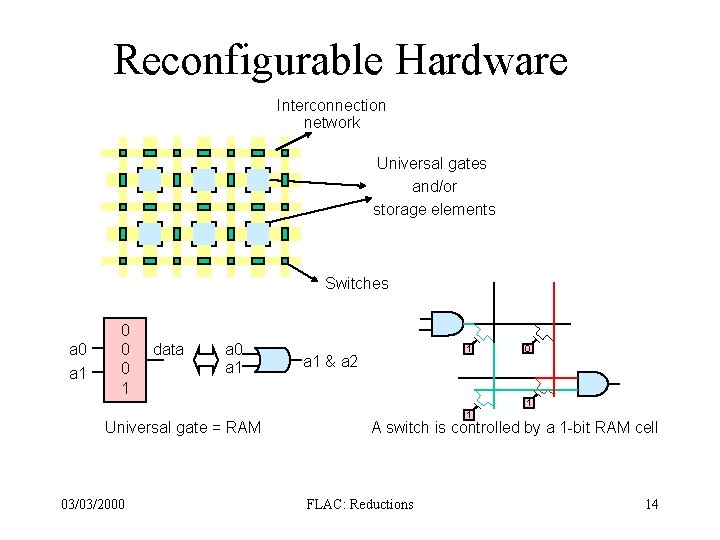
Reconfigurable Hardware Interconnection network Universal gates and/or storage elements Switches a 0 a 1 0 0 0 1 data a 0 a 1 1 a 1 & a 2 0 1 Universal gate = RAM 03/03/2000 1 A switch is controlled by a 1 -bit RAM cell FLAC: Reductions 14
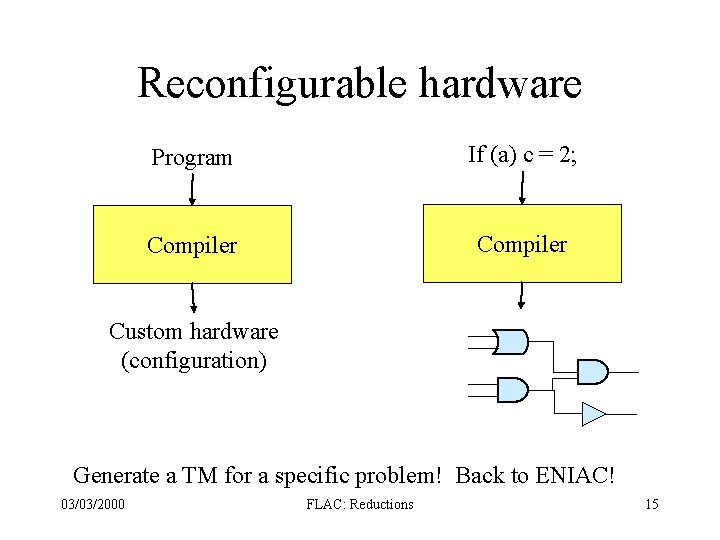
Reconfigurable hardware Program If (a) c = 2; Compiler Custom hardware (configuration) Generate a TM for a specific problem! Back to ENIAC! 03/03/2000 FLAC: Reductions 15
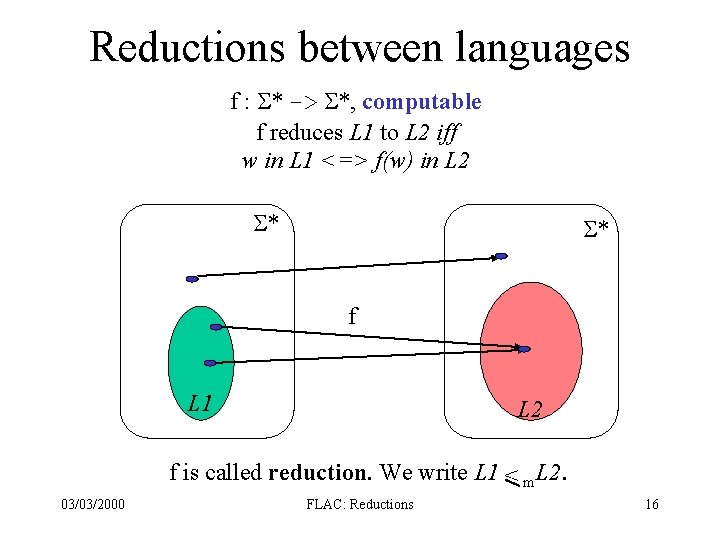
Reductions between languages f : S* -> S*, computable f reduces L 1 to L 2 iff w in L 1 <=> f(w) in L 2 S* S* f L 1 L 2 f is called reduction. We write L 1 < m. L 2. 03/03/2000 FLAC: Reductions 16
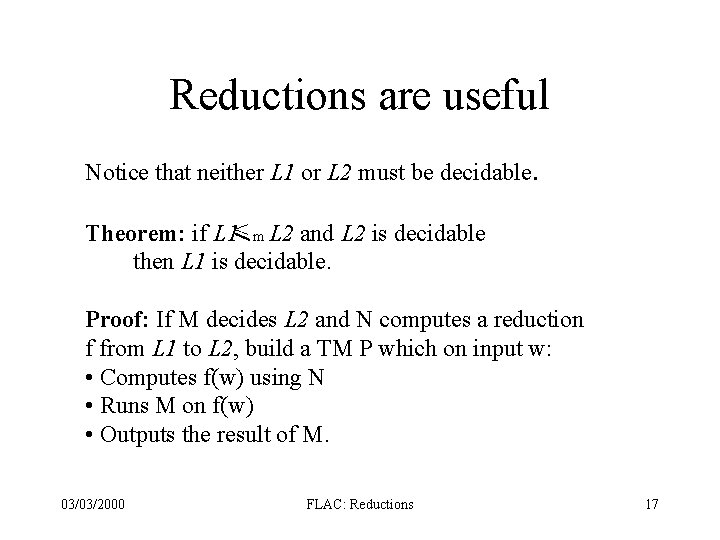
Reductions are useful Notice that neither L 1 or L 2 must be decidable. Theorem: if L 1< m L 2 and L 2 is decidable then L 1 is decidable. Proof: If M decides L 2 and N computes a reduction f from L 1 to L 2, build a TM P which on input w: • Computes f(w) using N • Runs M on f(w) • Outputs the result of M. 03/03/2000 FLAC: Reductions 17
Using reductions to prove undecidability • Use the converse of the previous theorem: if A < m B and A is undecidable, then B is undecidable. • We have seen two techniques to prove undecidability – The “diagonalization” proof – Reductions using this theorem. 03/03/2000 FLAC: Reductions 18
Undecidability • We know that most problems are undecidable • Turing exhibited one natural undecidable problem: the Halting Problem (does a TM halt when given an input w? ) • More than that: many important problems are undecidable • When you face a problem, you should be aware that it may be unsolvable: – You can search a solution – You can try to prove it has no solution (usu. by reduction) 03/03/2000 FLAC: Reductions 19
Some undecidable problems • • Does the TM M accept the word w? Is a mathematical statement true? Does a Diofantine equation have any roots? Does a TM accept a regular language? Does a CFG generate all words in S*? Will a parallel system of processes ever deadlock? Is there a smaller TM implementing the same function? • Are two programs computing the same thing? 03/03/2000 FLAC: Reductions 20
Compilers and undecidability • The HP is about a language describing TMs • Many other problems concerning TMs are undecidable • Compilers cannot prove some properties of programs: – – – Does a C program access an array out of bounds? Will ever a print instruction be executed? Can these two pointers point to the same location? Will a LISP program crash with a type error? Can this memory location be garbage collected at some point? • Compilers behave conservatively 03/03/2000 FLAC: Reductions 21
The full-employment theorem for compiler-writers Theorem: There is no best optimizing compiler for a general-purpose language. Proof: by reduction to the HP. Theorem: For any compiler, there’s a better one. Proof: we can always hardcode a program which doesn’t terminate. 03/03/2000 FLAC: Reductions 22
Research in programming languages • Contrast the decision problems for regular and context-free languages with Turing machines. • Research in programming languages tries to get the best of both worlds: – Languages powerful enough to express useful computations – But restricted enough to guarantee program properties 03/03/2000 FLAC: Reductions 23
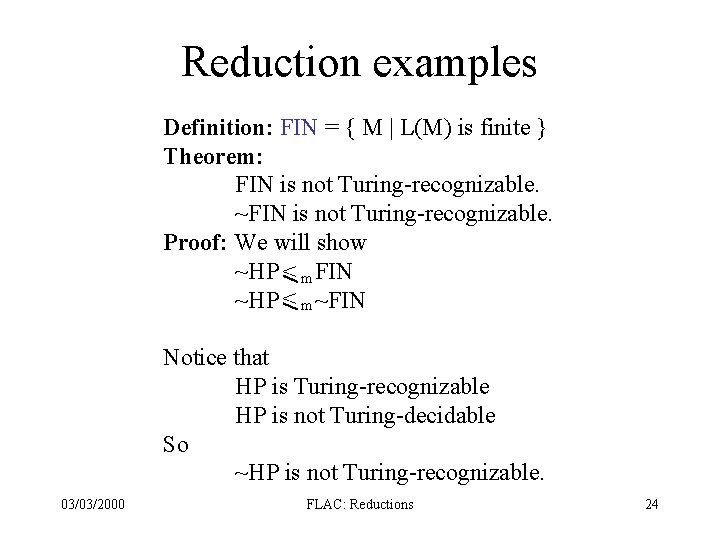
Reduction examples Definition: FIN = { M | L(M) is finite } Theorem: FIN is not Turing-recognizable. ~FIN is not Turing-recognizable. Proof: We will show ~HP < m FIN ~HP < m ~FIN Notice that HP is Turing-recognizable HP is not Turing-decidable So ~HP is not Turing-recognizable. 03/03/2000 FLAC: Reductions 24
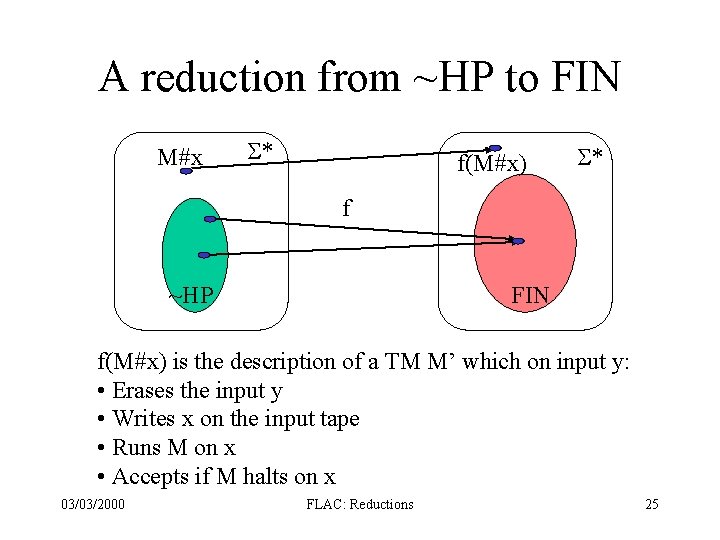
A reduction from ~HP to FIN M#x S* f(M#x) S* f ~HP FIN f(M#x) is the description of a TM M’ which on input y: • Erases the input y • Writes x on the input tape • Runs M on x • Accepts if M halts on x 03/03/2000 FLAC: Reductions 25
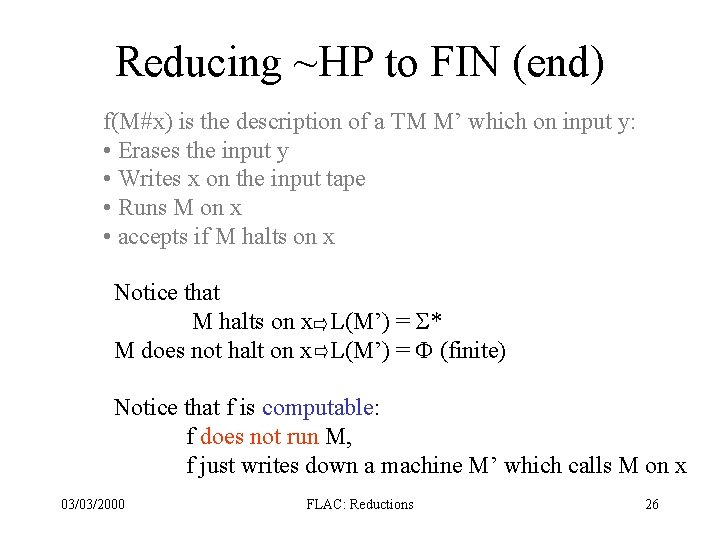
Reducing ~HP to FIN (end) f(M#x) is the description of a TM M’ which on input y: • Erases the input y • Writes x on the input tape • Runs M on x • accepts if M halts on x Notice that M halts on x L(M’) = S* M does not halt on x L(M’) = F (finite) Notice that f is computable: f does not run M, f just writes down a machine M’ which calls M on x 03/03/2000 FLAC: Reductions 26
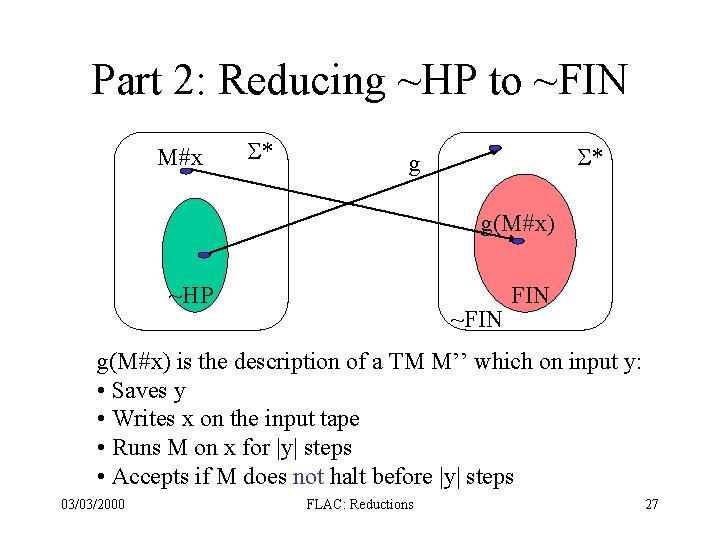
Part 2: Reducing ~HP to ~FIN M#x S* S* g g(M#x) ~HP ~FIN g(M#x) is the description of a TM M’’ which on input y: • Saves y • Writes x on the input tape • Runs M on x for |y| steps • Accepts if M does not halt before |y| steps 03/03/2000 FLAC: Reductions 27
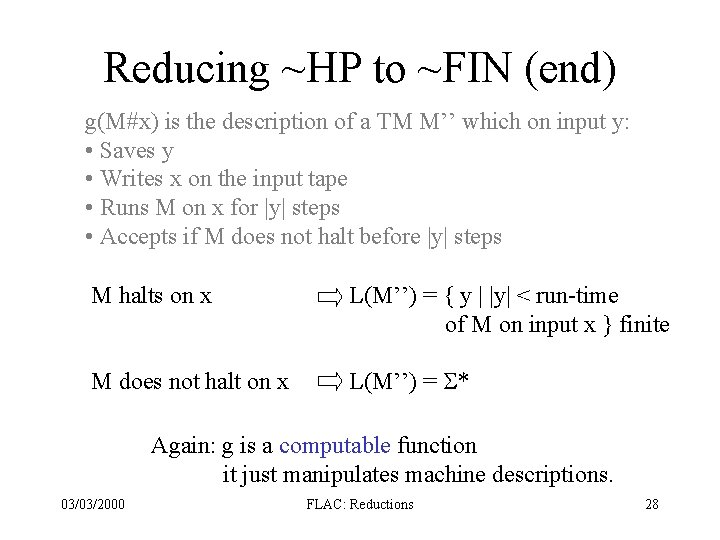
Reducing ~HP to ~FIN (end) g(M#x) is the description of a TM M’’ which on input y: • Saves y • Writes x on the input tape • Runs M on x for |y| steps • Accepts if M does not halt before |y| steps M halts on x L(M’’) = { y | |y| < run-time of M on input x } finite M does not halt on x L(M’’) = S* Again: g is a computable function it just manipulates machine descriptions. 03/03/2000 FLAC: Reductions 28
To remember • The theoretical notion of TM has profoundly influenced computer engineering • There are many important undecidable problems • Reductions are a tool to prove problems being undecidable (Note: we will see reductions again in complexity theory; we will use them to prove a problem is the hardest in a class of problems) 03/03/2000 FLAC: Reductions 29