
15 441 Computer Networking Lecture 22 Queue Management
![Explicit Congestion Notification (ECN) [ Floyd and Ramakrishnan 98] • Traditional mechanism • packet](https://slidetodoc.com/presentation_image_h/0f9ca80386f4d6c763711680f8581128/image-18.jpg "Explicit Congestion Notification (ECN) [ Floyd and Ramakrishnan 98] • Traditional mechanism • packet")
- Slides: 47
15 -441 Computer Networking Lecture 22 – Queue Management and Qo. S
Congestion Control Review • What is congestion control? • What is the principle of TCP? 2
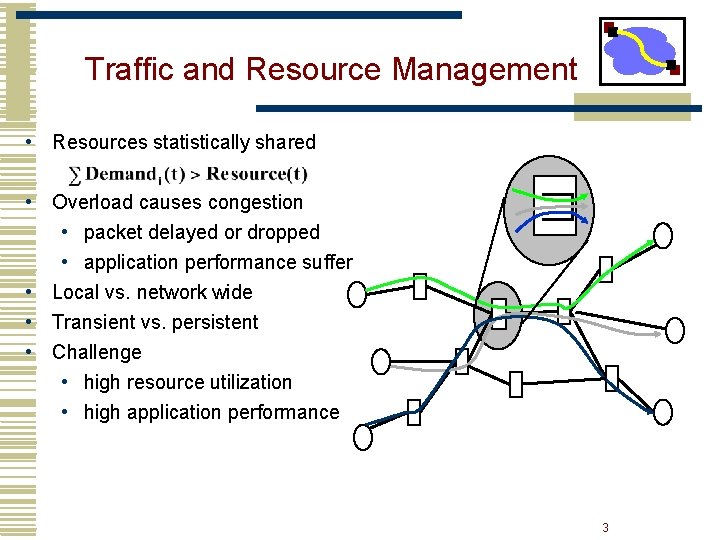
Traffic and Resource Management • Resources statistically shared • Overload causes congestion • packet delayed or dropped • application performance suffer • Local vs. network wide • Transient vs. persistent • Challenge • high resource utilization • high application performance 3
Resource Management Approaches • Increase resources • install new links, faster routers • capacity planning, provisioning, traffic engineering • happen at longer timescale • Reduce or delay demand • Reactive approach: encourage everyone to reduce or delay demand • Reservation approach: some requests will be rejected by the network 4
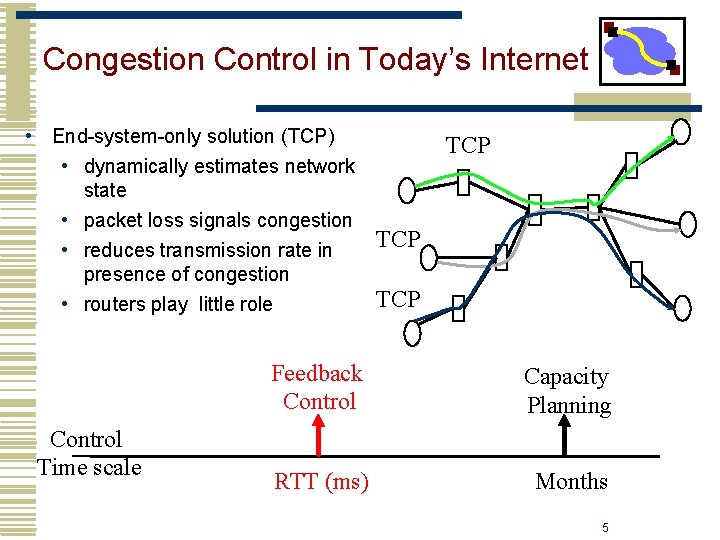
Congestion Control in Today’s Internet • End-system-only solution (TCP) • dynamically estimates network state • packet loss signals congestion • reduces transmission rate in presence of congestion • routers play little role Control Time scale TCP TCP Feedback Control Capacity Planning RTT (ms) Months 5
More Ideas on Traffic Management • Improve TCP • Stay with end-point only architecture • Enhance routers to help TCP • Random Early Discard • Enhance routers to control traffic • Rate limiting • Fair Queueing • Provide Qo. S by limiting congestion 6
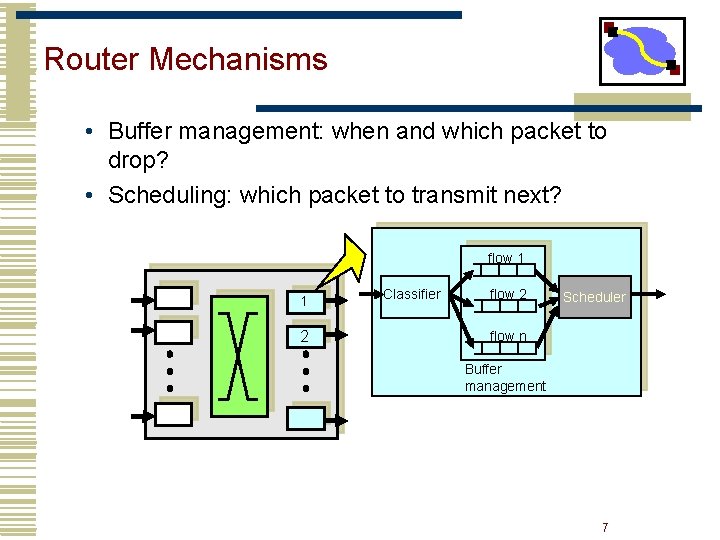
Router Mechanisms • Buffer management: when and which packet to drop? • Scheduling: which packet to transmit next? flow 1 1 2 Classifier flow 2 Scheduler flow n Buffer management 7
Typical Internet Queuing • FIFO + drop-tail • Simplest choice • Used widely in the Internet • FIFO (first-in-first-out) • Implies single class of traffic • Drop-tail • Arriving packets get dropped when queue is full regardless of flow or importance • Important distinction: • FIFO: scheduling discipline • Drop-tail: drop policy 8
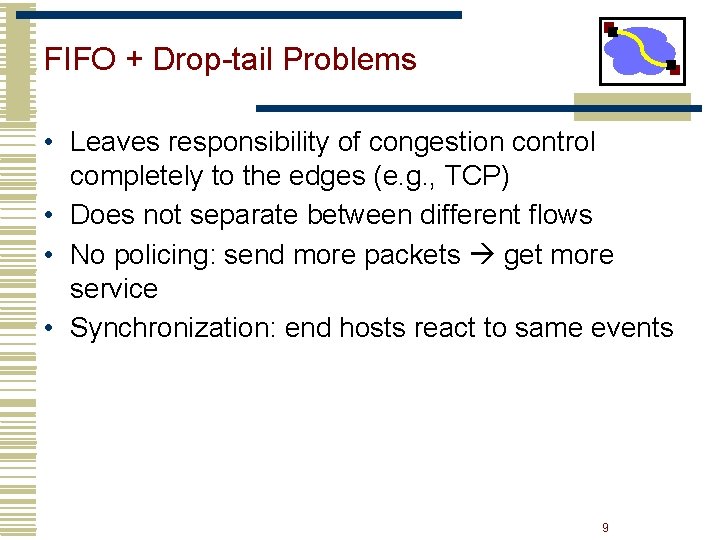
FIFO + Drop-tail Problems • Leaves responsibility of congestion control completely to the edges (e. g. , TCP) • Does not separate between different flows • No policing: send more packets get more service • Synchronization: end hosts react to same events 9
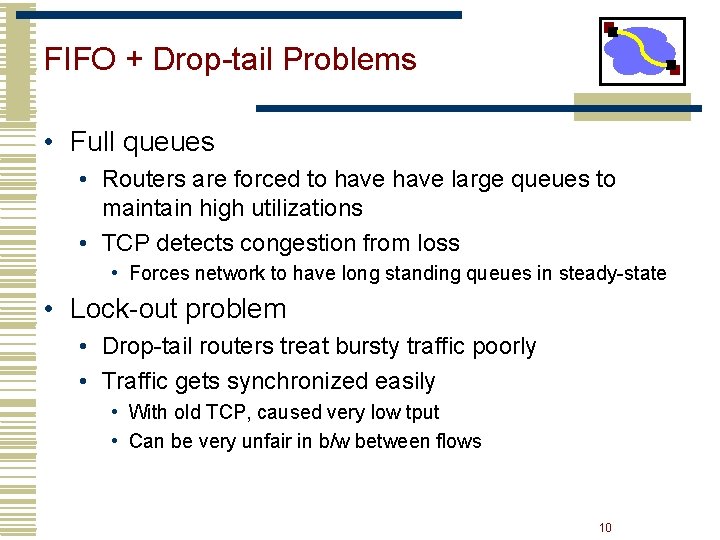
FIFO + Drop-tail Problems • Full queues • Routers are forced to have large queues to maintain high utilizations • TCP detects congestion from loss • Forces network to have long standing queues in steady-state • Lock-out problem • Drop-tail routers treat bursty traffic poorly • Traffic gets synchronized easily • With old TCP, caused very low tput • Can be very unfair in b/w between flows 10
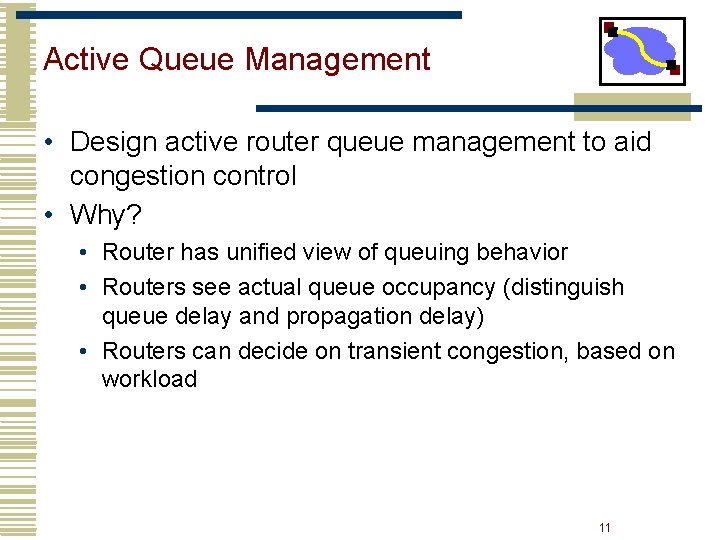
Active Queue Management • Design active router queue management to aid congestion control • Why? • Router has unified view of queuing behavior • Routers see actual queue occupancy (distinguish queue delay and propagation delay) • Routers can decide on transient congestion, based on workload 11
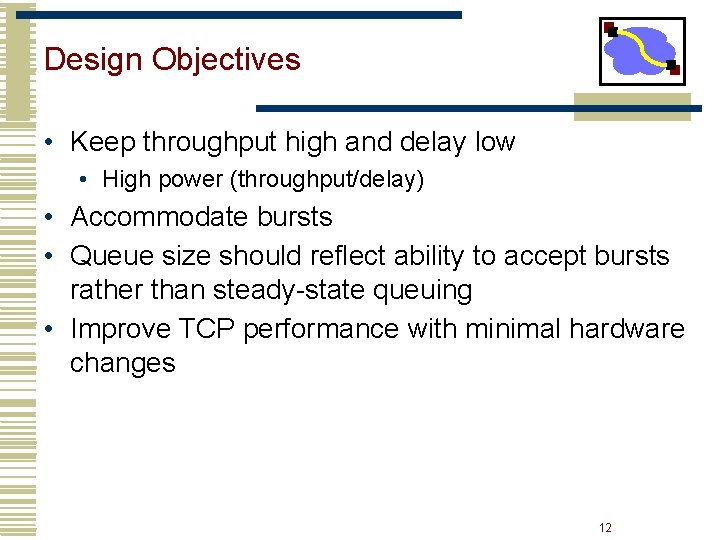
Design Objectives • Keep throughput high and delay low • High power (throughput/delay) • Accommodate bursts • Queue size should reflect ability to accept bursts rather than steady-state queuing • Improve TCP performance with minimal hardware changes 12
Lock-out Problem • Random drop • Packet arriving when queue is full causes some random packet to be dropped • Drop front • On full queue, drop packet at head of queue • Random drop and drop front solve the lock-out problem but not the full-queues problem 13
Full Queues Problem • Drop packets before queue becomes full (early drop) • Intuition: notify senders of incipient congestion • Example: early random drop (ERD): • If qlen > drop level, drop each new packet with fixed probability p • Does not control misbehaving users 14
Random Early Detection (RED) • Detect incipient congestion • Assume hosts respond to lost packets • Avoid window synchronization • Randomly mark packets • Avoid bias against bursty traffic 15
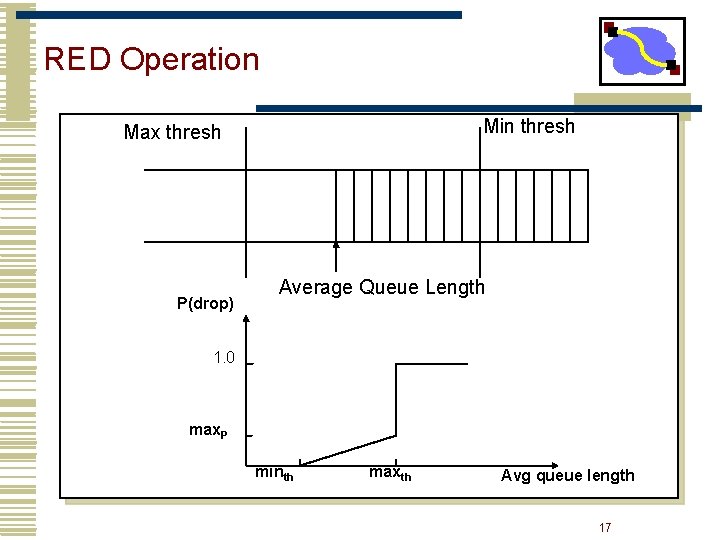
RED Algorithm • Maintain running average of queue length • If avg < minth do nothing • Low queuing, send packets through • If avg > maxth, drop packet • Protection from misbehaving sources • Else mark packet in a manner proportional to queue length • Notify sources of incipient congestion 16
RED Operation Min thresh Max thresh P(drop) Average Queue Length 1. 0 max. P minth maxth Avg queue length 17
Explicit Congestion Notification (ECN) [ Floyd and Ramakrishnan 98] • Traditional mechanism • packet drop as implicit congestion signal to end systems • TCP will slow down • Works well for bulk data transfer • Does not work well for delay sensitive applications • audio, Web, telnet • Explicit Congestion Notification (ECN) • borrow ideas from DECBit • use two bits in IP header • ECN-Capable Transport (ECT) bit set by sender • Congestion Experienced (CE) bit set by router 18
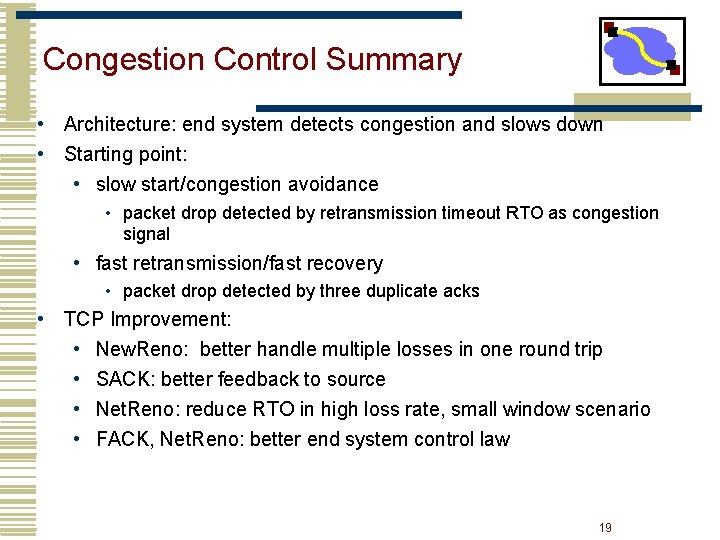
Congestion Control Summary • Architecture: end system detects congestion and slows down • Starting point: • slow start/congestion avoidance • packet drop detected by retransmission timeout RTO as congestion signal • fast retransmission/fast recovery • packet drop detected by three duplicate acks • TCP Improvement: • New. Reno: better handle multiple losses in one round trip • SACK: better feedback to source • Net. Reno: reduce RTO in high loss rate, small window scenario • FACK, Net. Reno: better end system control law 19
Congestion Control Summary (II) • Router support • RED: early signaling • ECN: explicit signaling 20
What are the Problems? • Works only if most sources implement TCP • most sources are cooperative • most sources implement homogeneous/compatible control law • compatible means less aggressive than TCP • What if sources do not play by the rule? 21
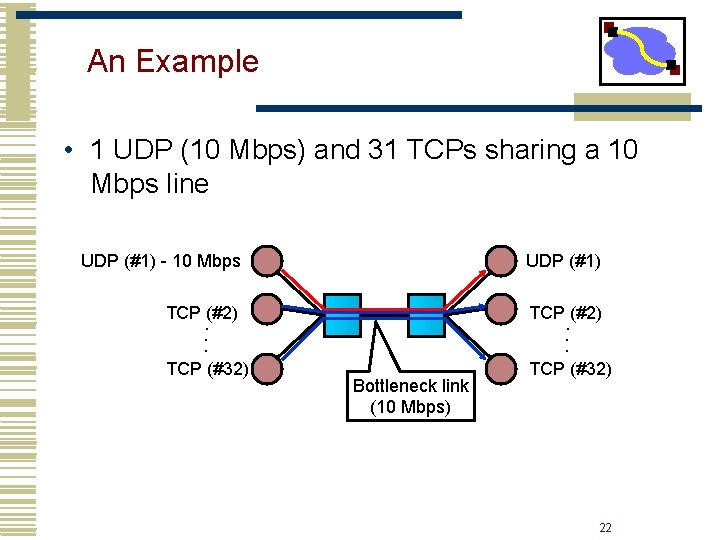
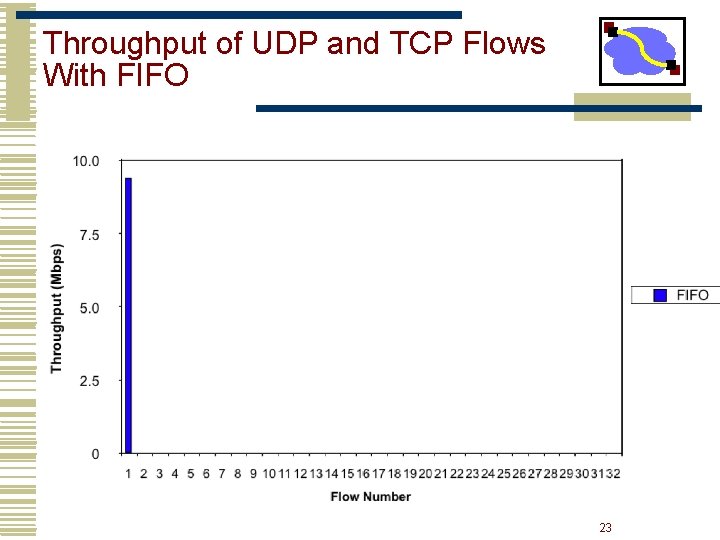
An Example • 1 UDP (10 Mbps) and 31 TCPs sharing a 10 Mbps line UDP (#1) - 10 Mbps TCP (#2). . . TCP (#32) UDP (#1) Bottleneck link (10 Mbps) TCP (#2). . . TCP (#32) 22
Throughput of UDP and TCP Flows With FIFO 23
What Is the Solution? • Enforcement mechanism inside the network • Rate limiting, scheduling 24
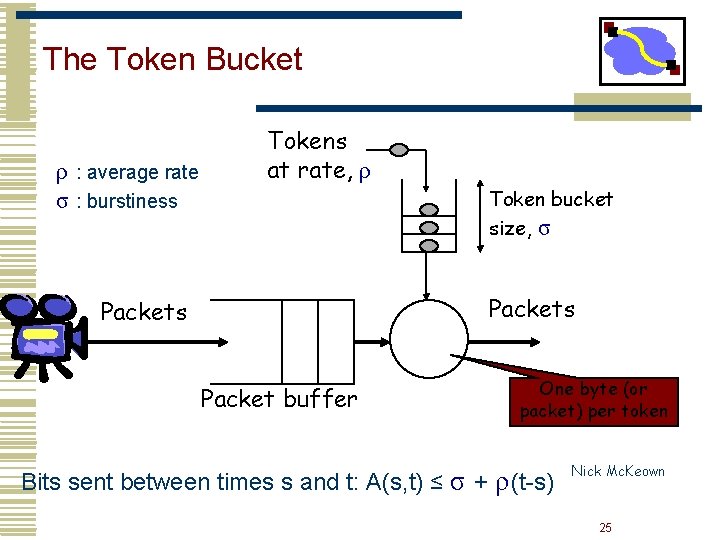
The Token Bucket ρ : average rate σ : burstiness Tokens at rate, ρ Token bucket size, σ Packets Packet buffer One byte (or packet) per token Bits sent between times s and t: A(s, t) ≤ σ + ρ (t-s) Nick Mc. Keown 25
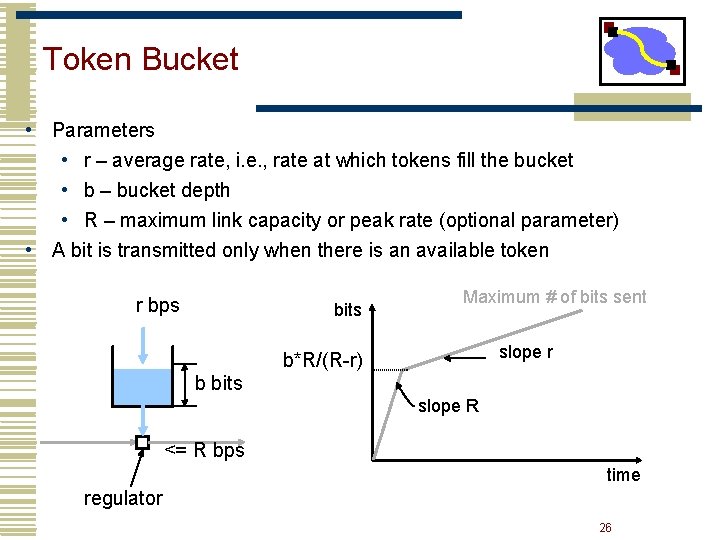
Token Bucket • Parameters • r – average rate, i. e. , rate at which tokens fill the bucket • b – bucket depth • R – maximum link capacity or peak rate (optional parameter) • A bit is transmitted only when there is an available token r bps bits Maximum # of bits sent slope r b*R/(R-r) b bits slope R <= R bps time regulator 26
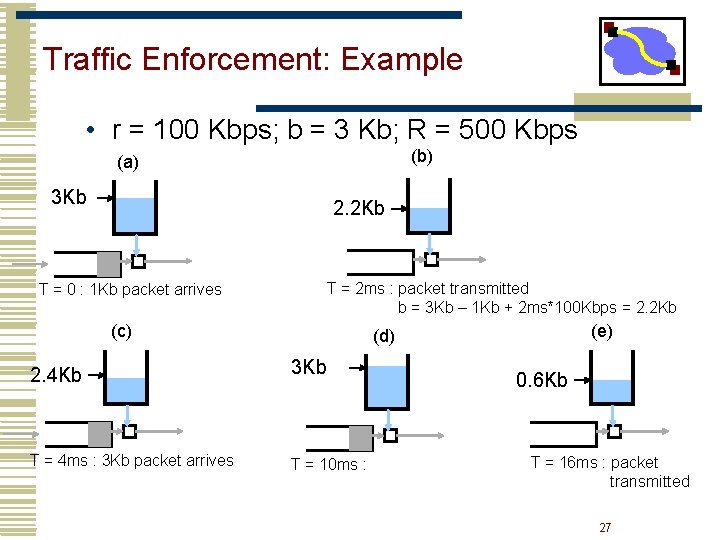
Traffic Enforcement: Example • r = 100 Kbps; b = 3 Kb; R = 500 Kbps (b) (a) 3 Kb 2. 2 Kb T = 2 ms : packet transmitted b = 3 Kb – 1 Kb + 2 ms*100 Kbps = 2. 2 Kb T = 0 : 1 Kb packet arrives (c) (e) (d) 2. 4 Kb 3 Kb T = 4 ms : 3 Kb packet arrives T = 10 ms : 0. 6 Kb T = 16 ms : packet transmitted 27
Rate-Limiting and Scheduling • Rate-limiting: limit the rate of one flow regardless the load in the network • Scheduling: dynamically allocates resources when multiple flows competing 28
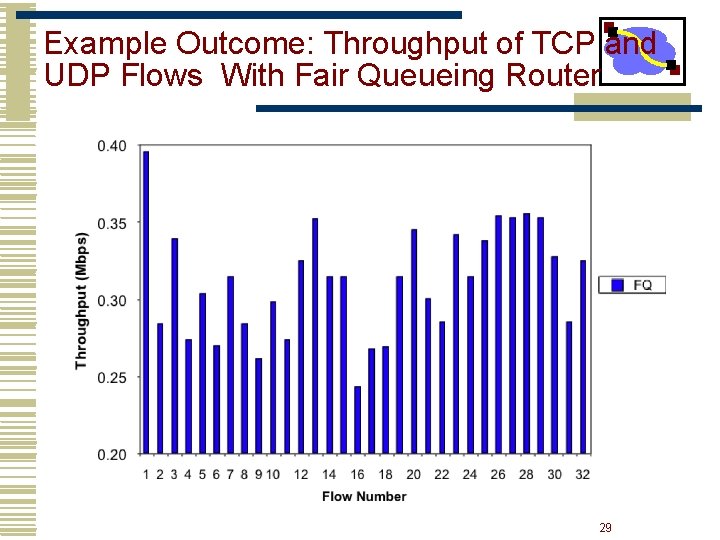
Example Outcome: Throughput of TCP and UDP Flows With Fair Queueing Router 29
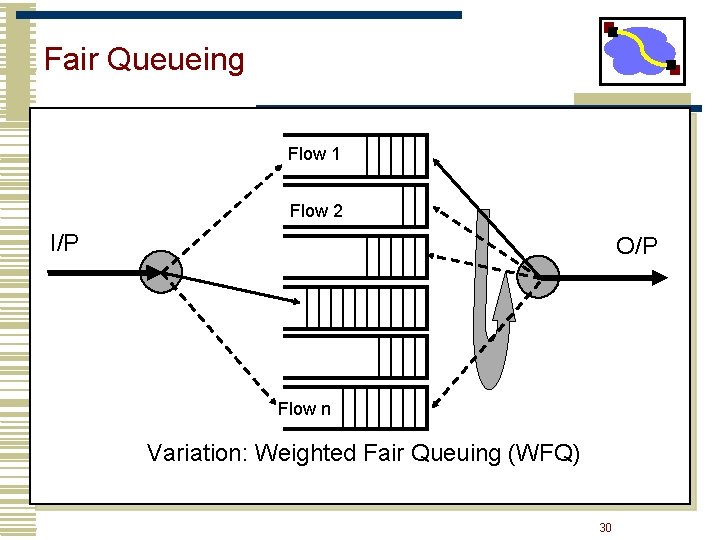
Fair Queueing Flow 1 Flow 2 I/P O/P Flow n Variation: Weighted Fair Queuing (WFQ) 30
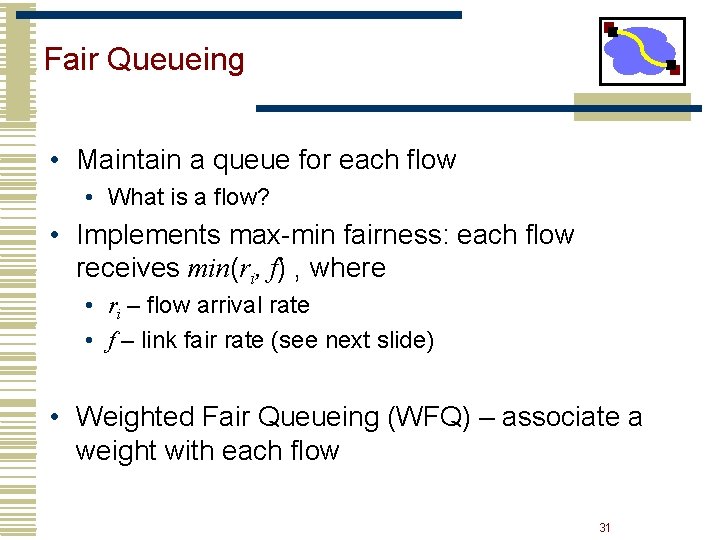
Fair Queueing • Maintain a queue for each flow • What is a flow? • Implements max-min fairness: each flow receives min(ri, f) , where • ri – flow arrival rate • f – link fair rate (see next slide) • Weighted Fair Queueing (WFQ) – associate a weight with each flow 31
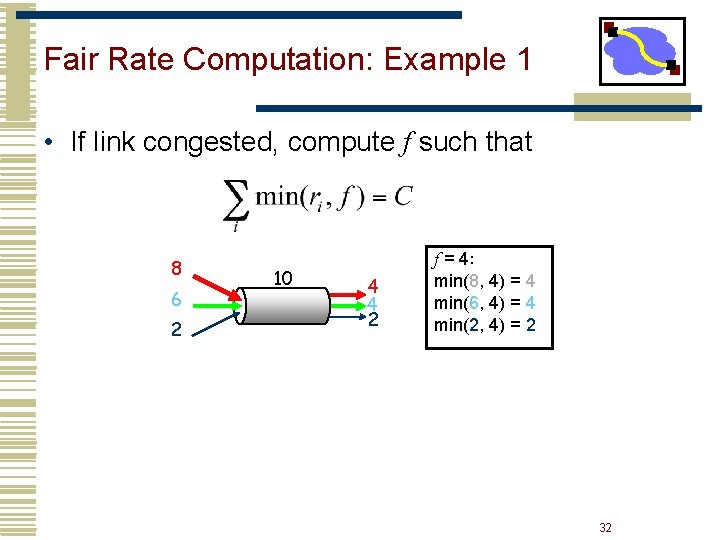
Fair Rate Computation: Example 1 • If link congested, compute f such that 8 6 2 10 4 4 2 f = 4: min(8, 4) = 4 min(6, 4) = 4 min(2, 4) = 2 32
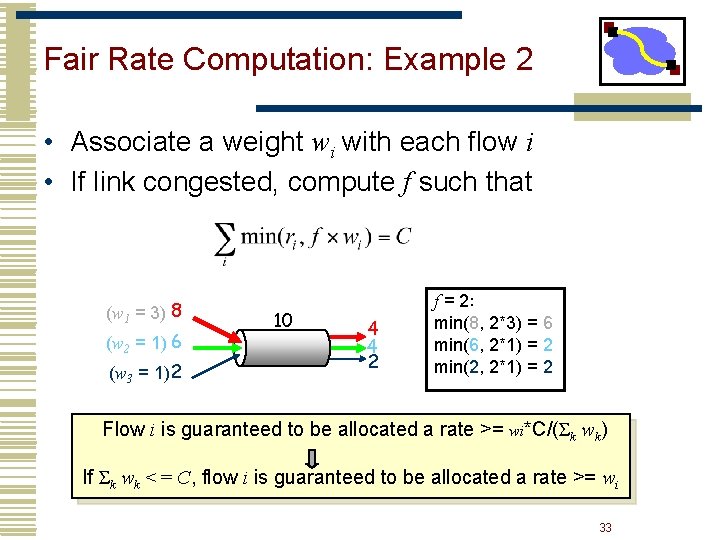
Fair Rate Computation: Example 2 • Associate a weight wi with each flow i • If link congested, compute f such that (w 1 = 3) 8 (w 2 = 1) 6 (w 3 = 1) 2 10 4 4 2 f = 2: min(8, 2*3) = 6 min(6, 2*1) = 2 min(2, 2*1) = 2 Flow i is guaranteed to be allocated a rate >= wi*C/(Σk wk) If Σk wk <= C, flow i is guaranteed to be allocated a rate >= wi 33
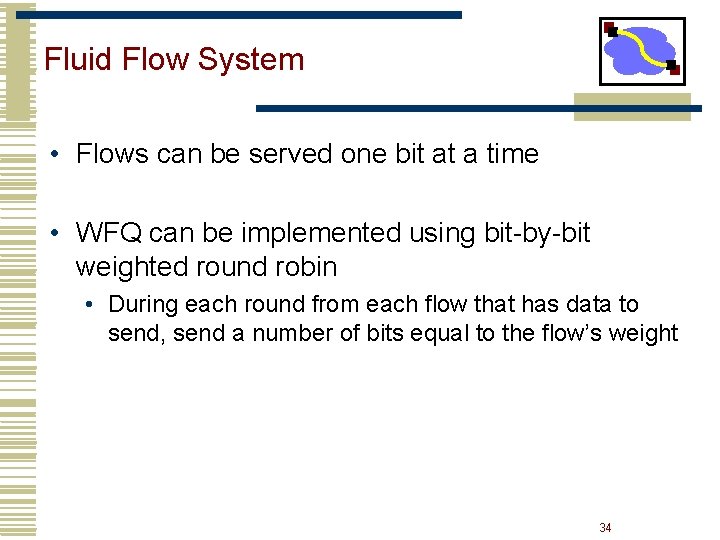
Fluid Flow System • Flows can be served one bit at a time • WFQ can be implemented using bit-by-bit weighted round robin • During each round from each flow that has data to send, send a number of bits equal to the flow’s weight 34
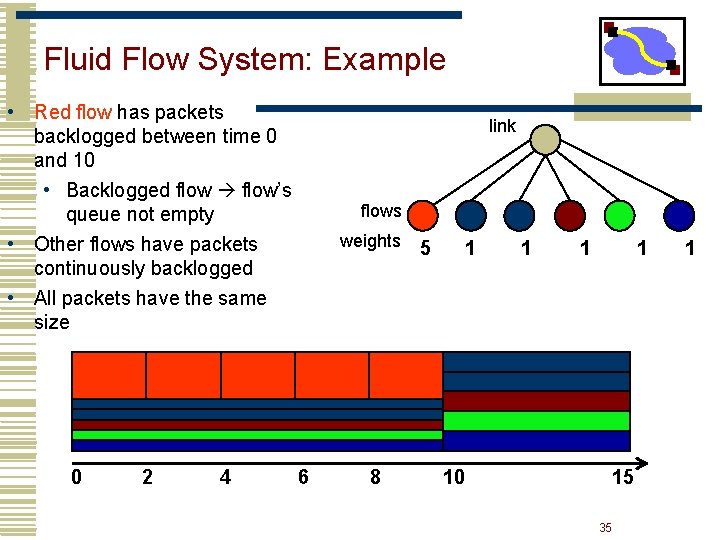
Fluid Flow System: Example • Red flow has packets backlogged between time 0 and 10 • Backlogged flow’s queue not empty • Other flows have packets continuously backlogged • All packets have the same size 0 2 4 link flows weights 6 8 5 1 1 10 15 35 1
Implementation In Packet System • Packet (Real) system: packet transmission cannot be preempted. Why? • Solution: serve packets in the order in which they would have finished being transmitted in the fluid flow system 36
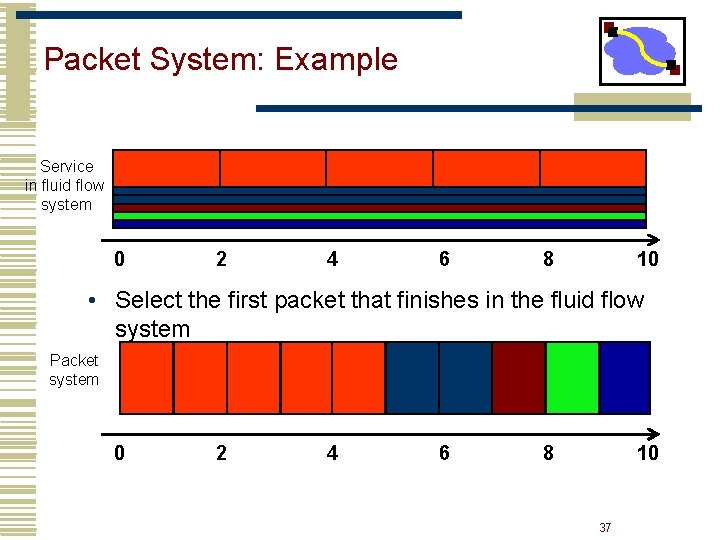
Packet System: Example Service in fluid flow system 0 2 4 6 8 10 • Select the first packet that finishes in the fluid flow system Packet system 0 2 4 6 8 10 37
Limitations of Resource Management Architecture Today (II) • IP provides only best effort service • IP does not participate in resource management, thus cannot provide Quality of Service (Qo. S) • Quality of Service • flow-based vs. class-based • absolute vs. relative (assurance vs. differentiation) • absolute: performance assurance regardless of behaviors of other traffic • relative: Qo. S defined with respect to other flows, e. g. priority, weighted fair share 38
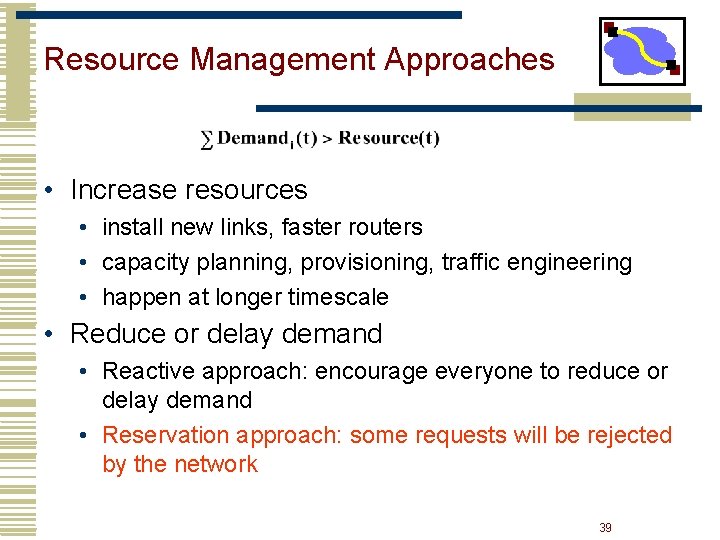
Resource Management Approaches • Increase resources • install new links, faster routers • capacity planning, provisioning, traffic engineering • happen at longer timescale • Reduce or delay demand • Reactive approach: encourage everyone to reduce or delay demand • Reservation approach: some requests will be rejected by the network 39
Components of Integrated Services Network • Service models • end-to-end per flow guaranteed, controlled load, best -effort • hierarchical link-sharing • Protocols and mechanisms • RSVP: signaling protocol to set-up and tear-down per flow reservation state • Admission control • determines whethere is enough resource and policy allows • Traffic control • classify packet to each flow • schedule packets transmission according to per flow state 40
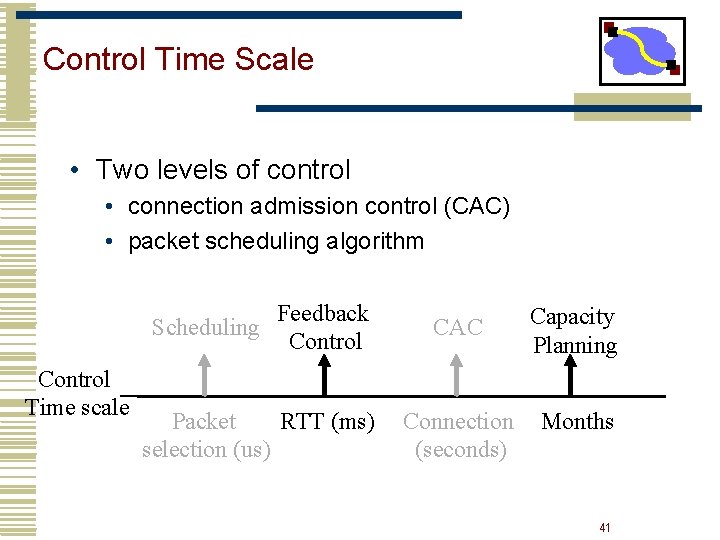
Control Time Scale • Two levels of control • connection admission control (CAC) • packet scheduling algorithm Scheduling Control Time scale Feedback Control Packet RTT (ms) selection (us) CAC Capacity Planning Connection (seconds) Months 41
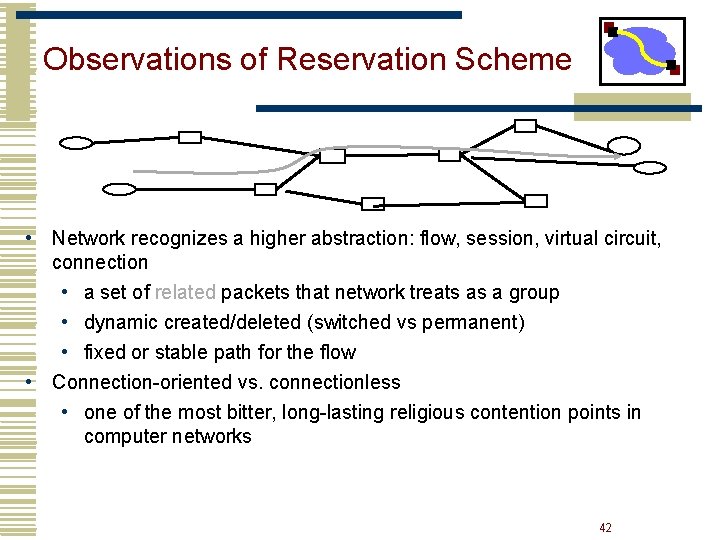
Observations of Reservation Scheme • Network recognizes a higher abstraction: flow, session, virtual circuit, connection • a set of related packets that network treats as a group • dynamic created/deleted (switched vs permanent) • fixed or stable path for the flow • Connection-oriented vs. connectionless • one of the most bitter, long-lasting religious contention points in computer networks 42
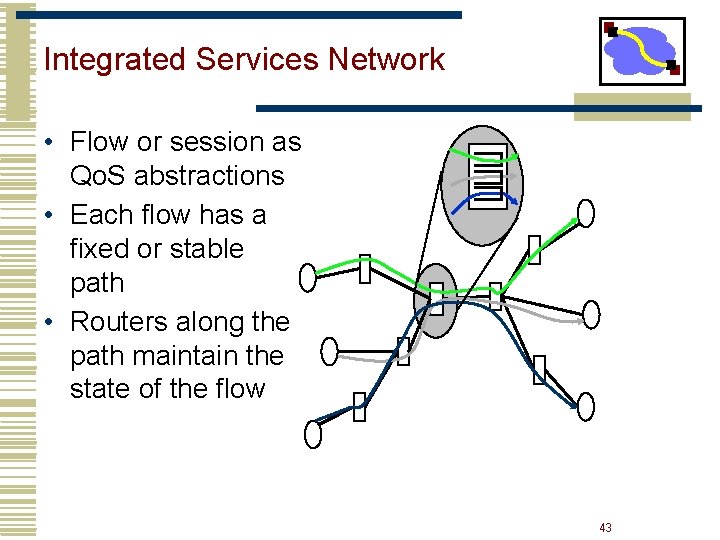
Integrated Services Network • Flow or session as Qo. S abstractions • Each flow has a fixed or stable path • Routers along the path maintain the state of the flow 43
Components of Flow Qo. S Network • Service models: end-to-end per flow • IETF Intserv: guaranteed, controlled load, besteffort • Protocols and mechanisms • Signaling protocol: set-up and tear-down per flow state • IETF: RSVP • Admission control • determines whethere is enough resource inside network • Traffic control • classify packet to each flow • schedule packets transmission according to per flow state 44
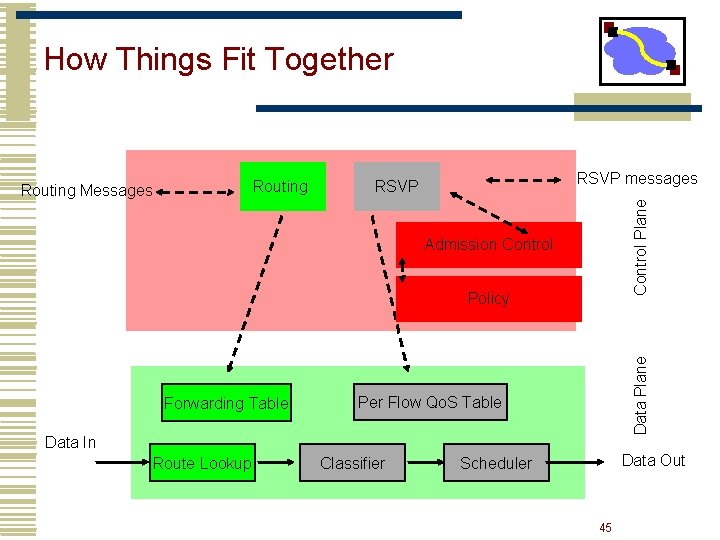
How Things Fit Together RSVP messages RSVP Control Plane Routing Messages Admission Control Forwarding Table Data Plane Policy Per Flow Qo. S Table Data In Route Lookup Classifier Data Out Scheduler 45
Packet Classification Algorithm • Map a packet to a flow • Flow identified by • <src. IP, dest. IP, src. Port, dest. Port, protocol> • Sometimes only prefixes of src. IP, dest. IP are specified • e. g <128. 2. x. x, 140. 247. x. x, x, 80, 6> • all web traffic from CMU to Harvard • Different fields have different matching rules • IP addresses: longest prefix match • port numbers: exact match or range match • protocol: exact match 46
Resource Management Approaches • Increase resources • install new links, faster routers • capacity planning, provisioning, traffic engineering • happen at longer timescale • Reduce or delay demand • Reactive approach: encourage everyone to reduce or delay demand • Reservation approach: some requests will be rejected by the network 47