
15 441 Computer Networking Lecture 17 Queue Management
- Slides: 24
15 -441 Computer Networking Lecture 17 – Queue Management As usual: Thanks to Srini Seshan and Dave Anderson
Overview • Queue management & RED • Fair-queuing Lecture 22: 2006 -11 -14 2
Queuing Disciplines • Each router must implement some queuing discipline • Queuing allocates both bandwidth and buffer space: • • Bandwidth: which packet to serve (transmit) next Buffer space: which packet to drop next (when required) • Queuing also affects latency Lecture 22: 2006 -11 -14 3
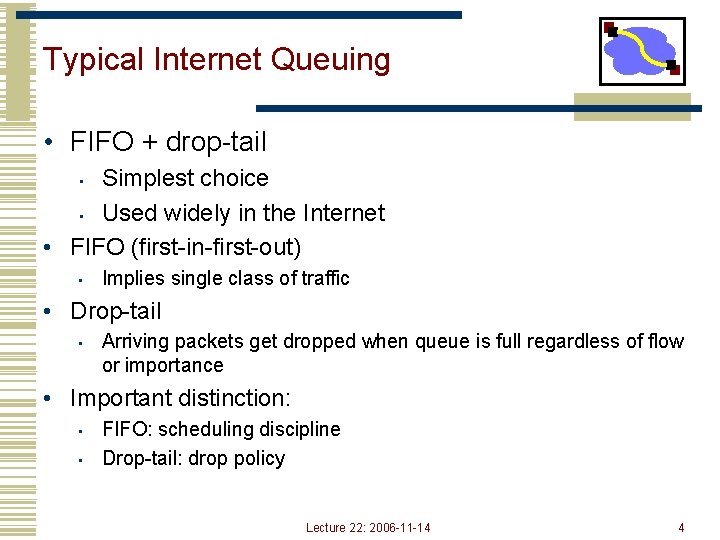
Typical Internet Queuing • FIFO + drop-tail Simplest choice • Used widely in the Internet • FIFO (first-in-first-out) • • Implies single class of traffic • Drop-tail • Arriving packets get dropped when queue is full regardless of flow or importance • Important distinction: • • FIFO: scheduling discipline Drop-tail: drop policy Lecture 22: 2006 -11 -14 4
FIFO + Drop-tail Problems • Leaves responsibility of congestion control completely to the edges (e. g. , TCP) • Does not separate between different flows • No policing: send more packets get more service • Synchronization: end hosts react to same events Lecture 22: 2006 -11 -14 5
FIFO + Drop-tail Problems • Full queues • • Routers are forced to have large queues to maintain high utilizations TCP detects congestion from loss • Forces network to have long standing queues in steady-state • Lock-out problem • • Drop-tail routers treat bursty traffic poorly Traffic gets synchronized easily allows a few flows to monopolize the queue space Lecture 22: 2006 -11 -14 6
Active Queue Management • Design active router queue management to aid congestion control • Why? • • • Router has unified view of queuing behavior Routers see actual queue occupancy (distinguish queue delay and propagation delay) Routers can decide on transient congestion, based on workload Lecture 22: 2006 -11 -14 7
Design Objectives • Keep throughput high and delay low • High power (throughput/delay) • Accommodate bursts • Queue size should reflect ability to accept bursts rather than steady-state queuing • Improve TCP performance with minimal hardware changes Lecture 22: 2006 -11 -14 8
Lock-out Problem • Random drop • Packet arriving when queue is full causes some random packet to be dropped • Drop front • On full queue, drop packet at head of queue • Random drop and drop front solve the lock-out problem but not the full-queues problem Lecture 22: 2006 -11 -14 9
Full Queues Problem • Drop packets before queue becomes full (early drop) • Intuition: notify senders of incipient congestion • Example: early random drop (ERD): • • If qlen > drop level, drop each new packet with fixed probability p Does not control misbehaving users Lecture 22: 2006 -11 -14 10
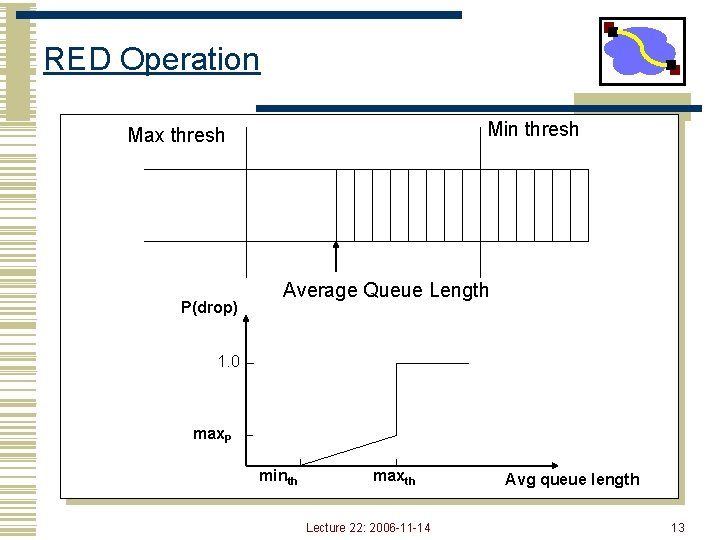
Random Early Detection (RED) • Detect incipient congestion • Assume hosts respond to lost packets • Avoid window synchronization • Randomly mark packets • Avoid bias against bursty traffic Lecture 22: 2006 -11 -14 11
RED Algorithm • Maintain running average of queue length • If avg < minth do nothing • Low queuing, send packets through • If avg > maxth, drop packet • Protection from misbehaving sources • Else mark packet in a manner proportional to queue length • Notify sources of incipient congestion Lecture 22: 2006 -11 -14 12
RED Operation Min thresh Max thresh P(drop) Average Queue Length 1. 0 max. P minth maxth Lecture 22: 2006 -11 -14 Avg queue length 13
Overview • Queue management & RED • Fair-queuing Lecture 22: 2006 -11 -14 14
Fairness Goals • Allocate resources fairly • Isolate ill-behaved users • • Router does not send explicit feedback to source Still needs e 2 e congestion control • Still achieve statistical muxing • • One flow can fill entire pipe if no contenders Work conserving scheduler never idles link if it has a packet Lecture 22: 2006 -11 -14 15
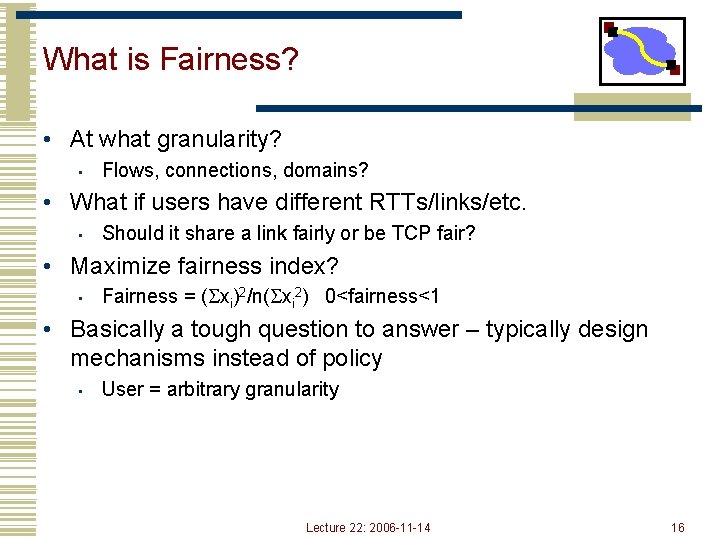
What is Fairness? • At what granularity? • Flows, connections, domains? • What if users have different RTTs/links/etc. • Should it share a link fairly or be TCP fair? • Maximize fairness index? • Fairness = (Sxi)2/n(Sxi 2) 0<fairness<1 • Basically a tough question to answer – typically design mechanisms instead of policy • User = arbitrary granularity Lecture 22: 2006 -11 -14 16
Max-min Fairness • Allocate user with “small” demand what it wants, evenly divide unused resources to “big” users • Formally: • • • Resources allocated in terms of increasing demand No source gets resource share larger than its demand Sources with unsatisfied demands get equal share of resource Lecture 22: 2006 -11 -14 17
Implementing Max-min Fairness • Generalized processor sharing • • Fluid fairness Bitwise round robin among all queues • Why not simple round robin? • • Variable packet length can get more service by sending bigger packets Unfair instantaneous service rate • What if arrive just before/after packet departs? Lecture 22: 2006 -11 -14 18
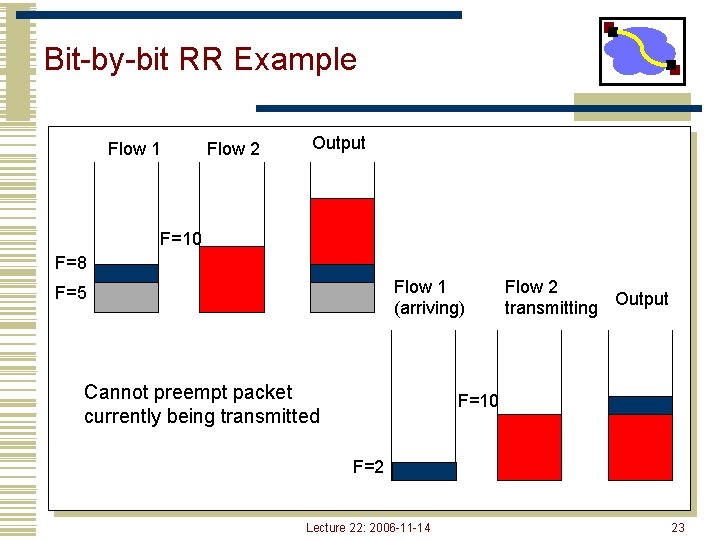
Bit-by-bit RR • Single flow: clock ticks when a bit is transmitted. For packet i: • • Pi = length, Ai = arrival time, Si = begin transmit time, Fi = finish transmit time Fi = Si+Pi = max (Fi-1, Ai) + Pi • Multiple flows: clock ticks when a bit from all active flows is transmitted round number • Can calculate Fi for each packet if number of flows is know at all times • Why do we need to know flow count? need to know A This can be complicated Lecture 22: 2006 -11 -14 19
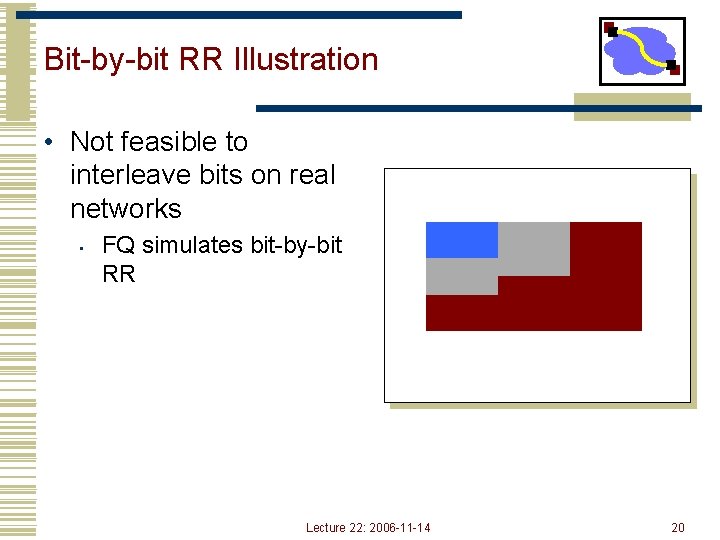
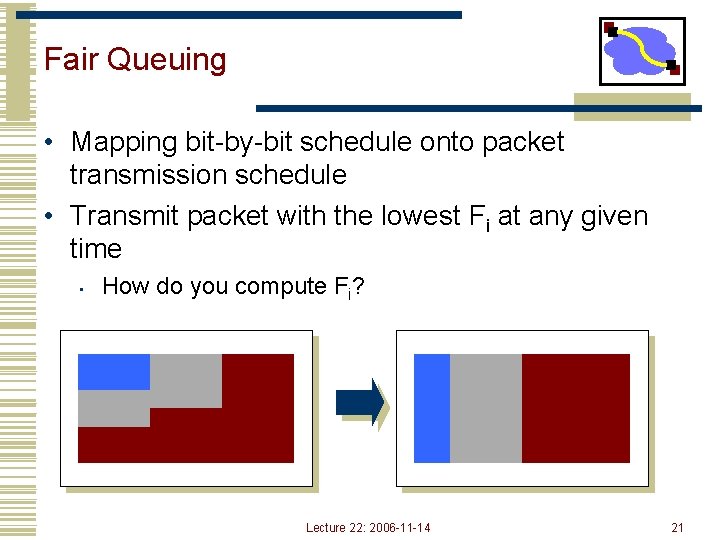
Bit-by-bit RR Illustration • Not feasible to interleave bits on real networks • FQ simulates bit-by-bit RR Lecture 22: 2006 -11 -14 20
Fair Queuing • Mapping bit-by-bit schedule onto packet transmission schedule • Transmit packet with the lowest Fi at any given time • How do you compute Fi? Lecture 22: 2006 -11 -14 21
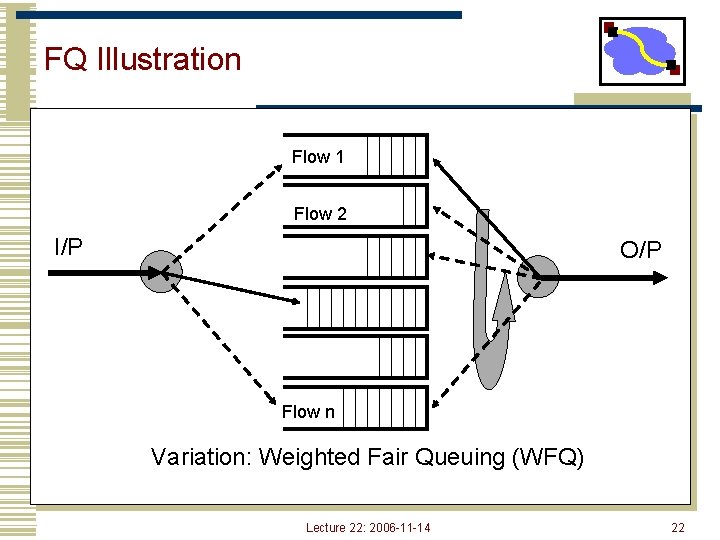
FQ Illustration Flow 1 Flow 2 I/P O/P Flow n Variation: Weighted Fair Queuing (WFQ) Lecture 22: 2006 -11 -14 22
Bit-by-bit RR Example Flow 1 Flow 2 Output F=10 F=8 Flow 1 (arriving) F=5 Cannot preempt packet currently being transmitted Flow 2 Output transmitting F=10 F=2 Lecture 22: 2006 -11 -14 23
Fair Queuing Tradeoffs • FQ can control congestion by monitoring flows • Non-adaptive flows can still be a problem – why? • Complex state • Must keep queue per flow • • Hard in routers with many flows (e. g. , backbone routers) Flow aggregation is a possibility (e. g. do fairness per domain) • Complex computation • • • Classification into flows may be hard Must keep queues sorted by finish times d. R/dt changes whenever the flow count changes Lecture 22: 2006 -11 -14 24