
15 441 Computer Networking Caching CDN Consistent Hashing
- Slides: 48
15 -441 Computer Networking Caching, CDN, Consistent Hashing, P 2 P
Web history • 1945: Vannevar Bush, “As we may think”, Atlantic Monthly, July, 1945. • describes the idea of a distributed hypertext system. • a “memex” that mimics the “web of trails” in our minds. • 1989: Tim Berners-Lee (CERN) writes internal proposal to develop a distributed hypertext system • connects “a web of notes with links”. • intended to help CERN physicists in large projects share and manage information • 1990: Tim BL writes graphical browser for Next machines. 15 -441 S'10 Lecture 21: CDN/Hashing/P 2 P 2
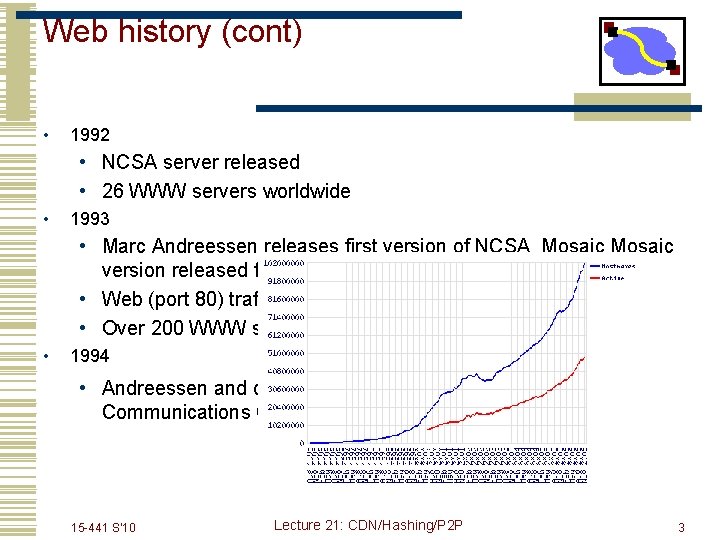
Web history (cont) • 1992 • NCSA server released • 26 WWW servers worldwide • 1993 • Marc Andreessen releases first version of NCSA Mosaic version released for (Windows, Mac, Unix). • Web (port 80) traffic at 1% of NSFNET backbone traffic. • Over 200 WWW servers worldwide. • 1994 • Andreessen and colleagues leave NCSA to form "Mosaic Communications Corp" (Netscape). 15 -441 S'10 Lecture 21: CDN/Hashing/P 2 P 3
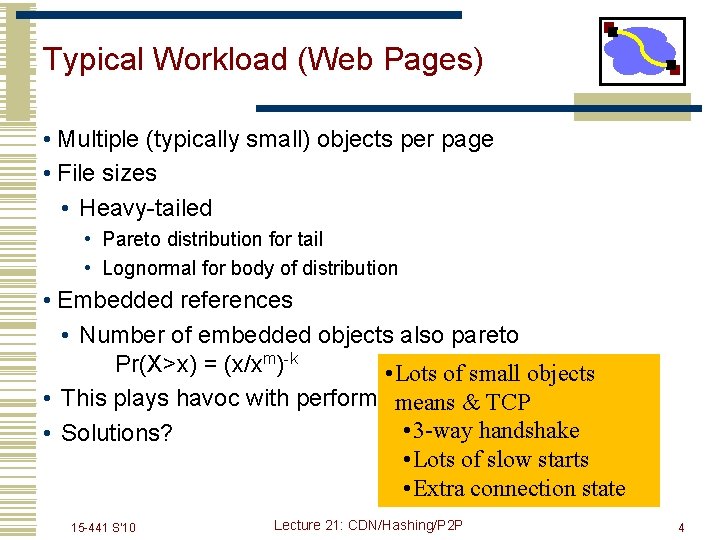
Typical Workload (Web Pages) • Multiple (typically small) objects per page • File sizes • Heavy-tailed • Pareto distribution for tail • Lognormal for body of distribution • Embedded references • Number of embedded objects also pareto Pr(X>x) = (x/xm)-k • Lots of small objects • This plays havoc with performance. Why? means & TCP • 3 -way handshake • Solutions? • Lots of slow starts • Extra connection state 15 -441 S'10 Lecture 21: CDN/Hashing/P 2 P 4
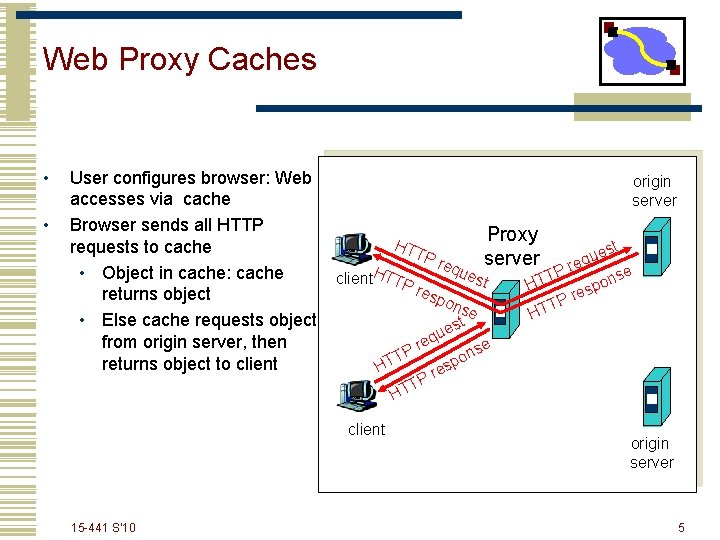
Web Proxy Caches • • User configures browser: Web accesses via cache Browser sends all HTTP requests to cache • Object in cache: cache returns object • Else cache requests object from origin server, then returns object to client origin server HT client. HTTP TP 15 -441 S'10 t pon eq r P se t es u es r P st e u req P se T n o HT p res P T HT se n po T HT client ues res TT H req Proxy server origin server 5
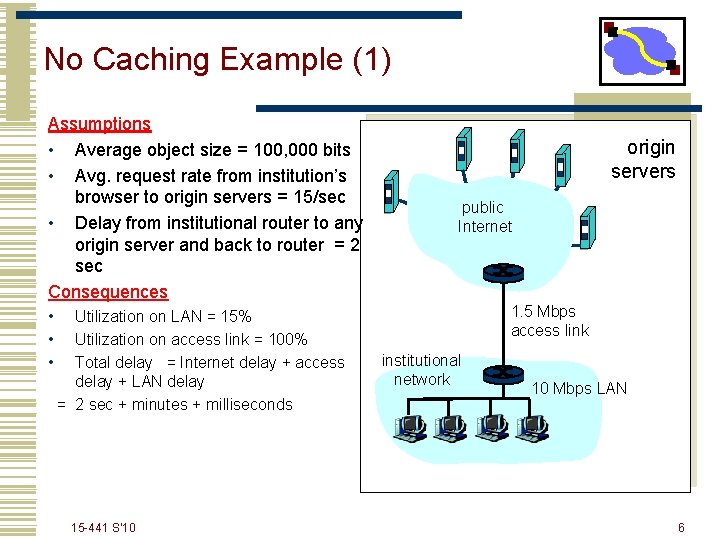
No Caching Example (1) Assumptions • Average object size = 100, 000 bits • Avg. request rate from institution’s browser to origin servers = 15/sec • Delay from institutional router to any origin server and back to router = 2 sec Consequences • • • Utilization on LAN = 15% Utilization on access link = 100% Total delay = Internet delay + access delay + LAN delay = 2 sec + minutes + milliseconds 15 -441 S'10 origin servers public Internet 1. 5 Mbps access link institutional network 10 Mbps LAN 6
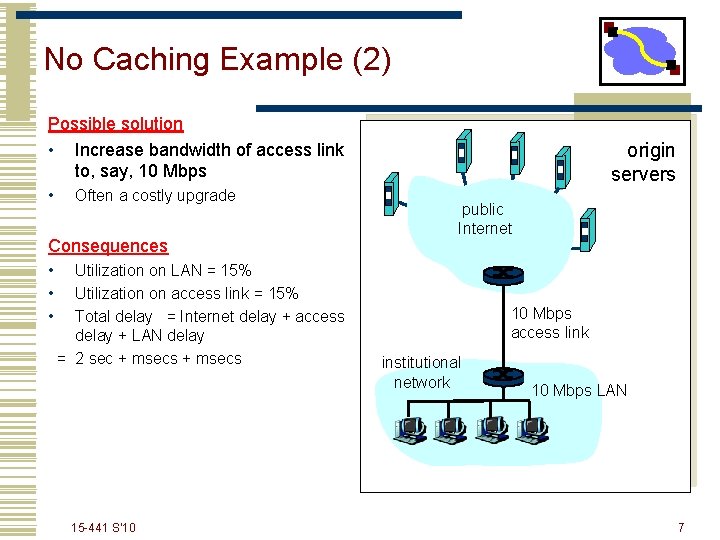
No Caching Example (2) Possible solution • Increase bandwidth of access link to, say, 10 Mbps • Often a costly upgrade Consequences • • • Utilization on LAN = 15% Utilization on access link = 15% Total delay = Internet delay + access delay + LAN delay = 2 sec + msecs 15 -441 S'10 origin servers public Internet 10 Mbps access link institutional network 10 Mbps LAN 7
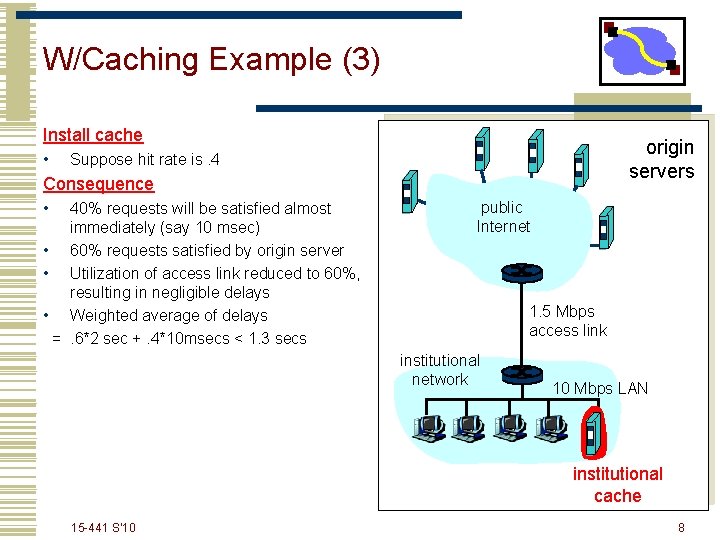
W/Caching Example (3) Install cache • origin servers Suppose hit rate is. 4 Consequence • 40% requests will be satisfied almost immediately (say 10 msec) • 60% requests satisfied by origin server • Utilization of access link reduced to 60%, resulting in negligible delays • Weighted average of delays =. 6*2 sec +. 4*10 msecs < 1. 3 secs public Internet 1. 5 Mbps access link institutional network 10 Mbps LAN institutional cache 15 -441 S'10 8
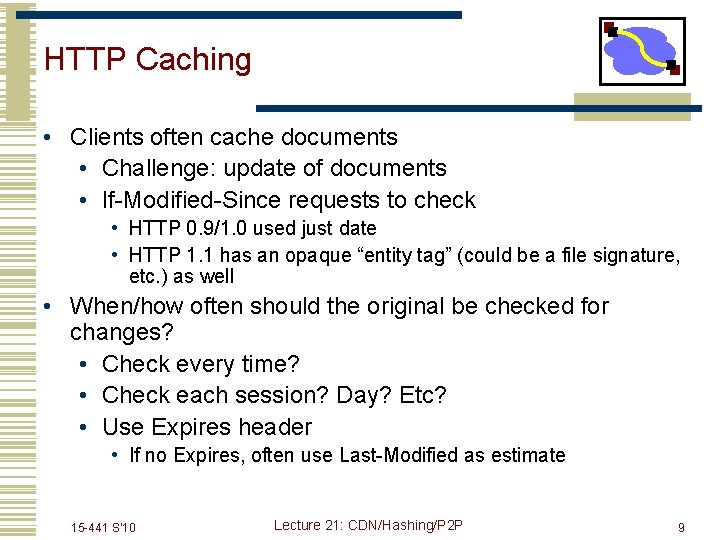
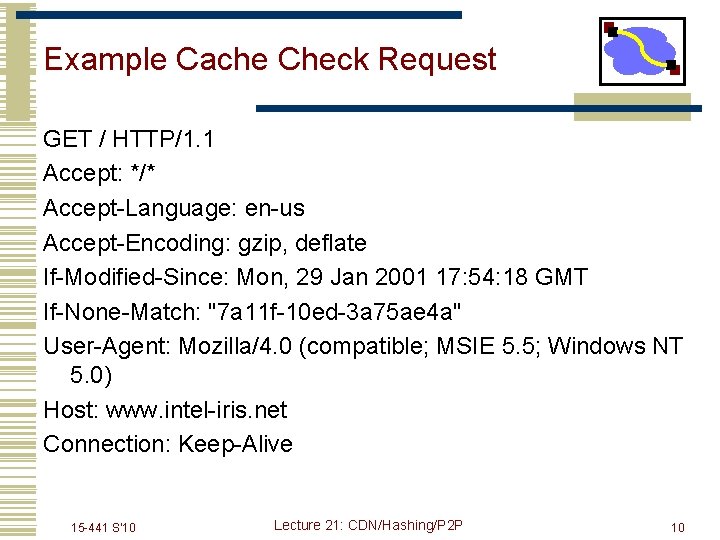
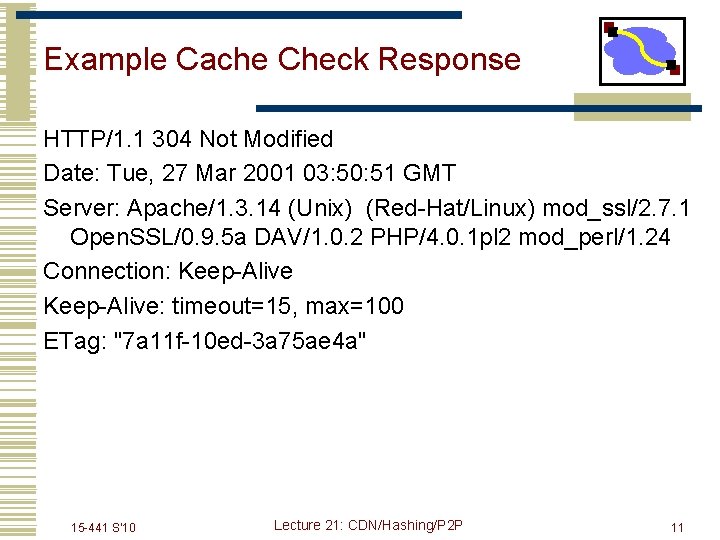
HTTP Caching • Clients often cache documents • Challenge: update of documents • If-Modified-Since requests to check • HTTP 0. 9/1. 0 used just date • HTTP 1. 1 has an opaque “entity tag” (could be a file signature, etc. ) as well • When/how often should the original be checked for changes? • Check every time? • Check each session? Day? Etc? • Use Expires header • If no Expires, often use Last-Modified as estimate 15 -441 S'10 Lecture 21: CDN/Hashing/P 2 P 9
Example Cache Check Request GET / HTTP/1. 1 Accept: */* Accept-Language: en-us Accept-Encoding: gzip, deflate If-Modified-Since: Mon, 29 Jan 2001 17: 54: 18 GMT If-None-Match: "7 a 11 f-10 ed-3 a 75 ae 4 a" User-Agent: Mozilla/4. 0 (compatible; MSIE 5. 5; Windows NT 5. 0) Host: www. intel-iris. net Connection: Keep-Alive 15 -441 S'10 Lecture 21: CDN/Hashing/P 2 P 10
Example Cache Check Response HTTP/1. 1 304 Not Modified Date: Tue, 27 Mar 2001 03: 50: 51 GMT Server: Apache/1. 3. 14 (Unix) (Red-Hat/Linux) mod_ssl/2. 7. 1 Open. SSL/0. 9. 5 a DAV/1. 0. 2 PHP/4. 0. 1 pl 2 mod_perl/1. 24 Connection: Keep-Alive: timeout=15, max=100 ETag: "7 a 11 f-10 ed-3 a 75 ae 4 a" 15 -441 S'10 Lecture 21: CDN/Hashing/P 2 P 11
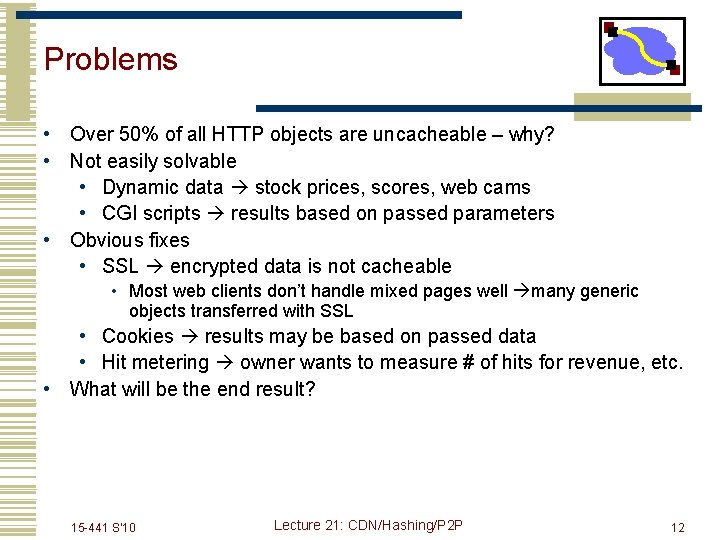
Problems • Over 50% of all HTTP objects are uncacheable – why? • Not easily solvable • Dynamic data stock prices, scores, web cams • CGI scripts results based on passed parameters • Obvious fixes • SSL encrypted data is not cacheable • Most web clients don’t handle mixed pages well many generic objects transferred with SSL • Cookies results may be based on passed data • Hit metering owner wants to measure # of hits for revenue, etc. • What will be the end result? 15 -441 S'10 Lecture 21: CDN/Hashing/P 2 P 12
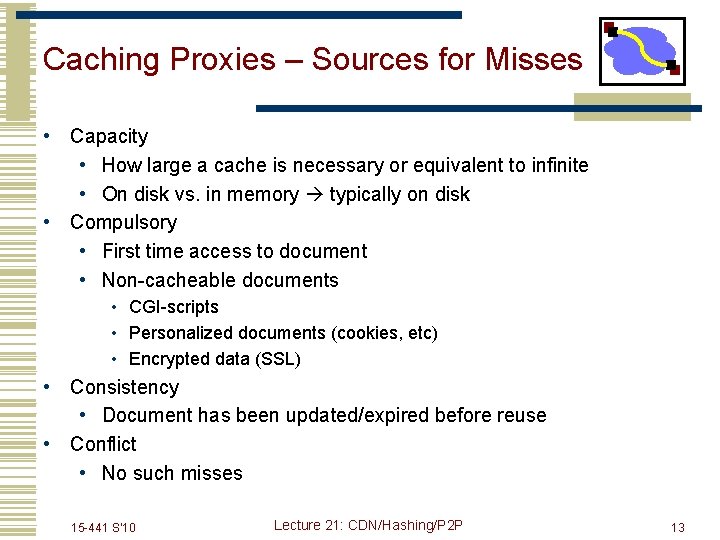
Caching Proxies – Sources for Misses • Capacity • How large a cache is necessary or equivalent to infinite • On disk vs. in memory typically on disk • Compulsory • First time access to document • Non-cacheable documents • CGI-scripts • Personalized documents (cookies, etc) • Encrypted data (SSL) • Consistency • Document has been updated/expired before reuse • Conflict • No such misses 15 -441 S'10 Lecture 21: CDN/Hashing/P 2 P 13
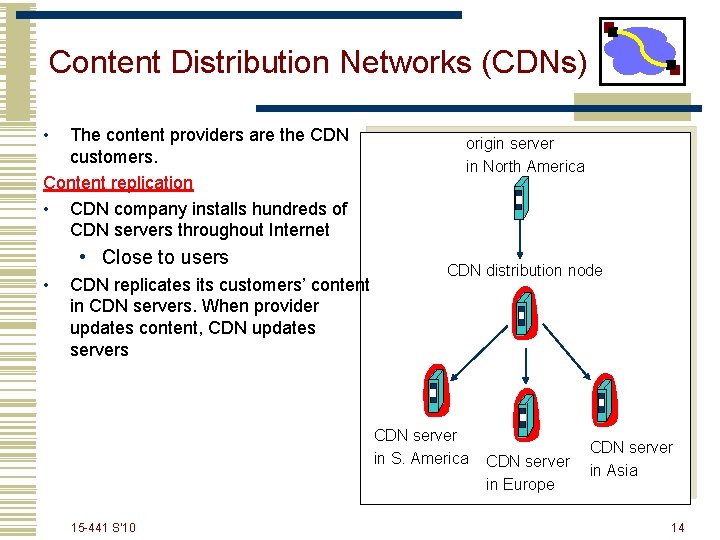
Content Distribution Networks (CDNs) • The content providers are the CDN customers. Content replication • CDN company installs hundreds of CDN servers throughout Internet • Close to users • CDN replicates its customers’ content in CDN servers. When provider updates content, CDN updates servers origin server in North America CDN distribution node CDN server in S. America 15 -441 S'10 CDN server in Europe CDN server in Asia 14
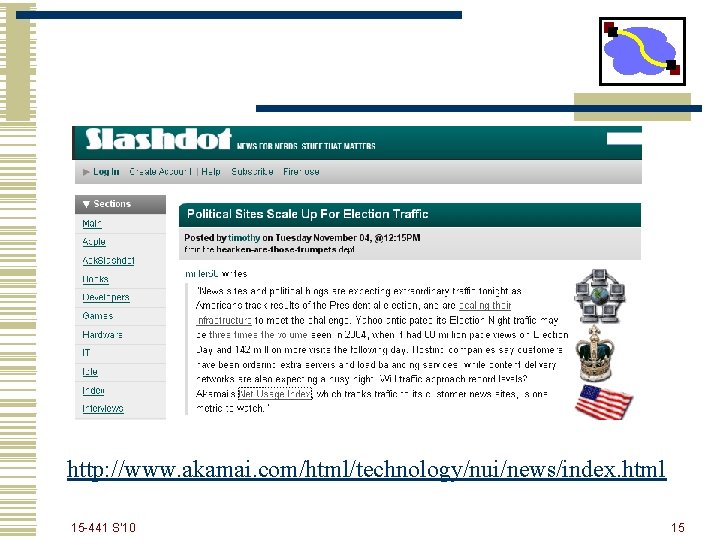
http: //www. akamai. com/html/technology/nui/news/index. html 15 -441 S'10 15
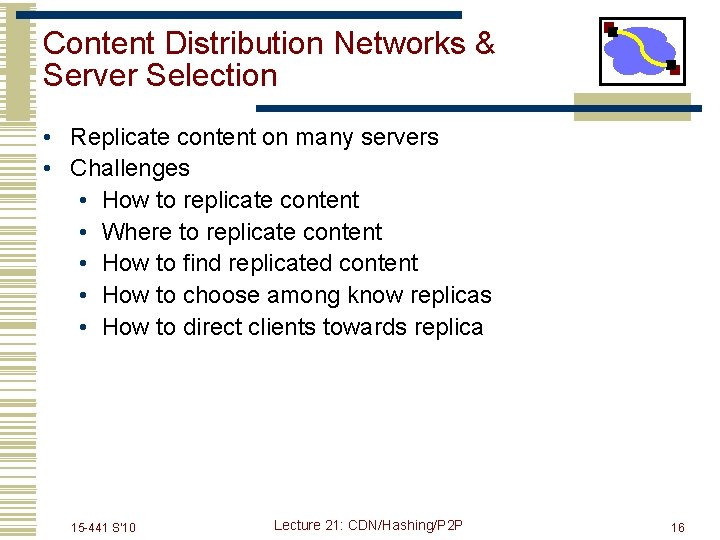
Content Distribution Networks & Server Selection • Replicate content on many servers • Challenges • How to replicate content • Where to replicate content • How to find replicated content • How to choose among know replicas • How to direct clients towards replica 15 -441 S'10 Lecture 21: CDN/Hashing/P 2 P 16
Server Selection • Which server? • Lowest load to balance load on servers • Best performance to improve client performance • Based on Geography? RTT? Throughput? Load? • Any alive node to provide fault tolerance • How to direct clients to a particular server? • As part of routing anycast, cluster load balancing • Not covered • As part of application HTTP redirect • As part of naming DNS 15 -441 S'10 Lecture 21: CDN/Hashing/P 2 P 17
Application Based • HTTP supports simple way to indicate that Web page has moved (30 X responses) • Server receives Get request from client • Decides which server is best suited for particular client and object • Returns HTTP redirect to that server • Can make informed application specific decision • May introduce additional overhead multiple connection setup, name lookups, etc. • While good solution in general, but… • HTTP Redirect has some design flaws – especially with current browsers 15 -441 S'10 Lecture 21: CDN/Hashing/P 2 P 18
Naming Based • Client does name lookup for service • Name server chooses appropriate server address • A-record returned is “best” one for the client • What information can name server base decision on? • Server load/location must be collected • Information in the name lookup request • Name service client typically the local name server for client 15 -441 S'10 Lecture 21: CDN/Hashing/P 2 P 19
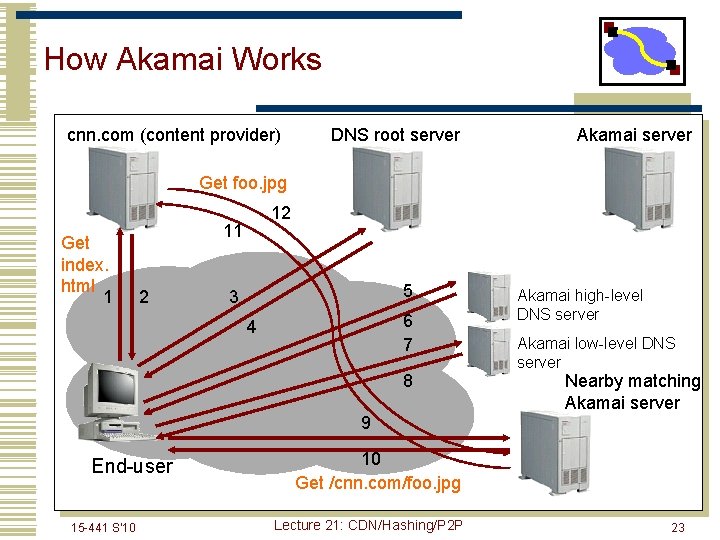
How Akamai Works • Clients fetch html document from primary server • E. g. fetch index. html from cnn. com • URLs for replicated content are replaced in html • E. g. <img src=“http: //cnn. com/af/x. gif”> replaced with <img src=“http: //a 73. g. akamaitech. net/7/23/cnn. com/af/x. gif”> • Client is forced to resolve a. XYZ. g. akamaitech. net hostname 15 -441 S'10 Lecture 21: CDN/Hashing/P 2 P 20
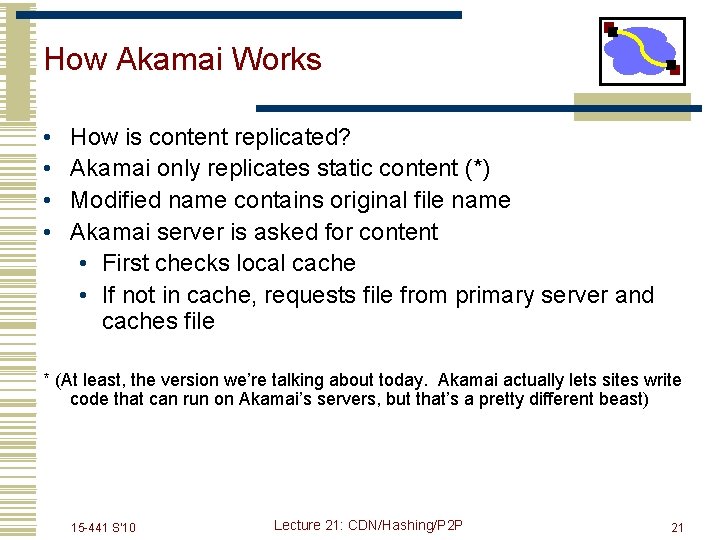
How Akamai Works • • How is content replicated? Akamai only replicates static content (*) Modified name contains original file name Akamai server is asked for content • First checks local cache • If not in cache, requests file from primary server and caches file * (At least, the version we’re talking about today. Akamai actually lets sites write code that can run on Akamai’s servers, but that’s a pretty different beast) 15 -441 S'10 Lecture 21: CDN/Hashing/P 2 P 21
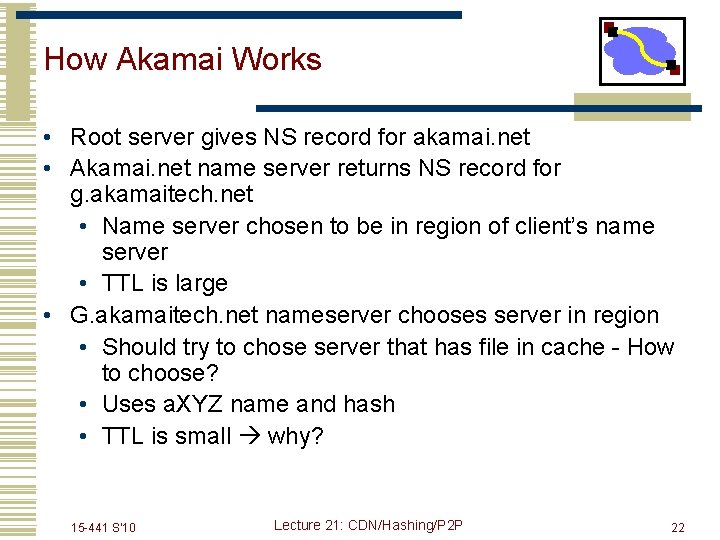
How Akamai Works • Root server gives NS record for akamai. net • Akamai. net name server returns NS record for g. akamaitech. net • Name server chosen to be in region of client’s name server • TTL is large • G. akamaitech. net nameserver chooses server in region • Should try to chose server that has file in cache - How to choose? • Uses a. XYZ name and hash • TTL is small why? 15 -441 S'10 Lecture 21: CDN/Hashing/P 2 P 22
How Akamai Works cnn. com (content provider) DNS root server Akamai server Get foo. jpg Get index. html 1 12 11 2 5 3 6 7 4 8 Akamai high-level DNS server Akamai low-level DNS server Nearby matching Akamai server 9 End-user 15 -441 S'10 10 Get /cnn. com/foo. jpg Lecture 21: CDN/Hashing/P 2 P 23
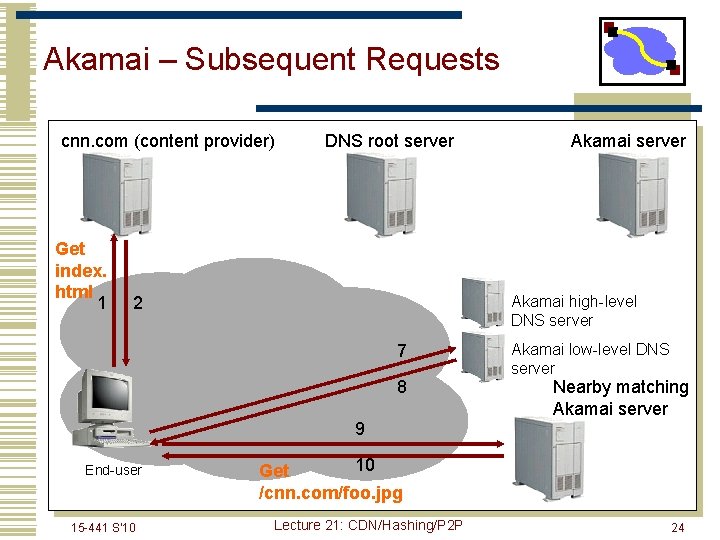
Akamai – Subsequent Requests cnn. com (content provider) Get index. html 1 DNS root server Akamai high-level DNS server 2 7 8 Akamai low-level DNS server Nearby matching Akamai server 9 End-user 15 -441 S'10 10 Get /cnn. com/foo. jpg Lecture 21: CDN/Hashing/P 2 P 24
Simple Hashing • Given document XYZ, we need to choose a server to use • Suppose we use modulo • Number servers from 1…n • Place document XYZ on server (XYZ mod n) • What happens when a servers fails? n n-1 • Same if different people have different measures of n • Why might this be bad? 15 -441 S'10 Lecture 21: CDN/Hashing/P 2 P 25
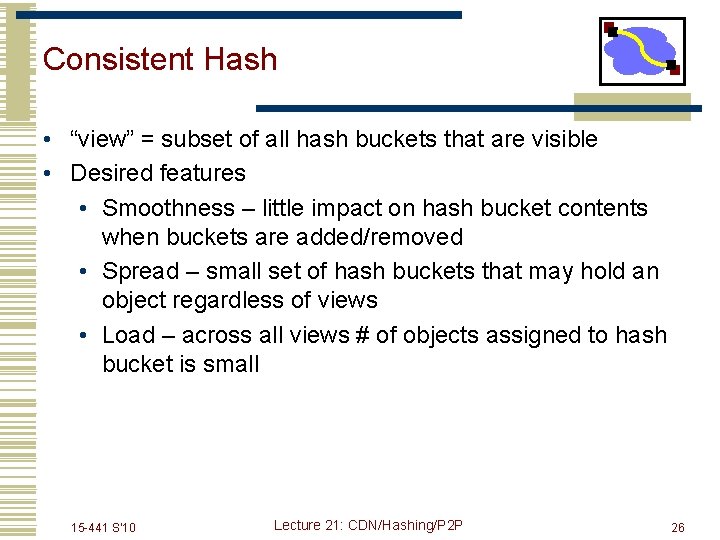
Consistent Hash • “view” = subset of all hash buckets that are visible • Desired features • Smoothness – little impact on hash bucket contents when buckets are added/removed • Spread – small set of hash buckets that may hold an object regardless of views • Load – across all views # of objects assigned to hash bucket is small 15 -441 S'10 Lecture 21: CDN/Hashing/P 2 P 26
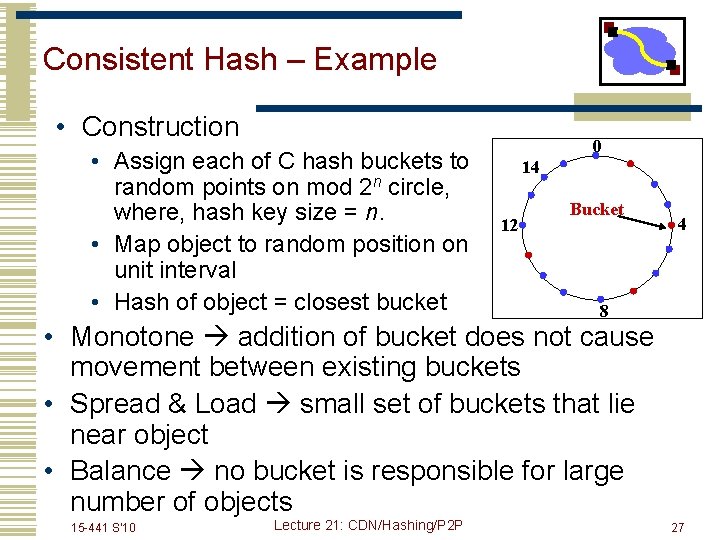
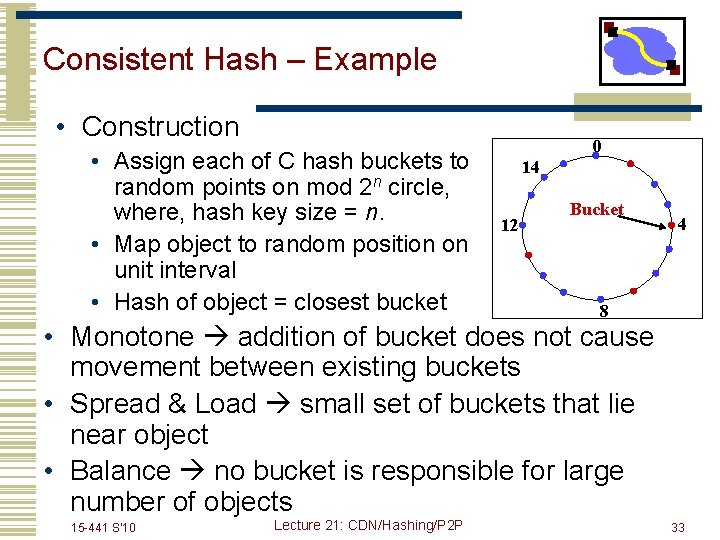
Consistent Hash – Example • Construction • Assign each of C hash buckets to random points on mod 2 n circle, where, hash key size = n. • Map object to random position on unit interval • Hash of object = closest bucket 0 14 12 Bucket 4 8 • Monotone addition of bucket does not cause movement between existing buckets • Spread & Load small set of buckets that lie near object • Balance no bucket is responsible for large number of objects 15 -441 S'10 Lecture 21: CDN/Hashing/P 2 P 27
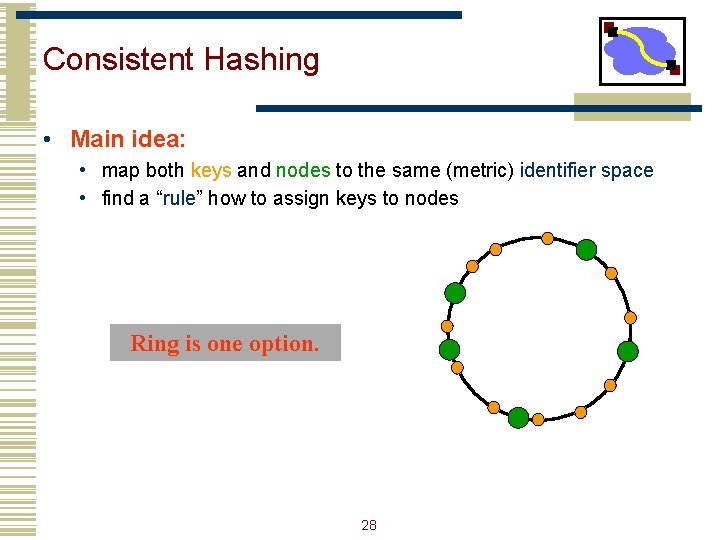
Consistent Hashing • Main idea: • map both keys and nodes to the same (metric) identifier space • find a “rule” how to assign keys to nodes Ring is one option. 28
Consistent Hashing • The consistent hash function assigns each node and key an m-bit identifier using SHA-1 as a base hash function • Node identifier: SHA-1 hash of IP address • Key identifier: SHA-1 hash of key 29
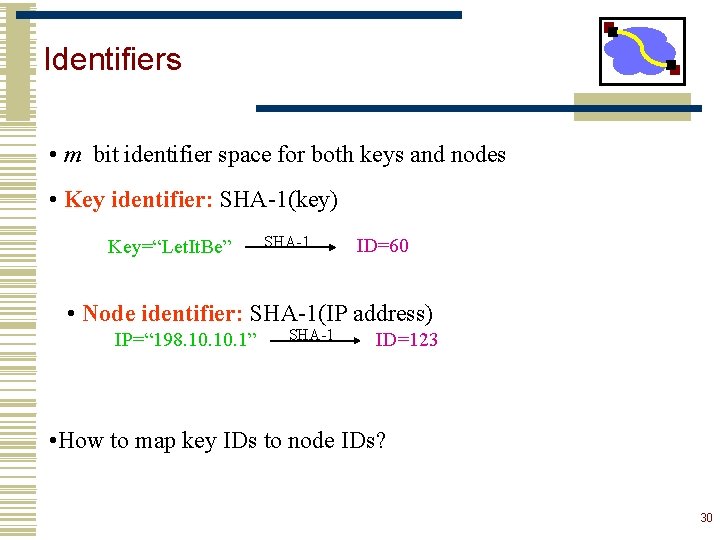
Identifiers • m bit identifier space for both keys and nodes • Key identifier: SHA-1(key) Key=“Let. It. Be” SHA-1 ID=60 • Node identifier: SHA-1(IP address) IP=“ 198. 10. 1” SHA-1 ID=123 • How to map key IDs to node IDs? 30
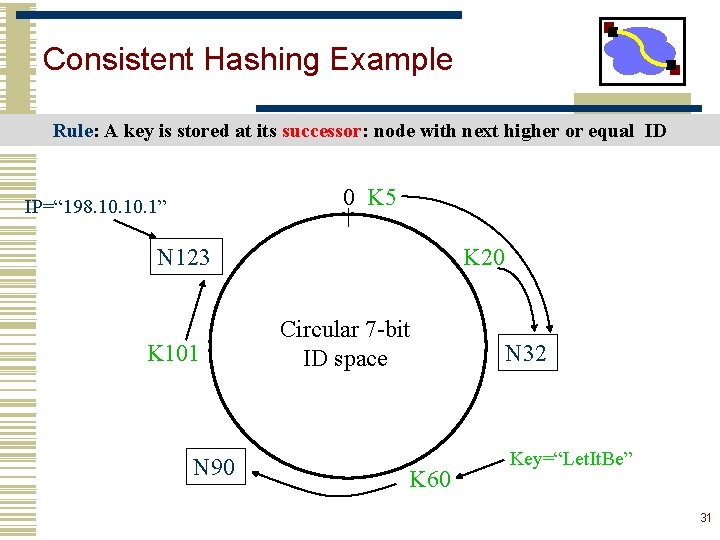
Consistent Hashing Example Rule: A key is stored at its successor: node with next higher or equal ID 0 K 5 IP=“ 198. 10. 1” N 123 K 101 N 90 K 20 Circular 7 -bit ID space K 60 N 32 Key=“Let. It. Be” 31
Consistent Hashing Properties • Load balance: all nodes receive roughly the same number of keys • For N nodes and K keys, with high probability • each node holds at most (1+ )K/N keys • (provided that K is large enough compared to N) 32
Consistent Hash – Example • Construction • Assign each of C hash buckets to random points on mod 2 n circle, where, hash key size = n. • Map object to random position on unit interval • Hash of object = closest bucket 0 14 12 Bucket 4 8 • Monotone addition of bucket does not cause movement between existing buckets • Spread & Load small set of buckets that lie near object • Balance no bucket is responsible for large number of objects 15 -441 S'10 Lecture 21: CDN/Hashing/P 2 P 33
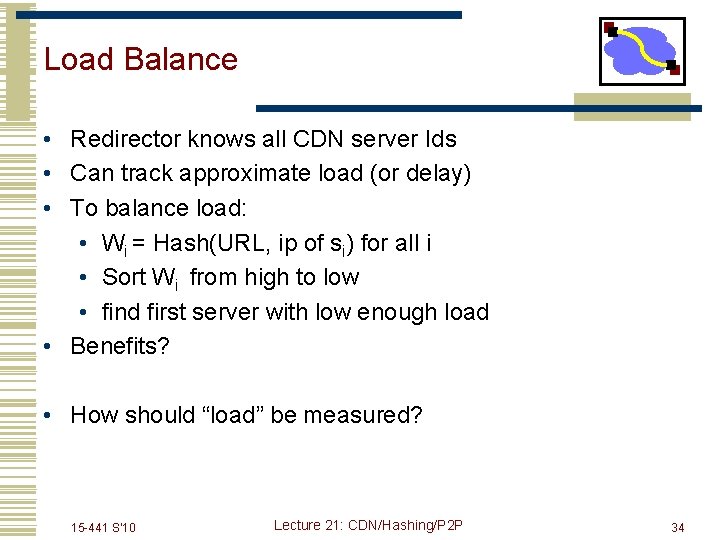
Load Balance • Redirector knows all CDN server Ids • Can track approximate load (or delay) • To balance load: • Wi = Hash(URL, ip of si) for all i • Sort Wi from high to low • find first server with low enough load • Benefits? • How should “load” be measured? 15 -441 S'10 Lecture 21: CDN/Hashing/P 2 P 34
Consistent Hashing not just for CDN • Finding a nearby server for an object in a CDN uses centralized knowledge. • Consistent hashing can also be used in a distributed setting • P 2 P systems like Bit. Torrent, e. g. , project 3, need a way of finding files. • Consistent Hashing to the rescue. 15 -441 S'10 Lecture 21: CDN/Hashing/P 2 P 35
Chord: Design Goals • Load balance: Chord acts as a distributed hash function, spreading keys evenly over the nodes. • Decentralization: Chord is fully distributed: no node is more important than any other. • Scalability: The cost of a Chord lookup grows as the log of the number of nodes, so even very large systems are feasible. • Availability: Chord automatically adjusts internal tables to reflect newly joined nodes as well as node failures, ensuring that the node responsible for a key can always be found. 36
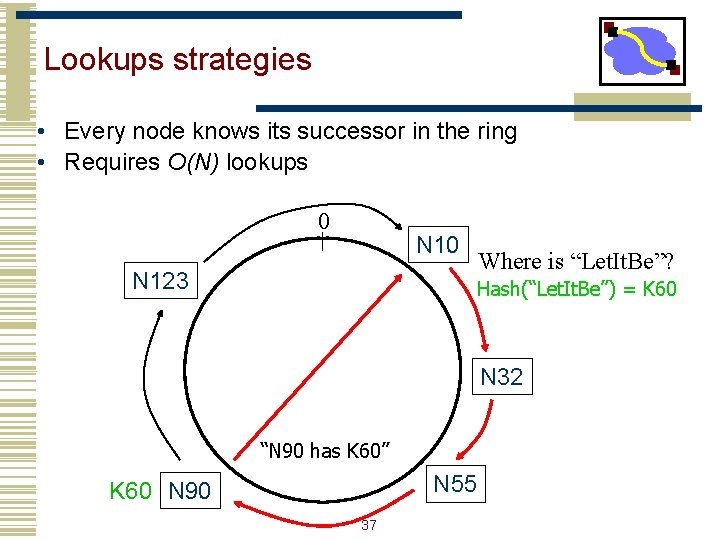
Lookups strategies • Every node knows its successor in the ring • Requires O(N) lookups 0 N 123 Where is “Let. It. Be”? Hash(“Let. It. Be”) = K 60 N 32 “N 90 has K 60” N 55 K 60 N 90 37
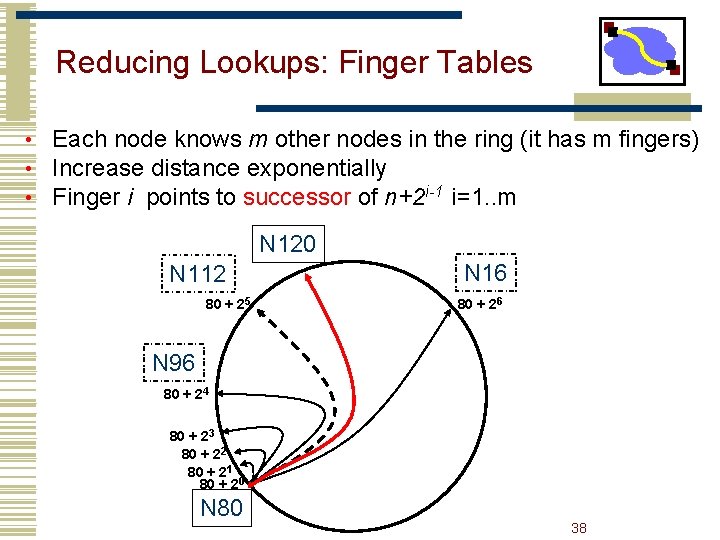
Reducing Lookups: Finger Tables • • • Each node knows m other nodes in the ring (it has m fingers) Increase distance exponentially Finger i points to successor of n+2 i-1 i=1. . m N 120 N 112 80 + 25 N 16 80 + 26 N 96 80 + 24 80 + 23 80 + 22 80 + 21 80 + 20 N 80 38
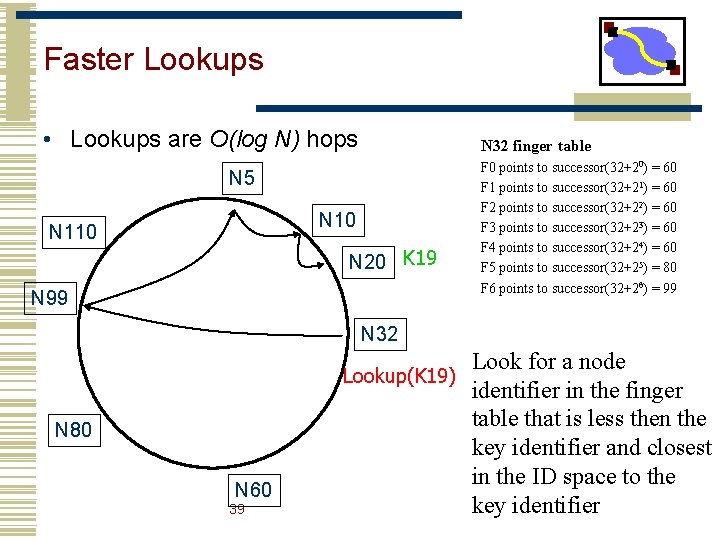
Faster Lookups • Lookups are O(log N) hops N 32 finger table N 5 N 10 N 110 N 20 K 19 N 99 F 0 points to successor(32+20) = 60 F 1 points to successor(32+21) = 60 F 2 points to successor(32+22) = 60 F 3 points to successor(32+23) = 60 F 4 points to successor(32+24) = 60 F 5 points to successor(32+25) = 80 F 6 points to successor(32+26) = 99 N 32 Lookup(K 19) N 80 N 60 39 Look for a node identifier in the finger table that is less then the key identifier and closest in the ID space to the key identifier
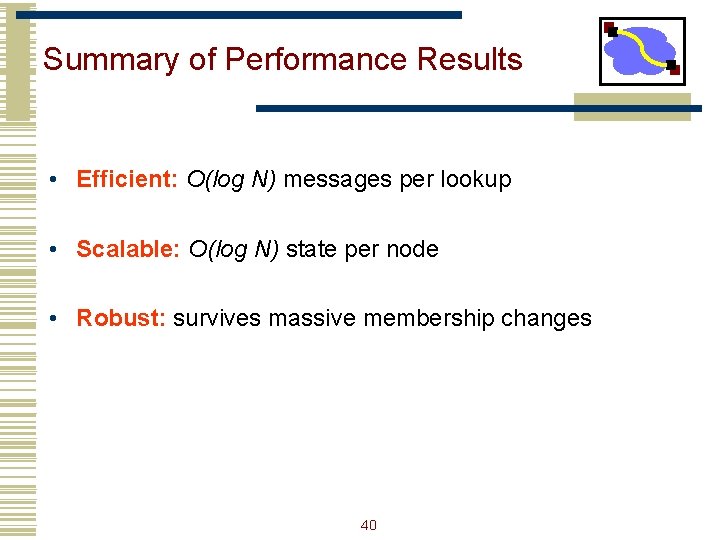
Summary of Performance Results • Efficient: O(log N) messages per lookup • Scalable: O(log N) state per node • Robust: survives massive membership changes 40
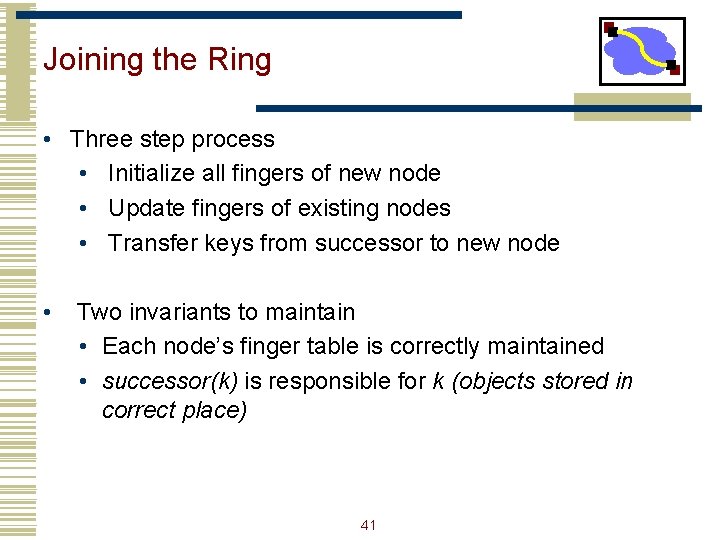
Joining the Ring • Three step process • Initialize all fingers of new node • Update fingers of existing nodes • Transfer keys from successor to new node • Two invariants to maintain • Each node’s finger table is correctly maintained • successor(k) is responsible for k (objects stored in correct place) 41
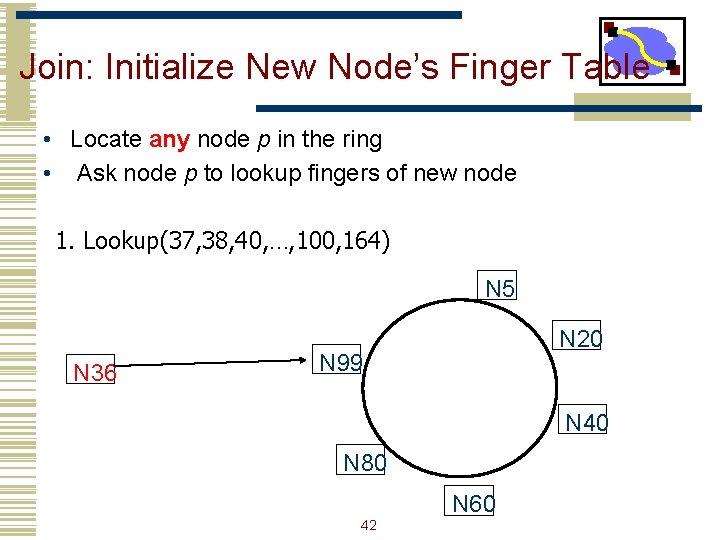
Join: Initialize New Node’s Finger Table • Locate any node p in the ring • Ask node p to lookup fingers of new node 1. Lookup(37, 38, 40, …, 100, 164) N 5 N 36 N 20 N 99 N 40 N 80 42 N 60
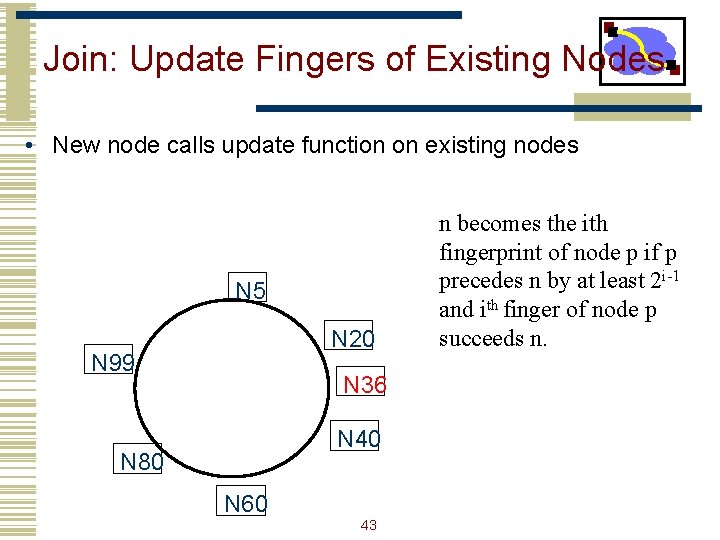
Join: Update Fingers of Existing Nodes • New node calls update function on existing nodes N 5 N 20 N 99 N 36 N 40 N 80 N 60 43 n becomes the ith fingerprint of node p if p precedes n by at least 2 i-1 and ith finger of node p succeeds n.
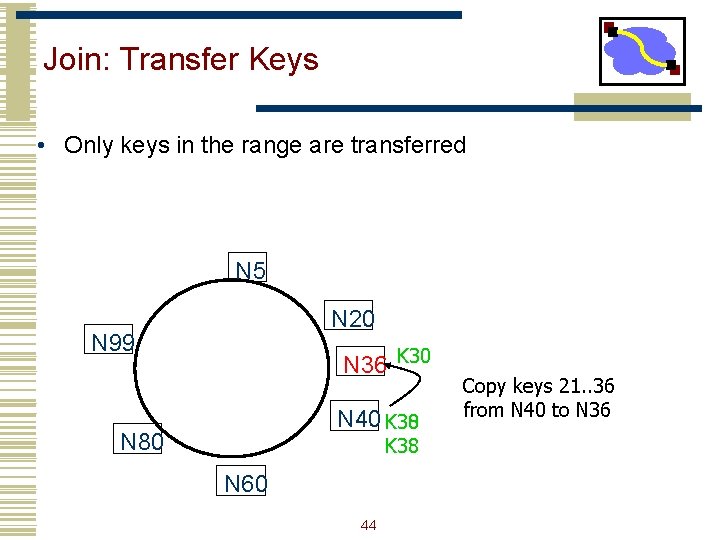
Join: Transfer Keys • Only keys in the range are transferred N 5 N 20 N 99 N 36 K 30 N 40 K 38 K 30 N 80 K 38 N 60 44 Copy keys 21. . 36 from N 40 to N 36
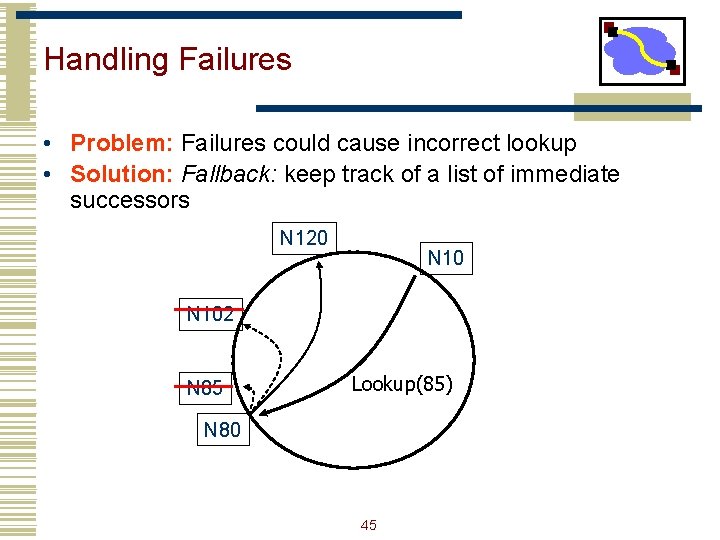
Handling Failures • Problem: Failures could cause incorrect lookup • Solution: Fallback: keep track of a list of immediate successors N 120 N 102 N 85 Lookup(85) N 80 45
Handling Failures • Use successor list • Each node knows r immediate successors • After failure, will know first live successor • Correct successors guarantee correct lookups • Guarantee with some probability • Can choose r to make probability of lookup failure arbitrarily small 46
Joining/Leaving overhead • When a node joins (or leaves) the network, only a fraction of the keys are moved to a different location. • For N nodes and K keys, with high probability • when node N+1 joins or leaves, O(K/N) keys change hands, and only to/from node N+1 47
Summary • Caching improves web performance • Caching only at client is only partial solution • Content Delivery Networks move data closer to user, maintain consistency, balance load • Consistent Caching maps keys AND buckets into the same space • Consistent caching can be fully distributed, useful in P 2 P systems using structured overlays 15 -441 S'10 Lecture 21: CDN/Hashing/P 2 P 48