
15 441 Computer Networking ATM and Label Switching
15 -441 Computer Networking ATM and Label Switching
Outline • ATM. • IP over ATM. • Label switching. Lecture #19: 11 -08 -01 2

History • Telephone companies supported voice telephony: 4 k. Hz analog, 64 kbps digital. • They already provided lines for data networking. • • • ISDN: 64 + 16 kbps T 1 (1. 544 Mbps) T 3 (44. 736 Mbps) • They wanted to become the primary service provider for data networking services. • • file transfer: bursty, many Mbps peak database access: bursty, low latency Multimedia: synchronized Video: 6 MHz analog, 1. 2 -200 Mbps digital • How? Lecture #19: 11 -08 -01 3
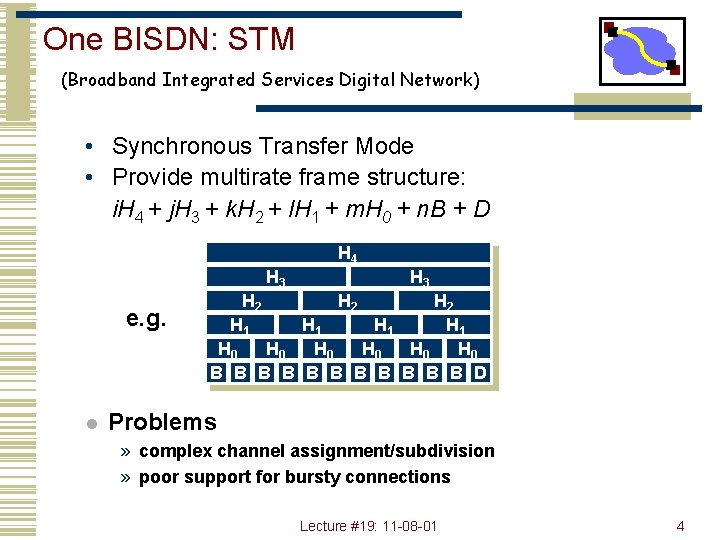
One BISDN: STM (Broadband Integrated Services Digital Network) • Synchronous Transfer Mode • Provide multirate frame structure: i. H 4 + j. H 3 + k. H 2 + l. H 1 + m. H 0 + n. B + D H 4 H 3 e. g. l H 3 H 2 H 2 H 1 H 1 H 0 H 0 H 0 B B B D Problems » complex channel assignment/subdivision » poor support for bursty connections Lecture #19: 11 -08 -01 4

More Flexible Solution: ATM • Asynchronous Transfer Mode • Instead of predefined TDM slots, tag each slot with a virtual connection ID. à Bandwidth can change dynamically VCI data • Small packets allow good real time behavior. • Fixed sized packets (cells) support fast switching Lecture #19: 11 -08 -01 5
ATM Features • Fixed size cells (53 bytes). • Virtual circuit technology using hierarchical virtual circuits (VP, VC). • PHY (physical layer) processing delineates cells by frame structure, cell header error check. • Support for multiple traffic classes by adaptation layer. • E. g. voice channels, data traffic • Elaborate signaling stack. • Backwards compatible with respect to the telephone standards • Standards defined by ATM Forum. • Organization of manufacturers, providers, users Lecture #19: 11 -08 -01 6
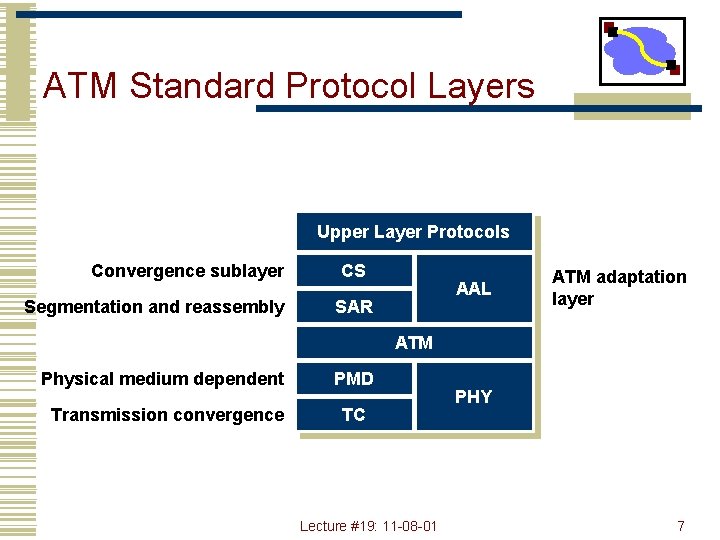
ATM Standard Protocol Layers Upper Layer Protocols Convergence sublayer Segmentation and reassembly CS AAL SAR ATM adaptation layer ATM Physical medium dependent PMD Transmission convergence TC Lecture #19: 11 -08 -01 PHY 7
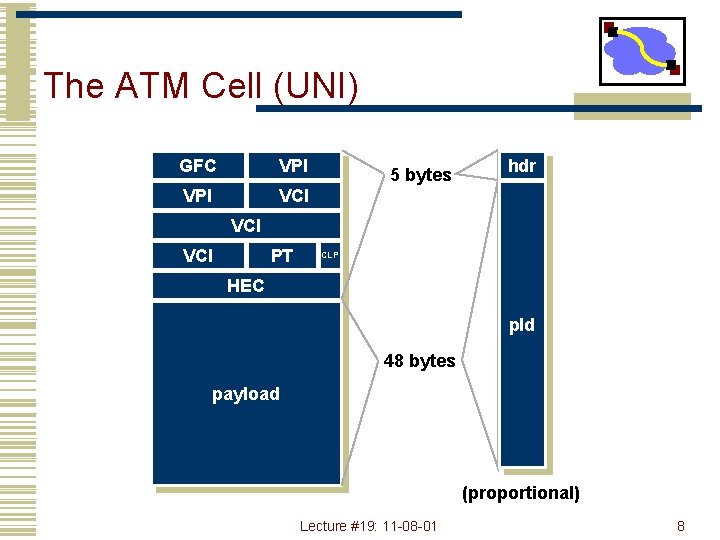
The ATM Cell (UNI) GFC VPI VCI 5 bytes hdr VCI PT CLP HEC pld 48 bytes payload (proportional) Lecture #19: 11 -08 -01 8
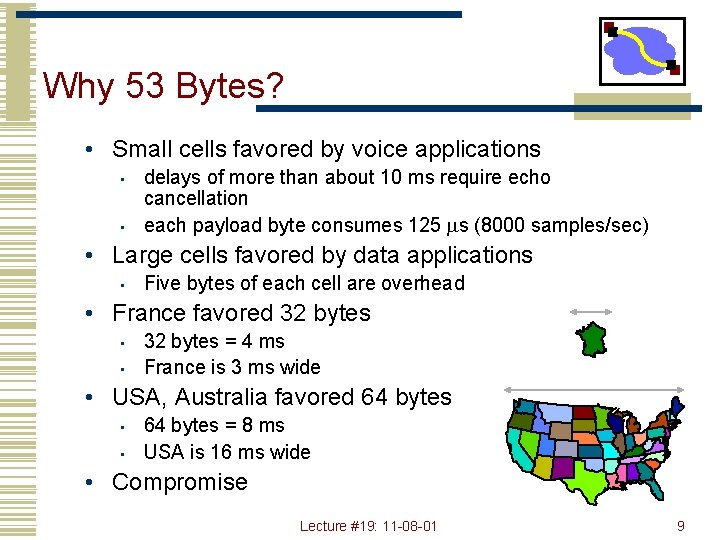
Why 53 Bytes? • Small cells favored by voice applications • • delays of more than about 10 ms require echo cancellation each payload byte consumes 125 s (8000 samples/sec) • Large cells favored by data applications • Five bytes of each cell are overhead • France favored 32 bytes • • 32 bytes = 4 ms France is 3 ms wide • USA, Australia favored 64 bytes • • 64 bytes = 8 ms USA is 16 ms wide • Compromise Lecture #19: 11 -08 -01 9
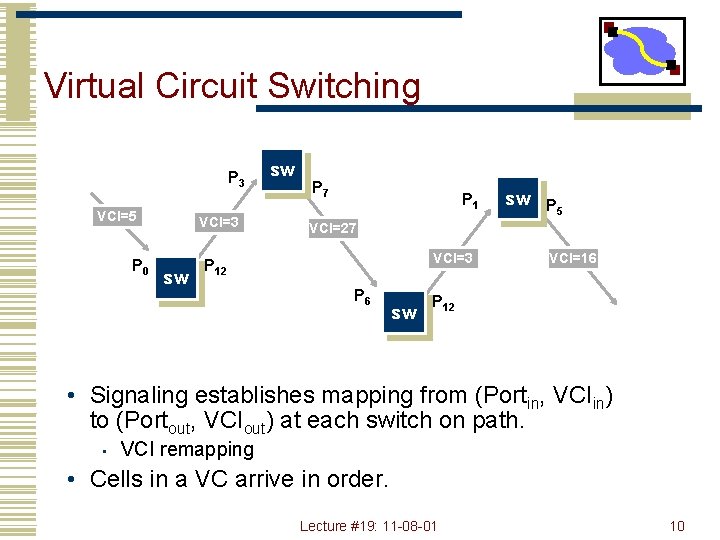
Virtual Circuit Switching P 3 VCI=5 P 0 VCI=3 sw sw P 7 P 1 sw P 5 VCI=27 VCI=3 P 12 P 6 sw VCI=16 P 12 • Signaling establishes mapping from (Portin, VCIin) to (Portout, VCIout) at each switch on path. • VCI remapping • Cells in a VC arrive in order. Lecture #19: 11 -08 -01 10
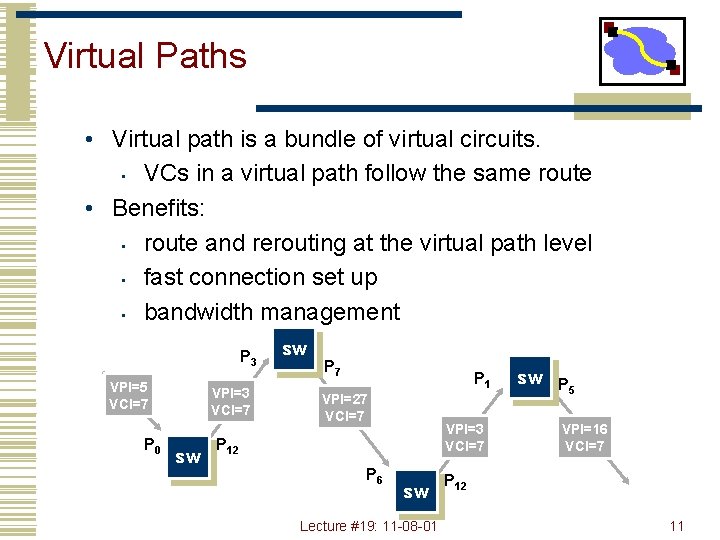
Virtual Paths • Virtual path is a bundle of virtual circuits. • VCs in a virtual path follow the same route • Benefits: • route and rerouting at the virtual path level • fast connection set up • bandwidth management P 3 VPI=5 VCI=7 P 0 VPI=3 VCI=7 sw sw P 7 P 1 VPI=27 VCI=7 VPI=3 VCI=7 P 12 P 6 sw Lecture #19: 11 -08 -01 sw P 5 VPI=16 VCI=7 P 12 11
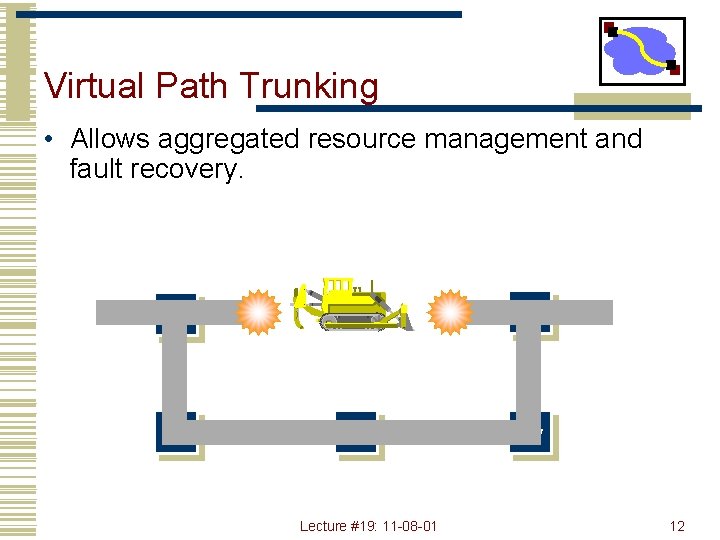
Virtual Path Trunking • Allows aggregated resource management and fault recovery. sw sw Lecture #19: 11 -08 -01 sw 12
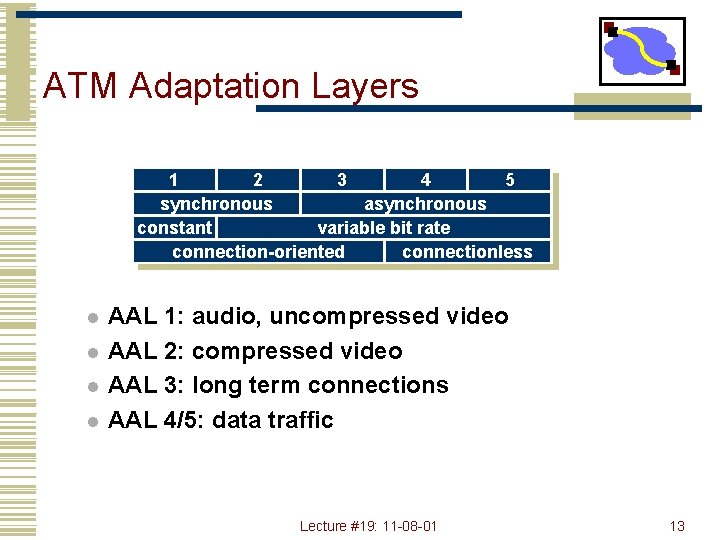
ATM Adaptation Layers 1 2 3 4 5 synchronous asynchronous constant variable bit rate connection-oriented connectionless l l AAL 1: audio, uncompressed video AAL 2: compressed video AAL 3: long term connections AAL 4/5: data traffic Lecture #19: 11 -08 -01 13
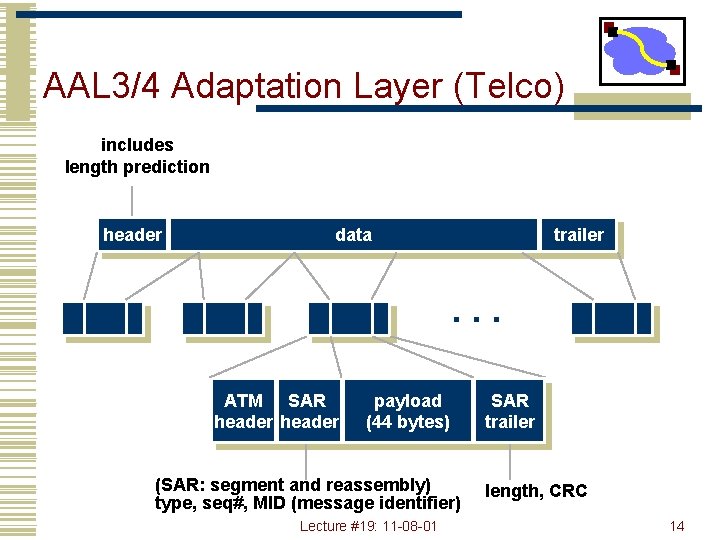
AAL 3/4 Adaptation Layer (Telco) includes length prediction header data trailer . . . ATM SAR header payload (44 bytes) (SAR: segment and reassembly) type, seq#, MID (message identifier) Lecture #19: 11 -08 -01 SAR trailer length, CRC 14
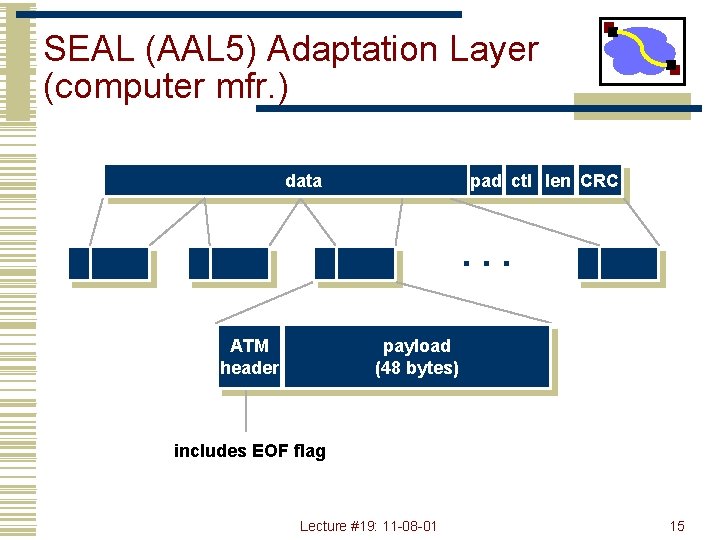
SEAL (AAL 5) Adaptation Layer (computer mfr. ) data pad ctl len CRC . . . ATM header payload (48 bytes) includes EOF flag Lecture #19: 11 -08 -01 15
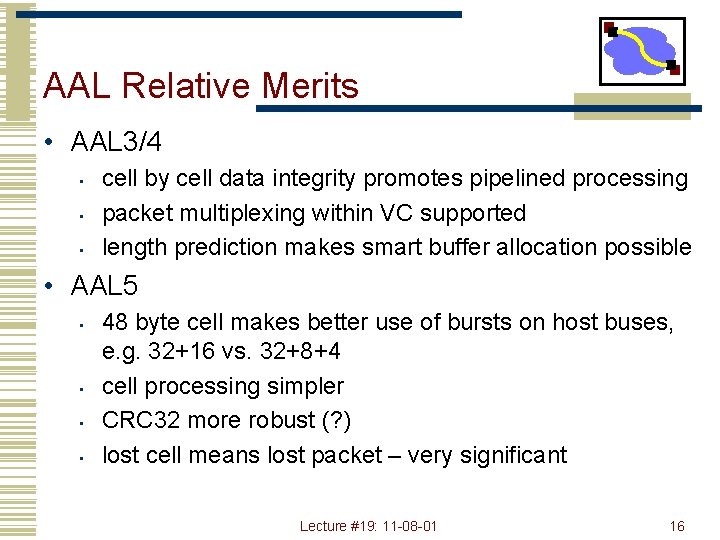
AAL Relative Merits • AAL 3/4 • • • cell by cell data integrity promotes pipelined processing packet multiplexing within VC supported length prediction makes smart buffer allocation possible • AAL 5 • • 48 byte cell makes better use of bursts on host buses, e. g. 32+16 vs. 32+8+4 cell processing simpler CRC 32 more robust (? ) lost cell means lost packet – very significant Lecture #19: 11 -08 -01 16
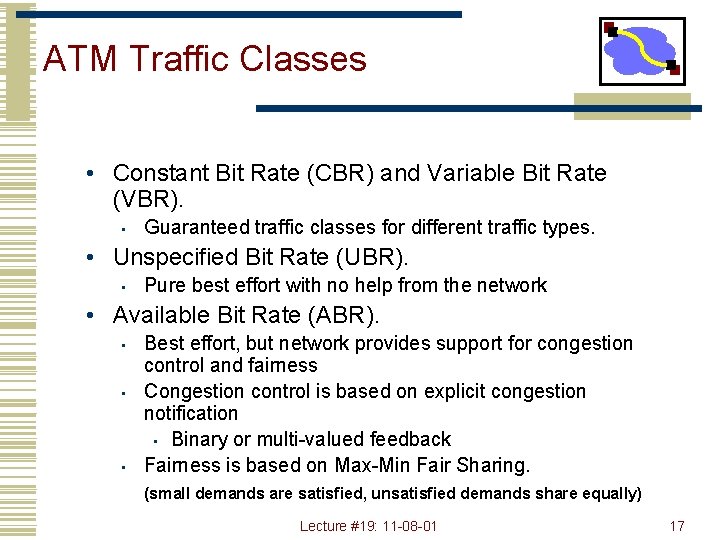
ATM Traffic Classes • Constant Bit Rate (CBR) and Variable Bit Rate (VBR). • Guaranteed traffic classes for different traffic types. • Unspecified Bit Rate (UBR). • Pure best effort with no help from the network • Available Bit Rate (ABR). • • • Best effort, but network provides support for congestion control and fairness Congestion control is based on explicit congestion notification • Binary or multi-valued feedback Fairness is based on Max-Min Fair Sharing. (small demands are satisfied, unsatisfied demands share equally) Lecture #19: 11 -08 -01 17
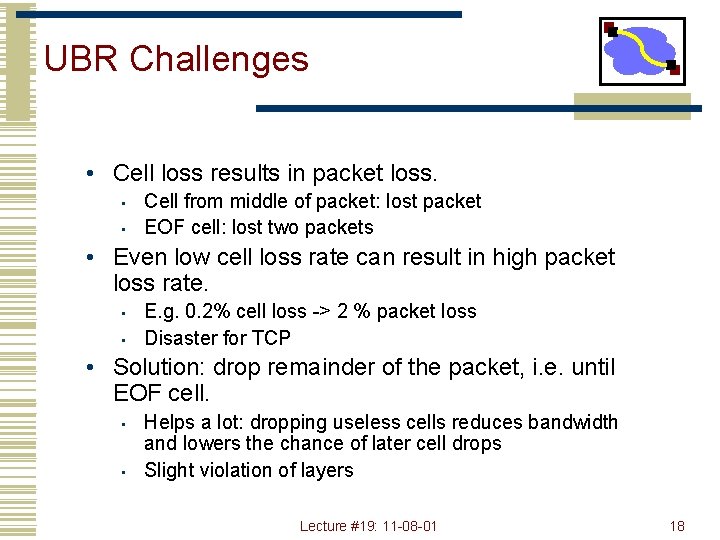
UBR Challenges • Cell loss results in packet loss. • • Cell from middle of packet: lost packet EOF cell: lost two packets • Even low cell loss rate can result in high packet loss rate. • • E. g. 0. 2% cell loss -> 2 % packet loss Disaster for TCP • Solution: drop remainder of the packet, i. e. until EOF cell. • • Helps a lot: dropping useless cells reduces bandwidth and lowers the chance of later cell drops Slight violation of layers Lecture #19: 11 -08 -01 18
ABR: Max-Min Fair Sharing • Flows are divided in two groups. • • Flows that are bottlenecked elsewhere Flows that are bottlenecked here • The max-min fair share rate Rfair of a network link is defined such that • • Flows bottlenecked at the link have rate r = Rfair Flows bottlenecked elsewhere have rate r, where • r < Rfair • r is the max-main fair share rate of the bottleneck link • Two implementations: • • Multi-valued feedback: switch returns rate Single bit feedback: use congestion bit in the header Lecture #19: 11 -08 -01 19
Max-Min Fair Sharing Example Lecture #19: 11 -08 -01 20
Connections and Signaling • Permanent vs. switched virtual connections • • static vs. dynamic services often start with PVCs (Permanent Virtual Circuits) • Call = bundle of connections, e. g. voice + video + data • Topology • • • point to multipoint to multipoint • Signaling VCs • • dedicated metasignaled, i. e. dynamically allocated Lecture #19: 11 -08 -01 21
Connection Setup calling party network called party SETUP CONNECT ACK Lecture #19: 11 -08 -01 22
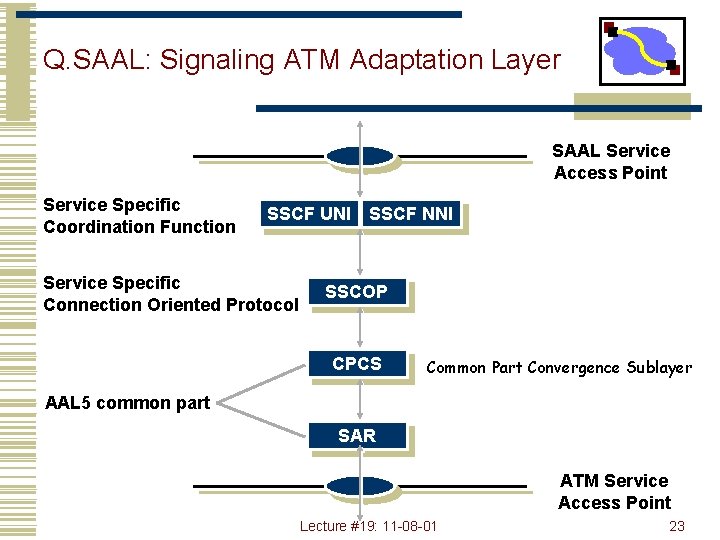
Q. SAAL: Signaling ATM Adaptation Layer SAAL Service Access Point Service Specific Coordination Function SSCF UNI Service Specific Connection Oriented Protocol SSCF NNI SSCOP CPCS Common Part Convergence Sublayer AAL 5 common part SAR ATM Service Access Point Lecture #19: 11 -08 -01 23
IP over ATM and SONET • Many options! • IP over ATM, with signaling support. • IP over ATM, using statically configured ATM pipes. • IP over SONET (Packets over SONET). • Differences in efficiency and flexibility in bandwidth management. Lecture #19: 11 -08 -01 24
IP over ATM • When sending IP packets over an ATM network, set up a VC to destination. • • ATM network can be end to end, or just a partial path ATM is just another link layer • Virtual connections can be cached. • • After a packet has been sent, the VC is maintained so that later packets can be forwarded immediately VCs eventually times out • Properties. – – + + Overhead of setting up VCs (delay for first packet) Complexity of managing a pool of VCs Flexible bandwidth management Can use ATM Qo. S support for individual connections (with appropriate signaling support) Lecture #19: 11 -08 -01 25
LAN Emulation • Motivation: • • support many protocols reuse software interfaces • Chosen: IEEE 802. x, (specifically Ethernet, token ring) • Issues • • • MAC - ATM mapping multicast and broadcast VC lifetime bridging ARP Lecture #19: 11 -08 -01 26
ATM ARP • ARP server with well-known address (or PVC) one per logical subnet. • • • Hosts communicate with ARP server directly instead of using broadcasting IP hosts register. Requests for IP-ATM bindings are sent to server. IP-ATM bindings are time out. “Classical IP” Lecture #19: 11 -08 -01 27
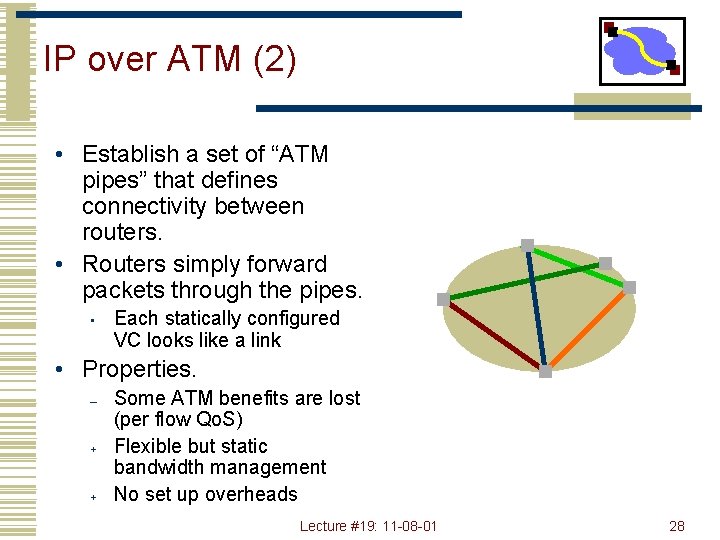
IP over ATM (2) • Establish a set of “ATM pipes” that defines connectivity between routers. • Routers simply forward packets through the pipes. • Each statically configured VC looks like a link • Properties. – + + Some ATM benefits are lost (per flow Qo. S) Flexible but static bandwidth management No set up overheads Lecture #19: 11 -08 -01 28
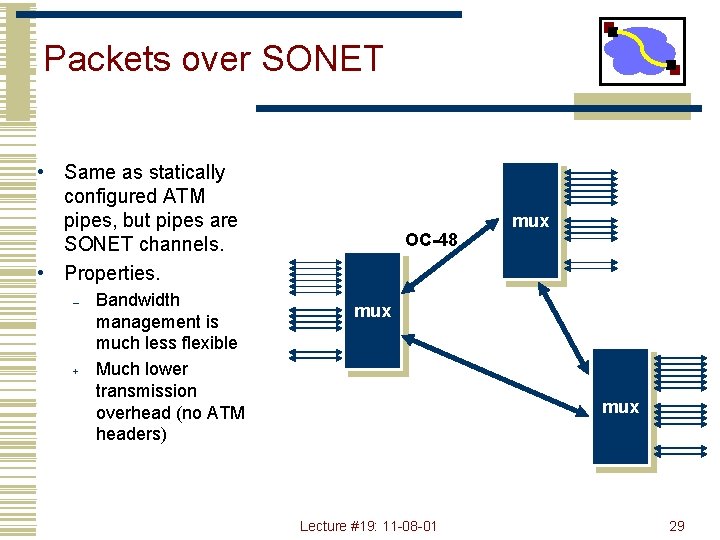
Packets over SONET • Same as statically configured ATM pipes, but pipes are SONET channels. • Properties. – + Bandwidth management is much less flexible Much lower transmission overhead (no ATM headers) OC-48 mux mux Lecture #19: 11 -08 -01 29
ATM Discussion • At one point, ATM was viewed as a replacement for IP. • Could carry both traditional telephone traffic (CBR circuits) and other traffic (data, VBR) • Better than IP, since it supports Qo. S • Complex technology. • Switching core is fairly simple, but • Support for different traffic classes • Signaling software is very complex • Technology did not match people’s experience with IP • deploying ATM in LAN is complex (e. g. broadcast) • supporting connection-less service model on connection-based technology • With IP over ATM, a lot of functionality is replicated • Currently used as a datalink layer supporting IP. Lecture #19: 11 -08 -01 30
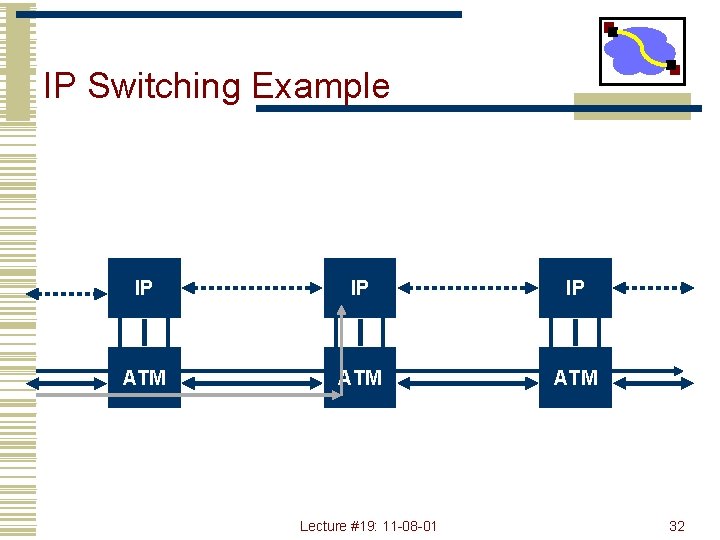
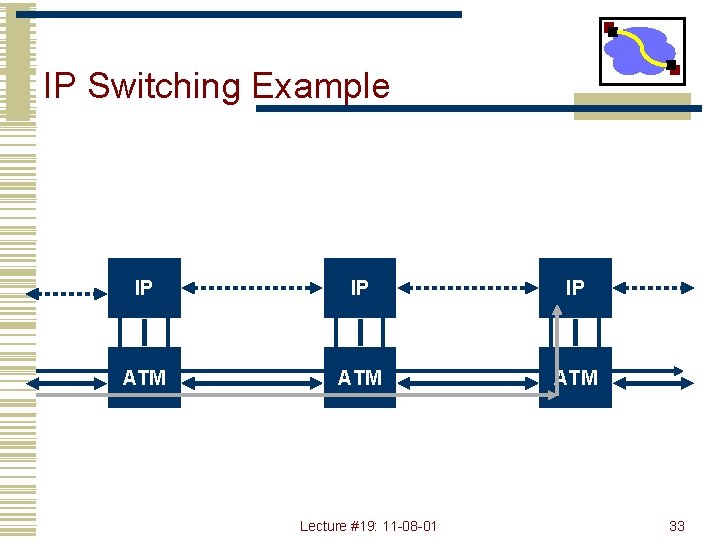
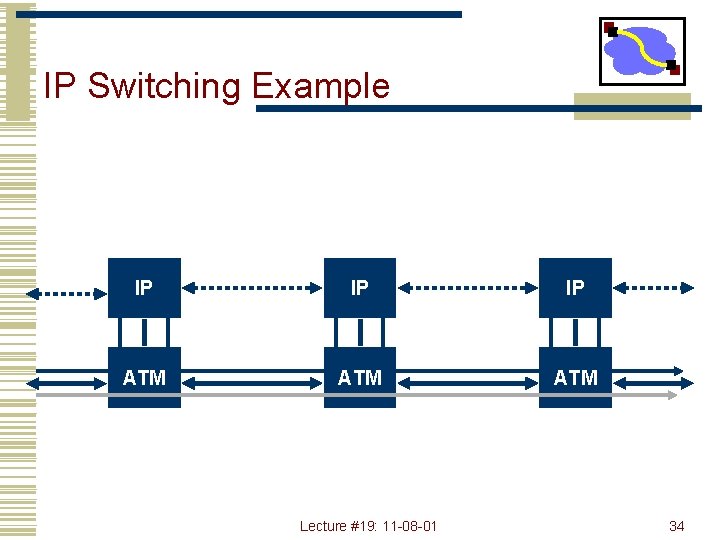
IP Switching • How to use ATM hardware without the software. • ATM switches are very fast data switches • software adds overhead, cost • The idea is to identify flows at the IP level and to create specific VCs to support these flows. • flows are identified on the fly by monitoring traffic • flow classification can use addresses, protocol types, . . . • can distinguish based on destination, protocol, Qo. S • Once established, data belonging to the flow bypasses level 3 routing. • never leaves the ATM switches • Interoperates fine with “regular” IP routers. • detects and collaborates with neighboring IP switches Lecture #19: 11 -08 -01 31
IP Switching Example IP IP IP ATM ATM Lecture #19: 11 -08 -01 32
IP Switching Example IP IP IP ATM ATM Lecture #19: 11 -08 -01 33
IP Switching Example IP IP IP ATM ATM Lecture #19: 11 -08 -01 34
IP Switching Discussion • IP switching selectively optimizes the forwarding of specific flows. • Offloads work from the IP router, so for a given size router, a less powerful forwarding engine can be used • Each data unit carries two addresses: IP and fast path • Can fall back on traditional IP forwarding if there are failures • IP switching couples a router with an ATM switching using the GSMP protocol. • General Switch Management Protocol • IP switching can be used for flows with different granularity. • Flows belonging to an application. . Organization • Controlled by the classifier • Introduces a notion of flows/connections in IP. Lecture #19: 11 -08 -01 35
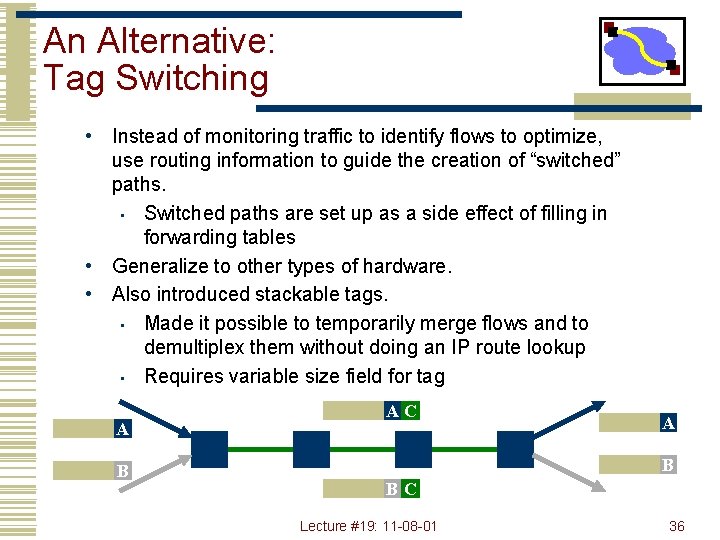
An Alternative: Tag Switching • Instead of monitoring traffic to identify flows to optimize, use routing information to guide the creation of “switched” paths. • Switched paths are set up as a side effect of filling in forwarding tables • Generalize to other types of hardware. • Also introduced stackable tags. • Made it possible to temporarily merge flows and to demultiplex them without doing an IP route lookup • Requires variable size field for tag A B AC A B BC Lecture #19: 11 -08 -01 36
IP Switching versus Tag Switching • Flows versus routes. • • • tags explicitly cover groups of routes tag bindings set up as part of route establishment flows in IP switching are driven by traffic and detected by “filters” • Supports both fine grain application flows and coarser grain flow groups • Stackable tags. • provides more flexibility • Generality • • IP switching focuses on ATM not clear that this is a fundamental difference Lecture #19: 11 -08 -01 37
Multi-Protocol Label Switching MPLS • Map packet onto Forward Equivalence Class (FEC) based on its header. • Simple case: longest prefix match of destination address • More complex if Qo. S of policy routing is used • In MPLS, a label is associated with the packet when it enters the network and forwarding is based on the label in the network core. • Label is swapped (as ATM VCIs) • Potential advantages. • Packet forwarding can be faster • Routing can be based on ingress router and port • Can use more complex routing decisions • Can force packets to followed a pinned route Lecture #19: 11 -08 -01 38
MPLS Mechanisms • Implementation of the label is technology specific. • Could be ATM VCI or an extra header • Label Distribution Protocols distributes information on label/FEC bindings. • • Extensions of existing protocols (routing, RSVP) or stand-alone protocols Can be upstream or downstream • Supports stacked labels. Lecture #19: 11 -08 -01 39
- Slides: 39