
15 2 Homogeneous Aqueous Systems Chapter 15 Water
- Slides: 56
15. 2 Homogeneous Aqueous Systems > Chapter 15 Water and Aqueous Systems 15. 1 Water and Its Properties 15. 2 Homogeneous Aqueous Systems 15. 3 Heterogeneous Aqueous Systems 1 Copyright © Pearson Education, Inc. , or its affiliates. All Rights Reserved.
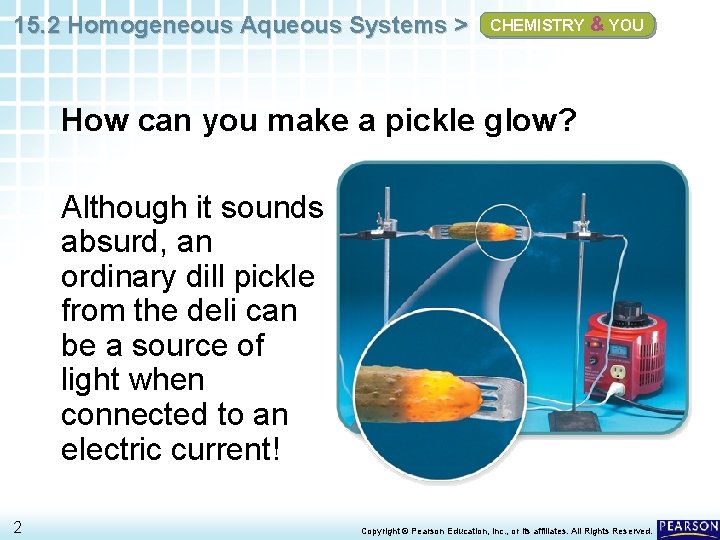
15. 2 Homogeneous Aqueous Systems > CHEMISTRY & YOU How can you make a pickle glow? Although it sounds absurd, an ordinary dill pickle from the deli can be a source of light when connected to an electric current! 2 Copyright © Pearson Education, Inc. , or its affiliates. All Rights Reserved.
15. 2 Homogeneous Aqueous Systems > Solutions What types of substances dissolve most readily in water? 3 Copyright © Pearson Education, Inc. , or its affiliates. All Rights Reserved.
15. 2 Homogeneous Aqueous Systems > Solutions What types of substances dissolve most readily in water? • An aqueous solution is water that contains dissolved substances. 4 Copyright © Pearson Education, Inc. , or its affiliates. All Rights Reserved.
15. 2 Homogeneous Aqueous Systems > Solutions Solvents and Solutes • In a solution, the dissolving medium is the solvent. • The dissolved particles in a solution are the solute. 5 Copyright © Pearson Education, Inc. , or its affiliates. All Rights Reserved.
15. 2 Homogeneous Aqueous Systems > Solutions Solvents and Solutes • A solvent dissolves the solute. • The solute becomes dispersed in the solvent. • Solvents and solutes may be gases, liquids, or solids. 6 Copyright © Pearson Education, Inc. , or its affiliates. All Rights Reserved.
15. 2 Homogeneous Aqueous Systems > Solutions Solvents and Solutes • Solutions are homogeneous mixtures. • Solute particles can be atoms, ions, or molecules. • If you filter a solution through filter paper, both the solute and solvent pass through the filter. 7 Copyright © Pearson Education, Inc. , or its affiliates. All Rights Reserved.
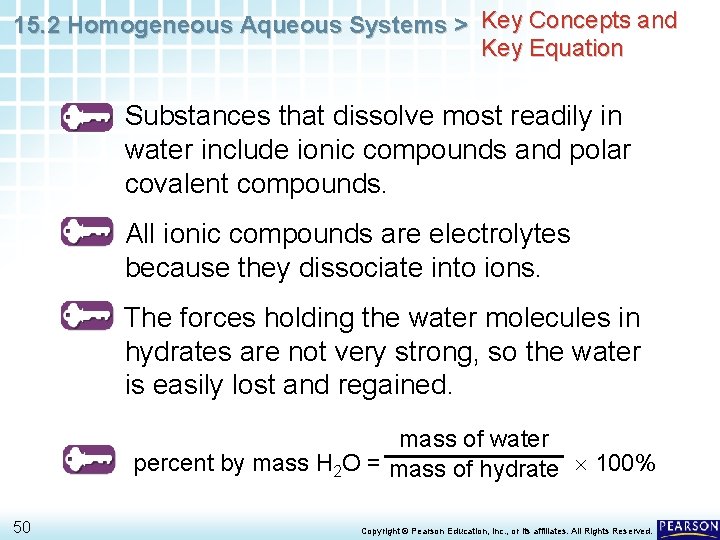
15. 2 Homogeneous Aqueous Systems > Solutions Solvents and Solutes Substances that dissolve most readily in water include ionic compounds and polar covalent compounds. 8 Copyright © Pearson Education, Inc. , or its affiliates. All Rights Reserved.
15. 2 Homogeneous Aqueous Systems > Solutions Solvents and Solutes Substances that dissolve most readily in water include ionic compounds and polar covalent compounds. • Nonpolar covalent compounds, such as methane, and compounds found in oil, grease, and gasoline, do not dissolve in water. • However, oil and grease will dissolve in gasoline. 9 Copyright © Pearson Education, Inc. , or its affiliates. All Rights Reserved.
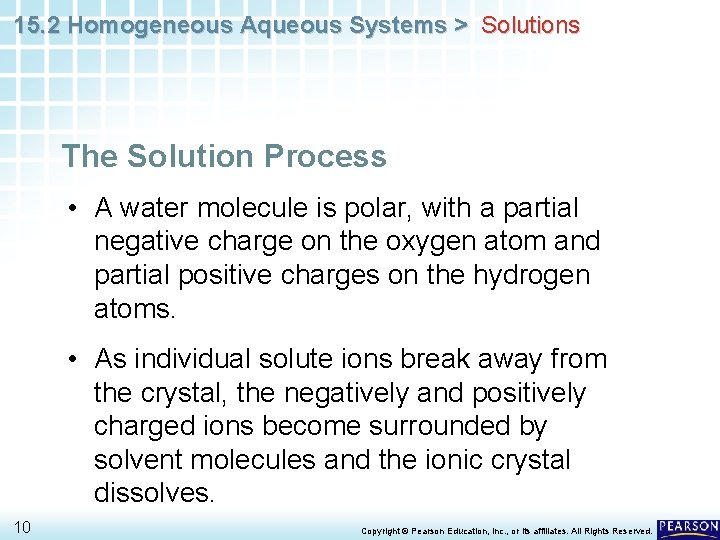
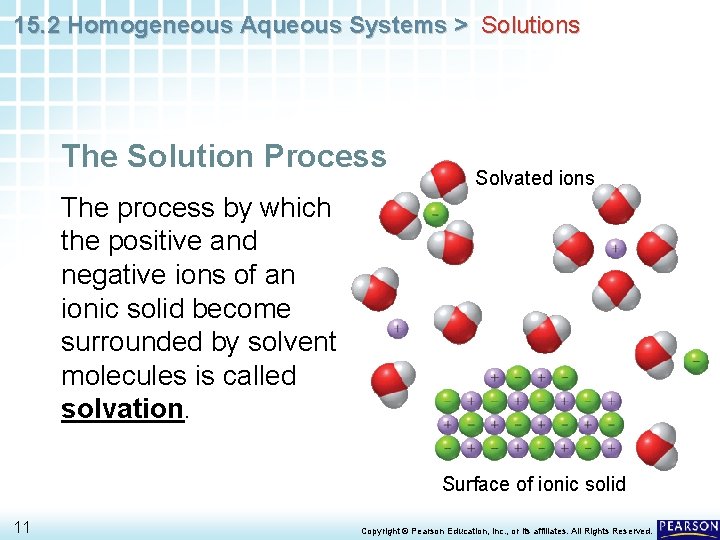
15. 2 Homogeneous Aqueous Systems > Solutions The Solution Process • A water molecule is polar, with a partial negative charge on the oxygen atom and partial positive charges on the hydrogen atoms. • As individual solute ions break away from the crystal, the negatively and positively charged ions become surrounded by solvent molecules and the ionic crystal dissolves. 10 Copyright © Pearson Education, Inc. , or its affiliates. All Rights Reserved.
15. 2 Homogeneous Aqueous Systems > Solutions The Solution Process Solvated ions The process by which the positive and negative ions of an ionic solid become surrounded by solvent molecules is called solvation. Surface of ionic solid 11 Copyright © Pearson Education, Inc. , or its affiliates. All Rights Reserved.
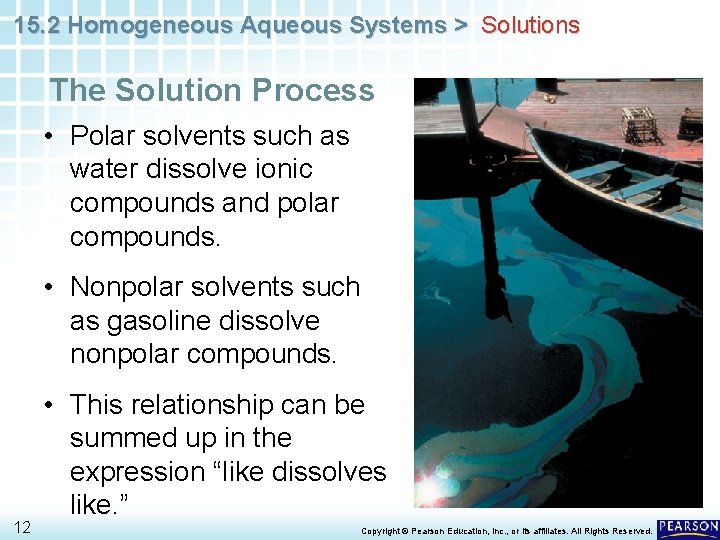
15. 2 Homogeneous Aqueous Systems > Solutions The Solution Process • Polar solvents such as water dissolve ionic compounds and polar compounds. • Nonpolar solvents such as gasoline dissolve nonpolar compounds. 12 • This relationship can be summed up in the expression “like dissolves like. ” Copyright © Pearson Education, Inc. , or its affiliates. All Rights Reserved.
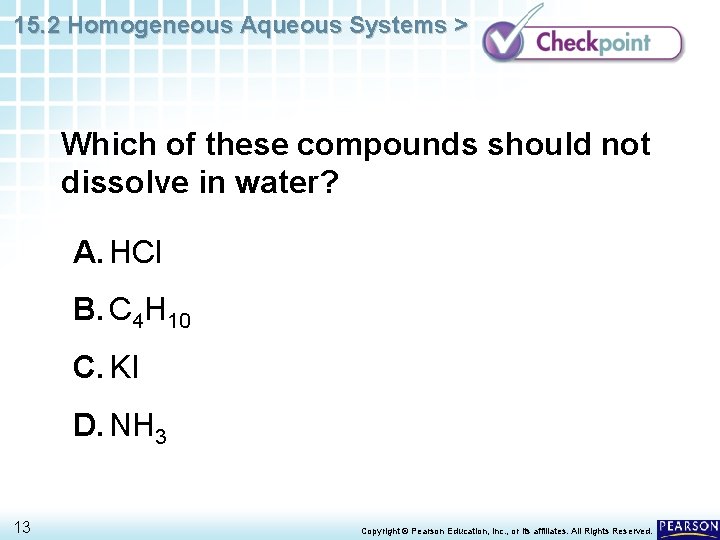
15. 2 Homogeneous Aqueous Systems > Which of these compounds should not dissolve in water? A. HCl B. C 4 H 10 C. KI D. NH 3 13 Copyright © Pearson Education, Inc. , or its affiliates. All Rights Reserved.
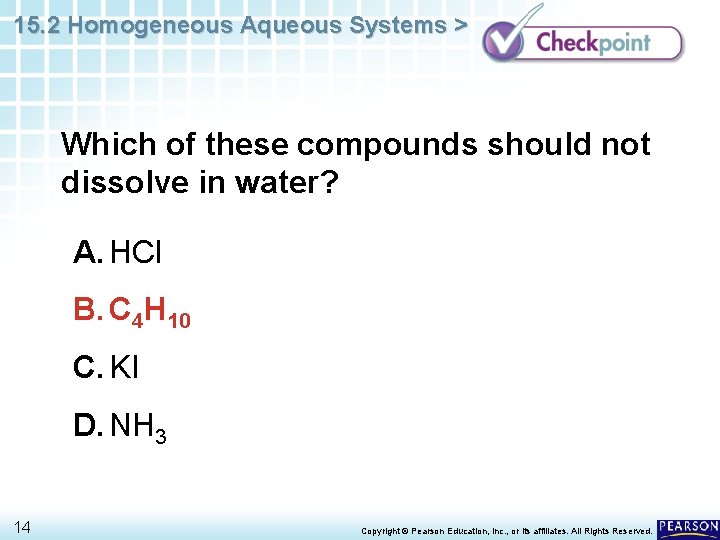
15. 2 Homogeneous Aqueous Systems > Which of these compounds should not dissolve in water? A. HCl B. C 4 H 10 C. KI D. NH 3 14 Copyright © Pearson Education, Inc. , or its affiliates. All Rights Reserved.
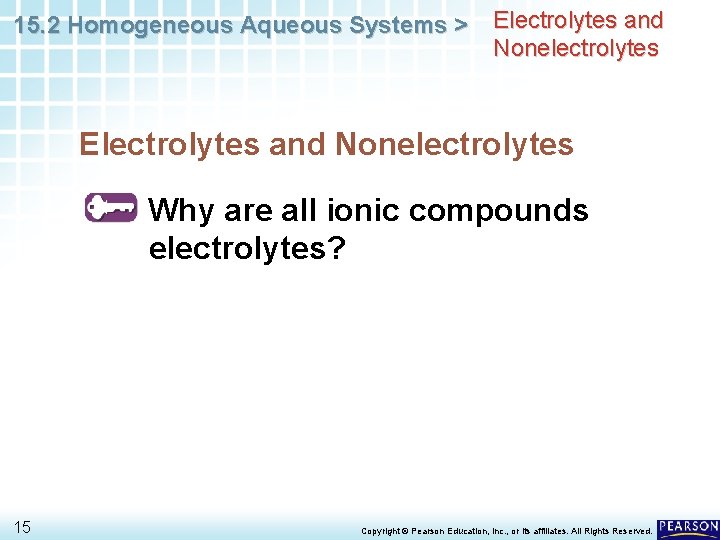
15. 2 Homogeneous Aqueous Systems > Electrolytes and Nonelectrolytes Why are all ionic compounds electrolytes? 15 Copyright © Pearson Education, Inc. , or its affiliates. All Rights Reserved.
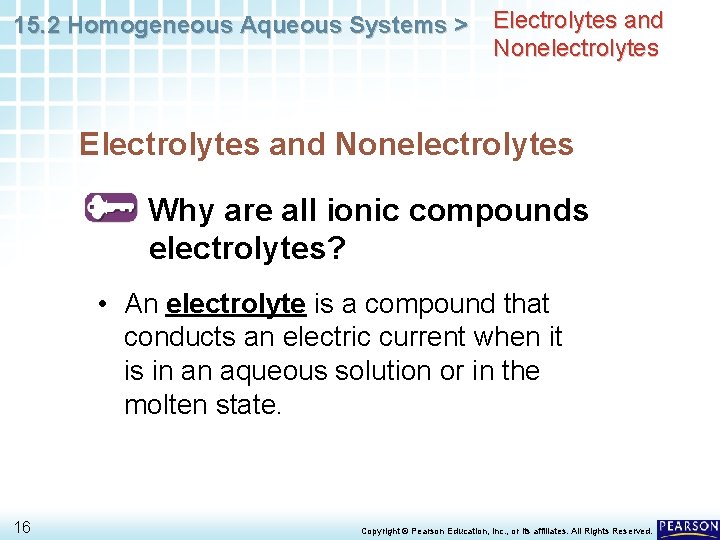
15. 2 Homogeneous Aqueous Systems > Electrolytes and Nonelectrolytes Why are all ionic compounds electrolytes? • An electrolyte is a compound that conducts an electric current when it is in an aqueous solution or in the molten state. 16 Copyright © Pearson Education, Inc. , or its affiliates. All Rights Reserved.
15. 2 Homogeneous Aqueous Systems > Electrolytes and Nonelectrolytes All ionic compounds are electrolytes because they dissociate into ions. 17 Copyright © Pearson Education, Inc. , or its affiliates. All Rights Reserved.
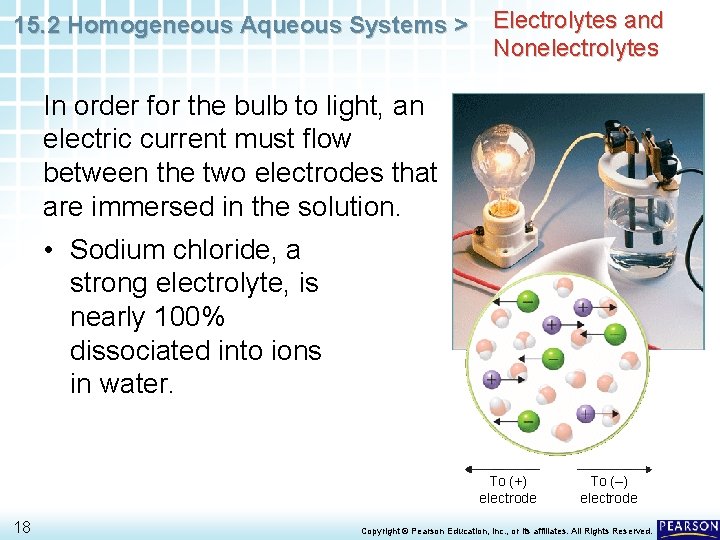
15. 2 Homogeneous Aqueous Systems > Electrolytes and Nonelectrolytes In order for the bulb to light, an electric current must flow between the two electrodes that are immersed in the solution. • Sodium chloride, a strong electrolyte, is nearly 100% dissociated into ions in water. To (+) electrode 18 To (–) electrode Copyright © Pearson Education, Inc. , or its affiliates. All Rights Reserved.
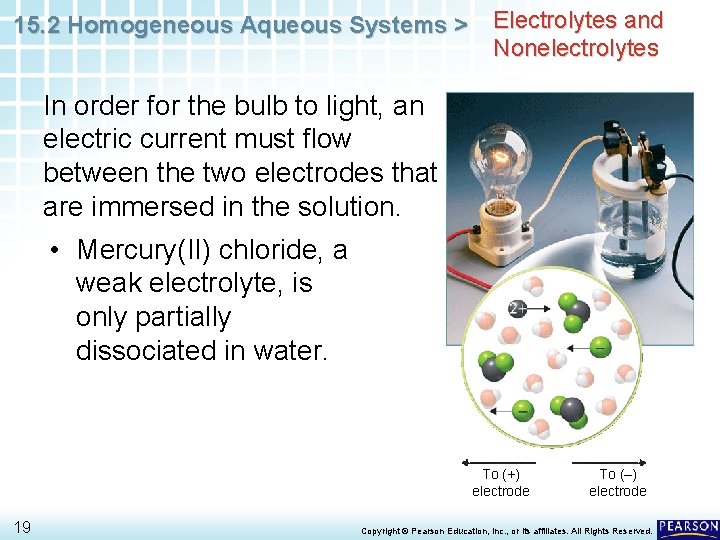
15. 2 Homogeneous Aqueous Systems > Electrolytes and Nonelectrolytes In order for the bulb to light, an electric current must flow between the two electrodes that are immersed in the solution. • Mercury(II) chloride, a weak electrolyte, is only partially dissociated in water. To (+) electrode 19 To (–) electrode Copyright © Pearson Education, Inc. , or its affiliates. All Rights Reserved.
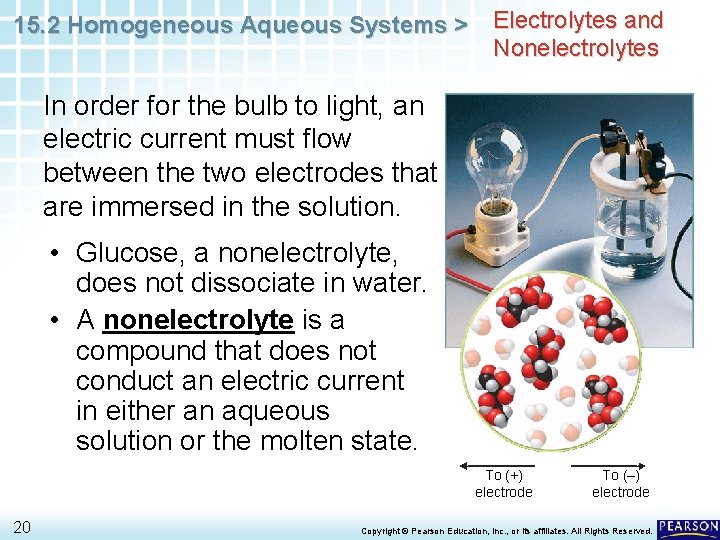
15. 2 Homogeneous Aqueous Systems > Electrolytes and Nonelectrolytes In order for the bulb to light, an electric current must flow between the two electrodes that are immersed in the solution. • Glucose, a nonelectrolyte, does not dissociate in water. • A nonelectrolyte is a compound that does not conduct an electric current in either an aqueous solution or the molten state. To (+) electrode 20 To (–) electrode Copyright © Pearson Education, Inc. , or its affiliates. All Rights Reserved.
15. 2 Homogeneous Aqueous Systems > Electrolytes and Nonelectrolytes Some polar molecular compounds are nonelectrolytes in the pure state but become electrolytes when they dissolve in water. • This change occurs because such compounds ionize in solution. 21 Copyright © Pearson Education, Inc. , or its affiliates. All Rights Reserved.
15. 2 Homogeneous Aqueous Systems > Electrolytes and Nonelectrolytes Some polar molecular compounds are nonelectrolytes in the pure state but become electrolytes when they dissolve in water. • For example, ammonia (NH 3(g)) is not an electrolyte in the pure state. • Yet an aqueous solution of ammonia conducts an electric current because ammonium ions (NH 4+) and hydroxide ions (OH–) form when ammonia dissolves in water. NH 3(g) + H 2 O(l) NH 4+(aq) + OH–(aq) 22 Copyright © Pearson Education, Inc. , or its affiliates. All Rights Reserved.
15. 2 Homogeneous Aqueous Systems > Electrolytes and Nonelectrolytes Not all electrolytes conduct electric current to the same degree. • In a solution that contains a strong electrolyte, all or nearly all of the solute exists as ions. • A weak electrolyte conducts an electric current poorly because only a fraction of the solute in the solution exists as ions. 23 Copyright © Pearson Education, Inc. , or its affiliates. All Rights Reserved.
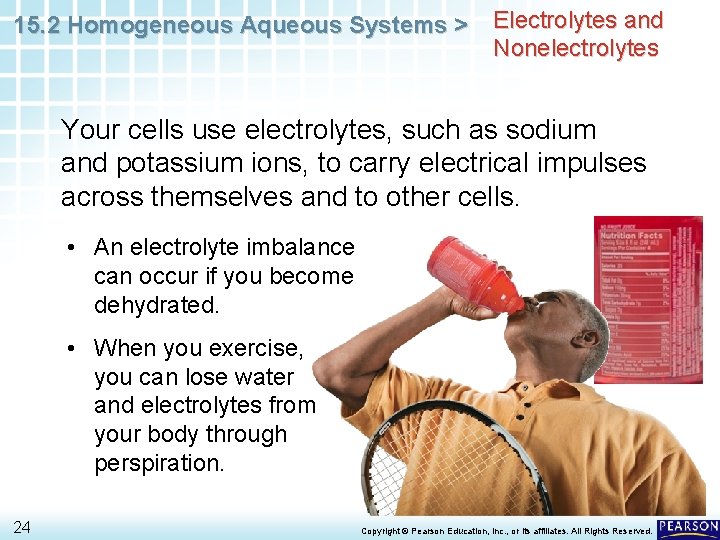
15. 2 Homogeneous Aqueous Systems > Electrolytes and Nonelectrolytes Your cells use electrolytes, such as sodium and potassium ions, to carry electrical impulses across themselves and to other cells. • An electrolyte imbalance can occur if you become dehydrated. • When you exercise, you can lose water and electrolytes from your body through perspiration. 24 Copyright © Pearson Education, Inc. , or its affiliates. All Rights Reserved.
15. 2 Homogeneous Aqueous Systems > CHEMISTRY & YOU Pickles contain table salt. Why can electric current flow through a pickle, causing it to glow? 25 Copyright © Pearson Education, Inc. , or its affiliates. All Rights Reserved.
15. 2 Homogeneous Aqueous Systems > CHEMISTRY & YOU Pickles contain table salt. Why can electric current flow through a pickle, causing it to glow? Electrolytes conduct an electric current when they are in an aqueous solution. Table salt, or Na. Cl, is a strong electrolyte. The water and salt in the pickle form a solution that conducts an electric current. The electric current causes the pickle to glow. 26 Copyright © Pearson Education, Inc. , or its affiliates. All Rights Reserved.
15. 2 Homogeneous Aqueous Systems > Explain why you must be extremely careful when using electricity near a swimming pool. 27 Copyright © Pearson Education, Inc. , or its affiliates. All Rights Reserved.
15. 2 Homogeneous Aqueous Systems > Explain why you must be extremely careful when using electricity near a swimming pool. The chlorinated water in a swimming pool is a solution that can conduct an electric current. If a current is introduced into the water, any swimmers could be shocked. 28 Copyright © Pearson Education, Inc. , or its affiliates. All Rights Reserved.
15. 2 Homogeneous Aqueous Systems > Hydrates Why do hydrates easily lose and regain water? 29 Copyright © Pearson Education, Inc. , or its affiliates. All Rights Reserved.
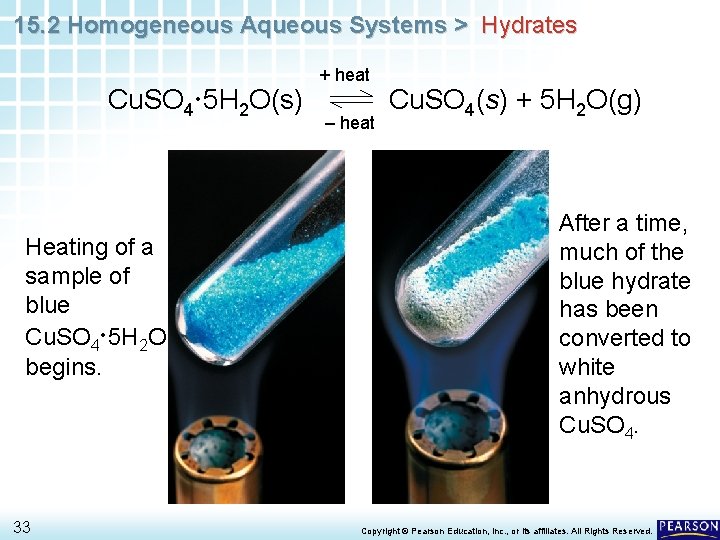
15. 2 Homogeneous Aqueous Systems > Hydrates The water contained in a crystal is called the water of hydration or water of crystallization. • A compound that contains water of hydration is called a hydrate. 30 Copyright © Pearson Education, Inc. , or its affiliates. All Rights Reserved.
15. 2 Homogeneous Aqueous Systems > Hydrates The forces holding the water molecules in hydrates are not very strong, so the water is easily lost and regained. 31 Copyright © Pearson Education, Inc. , or its affiliates. All Rights Reserved.
15. 2 Homogeneous Aqueous Systems > Hydrates The forces holding the water molecules in hydrates are not very strong, so the water is easily lost and regained. • A substance that is anhydrous does not contain water. 32 Copyright © Pearson Education, Inc. , or its affiliates. All Rights Reserved.
15. 2 Homogeneous Aqueous Systems > Hydrates Cu. SO 4 5 H 2 O(s) Heating of a sample of blue Cu. SO 4 5 H 2 O begins. 33 + heat – heat Cu. SO 4(s) + 5 H 2 O(g) After a time, much of the blue hydrate has been converted to white anhydrous Cu. SO 4. Copyright © Pearson Education, Inc. , or its affiliates. All Rights Reserved.
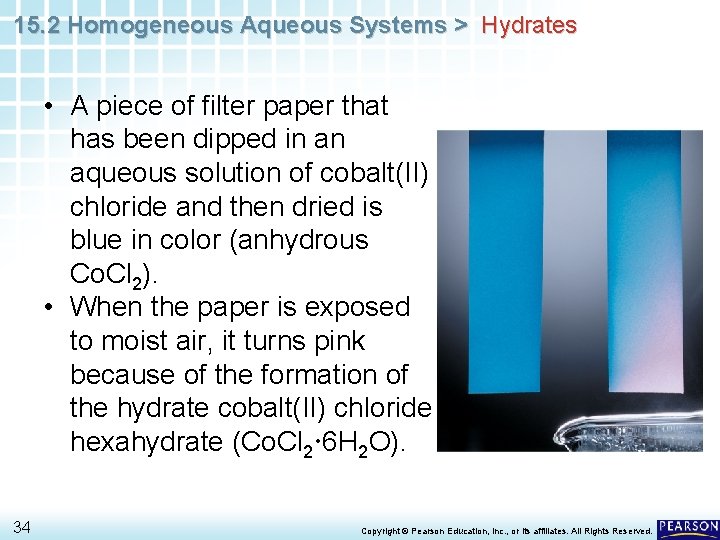
15. 2 Homogeneous Aqueous Systems > Hydrates • A piece of filter paper that has been dipped in an aqueous solution of cobalt(II) chloride and then dried is blue in color (anhydrous Co. Cl 2). • When the paper is exposed to moist air, it turns pink because of the formation of the hydrate cobalt(II) chloride hexahydrate (Co. Cl 2 6 H 2 O). 34 Copyright © Pearson Education, Inc. , or its affiliates. All Rights Reserved.
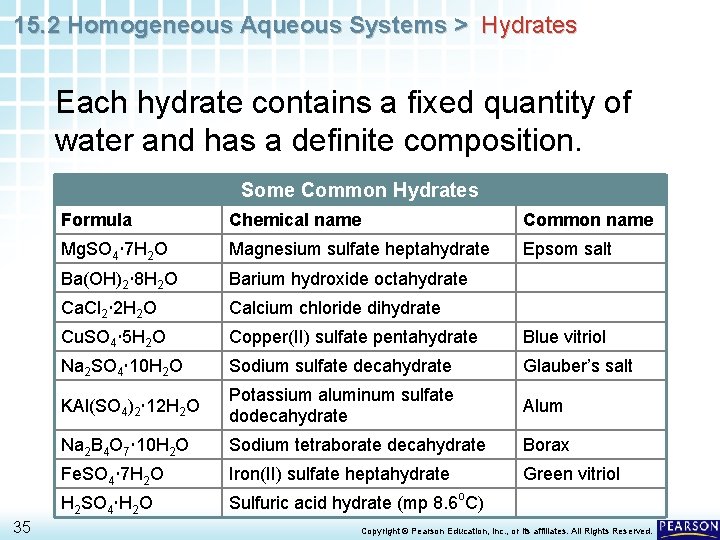
15. 2 Homogeneous Aqueous Systems > Hydrates Each hydrate contains a fixed quantity of water and has a definite composition. Some Common Hydrates 35 Formula Chemical name Common name Mg. SO 4 7 H 2 O Magnesium sulfate heptahydrate Epsom salt Ba(OH)2 8 H 2 O Barium hydroxide octahydrate Ca. Cl 2 2 H 2 O Calcium chloride dihydrate Cu. SO 4 5 H 2 O Copper(II) sulfate pentahydrate Blue vitriol Na 2 SO 4 10 H 2 O Sodium sulfate decahydrate Glauber’s salt KAl(SO 4)2 12 H 2 O Potassium aluminum sulfate dodecahydrate Alum Na 2 B 4 O 7 10 H 2 O Sodium tetraborate decahydrate Borax Fe. SO 4 7 H 2 O Iron(II) sulfate heptahydrate Green vitriol H 2 SO 4 H 2 O Sulfuric acid hydrate (mp 8. 6 C) o Copyright © Pearson Education, Inc. , or its affiliates. All Rights Reserved.
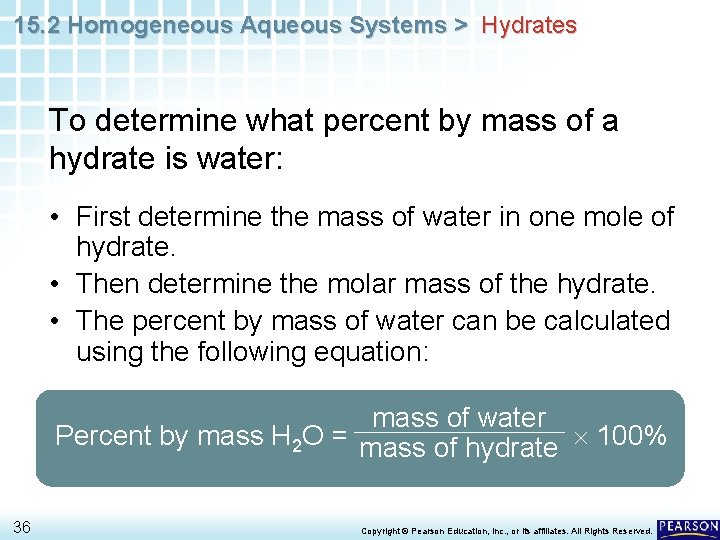
15. 2 Homogeneous Aqueous Systems > Hydrates To determine what percent by mass of a hydrate is water: • First determine the mass of water in one mole of hydrate. • Then determine the molar mass of the hydrate. • The percent by mass of water can be calculated using the following equation: mass of water Percent by mass H 2 O = mass of hydrate 100% 36 Copyright © Pearson Education, Inc. , or its affiliates. All Rights Reserved.
15. 2 Homogeneous Aqueous Systems > Hydrates Efflorescent Hydrates The water molecules in hydrates are held by weak forces, so hydrates often have an appreciable vapor pressure. • If a hydrate has a vapor pressure higher than the pressure of water vapor in the air, the hydrate will lose its water of hydration, or effloresce. 37 Copyright © Pearson Education, Inc. , or its affiliates. All Rights Reserved.
15. 2 Homogeneous Aqueous Systems > Hydrates Hygroscopic Hydrates Hydrated ionic compounds that have low vapor pressure remove water from moist air to form higher hydrates. • These hydrates and other compounds that remove moisture from air are called hygroscopic. 38 Copyright © Pearson Education, Inc. , or its affiliates. All Rights Reserved.
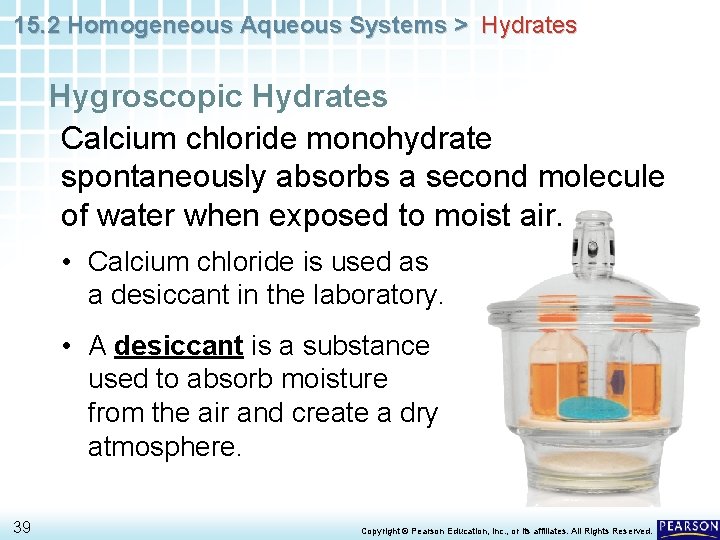
15. 2 Homogeneous Aqueous Systems > Hydrates Hygroscopic Hydrates Calcium chloride monohydrate spontaneously absorbs a second molecule of water when exposed to moist air. • Calcium chloride is used as a desiccant in the laboratory. • A desiccant is a substance used to absorb moisture from the air and create a dry atmosphere. 39 Copyright © Pearson Education, Inc. , or its affiliates. All Rights Reserved.
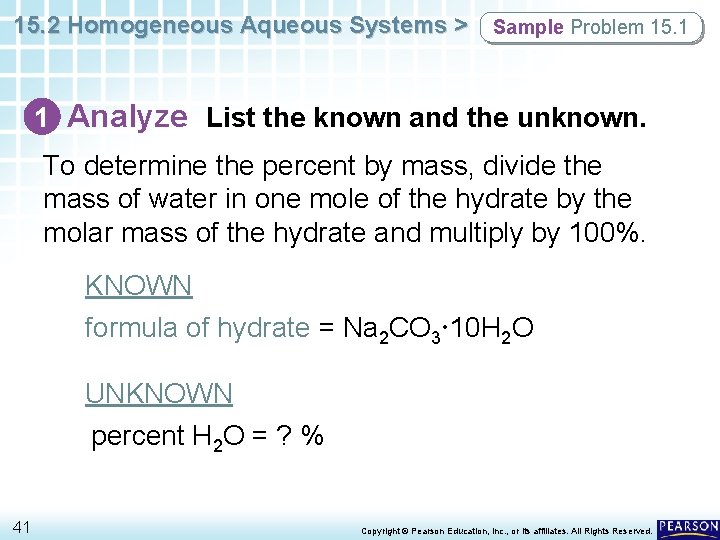
15. 2 Homogeneous Aqueous Systems > Sample Problem 15. 1 Finding the Percent by Mass of Water in a Hydrate Calculate the percent by mass of water in washing soda, sodium carbonate decahydrate (Na 2 CO 3 10 H 2 O). 40 Copyright © Pearson Education, Inc. , or its affiliates. All Rights Reserved.
15. 2 Homogeneous Aqueous Systems > Sample Problem 15. 1 1 Analyze List the known and the unknown. To determine the percent by mass, divide the mass of water in one mole of the hydrate by the molar mass of the hydrate and multiply by 100%. KNOWN formula of hydrate = Na 2 CO 3 10 H 2 O UNKNOWN percent H 2 O = ? % 41 Copyright © Pearson Education, Inc. , or its affiliates. All Rights Reserved.
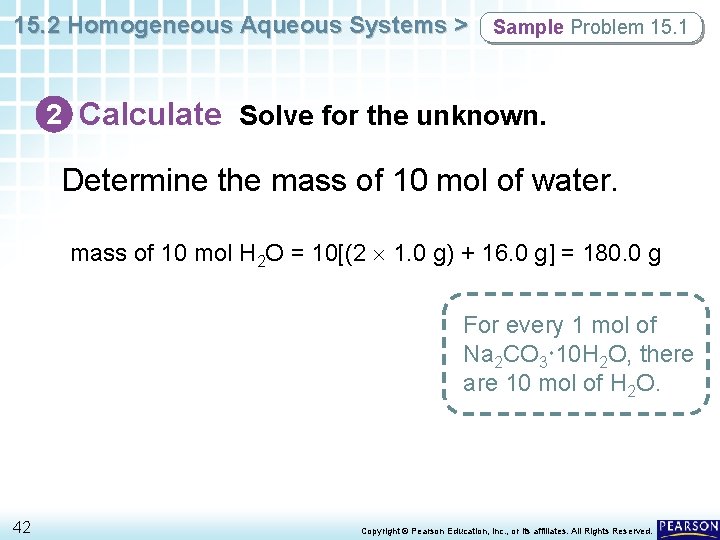
15. 2 Homogeneous Aqueous Systems > Sample Problem 15. 1 2 Calculate Solve for the unknown. Determine the mass of 10 mol of water. mass of 10 mol H 2 O = 10[(2 1. 0 g) + 16. 0 g] = 180. 0 g For every 1 mol of Na 2 CO 3 10 H 2 O, there are 10 mol of H 2 O. 42 Copyright © Pearson Education, Inc. , or its affiliates. All Rights Reserved.
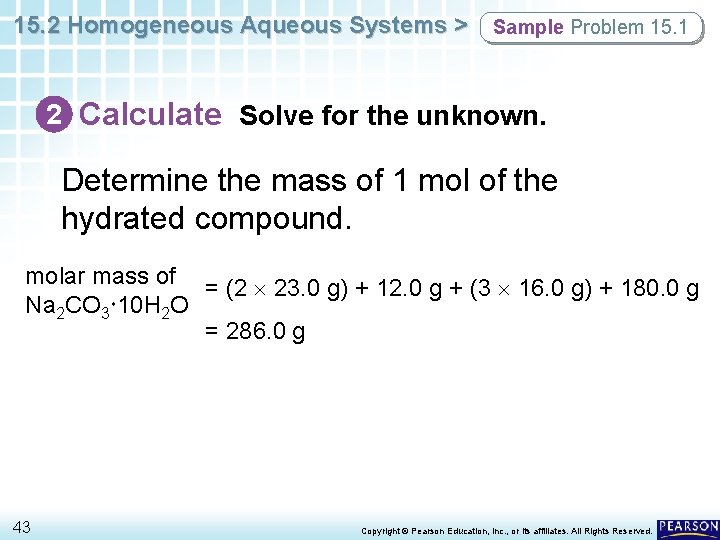
15. 2 Homogeneous Aqueous Systems > Sample Problem 15. 1 2 Calculate Solve for the unknown. Determine the mass of 1 mol of the hydrated compound. molar mass of = (2 23. 0 g) + 12. 0 g + (3 16. 0 g) + 180. 0 g Na 2 CO 3 10 H 2 O = 286. 0 g 43 Copyright © Pearson Education, Inc. , or its affiliates. All Rights Reserved.
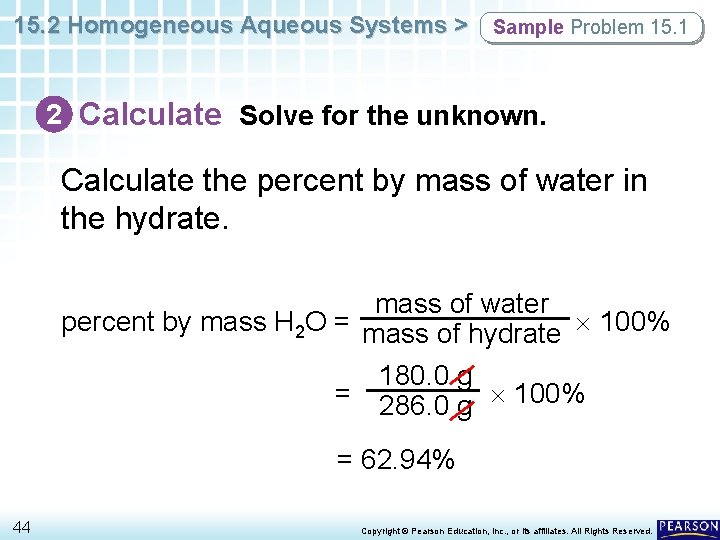
15. 2 Homogeneous Aqueous Systems > Sample Problem 15. 1 2 Calculate Solve for the unknown. Calculate the percent by mass of water in the hydrate. mass of water percent by mass H 2 O = mass of hydrate 100% 180. 0 g = 286. 0 g 100% = 62. 94% 44 Copyright © Pearson Education, Inc. , or its affiliates. All Rights Reserved.
15. 2 Homogeneous Aqueous Systems > Sample Problem 15. 1 3 Evaluate Does the result make sense? • The mass of the water accounts for more than half the molar mass of the compound. • So, a percentage greater than 50% is expected. 45 Copyright © Pearson Education, Inc. , or its affiliates. All Rights Reserved.
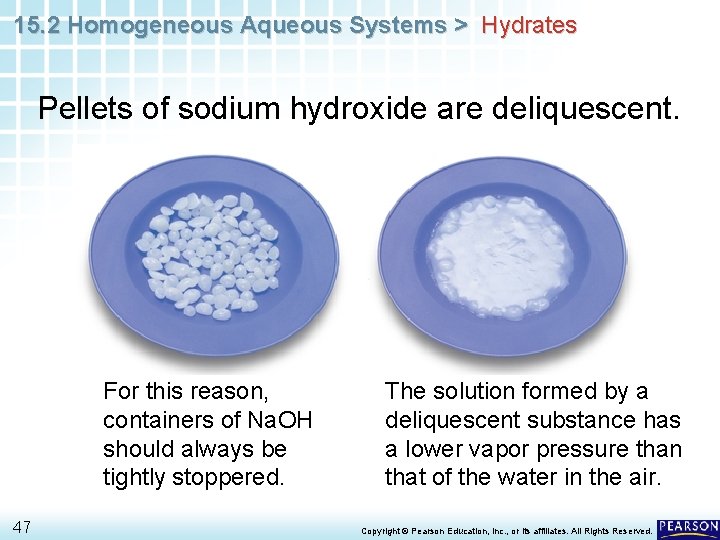
15. 2 Homogeneous Aqueous Systems > Hydrates Deliquescent Compounds Some compounds are so hygroscopic that they become wet when exposed to normally moist air. • These compounds are deliquescent, which means that they remove sufficient water from the air to dissolve completely and form solutions. 46 Copyright © Pearson Education, Inc. , or its affiliates. All Rights Reserved.
15. 2 Homogeneous Aqueous Systems > Hydrates Pellets of sodium hydroxide are deliquescent. For this reason, containers of Na. OH should always be tightly stoppered. 47 The solution formed by a deliquescent substance has a lower vapor pressure than that of the water in the air. Copyright © Pearson Education, Inc. , or its affiliates. All Rights Reserved.
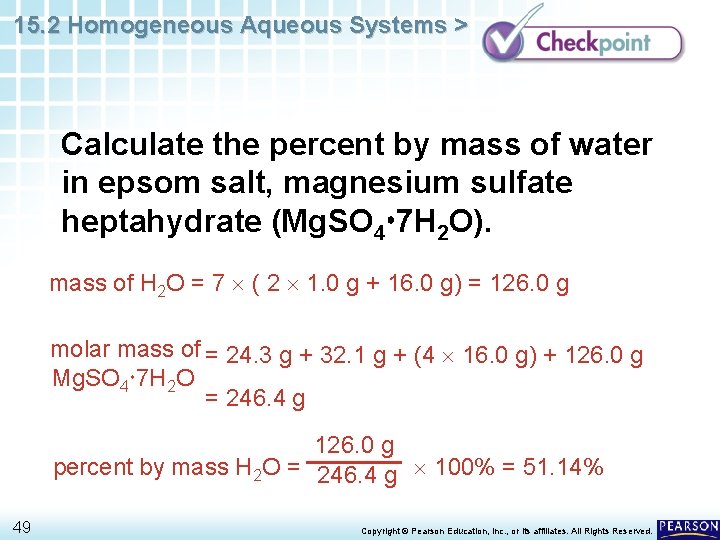
15. 2 Homogeneous Aqueous Systems > Calculate the percent by mass of water in epsom salt, magnesium sulfate heptahydrate (Mg. SO 4 7 H 2 O). 48 Copyright © Pearson Education, Inc. , or its affiliates. All Rights Reserved.
15. 2 Homogeneous Aqueous Systems > Calculate the percent by mass of water in epsom salt, magnesium sulfate heptahydrate (Mg. SO 4 7 H 2 O). mass of H 2 O = 7 ( 2 1. 0 g + 16. 0 g) = 126. 0 g molar mass of = 24. 3 g + 32. 1 g + (4 16. 0 g) + 126. 0 g Mg. SO 4 7 H 2 O = 246. 4 g 126. 0 g percent by mass H 2 O = 246. 4 g 100% = 51. 14% 49 Copyright © Pearson Education, Inc. , or its affiliates. All Rights Reserved.
15. 2 Homogeneous Aqueous Systems > Key Concepts and Key Equation Substances that dissolve most readily in water include ionic compounds and polar covalent compounds. All ionic compounds are electrolytes because they dissociate into ions. The forces holding the water molecules in hydrates are not very strong, so the water is easily lost and regained. mass of water percent by mass H 2 O = mass of hydrate 100% 50 Copyright © Pearson Education, Inc. , or its affiliates. All Rights Reserved.
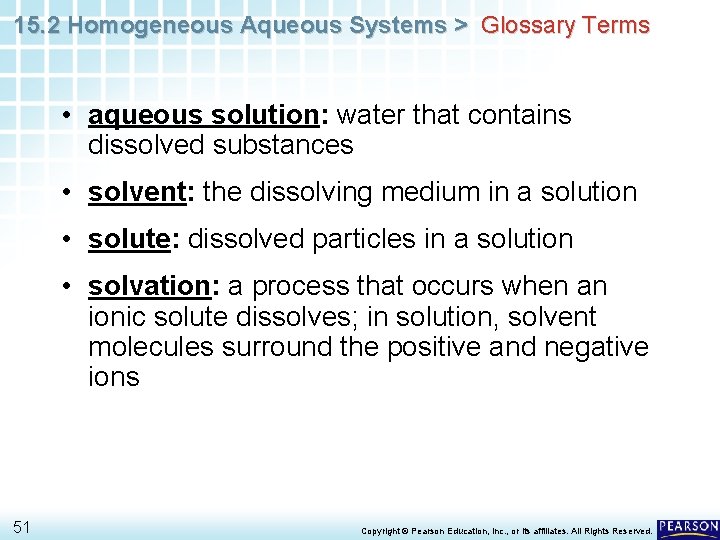
15. 2 Homogeneous Aqueous Systems > Glossary Terms • aqueous solution: water that contains dissolved substances • solvent: the dissolving medium in a solution • solute: dissolved particles in a solution • solvation: a process that occurs when an ionic solute dissolves; in solution, solvent molecules surround the positive and negative ions 51 Copyright © Pearson Education, Inc. , or its affiliates. All Rights Reserved.
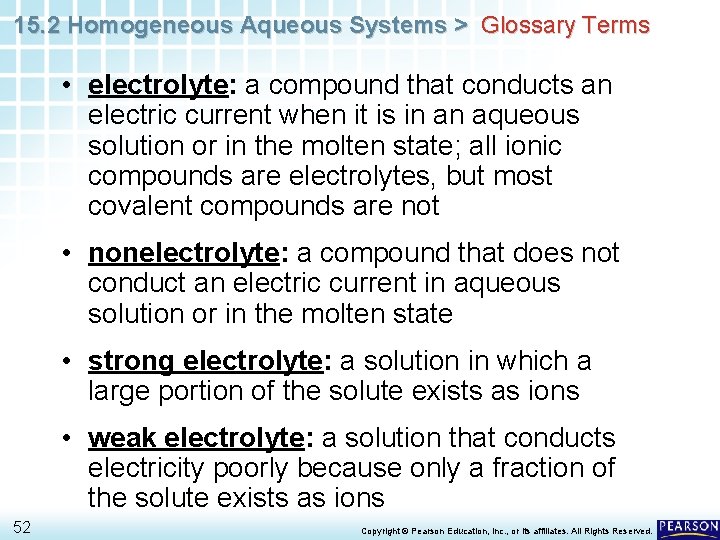
15. 2 Homogeneous Aqueous Systems > Glossary Terms • electrolyte: a compound that conducts an electric current when it is in an aqueous solution or in the molten state; all ionic compounds are electrolytes, but most covalent compounds are not • nonelectrolyte: a compound that does not conduct an electric current in aqueous solution or in the molten state • strong electrolyte: a solution in which a large portion of the solute exists as ions • weak electrolyte: a solution that conducts electricity poorly because only a fraction of the solute exists as ions 52 Copyright © Pearson Education, Inc. , or its affiliates. All Rights Reserved.
15. 2 Homogeneous Aqueous Systems > Glossary Terms • water of hydration: water molecules that are an integral part of a crystal structure • hydrate: a compound that has a specific number of water molecules bound to each formula unit • anhydrous: a substance that does not contain water • effloresce: to lose water of hydration; the process occurs when the hydrate has a vapor pressure higher than that of water vapor in the air 53 Copyright © Pearson Education, Inc. , or its affiliates. All Rights Reserved.
15. 2 Homogeneous Aqueous Systems > Glossary Terms • hygroscopic: a term describing salts and other compounds that remove moisture from the air • desiccant: a hygroscopic substance used as a drying agent • deliquescent: describes a substance that removes sufficient water from the air to form a solution; the solution formed has a lower vapor pressure than that of the water in the air 54 Copyright © Pearson Education, Inc. , or its affiliates. All Rights Reserved.
15. 2 Homogeneous Aqueous Systems > BIG IDEA Bonding and Interactions • Ionic compounds and polar covalent compounds dissolve most readily in water to form aqueous solutions. • Ionic compounds dissolve in water when the polar water molecules attract the ions of the solute, causing the individual solute ions to break away from the ionic crystal. 55 Copyright © Pearson Education, Inc. , or its affiliates. All Rights Reserved.
15. 2 Homogeneous Aqueous Systems > END OF 15. 2 56 Copyright © Pearson Education, Inc. , or its affiliates. All Rights Reserved.