
15 1 Darwins Theory of Evolution by Natural
15. 1 Darwin’s Theory of Evolution by Natural Selection 7(D) Analyze and evaluate how the elements of natural selection, including inherited variation, the potential of a population to produce more offspring than can survive, and a finite supply of environmental resources, result in differential reproductive success.
Section 1: Darwin’s Theory of Evolution by Natural Selection Charles Darwin developed a theory of evolution based on natural selection. K What I Know W What I Want to Find Out L What I Learned
Review Essential Questions • • • What evidence convinced Darwin that species could change over time? What are the four principles of natural selection? How can natural selection change a population? Vocabulary • • • artificial selection natural selection evolution Copyright © Mc. Graw-Hill Education Darwin’s Theory of Evolution by Natural Selection
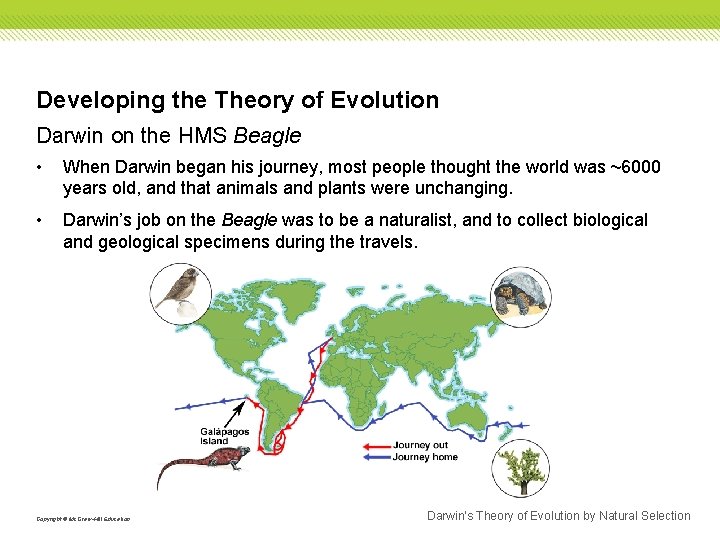
Developing the Theory of Evolution Darwin on the HMS Beagle • When Darwin began his journey, most people thought the world was ~6000 years old, and that animals and plants were unchanging. • Darwin’s job on the Beagle was to be a naturalist, and to collect biological and geological specimens during the travels. Copyright © Mc. Graw-Hill Education Darwin’s Theory of Evolution by Natural Selection
Developing the Theory of Evolution The Galápagos Islands • Darwin noticed that the different islands all seemed to have their own, slightly different varieties of animals. • Almost every specimen Darwin collected on the Galápagos was new to European scientists, though they were similar to species on mainland South America. • Island mainland species should not have been so similar, unless mainland species had changed since arriving on the islands. Copyright © Mc. Graw-Hill Education Darwin’s Theory of Evolution by Natural Selection
Developing the Theory of Evolution Darwin continued his studies • Darwin hypothesized that new species could appear gradually through small changes in ancestral species. • Darwin inferred that if humans could change species by artificial selection – directed breeding to produce offspring with desired traits, then perhaps the same process could work in nature. Copyright © Mc. Graw-Hill Education Darwin’s Theory of Evolution by Natural Selection
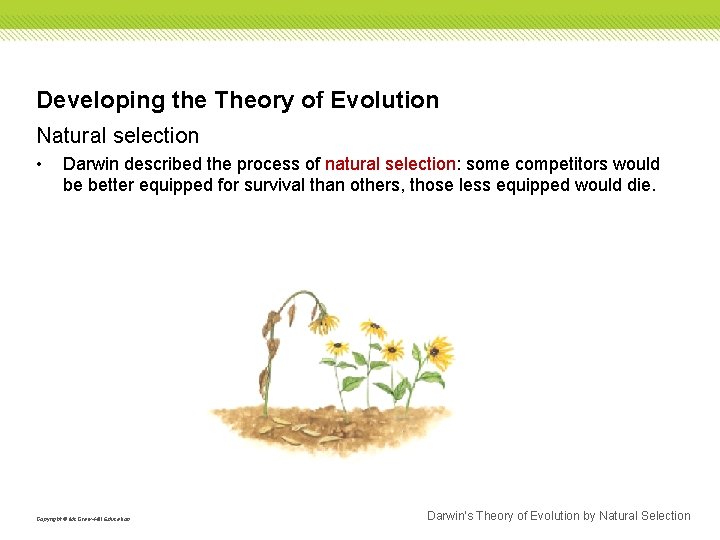
Developing the Theory of Evolution Natural selection • Darwin described the process of natural selection: some competitors would be better equipped for survival than others, those less equipped would die. Copyright © Mc. Graw-Hill Education Darwin’s Theory of Evolution by Natural Selection
Developing the Theory of Evolution Natural selection • Principles of natural selection: • Individuals show variation • Variations are heritable • More offspring are born than can survive • Variations that increase reproductive success will be more common in the next generation Copyright © Mc. Graw-Hill Education Darwin’s Theory of Evolution by Natural Selection
The Origin of Species • Darwin published On the Origin of Species by Means of Natural Selection in 1859. • Today, scientists use evolution to mean cumulative change in a group of organisms through time. • Natural selection is not synonymous with evolution – it is a mechanism by which evolution occurs. Copyright © Mc. Graw-Hill Education Darwin’s Theory of Evolution by Natural Selection
- Slides: 9