
1476 William Caxton introduces printing press to England

- Slides: 13
1476 William Caxton introduces printing press to England 1485 accession of Henry VII to the throne, concluding the Wars of the Roses From the middle of the 15 th c. : journeys of Oxford students to Italy 1492 Columbus sails to North America 1517 Martin Luther’s Wittenberg Theses 1543 Copernicus: On the Revolution of the Spheres. the Earth as one of the several planets orbiting the sun in circular spheres. the flowering of Renaissance after the accession of Henry VIII (15851660)
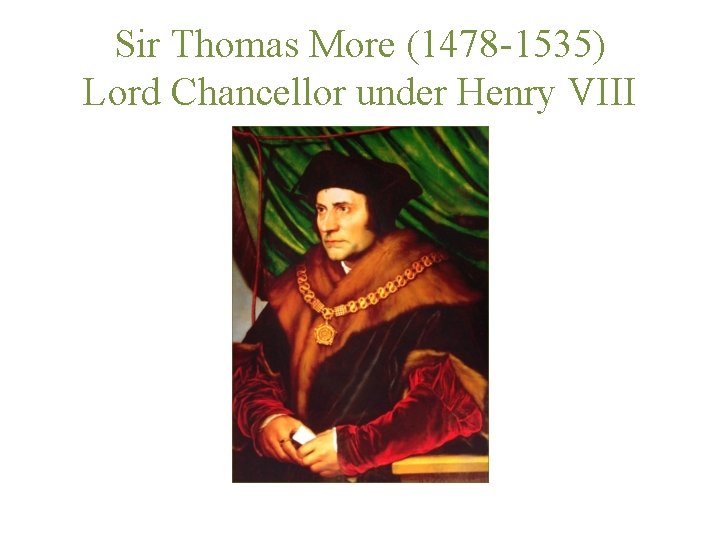
Sir Thomas More (1478 -1535) Lord Chancellor under Henry VIII
• • placed, as a boy, in the household of Cardinal John Morton, Archbishop of Canterbury and Lord Chancellor. At the age of about nineteen, he was sent to Canterbury College, Oxford, by his patron, where he learnt Greek of the first men who brought Greek studies from Italy to England—William Grocyn and Thomas Linacre. At twenty-one he entered Parliament, and soon after he had been called to the bar he was made Under Sheriff of London. In the first years of the reign of Henry VIII. he became a prominent lawyer in the courts, where it is said he refused to plead in cases which he thought unjust, and took no fees from widows, orphans, or the poor. * * From The Western Heritage, Osment
• In 1516, Cuthbert Tunstal, chancellor to the Archbishop of Canterbury was sent to the Low Countries, and More then went with him to Brussels, where they were in close companionship with Erasmus. • Utopia was first printed at Louvain, late in 1516, under the editorship of Erasmus, Peter Giles, and other of More’s friends in Flanders. • Written in Latin, it was not printed in England during More’s lifetime. • Its first publication in England was in the English translation, made in Edward’s VI. ’s reign (1551) by Ralph Robinson. • Although More became one of Henry VIII’s most trusted diplomats, his criticism of the Act of Supremacy (1534), which made the king of England head of the English church in place of the pope, and his refusal to recognize the king’s marriage to Anne Boleyn led to his execution in July 1535
’Utopia’, the name of the imaginary new country, is derived from the Greek and means ’no place’; Hythlodaeus, the character who tells us about Utopia, means ’nonsensepedlar”; Anydrus, the chief river in Utopia, means ’waterless’…but the real play in Utopia is between two types of Greek behavior and rhetoric, between the private identity of Socrates and the social identity of Plato. ” –The Oxford Illustrated History of English Literature, 71
„…the personality, motives, and failings of each speaker clog up his good intentions. Raphael has the right ideas, but he despairs of being listened to, and so he will not be. The Cardinal is wise and learned, and listens carefully to Raphael, but in the end he allows his household and guests to be sycophantic, and his private audiences to applaud his suggestions alone. This is why the first book is Socratic, because it identifies truth and justice as elusive, inward virtues which men must have teased out of them, and which no one man can lay exclusive claim to. ” –Oxford Ilustrated History, 73
• • Raphael Hythloday (Amerigo Vespucci) Sir Thomas More Peter Giles Cardinal Amaurot Syphogrant Tranibors
„Raphael meets and debates with an English lawyer…Raphael’s opponent, though he says little, is made to look stupid, pedantic, and brutal as he clings onto English law and social order (hang all thieves, starve the peasants into submission, etc. ), while Raphael, step by step, shows how needlessly vicious and economically inefficient all this repression is. ” Oxford Illustrated History, 73
„There is a great number of noblemen among you that are themselves as idle as drones, that subsist on other men’s labour, on the labour of their tenants, whom, to raise their revenues, they pare to the quick. ” page 21
„…if it is pretended that the mutual consent of men in making laws can authorise man-slaughter in cases in which God has given us no example, that it frees people from the obligation of the divine law, and so makes murder a lawful action, what is this, but to give a preference to human laws before the divine? ” page 30
„The Utopians wonder how any man should be so much taken with the glaring doubtful lustre of a jewel or a stone, that can look up to a star or to the sun himself; or how any should value himself because his cloth is made of a finer thread; for, how fine soever that thread may be, it was once no better than the fleece of a sheep, and that sheep, was a sheep still, for all its wearing it. They wonder much to hear that gold, which in itself is so useless a thing, should be everywhere so much esteemed that even man, for whom it was made, and by whom it has its value, should yet be thought of less value than this metal; „ page 100
„…but in Utopia, where every man has a right to everything, they all know that if care is taken to keep the public stores full no private man can want anything; ” page 176
„When Raphael had thus made an end of speaking, though many things occurred to me, both concerning the manners and laws of that people, that seemed very absurd… I cannot perfectly agree to everything he has related. ” page 183