
14 Regulation of Gene Expression in Bacteria and
14 Regulation of Gene Expression in Bacteria and Bacteriophage Lectures by Dr. Tara Stoulig Southeastern Louisiana University © 2015 Pearson Education Inc.
14. 1 Transcriptional Control of Gene Expression Requires DNA–Protein Interaction § Certain bacterial genes needed to continuously perform routine tasks undergo constitutive (i. e. , continuous) transcription § Some genes, needed for responses to changing environmental conditions require regulated transcription § Regulation of transcription includes control of both initiation and amount of transcription © 2015 Pearson Education, Inc. 2
Gene Regulation in Bacteria § Most regulation of gene expression in bacteria is transcriptional regulation § Control results from interactions between DNAbinding proteins and regulatory sequences of DNA § Post-transcriptional mechanisms are also important © 2015 Pearson Education, Inc. 3
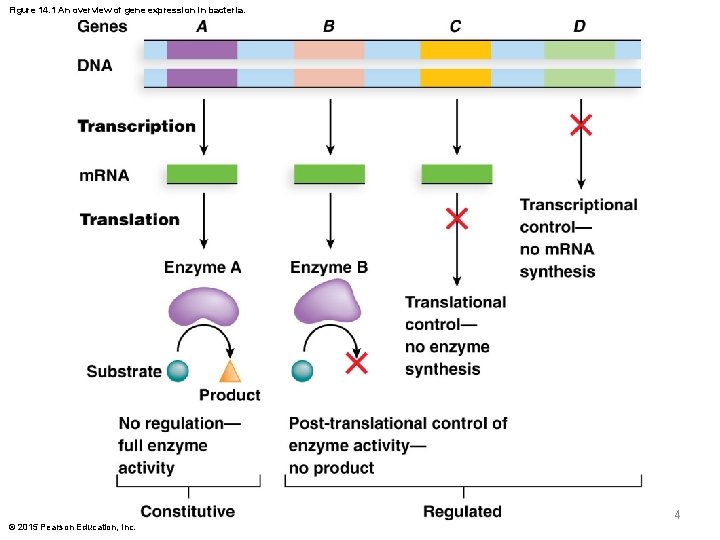
Figure 14. 1 An overview of gene expression in bacteria. 4 © 2015 Pearson Education, Inc.
Negative and Positive Control of Transcription § Negative control of transcription involves binding of a repressor protein to a regulatory DNA sequence and preventing transcription of a gene or gene cluster § Positive control of transcription involves binding of an activator protein to regulatory DNA and initiating gene transcription © 2015 Pearson Education, Inc. 5
Repressor Proteins § Repressor proteins are a broad category of regulatory proteins that exert negative control of transcription § Activated repressors bind to sequences such as those called operators: a) Their binding blocks transcription initiation. b) They can be activated or inactivated via interactions with other compounds © 2015 Pearson Education, Inc. 6
Repressor Proteins Have Two Active Sites § Repressor proteins usually have two active sites through which they perform their functions § The DNA-binding domain locates and binds operator DNA sequence or other target DNA sequences § The allosteric domain binds a molecule or protein, which causes a change in conformation of the DNAbinding domain; this property is called allostery © 2015 Pearson Education, Inc. 7
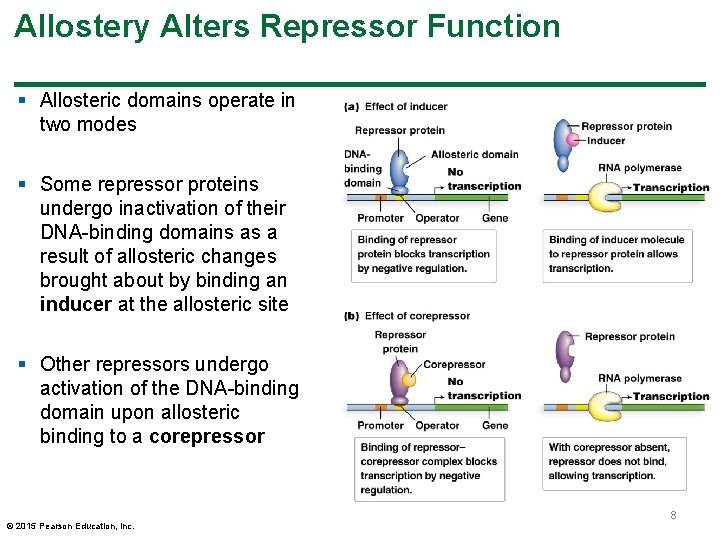
Allostery Alters Repressor Function § Allosteric domains operate in two modes § Some repressor proteins undergo inactivation of their DNA-binding domains as a result of allosteric changes brought about by binding an inducer at the allosteric site § Other repressors undergo activation of the DNA-binding domain upon allosteric binding to a corepressor © 2015 Pearson Education, Inc. 8
Positive Control § Positive control of transcription is accomplished by activator proteins that bind regulatory DNA sequences called activator binding sites § Activator protein binding facilitates RNA polymerase binding at promoters and helps initiate transcription § Activator proteins have a DNA-binding domain © 2015 Pearson Education, Inc. 9
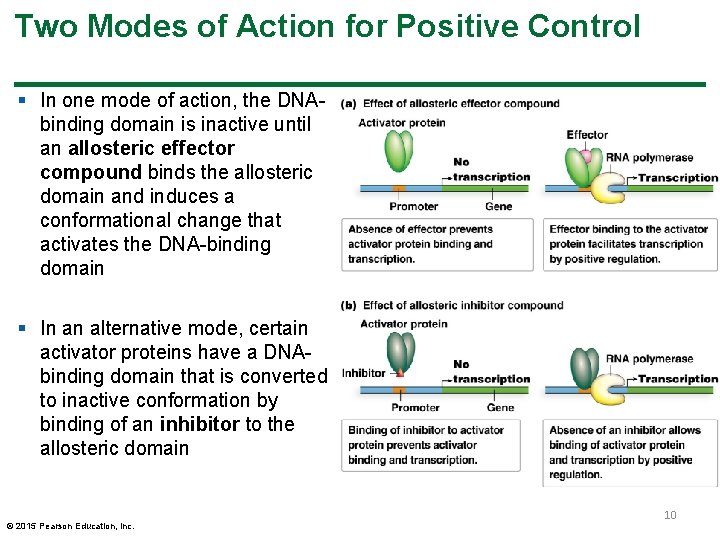
Two Modes of Action for Positive Control § In one mode of action, the DNAbinding domain is inactive until an allosteric effector compound binds the allosteric domain and induces a conformational change that activates the DNA-binding domain § In an alternative mode, certain activator proteins have a DNAbinding domain that is converted to inactive conformation by binding of an inhibitor to the allosteric domain © 2015 Pearson Education, Inc. 10
Regulatory DNA-Binding Proteins § DNA-binding proteins have amino acids with side chains that associate with nucleotides of particular DNA sequences § The protein simultaneously contacts multiple nucleotides; specificity is dictated by the unique patterns of hydrogen, nitrogen, and oxygen atoms that characterize the nucleotides § A common motif in DNA-binding regions of proteins is secondary structure, usually helices © 2015 Pearson Education, Inc. 11
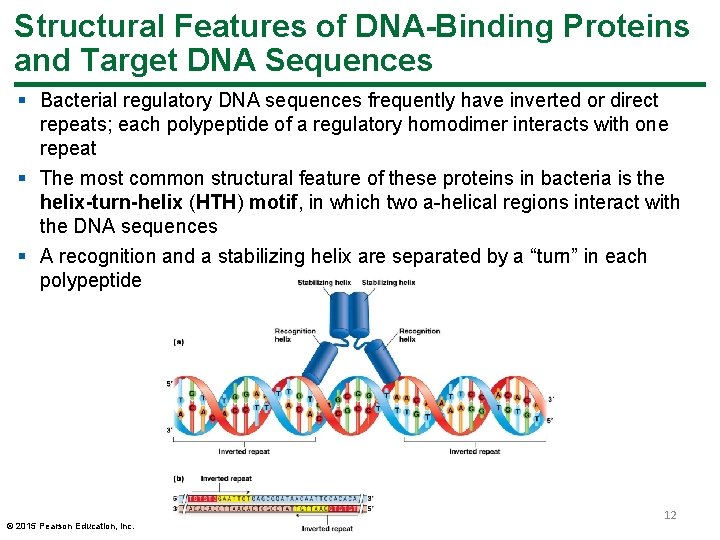
Structural Features of DNA-Binding Proteins and Target DNA Sequences § Bacterial regulatory DNA sequences frequently have inverted or direct repeats; each polypeptide of a regulatory homodimer interacts with one repeat § The most common structural feature of these proteins in bacteria is the helix-turn-helix (HTH) motif, in which two a-helical regions interact with the DNA sequences § A recognition and a stabilizing helix are separated by a “turn” in each polypeptide © 2015 Pearson Education, Inc. 12
14. 2 The lac Operon Is an Inducible Operon System under Negative and Positive Control § Clusters of genes undergoing coordinated transcriptional regulation by a shared regulatory region are called operons § These are common in bacterial genomes; genes in a particular operon nearly always participate in the same metabolic or biosynthetic pathway § The lactose (lac) operon of E. coli is responsible for producing three polypeptides needed for use of lactose © 2015 Pearson Education, Inc. 13
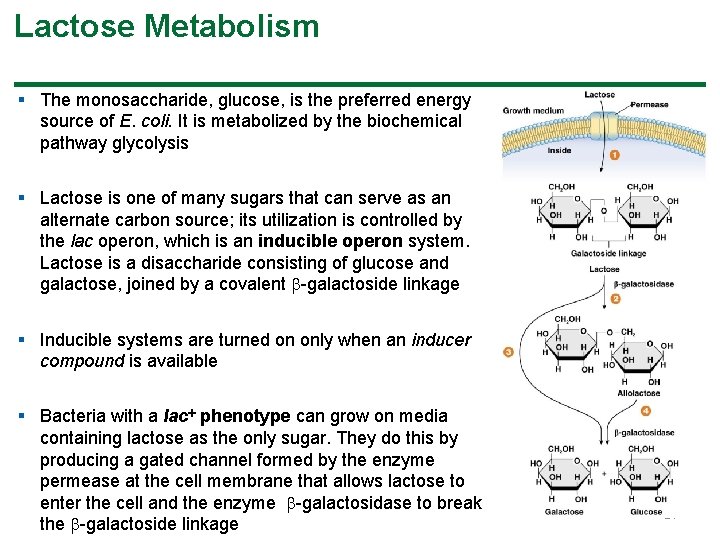
Lactose Metabolism § The monosaccharide, glucose, is the preferred energy source of E. coli. It is metabolized by the biochemical pathway glycolysis § Lactose is one of many sugars that can serve as an alternate carbon source; its utilization is controlled by the lac operon, which is an inducible operon system. Lactose is a disaccharide consisting of glucose and galactose, joined by a covalent -galactoside linkage § Inducible systems are turned on only when an inducer compound is available § Bacteria with a lac phenotype can grow on media containing lactose as the only sugar. They do this by producing a gated channel formed by the enzyme permease at the cell membrane that allows lactose to enter the cell and the enzyme -galactosidase to break the -galactoside linkage 14
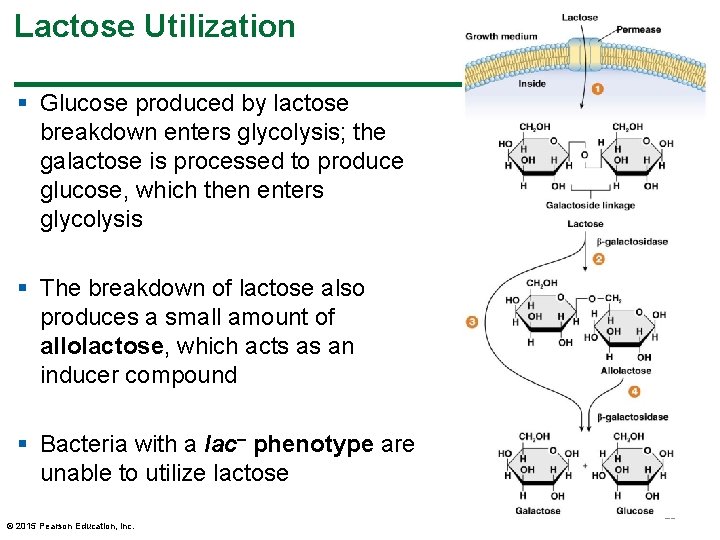
Lactose Utilization § Glucose produced by lactose breakdown enters glycolysis; the galactose is processed to produce glucose, which then enters glycolysis § The breakdown of lactose also produces a small amount of allolactose, which acts as an inducer compound § Bacteria with a lac phenotype are unable to utilize lactose © 2015 Pearson Education, Inc. 15
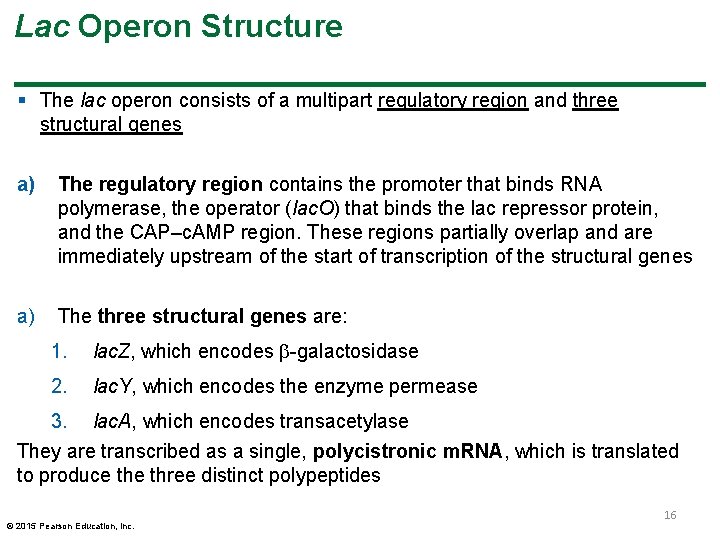
Lac Operon Structure § The lac operon consists of a multipart regulatory region and three structural genes a) The regulatory region contains the promoter that binds RNA polymerase, the operator (lac. O) that binds the lac repressor protein, and the CAP–c. AMP region. These regions partially overlap and are immediately upstream of the start of transcription of the structural genes a) The three structural genes are: 1. lac. Z, which encodes -galactosidase 2. lac. Y, which encodes the enzyme permease 3. lac. A, which encodes transacetylase They are transcribed as a single, polycistronic m. RNA, which is translated to produce three distinct polypeptides © 2015 Pearson Education, Inc. 16
Lac. I § The lac. I gene is next to, but not part of, the lac operon § Lac. I encodes the lac repressor protein; it is constitutively expressed § The lac repressor protein have a DNA-binding domain that binds to the lac. O sequence and an allosteric domain that binds the inducer, allolactose © 2015 Pearson Education, Inc. 17
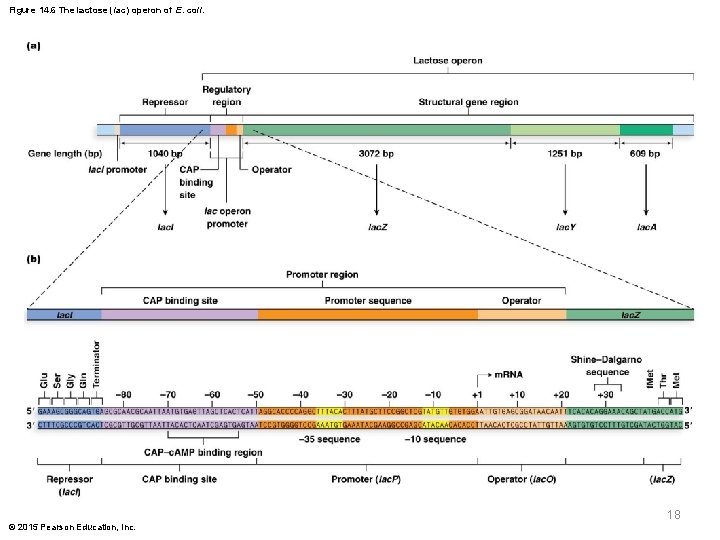
Figure 14. 6 The lactose (lac) operon of E. coli. 18 © 2015 Pearson Education, Inc.
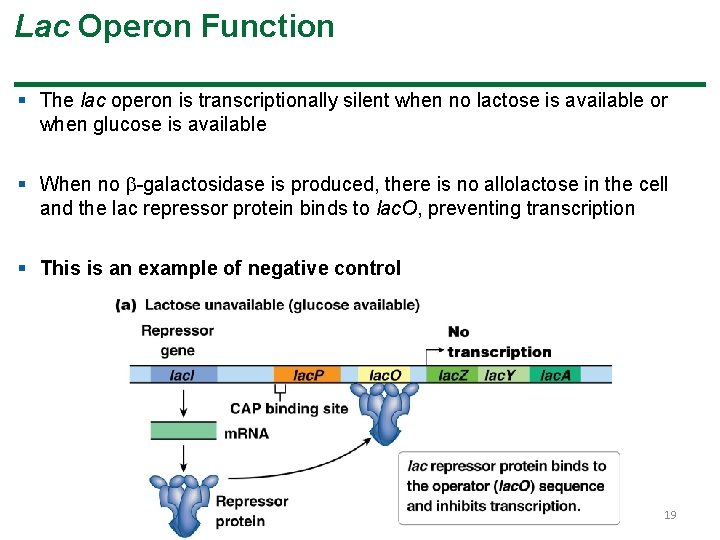
Lac Operon Function § The lac operon is transcriptionally silent when no lactose is available or when glucose is available § When no -galactosidase is produced, there is no allolactose in the cell and the lac repressor protein binds to lac. O, preventing transcription § This is an example of negative control 19
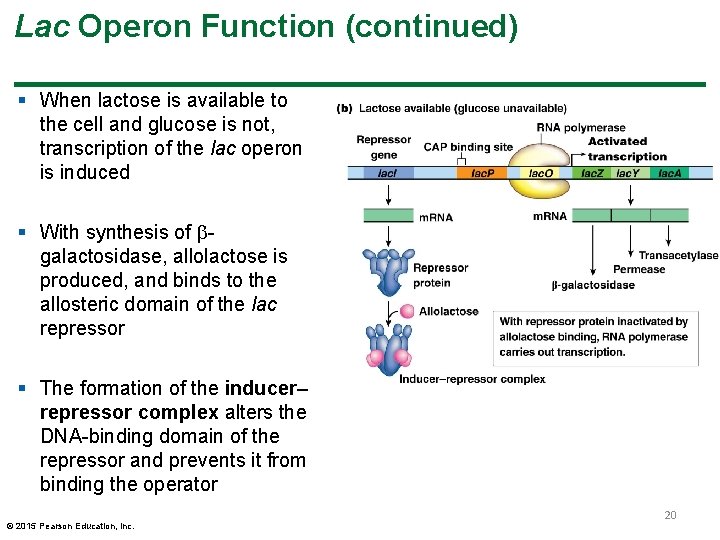
Lac Operon Function (continued) § When lactose is available to the cell and glucose is not, transcription of the lac operon is induced § With synthesis of galactosidase, allolactose is produced, and binds to the allosteric domain of the lac repressor § The formation of the inducer– repressor complex alters the DNA-binding domain of the repressor and prevents it from binding the operator © 2015 Pearson Education, Inc. 20
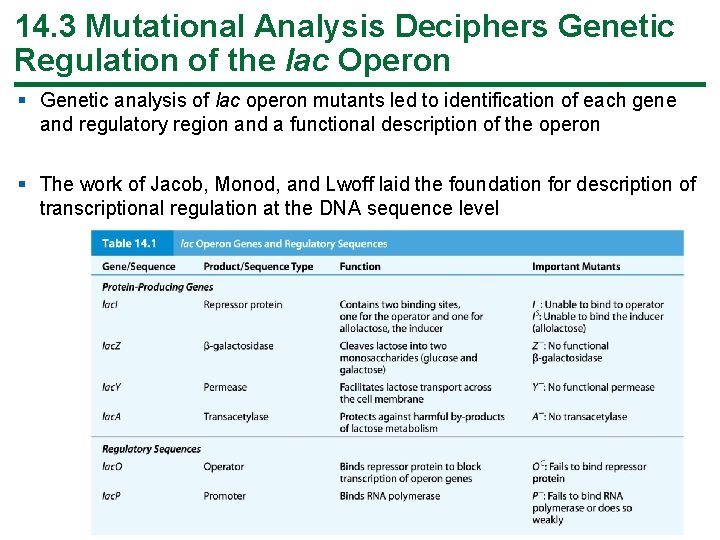
14. 3 Mutational Analysis Deciphers Genetic Regulation of the lac Operon § Genetic analysis of lac operon mutants led to identification of each gene and regulatory region and a functional description of the operon § The work of Jacob, Monod, and Lwoff laid the foundation for description of transcriptional regulation at the DNA sequence level 21
Analysis of Structural Gene Mutations § Several dozen lac mutants were generated by treating E. coli with mutagens § Complementation analysis assigned mutations into two complementation groups; these correspond to the lac. Z and lac. Y genes § Complementation analysis is carried out in partial diploids produced by conjugation between F (lac) and F bacteria © 2015 Pearson Education, Inc. 22
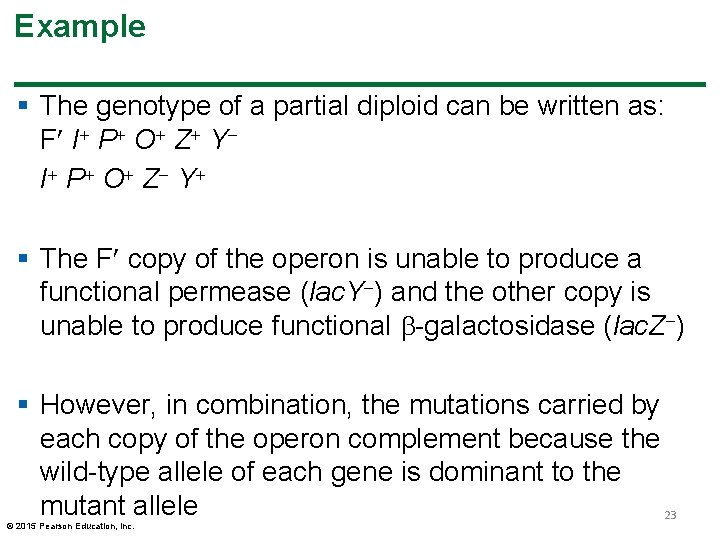
Example § The genotype of a partial diploid can be written as: F I P O Z Y I P O Z Y § The F copy of the operon is unable to produce a functional permease (lac. Y ) and the other copy is unable to produce functional -galactosidase (lac. Z ) § However, in combination, the mutations carried by each copy of the operon complement because the wild-type allele of each gene is dominant to the mutant allele 23 © 2015 Pearson Education, Inc.
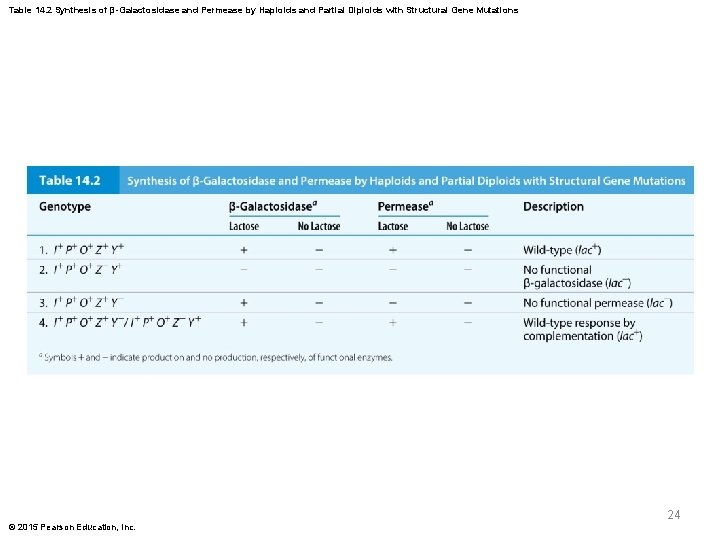
Table 14. 2 Synthesis of β-Galactosidase and Permease by Haploids and Partial Diploids with Structural Gene Mutations 24 © 2015 Pearson Education, Inc.
Lac Operon Regulatory Mutations § Certain mutations of the lac operon lead to constitutive mutants, in which the genes are transcribed continuously whether or not lactose is available § Other regulatory mutants cause cells to be unresponsive to the presence of lactose, and therefore lac § Genetic mapping of constitutive mutants localizes them to the lac. O and lac. I regions © 2015 Pearson Education, Inc. 25
Two Components to the lac Operon § The discovery of the two sites of constitutive mutations led Jacob and Monod to suggest that the operon functioned under a negative regulatory system § Constitutive mutations could affect the production of a regulatory protein (lac. I) or its DNA-binding site (lac. O) © 2015 Pearson Education, Inc. 26
Operator Mutations § Lac operator mutations are exclusively cis-acting, meaning they influence transcription of genes only on the same chromosome § Normally the lac repressor protein binds operator sequences unless allolactose is bound to its allosteric site § Oc mutants have altered operator sequences to which the repressor protein cannot bind and the structural genes are continuously expressed © 2015 Pearson Education, Inc. 27
Experiments with Partial Diploids § Partial diploids in which an Oc mutation was adjacent to Z and an O sequence was adjacent to Z led to constitutive expression of Z § A second experiment in which the Oc mutation was adjacent to Z and the O sequence was adjacent to Z led to normal expression of Z § Together these two experiments showed that operator is cis-dominant, influencing transcription only of downstream genes © 2015 Pearson Education, Inc. 28
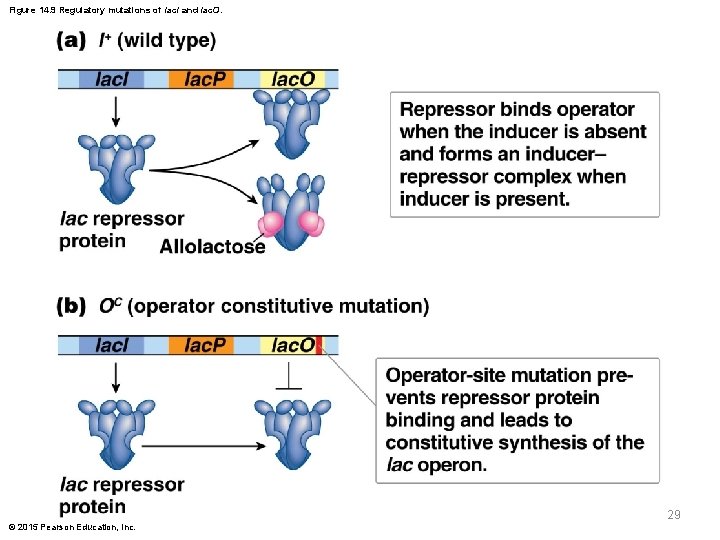
Figure 14. 9 Regulatory mutations of lac. I and lac. O. 29 © 2015 Pearson Education, Inc.
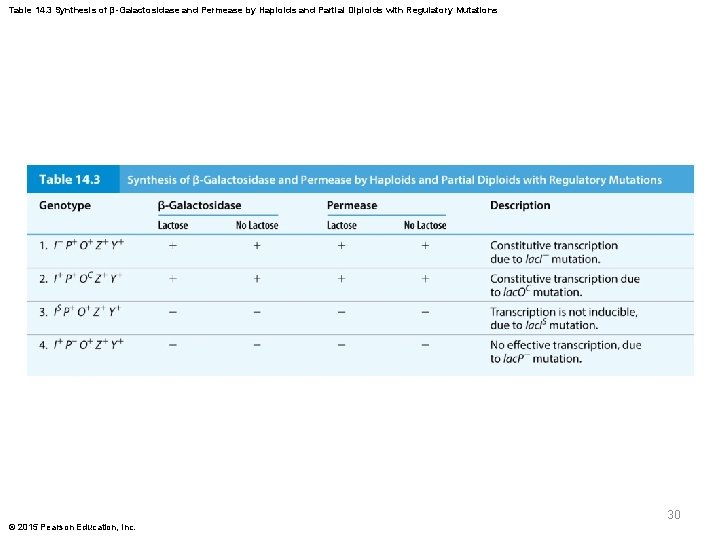
Table 14. 3 Synthesis of β-Galactosidase and Permease by Haploids and Partial Diploids with Regulatory Mutations 30 © 2015 Pearson Education, Inc.
Constitutive Repressor Protein Mutations § In a haploid cell with genotype lac. I that is otherwise wild type, the Z and Y genes are constitutively expressed § A partial diploid with I on one chromosome, which also carries Z and Y , and I on the other chromosome, which also carries Z and Y , has normal expression of both the Z and Y genes § This indicates that lac. I produces a regulatory protein that is trans-acting; that is, it is capable of diffusing and interacting with both operators in a partial diploid 31 © 2015 Pearson Education, Inc.
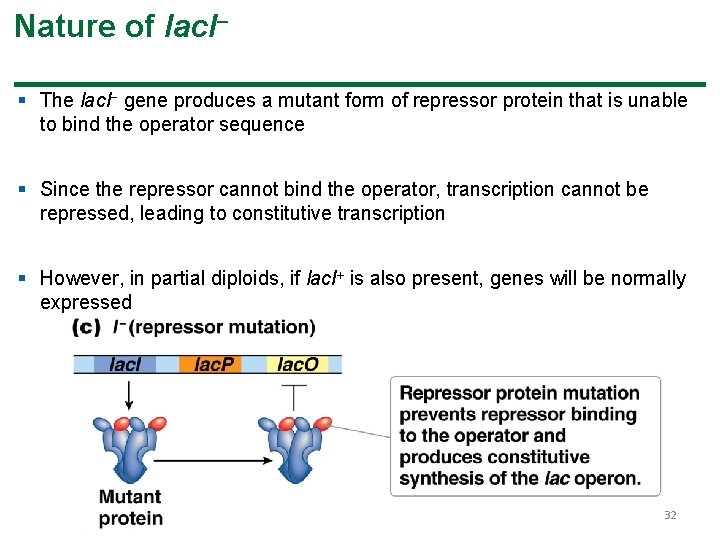
Nature of lac. I § The lac. I gene produces a mutant form of repressor protein that is unable to bind the operator sequence § Since the repressor cannot bind the operator, transcription cannot be repressed, leading to constitutive transcription § However, in partial diploids, if lac. I is also present, genes will be normally expressed 32
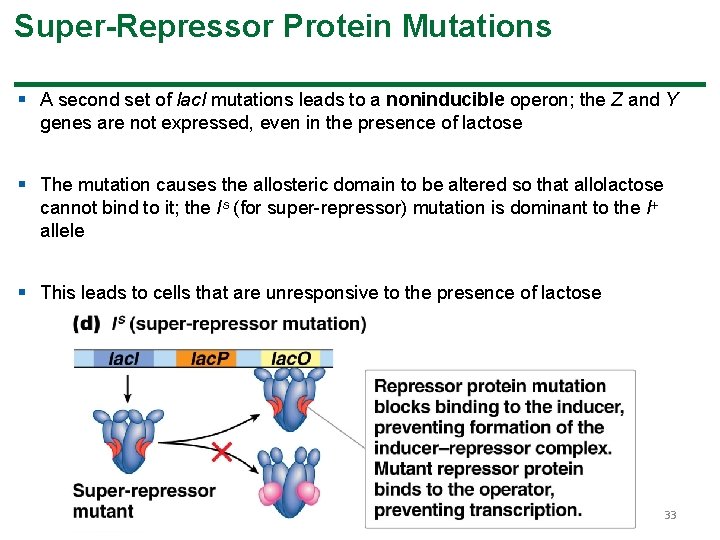
Super-Repressor Protein Mutations § A second set of lac. I mutations leads to a noninducible operon; the Z and Y genes are not expressed, even in the presence of lactose § The mutation causes the allosteric domain to be altered so that allolactose cannot bind to it; the Is (for super-repressor) mutation is dominant to the I allele § This leads to cells that are unresponsive to the presence of lactose 33
Promoter Mutations § Mutations of promoter consensus sequences significantly reduce transcription and may eliminate it entirely § Most mutations of lac. P reduce or eliminate transcription of lac. Z and lac. Y, which are located in cis § Active transcription of lac operon genes takes place only when glucose is depleted from the cell and lactose is available to it © 2015 Pearson Education, Inc. 34
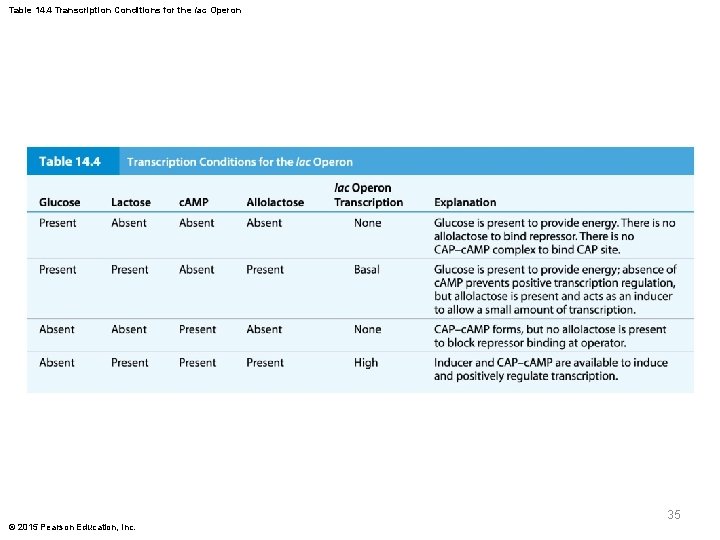
Table 14. 4 Transcription Conditions for the lac Operon 35 © 2015 Pearson Education, Inc.
Operon Transcription in Absence of Glucose, Presence of Lactose 1. c. AMP levels rise due to availability of adenylcyclase 2. CAP-c. AMP complex forms and binds the CAP site of the lac promoter 3. Allolactose forms in a side reaction of lactose metabolism 4. Repressor protein binds allolactose, changes conformation, and releases from the operator © 2015 Pearson Education, Inc. 36
Molecular Analysis of the lac Operon § Molecular analysis has identified the DNA sequences of the lac operon components § The repressor protein-binding region overlaps with the promoter-binding location for RNA polymerase, supporting the hypothesis that repressor protein blocks RNA polymerase binding § Three distinct segments of operator DNA sequence are identified: O 1, O 2, and O 3. Each of the three segments of the operator sequences interacts differently with the repressor protein © 2015 Pearson Education, Inc. 37
Operator and Repressor Interactions § The three segments of the operator share a conserved 21 -bp inverted repeat around a central G-C base pair § The tetrameric repressor binds to O 1 and O 3 and induces DNA loop formation that brings O 1 and O 3 close together § The loop structure includes part of the promoter and blocks access by RNA polymerase © 2015 Pearson Education, Inc. 38
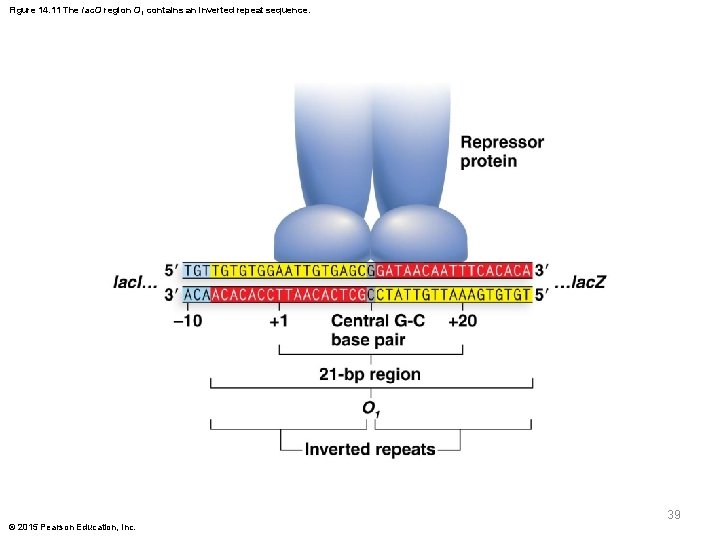
Figure 14. 11 The lac. O region O 1 contains an inverted repeat sequence. 39 © 2015 Pearson Education, Inc.
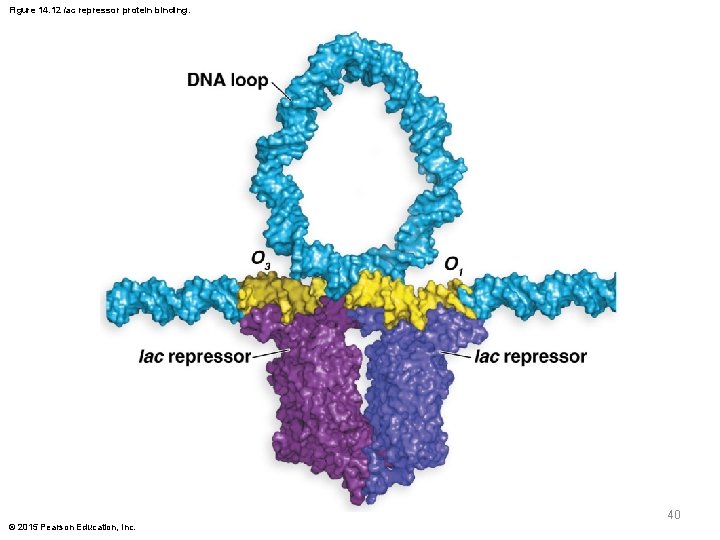
Figure 14. 12 lac repressor protein binding. 40 © 2015 Pearson Education, Inc.
14. 4 Transcription from the Tryptophan Operon Is Repressible and Attenuated § Repressible operons: are operons involved in anabolic pathways operate through activity of the end product to block transcription of the operon § Certain repressible operons have a second regulatory capability called attenuation, which can fine-tune transcription to match the immediate needs of the cell © 2015 Pearson Education, Inc. 41
Feedback Inhibition of Tryptophan Synthesis § The trp operon contains five structural genes and a regulatory region with a promoter (trp. P), operator (trp. O), and leader region (trp. L) that contains the attenuator region § The protein products of the structural genes (trp. E, trp. D, trp. C, trp. B, and trp. A) are responsible for tryptophan synthesis § A sixth gene outside the operon encodes the trp. R protein, a repressor protein that is activated when bound to tryptophan © 2015 Pearson Education, Inc. 42
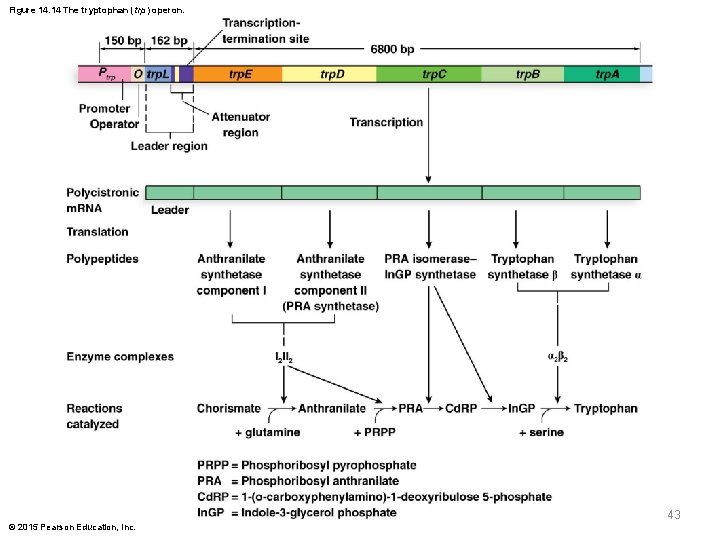
Figure 14. 14 The tryptophan (trp) operon. 43 © 2015 Pearson Education, Inc.
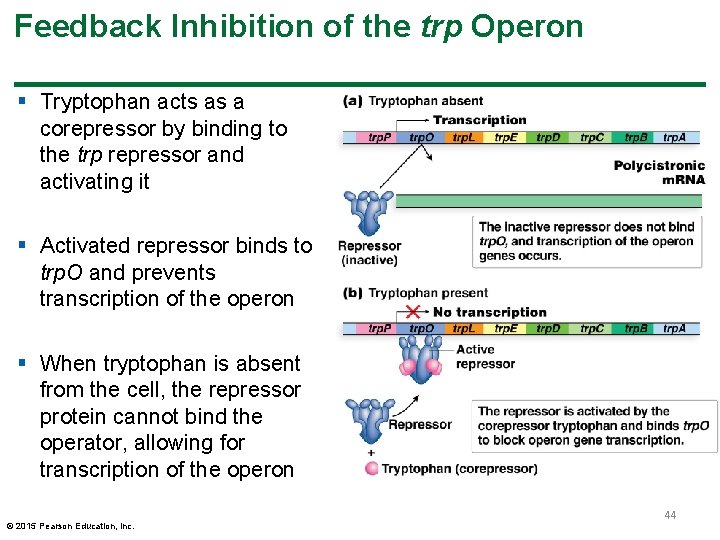
Feedback Inhibition of the trp Operon § Tryptophan acts as a corepressor by binding to the trp repressor and activating it § Activated repressor binds to trp. O and prevents transcription of the operon § When tryptophan is absent from the cell, the repressor protein cannot bind the operator, allowing for transcription of the operon © 2015 Pearson Education, Inc. 44
Limitations of Feedback Inhibition of the trp Operon § Given the function of the trp. R protein, it would be expected that trp. R cells should produce tryptophan constitutively, as the repressor protein is not available to inhibit transcription § However, this is not the case; trp. R strains have higher rates of operon transcription in the presence of tryptophan trp. R strains but not 100% § This suggests that a second mechanism regulates operon expression © 2015 Pearson Education, Inc. 45
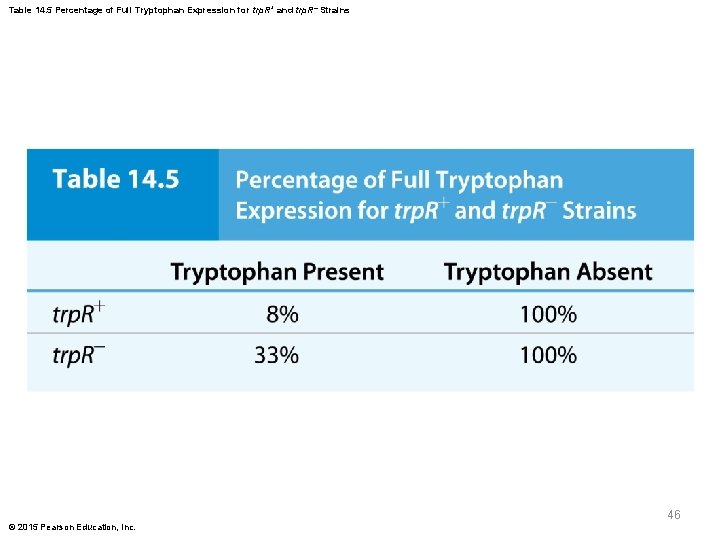
Table 14. 5 Percentage of Full Tryptophan Expression for trp. R+ and trp. R Strains 46 © 2015 Pearson Education, Inc.
Attenuation of the trp Operon § The second mechanism controlling trp operon expression is attenuation, controlled by the 162 -bp trp. L region § The trp. L region contains four repeat DNA sequences and the m. RNA produced contains complementary repeats as well as start and stop codons for a 14– amino acid polypeptide © 2015 Pearson Education, Inc. 47
Critical Features of the trp. L Sequence § The four repeat sequences (1, 2, 3, and 4) can form different stem-loop structures § Among the codons for the short polypeptide are two back-to-back codons for tryptophan § These codons are “sensors” for the availability of tryptophan in the cell © 2015 Pearson Education, Inc. 48
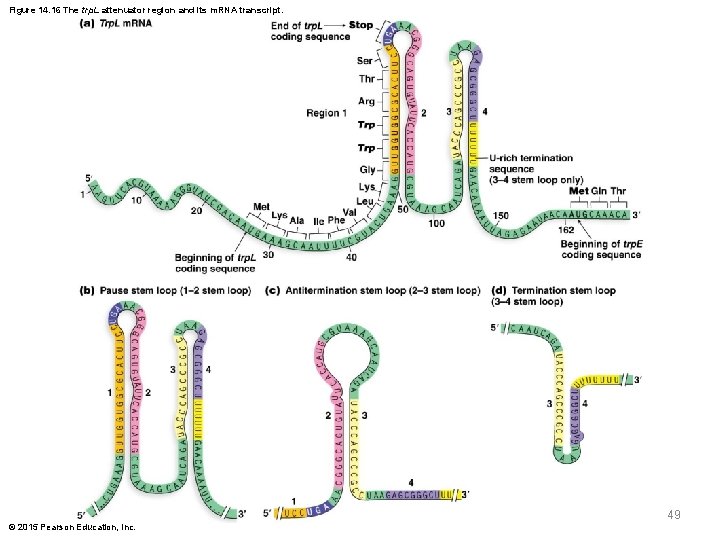
Figure 14. 16 The trp. L attenuator region and its m. RNA transcript. 49 © 2015 Pearson Education, Inc.
Stem-Loop Structures and Attenuation § Two stem-loop structures, the 3– 4 stem loop and 2– 3 stem loop, are central to attenuation; the 1– 2 stem loop plays a relatively minor role § The 3– 4 stem loop of m. RNA is the termination stem loop, which halts RNA polymerase progress along the DNA within the leader region § Region 4 is followed by a poly-uracil sequence that functions similarly to intrinsic termination of transcription in bacteria © 2015 Pearson Education, Inc. 50
Stem-Loop Structures and Attenuation (continued) § The 3– 4 stem loop may be accompanied by formation of a 1– 2 stem loop, which can induce a pause in the attenuation § Alternatively, a 2– 3 stem loop of m. RNA, the antitermination stem loop, forms when region 1 is not available for pairing and thus prevents region 3 from interacting with region 4 § This allows RNA polymerase to continue through the leader sequence and into the structural genes © 2015 Pearson Education, Inc. 51
Role of trp in Formation of Regulatory Stem. Loop Structures § Transcription across regions 1 and 2 allows for the 1– 2 stem loop to form, and a slight pause in transcription is just long enough for a ribosome to bind to the start codon in trp. L § Codons 10 and 11 of the trp. L region are tryptophan codons; with an adequate supply of tryptophan, these are easily translated and the ribosome moves to the stop codon, partially obscuring regions 1 and 2 § This allows only regions 3 and 4 to pair, causing termination of transcription by attenuation © 2015 Pearson Education, Inc. 52
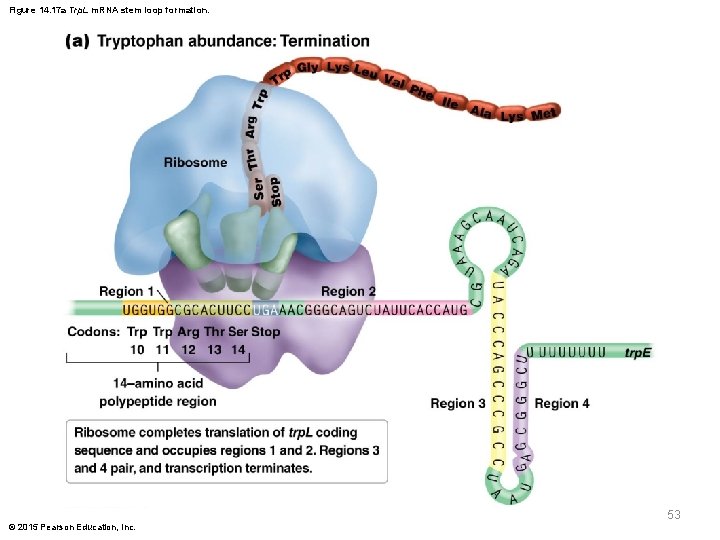
Figure 14. 17 a Trp. L m. RNA stem loop formation. 53 © 2015 Pearson Education, Inc.
Role of trp in Formation of Regulatory Stem. Loop Structures (continued) § Without an adequate supply of tryptophan, translation stalls at codons 10 and 11 § The ribosome obscures region 1, allowing regions 2 and 3 to pair § This creates that antitermination conformation, allowing for continued transcription of genes needed for production of tryptophan © 2015 Pearson Education, Inc. 54
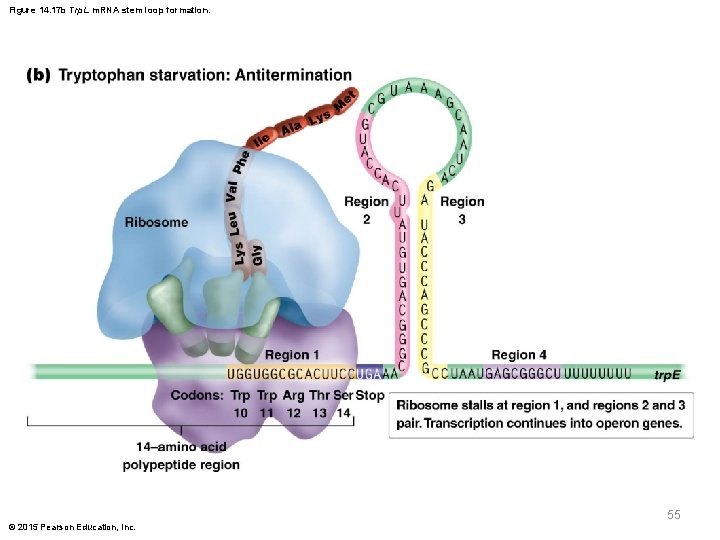
Figure 14. 17 b Trp. L m. RNA stem loop formation. 55 © 2015 Pearson Education, Inc.
Attenuation Mutations § If the tryptophan codons are altered to specify different amino acids, tryptophan production is affected § Mutating one of the two codons alters attenuator responsiveness to tryptophan, and mutating both of them abolishes the attenuator’s ability to sense tryptophan § Mutation of regions 3 and 4, which prevents stable binding between them, also reduces the efficiency of the attenuation mechanism © 2015 Pearson Education, Inc. 56
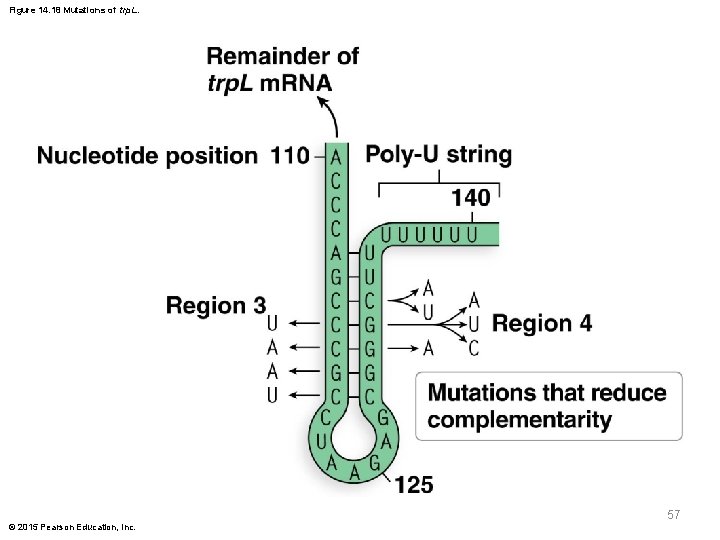
Figure 14. 18 Mutations of trp. L. 57 © 2015 Pearson Education, Inc.
- Slides: 57