
14 POINTS THE TREATY OF VERSAILLES Essential Questions











- Slides: 30
14 POINTS & THE TREATY OF VERSAILLES
Essential Questions ■ What world events motivated President Wilson to create the League of Nations? ■ What political forces would not be in favor of the League of Nations? Why? ■ What were the advantages and disadvantages of open negotiations, free trade, and dispute resolution by international organizations?
The End of WWI ■ U. S. Declares war on Germany April 1917 ■ By November 1918 the war is over What happened? ■ During the 1917 Russian Revolution, The Bolsheviks (Communists) seize power. The new Communist Russian government pulled out of WWI. ■ This allowed Germany to move a lot of troops to the Western Front. ■ At the same time, the U. S. involvement supplied fresh troops to the Allied powers and by spring 1918, 10, 000 soldiers a day were arriving in France to fight.
War of Attrition ■ Attrition Warfare- a military strategy in which a side attempts to win a war by wearing down the enemy to the point of collapse through continuous losses of their people and materials. ■ The significance of the U. S. in WWI is not necessarily their importance in battles but the sign that the Allied powers have a fresh new supply of soldiers and weapons where Germany is struggling to survive. ■ Germany is crippled by the collapse of their allies, significant decrease in production of goods, and unrest amongst their soldiers and civilians. The government is also worried about Communists thought from the East spreading to Germany and causing a revolution. ■ On November 11 th, 1918 an armistice was signed and the fighting of WWI officially came to a close.
The Treaty of Versailles- The Peace Treaty of WWI ■ At the end of the war the major allied powers met just outside of Paris to establish a peace treaty, called the Treaty of Versailles. ■ The Allied powers each sent a representative to negotiate on their behalf. The ones with the most influence were called the Big Four (Sometimes the Big Three) – France: Prime Minister Georges Clemenceau – Great Britain: Prime Minister David Lloyd-George – U. S. : President Woodrow Wilson – Italy: Prime Minister Vittorio Orlando
Woodrow Wilson USA David Lloyd-George Great Britain The Big Four Georges Clemenceau France Vittorio Orlando Italy
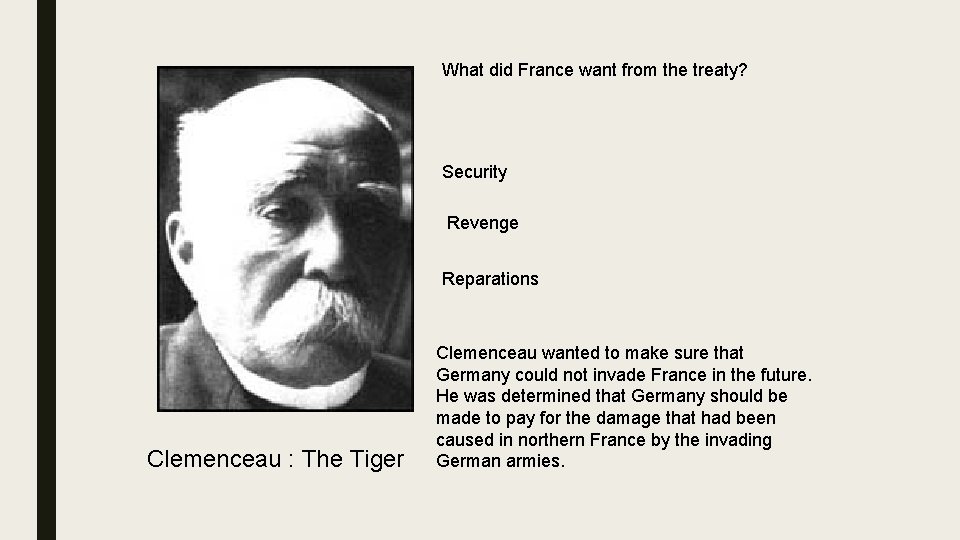
What did France want from the treaty? Security Revenge Reparations Clemenceau : The Tiger Clemenceau wanted to make sure that Germany could not invade France in the future. He was determined that Germany should be made to pay for the damage that had been caused in northern France by the invading German armies.
What did Britain Want? In public Lloyd-George said he wanted to punish the Germans. The British public was very anti-German at the end of the war. In private he realised that Britain needed Germany to recover because she was an important trading partner. David Lloyd-George He was also worried about the “disease from the east”, communism. The Russian government had been overthrown by a communist revolution in 1917. Lloyd-George believed that the spread of communism had to be stopped. A strong Germany would be a barrier against it.
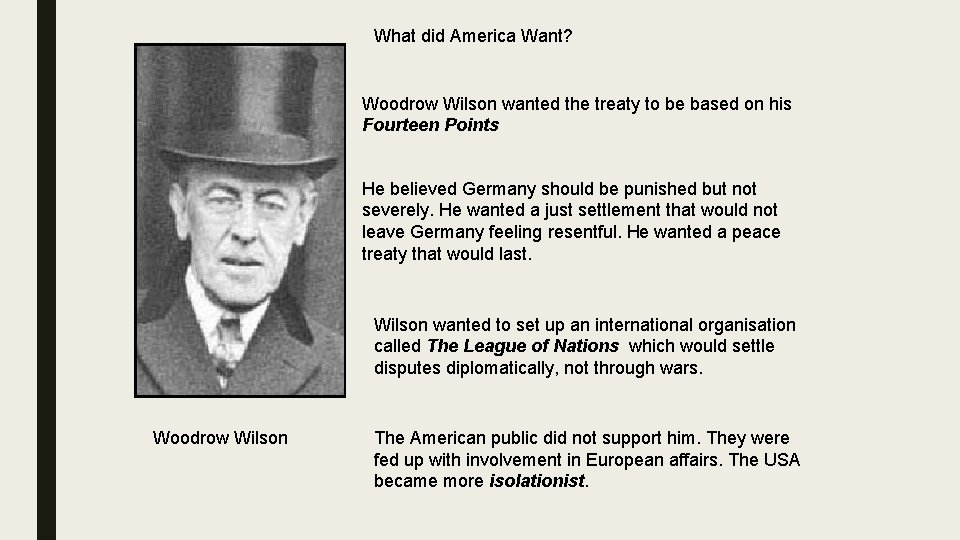
What did America Want? Woodrow Wilson wanted the treaty to be based on his Fourteen Points He believed Germany should be punished but not severely. He wanted a just settlement that would not leave Germany feeling resentful. He wanted a peace treaty that would last. Wilson wanted to set up an international organisation called The League of Nations which would settle disputes diplomatically, not through wars. Woodrow Wilson The American public did not support him. They were fed up with involvement in European affairs. The USA became more isolationist.
The Fourteen Points- A Plan for peace ■ Woodrow Wilson creates the Fourteen Points as America’s plan for peace. ■ This is the plan Woodrow Wilson will bring to the Treaty of Versailles
14 Points 1. Open Diplomacy – No secret alliances – Open covenants of peace, openly arrived at, after which there shall be no private international understandings of any kind but diplomacy shall proceed always frankly and in the public view. 2. Free Seas (Who might not like this? ) – Absolute freedom of navigation upon the seas, outside territorial waters, alike in peace and in war, except as the seas may be closed in whole or in part by international action for the enforcement of international covenants. 3. Free trade – The removal, so far as possible, of all economic barriers and the establishment of an equality of trade conditions among all the nations consenting to the peace and associating themselves for its maintenance. 4. Disarm, reduce armaments – Adequate guarantees given and taken that national armaments will be reduced to the lowest point consistent with domestic safety. 5. Impartial adjustment of colonial claims with regard for native peoples – A free, open-minded, and absolutely impartial adjustment of all colonial claims, based upon a strict observance of the principle that in determining all such questions of sovereignty the interests of the populations concerned must have equal weight with the equitable claims of the government whose title is to be determined.
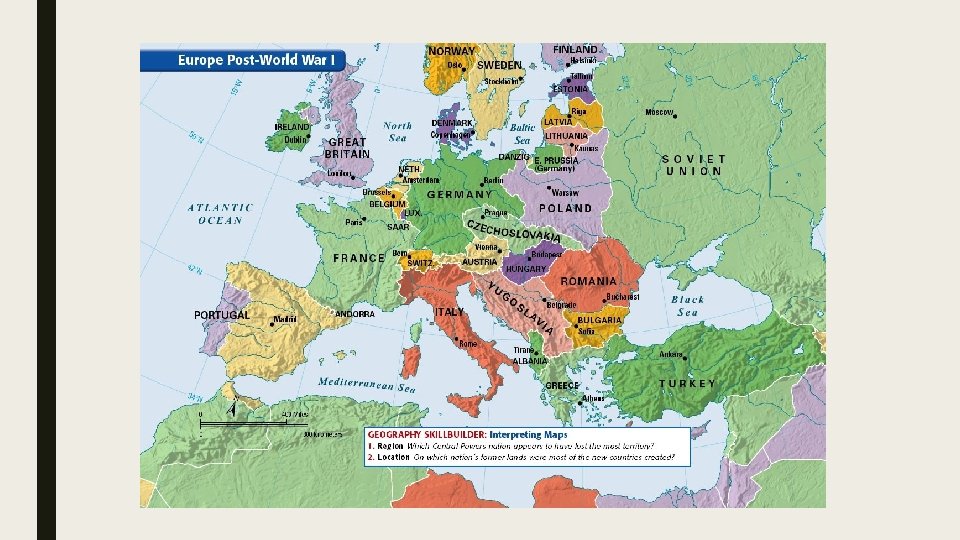
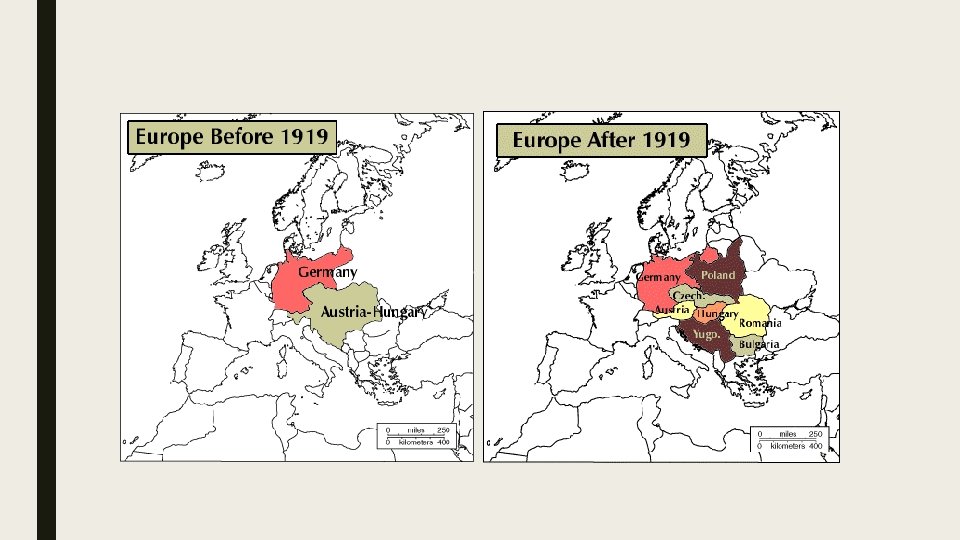
14 Points 6 -13 Restoration of prewar borders (Russia, Poland, Belgium, France, Italy), and self determination for Austria-Hungary and Ottoman Empire. Adjustment of European boundaries in accordance with the principle of nationality. i. e. , the right of any group to self determination regarding its own government and the form of an independent nation state. These points seek to spread the principles of democracy in Europe with the key being the concept of the ‘self determination of all peoples. The last of the Fourteen Points was another broad issue and the particular favorite of Wilson: 14. ***League of Nations to promote collective security and avoid unnecessary wars, through diplomacy **** – A general association of nations must be formed under specific covenants for the purpose of affording mutual guarantees of political independence and territorial integrity to great and small states alike.
14 Points ■ https: //www. youtube. com/watch? v=lbdhx. LVlrh. I
a. Explain the purpose of Point 14? What effect could this have on the world? Do you see any similarities to it today? b. Explain why other countries may be less inclined to be lenient on Germany compared to the U. S.
Think-Pair-Share ■ Many of Wilson’s points deal with the idea of self-determination for countries, the idea that areas should be able to choose whether or not they want to be part of a larger country. This was his solution to the problem of Nationalism in countries that consisted of many different ethnicities. Why might self-determination be a dangerous idea for the other victors to agree to?
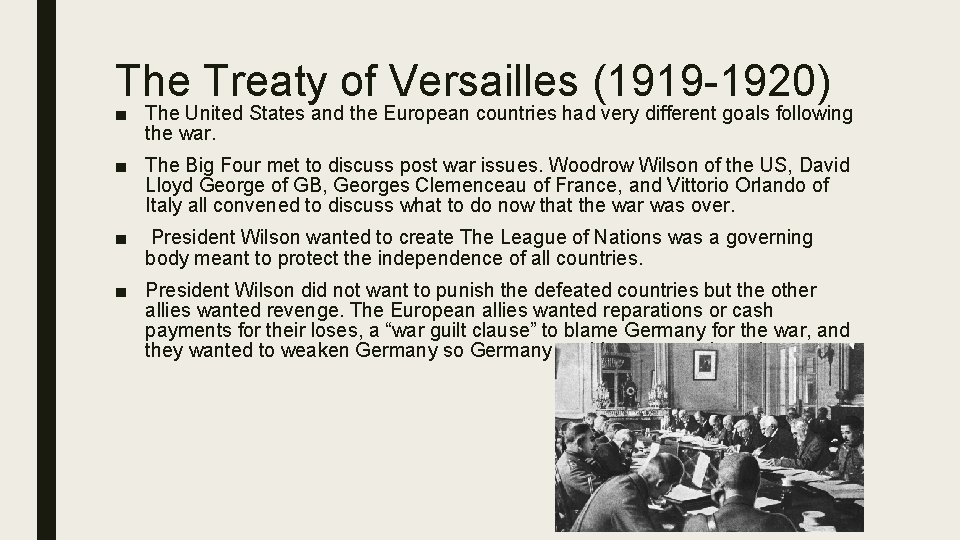
The Treaty of Versailles (1919 -1920) ■ The United States and the European countries had very different goals following the war. ■ The Big Four met to discuss post war issues. Woodrow Wilson of the US, David Lloyd George of GB, Georges Clemenceau of France, and Vittorio Orlando of Italy all convened to discuss what to do now that the war was over. ■ President Wilson wanted to create The League of Nations was a governing body meant to protect the independence of all countries. ■ President Wilson did not want to punish the defeated countries but the other allies wanted revenge. The European allies wanted reparations or cash payments for their loses, a “war guilt clause” to blame Germany for the war, and they wanted to weaken Germany so Germany could never attack again.
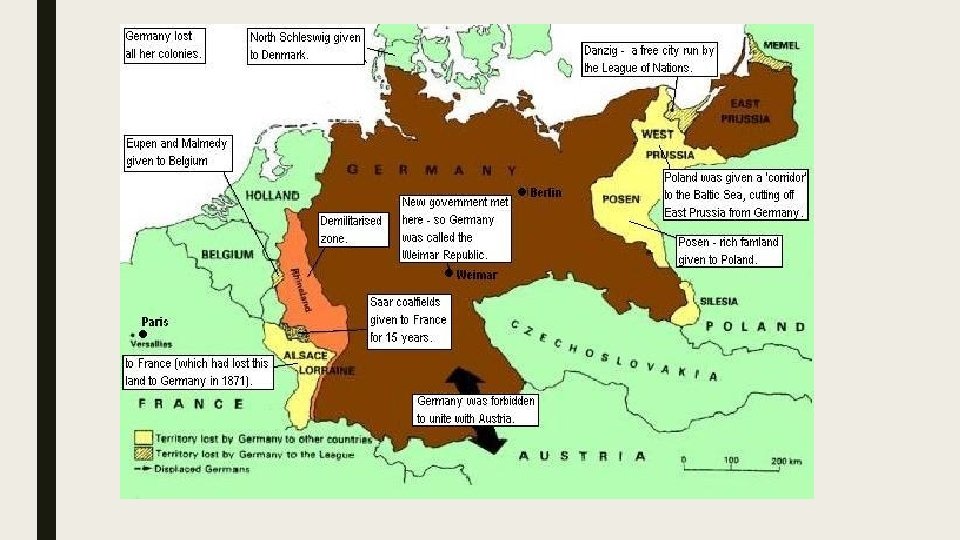
What actually happens at the Treaty of Versailles 1. Germany was not even invited to the meeting 2. Germany takes full blame for the war; “war guilt clause” 3. Germany had to pay reparations to the Allies over $30 Billion total 4. Limited the size of Germany’s military 5. Gave land back to France that Germany had taken 6. Took Germany’s overseas colonies and gave them to Great Britain and France 7. President Wilson got to keep some of his fourteen points, The League of Nations was created!
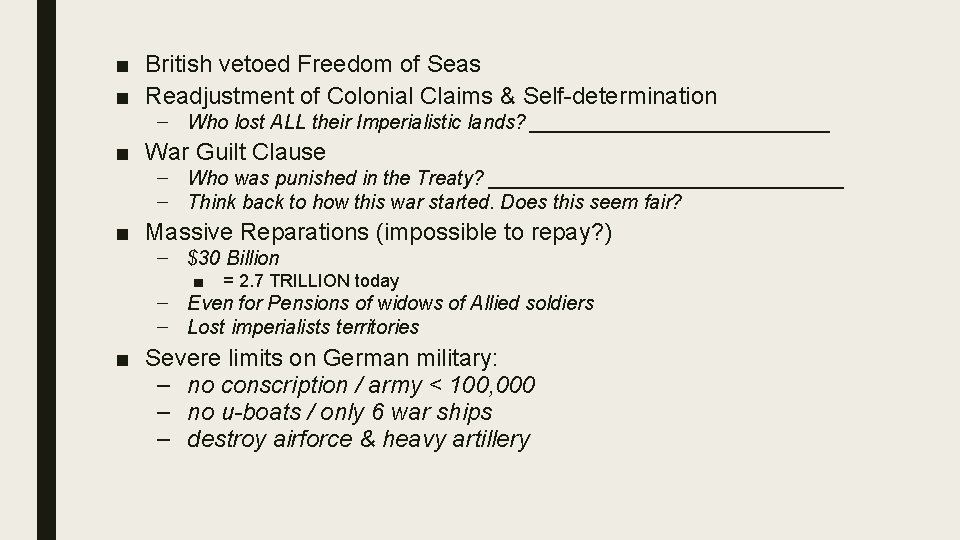
■ British vetoed Freedom of Seas ■ Readjustment of Colonial Claims & Self-determination – Who lost ALL their Imperialistic lands? ______________ ■ War Guilt Clause – Who was punished in the Treaty? ________________ – Think back to how this war started. Does this seem fair? ■ Massive Reparations (impossible to repay? ) – $30 Billion ■ = 2. 7 TRILLION today – Even for Pensions of widows of Allied soldiers – Lost imperialists territories ■ Severe limits on German military: – no conscription / army < 100, 000 – no u-boats / only 6 war ships – destroy airforce & heavy artillery
The War Guilt Clause "The Allied and Associated Governments affirm, and Germany accepts, the responsibility of Germany and her Allies for causing all the loss and damage to which the Allied and Associate Governments and their nationals have been subjected as a consequence of a war imposed upon them by the aggression of Germany and her Allies. " Article 231 GERMANY ACCEPTED RESPONSIBILITY FOR STARTING THE WAR
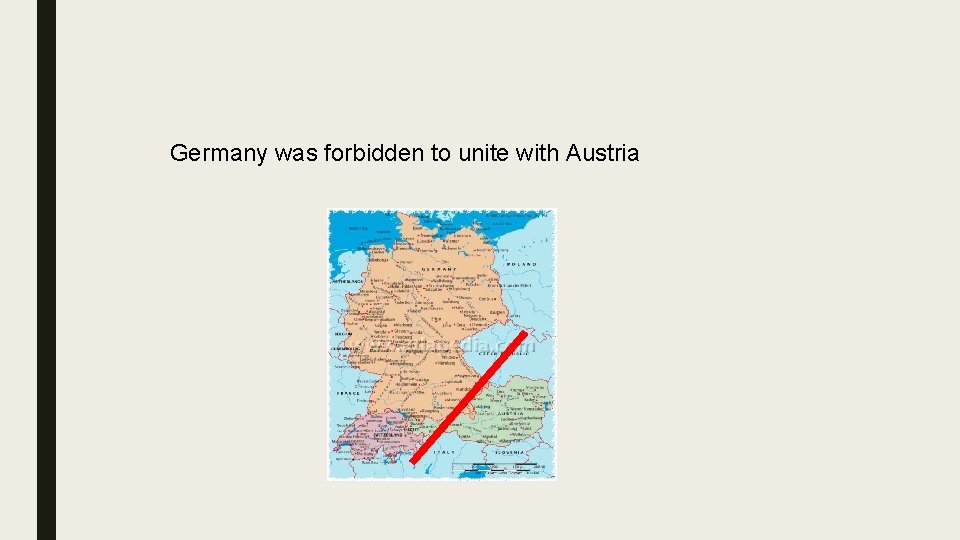
Germany was forbidden to unite with Austria
How did Germans React to the Treaty? Germans thought the Treaty was a “diktat” : a dictated peace. They had not been invited to the peace conference at Versailles and when the Treaty was presented to them they were threatened with war if they did not sign it. The Treaty was NOT based on Wilson’s Fourteen Points as the Germans had been promised it would. Most Germans believed that the War Guilt Clause was unjustified. The French and British had done just as much to start the war The loss of territory and population angered most Germans who believed that the losses were too severe. Many Germans believed the German economy would be crippled by having to pay reparations.
The Treaty of Versailles was signed on 28 th June 1919. It officially ended the 1 st World War. Many historians believe that it was a major cause of the 2 nd World War. Most Germans were horrified by the harshness of the Treaty. There was anger amongst all groups in Germany, no matter what their political beliefs. Some German newspapers called for revenge for the humiliation of Versailles. However anger was also directed against the government in Germany. Already there was a myth growing in the country that the German army had been “stabbed in the back” by politicians…the so called “November Criminals”. Now these same politicians had signed the “Diktat”, the dictated peace. The new democracy in Germany was now closely linked with the humiliation of Versailles.
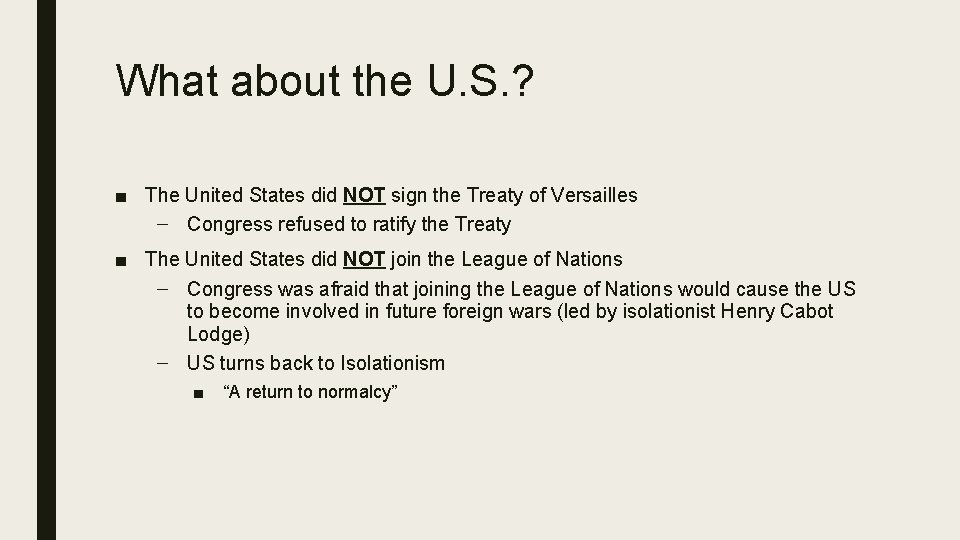
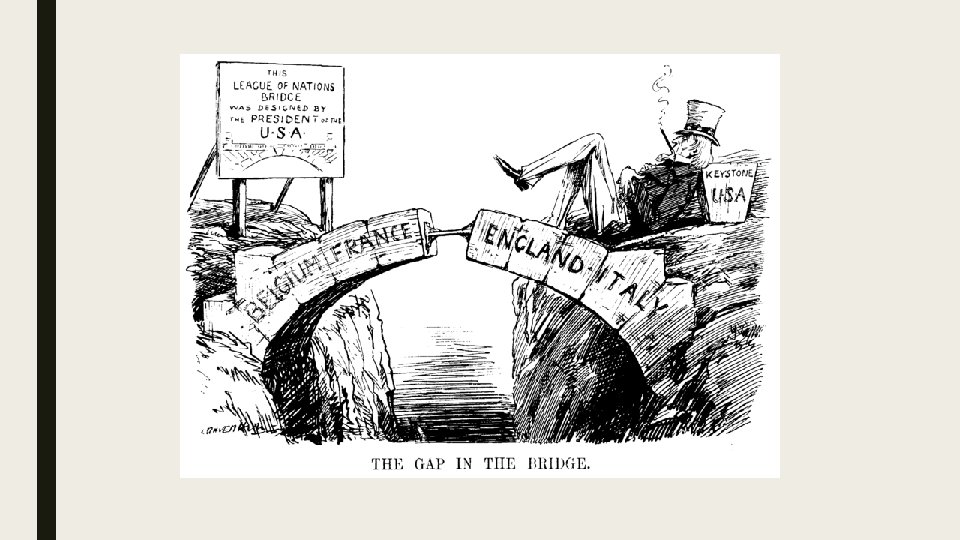
What about the U. S. ? ■ The United States did NOT sign the Treaty of Versailles – Congress refused to ratify the Treaty ■ The United States did NOT join the League of Nations – Congress was afraid that joining the League of Nations would cause the US to become involved in future foreign wars (led by isolationist Henry Cabot Lodge) – US turns back to Isolationism ■ “A return to normalcy”
Treaty of Versailles/ League of Nations ■ https: //www. youtube. com/watch? v=r 0 ldr 18 Rnho