
14 Pastry Basics Copyright 2017 by John Wiley
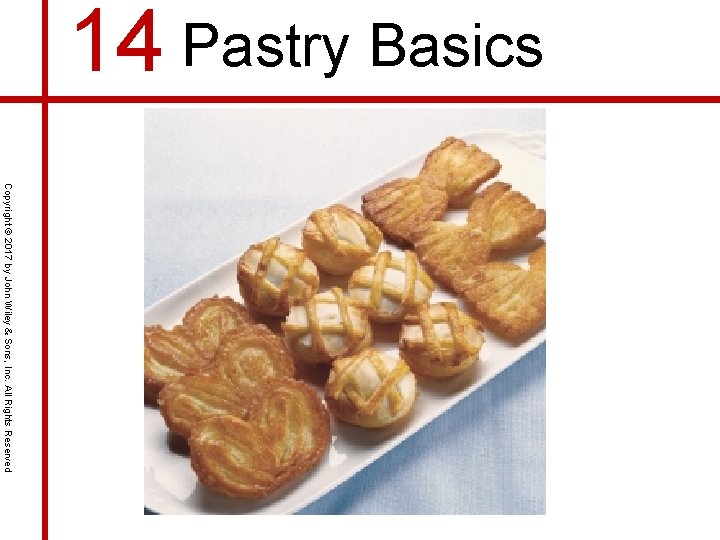
14 Pastry Basics Copyright © 2017 by John Wiley & Sons, Inc. All Rights Reserved
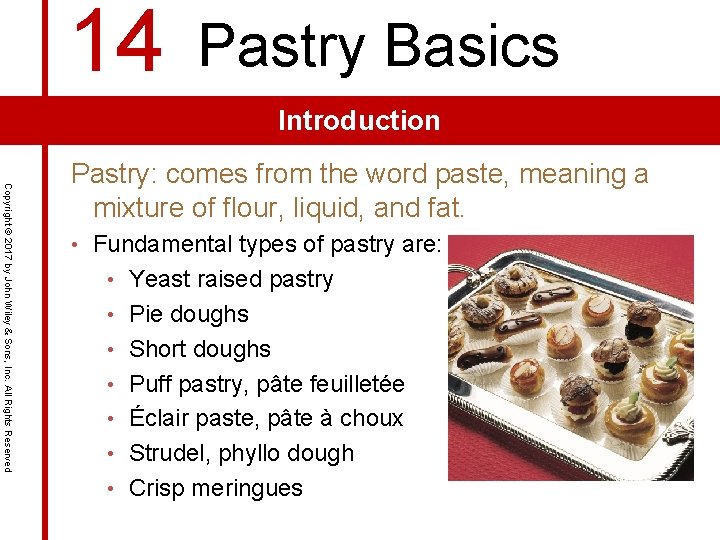
14 Pastry Basics Introduction Copyright © 2017 by John Wiley & Sons, Inc. All Rights Reserved Pastry: comes from the word paste, meaning a mixture of flour, liquid, and fat. • Fundamental types of pastry are: • Yeast raised pastry • Pie doughs • Short doughs • Puff pastry, pâte feuilletée • Éclair paste, pâte à choux • Strudel, phyllo dough • Crisp meringues
14 Pastry Basics Pȃte Brisée and Short Pastries Copyright © 2017 by John Wiley & Sons, Inc. All Rights Reserved • Pâte Brisée is mixed like mealy pie dough. (The French name means “broken dough. ”) • Pâte Sucrée is mixed by the creaming method. This dough is fragile and usually used for tartlets and petit fours.
14 Pastry Basics Puff Pastry Copyright © 2017 by John Wiley & Sons, Inc. All Rights Reserved Puff pastry is a laminated or rolled-in dough. • It can rise to 8 times its original height. • Steam is the leavening agent. • Butter is the preferred fat because of its flavor and melt in the mouth quality. • Special puff pastry shortenings are available but not as desirable as butter. • The quantity of rolled in fat may vary from 50%100% of the weight of the flour.
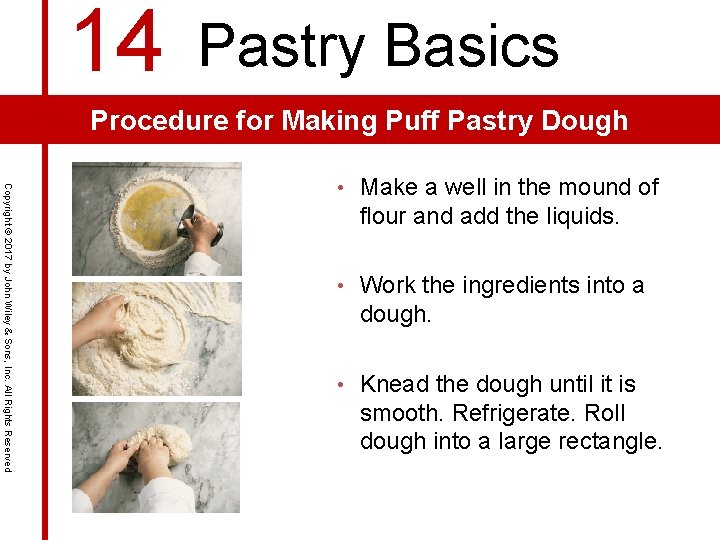
14 Pastry Basics Procedure for Making Puff Pastry Dough Copyright © 2017 by John Wiley & Sons, Inc. All Rights Reserved • Make a well in the mound of flour and add the liquids. • Work the ingredients into a dough. • Knead the dough until it is smooth. Refrigerate. Roll dough into a large rectangle.
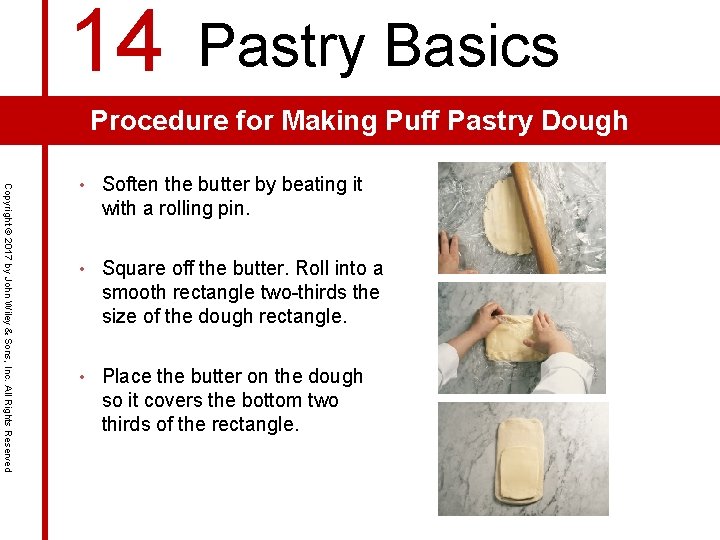
14 Pastry Basics Procedure for Making Puff Pastry Dough Copyright © 2017 by John Wiley & Sons, Inc. All Rights Reserved • Soften the butter by beating it with a rolling pin. • Square off the butter. Roll into a smooth rectangle two-thirds the size of the dough rectangle. • Place the butter on the dough so it covers the bottom two thirds of the rectangle.

14 Pastry Basics Procedure for Making Puff Pastry Dough Copyright © 2017 by John Wiley & Sons, Inc. All Rights Reserved • Fold down the top unbuttered third of the dough so it covers half the butter. • Fold the bottom third over the center. • Roll the dough into a long rectangle.
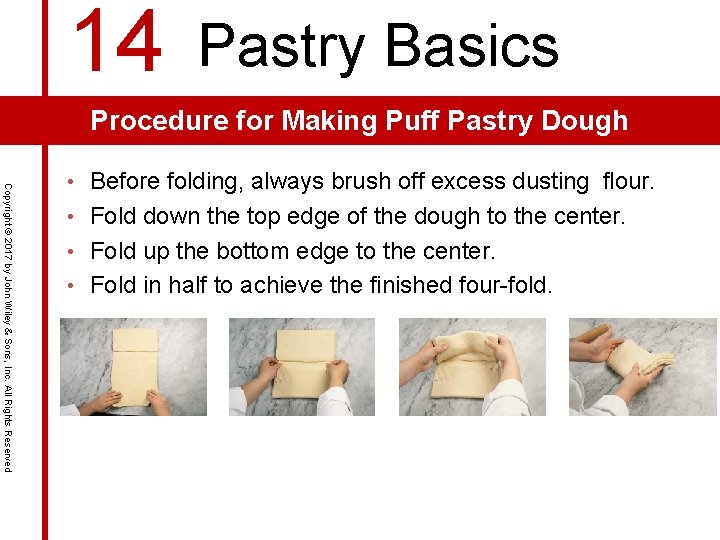
14 Pastry Basics Procedure for Making Puff Pastry Dough Copyright © 2017 by John Wiley & Sons, Inc. All Rights Reserved • Before folding, always brush off excess dusting flour. • Fold down the top edge of the dough to the center. • Fold up the bottom edge to the center. • Fold in half to achieve the finished four-fold.
14 Pastry Basics Guidelines for Makeup Puff Pastry Copyright © 2017 by John Wiley & Sons, Inc. All Rights Reserved • The dough should be cool and firm when it is rolled • • • and cut. Cut straight down with firm, even cuts. Avoid touching the cut edges with your fingers. For best rising, place units upside down on baking sheets. Avoid letting egg wash run down edges. Rest made-up products for 30 minutes in a cool place before baking. Trimmings may be pressed together, keeping the layers in the same direction.
14 Pastry Basics Guidelines for Baking Puff Pastry Copyright © 2017 by John Wiley & Sons, Inc. All Rights Reserved • Baking temperatures of 400° to 425°F (200° to 220°C) are best for most puff dough products. • Bake larger products starting at a high temperature until they are well risen and then turn the temperature down and finish baking until crisp.
14 Pastry Basics Éclair Paste Copyright © 2017 by John Wiley & Sons, Inc. All Rights Reserved Éclairs and cream puffs are made from a dough called éclair paste or choux paste. • • The French name pâte à choux means “cabbage paste, ” referring the resemblance of cream puffs to little cabbages. Procedure for making éclair paste: • Bring the liquid, fat, salt, and sugar to a boil. • Add the flour all at once and stir until the paste forms a ball and pulls away from the sides of the pan. • • Remove the paste from the heat and let it cool to 140°F (60°C). Beat in the eggs a little at a time. Completely mix in each addition of eggs before adding more.
14 Pastry Basics Éclair Paste Copyright © 2017 by John Wiley & Sons, Inc. All Rights Reserved Éclair paste is leavened by steam. • The steam expands the product rapidly and forms large holes in the • • center of the item. The gluten and egg proteins coagulate and set the structure. A strong flour is needed for structure. It must be firm enough to hold its shape when piped from a pastry bag. Proper baking temperatures are vital. • Start at a high temperature (425°F/220°C) for 15 minutes. • Then reduce to 375°F/190°C to finish baking. • Cool slowly in a warm place.
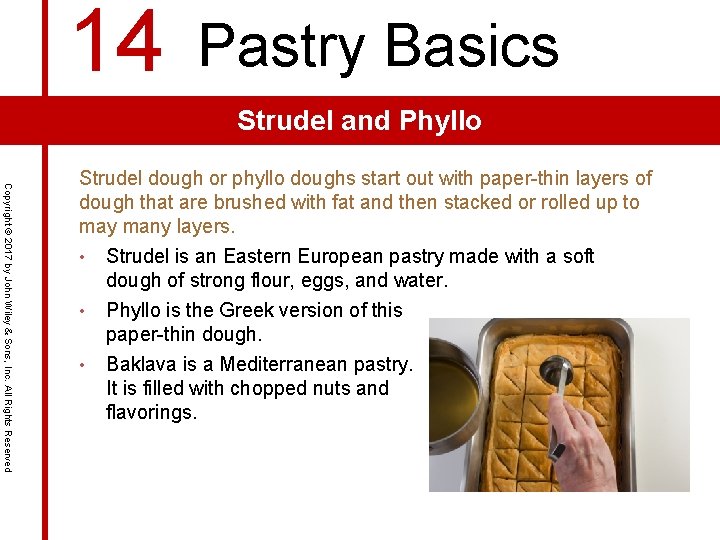
14 Pastry Basics Strudel and Phyllo Copyright © 2017 by John Wiley & Sons, Inc. All Rights Reserved Strudel dough or phyllo doughs start out with paper-thin layers of dough that are brushed with fat and then stacked or rolled up to may many layers. • Strudel is an Eastern European pastry made with a soft dough of strong flour, eggs, and water. • Phyllo is the Greek version of this paper-thin dough. • Baklava is a Mediterranean pastry. It is filled with chopped nuts and flavorings.
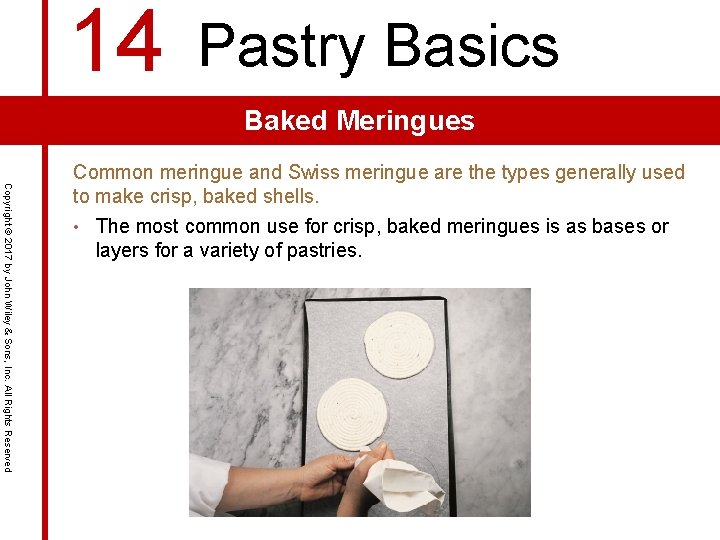
14 Pastry Basics Baked Meringues Copyright © 2017 by John Wiley & Sons, Inc. All Rights Reserved Common meringue and Swiss meringue are the types generally used to make crisp, baked shells. • The most common use for crisp, baked meringues is as bases or layers for a variety of pastries.
- Slides: 14