
14 P Multiple Integration Copyright Cengage Learning All



- Slides: 17
14 P Multiple Integration Copyright © Cengage Learning. All rights reserved.
14. 8 Change of Variables: Jacobians Copyright © Cengage Learning. All rights reserved.
Objectives n Understand the concept of a Jacobian. n Use a Jacobian to change variables in a double integral. 3
Jacobians 4
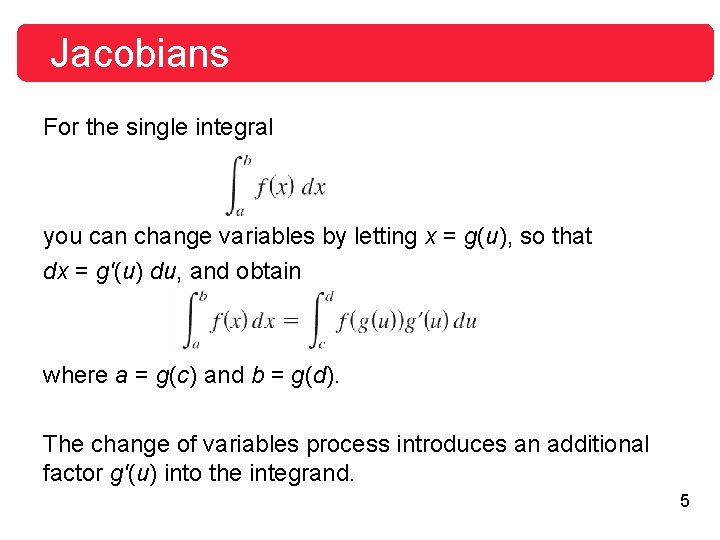
Jacobians For the single integral you can change variables by letting x = g(u), so that dx = g′(u) du, and obtain where a = g(c) and b = g(d). The change of variables process introduces an additional factor g′(u) into the integrand. 5
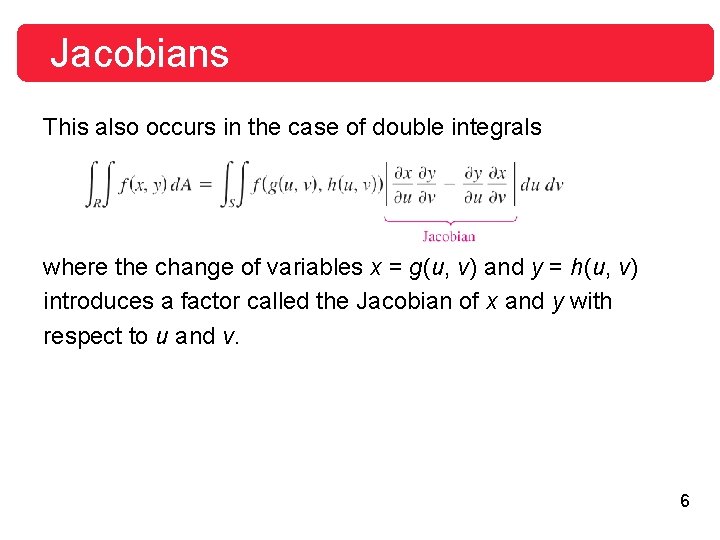
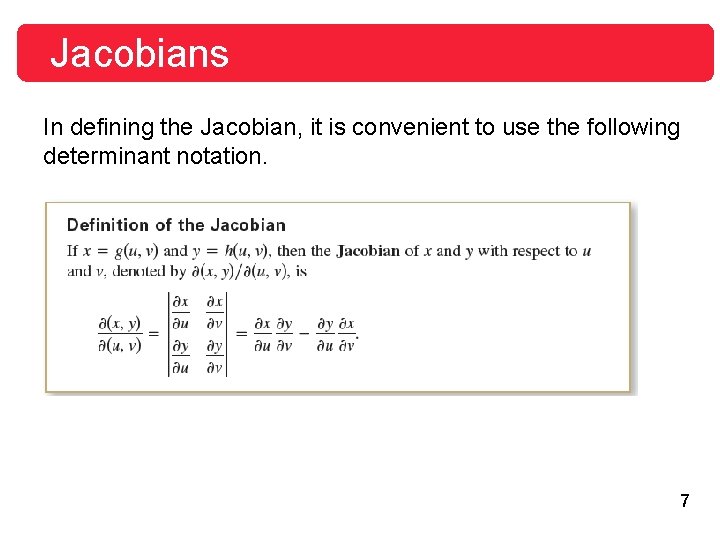
Jacobians This also occurs in the case of double integrals where the change of variables x = g(u, v) and y = h(u, v) introduces a factor called the Jacobian of x and y with respect to u and v. 6
Jacobians In defining the Jacobian, it is convenient to use the following determinant notation. 7
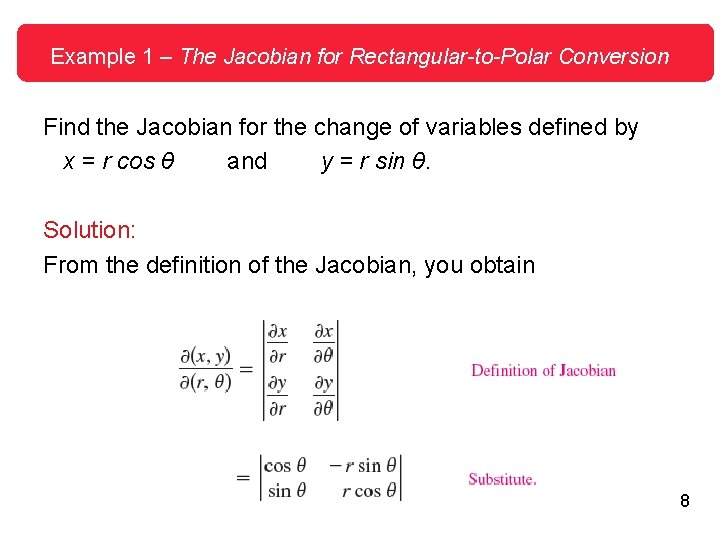
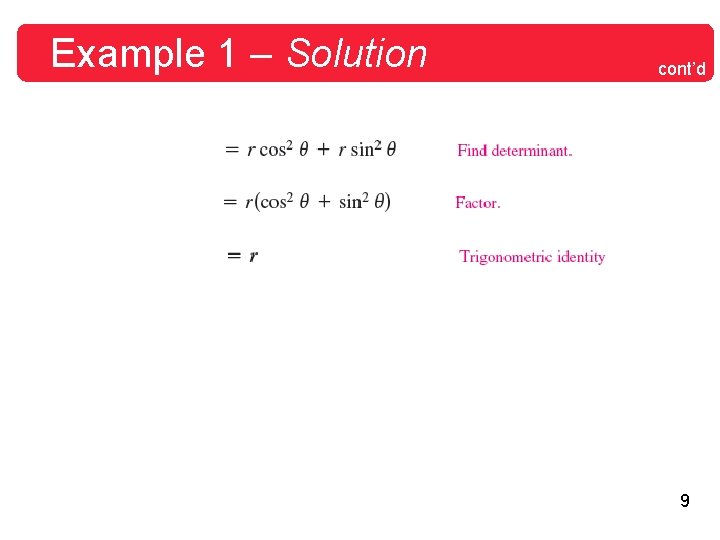
Example 1 – The Jacobian for Rectangular-to-Polar Conversion Find the Jacobian for the change of variables defined by x = r cos θ and y = r sin θ. Solution: From the definition of the Jacobian, you obtain 8
Example 1 – Solution cont’d 9
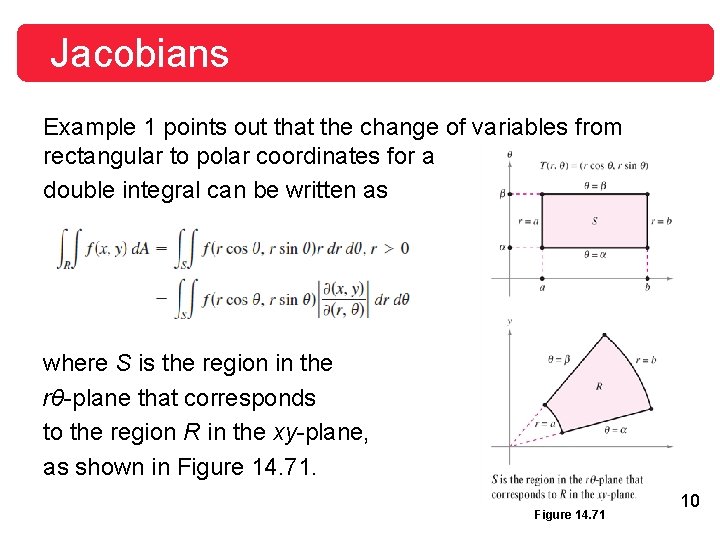
Jacobians Example 1 points out that the change of variables from rectangular to polar coordinates for a double integral can be written as where S is the region in the rθ-plane that corresponds to the region R in the xy-plane, as shown in Figure 14. 71 10
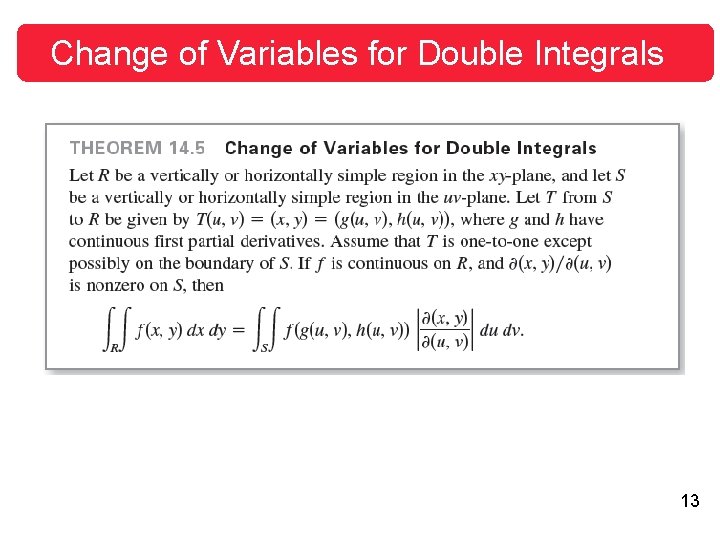
Jacobians In general, a change of variables using a one-to-one transformation T from a region S in the uv-plane to a region R in the xy-plane is given by T(u, v) = (x, y) = (g(u, v), h(u, v)) where g and h have continuous first partial derivatives in the region S. Note that the point (u, v) lies in S and the point (x, y) lies in R. In most cases, you are hunting for a transformation in which the region S is simpler than the region R. 11
Change of Variables for Double Integrals 12
Change of Variables for Double Integrals 13
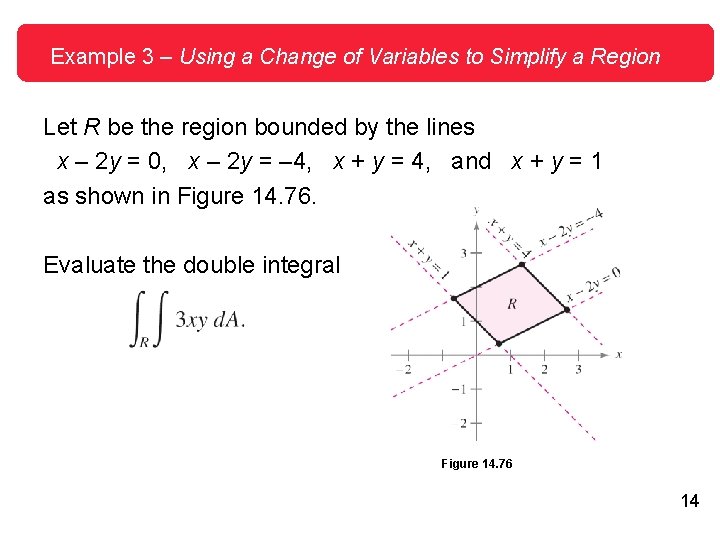
Example 3 – Using a Change of Variables to Simplify a Region Let R be the region bounded by the lines x – 2 y = 0, x – 2 y = – 4, x + y = 4, and x + y = 1 as shown in Figure 14. 76. Evaluate the double integral Figure 14. 76 14
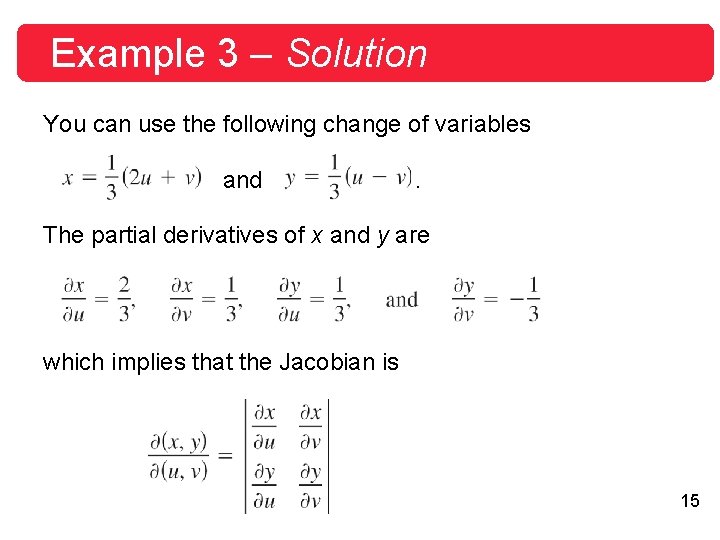
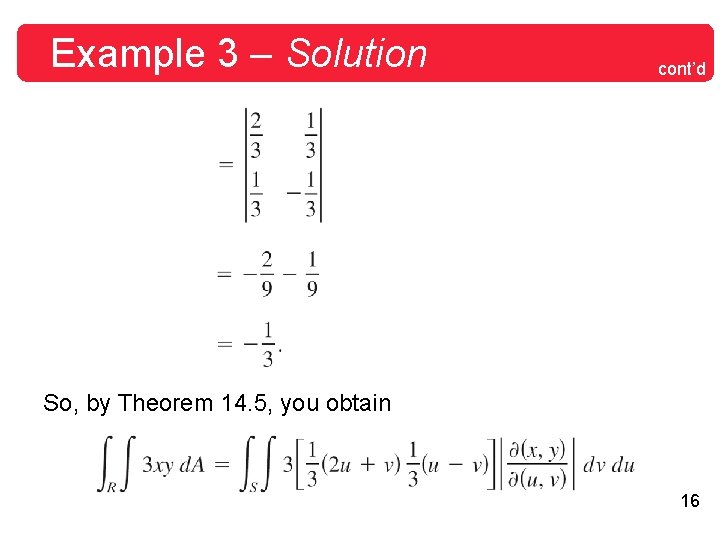
Example 3 – Solution You can use the following change of variables and . The partial derivatives of x and y are which implies that the Jacobian is 15
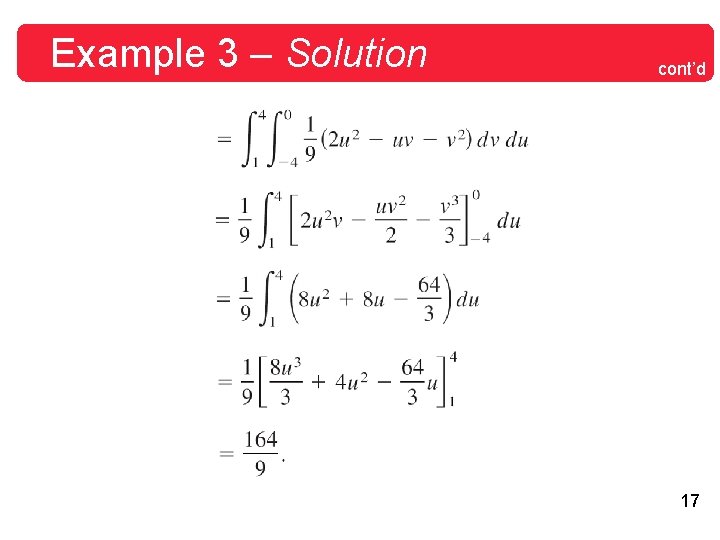
Example 3 – Solution cont’d So, by Theorem 14. 5, you obtain 16
Example 3 – Solution cont’d 17