
14 Oligopoly and Strategic Behavior Mc GrawHillIrwin Copyright
14 Oligopoly and Strategic Behavior Mc. Graw-Hill/Irwin Copyright © 2012 by The Mc. Graw-Hill Companies, Inc. All rights reserved.
Oligopoly • A few large producers • Homogeneous or differentiated • • • LO 3 products Limited control over price • Mutual interdependence • Strategic behavior Entry barriers Mergers
Oligopolistic Industries • Four-firm concentration ratio • 40% or more to be oligopoly • Shortcomings • Localized markets • Inter-industry competition • World price • Dominant firms – Herfindahl Index LO 3
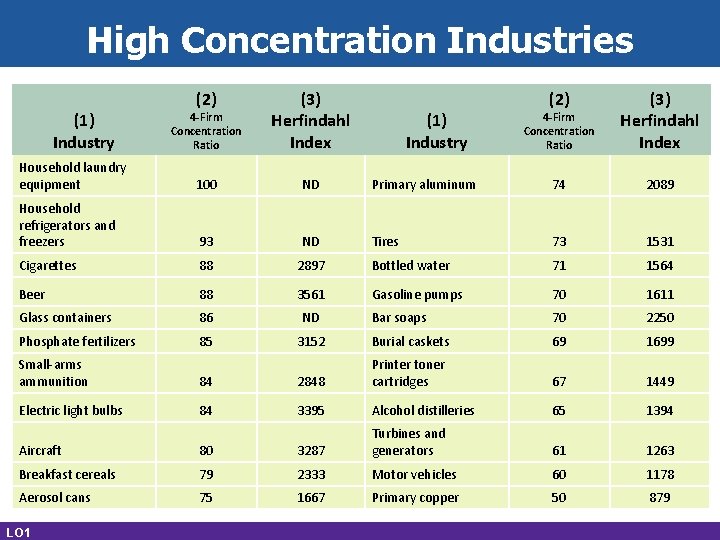
High Concentration Industries (2) 4 -Firm Concentration Ratio (3) Herfindahl Index Household laundry equipment 100 ND Primary aluminum 74 2089 Household refrigerators and freezers 93 ND Tires 73 1531 Cigarettes 88 2897 Bottled water 71 1564 Beer 88 3561 Gasoline pumps 70 1611 Glass containers 86 ND Bar soaps 70 2250 Phosphate fertilizers 85 3152 Burial caskets 69 1699 67 1449 (1) Industry Small-arms ammunition 84 2848 Printer toner cartridges Electric light bulbs 84 3395 Alcohol distilleries 65 1394 61 1263 Aircraft 80 3287 Turbines and generators Breakfast cereals 79 2333 Motor vehicles 60 1178 Aerosol cans 75 1667 Primary copper 50 879 LO 1
Oligopoly Behavior • Game theory • Profit matrix – Shows the profits for each firm based on the firm’s actions and his rivals actions. • Collusion – Incentive to cheat – Prisoner’s dilemma LO 3
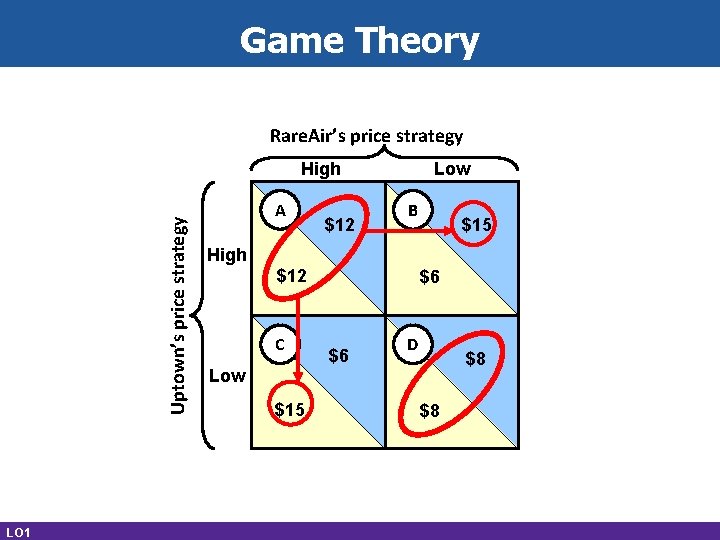
Game Theory Rare. Air’s price strategy Uptown’s price strategy High LO 1 A $12 Low B $15 High $12 C $6 $6 D $8 Low $15 $8
3 Oligopoly Models • Kinked Demand Curve • Collusive Pricing • Price Leadership • Reasons for 3 models • Diversity of oligopolies • Complications of interdependence LO 5
Kinked Demand Curve • Criticisms • Explains inflexibility, not price • Prices are not that rigid • Price wars LO 6
Overt Collusion • Collusion reduces uncertainty, • • LO 6 improves control of price, profits rise, and prevents entry of firms Cartels - a group of firms or nations that collude • Formally written agreement • Sets output levels and price for members OPEC
Covert Collusion • Gentleman’s agreements • Informal understandings often in social settings between firms about price and output LO 6
Obstacles to Collusion • Demand cost differences • Number of firms • Cheating • Recession • New entrants • Legal obstacles • Golden Balls LO 6
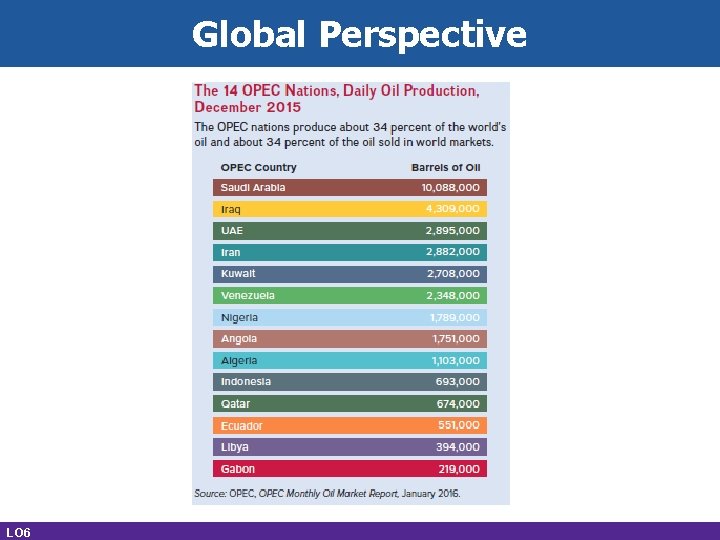
Global Perspective LO 6
Price Leadership Model • Price Leadership • Dominant firm initiates price • • LO 6 changes • Communicates price change • Other firms follow the leader Use limit pricing to block entry of new firms Possible price war
Positive Effects of Advertising • Low cost way of providing information • • • LO 7 to customers Enhances competition Speeds up technological progress Helps firms attain economies of scale

Negative Effects of Advertising • Can be manipulative • Contains misleading claims that • LO 7 confuse consumers Consumers may pay high prices for a good while forgoing a better, lower priced, unadvertised good
Oligopoly and Efficiency • Oligopolies are inefficient • Productively inefficient P > min. ATC • Allocatively inefficient P > MC • Qualifications • Increased foreign competition • Limit pricing • Technological advance LO 7
One-Time Game: Strategy • One-time game • Simultaneous game • Positive sum game LO 7
One-Time Game: Strategy • One-time game • Simultaneous game • Positive sum game LO 7
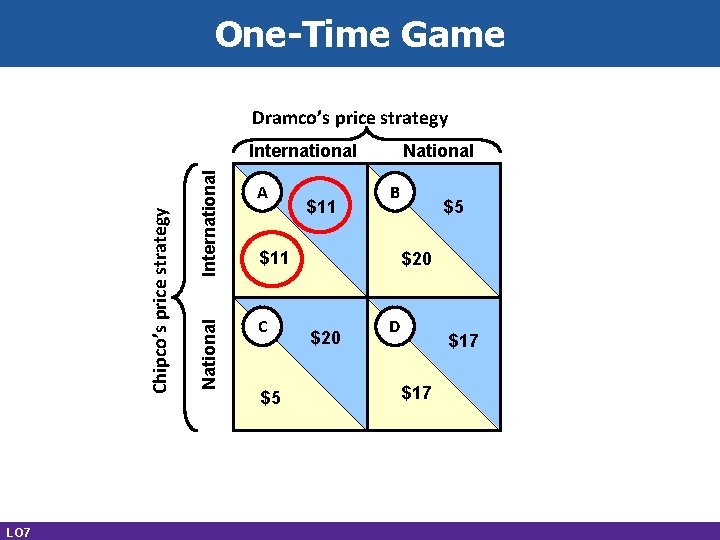
One-Time Game Dramco’s price strategy LO 7 International National Chipco’s price strategy International A $11 National B $11 C $5 $5 $20 D $17
A One-Time Game: Equilibrium • Nash Equilibrium • Outcome from which neither firm wants to deviate • Current strategy viewed as optimal • Stable and persistent outcome LO 7
Credible and Empty Threats • Credible threats • • • Threat is believable Can be used for collusion A strong enforcer can prevent cheating Can generate higher profits May be countered by rival firm • Empty threats • Threat is not believable LO 7
Repeated Games • Game recurs • May cooperate and choose not to • LO 7 compete strongly Rival reciprocates
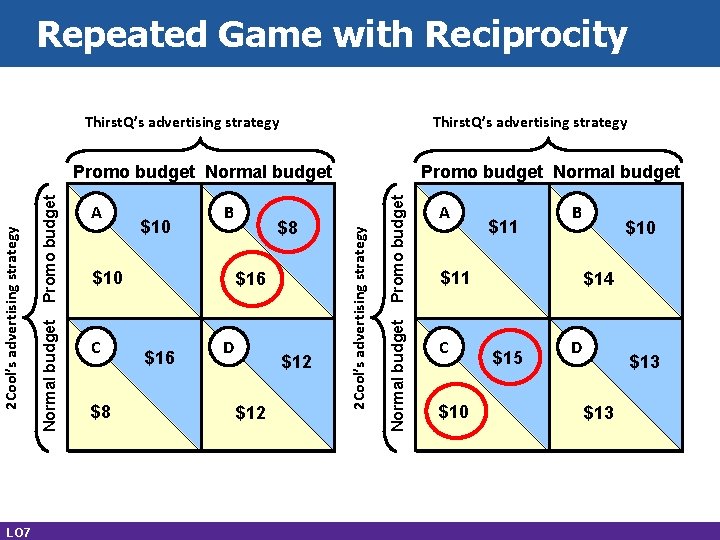
Repeated Game with Reciprocity Thirst. Q’s advertising strategy LO 7 $10 B $10 C $8 $8 $16 D $12 Normal budget Promo budget A Promo budget Normal budget 2 Cool’s advertising strategy Normal budget Promo budget 2 Cool’s advertising strategy Promo budget Normal budget A $11 B $11 C $10 $14 $15 D $13
Sequential Game • Firms move sequentially • Final outcome is dependent on who • moves first First Mover Advantage • • • LO 7 Advantages for the firm that is first May be better prepared May preempt entry of rival
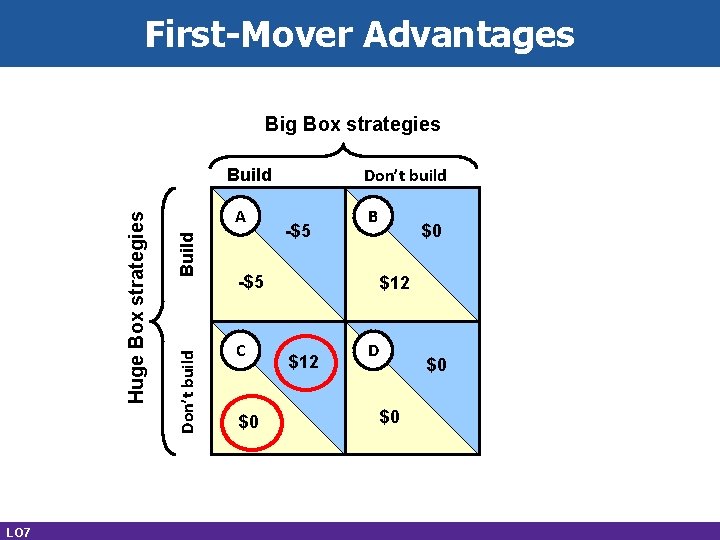
First-Mover Advantages Big Box strategies Don’t build LO 7 Build A Don’t build Huge Box strategies Build -$5 B -$5 C $0 $0 $12 D $0 $0
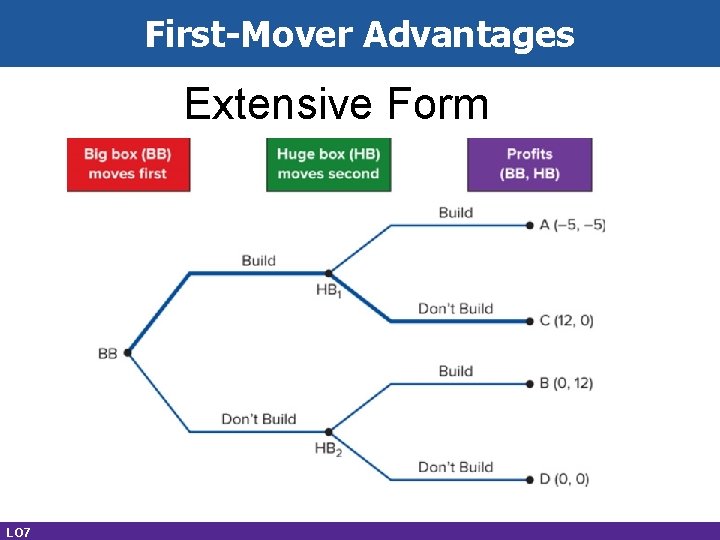
First-Mover Advantages Extensive Form LO 7
Extensive Form • Subgame perfect Nash Equilibrium • Stackelberg Duopoly • Leader-follower game LO 7
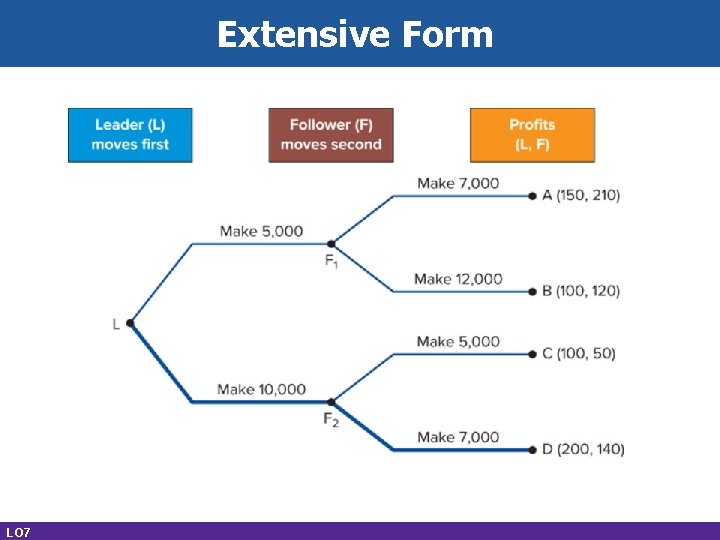
Extensive Form LO 7
- Slides: 28