
14 NH THz Rotational transition lines of 3
- Slides: 1
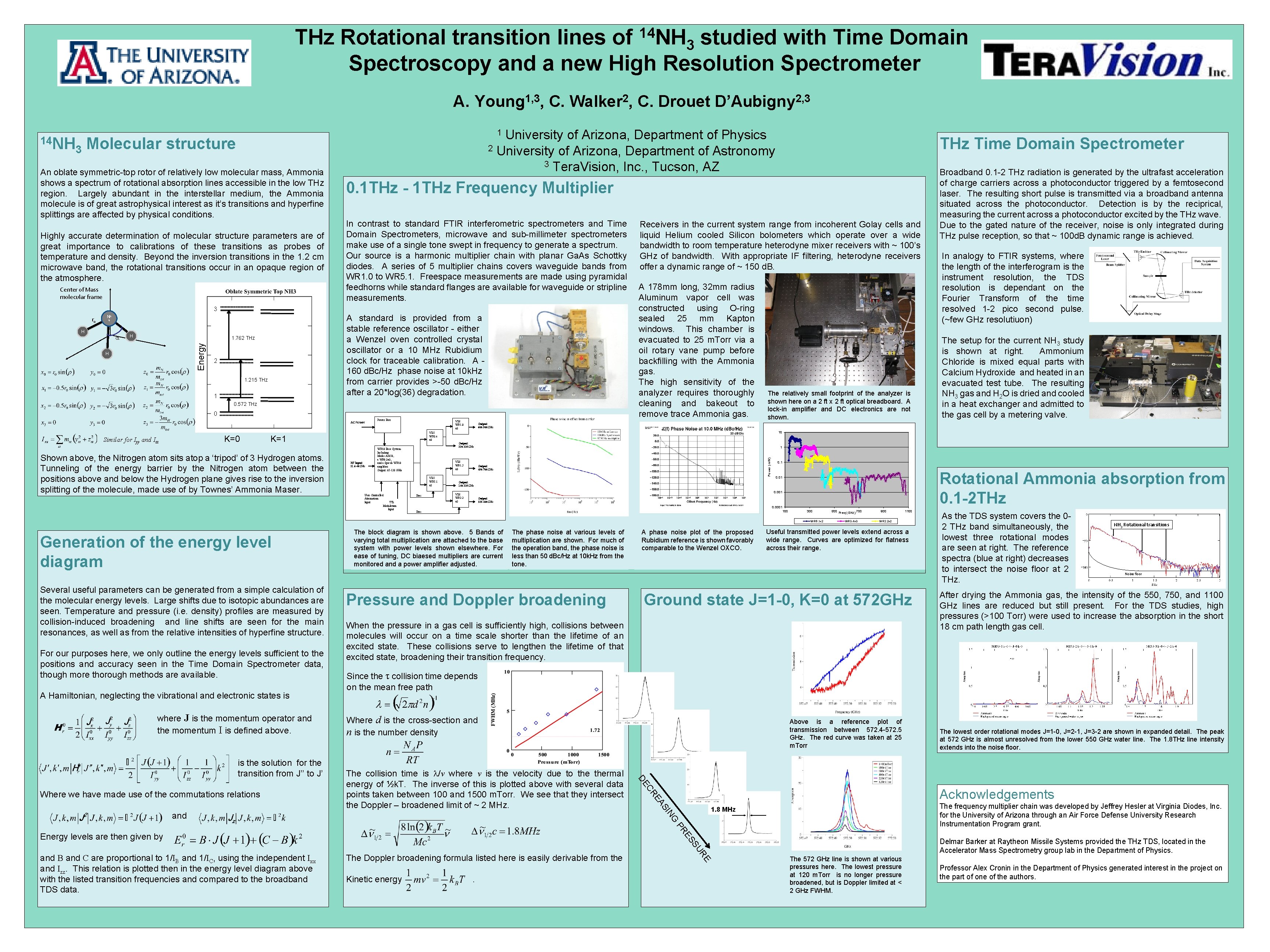
14 NH THz Rotational transition lines of 3 studied with Time Domain Spectroscopy and a new High Resolution Spectrometer A. Young 1, 3, C. Walker 2, C. Drouet D’Aubigny 2, 3 14 NH 3 University of Arizona, Department of Physics 2 University of Arizona, Department of Astronomy 3 Tera. Vision, Inc. , Tucson, AZ 1 Molecular structure An oblate symmetric-top rotor of relatively low molecular mass, Ammonia shows a spectrum of rotational absorption lines accessible in the low THz region. Largely abundant in the interstellar medium, the Ammonia molecule is of great astrophysical interest as it’s transitions and hyperfine splittings are affected by physical conditions. Highly accurate determination of molecular structure parameters are of great importance to calibrations of these transitions as probes of temperature and density. Beyond the inversion transitions in the 1. 2 cm microwave band, the rotational transitions occur in an opaque region of the atmosphere. THz Time Domain Spectrometer 0. 1 THz - 1 THz Frequency Multiplier In contrast to standard FTIR interferometric spectrometers and Time Domain Spectrometers, microwave and sub-millimeter spectrometers make use of a single tone swept in frequency to generate a spectrum. Our source is a harmonic multiplier chain with planar Ga. As Schottky diodes. A series of 5 multiplier chains covers waveguide bands from WR 1. 0 to WR 5. 1. Freespace measurements are made using pyramidal feedhorns while standard flanges are available for waveguide or stripline measurements. Receivers in the current system range from incoherent Golay cells and liquid Helium cooled Silicon bolometers which operate over a wide bandwidth to room temperature heterodyne mixer receivers with ~ 100’s GHz of bandwidth. With appropriate IF filtering, heterodyne receivers offer a dynamic range of ~ 150 d. B. 3 Energy 1. 762 THz 2 1 0. 572 THz 0 K=0 In analogy to FTIR systems, where the length of the interferogram is the instrument resolution, the TDS resolution is dependant on the Fourier Transform of the time resolved 1 -2 pico second pulse. (~few GHz resolutiuon) The setup for the current NH 3 study is shown at right. Ammonium Chloride is mixed equal parts with Calcium Hydroxide and heated in an evacuated test tube. The resulting NH 3 gas and H 2 O is dried and cooled in a heat exchanger and admitted to the gas cell by a metering valve. 1. 215 THz Similar for Iyy and Izz Broadband 0. 1 -2 THz radiation is generated by the ultrafast acceleration of charge carriers across a photoconductor triggered by a femtosecond laser. The resulting short pulse is transmitted via a broadband antenna situated across the photoconductor. Detection is by the reciprical, measuring the current across a photoconductor excited by the THz wave. Due to the gated nature of the receiver, noise is only integrated during THz pulse reception, so that ~ 100 d. B dynamic range is achieved. K=1 Power (m. W) Shown above, the Nitrogen atom sits atop a ‘tripod’ of 3 Hydrogen atoms. Tunneling of the energy barrier by the Nitrogen atom between the positions above and below the Hydrogen plane gives rise to the inversion splitting of the molecule, made use of by Townes’ Ammonia Maser. Rotational Ammonia absorption from 0. 1 -2 THz Freq (GHz) Generation of the energy level diagram Several useful parameters can be generated from a simple calculation of the molecular energy levels. Large shifts due to isotopic abundances are seen. Temperature and pressure (i. e. density) profiles are measured by collision-induced broadening and line shifts are seen for the main resonances, as well as from the relative intensities of hyperfine structure. For our purposes here, we only outline the energy levels sufficient to the positions and accuracy seen in the Time Domain Spectrometer data, though more thorough methods are available. Pressure and Doppler broadening When the pressure in a gas cell is sufficiently high, collisions between molecules will occur on a time scale shorter than the lifetime of an excited state. These collisions serve to lengthen the lifetime of that excited state, broadening their transition frequency. Ground state J=1 -0, K=0 at 572 GHz As the TDS system covers the 02 THz band simultaneously, the lowest three rotational modes are seen at right. The reference spectra (blue at right) decreases to intersect the noise floor at 2 THz. NH 3 Rotational transitions Noise floor After drying the Ammonia gas, the intensity of the 550, 750, and 1100 GHz lines are reduced but still present. For the TDS studies, high pressures (>100 Torr) were used to increase the absorption in the short 18 cm path length gas cell. A Hamiltonian, neglecting the vibrational and electronic states is where J is the momentum operator and the momentum I is defined above. is the solution for the transition from J’’ to J’ Where we have made use of the commutations relations The lowest order rotational modes J=1 -0, J=2 -1, J=3 -2 are shown in expanded detail. The peak at 572 GHz is almost unresolved from the lower 550 GHz water line. The 1. 8 THz line intensity extends into the noise floor. The collision time is l/v where v is the velocity due to thermal energy of ½k. T. The inverse of this is plotted above with several data points taken between 100 and 1500 m. Torr. We see that they intersect the Doppler – broadened limit of ~ 2 MHz. and Energy levels are then given by and B and C are proportional to 1/IB and 1/IC, using the independent Ixx and Izz. This relation is plotted then in the energy level diagram above with the listed transition frequencies and compared to the broadband TDS data. The Doppler broadening formula listed here is easily derivable from the Kinetic energy . Acknowledgements The frequency multiplier chain was developed by Jeffrey Hesler at Virginia Diodes, Inc. for the University of Arizona through an Air Force Defense University Research Instrumentation Program grant. Delmar Barker at Raytheon Missile Systems provided the THz TDS, located in the Accelerator Mass Spectrometry group lab in the Department of Physics. Professor Alex Cronin in the Department of Physics generated interest in the project on the part of one of the authors.