
14 Glycolysis Gluconeogenesis and the Pentose Phosphate Pathway

- Slides: 50
14| Glycolysis, Gluconeogenesis, and the Pentose Phosphate Pathway © 2017 W. H. Freeman and Company
CHAPTER 14 Glycolysis, Gluconeogenesis, and the Pentose Phosphate Pathway Learning goals: • Harnessing energy from glucose via glycolysis • Fermentation under anaerobic conditions • Synthesis of glucose from simpler compounds: gluconeogenesis • Oxidation of glucose in pentose phosphate pathway
Central Importance of Glucose • Glucose is an excellent fuel. – yields good amount of energy upon oxidation • − 2840 k. J/mol glucose – can be efficiently stored in the polymeric form – Many organisms and tissues can meet their energy needs on glucose only. • Glucose is a versatile biochemical precursor. – Many organisms can use glucose to generate: • all the amino acids • membrane lipids • nucleotides in DNA and RNA • cofactors needed for the metabolism
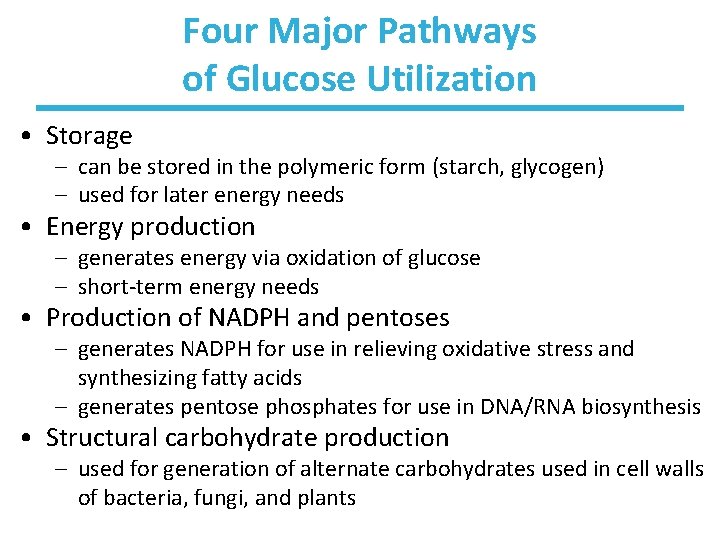
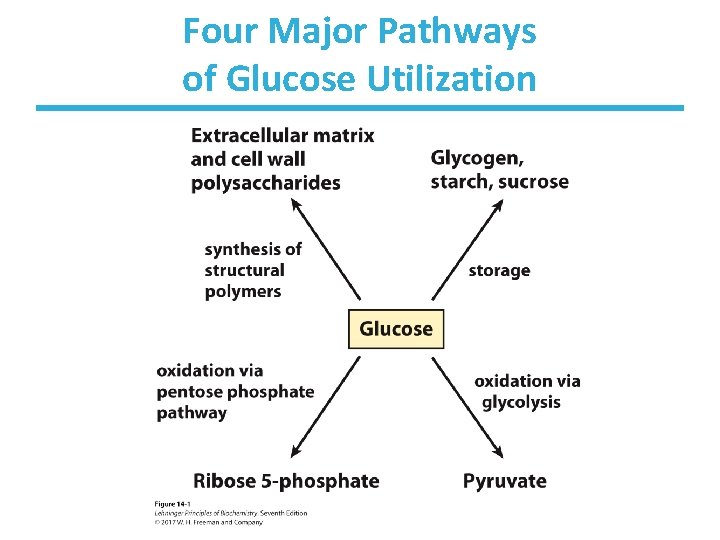
Four Major Pathways of Glucose Utilization • Storage – can be stored in the polymeric form (starch, glycogen) – used for later energy needs • Energy production – generates energy via oxidation of glucose – short-term energy needs • Production of NADPH and pentoses – generates NADPH for use in relieving oxidative stress and synthesizing fatty acids – generates pentose phosphates for use in DNA/RNA biosynthesis • Structural carbohydrate production – used for generation of alternate carbohydrates used in cell walls of bacteria, fungi, and plants
Four Major Pathways of Glucose Utilization
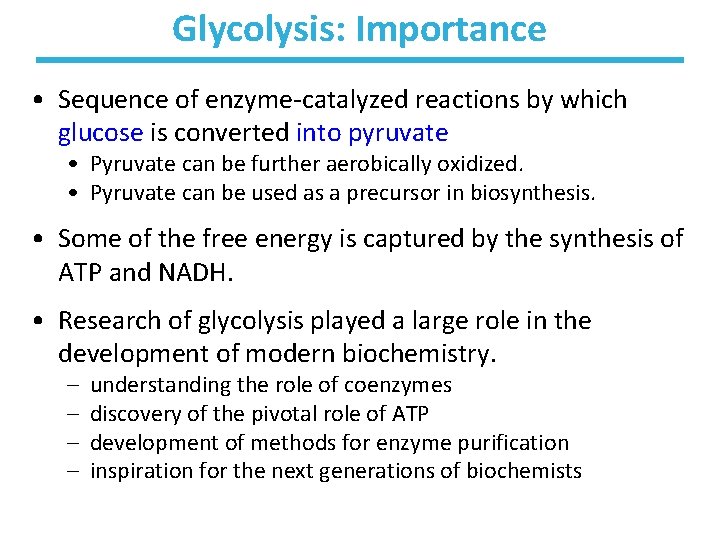
Glycolysis: Importance • Sequence of enzyme-catalyzed reactions by which glucose is converted into pyruvate • Pyruvate can be further aerobically oxidized. • Pyruvate can be used as a precursor in biosynthesis. • Some of the free energy is captured by the synthesis of ATP and NADH. • Research of glycolysis played a large role in the development of modern biochemistry. – – understanding the role of coenzymes discovery of the pivotal role of ATP development of methods for enzyme purification inspiration for the next generations of biochemists
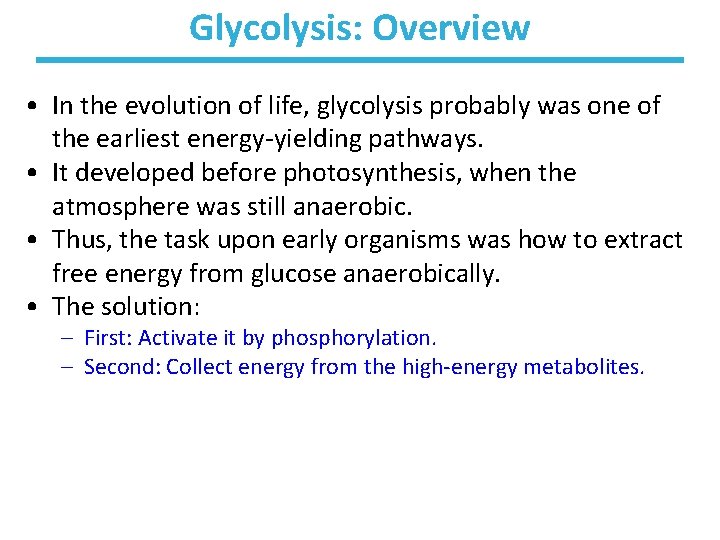
Glycolysis: Overview • In the evolution of life, glycolysis probably was one of the earliest energy-yielding pathways. • It developed before photosynthesis, when the atmosphere was still anaerobic. • Thus, the task upon early organisms was how to extract free energy from glucose anaerobically. • The solution: – First: Activate it by phosphorylation. – Second: Collect energy from the high-energy metabolites.
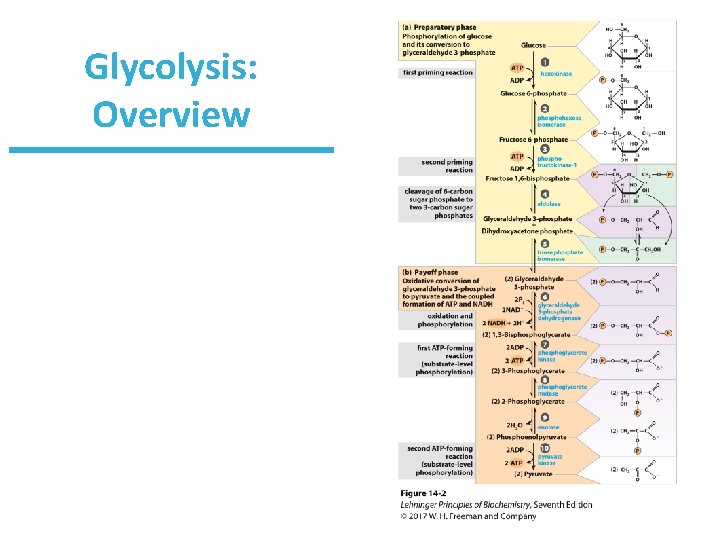
Glycolysis: Overview
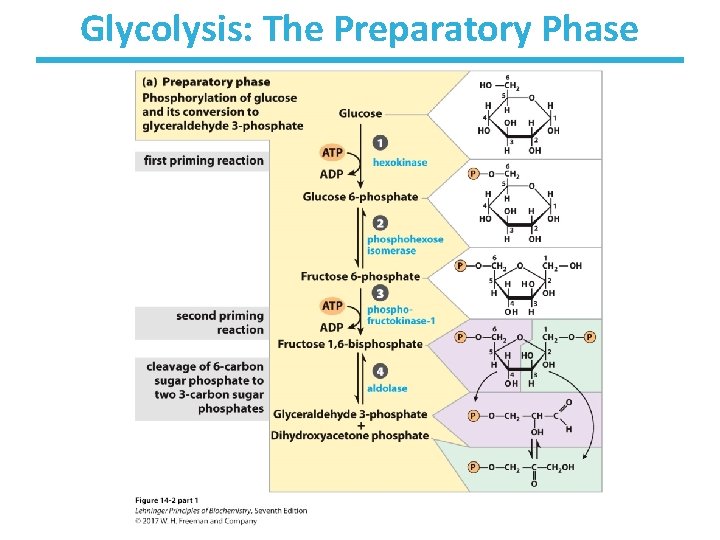
Glycolysis: The Preparatory Phase
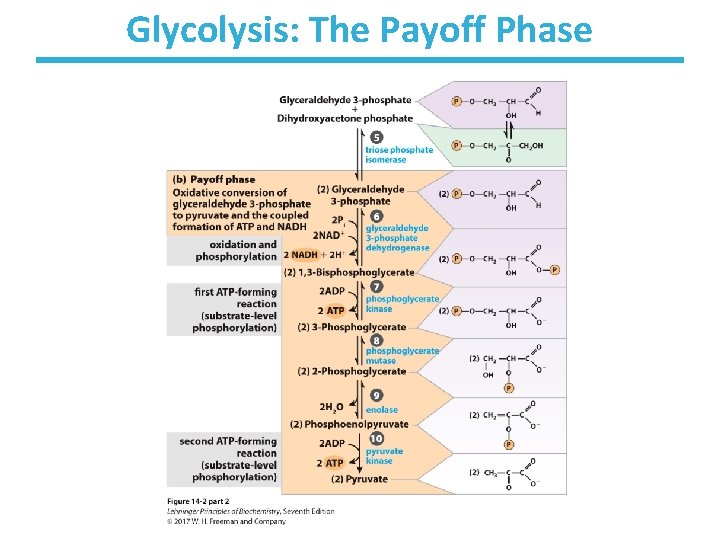
Glycolysis: The Payoff Phase
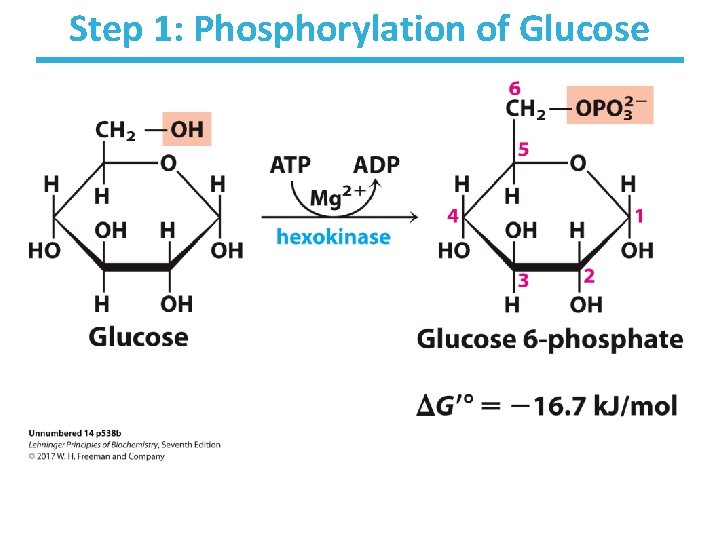
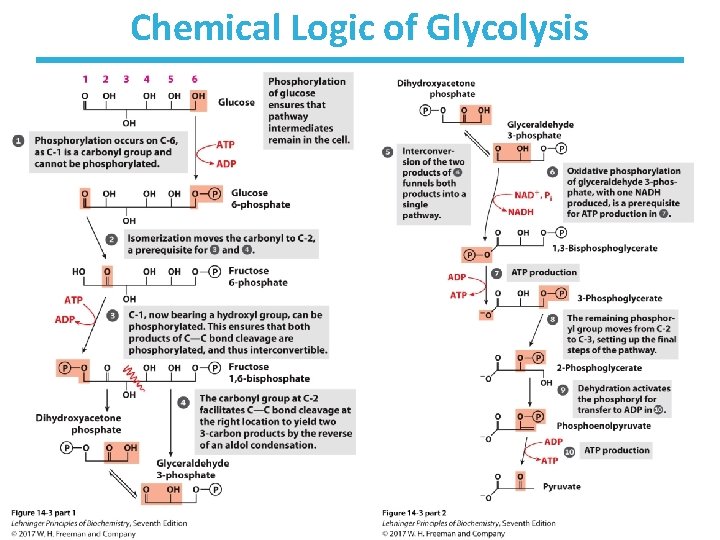
Step 1: Phosphorylation of Glucose
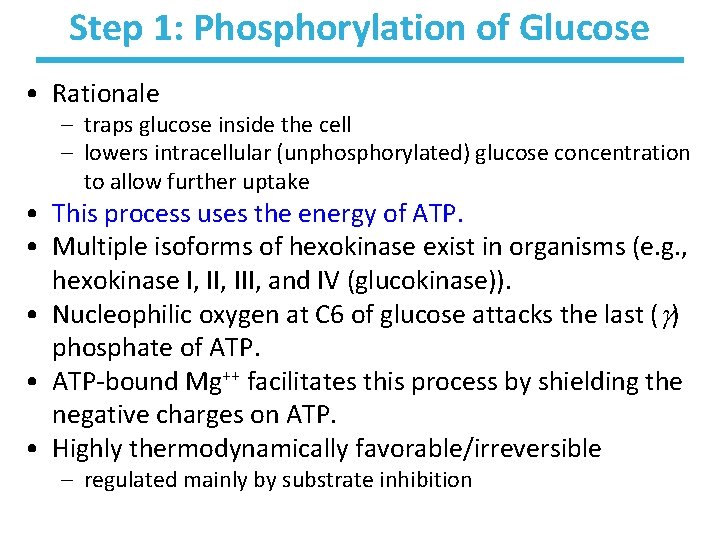
Step 1: Phosphorylation of Glucose • Rationale – traps glucose inside the cell – lowers intracellular (unphosphorylated) glucose concentration to allow further uptake • This process uses the energy of ATP. • Multiple isoforms of hexokinase exist in organisms (e. g. , hexokinase I, III, and IV (glucokinase)). • Nucleophilic oxygen at C 6 of glucose attacks the last ( ) phosphate of ATP. • ATP-bound Mg++ facilitates this process by shielding the negative charges on ATP. • Highly thermodynamically favorable/irreversible – regulated mainly by substrate inhibition
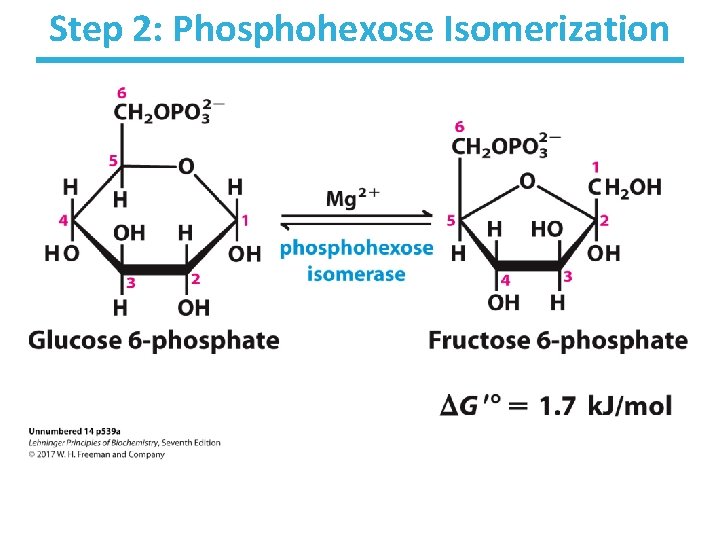
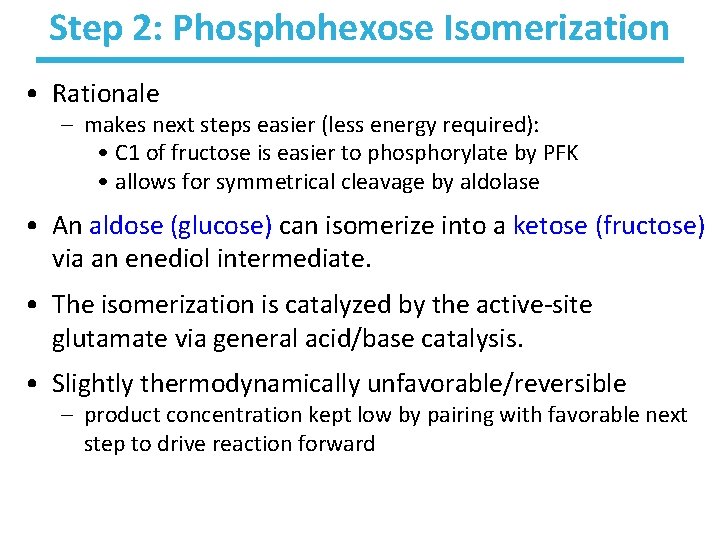
Step 2: Phosphohexose Isomerization
Step 2: Phosphohexose Isomerization • Rationale – makes next steps easier (less energy required): • C 1 of fructose is easier to phosphorylate by PFK • allows for symmetrical cleavage by aldolase • An aldose (glucose) can isomerize into a ketose (fructose) via an enediol intermediate. • The isomerization is catalyzed by the active-site glutamate via general acid/base catalysis. • Slightly thermodynamically unfavorable/reversible – product concentration kept low by pairing with favorable next step to drive reaction forward
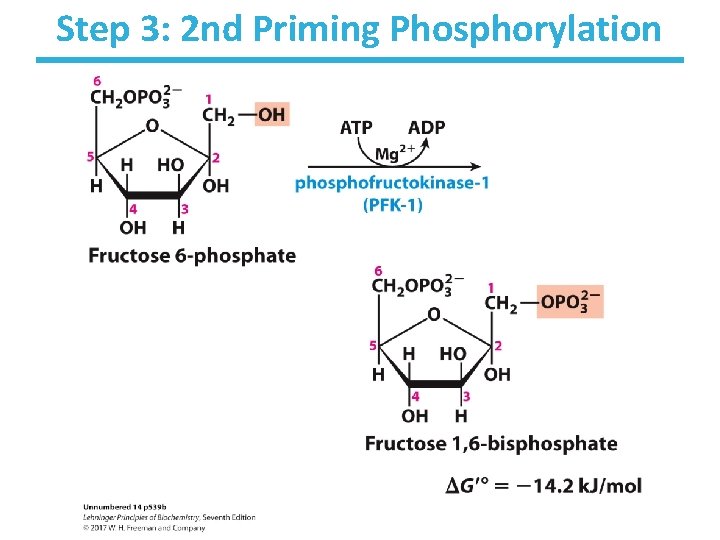
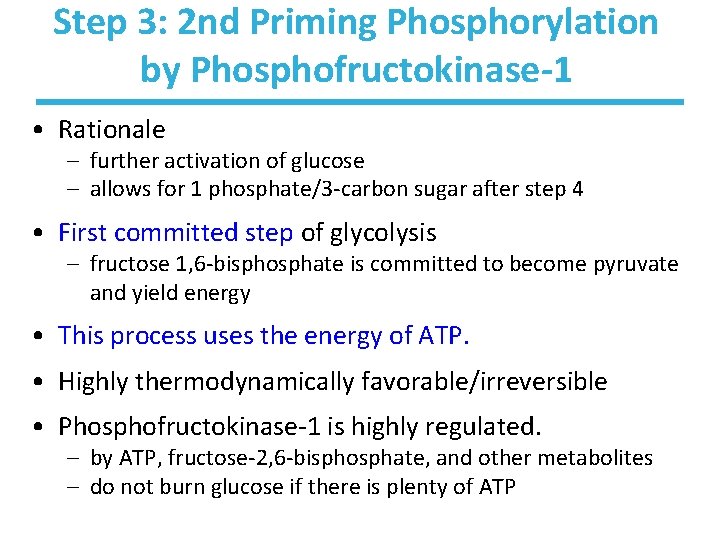
Step 3: 2 nd Priming Phosphorylation
Step 3: 2 nd Priming Phosphorylation by Phosphofructokinase-1 • Rationale – further activation of glucose – allows for 1 phosphate/3 -carbon sugar after step 4 • First committed step of glycolysis – fructose 1, 6 -bisphosphate is committed to become pyruvate and yield energy • This process uses the energy of ATP. • Highly thermodynamically favorable/irreversible • Phosphofructokinase-1 is highly regulated. – by ATP, fructose-2, 6 -bisphosphate, and other metabolites – do not burn glucose if there is plenty of ATP
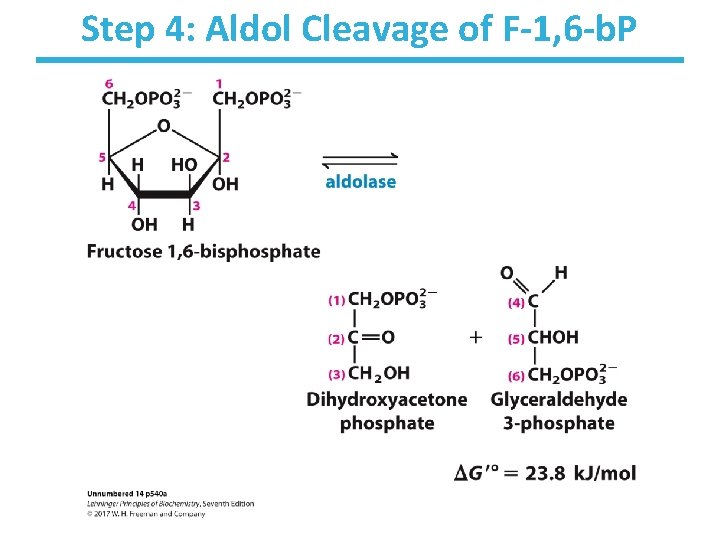
Step 4: Aldol Cleavage of F-1, 6 -b. P
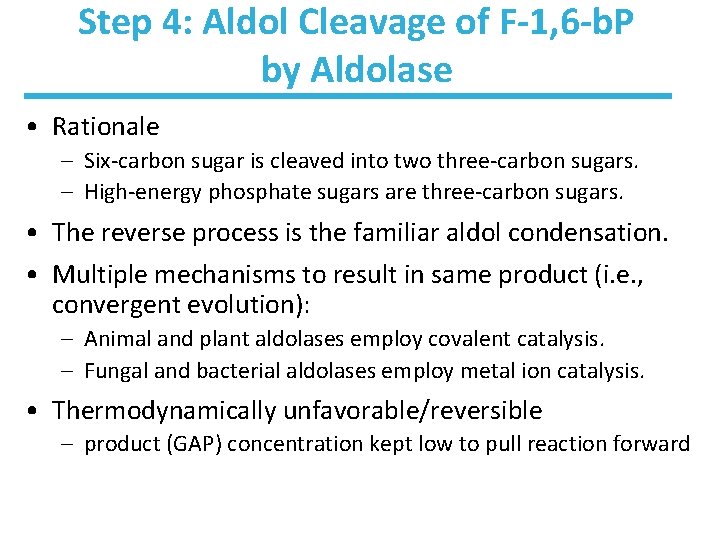
Step 4: Aldol Cleavage of F-1, 6 -b. P by Aldolase • Rationale – Six-carbon sugar is cleaved into two three-carbon sugars. – High-energy phosphate sugars are three-carbon sugars. • The reverse process is the familiar aldol condensation. • Multiple mechanisms to result in same product (i. e. , convergent evolution): – Animal and plant aldolases employ covalent catalysis. – Fungal and bacterial aldolases employ metal ion catalysis. • Thermodynamically unfavorable/reversible – product (GAP) concentration kept low to pull reaction forward
Step 5: Triose Phosphate Interconversion
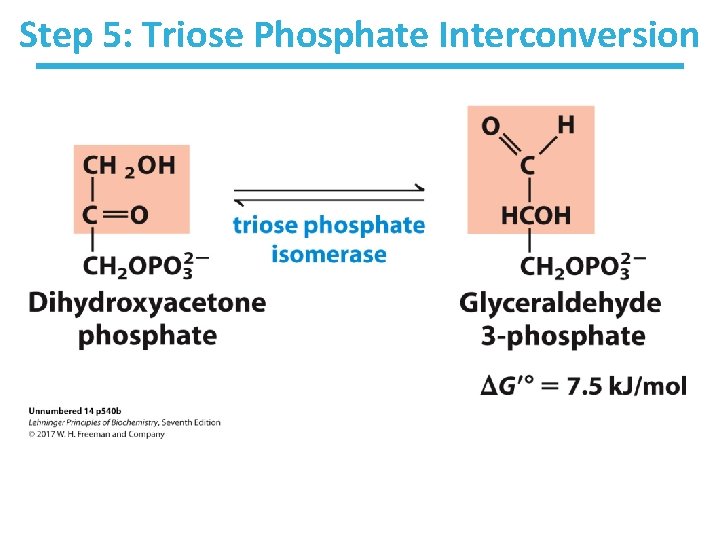
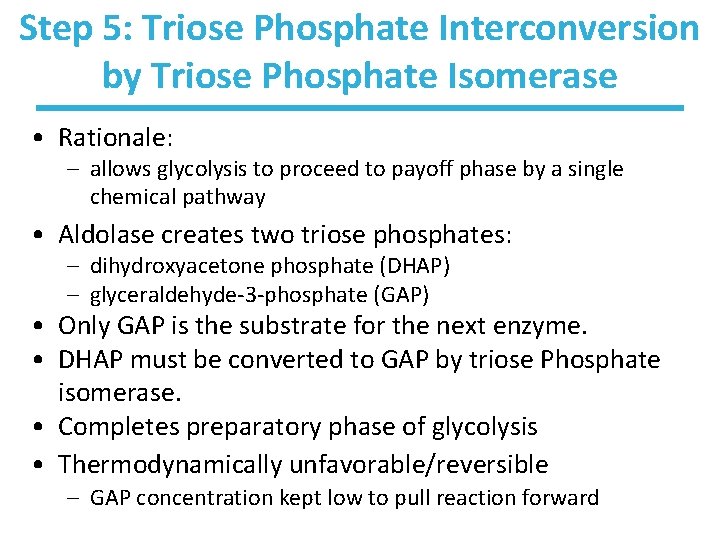
Step 5: Triose Phosphate Interconversion by Triose Phosphate Isomerase • Rationale: – allows glycolysis to proceed to payoff phase by a single chemical pathway • Aldolase creates two triose phosphates: – dihydroxyacetone phosphate (DHAP) – glyceraldehyde-3 -phosphate (GAP) • Only GAP is the substrate for the next enzyme. • DHAP must be converted to GAP by triose Phosphate isomerase. • Completes preparatory phase of glycolysis • Thermodynamically unfavorable/reversible – GAP concentration kept low to pull reaction forward
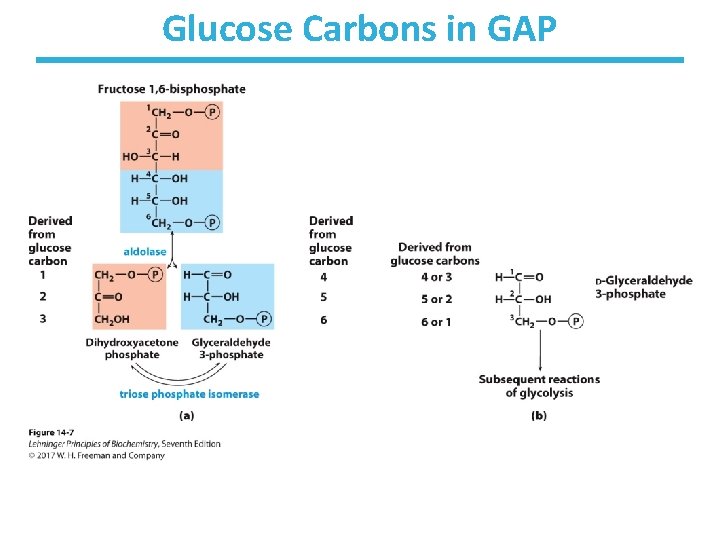
Glucose Carbons in GAP
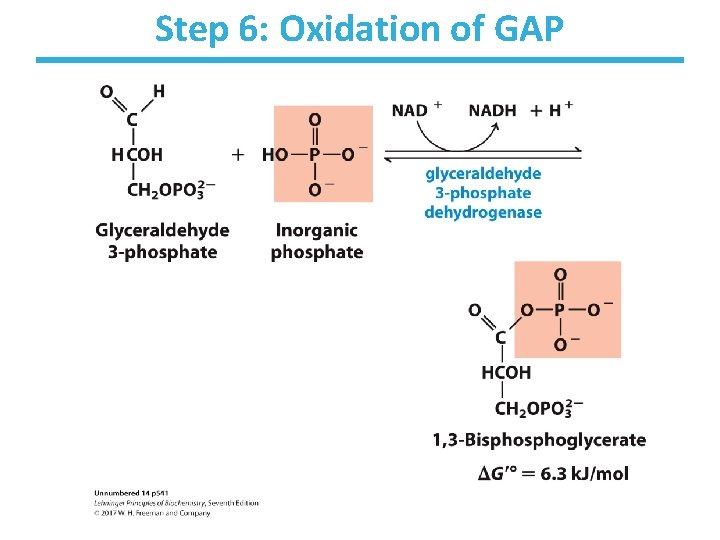
Step 6: Oxidation of GAP
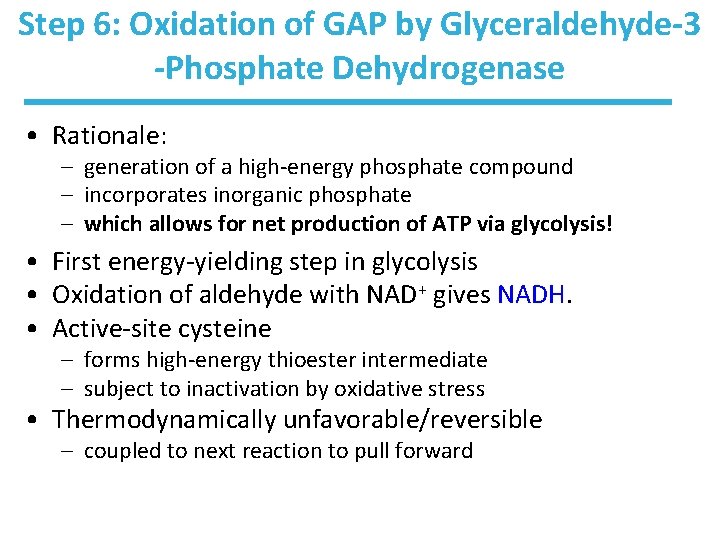
Step 6: Oxidation of GAP by Glyceraldehyde-3 -Phosphate Dehydrogenase • Rationale: – generation of a high-energy phosphate compound – incorporates inorganic phosphate – which allows for net production of ATP via glycolysis! • First energy-yielding step in glycolysis • Oxidation of aldehyde with NAD+ gives NADH. • Active-site cysteine – forms high-energy thioester intermediate – subject to inactivation by oxidative stress • Thermodynamically unfavorable/reversible – coupled to next reaction to pull forward
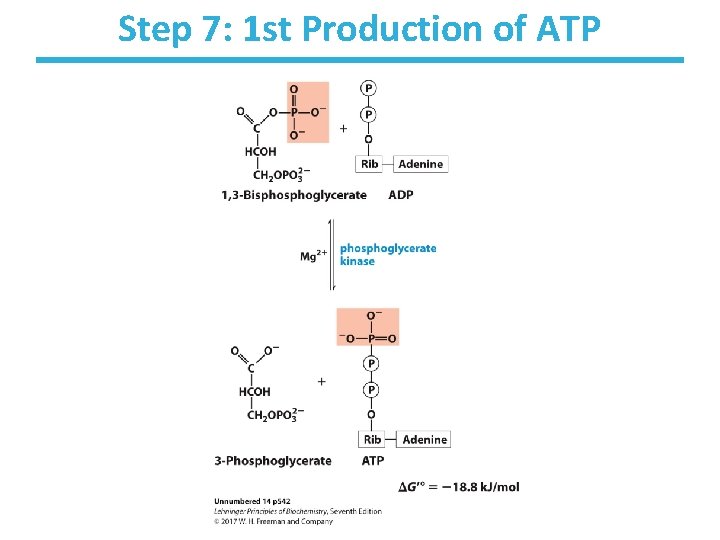
Step 7: 1 st Production of ATP
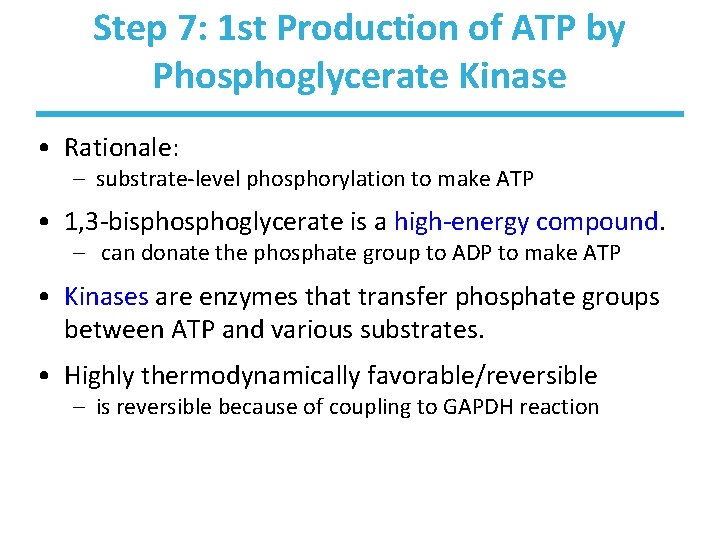
Step 7: 1 st Production of ATP by Phosphoglycerate Kinase • Rationale: – substrate-level phosphorylation to make ATP • 1, 3 -bisphoglycerate is a high-energy compound. – can donate the phosphate group to ADP to make ATP • Kinases are enzymes that transfer phosphate groups between ATP and various substrates. • Highly thermodynamically favorable/reversible – is reversible because of coupling to GAPDH reaction
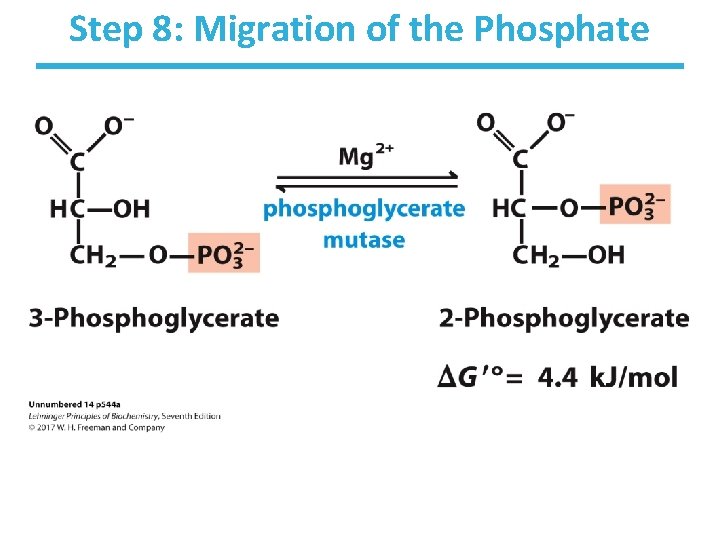
Step 8: Migration of the Phosphate
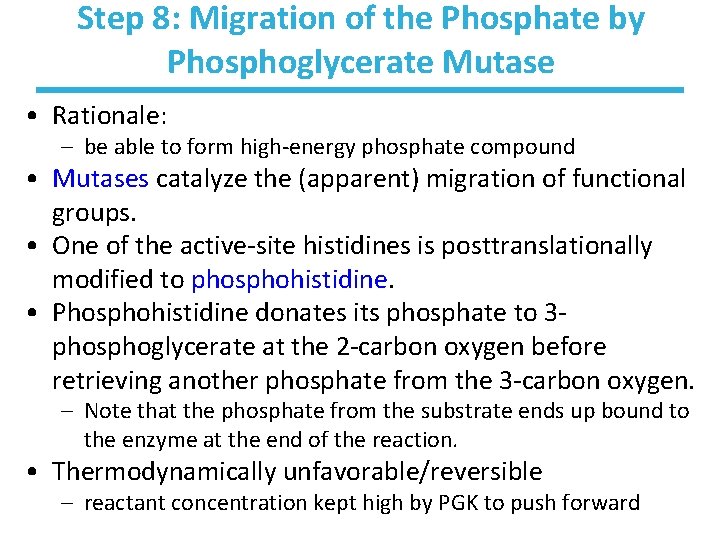
Step 8: Migration of the Phosphate by Phosphoglycerate Mutase • Rationale: – be able to form high-energy phosphate compound • Mutases catalyze the (apparent) migration of functional groups. • One of the active-site histidines is posttranslationally modified to phosphohistidine. • Phosphohistidine donates its phosphate to 3 phosphoglycerate at the 2 -carbon oxygen before retrieving another phosphate from the 3 -carbon oxygen. – Note that the phosphate from the substrate ends up bound to the enzyme at the end of the reaction. • Thermodynamically unfavorable/reversible – reactant concentration kept high by PGK to push forward
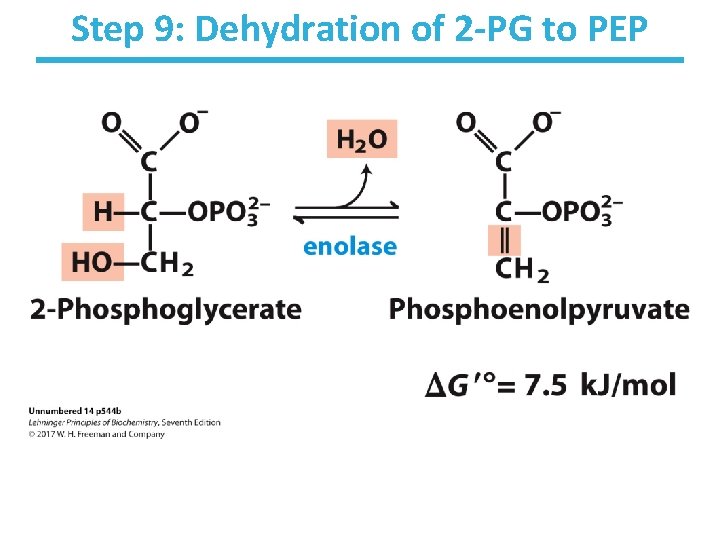
Step 9: Dehydration of 2 -PG to PEP
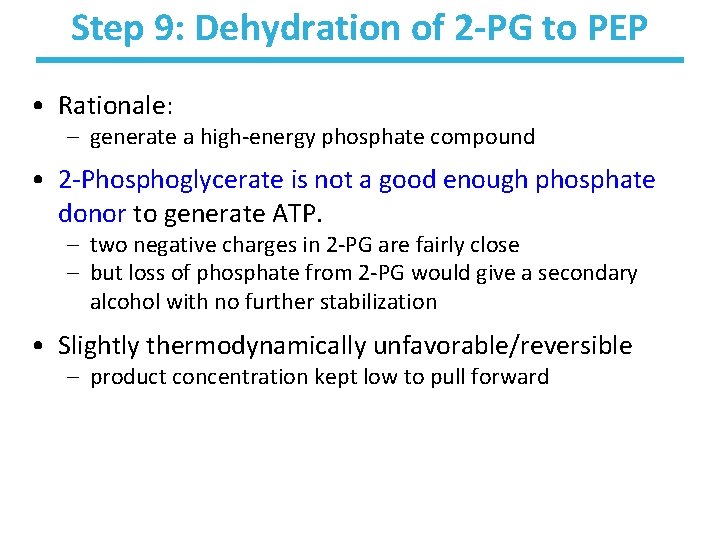
Step 9: Dehydration of 2 -PG to PEP • Rationale: – generate a high-energy phosphate compound • 2 -Phosphoglycerate is not a good enough phosphate donor to generate ATP. – two negative charges in 2 -PG are fairly close – but loss of phosphate from 2 -PG would give a secondary alcohol with no further stabilization • Slightly thermodynamically unfavorable/reversible – product concentration kept low to pull forward
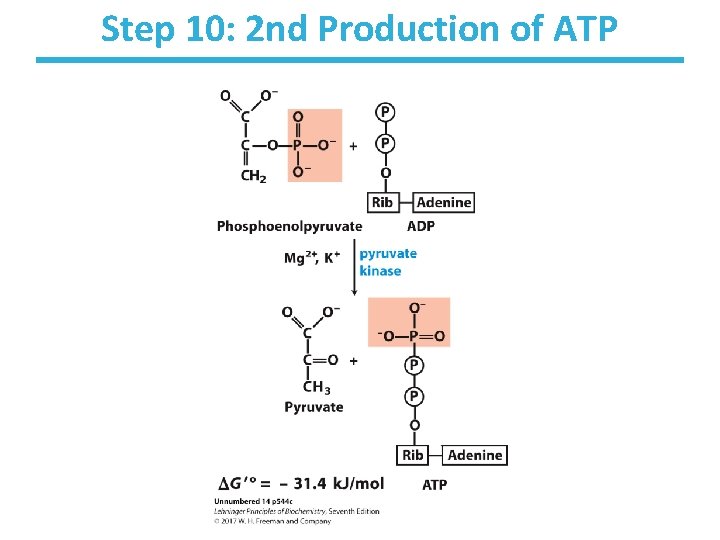
Step 10: 2 nd Production of ATP
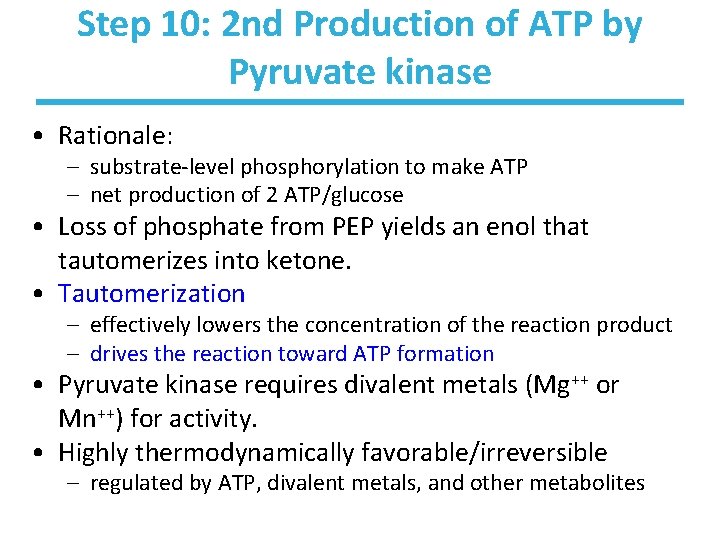
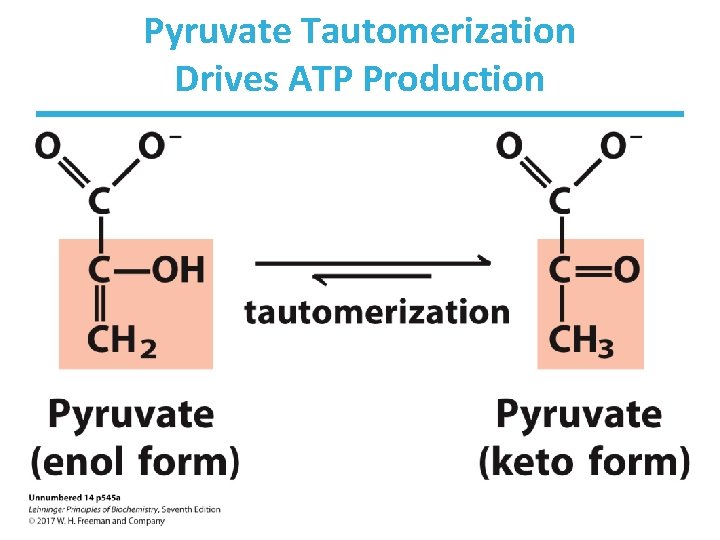
Step 10: 2 nd Production of ATP by Pyruvate kinase • Rationale: – substrate-level phosphorylation to make ATP – net production of 2 ATP/glucose • Loss of phosphate from PEP yields an enol that tautomerizes into ketone. • Tautomerization – effectively lowers the concentration of the reaction product – drives the reaction toward ATP formation • Pyruvate kinase requires divalent metals (Mg++ or Mn++) for activity. • Highly thermodynamically favorable/irreversible – regulated by ATP, divalent metals, and other metabolites
Pyruvate Tautomerization Drives ATP Production
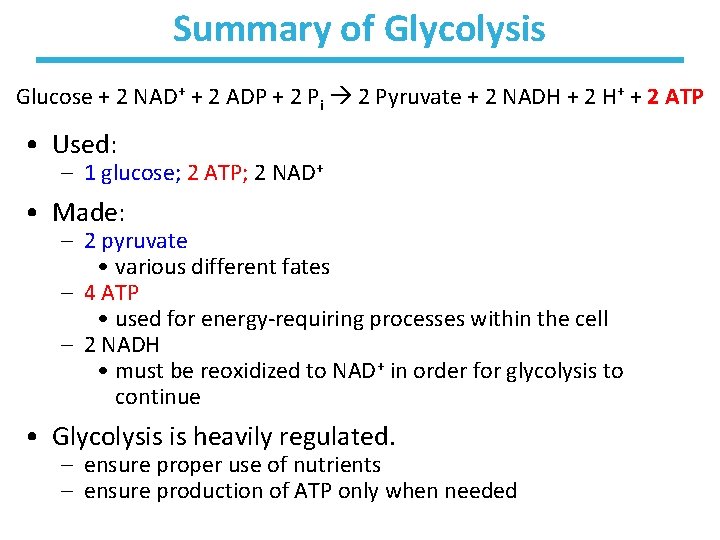
Summary of Glycolysis Glucose + 2 NAD+ + 2 ADP + 2 Pi 2 Pyruvate + 2 NADH + 2 H+ + 2 ATP • Used: – 1 glucose; 2 ATP; 2 NAD+ • Made: – 2 pyruvate • various different fates – 4 ATP • used for energy-requiring processes within the cell – 2 NADH • must be reoxidized to NAD+ in order for glycolysis to continue • Glycolysis is heavily regulated. – ensure proper use of nutrients – ensure production of ATP only when needed
Chemical Logic of Glycolysis
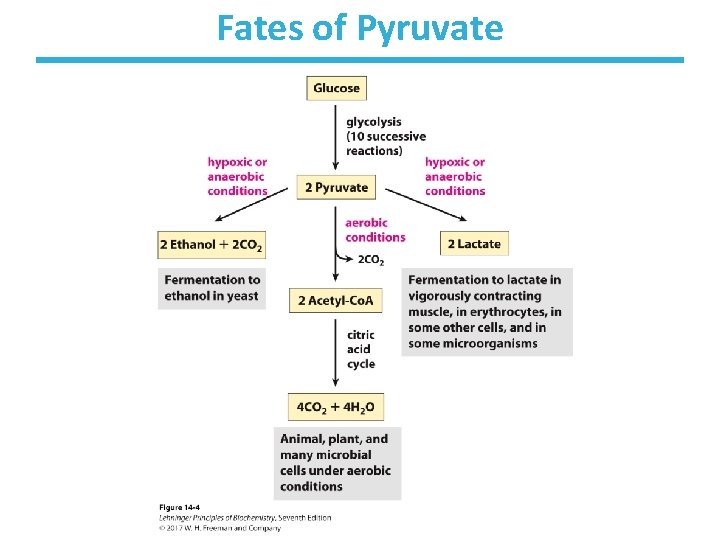
Fates of Pyruvate
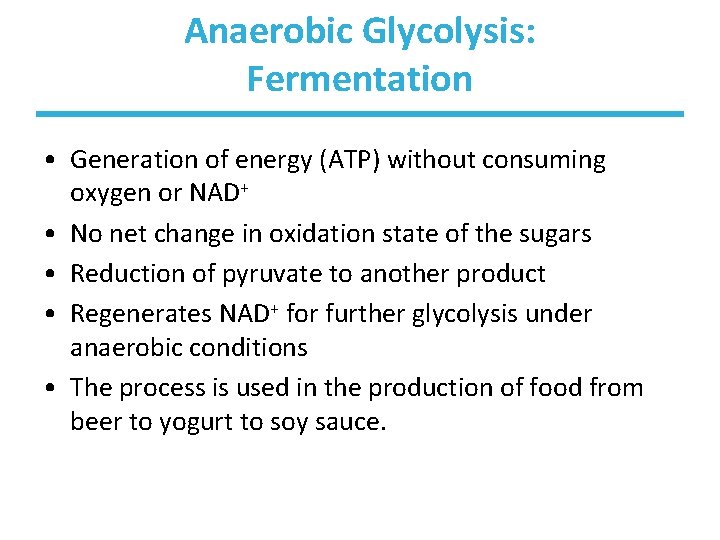
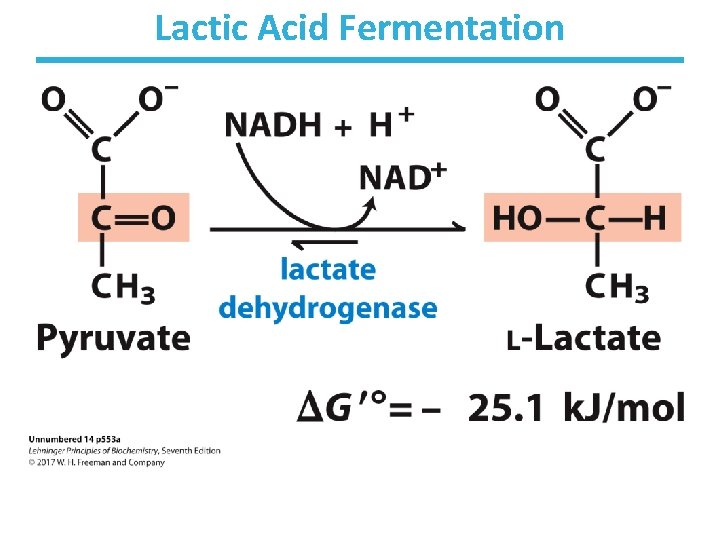
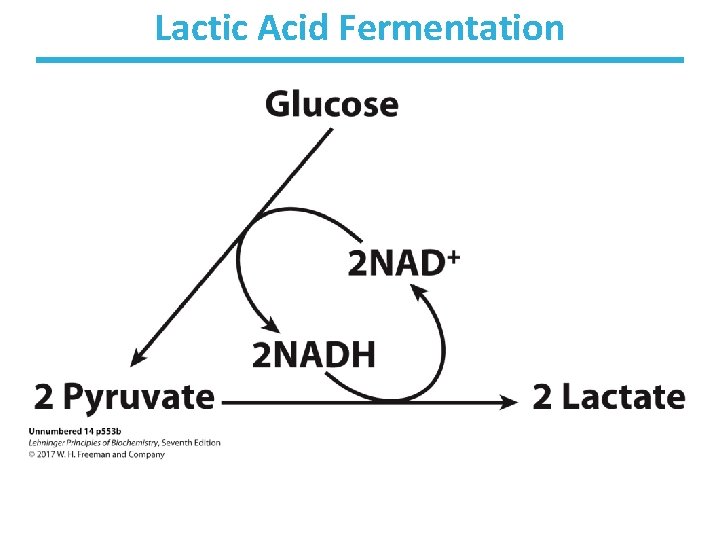
Anaerobic Glycolysis: Fermentation • Generation of energy (ATP) without consuming oxygen or NAD+ • No net change in oxidation state of the sugars • Reduction of pyruvate to another product • Regenerates NAD+ for further glycolysis under anaerobic conditions • The process is used in the production of food from beer to yogurt to soy sauce.
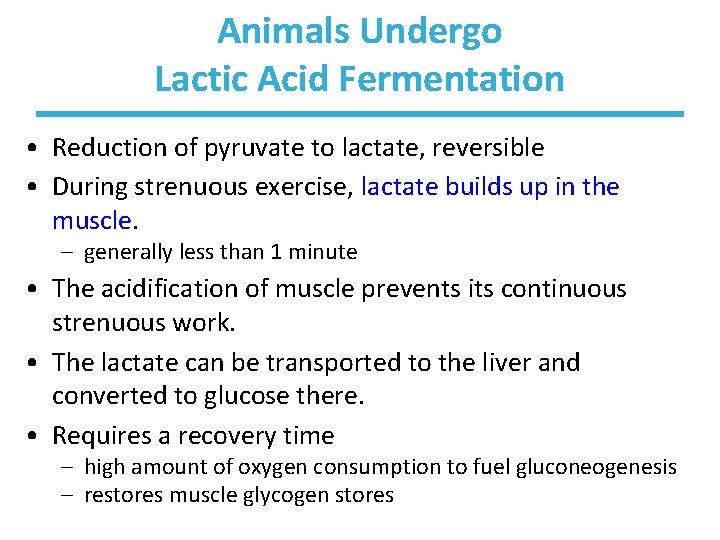
Animals Undergo Lactic Acid Fermentation • Reduction of pyruvate to lactate, reversible • During strenuous exercise, lactate builds up in the muscle. – generally less than 1 minute • The acidification of muscle prevents its continuous strenuous work. • The lactate can be transported to the liver and converted to glucose there. • Requires a recovery time – high amount of oxygen consumption to fuel gluconeogenesis – restores muscle glycogen stores
Lactic Acid Fermentation
Lactic Acid Fermentation
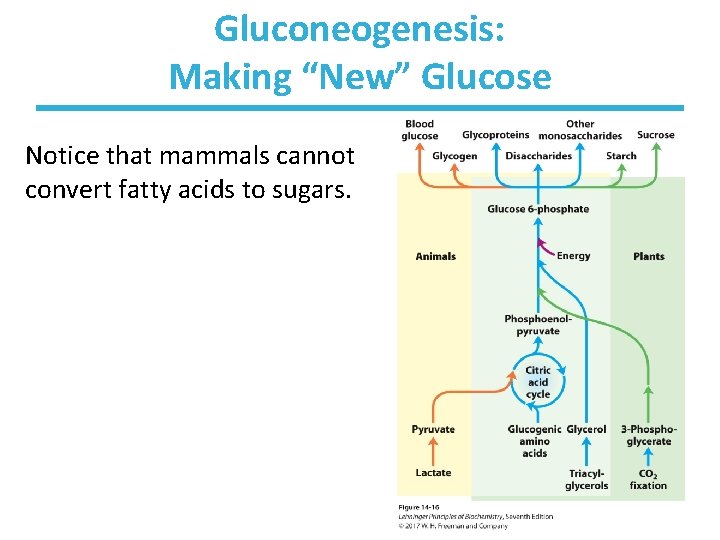
Gluconeogenesis: Making “New” Glucose Notice that mammals cannot convert fatty acids to sugars.
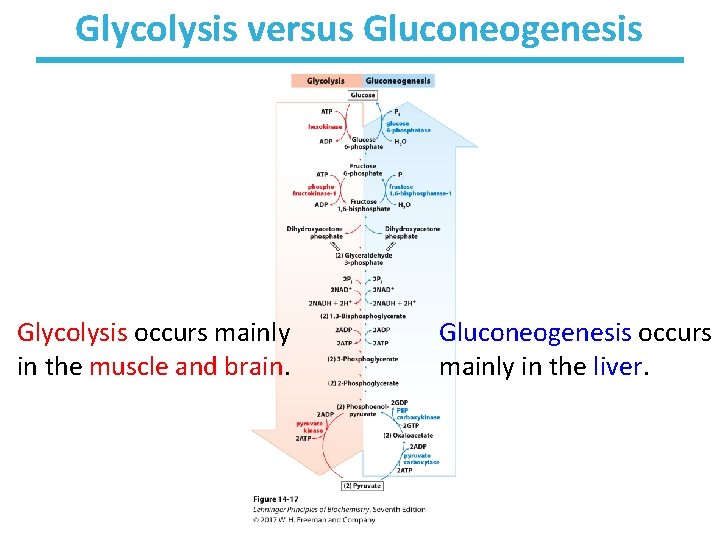
Glycolysis versus Gluconeogenesis Glycolysis occurs mainly in the muscle and brain. Gluconeogenesis occurs mainly in the liver.
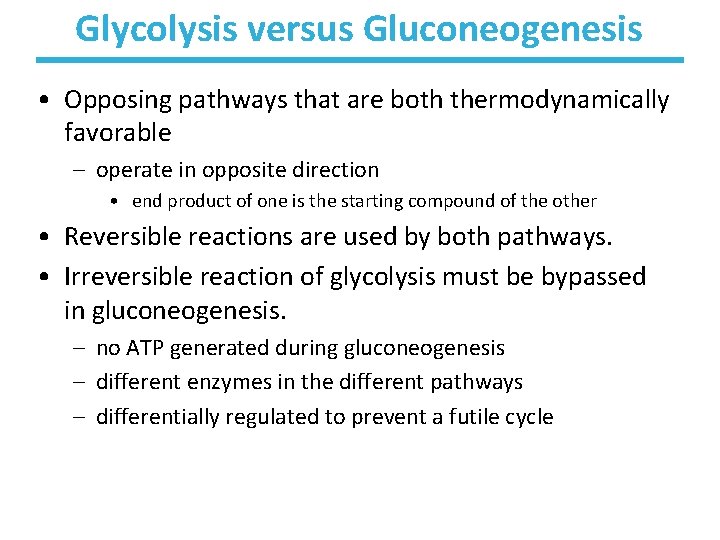
Glycolysis versus Gluconeogenesis • Opposing pathways that are both thermodynamically favorable – operate in opposite direction • end product of one is the starting compound of the other • Reversible reactions are used by both pathways. • Irreversible reaction of glycolysis must be bypassed in gluconeogenesis. – no ATP generated during gluconeogenesis – different enzymes in the different pathways – differentially regulated to prevent a futile cycle
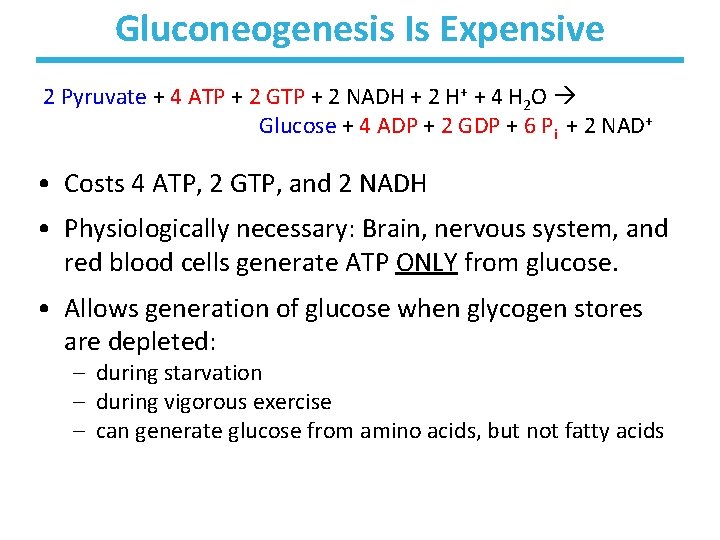
Gluconeogenesis Is Expensive 2 Pyruvate + 4 ATP + 2 GTP + 2 NADH + 2 H+ + 4 H 2 O Glucose + 4 ADP + 2 GDP + 6 Pi + 2 NAD+ • Costs 4 ATP, 2 GTP, and 2 NADH • Physiologically necessary: Brain, nervous system, and red blood cells generate ATP ONLY from glucose. • Allows generation of glucose when glycogen stores are depleted: – during starvation – during vigorous exercise – can generate glucose from amino acids, but not fatty acids
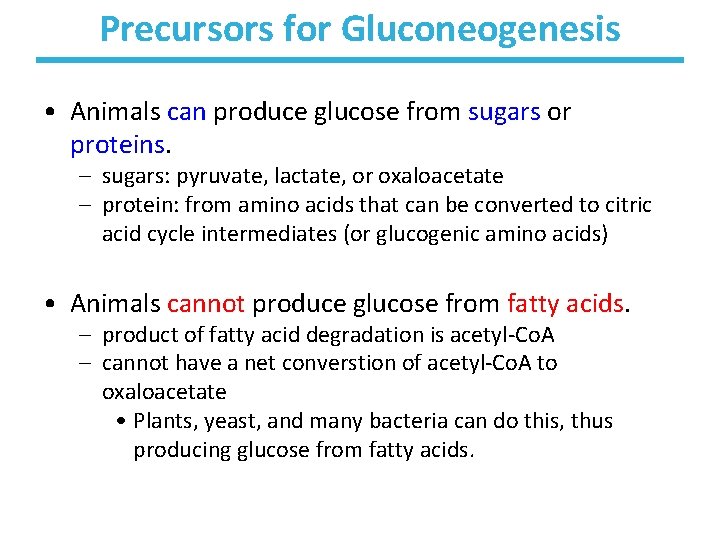
Precursors for Gluconeogenesis • Animals can produce glucose from sugars or proteins. – sugars: pyruvate, lactate, or oxaloacetate – protein: from amino acids that can be converted to citric acid cycle intermediates (or glucogenic amino acids) • Animals cannot produce glucose from fatty acids. – product of fatty acid degradation is acetyl-Co. A – cannot have a net converstion of acetyl-Co. A to oxaloacetate • Plants, yeast, and many bacteria can do this, thus producing glucose from fatty acids.
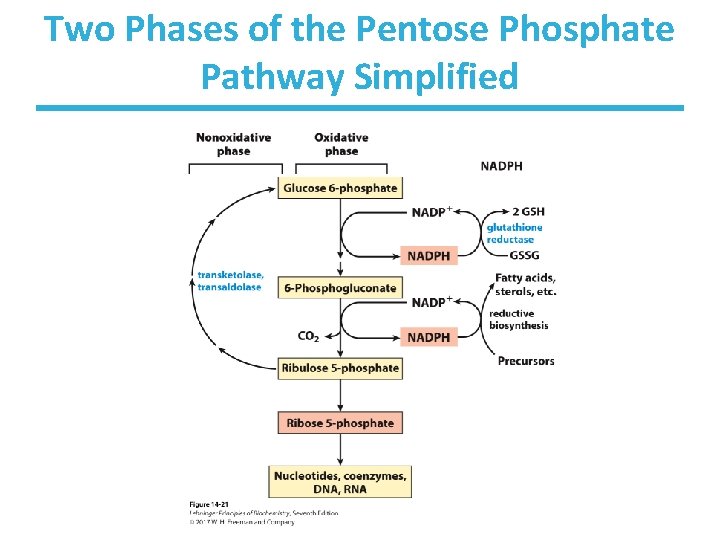
Two Phases of the Pentose Phosphate Pathway Simplified
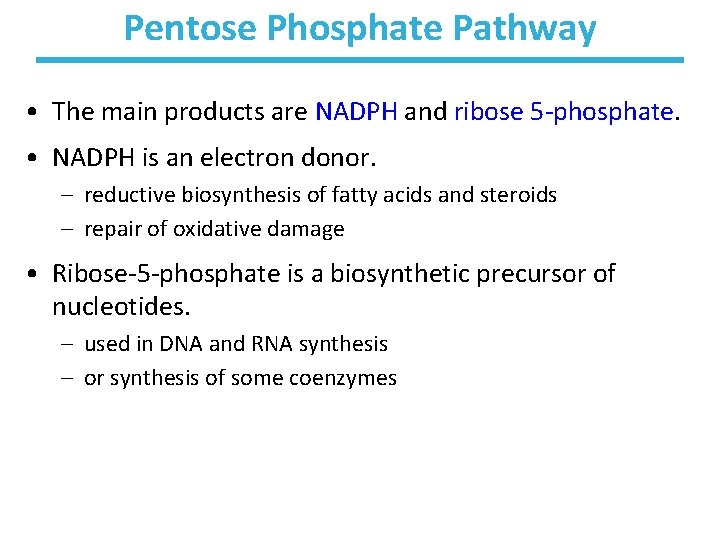
Pentose Phosphate Pathway • The main products are NADPH and ribose 5 -phosphate. • NADPH is an electron donor. – reductive biosynthesis of fatty acids and steroids – repair of oxidative damage • Ribose-5 -phosphate is a biosynthetic precursor of nucleotides. – used in DNA and RNA synthesis – or synthesis of some coenzymes
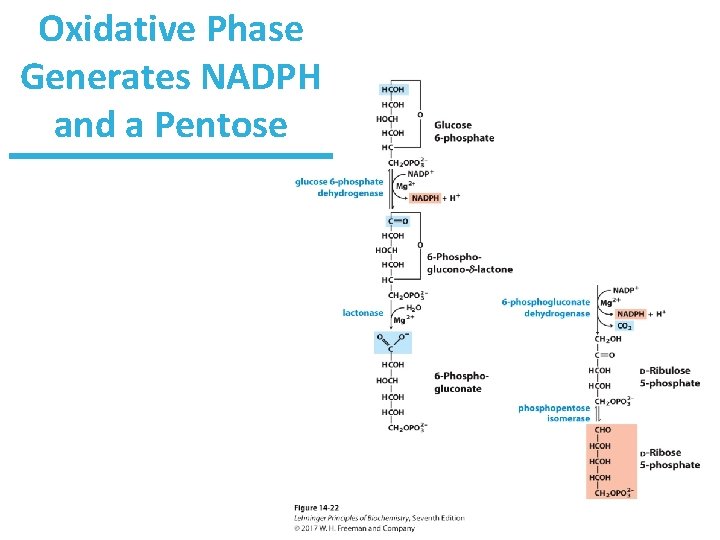
Oxidative Phase Generates NADPH and a Pentose
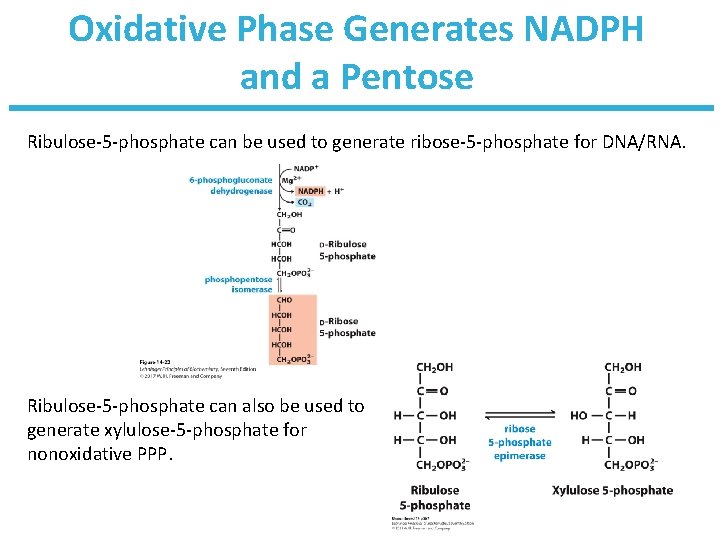
Oxidative Phase Generates NADPH and a Pentose Ribulose-5 -phosphate can be used to generate ribose-5 -phosphate for DNA/RNA. Ribulose-5 -phosphate can also be used to generate xylulose-5 -phosphate for nonoxidative PPP.
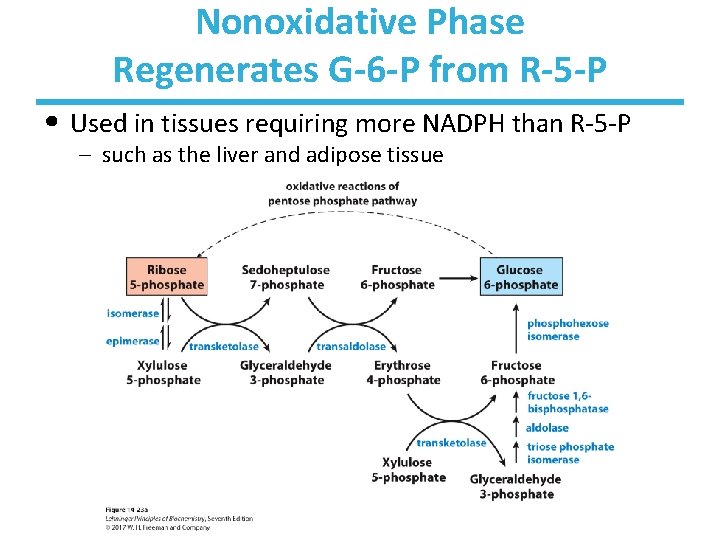
Nonoxidative Phase Regenerates G-6 -P from R-5 -P • Used in tissues requiring more NADPH than R-5 -P – such as the liver and adipose tissue
Chapter 14: Summary In this chapter, we learned about: • Glycolysis, a process by which cells can extract a limited amount of energy from glucose • Fermentation, a process by which cells can continue using glycolysis to extract energy in anaerobic conditions • Gluconeogenesis, a process by which cells can use a variety of metabolites for the synthesis of glucose • The differences between glycolysis and gluconeogenesis – how they are both made thermodynamically favorable – how they are differentially regulated to avoid a futile cycle • The pentose phosphate pathway, a process by which cells can generate pentose phosphates and NADPH. The pentose phosphates can be regenerated into glucose-6 -phosphate, which requires no ATP.