
14 Financial Performance Measurement Foundations of Financial Performance







- Slides: 41
14 Financial Performance Measurement
Foundations of Financial Performance Measurement OBJECTIVE 1: Describe the objectives, standards of comparison, sources of information, and compensation issues in measuring financial performance.
Exhibit 1: Selected Segment Information for Starbucks Corporation
Exhibit 1: Selected Segment Information for Starbucks Corporation
Exhibit 2: Listing from Mergent’s Dividend Achievers
Exhibit 2: Listing from Mergent’s Dividend Achievers
Foundations of Financial Performance Measurement • Financial performance measurement comprises all the techniques that users of financial statements employ to show relationships in an organization’s financial statements and to relate those relationships to the organization's financial objectives.
Foundations of Financial Performance Measurement • Users of financial statements are classified as either internal or external. – Internal users include top managers who set and strive to achieve financial performance objectives, middle-level managers of business processes, and employee stockholders. – External users include creditors and investors wanting to assess how well managers accomplished their financial objectives and customers forming cooperative agreements with the company.
Foundations of Financial Performance Measurement • Management is responsible for devising, executing, monitoring, and reporting on a complete financial plan for a business that focuses on the following: – Liquidity—ability to pay bills when due and to meet unexpected needs for cash – Profitability—ability to earn a satisfactory net income – Long-term solvency—ability to survive for many years – Cash flow adequacy—ability to generate sufficient cash through operating, investing, and financing activities – Market strength—ability to increase the wealth of owners
Foundations of Financial Performance Measurement • Creditors and investors use financial statement analysis in two ways. – To judge past performance and current position – To judge future potential and the risk associated with it
Foundations of Financial Performance Measurement • Decision makers judge performance in (at least) three ways. – Rule-of-thumb measures – Analysis of past performance – Comparison with industry norms (discuss limitations)
Foundations of Financial Performance Measurement • A company’s annual report provides a significant amount of information. • Interim financial statements may indicate recent changes in earnings. • Incentive bonuses and stock options for top executives are typically based on the company's achievement of certain financial goals. – For public companies, a compensation committee of independent directors must establish remuneration policy for top-level executives, and the components and criteria used must be reported to the SEC.
© 2011 Cengage Learning All Rights Reserved. May not be scanned, copied or duplicated, or posted to a publicly accessible website, in whole or in part.
Tools and Techniques of Financial Analysis OBJECTIVE 2: Apply horizontal analysis, trend analysis, vertical analysis, and ratio analysis to financial statements.
Exhibit 3: Comparative Balance Sheets with Horizontal Analysis
Exhibit 3: Comparative Balance Sheets with Horizontal Analysis
Exhibit 4: Comparative Income Statements with Horizontal Analysis
Exhibit 4: Comparative Income Statements with Horizontal Analysis
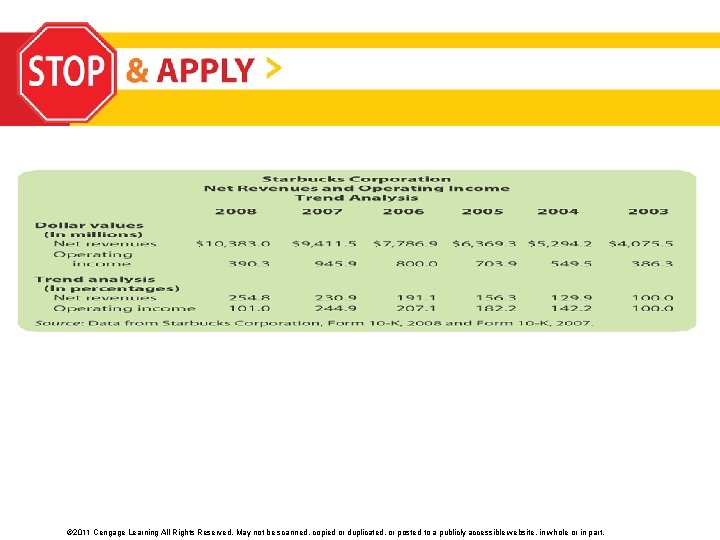
Exhibit 5: Trend Analysis
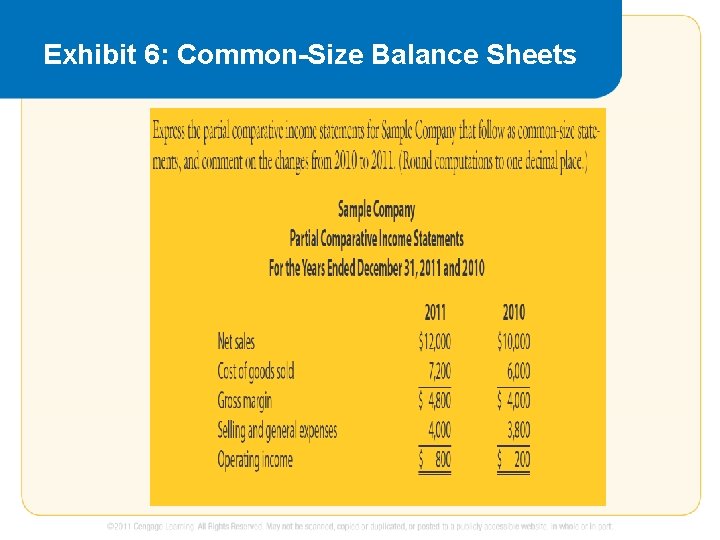
Exhibit 6: Common-Size Balance Sheets
Exhibit 7: Common-Size Income Statements
Tools and Techniques of Financial Analysis • Horizontal analysis shows absolute and percentage changes from one year to the next. • Trend analysis is an application of horizontal analysis over several consecutive years.
Tools and Techniques of Financial Analysis • Vertical analysis calculates percentage relationships within a single statement. – The result is a common-size statement. • On a common-size balance sheet, total assets and total liabilities and equity in their respective areas of the balance sheet are labeled 100 percent. • On a common-size income statement, net sales or net revenues are labeled 100 percent. • Common-size statements can be presented in comparative form.
Tools and Techniques of Financial Analysis • Ratio analysis shows meaningful relationships between financial statement components.
© 2011 Cengage Learning All Rights Reserved. May not be scanned, copied or duplicated, or posted to a publicly accessible website, in whole or in part.
© 2011 Cengage Learning All Rights Reserved. May not be scanned, copied or duplicated, or posted to a publicly accessible website, in whole or in part.
© 2011 Cengage Learning All Rights Reserved. May not be scanned, copied or duplicated, or posted to a publicly accessible website, in whole or in part.
Comprehensive Illustration of Ratio Analysis OBJECTIVE 3: Apply ratio analysis to financial statements in a comprehensive evaluation of a company’s financial performance.
Exhibit 8: Liquidity Ratios of Starbucks Corporation
Exhibit 8: Liquidity Ratios of Starbucks Corporation
Exhibit 9: Profitability Ratios of Starbucks Corporation
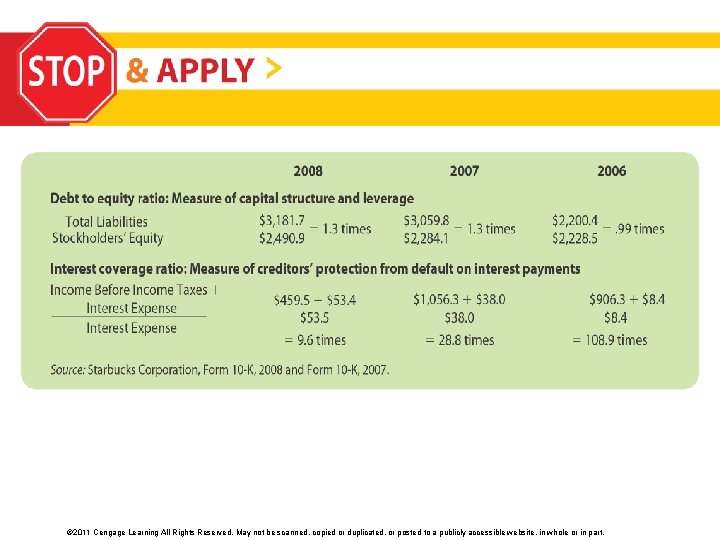
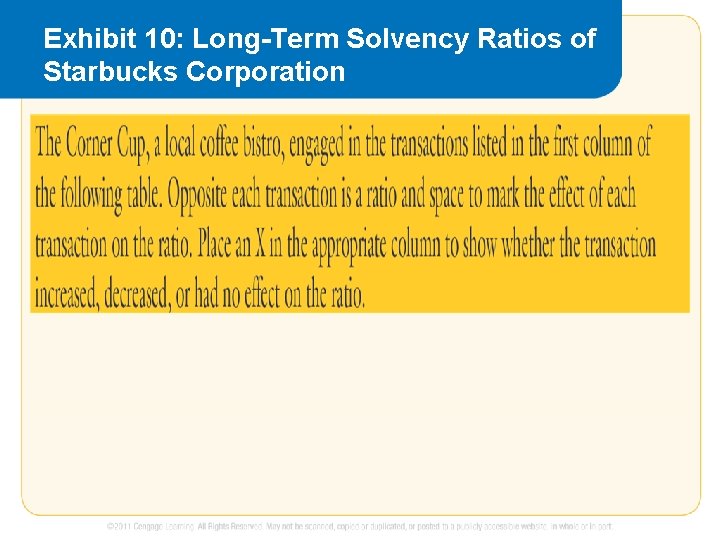
Exhibit 10: Long-Term Solvency Ratios of Starbucks Corporation
Exhibit 11: Cash Flow Adequacy Ratios of Starbucks Corporation
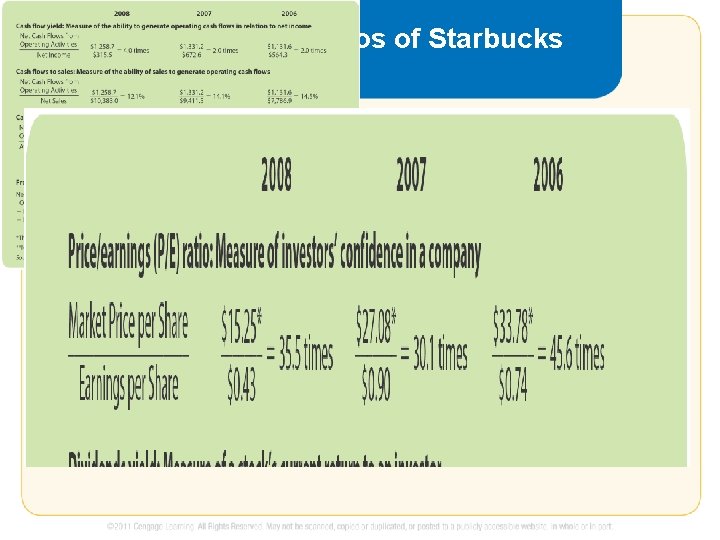
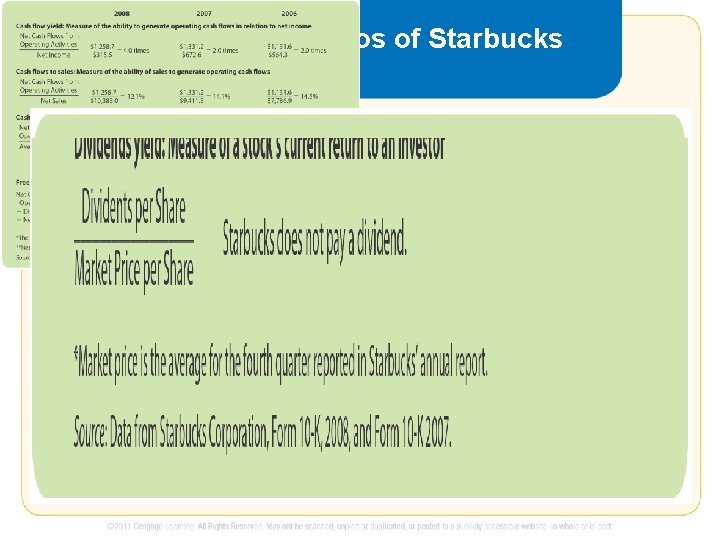
Exhibit 12: Market Strength Ratios of Starbucks Corporation
Comprehensive Illustration of Ratio Analysis • Ratio analysis provides information about a company’s liquidity, profitability, long-term solvency, cash flow adequacy, and market strength.
Comprehensive Illustration of Ratio Analysis • There are five major types of ratios. – Liquidity ratios • • Current ratio Quick ratio Receivable turnover Days’ sales uncollected Inventory turnover Average days’ inventory on hand Payables turnover Average days’ payable
Comprehensive Illustration of Ratio Analysis – Profitability ratios • • Profit margin Asset turnover Return on assets Return on equity
Comprehensive Illustration of Ratio Analysis – Long-term solvency ratios • Debt to equity ratio • Interest coverage ratio
Comprehensive Illustration of Ratio Analysis – Cash flow adequacy ratios • • Cash flow yield Cash flows to sales Cash flows to assets Free cash flow
Comprehensive Illustration of Ratio Analysis – Market strength ratios • Price/earnings ratio • Dividends yield
© 2011 Cengage Learning All Rights Reserved. May not be scanned, copied or duplicated, or posted to a publicly accessible website, in whole or in part.