
14 Financial Performance Evaluation and Transfer Pricing in




- Slides: 30
14 Financial Performance Evaluation and Transfer Pricing in the Decentralized Firm 14 -1
Learning Objectives l Define responsibility accounting责任会计 and describe four types of responsibility centres责任中心. l Explain why companies decentralize分权. 14 -2
Learning Objectives l Compute and interpret return on investment (ROI)投资报酬率, residual income (RI)剩余收益and economic value added (EVA)经济附加值. l Explain the role of transfer pricing转移定 价 in decentralized companies. 14 -3
Responsibility Accounting Responsibility accounting is a system that measures the results of each responsibility centre according to the information managers need to operate their centres. There are four major types of responsibility centres: • Cost centre成本中心 • Revenue centre收入中心 • Profit centre利润中心 • Investment centre投资中心 14 -4
Decentralization: The Major Issues l The degree of decentralization l Performance measurement l Management compensation l The setting of transfer prices 14 -5
Reasons for Decentralization There are many reasons to explain why firms decide to decentralize, including: 1. Utilization of local information 2. Strategic focus of central management 3. Training and motivational opportunities for managers 4. Enhanced competition among divisions 14 -6
Measuring the Performance of Investment Centres l Return on Investment (ROI) l Residual Income (RI) l Economic Value Added (EVA) 14 -7
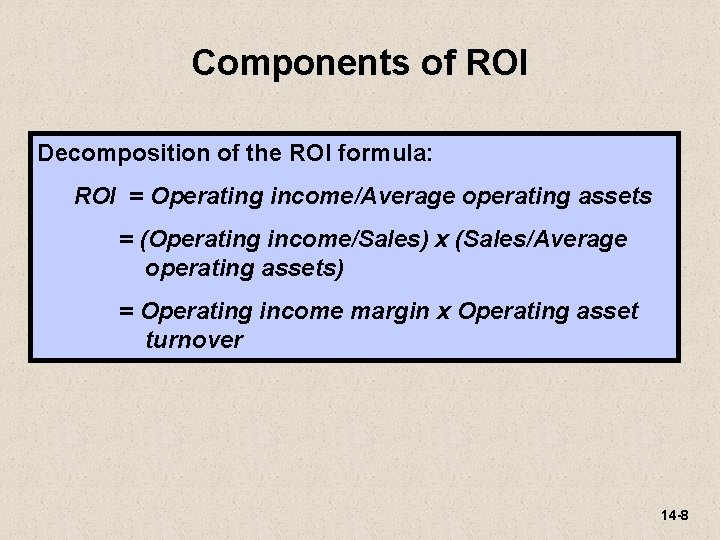
Components of ROI Decomposition of the ROI formula: ROI = Operating income/Average operating assets = (Operating income/Sales) x (Sales/Average operating assets) = Operating income margin x Operating asset turnover 14 -8
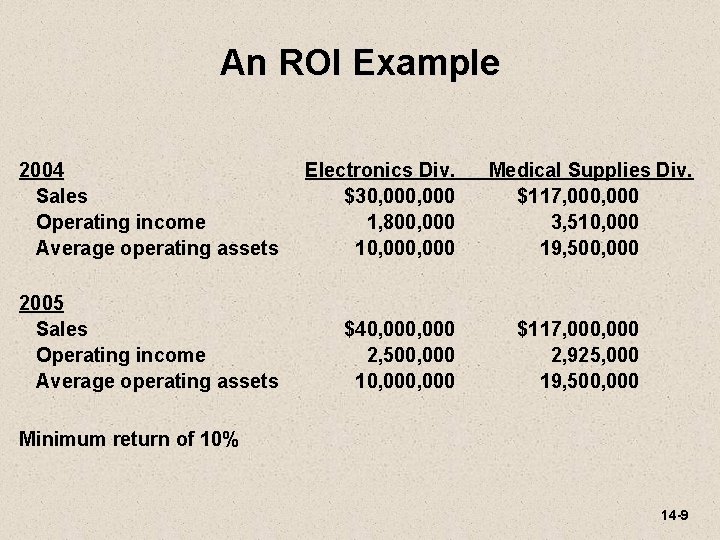
An ROI Example 2004 Sales Operating income Average operating assets Electronics Div. $30, 000 1, 800, 000 10, 000 2005 Sales Operating income Average operating assets $40, 000 2, 500, 000 10, 000 Medical Supplies Div. $117, 000 3, 510, 000 19, 500, 000 $117, 000 2, 925, 000 19, 500, 000 Minimum return of 10% 14 -9
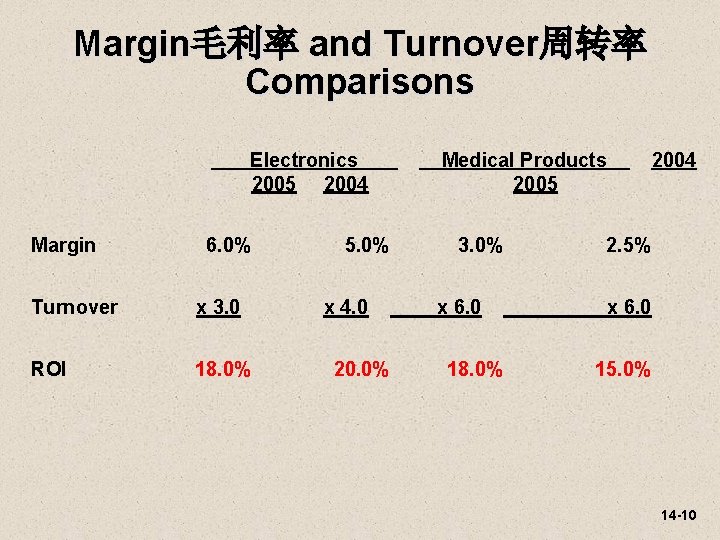
Margin毛利率 and Turnover周转率 Comparisons Electronics 2005 2004 Margin 6. 0% Turnover x 3. 0 ROI 18. 0% 5. 0% x 4. 0 20. 0% Medical Products 2005 3. 0% x 6. 0 18. 0% 2004 2. 5% x 6. 0 15. 0% 14 -10
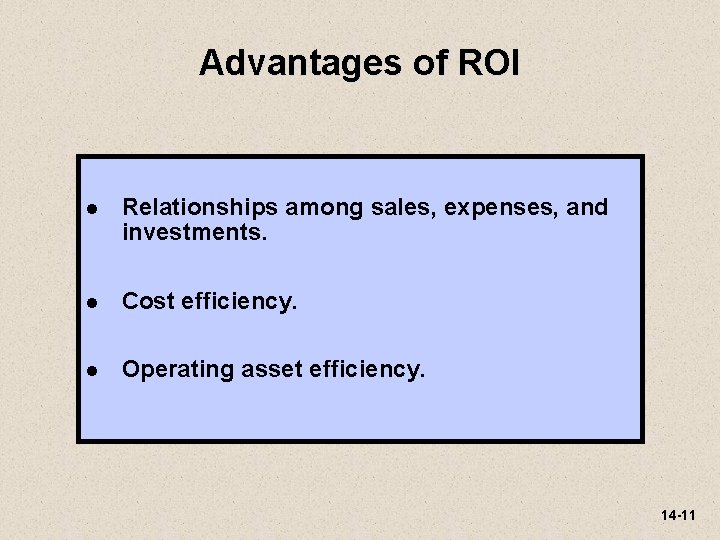
Advantages of ROI l Relationships among sales, expenses, and investments. l Cost efficiency. l Operating asset efficiency. 14 -11
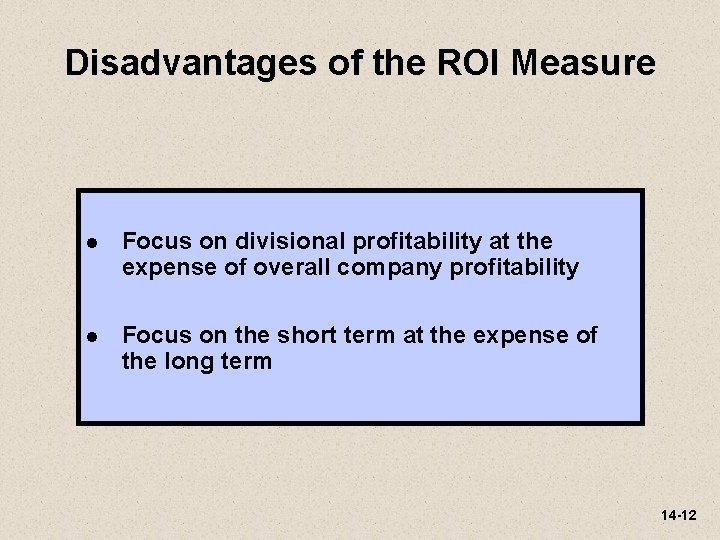
Disadvantages of the ROI Measure l Focus on divisional profitability at the expense of overall company profitability l Focus on the short term at the expense of the long term 14 -12
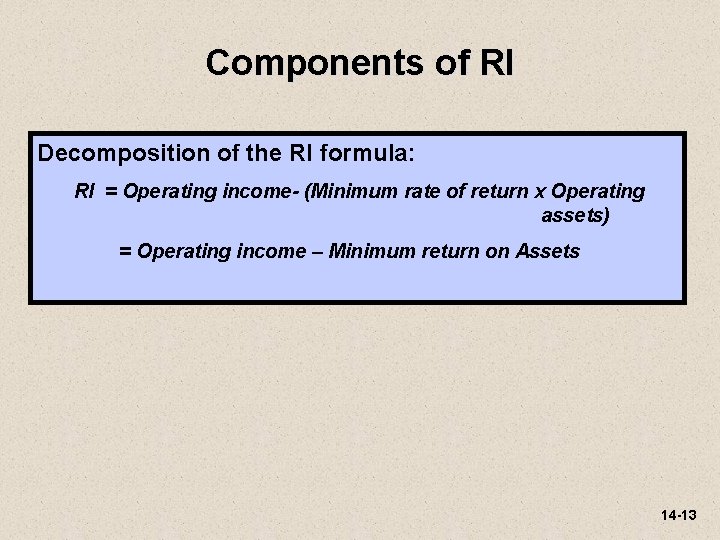
Components of RI Decomposition of the RI formula: RI = Operating income- (Minimum rate of return x Operating assets) = Operating income – Minimum return on Assets 14 -13
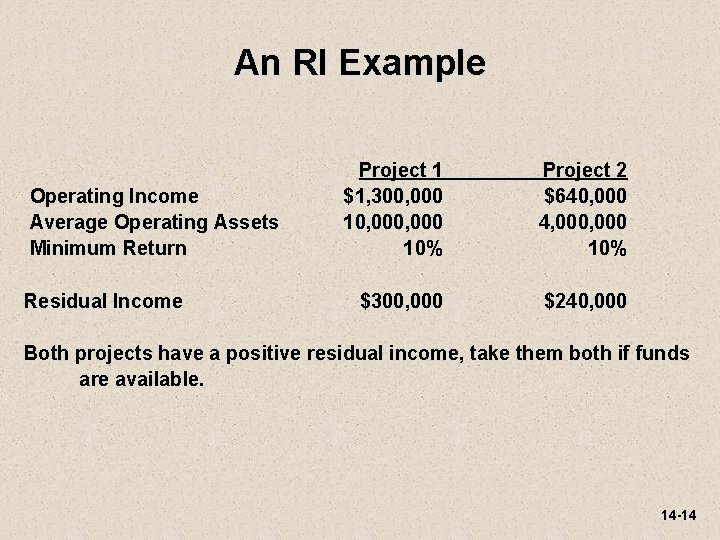
An RI Example Operating Income Average Operating Assets Minimum Return Residual Income Project 1 $1, 300, 000 10, 000 10% Project 2 $640, 000 4, 000 10% $300, 000 $240, 000 Both projects have a positive residual income, take them both if funds are available. 14 -14
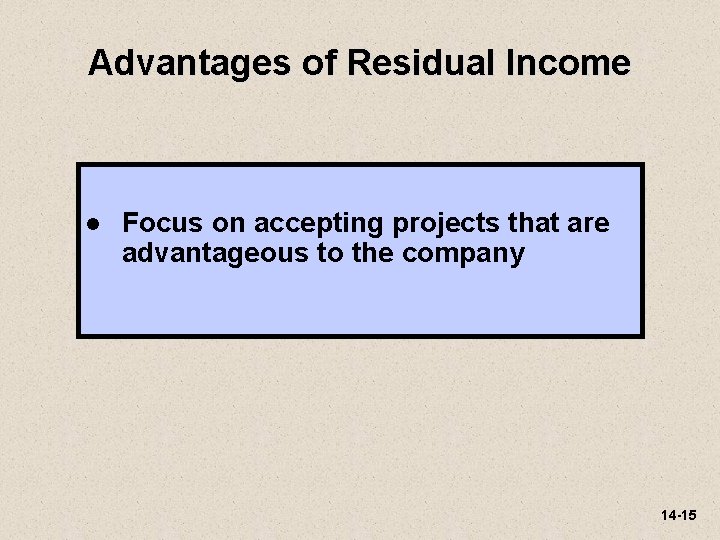
Advantages of Residual Income l Focus on accepting projects that are advantageous to the company 14 -15
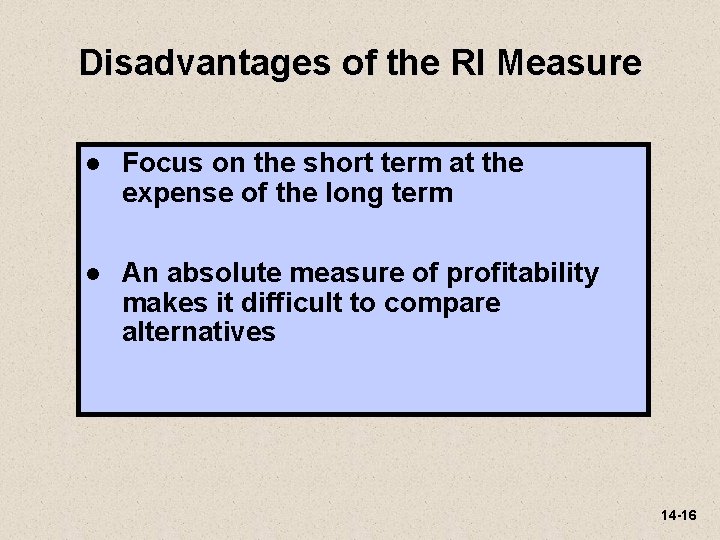
Disadvantages of the RI Measure l Focus on the short term at the expense of the long term l An absolute measure of profitability makes it difficult to compare alternatives 14 -16
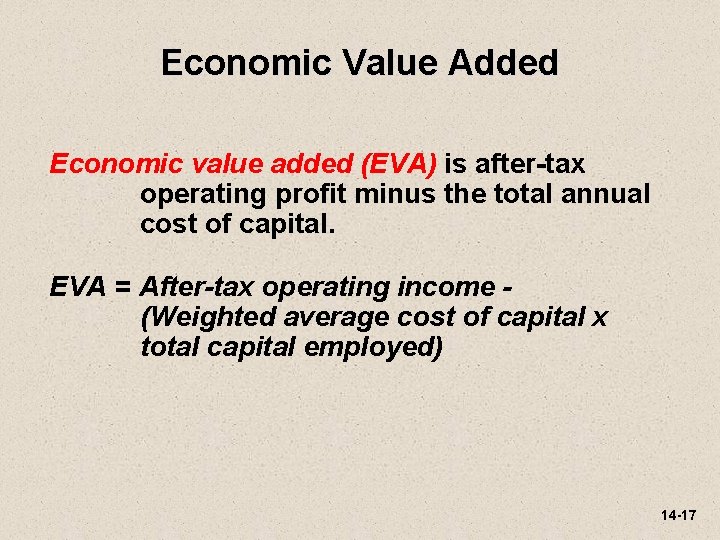
Economic Value Added Economic value added (EVA) is after-tax operating profit minus the total annual cost of capital. EVA = After-tax operating income (Weighted average cost of capital x total capital employed) 14 -17
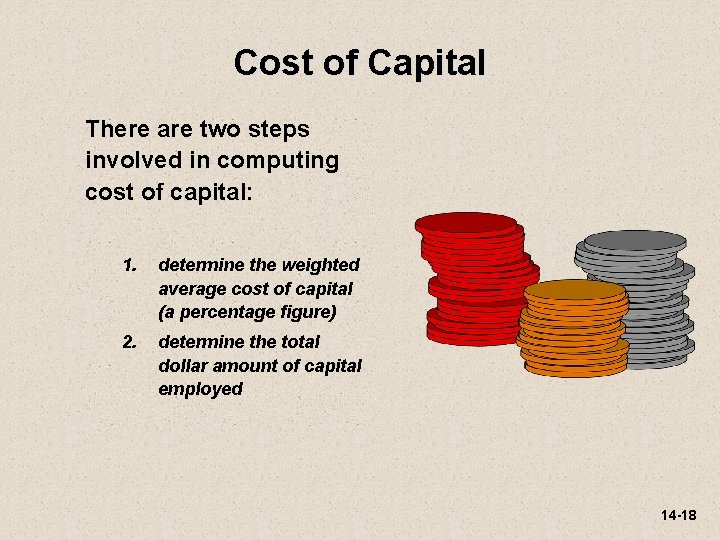
Cost of Capital There are two steps involved in computing cost of capital: 1. determine the weighted average cost of capital (a percentage figure) 2. determine the total dollar amount of capital employed 14 -18
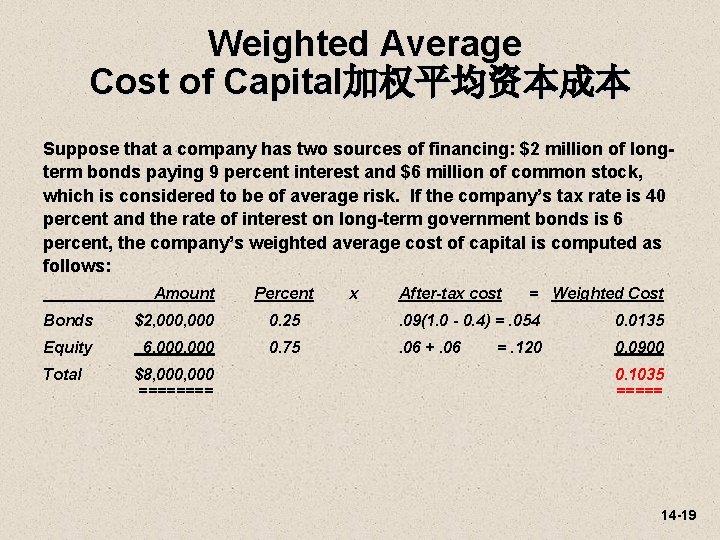
Weighted Average Cost of Capital加权平均资本成本 Suppose that a company has two sources of financing: $2 million of longterm bonds paying 9 percent interest and $6 million of common stock, which is considered to be of average risk. If the company’s tax rate is 40 percent and the rate of interest on long-term government bonds is 6 percent, the company’s weighted average cost of capital is computed as follows: Amount Percent x After-tax cost = Weighted Cost Bonds $2, 000 0. 25 . 09(1. 0 - 0. 4) =. 054 0. 0135 Equity 6, 000 0. 75 . 06 +. 06 0. 0900 Total $8, 000 ==== =. 120 0. 1035 ===== 14 -19
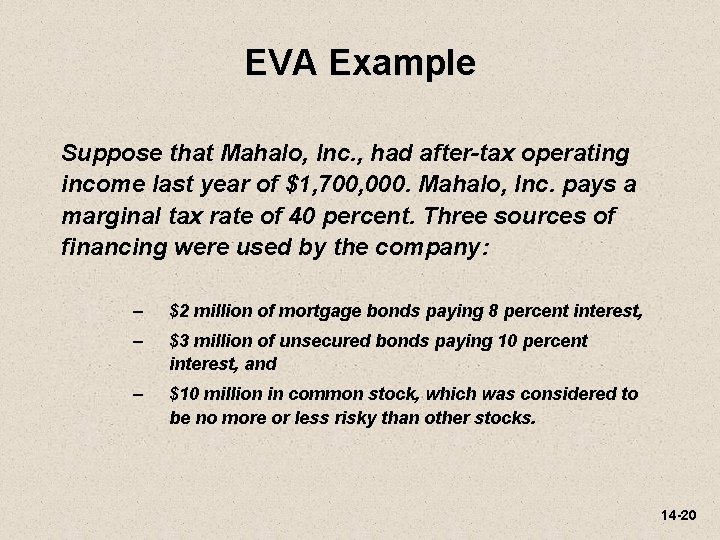
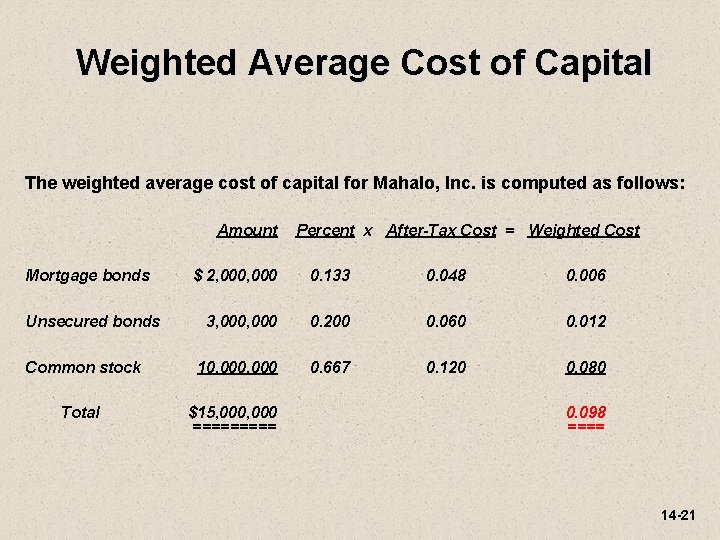
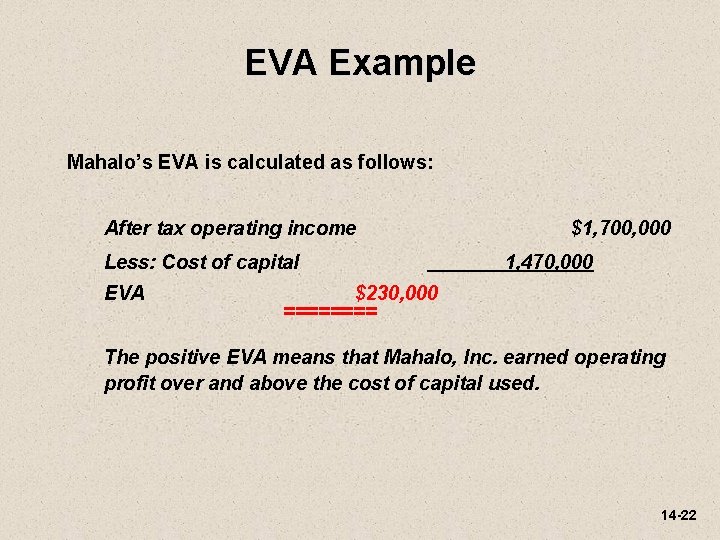
EVA Example Suppose that Mahalo, Inc. , had after-tax operating income last year of $1, 700, 000. Mahalo, Inc. pays a marginal tax rate of 40 percent. Three sources of financing were used by the company: – $2 million of mortgage bonds paying 8 percent interest, – $3 million of unsecured bonds paying 10 percent interest, and – $10 million in common stock, which was considered to be no more or less risky than other stocks. 14 -20
Weighted Average Cost of Capital The weighted average cost of capital for Mahalo, Inc. is computed as follows: Amount Mortgage bonds Percent x After-Tax Cost = Weighted Cost $ 2, 000 0. 133 0. 048 0. 006 3, 000 0. 200 0. 060 0. 012 Common stock 10, 000 0. 667 0. 120 0. 080 Total $15, 000 ===== Unsecured bonds 0. 098 ==== 14 -21
EVA Example Mahalo’s EVA is calculated as follows: After tax operating income Less: Cost of capital EVA $1, 700, 000 1, 470, 000 $230, 000 ==== The positive EVA means that Mahalo, Inc. earned operating profit over and above the cost of capital used. 14 -22
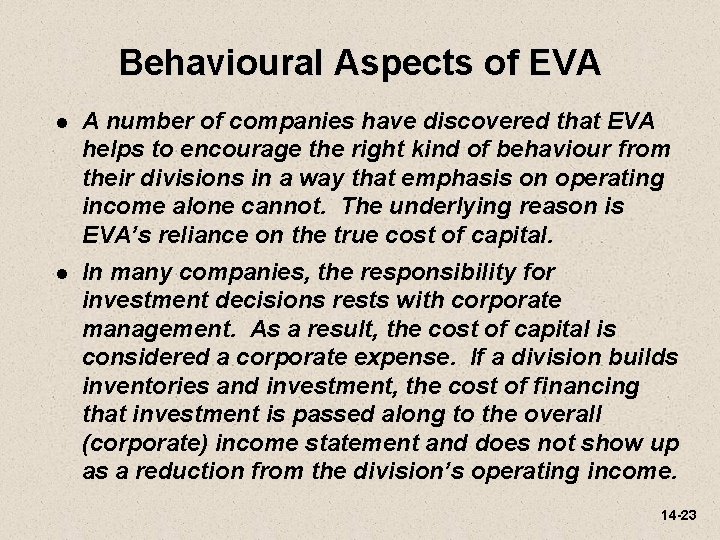
Behavioural Aspects of EVA l A number of companies have discovered that EVA helps to encourage the right kind of behaviour from their divisions in a way that emphasis on operating income alone cannot. The underlying reason is EVA’s reliance on the true cost of capital. l In many companies, the responsibility for investment decisions rests with corporate management. As a result, the cost of capital is considered a corporate expense. If a division builds inventories and investment, the cost of financing that investment is passed along to the overall (corporate) income statement and does not show up as a reduction from the division’s operating income. 14 -23
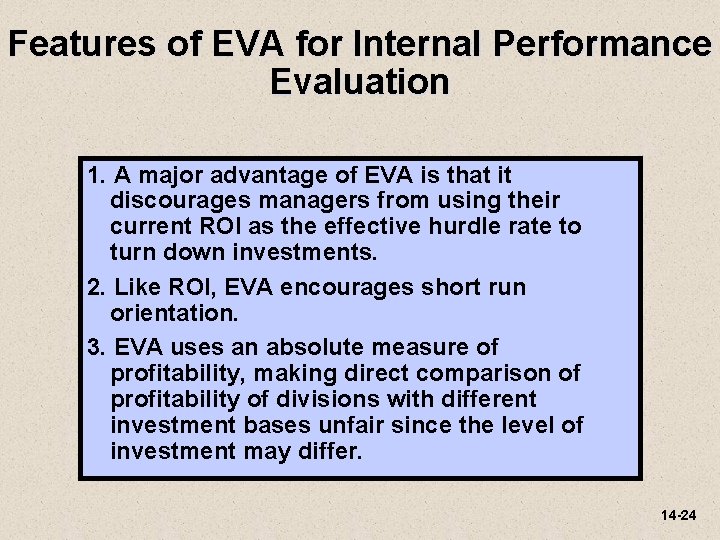
Features of EVA for Internal Performance Evaluation 1. A major advantage of EVA is that it discourages managers from using their current ROI as the effective hurdle rate to turn down investments. 2. Like ROI, EVA encourages short run orientation. 3. EVA uses an absolute measure of profitability, making direct comparison of profitability of divisions with different investment bases unfair since the level of investment may differ. 14 -24
Multiple Performance Measurements l Why have Multiple Performance Measures? l Tends to Focus on Long-run Discourages Myopic Behaviour 14 -25
Transfer Pricing The transferred good is revenue to the selling division and cost to the buying division. This value is called a transfer price. 14 -26
Transfer Pricing: General Concerns Some Major Issues l Impact on divisional performance measures l Impact on firm-wide profits l Impact on divisional autonomy 14 -27
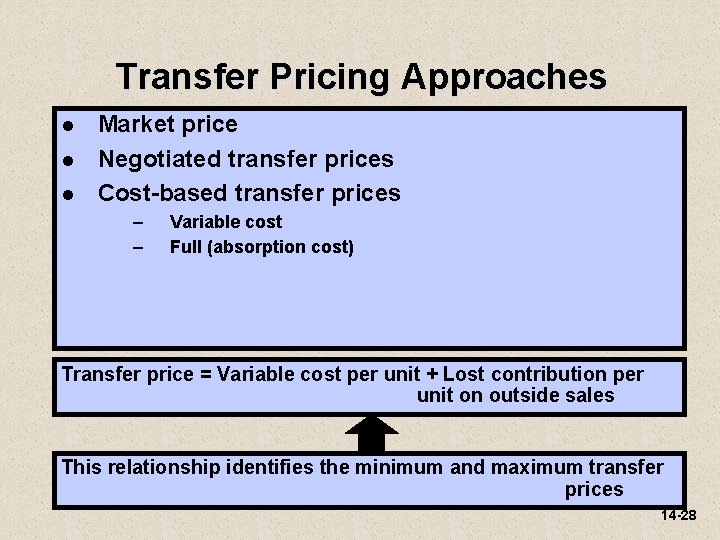
Transfer Pricing Approaches l l l Market price Negotiated transfer prices Cost-based transfer prices – – Variable cost Full (absorption cost) Transfer price = Variable cost per unit + Lost contribution per unit on outside sales This relationship identifies the minimum and maximum transfer prices 14 -28
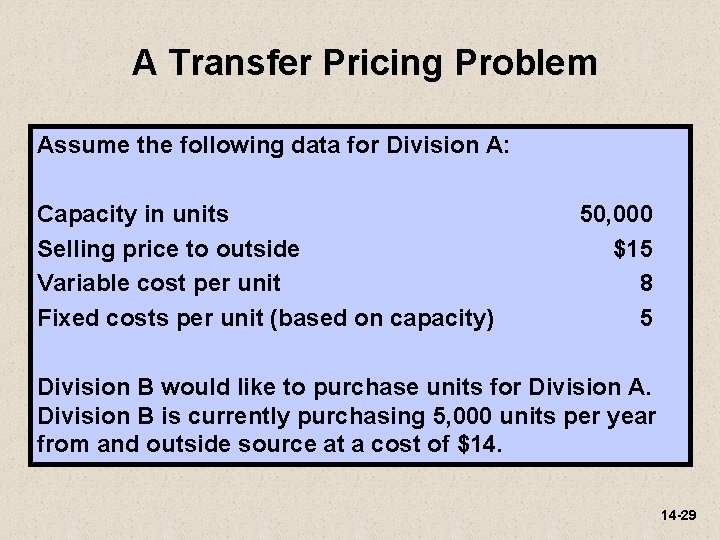
A Transfer Pricing Problem Assume the following data for Division A: Capacity in units Selling price to outside Variable cost per unit Fixed costs per unit (based on capacity) 50, 000 $15 8 5 Division B would like to purchase units for Division A. Division B is currently purchasing 5, 000 units per year from and outside source at a cost of $14. 14 -29
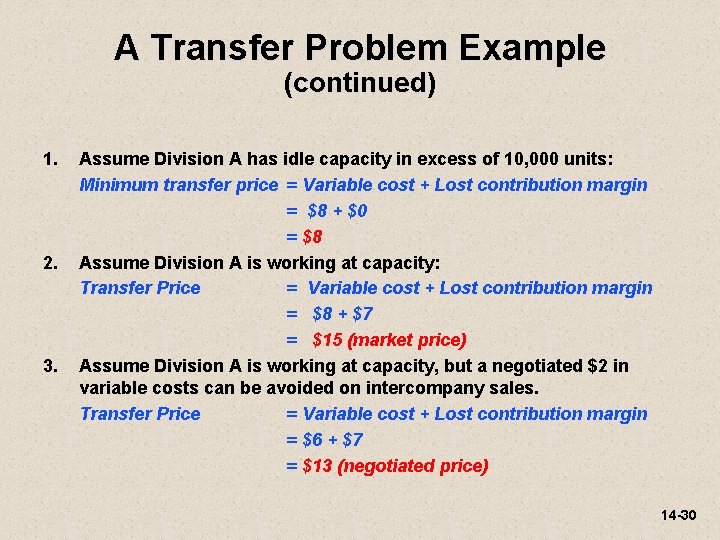
A Transfer Problem Example (continued) 1. 2. 3. Assume Division A has idle capacity in excess of 10, 000 units: Minimum transfer price = Variable cost + Lost contribution margin = $8 + $0 = $8 Assume Division A is working at capacity: Transfer Price = Variable cost + Lost contribution margin = $8 + $7 = $15 (market price) Assume Division A is working at capacity, but a negotiated $2 in variable costs can be avoided on intercompany sales. Transfer Price = Variable cost + Lost contribution margin = $6 + $7 = $13 (negotiated price) 14 -30