
14 Conflict and Negotiation 14 0 Learning Objectives
14 Conflict and Negotiation 14 -0
Learning Objectives n n n n n Define conflict. Differentiate between the traditional, human relations, and interactionist views of conflict. Outline the conflict process. Define negotiation. Contrast distributive and integrative bargaining. Apply the five steps in the negotiation process. Show individual differences influence negotiations. Assess the roles and functions of third-party negotiations. Describe cultural differences in negotiations. 14 -1
Conflict Defined n A process that begins when a person perceives(thinks) that another person has negatively affected, or is about to negatively affect, something that the first person cares about n n That point in an ongoing activity when an interaction “crosses over” to become an inter-party conflict Includes a wide range of conflicts that people experience in organizations n Incompatibility (mis-match) of goals n Differences over interpretations of facts n Disagreements based on behavioral expectations 14 -2
Transitions in Conflict Thought n n A Traditional View of Conflict n The belief that all conflict is harmful and must be avoided n A strong view in the 1930 s-1940 s Conflict resulted from: n Poor communication n Lack of openness n Failure to respond to employee needs 14 -3
Continued Transitions in Conflict Thought n n Human Relations View of Conflict n The belief that conflict is a natural and inevitable outcome in any group Inter-actionist View of Conflict n The belief that conflict is not only a positive force in a group but that it is absolutely necessary for a group to perform effectively n Current view 14 -4
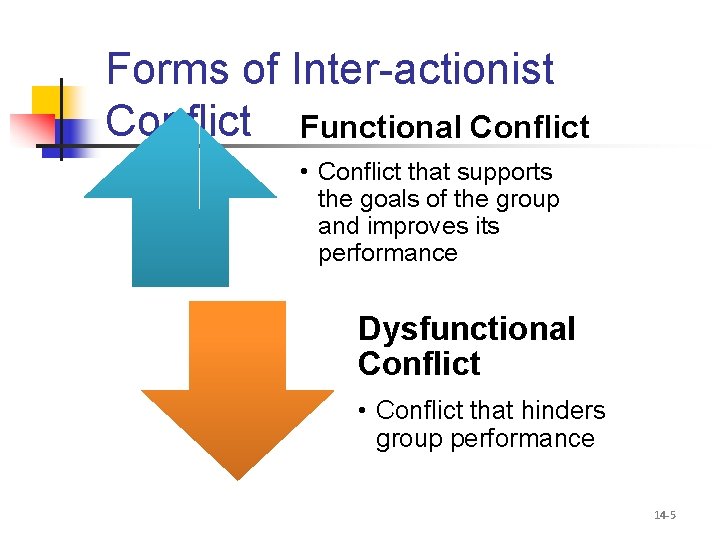
Forms of Inter-actionist Conflict Functional Conflict • Conflict that supports the goals of the group and improves its performance Dysfunctional Conflict • Conflict that hinders group performance 14 -5

Types of Interactionist Conflict n Task Conflict n n n Conflicts over content and goals of the work Low-to-moderate levels of this type are FUNCTIONAL Relationship Conflict based on interpersonal relationships Copyright © 2011 Pearson Education, Inc. publishing as Prentice Hall n 14 -6
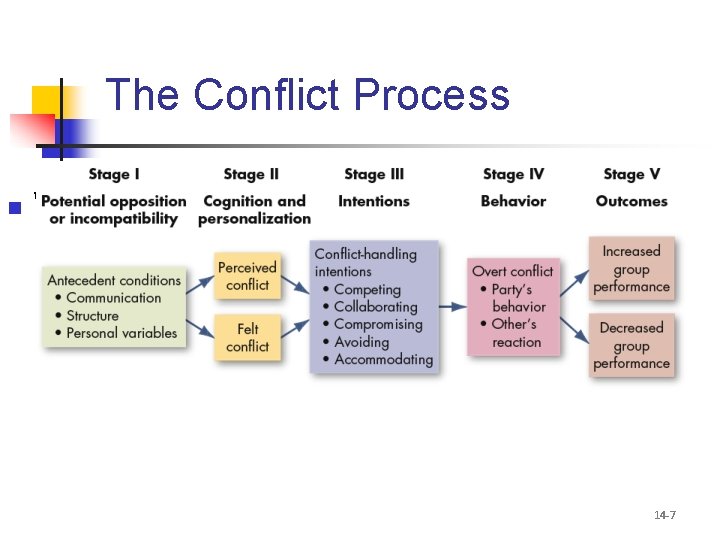
The Conflict Process n We will focus on each step in a moment… 14 -7
Stage I: Potential Opposition or Incompatibility n n n Communication n Semantic difficulties (use of words), misunderstandings, over communication and “noise” (disruptions) Structure n Size and specialization of jobs n Jurisdictional clarity/ambiguity (do you have authority in this area? ) n Member/goal incompatibility n Leadership styles (close or participative) n Reward systems (win-lose) n Dependence/interdependence of groups Personal Variables n Differing individual value systems n Personality types 14 -8
Stage II: Cognition and Personalization n Important stage for two reasons: 1. 2. Conflict is defined n Perceived Conflict n Awareness by one or more parties of the existence of conditions that create opportunities for conflict to arise Emotions are expressed that have a strong impact on the eventual outcome n Felt Conflict n Emotional involvement in a conflict creating anxiety, tenseness, frustration, or hostility 14 -9
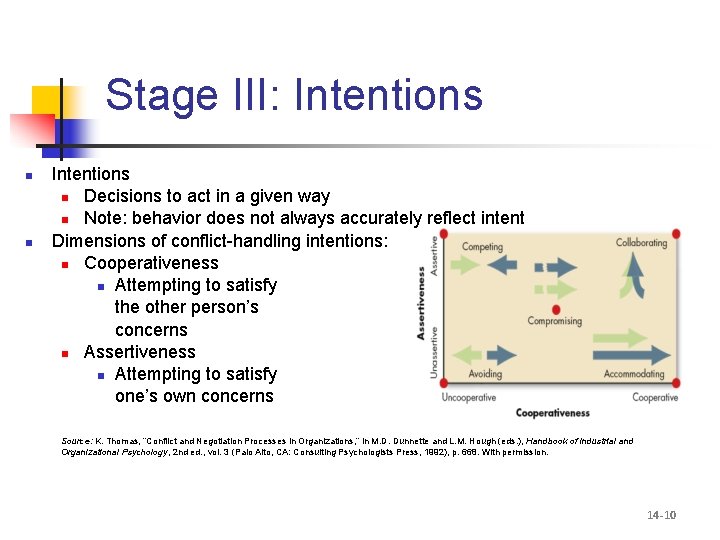
Stage III: Intentions n n Intentions n Decisions to act in a given way n Note: behavior does not always accurately reflect intent Dimensions of conflict-handling intentions: n Cooperativeness n Attempting to satisfy the other person’s concerns n Assertiveness n Attempting to satisfy one’s own concerns Source: K. Thomas, “Conflict and Negotiation Processes in Organizations, ” in M. D. Dunnette and L. M. Hough (eds. ), Handbook of Industrial and Organizational Psychology, 2 nd ed. , vol. 3 (Palo Alto, CA: Consulting Psychologists Press, 1992), p. 668. With permission. 14 -10
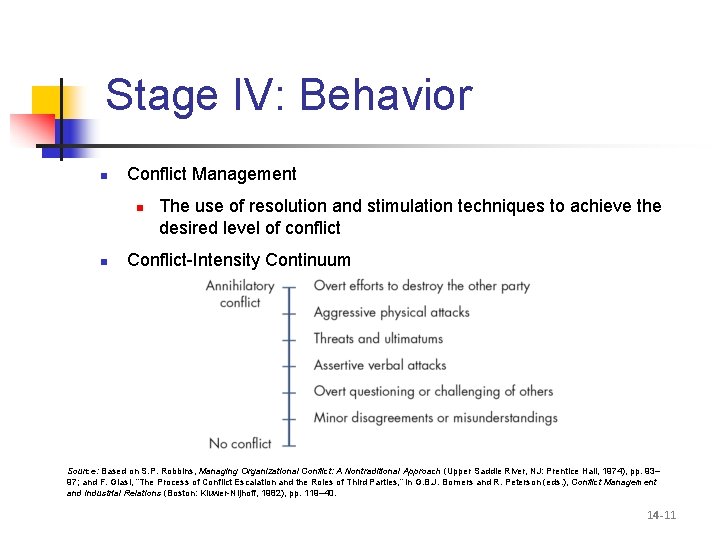
Stage IV: Behavior n Conflict Management n n The use of resolution and stimulation techniques to achieve the desired level of conflict Conflict-Intensity Continuum Source: Based on S. P. Robbins, Managing Organizational Conflict: A Nontraditional Approach (Upper Saddle River, NJ: Prentice Hall, 1974), pp. 93– 97; and F. Glasi, “The Process of Conflict Escalation and the Roles of Third Parties, ” in G. B. J. Bomers and R. Peterson (eds. ), Conflict Management and Industrial Relations (Boston: Kluwer-Nijhoff, 1982), pp. 119– 40. 14 -11
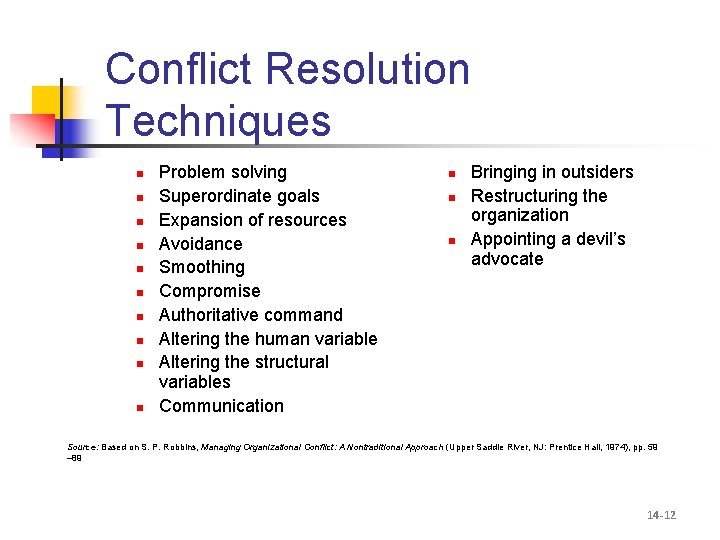
Conflict Resolution Techniques n n n n n Problem solving Superordinate goals Expansion of resources Avoidance Smoothing Compromise Authoritative command Altering the human variable Altering the structural variables Communication n Bringing in outsiders Restructuring the organization Appointing a devil’s advocate Source: Based on S. P. Robbins, Managing Organizational Conflict: A Nontraditional Approach (Upper Saddle River, NJ: Prentice Hall, 1974), pp. 59 – 89 14 -12
Stage V: Outcomes n Functional n n n n Increased group performance n n Improved quality of decisions n Stimulation of creativity and innovation n Encouragement of interest and curiosity Provision of a medium for problem solving Creation of an environment for self-evaluation and change Dysfunctional n n Development of discontent Reduced group effectiveness Poor communication Reduced group cohesiveness Infighting among group members overcomes group goals Creating Functional Conflict n Reward dissent (causers) and punish conflict avoiders 14 -13
Negotiation n n Negotiation (Bargaining) n A process in which two or more people (parties) exchange goods or services and attempt to agree on the exchange rate (price) for them Two General Approaches: n Distributive Bargaining n Negotiation that seeks to divide up a fixed amount of resources; a win-lose situation (less for 1 person…e. g. a low undervalue price) n Integrative Bargaining n Negotiation that seeks one or more settlements that can create a win-win solution (good price for both) 14 -14
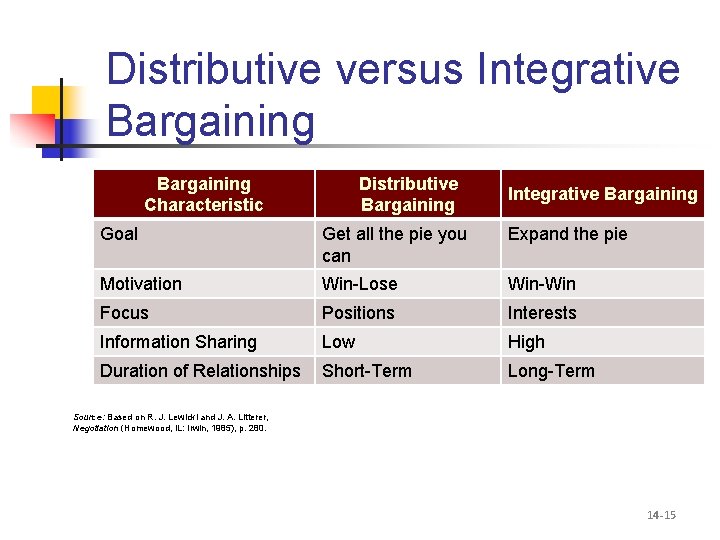
Distributive versus Integrative Bargaining Characteristic Distributive Bargaining Integrative Bargaining Goal Get all the pie you can Expand the pie Motivation Win-Lose Win-Win Focus Positions Interests Information Sharing Low High Duration of Relationships Short-Term Long-Term Source: Based on R. J. Lewicki and J. A. Litterer, Negotiation (Homewood, IL: Irwin, 1985), p. 280. 14 -15
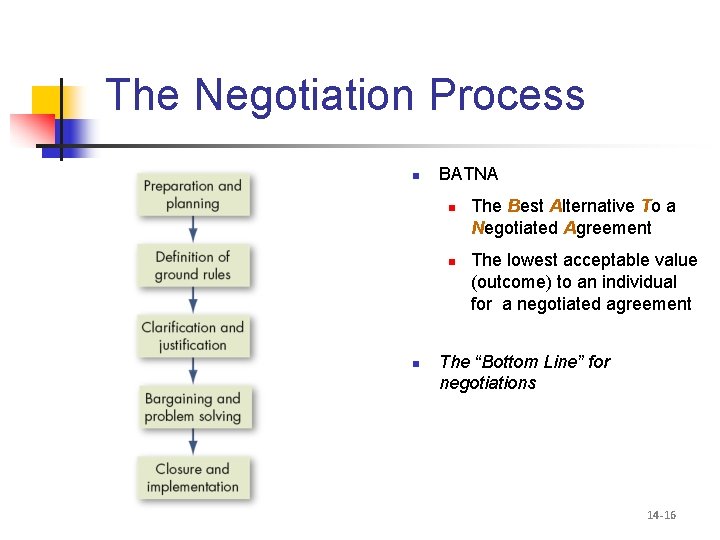
The Negotiation Process n BATNA n n n The Best Alternative To a Negotiated Agreement The lowest acceptable value (outcome) to an individual for a negotiated agreement The “Bottom Line” for negotiations 14 -16
Individual Differences in Negotiation Effectiveness n n n Personality Traits n Extroverts and agreeable people are weaker at distributive negotiation – disagreeable introvert is best n Intelligence is a poor indicator of effectiveness Mood and Emotion n Ability to show anger helps in distributive bargaining n Positive moods and emotions help integrative bargaining Gender n Men and women negotiate the same way, but may experience different outcomes n Women and men take on gender stereotypes in negotiations: tender and tough n Women are less likely to negotiate 14 -17
Third-Party Negotiations n Four Basic Third-Party Roles n Mediator n A neutral third party who facilitates a negotiated solution by using reasoning, persuasion, and suggestions for alternatives n Arbitrator n A third party to a negotiation who has the authority to dictate an agreement. n Conciliator n A trusted third party who provides an informal communication link between the negotiator and the opponent (2 nd person/party) n Consultant n An impartial third party, skilled in conflict management, who attempts to facilitate creative problem solving through communication and analysis 14 -18
Global Implications n n Conflict and Culture n Asian and U. S. managers view conflict differently n U. S. managers are more likely to use competing tactics while Asian managers are likely to use compromise and avoidance Cultural Differences in Negotiations There are multiple cross-cultural studies on negotiation styles, for instance: n American negotiators are more likely than Asian bargainers to make a first offer n North Americans use facts to persuade, Arabs use emotion, and Russians use asserted ideals n Brazilians say “no” more often than Americans or Asians 14 -19
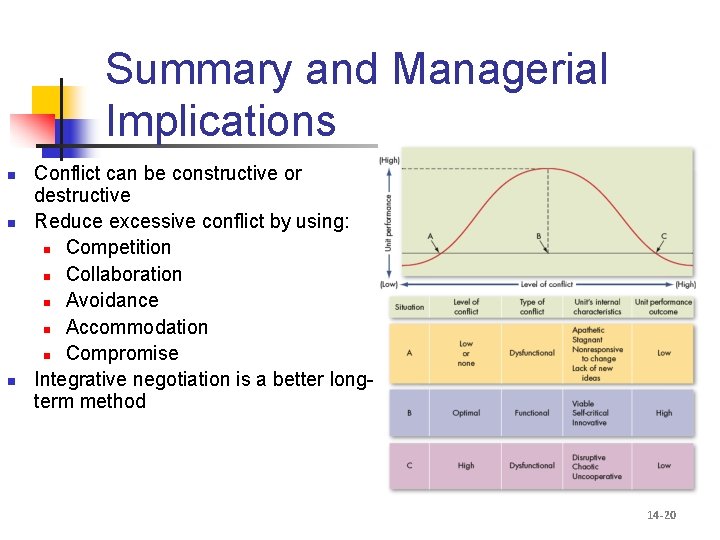
Summary and Managerial Implications n n n Conflict can be constructive or destructive Reduce excessive conflict by using: n Competition n Collaboration n Avoidance n Accommodation n Compromise Integrative negotiation is a better longterm method 14 -20
- Slides: 21