
14 Chapter Robbins Judge Organizational Behavior 14 th
14 Chapter Robbins & Judge Organizational Behavior 14 th Edition Conflict and Negotiation Kelli J. Schutte William Jewell College Copyright © 2011 Pearson Education, Inc. publishing as Prentice Hall 14 -0
Conflict Defined Ø A process that begins when one party perceives that another party has negatively affected, or is about to negatively affect, something that the first party cares about – That point in an ongoing activity when an interaction “crosses over” to become an interparty conflict Ø Encompasses a wide range of conflicts that people experience in organizations – Incompatibility of goals – Differences over interpretations of facts – Disagreements based on behavioral expectations Copyright © 2011 Pearson Education, Inc. publishing as Prentice Hall 14 -1
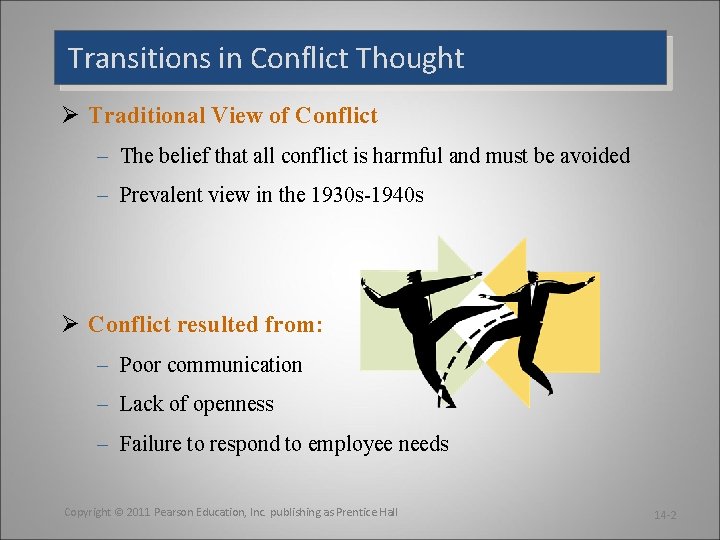
Transitions in Conflict Thought Ø Traditional View of Conflict – The belief that all conflict is harmful and must be avoided – Prevalent view in the 1930 s-1940 s Ø Conflict resulted from: – Poor communication – Lack of openness – Failure to respond to employee needs Copyright © 2011 Pearson Education, Inc. publishing as Prentice Hall 14 -2
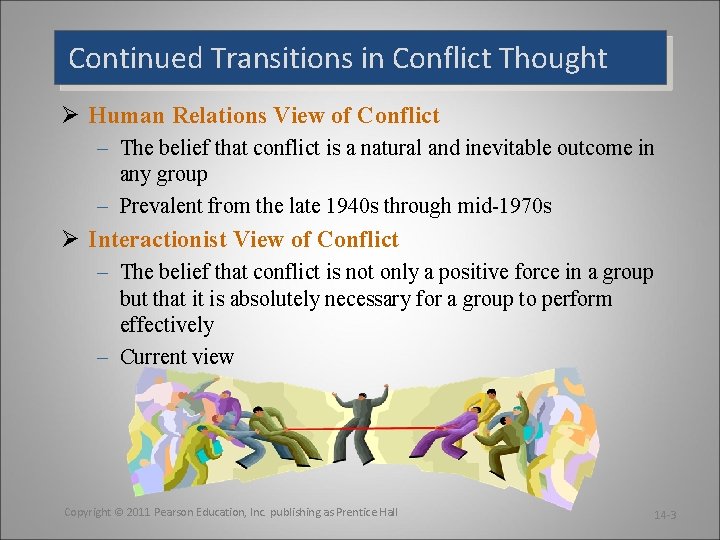
Continued Transitions in Conflict Thought Ø Human Relations View of Conflict – The belief that conflict is a natural and inevitable outcome in any group – Prevalent from the late 1940 s through mid-1970 s Ø Interactionist View of Conflict – The belief that conflict is not only a positive force in a group but that it is absolutely necessary for a group to perform effectively – Current view Copyright © 2011 Pearson Education, Inc. publishing as Prentice Hall 14 -3
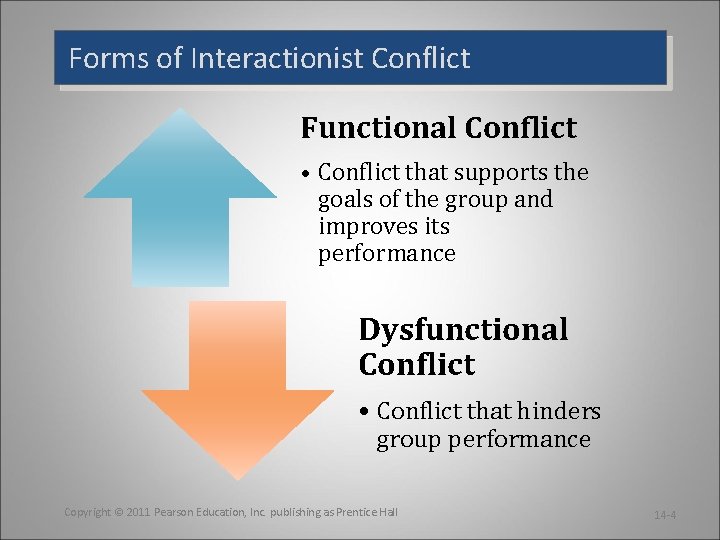
Forms of Interactionist Conflict Functional Conflict • Conflict that supports the goals of the group and improves its performance Dysfunctional Conflict • Conflict that hinders group performance Copyright © 2011 Pearson Education, Inc. publishing as Prentice Hall 14 -4
Types of Interactionist Conflict Ø Task Conflict – Conflicts over content and goals of the work – Low-to-moderate levels of this type are FUNCTIONAL Ø Relationship Conflict – Conflict based on interpersonal relationships – Almost always DYSFUNCTIONAL Ø Process Conflict – Conflict over how work gets done – Low levels of this type are FUNCTIONAL Copyright © 2011 Pearson Education, Inc. publishing as Prentice Hall 14 -5
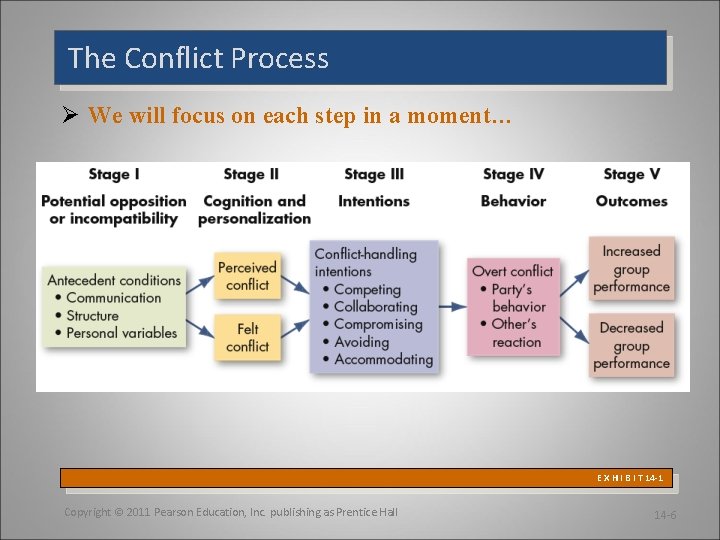
The Conflict Process Ø We will focus on each step in a moment… E X H I B I T 14 -1 Copyright © 2011 Pearson Education, Inc. publishing as Prentice Hall 14 -6
Stage I: Potential Opposition or Incompatibility Ø Communication – Semantic difficulties, misunderstandings, over communication and “noise” Ø Structure – – – Size and specialization of jobs Jurisdictional clarity/ambiguity Member/goal incompatibility Leadership styles (close or participative) Reward systems (win-lose) Dependence/interdependence of groups Ø Personal Variables – Differing individual value systems – Personality types Copyright © 2011 Pearson Education, Inc. publishing as Prentice Hall 14 -7
Stage II: Cognition and Personalization Ø Important stage for two reasons: 1. Conflict is defined • Perceived Conflict – Awareness by one or more parties of the existence of conditions that create opportunities for conflict to arise 2. Emotions are expressed that have a strong impact on the eventual outcome • Felt Conflict – Emotional involvement in a conflict creating anxiety, tenseness, frustration, or hostility Copyright © 2011 Pearson Education, Inc. publishing as Prentice Hall 14 -8
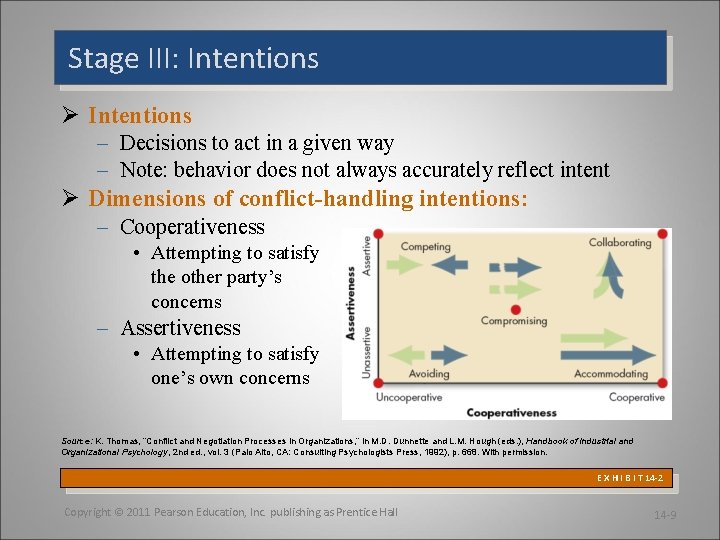
Stage III: Intentions Ø Intentions – Decisions to act in a given way – Note: behavior does not always accurately reflect intent Ø Dimensions of conflict-handling intentions: – Cooperativeness • Attempting to satisfy the other party’s concerns – Assertiveness • Attempting to satisfy one’s own concerns Source: K. Thomas, “Conflict and Negotiation Processes in Organizations, ” in M. D. Dunnette and L. M. Hough (eds. ), Handbook of Industrial and Organizational Psychology, 2 nd ed. , vol. 3 (Palo Alto, CA: Consulting Psychologists Press, 1992), p. 668. With permission. E X H I B I T 14 -2 Copyright © 2011 Pearson Education, Inc. publishing as Prentice Hall 14 -9
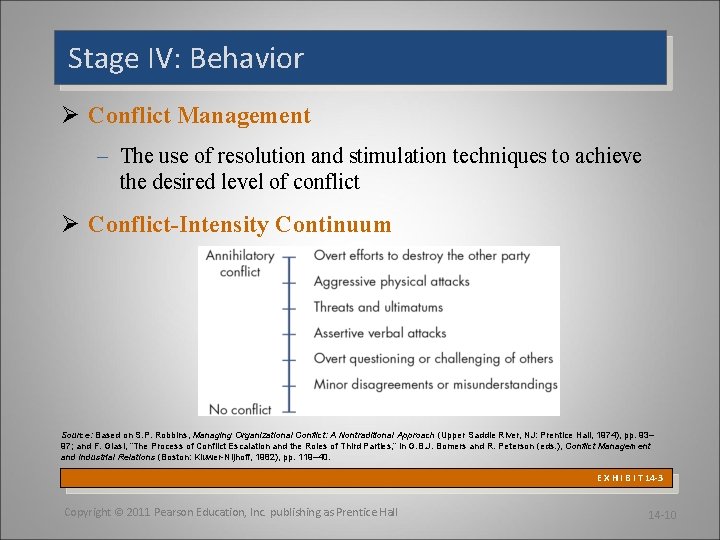
Stage IV: Behavior Ø Conflict Management – The use of resolution and stimulation techniques to achieve the desired level of conflict Ø Conflict-Intensity Continuum Source: Based on S. P. Robbins, Managing Organizational Conflict: A Nontraditional Approach (Upper Saddle River, NJ: Prentice Hall, 1974), pp. 93– 97; and F. Glasi, “The Process of Conflict Escalation and the Roles of Third Parties, ” in G. B. J. Bomers and R. Peterson (eds. ), Conflict Management and Industrial Relations (Boston: Kluwer-Nijhoff, 1982), pp. 119– 40. E X H I B I T 14 -3 Copyright © 2011 Pearson Education, Inc. publishing as Prentice Hall 14 -10
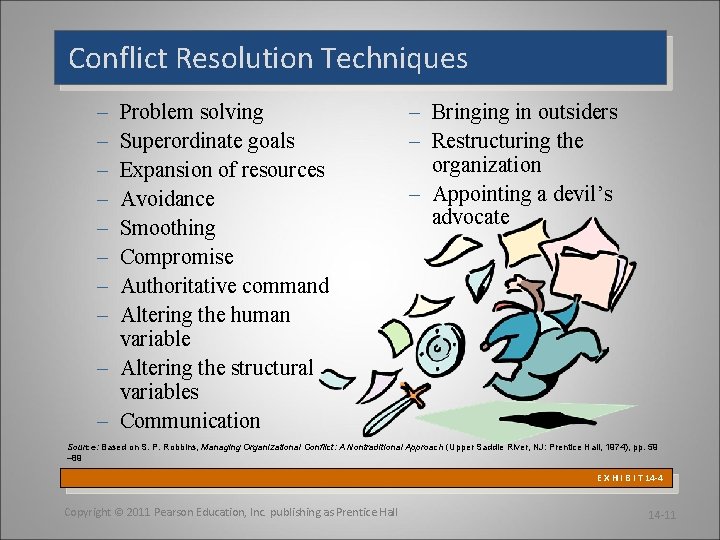
Conflict Resolution Techniques – – – – Problem solving Superordinate goals Expansion of resources Avoidance Smoothing Compromise Authoritative command Altering the human variable – Altering the structural variables – Communication – Bringing in outsiders – Restructuring the organization – Appointing a devil’s advocate Source: Based on S. P. Robbins, Managing Organizational Conflict: A Nontraditional Approach (Upper Saddle River, NJ: Prentice Hall, 1974), pp. 59 – 89 E X H I B I T 14 -4 Copyright © 2011 Pearson Education, Inc. publishing as Prentice Hall 14 -11
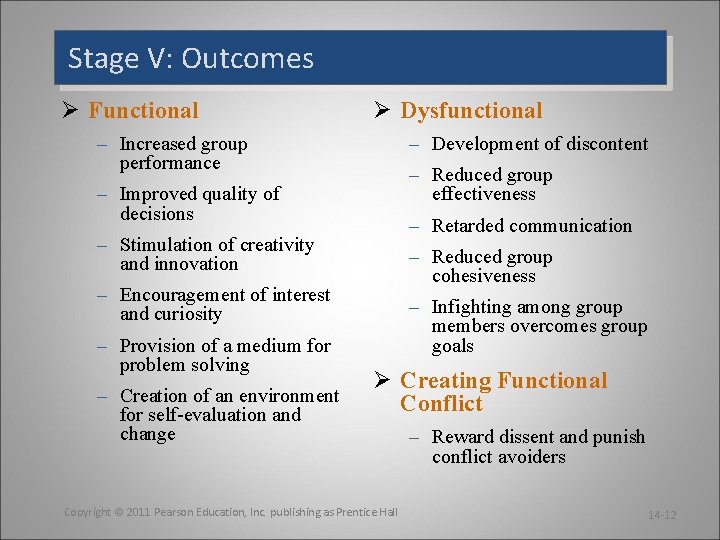
Stage V: Outcomes Ø Functional Ø Dysfunctional – Increased group performance – Development of discontent – Reduced group effectiveness – Improved quality of decisions – Retarded communication – Stimulation of creativity and innovation – Reduced group cohesiveness – Encouragement of interest and curiosity – Provision of a medium for problem solving – Creation of an environment for self-evaluation and change – Infighting among group members overcomes group goals Ø Creating Functional Conflict Copyright © 2011 Pearson Education, Inc. publishing as Prentice Hall – Reward dissent and punish conflict avoiders 14 -12
Negotiation Ø Negotiation (Bargaining) – A process in which two or more parties exchange goods or services and attempt to agree on the exchange rate for them Ø Two General Approaches: – Distributive Bargaining • Negotiation that seeks to divide up a fixed amount of resources; a win-lose situation – Integrative Bargaining • Negotiation that seeks one or more settlements that can create a win-win solution Copyright © 2011 Pearson Education, Inc. publishing as Prentice Hall 14 -13
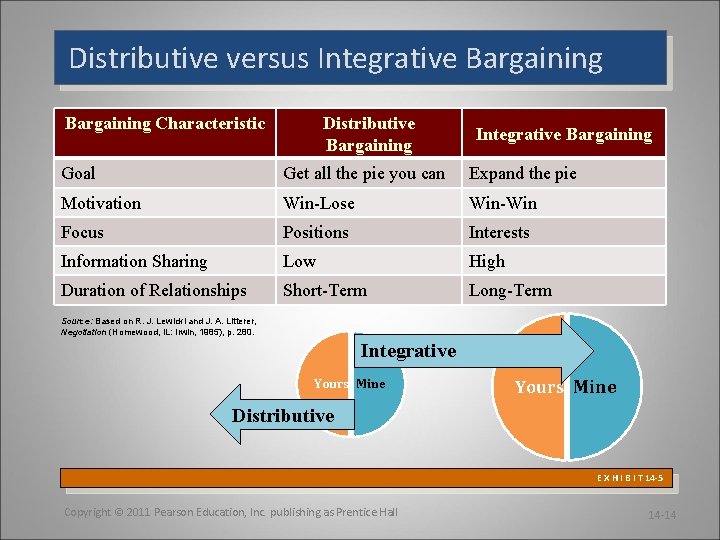
Distributive versus Integrative Bargaining Characteristic Distributive Bargaining Integrative Bargaining Goal Get all the pie you can Expand the pie Motivation Win-Lose Win-Win Focus Positions Interests Information Sharing Low High Duration of Relationships Short-Term Long-Term Source: Based on R. J. Lewicki and J. A. Litterer, Negotiation (Homewood, IL: Irwin, 1985), p. 280. Integrative Yours Mine Distributive E X H I B I T 14 -5 Copyright © 2011 Pearson Education, Inc. publishing as Prentice Hall 14 -14
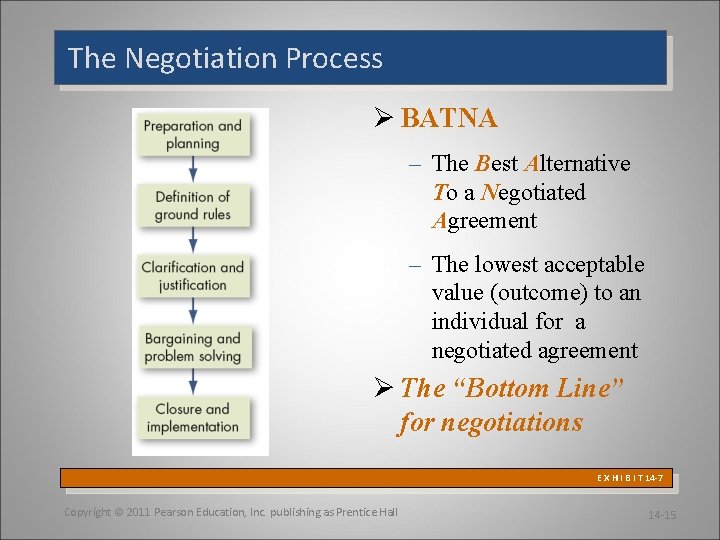
The Negotiation Process Ø BATNA – The Best Alternative To a Negotiated Agreement – The lowest acceptable value (outcome) to an individual for a negotiated agreement Ø The “Bottom Line” for negotiations E X H I B I T 14 -7 Copyright © 2011 Pearson Education, Inc. publishing as Prentice Hall 14 -15
Individual Differences in Negotiation Effectiveness Ø Personality Traits – Extroverts and agreeable people weaker at distributive negotiation – disagreeable introvert is best – Intelligence is a weak indicator of effectiveness Ø Mood and Emotion – Ability to show anger helps in distributive bargaining – Positive moods and emotions help integrative bargaining Ø Gender – Men and women negotiate the same way, but may experience different outcomes – Women and men take on gender stereotypes in negotiations: tender and tough – Women are less likely to negotiate Copyright © 2011 Pearson Education, Inc. publishing as Prentice Hall 14 -16
Third-Party Negotiations Ø Four Basic Third-Party Roles – Mediator • A neutral third party who facilitates a negotiated solution by using reasoning, persuasion, and suggestions for alternatives – Arbitrator • A third party to a negotiation who has the authority to dictate an agreement. – Conciliator • A trusted third party who provides an informal communication link between the negotiator and the opponent – Consultant • An impartial third party, skilled in conflict management, who attempts to facilitate creative problem solving through communication and analysis Copyright © 2011 Pearson Education, Inc. publishing as Prentice Hall 14 -17
- Slides: 18