
14 736 DISTRIBTED SYSTEMS LECTURE 8 SPRING 2019
14 -736: DISTRIBTED SYSTEMS LECTURE 8 * SPRING 2019 * KESDEN
COORDINATOR SELECTION: SELECTING A “SPECIAL HOST” • Given N available hosts, where N isn’t 1, how do we pick one for a different role, e. g. coordinator, front-end server, etc? • Appoint one: A human simply picks • Elect one: Participating hosts pick
APPOINTING A COORDINATOR • A human, e. g. system administrator, picks from available hosts • Advantages: • Simple • Minimal development time • Agile • Disadvantages • Slow, i. e. human speed • Requires human to detect failure, understand cause, determine participants, and react.
ELECTING A COORDINATOR • The participants determine the need to pick a (new? ) coordinator • Participants “discuss” it among themselves • Participants agree on coordinator • New coordinator takes charge • Advantages: • Automatic • Disadvantages • Complexity (partitionings, etc) • Network traffic (storms) • Failure mode can be complex, e. g. many coordinators or none
BULLY APPROACH (GARCIA-MOLINA '82) • Probably the most common • Simplest • Can lead to storms (We’ll see why)

BULLY ALGORITHM • Assumptions: • All messages are delivered within some Tm units of time, called the message propagation time. • Once a message is received, the reply will be dispatched within some Tp units of time, called the message handling time. • Tp and Tm are known. • These are nice, because together they imply that if a response is is not received within (2*Tm + Tp) units of time the process or connection has failed. • But, of course, in the real world congestion, load, and the indeterminate nature of most networks mean that a good amount of “slop” needs to be included.
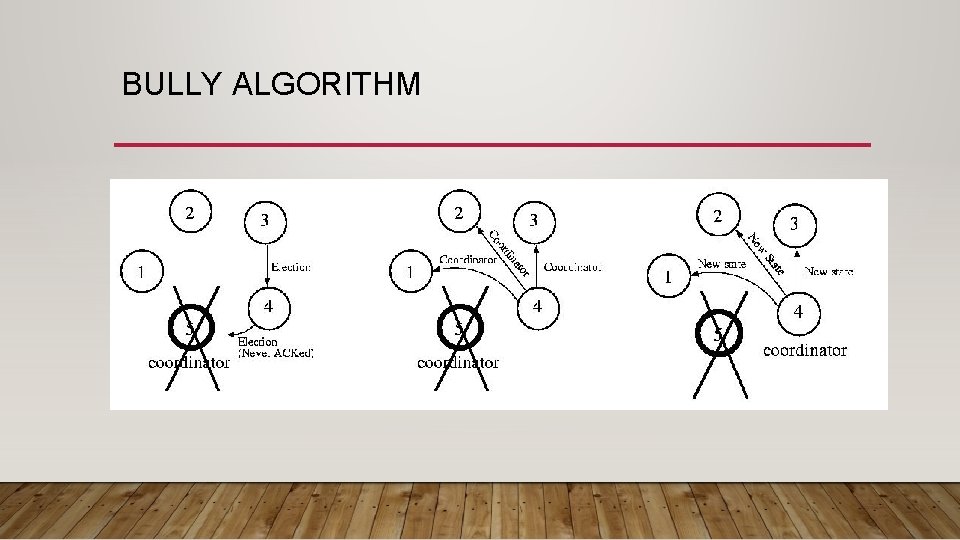
BULLY ALGORITHM The idea behind the Bully Algorithm is to elect the highest-numbered processor as the coordinator. • If any host thinks that the coordinator has failed, it tries to elect itself by sending a message to the highernumbered processors. • If any of them answer it loses the election. • At this point each of these processors will call an election and try to win themselves. • If none of the higher-ups answer, the processor is the highest numbered processor, so it should be the coordinator. • So it sends the lower level processors a message declaring itself the coordinator • After they answer (or the ACK of a reliable protocol), it starts doing its job as coordinator • E. g. It starts to query participants to find out what they know, then begins providing coordination, etc. • If a new processor arrives, or recovers from a failure, it gets the state from the current coordinator and then calls an election • Or, for efficiency, just remains a participant and lets the new coordinator lead, until it fails, etc.

BULLY ALGORITHM
BULLY ALGORITHM
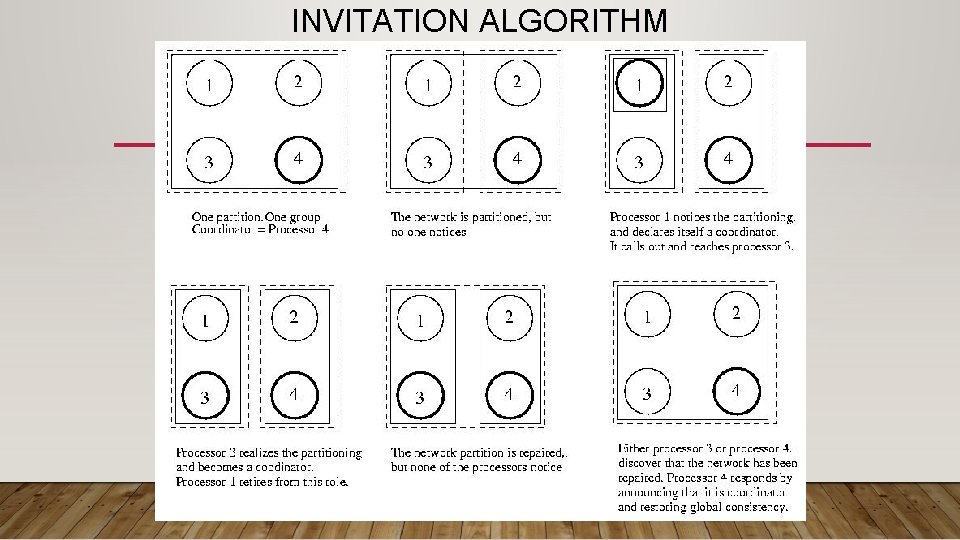
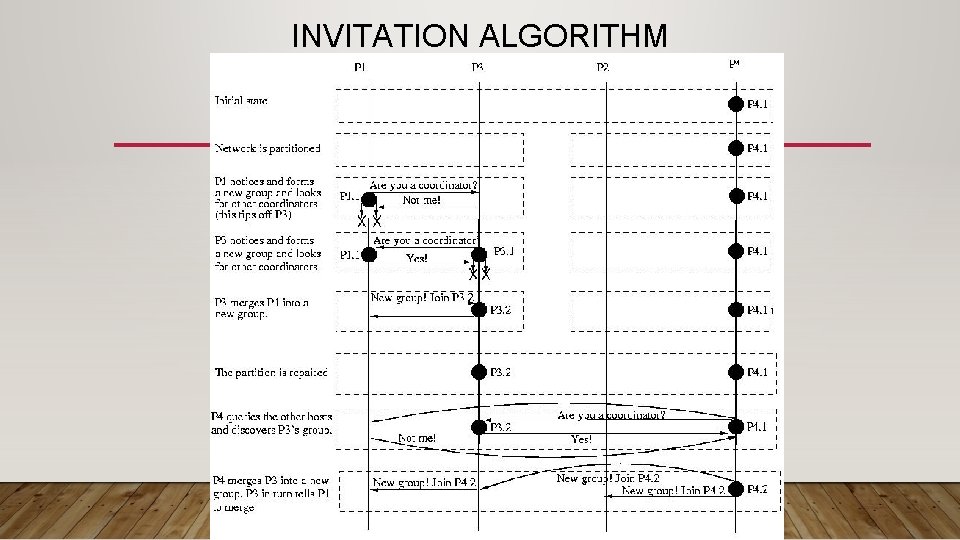
INVITATION ALGORITHM: ASSUMPTIONS AND GOAL • Goal: The Invitation Algorithm provides a protocol forming groups of available participants within partitions, and then merging them into larger groups as partitions heal or failed coordinators are returned to service. • In many ways, it is like a self-healing, partitionable Bully Algorithm • Assumption: In practice communication failure, high latency, and/or congestion can partition a network. • Assumption: A collection of participants under the direction of a coordinator, can perform useful work, even if other such groups exists. • In other words, partitioned participants can still organize and make progress
INVITATION ALGORITHM: ASSUMPTIONS AND GOAL • Groups are named using a group number. • The group number is unique among all groups, is changed every time a new group is formed, and is never reused. • To accomplish this, the group number might be a simple sequence number attached to the processor ID. • The sequence number component can be incremented each time the processor becomes the coordinator of a new group. • Basic idea: • Partitioned participants (or whole group) elect their own coordinator • Coordinators "yell out" periodically to participants outside their group asking each if it is a coordinator. • When a coordinator answers, the coordinators pick one to coordinate, and merge their groups, electing a new coordinator • Choosing the coordinator is Bully-like, with higher nodes winning.
INVITATION ALGORITHM: MERGING GROUPS • One might think that it is acceptable for the coordinator that initiated the merge to be the coordinator of the new group. • But it might be the case that two or more coordinators were concurrently looking for other coordinators and that their messages may arrive in different orders. • To handle this situation, there should be some priority among the coordinators -- some method to determine which of the perhaps many coordinators should take over. • One way of doing this might be to use the processor ID to act as a priority. • Perhaps higher-numbered processors ignore queries from lower-level processors. • This would allow lower-level processors to merge the groups with lower priority coordinators during this operation. • At some later time the higher-level coordinators will each act to discover other coordinators and merge these lower-priority groups. • Perhaps receiving the query will prompt the higher-level coordinator to try to merge its group with others sooner than it otherwise might. • An alternative would be for a coordinator only to try to merge lower-level coordinators.
INVITATION ALGORITHM: OPTIONS • Perhaps higher-numbered processors ignore queries from lower-level processors. • This would allow lower-level processors to merge the groups with lower priority coordinators during this operation. At some later time the higher-level coordinators will each act to discover other coordinators and merge these lowerpriority groups. • Perhaps receiving the query will prompt the higher-level coordinator to try to merge its group with others sooner than it otherwise might. • An alternative would be for a coordinator only to try to merge lower-level coordinators. • Or perhaps processors delay some amount of time between the time that they look for other coordinators and the time that they start to merge these groups. • This would allow time for a higher-priority coordinator to search for other coordinators (it knows that there is at least one) and ask them to merge into its group. • If after such a delay, the old coordinator finds itself in a new group, it stops and accepts its new role as a participant. • In this case, it might be useful to make the delay inversely proportional to one's priority. For example, there is no reason for the highest-priority processor to delay. But the lowest priority processor might want to delay for a long time.
INVITATION ALGORITHM
INVITATION ALGORITHM
RING ELECTION • Another approach, Ring election, is very similar to token ring synchronization, except no token is used. • Assumptions: • We assume that each processor is logically ordered, perhaps by IP address, so that each processor knows its successor, and its successor's successor, and so on. • Each processor must know the entire logical structure.
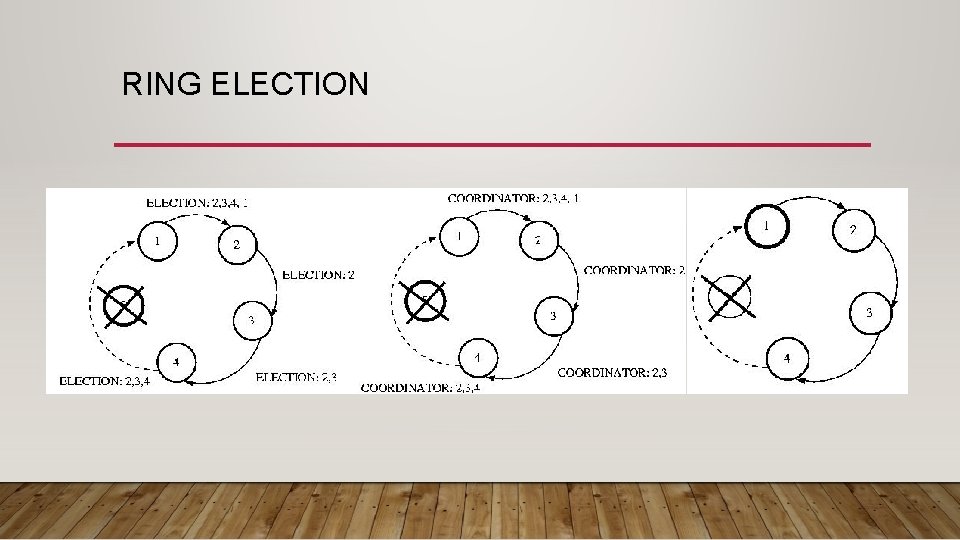
RING ELECTION • When a processor discovers that the coordinator has died, it starts circulating an ELECTION message around the ring. • Each node advances it in logical order, skipping failed nodes as necessary. • Each node adds their node number to the list. • Once this message has made its way all the way around the ring, the message which started it will see its own number in the list. • It then considers the node with the highest number to be the coordinator, and this messages is circulated. • Each receiving node does the same thing. Once this message has made its way around the ring, it is removed. • If multiple nodes concurrently discover a failed coordinator, each will start an ELECTION. • This isn't a problem, because each election will select the same coordinator. The extra messages are wasted overhead, while this isn't optimal, it isn't deadly, either.
RING ELECTION
- Slides: 18