
14 4 Simple Machines The output of one
- Slides: 28
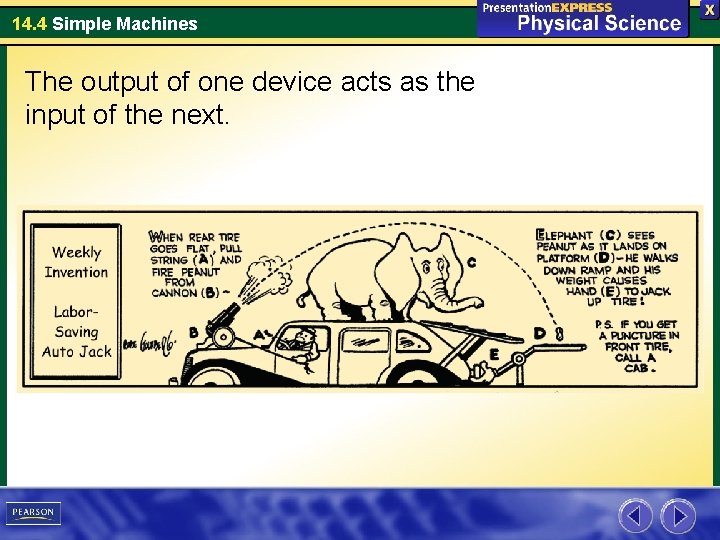
14. 4 Simple Machines The output of one device acts as the input of the next.
14. 4 Simple Machines What are the six types of simple machines? The six types of simple machines are the lever, the wheel and axle, the inclined plane, the wedge, the screw, and the pulley.
14. 4 Simple Machines Levers A lever is a rigid bar that is free to move around a fixed point. The fixed point the bar rotates around is the fulcrum.
14. 4 Simple Machines Levers The input arm of a lever is the distance between the input force and the fulcrum. The output arm is the distance between the output force and the fulcrum. Levers are classified into three categories based on the locations of the input force, the output force, and the fulcrum.
14. 4 Simple Machines Levers First-Class Levers The fulcrum of a first-class lever is always located between the input force and the output force. Depending on the fulcrum position, the mechanical advantage can be greater than 1, equal to 1, or less than 1.
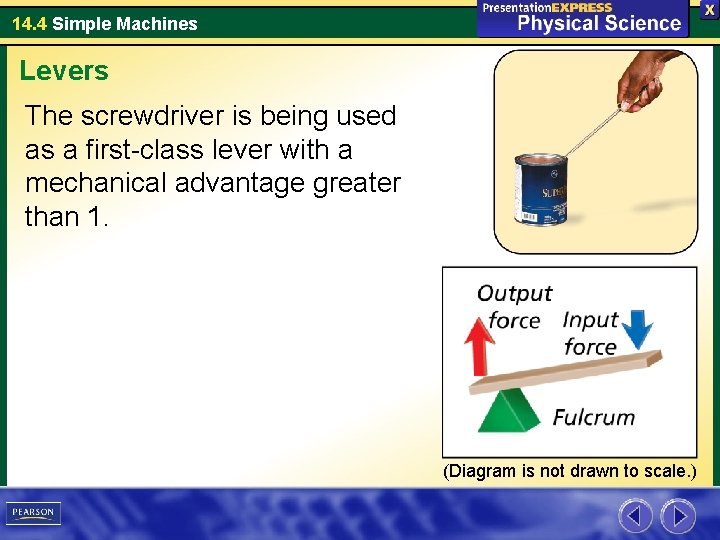
14. 4 Simple Machines Levers The screwdriver is being used as a first-class lever with a mechanical advantage greater than 1. (Diagram is not drawn to scale. )
14. 4 Simple Machines Levers Second-Class Levers • In a second-class lever, the output force is located between the input force and the fulcrum. • The input distance is larger than the output distance. • The mechanical advantage of a second-class lever is always greater than 1.
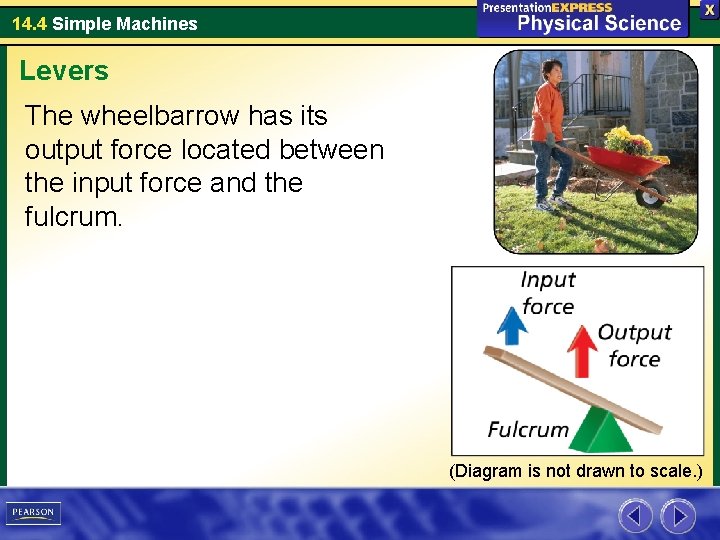
14. 4 Simple Machines Levers The wheelbarrow has its output force located between the input force and the fulcrum. (Diagram is not drawn to scale. )
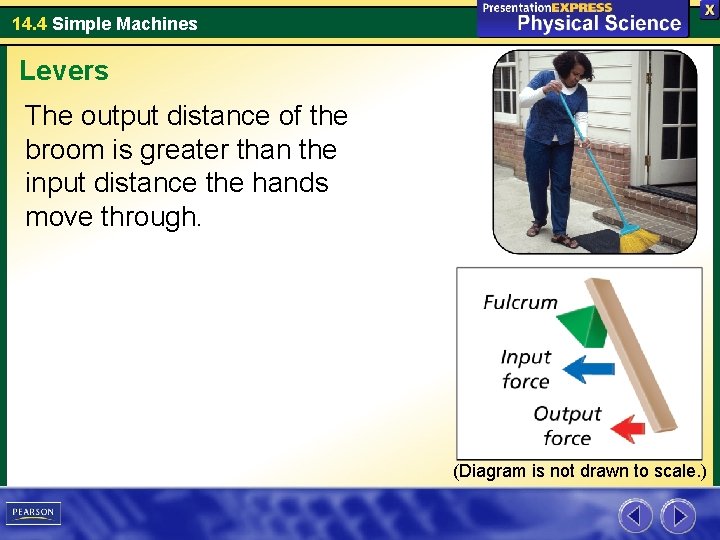
14. 4 Simple Machines Levers Third-Class Levers • The input force of a third-class lever is located between the fulcrum and the output force. • The output distance over which the third-class lever exerts its force is larger than the input distance. • The mechanical advantage of a third-class lever is always less than 1.
14. 4 Simple Machines Levers The output distance of the broom is greater than the input distance the hands move through. (Diagram is not drawn to scale. )
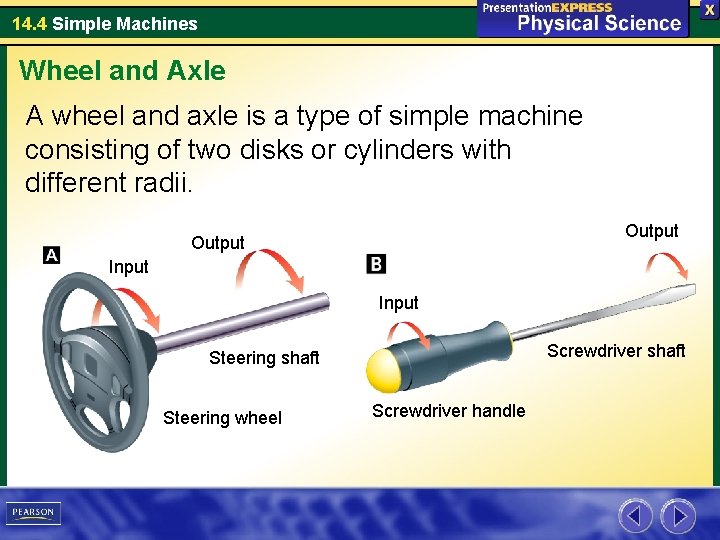
14. 4 Simple Machines Wheel and Axle A wheel and axle is a simple machine that consists of two disks or cylinders, each one with a different radius. The outer disk is the wheel and the inner cylinder is the axle. The wheel and the axle rotate together as a unit.
14. 4 Simple Machines Wheel and Axle A wheel and axle is a type of simple machine consisting of two disks or cylinders with different radii. Output Input Screwdriver shaft Steering wheel Screwdriver handle
14. 4 Simple Machines Inclined Planes An inclined plane is a slanted surface along which a force moves an object to a different elevation. • The distance traveled is the input distance. • The change in height of the ramp is its output distance. • The mechanical advantage of an inclined plane is greater than 1.
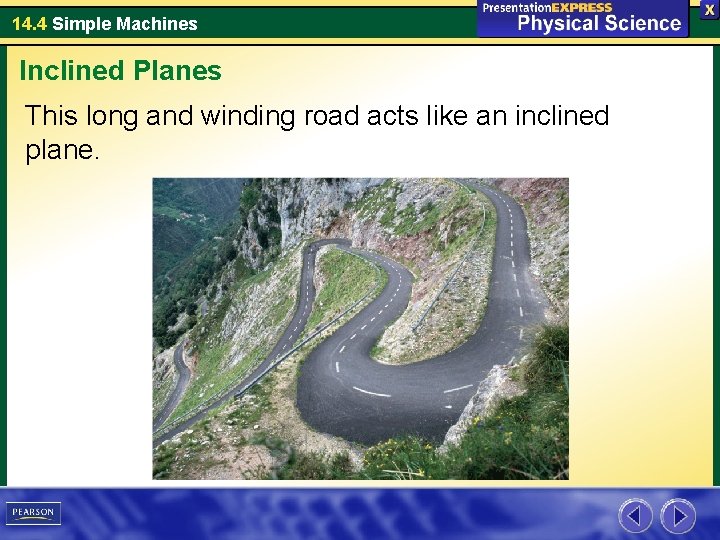
14. 4 Simple Machines Inclined Planes This long and winding road acts like an inclined plane.
14. 4 Simple Machines Wedges and Screws Wedges A wedge is a V-shaped object whose sides are two inclined planes sloped toward each other. A wedge has a mechanical advantage greater than 1.
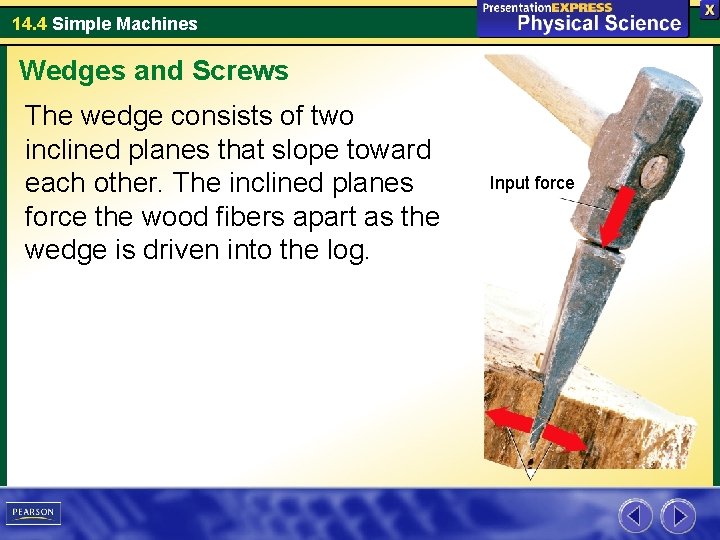
14. 4 Simple Machines Wedges and Screws The wedge consists of two inclined planes that slope toward each other. The inclined planes force the wood fibers apart as the wedge is driven into the log. Input force
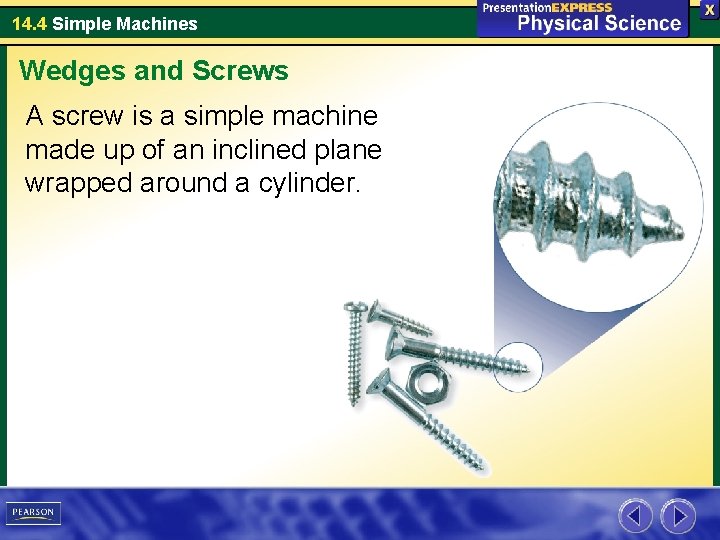
14. 4 Simple Machines Wedges and Screws A screw is an inclined plane wrapped around a cylinder. For two screws of the same length, the one whose threads are closer together moves forward less for each turn of the screw. A screw has a mechanical advantage greater than 1.
14. 4 Simple Machines Wedges and Screws A screw is a simple machine made up of an inclined plane wrapped around a cylinder.
14. 4 Simple Machines Pulleys A pulley is a simple machine that consists of a rope that fits into a groove in a wheel. • Pulleys produce an output force that is different in size, direction, or both, from that of the input force. • The mechanical advantage of a pulley can be equal to or greater than 1.
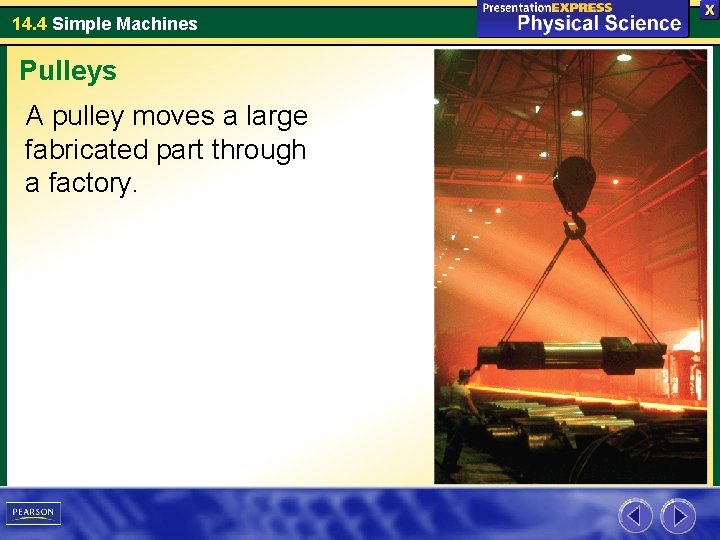
14. 4 Simple Machines Pulleys A pulley moves a large fabricated part through a factory.
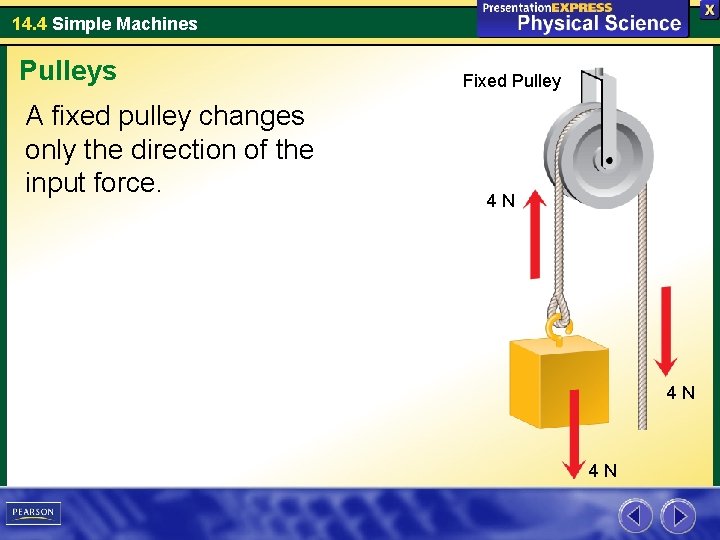
14. 4 Simple Machines Pulleys Fixed Pulleys A fixed pulley is a wheel attached in a fixed location. The direction of the exerted force is changed by a fixed pulley, but the size of the force is not. The ideal mechanical advantage of a fixed pulley is always 1.
14. 4 Simple Machines Pulleys A fixed pulley changes only the direction of the input force. Fixed Pulley 4 N 4 N 4 N
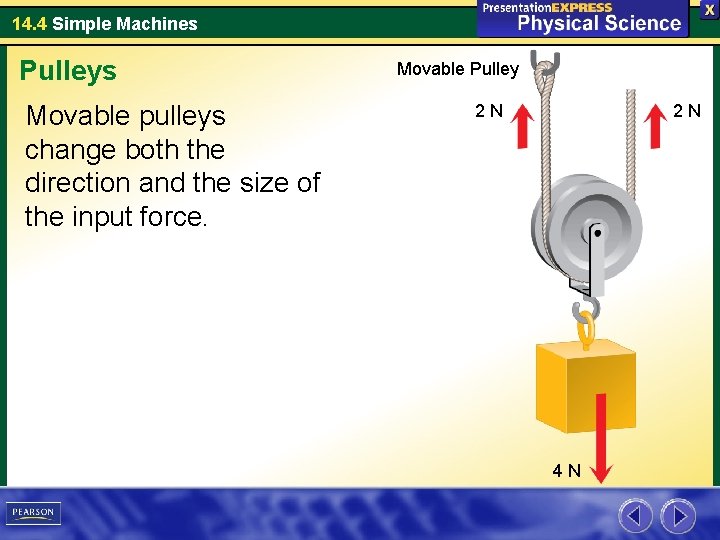
14. 4 Simple Machines Pulleys Movable Pulley A movable pulley is attached to the object being moved rather than to a fixed location. • Both sections of the rope pull up with the same force. • The movable pulley has a mechanical advantage of 2.
14. 4 Simple Machines Pulleys Movable pulleys change both the direction and the size of the input force. Movable Pulley 2 N 2 N 4 N
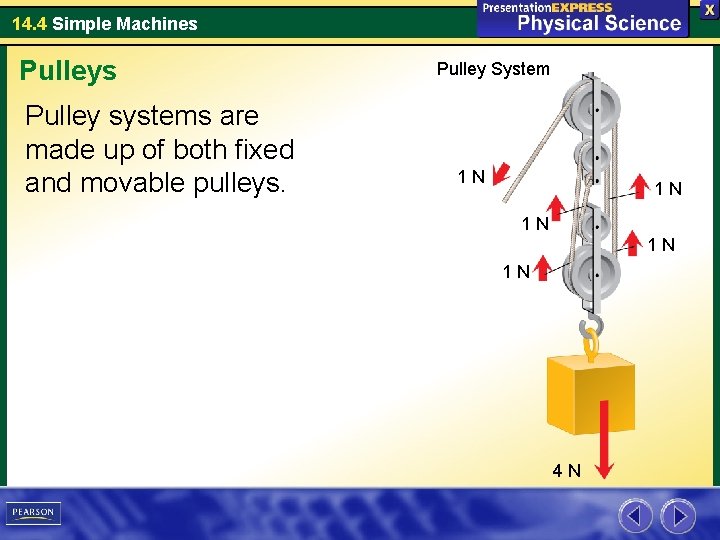
14. 4 Simple Machines Pulley System A large mechanical advantage can be achieved by combining fixed and movable pulleys into a pulley system. • The mechanical advantage depends on how the pulleys are arranged. • The ideal mechanical advantage of a pulley system is equal to the number of rope sections supporting the load being lifted.
14. 4 Simple Machines Pulley systems are made up of both fixed and movable pulleys. Pulley System 1 N 1 N 1 N 4 N
14. 4 Simple Machines Compound Machines • A compound machine is a combination of two or more simple machines that operate together. Most of the machines you use are compound machines. • The edges of a pair of scissors are sharpened like wedges. The blades and the handles together function as levers. • Cars, washing machines, and clocks are combinations of hundreds or thousands of simple machines.
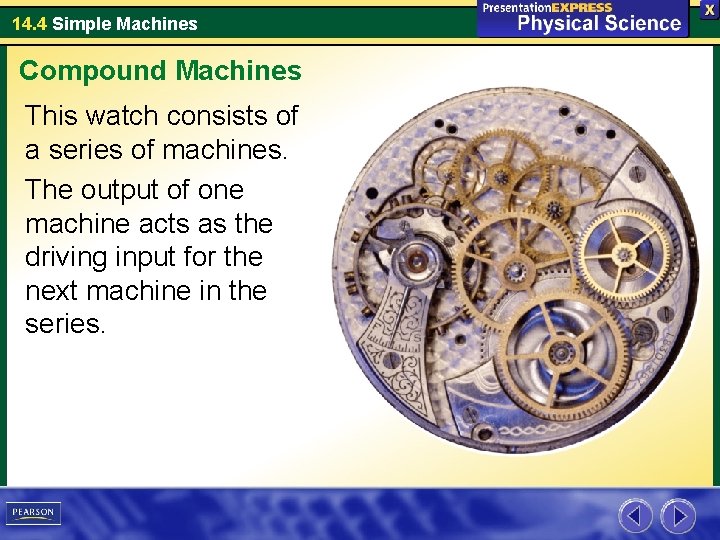
14. 4 Simple Machines Compound Machines This watch consists of a series of machines. The output of one machine acts as the driving input for the next machine in the series.