
14 14 0 14 1 Understanding Natural Language
- Slides: 36
14 14. 0 14. 1 Understanding Natural Language The Natural Language Understanding Problem Deconstructing Language: A Symbolic Analysis 14. 2 Syntax 14. 3 Syntax and Knowledge with ATN parsers 14. 4 Stochastic Tools for Language Analysis 14. 5 Natural Language Applications 14. 6 Epilogue and References 14. 7 Exercises Additional source used in preparing the slides: Patrick H. Winston’s AI textbook, Addison Wesley, 1993. 1
Chapter objective • Give a brief introduction to deterministic techniques used in understanding natural language 2
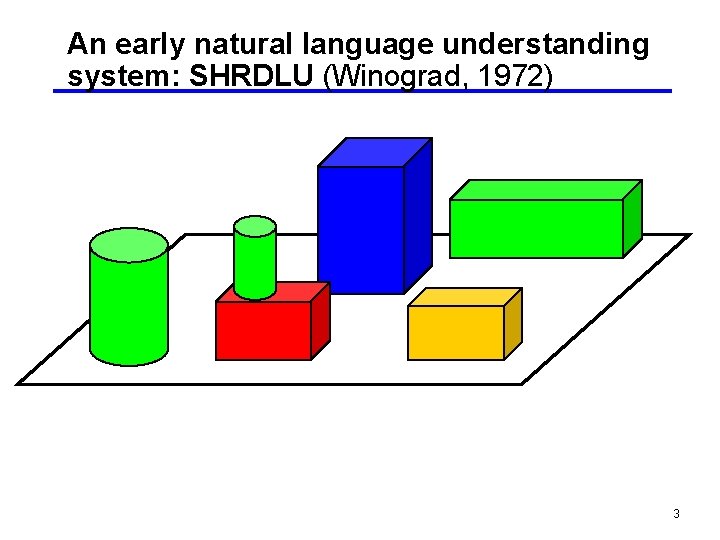
An early natural language understanding system: SHRDLU (Winograd, 1972) 3
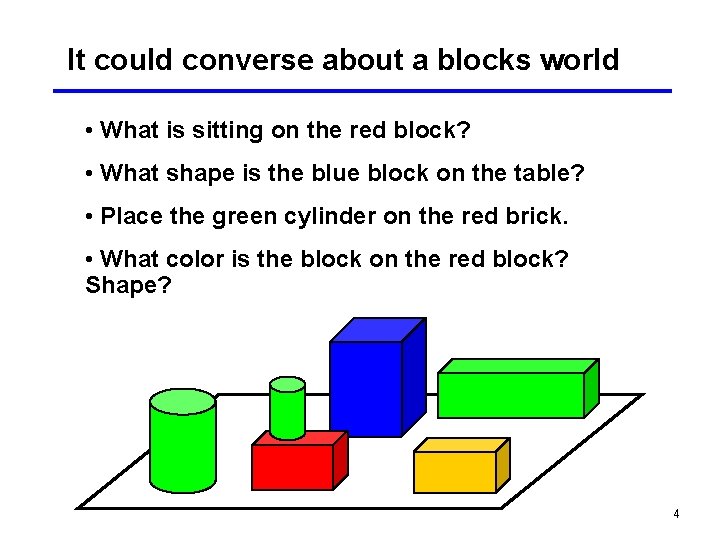
It could converse about a blocks world • What is sitting on the red block? • What shape is the blue block on the table? • Place the green cylinder on the red brick. • What color is the block on the red block? Shape? 4
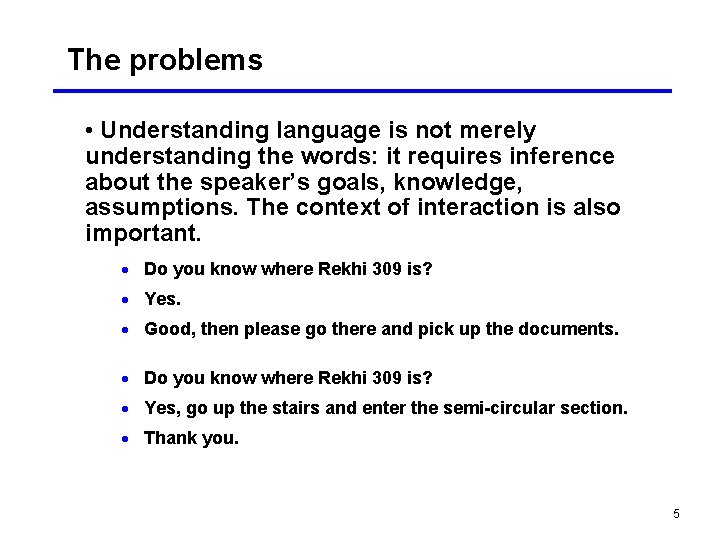
The problems • Understanding language is not merely understanding the words: it requires inference about the speaker’s goals, knowledge, assumptions. The context of interaction is also important. · Do you know where Rekhi 309 is? · Yes. · Good, then please go there and pick up the documents. · Do you know where Rekhi 309 is? · Yes, go up the stairs and enter the semi-circular section. · Thank you. 5
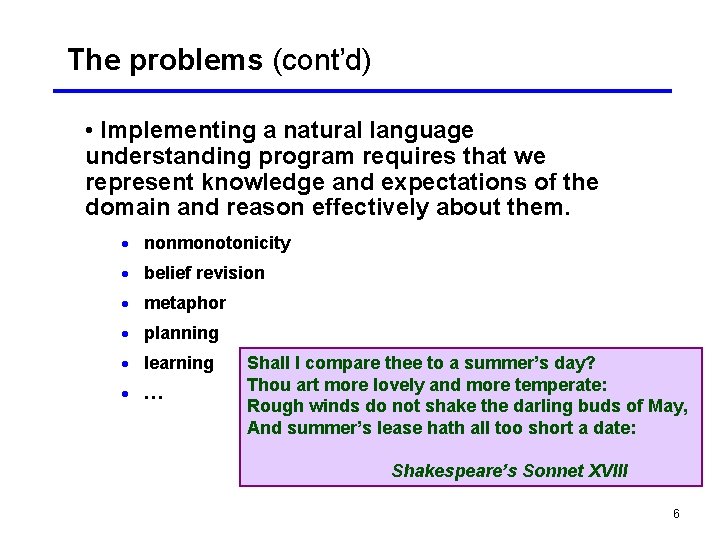
The problems (cont’d) • Implementing a natural language understanding program requires that we represent knowledge and expectations of the domain and reason effectively about them. · nonmonotonicity · belief revision · metaphor · planning · learning · … Shall I compare thee to a summer’s day? Thou art more lovely and more temperate: Rough winds do not shake the darling buds of May, And summer’s lease hath all too short a date: Shakespeare’s Sonnet XVIII 6
The problems (cont’d) • There are three major issues involved in understanding natural language: · A large amount of human knowledge is assumed. · Language is pattern based. Phoneme, word, and sentence orders are not random. · Language acts are products of agents embedded in complex environments. 7
SHRDLU’s solution • Restrict focus to a microworld : blocks world • Constrain the language: use templates • Do not deal with problems involving commonsense reasoning: still can communicate meaningfully 8
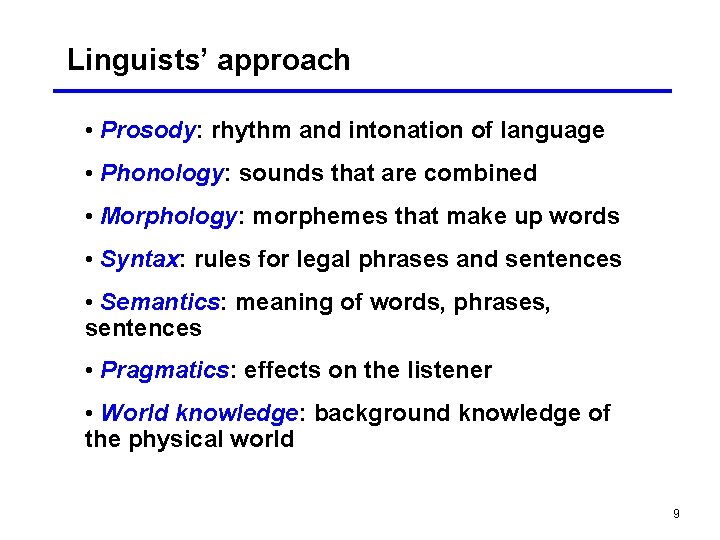
Linguists’ approach • Prosody: rhythm and intonation of language • Phonology: sounds that are combined • Morphology: morphemes that make up words • Syntax: rules for legal phrases and sentences • Semantics: meaning of words, phrases, sentences • Pragmatics: effects on the listener • World knowledge: background knowledge of the physical world 9
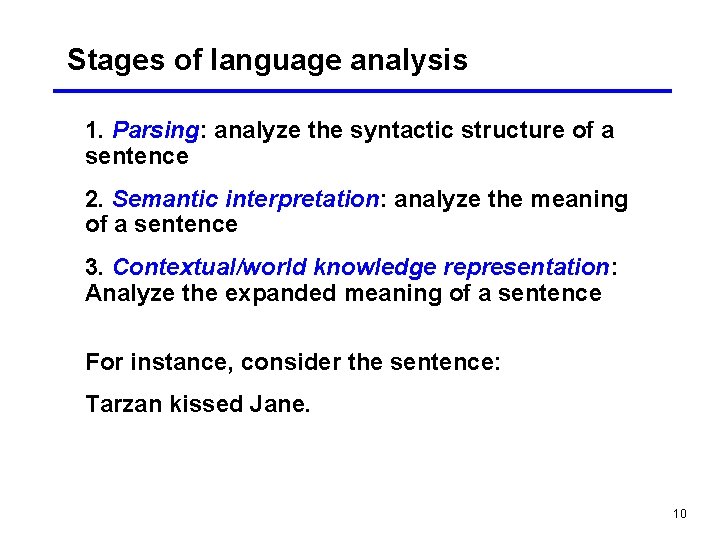
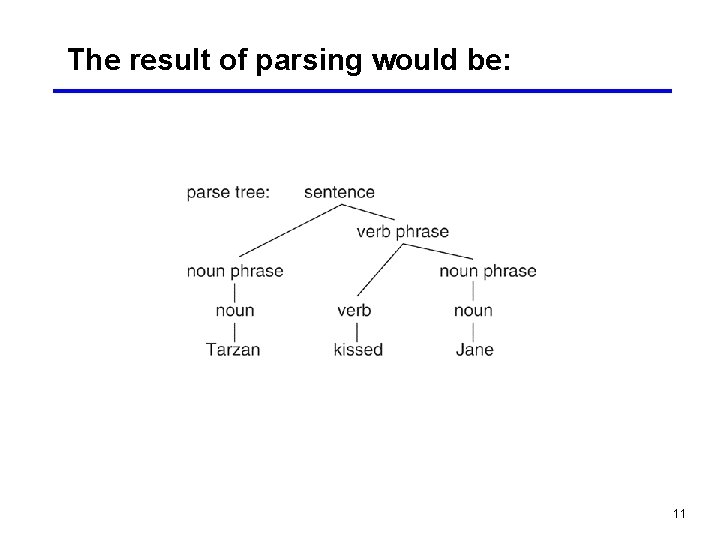
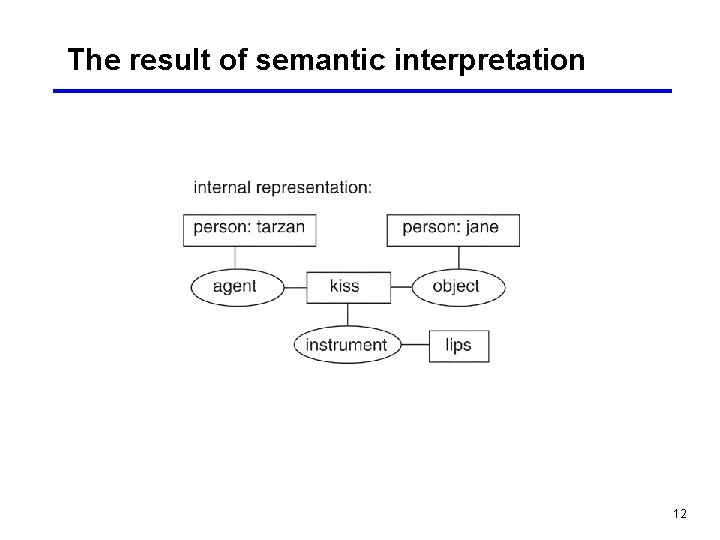
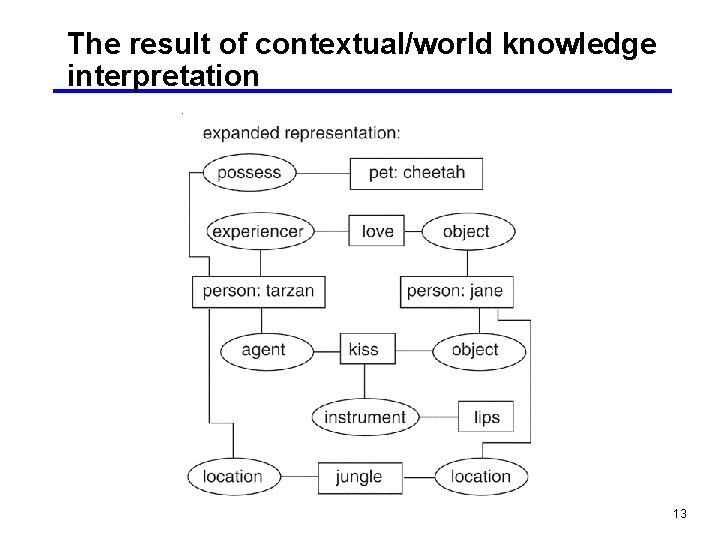
Stages of language analysis 1. Parsing: analyze the syntactic structure of a sentence 2. Semantic interpretation: analyze the meaning of a sentence 3. Contextual/world knowledge representation: Analyze the expanded meaning of a sentence For instance, consider the sentence: Tarzan kissed Jane. 10
The result of parsing would be: 11
The result of semantic interpretation 12
The result of contextual/world knowledge interpretation 13
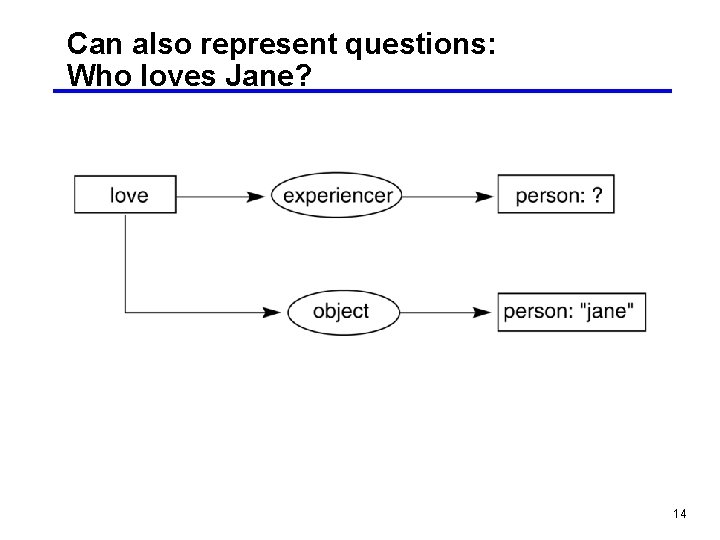
Can also represent questions: Who loves Jane? 14
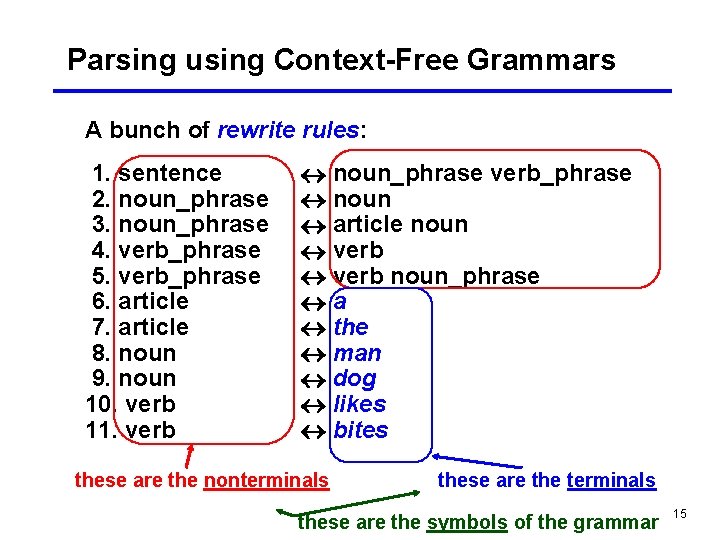
Parsing using Context-Free Grammars A bunch of rewrite rules: 1. sentence 2. noun_phrase 3. noun_phrase 4. verb_phrase 5. verb_phrase 6. article 7. article 8. noun 9. noun 10. verb 11. verb noun_phrase verb_phrase noun article noun verb noun_phrase a the man dog likes bites these are the nonterminals these are the symbols of the grammar 15
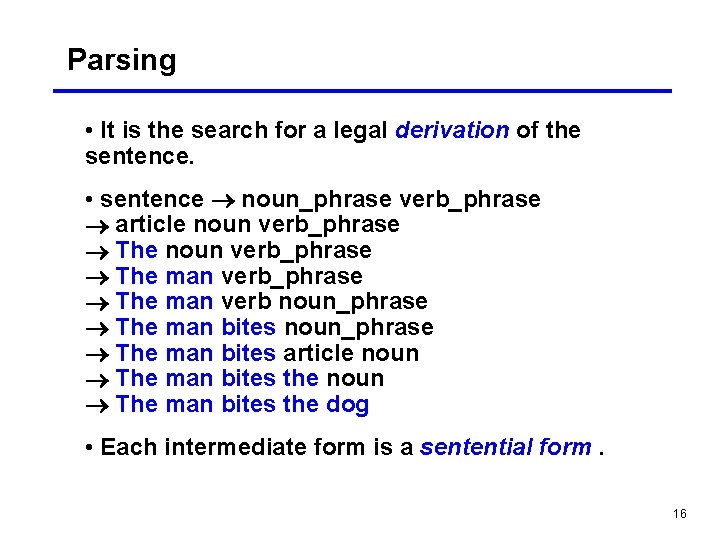
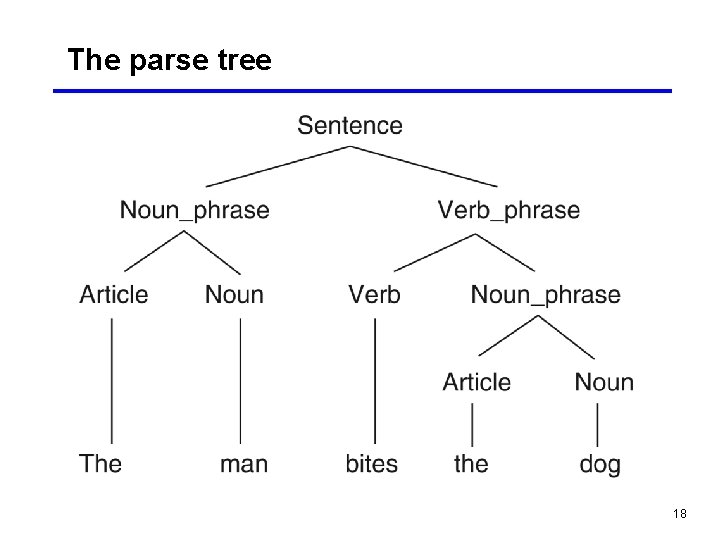
Parsing • It is the search for a legal derivation of the sentence. • sentence noun_phrase verb_phrase article noun verb_phrase The man verb noun_phrase The man bites article noun The man bites the dog • Each intermediate form is a sentential form. 16
Parsing (cont’d) • The result is a parse tree. A parse tree is a structure where each node is a symbol from the grammar. The root node is the starting nonterminal, the intermediate nodes are nonterminals, the leaf nodes are terminals. • “Sentence” is the starting nonterminal. • There are two classes of parsing algorithms · top-down parsers: start with the starting symbol and try to derive the complete sentence · bottom-up parsers: start with the complete sentence and attempt to find a series of reductions to derive the start symbol 17
The parse tree 18
Parsing is a search problem • Search for the correct derivation • If a wrong choice is made, the parser needs to backtrack • Recursive descent parsers maintain backtrack pointers • Look-ahead techniques help determine the proper rule to apply • We’ll study transition network parsers (and augmented transition networks) 19
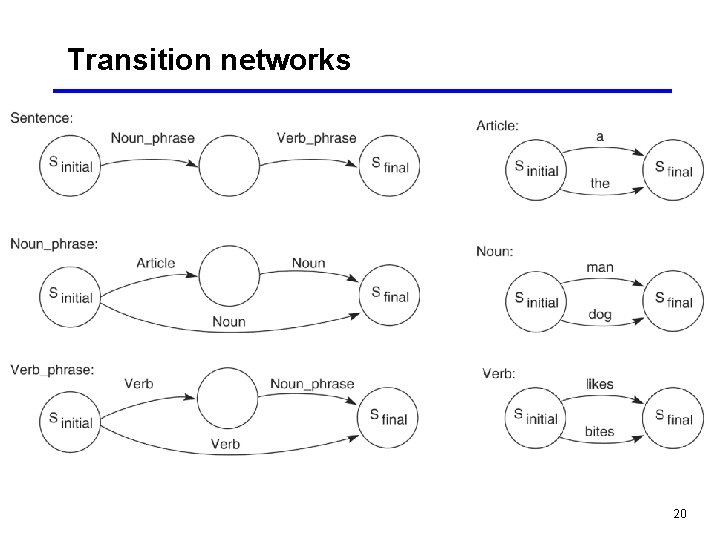
Transition networks 20
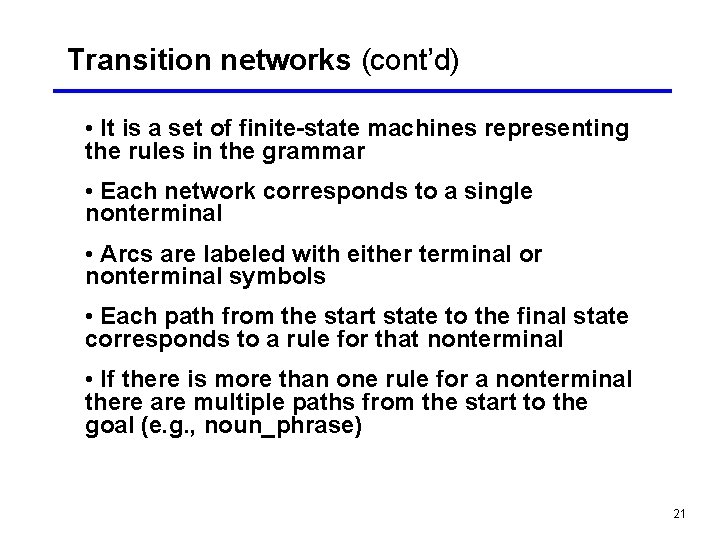
Transition networks (cont’d) • It is a set of finite-state machines representing the rules in the grammar • Each network corresponds to a single nonterminal • Arcs are labeled with either terminal or nonterminal symbols • Each path from the start state to the final state corresponds to a rule for that nonterminal • If there is more than one rule for a nonterminal there are multiple paths from the start to the goal (e. g. , noun_phrase) 21
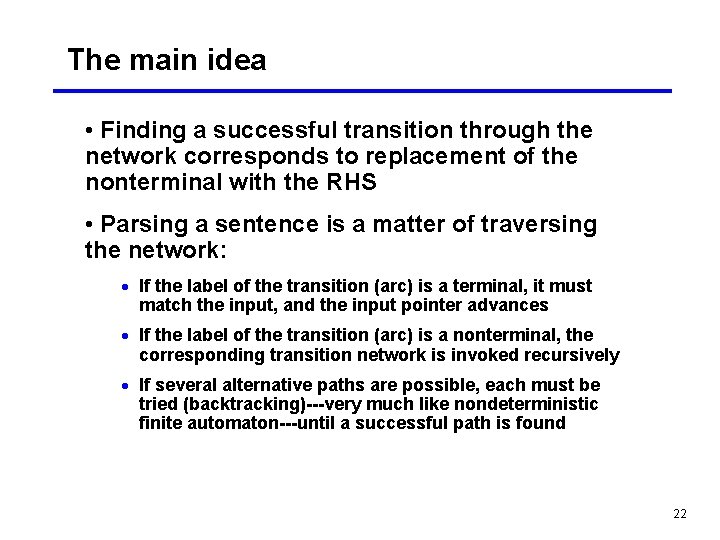
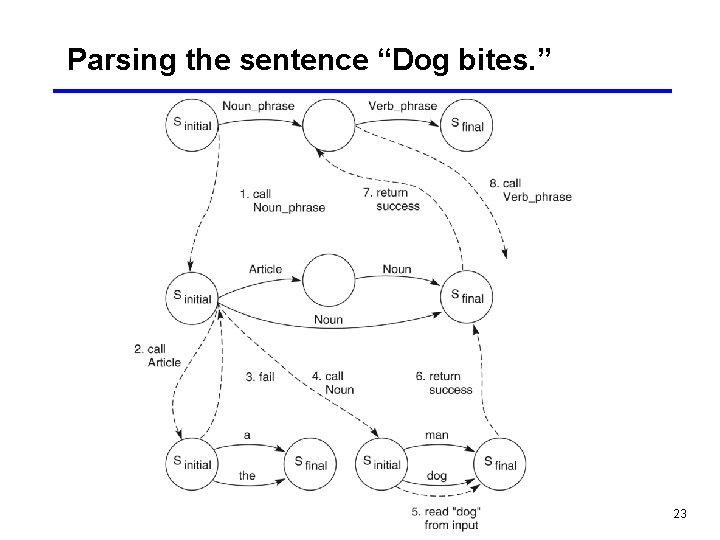
The main idea • Finding a successful transition through the network corresponds to replacement of the nonterminal with the RHS • Parsing a sentence is a matter of traversing the network: · If the label of the transition (arc) is a terminal, it must match the input, and the input pointer advances · If the label of the transition (arc) is a nonterminal, the corresponding transition network is invoked recursively · If several alternative paths are possible, each must be tried (backtracking)---very much like nondeterministic finite automaton---until a successful path is found 22
Parsing the sentence “Dog bites. ” 23
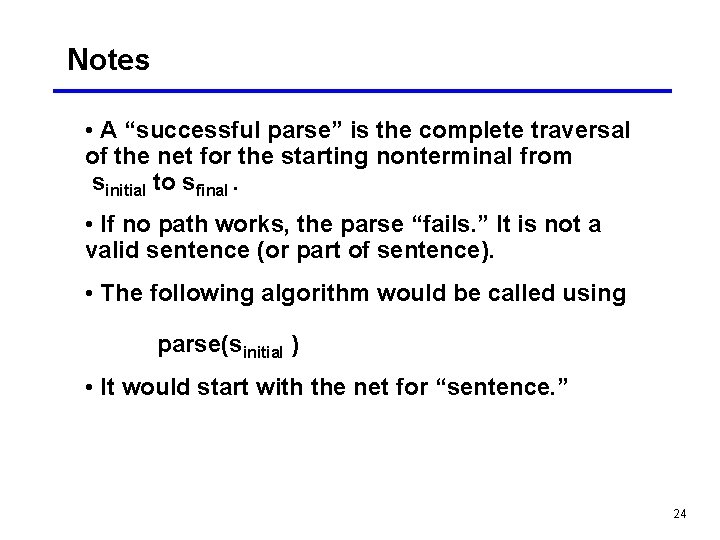
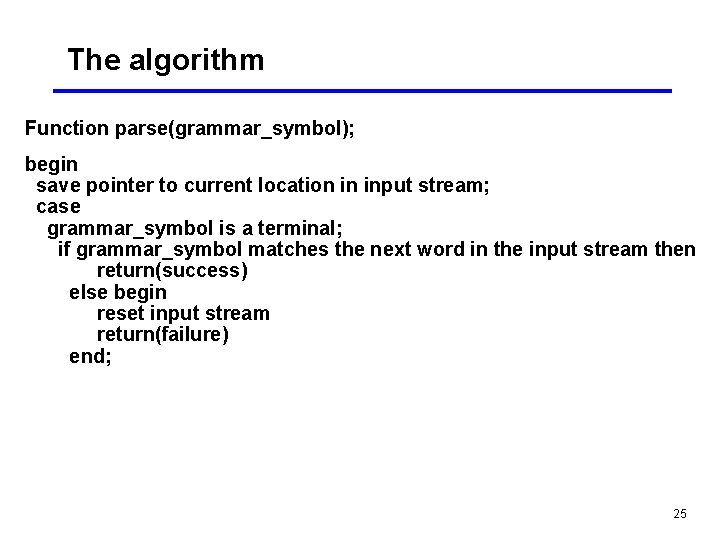
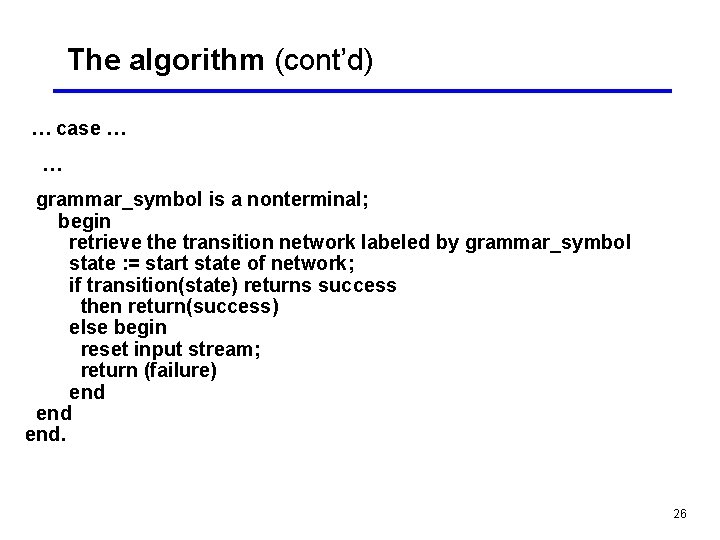
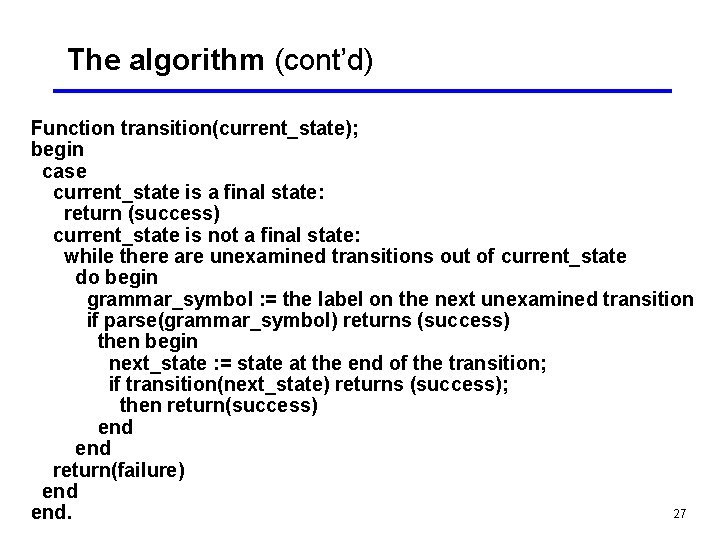
Notes • A “successful parse” is the complete traversal of the net for the starting nonterminal from sinitial to sfinal. • If no path works, the parse “fails. ” It is not a valid sentence (or part of sentence). • The following algorithm would be called using parse(sinitial ) • It would start with the net for “sentence. ” 24
The algorithm Function parse(grammar_symbol); begin save pointer to current location in input stream; case grammar_symbol is a terminal; if grammar_symbol matches the next word in the input stream then return(success) else begin reset input stream return(failure) end; 25
The algorithm (cont’d) … case … … grammar_symbol is a nonterminal; begin retrieve the transition network labeled by grammar_symbol state : = start state of network; if transition(state) returns success then return(success) else begin reset input stream; return (failure) end end. 26
The algorithm (cont’d) Function transition(current_state); begin case current_state is a final state: return (success) current_state is not a final state: while there are unexamined transitions out of current_state do begin grammar_symbol : = the label on the next unexamined transition if parse(grammar_symbol) returns (success) then begin next_state : = state at the end of the transition; if transition(next_state) returns (success); then return(success) end return(failure) end 27 end.
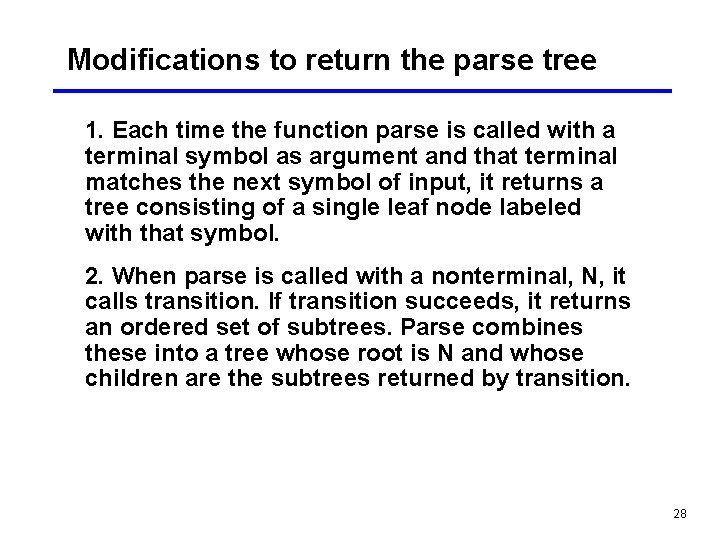
Modifications to return the parse tree 1. Each time the function parse is called with a terminal symbol as argument and that terminal matches the next symbol of input, it returns a tree consisting of a single leaf node labeled with that symbol. 2. When parse is called with a nonterminal, N, it calls transition. If transition succeeds, it returns an ordered set of subtrees. Parse combines these into a tree whose root is N and whose children are the subtrees returned by transition. 28
Modifications to return the parse tree (cont’d) 3. In searching for a path through a network, transition calls parse on the label of each arc. On success, parse returns a tree representing a parse of that symbol. Transition saves these subtrees in an ordered set and, on finding a path through the network, returns the ordered set of parse trees corresponding to the sequence of arc labels on the path. 29
Comments of transition networks • They capture the regularity in the sentence structure • They exploit the fact that only a small vocabulary is needed in a specific domain • If a sentence “doesn’t make sense”, it might be caught by the domain information. For instance, the answer to both of the following questions is “there is none” · “Pick up the blue cylinder” · “Pick up the red blue cylinder” 30
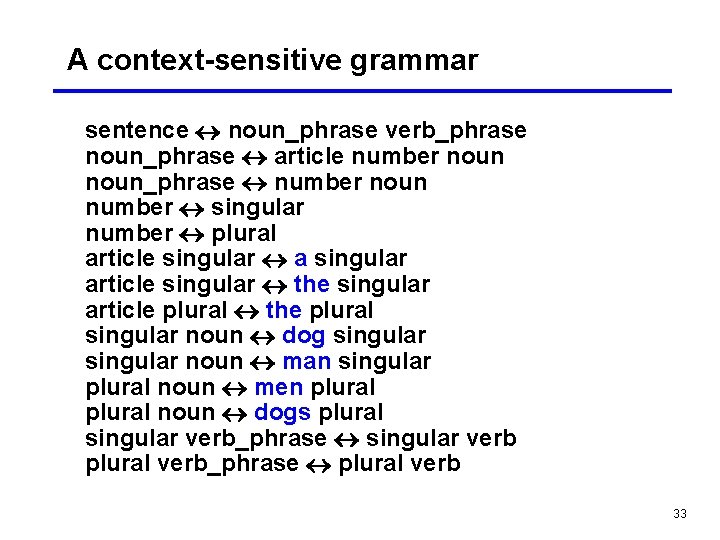
The Chomsky Hierarchy and CFGs • A CFG: a single nonterminal is allowed on the left-hand side. • CFGs are not powerful enough to represent natural language • Simply add plural nouns to the dogs world grammar: noun men noun dogs verb bites verb like “A men bites a dogs” will be a legal sentence 31
Options to deal with context • Extend CFGs • Use context-sensitive grammars (CSGs) With CSGs the only restriction is that the RHS is at least as long as the LHS • Note that the one higher class, recursively enumerable languages or Turing recognizable languages is not an usually regarded as an option 32
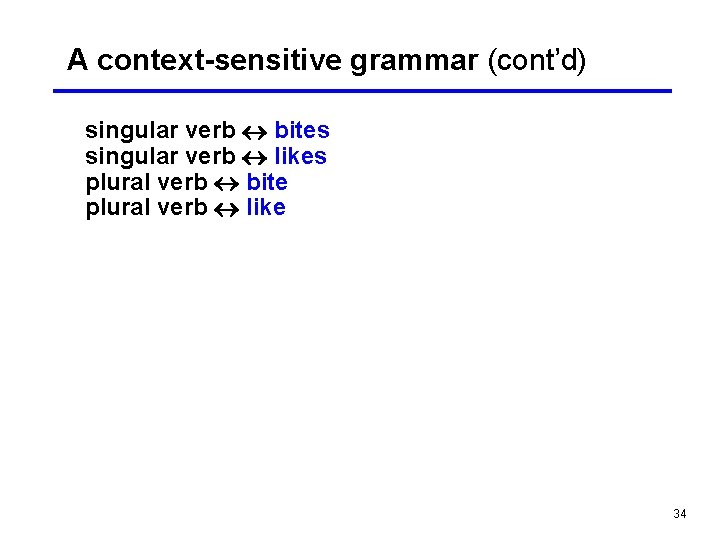
A context-sensitive grammar sentence noun_phrase verb_phrase noun_phrase article number noun_phrase number noun number singular number plural article singular a singular article singular the singular article plural the plural singular noun dog singular noun man singular plural noun men plural noun dogs plural singular verb_phrase singular verb plural verb_phrase plural verb 33
A context-sensitive grammar (cont’d) singular verb bites singular verb likes plural verb bite plural verb like 34
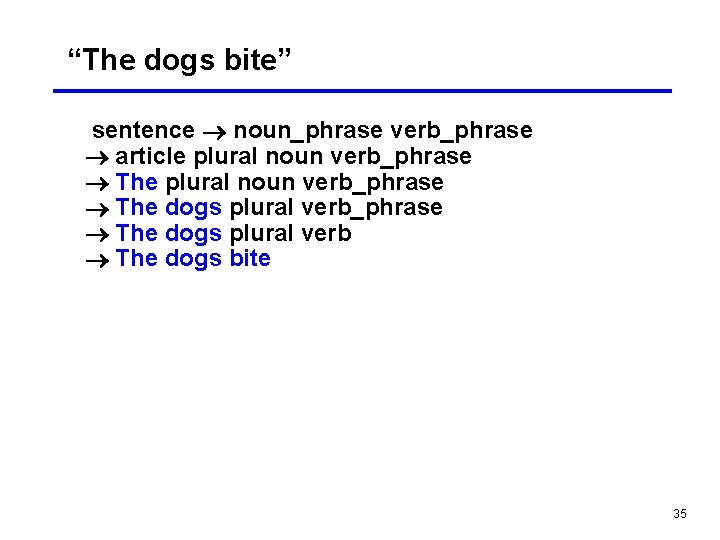
“The dogs bite” sentence noun_phrase verb_phrase article plural noun verb_phrase The dogs plural verb The dogs bite 35
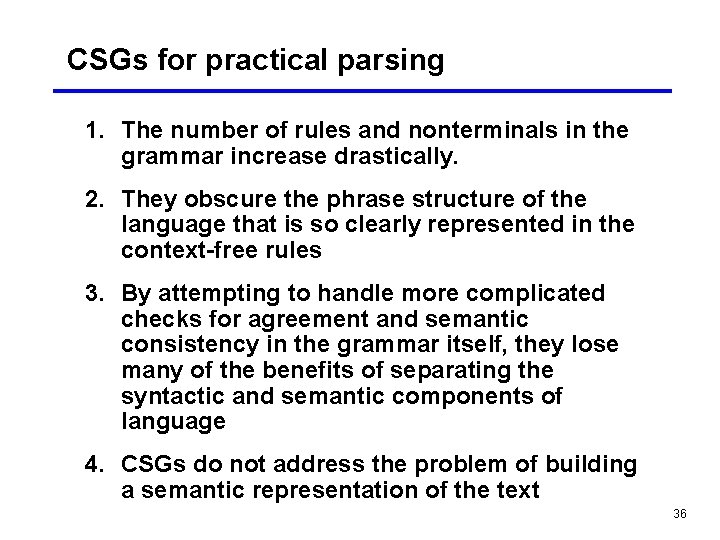
CSGs for practical parsing 1. The number of rules and nonterminals in the grammar increase drastically. 2. They obscure the phrase structure of the language that is so clearly represented in the context-free rules 3. By attempting to handle more complicated checks for agreement and semantic consistency in the grammar itself, they lose many of the benefits of separating the syntactic and semantic components of language 4. CSGs do not address the problem of building a semantic representation of the text 36