
14 1 B 40 2302 Class 8 w
14 - 1 B 40. 2302 Class #8 w BM 6 chapters 16. 5 -16. 8, 18. 1 -18. 3, 18. 5, 19 16. 5 -16. 8: Dividend relevance under taxes etc. 18. 1 -18. 3, 18. 5: Capital structure relevance under taxes and financial distress 19: Valuation under financing effects w Based on slides created by Matthew Will w Modified 10/31/2001 by Jeffrey Wurgler Irwin/Mc. Graw Hill ©The Mc. Graw-Hill Companies, Inc. , 2000
Principles of Corporate Finance Brealey and Myers u Sixth Edition The Dividend Controversy Slides by Matthew Will, Jeffrey Wurgler Irwin/Mc. Graw Hill Chapter 16. 5 -16. 8 ©The Mc. Graw-Hill Companies, Inc. , 2000
14 - 3 Topics Covered w Views on dividend relevance The “Rightists” (dividends increase value) The “Radical Left” (dividends decrease value) The “Middle-of-the-Roaders” (little or no effect) Irwin/Mc. Graw Hill ©The Mc. Graw-Hill Companies, Inc. , 2000
14 - 4 Dividends Increase Value A “rightist” (high-payout) view … the considered and continuous verdict of the stock market is overwhelmingly in favor of liberal dividends as against niggardly ones… Benjamin Graham and David Dodd Security Analysis (1951) (1 st ed. 1934) Irwin/Mc. Graw Hill ©The Mc. Graw-Hill Companies, Inc. , 2000
14 - 5 Dividends Increase Value Rightist argument: M&M ignore risk Dividends are cash in hand, but capital gains are not “Bird in hand versus bird in bush” So isn’t the dividend to be preferred? Questionable argument Declaring high dividend makes (residual) capital gain component more risky, overall risk to shareholders does not change Can get dividend-like “bird in hand” whenever you like, just by selling some of your stock M&M assume efficient capital market: $1 in dividend would otherwise be capitalized at $1 in share price. So long as this is true, the “bird in hand” argument is invalid. If this is not true (as Graham and Dodd imply), argument is valid. Irwin/Mc. Graw Hill ©The Mc. Graw-Hill Companies, Inc. , 2000
14 - 6 Dividends Increase Value Rightist argument: There are “clienteles” that prefer dividends Some financial institutions cannot hold stocks that do not have established dividend records Trusts and endowments may be discouraged from spending capital gains (which may be viewed as “principal”) but allowed to spend dividends (may be viewed as “income”) Retirees(? )/Small investors(? ) may prefer to spend from their AT&T dividend checks rather than sell a few shares every month. (Reduces transaction costs, inconvenience) Corporations pay corporate income tax on only 30% of dividends they receive, but 100% of capital gains. The demand of these “dividend clienteles” may increase the price of a dividend-paying stock But… Unclear whether any particular firm can benefit by increasing dividends. There may already be enough high-dividend stocks to choose from. Irwin/Mc. Graw Hill ©The Mc. Graw-Hill Companies, Inc. , 2000
14 - 7 Dividends Increase Value Rightist argument: Dividends can’t be wasted Investors may not trust managers to invest retained earnings wisely Firms that refuse to pay out cash may sell at a discount Comments In this case dividend decision is tied to investment decision May have particular merit in countries with poor corporate governance systems Irwin/Mc. Graw Hill ©The Mc. Graw-Hill Companies, Inc. , 2000
14 - 8 Dividends Decrease Value Leftist (low-payout) argument: Taxes If dividends are taxed more heavily than capital gains, investors dislike dividends. Firms should pay low dividend, retain cash or repurchase shares Investors should require higher pre-tax return on dividend-paying stocks (i. e, dividend-paying stocks sell at a discount price) Irwin/Mc. Graw Hill ©The Mc. Graw-Hill Companies, Inc. , 2000
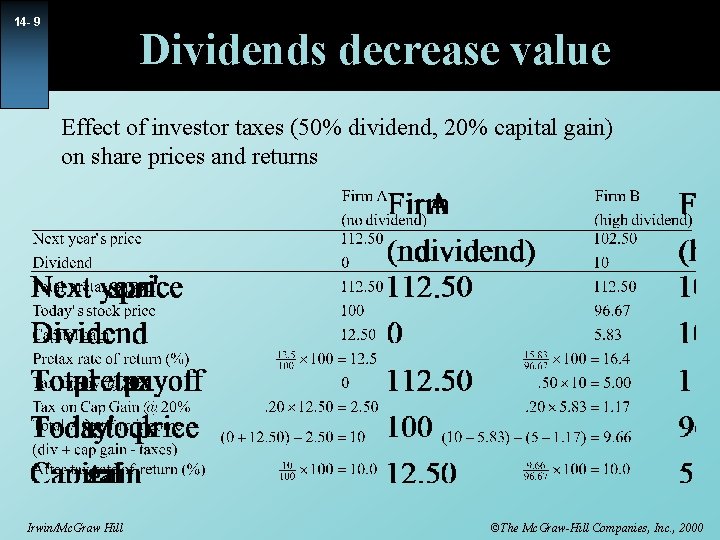
14 - 9 Dividends decrease value Effect of investor taxes (50% dividend, 20% capital gain) on share prices and returns Irwin/Mc. Graw Hill ©The Mc. Graw-Hill Companies, Inc. , 2000
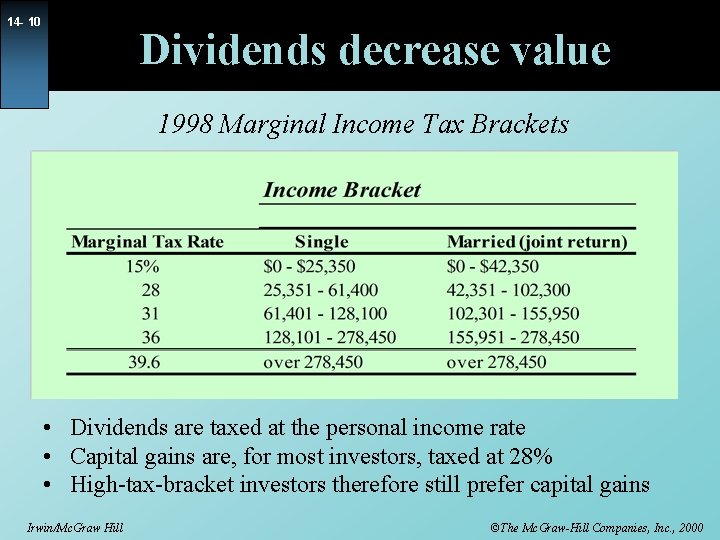
14 - 10 Dividends decrease value 1998 Marginal Income Tax Brackets • Dividends are taxed at the personal income rate • Capital gains are, for most investors, taxed at 28% • High-tax-bracket investors therefore still prefer capital gains Irwin/Mc. Graw Hill ©The Mc. Graw-Hill Companies, Inc. , 2000
14 - 11 Dividends decrease value Empirical evidence on dividends, prices, returns: • Mixed. • Generally a positive relationship between dividend yield and pre-tax returns, as predicted by “leftists” • But statistically unreliable Irwin/Mc. Graw Hill ©The Mc. Graw-Hill Companies, Inc. , 2000
14 - 12 Middle of the road Maybe M&M conclusion of irrelevance is right even when some of the assumptions are relaxed: • High- or low-payout clienteles may exist, but they are already satisfied, so no firm can increase its value by changing dividends • This “middle of the road” view argues that dividends have little or no effect on value Irwin/Mc. Graw Hill ©The Mc. Graw-Hill Companies, Inc. , 2000
Principles of Corporate Finance Brealey and Myers u Sixth Edition How Much Should a Firm Borrow? Slides by Matthew Will, Jeffrey Wurgler Irwin/Mc. Graw Hill Chapter 18. 118. 3, 18. 5 ©The Mc. Graw-Hill Companies, Inc. , 2000
14 - 14 Topics Covered w Corporate Taxes w Corporate and Personal Taxes w Costs of Financial Distress Financial distress games w The “trade-off theory” of capital structure Irwin/Mc. Graw Hill ©The Mc. Graw-Hill Companies, Inc. , 2000
14 - 15 Corporate Taxes w Main advantage of debt in U. S. : Corporations can deduct interest Whereas retained earnings and dividends are taxed at the corporate level Thus, more cash left for investors if firm uses debt finance Irwin/Mc. Graw Hill ©The Mc. Graw-Hill Companies, Inc. , 2000
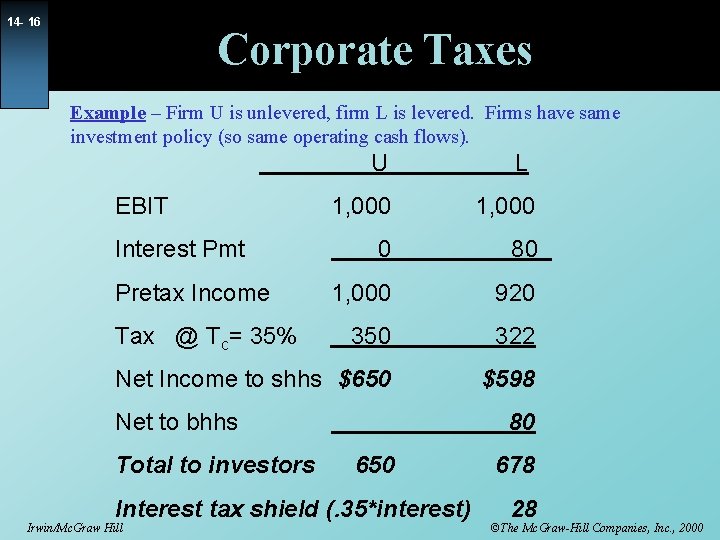
14 - 16 Corporate Taxes Example – Firm U is unlevered, firm L is levered. Firms have same investment policy (so same operating cash flows). U L 1, 000 0 80 1, 000 920 350 322 Net Income to shhs $650 $598 EBIT Interest Pmt Pretax Income Tax @ Tc= 35% Net to bhhs Total to investors 80 650 Interest tax shield (. 35*interest) Irwin/Mc. Graw Hill 678 28 ©The Mc. Graw-Hill Companies, Inc. , 2000
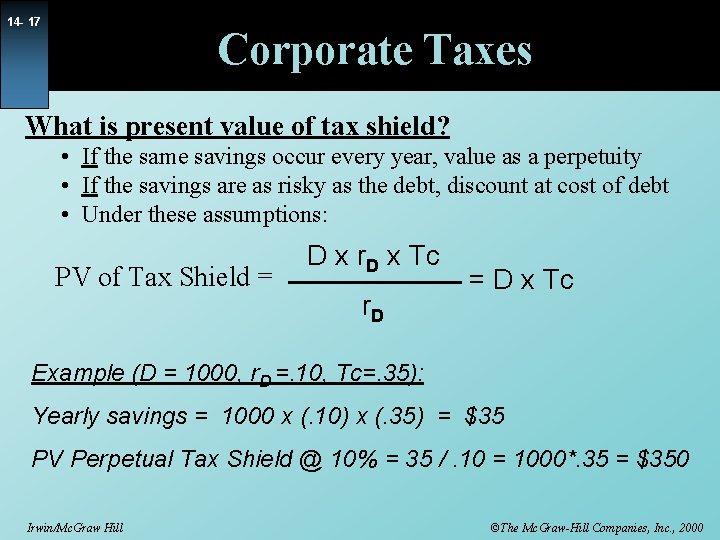
14 - 17 Corporate Taxes What is present value of tax shield? • If the same savings occur every year, value as a perpetuity • If the savings are as risky as the debt, discount at cost of debt • Under these assumptions: PV of Tax Shield = D x r. D x Tc r. D = D x Tc Example (D = 1000, r. D =. 10, Tc=. 35): Yearly savings = 1000 x (. 10) x (. 35) = $35 PV Perpetual Tax Shield @ 10% = 35 /. 10 = 1000*. 35 = $350 Irwin/Mc. Graw Hill ©The Mc. Graw-Hill Companies, Inc. , 2000
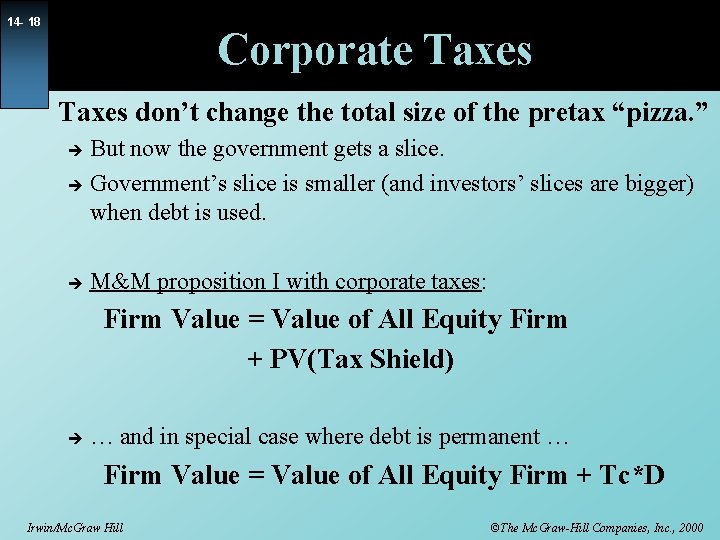
14 - 18 Corporate Taxes don’t change the total size of the pretax “pizza. ” But now the government gets a slice. Government’s slice is smaller (and investors’ slices are bigger) when debt is used. M&M proposition I with corporate taxes: Firm Value = Value of All Equity Firm + PV(Tax Shield) … and in special case where debt is permanent … Firm Value = Value of All Equity Firm + Tc*D Irwin/Mc. Graw Hill ©The Mc. Graw-Hill Companies, Inc. , 2000
14 - 19 Corporate Taxes w So why not 100% debt, then, or close to it? Maybe looking at corporate and personal taxation will uncover a personal tax disadvantage to borrowing (to offset the corporate tax advantage) Or, maybe firms that borrow incur other costs – such as costs of financial distress – that offset interest tax shield Irwin/Mc. Graw Hill ©The Mc. Graw-Hill Companies, Inc. , 2000
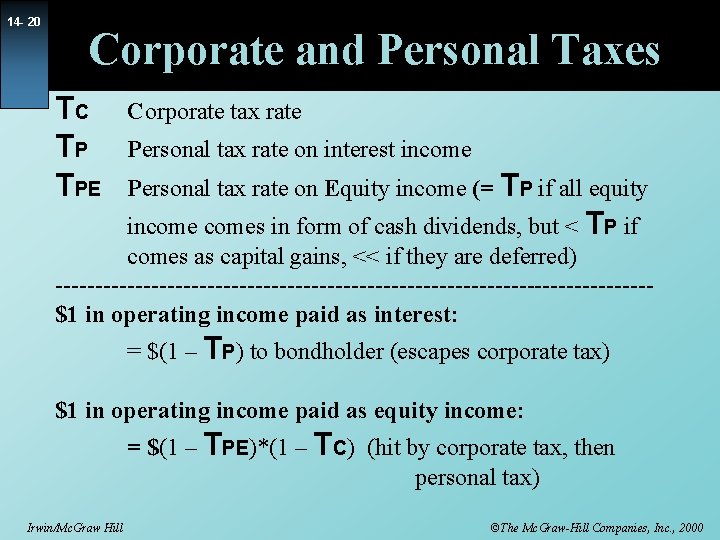
14 - 20 Corporate and Personal Taxes TC TP TPE Corporate tax rate Personal tax rate on interest income Personal tax rate on Equity income (= TP if all equity incomes in form of cash dividends, but < TP if comes as capital gains, << if they are deferred) -------------------------------------$1 in operating income paid as interest: = $(1 – TP) to bondholder (escapes corporate tax) $1 in operating income paid as equity income: = $(1 – TPE)*(1 – TC) (hit by corporate tax, then personal tax) Irwin/Mc. Graw Hill ©The Mc. Graw-Hill Companies, Inc. , 2000
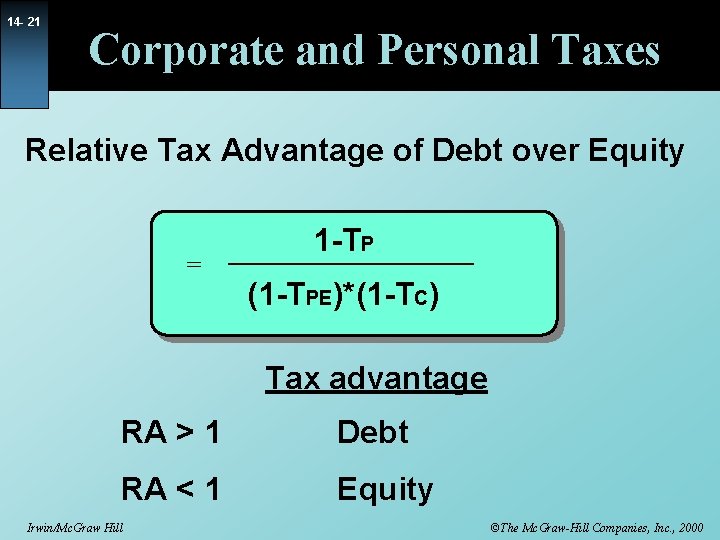
14 - 21 Corporate and Personal Taxes Relative Tax Advantage of Debt over Equity = 1 -TP (1 -TPE)*(1 -TC) Tax advantage RA > 1 Debt RA < 1 Equity Irwin/Mc. Graw Hill ©The Mc. Graw-Hill Companies, Inc. , 2000
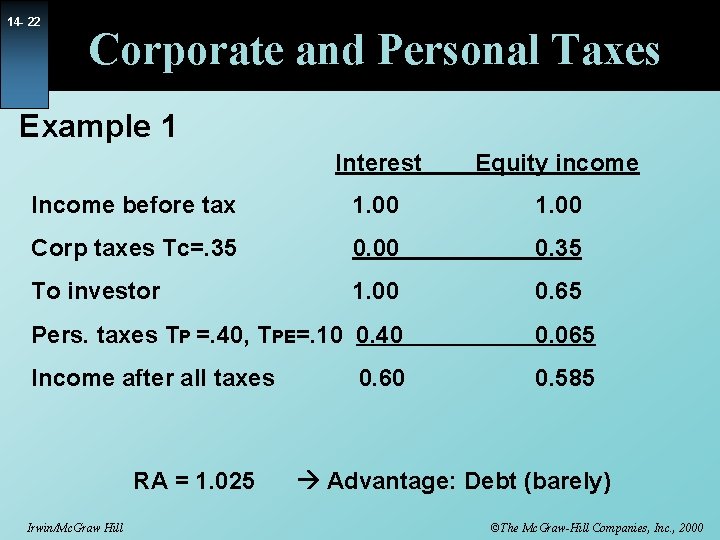
14 - 22 Corporate and Personal Taxes Example 1 Interest Equity income Income before tax 1. 00 Corp taxes Tc=. 35 0. 00 0. 35 To investor 1. 00 0. 65 Pers. taxes TP =. 40, TPE=. 10 0. 40 0. 065 Income after all taxes 0. 585 RA = 1. 025 Irwin/Mc. Graw Hill 0. 60 Advantage: Debt (barely) ©The Mc. Graw-Hill Companies, Inc. , 2000
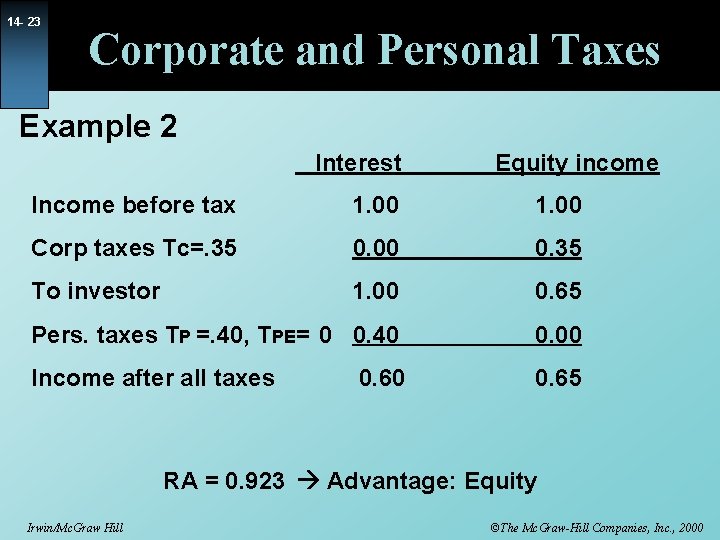
14 - 23 Corporate and Personal Taxes Example 2 Interest Equity income Income before tax 1. 00 Corp taxes Tc=. 35 0. 00 0. 35 To investor 1. 00 0. 65 Pers. taxes TP =. 40, TPE= 0 0. 40 0. 00 Income after all taxes 0. 65 0. 60 RA = 0. 923 Advantage: Equity Irwin/Mc. Graw Hill ©The Mc. Graw-Hill Companies, Inc. , 2000
14 - 24 Corporate and Personal Taxes So then … equity or debt? Merton Miller’s argument: Suppose TPE = 0 and TP varies across investors. Then • Economy-wide tax-minimizing mix of debt and equity depends on distribution of personal tax rates • But there still may be are no tax gains left for individual firms to get by varying their own leverage - “Low-tax” investors already hold all the bonds they want - If “marginal investor” has high tax rate, may be no tax gain left from issuing debt to him! - Current tax law still seems to favor borrowing, though (TPE not as low as Miller assumed) Irwin/Mc. Graw Hill ©The Mc. Graw-Hill Companies, Inc. , 2000
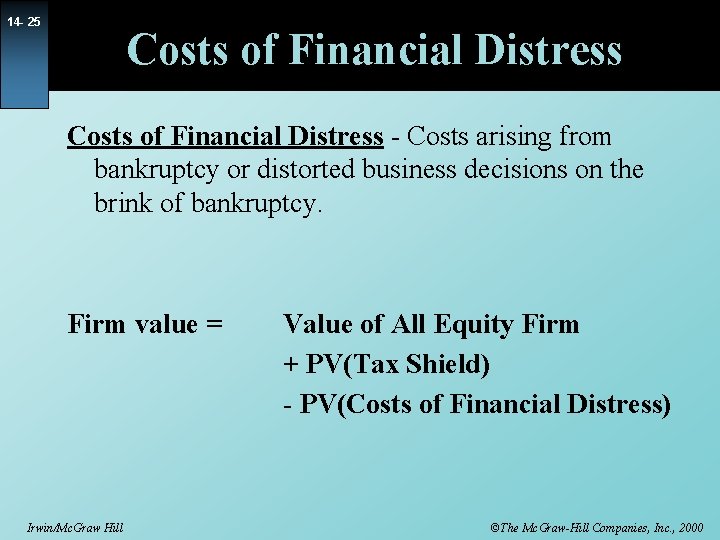
14 - 25 Costs of Financial Distress - Costs arising from bankruptcy or distorted business decisions on the brink of bankruptcy. Firm value = Irwin/Mc. Graw Hill Value of All Equity Firm + PV(Tax Shield) - PV(Costs of Financial Distress) ©The Mc. Graw-Hill Companies, Inc. , 2000
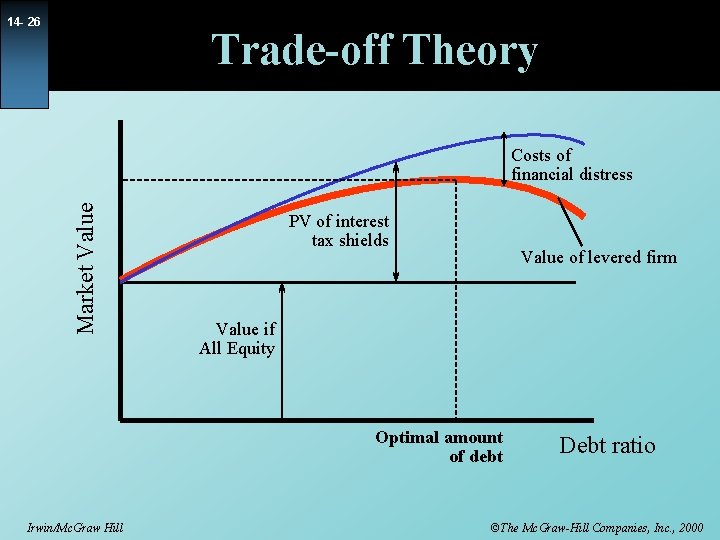
14 - 26 Trade-off Theory Market Value Costs of financial distress PV of interest tax shields Value of levered firm Value if All Equity Optimal amount of debt Irwin/Mc. Graw Hill Debt ratio ©The Mc. Graw-Hill Companies, Inc. , 2000
14 - 27 Costs of Financial Distress w Bankruptcy is not costly in itself; bankruptcy costs are the cost of using this legal mechanism w Bankruptcy costs and costs of financial distress are borne by shareholders Creditors foresee the costs and foresee that they will pay them if default occurs For this, they demand higher interest rates in advance This reduces the present market value of shares Irwin/Mc. Graw Hill ©The Mc. Graw-Hill Companies, Inc. , 2000
14 - 28 Costs of Financial Distress w Direct costs (legal, administrative fees) Manville (1982, asbestos): $200 m on fees Eastern Airlines (1989): $114 m on fees On average, direct costs = 3% of book assets, or 20% of market equity in year prior to bankruptcy w Indirect costs Customers may stray if firm may not be around, suppliers may be unwilling to give much effort to firm’s account, good employees hard to attract … Hard to measure, but probably large Irwin/Mc. Graw Hill ©The Mc. Graw-Hill Companies, Inc. , 2000
14 - 29 Costs of Financial Distress w US bankruptcy procedures Chapter 11 Aims to rehabilitate firm; protect value of assets while reorganization plan is worked out; used more by large, public companies Chapter 7 Aims to dismember firm; assets are auctioned and creditors paid off (usually) according to seniority; used more by small companies Irwin/Mc. Graw Hill ©The Mc. Graw-Hill Companies, Inc. , 2000
14 - 30 Costs of Financial Distress w Financial distress may be costly even without formal bankruptcy w When a firm is in trouble, both shareholders and bondholders want it to recover, but otherwise their interests may conflict w Shareholders may pursue self-interest rather than the usual objective of maximizing overall market value Shareholders may play “games” at creditors’ expense These games can reduce overall value Irwin/Mc. Graw Hill ©The Mc. Graw-Hill Companies, Inc. , 2000
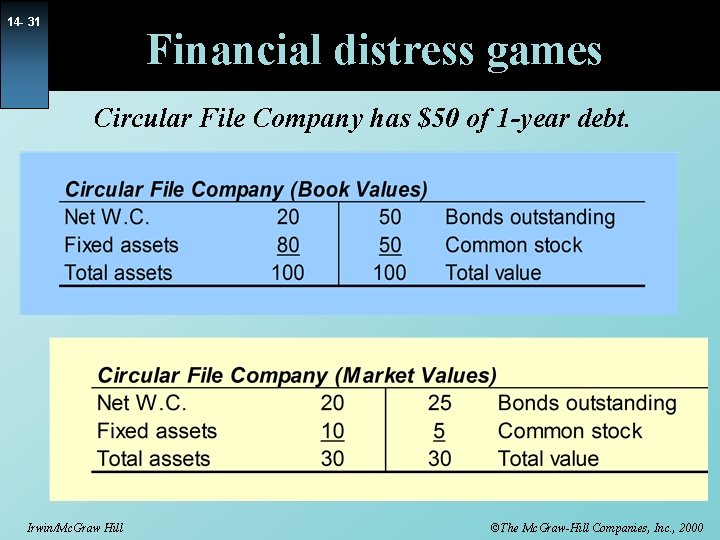
14 - 31 Financial distress games Circular File Company has $50 of 1 -year debt. Irwin/Mc. Graw Hill ©The Mc. Graw-Hill Companies, Inc. , 2000
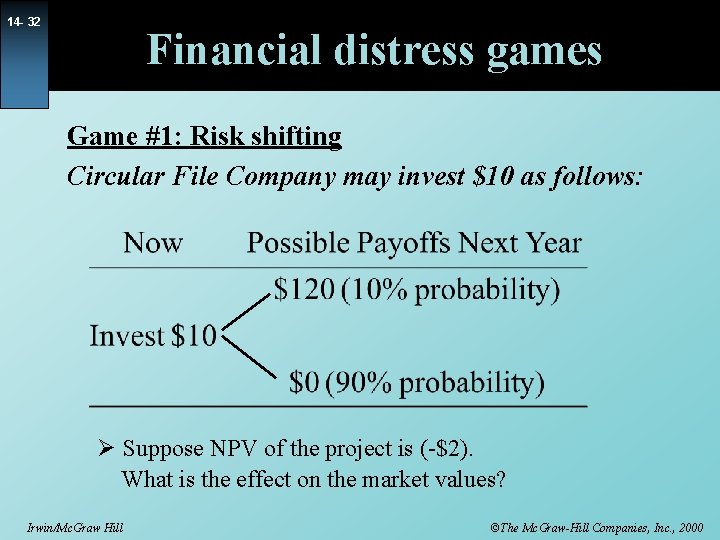
14 - 32 Financial distress games Game #1: Risk shifting Circular File Company may invest $10 as follows: Ø Suppose NPV of the project is (-$2). What is the effect on the market values? Irwin/Mc. Graw Hill ©The Mc. Graw-Hill Companies, Inc. , 2000
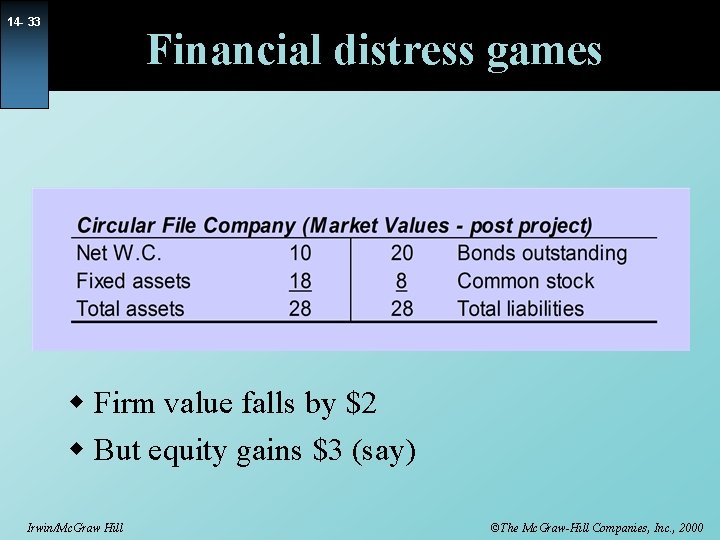
14 - 33 Financial distress games w Firm value falls by $2 w But equity gains $3 (say) Irwin/Mc. Graw Hill ©The Mc. Graw-Hill Companies, Inc. , 2000
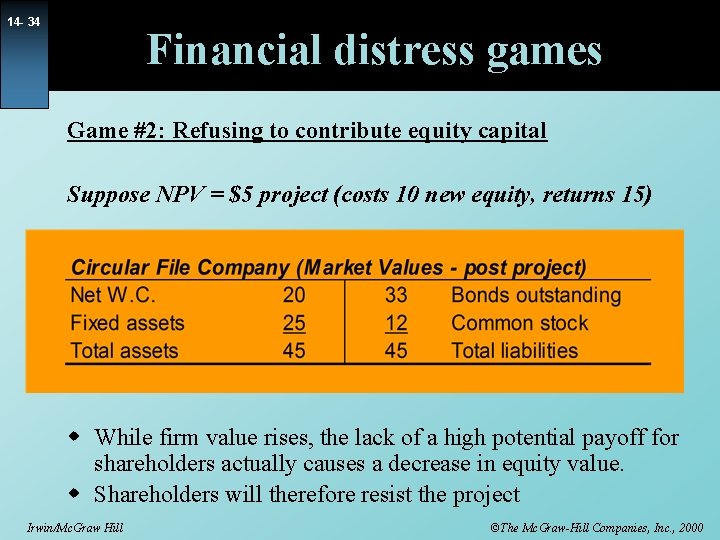
14 - 34 Financial distress games Game #2: Refusing to contribute equity capital Suppose NPV = $5 project (costs 10 new equity, returns 15) w While firm value rises, the lack of a high potential payoff for shareholders actually causes a decrease in equity value. w Shareholders will therefore resist the project Irwin/Mc. Graw Hill ©The Mc. Graw-Hill Companies, Inc. , 2000
14 - 35 Financial distress games Other games ØCash In and Run ØPlaying for Time ØBait and Switch Irwin/Mc. Graw Hill ©The Mc. Graw-Hill Companies, Inc. , 2000
14 - 36 Trade-off theory redux w Trade-off theory argues that optimal debt ratios vary from firm to firm PV (tax shields) vary • Depends on level and risk of taxable income PV (costs of financial distress) vary • Tangible assets lose least value in distress • So can take on more debt w So trade-off theory may explain why different firms have different capital structures Irwin/Mc. Graw Hill ©The Mc. Graw-Hill Companies, Inc. , 2000
Principles of Corporate Finance Brealey and Myers u Sixth Edition Financing and Valuation Slides by Matthew Will, Jeffrey Wurgler Irwin/Mc. Graw Hill Chapter 19 ©The Mc. Graw-Hill Companies, Inc. , 2000
14 - 38 Topics Covered w After-Tax WACC w Using WACC: Tricks of the Trade w Adjusting WACC when risks change w Adjusted Present Value (APV) Irwin/Mc. Graw Hill ©The Mc. Graw-Hill Companies, Inc. , 2000
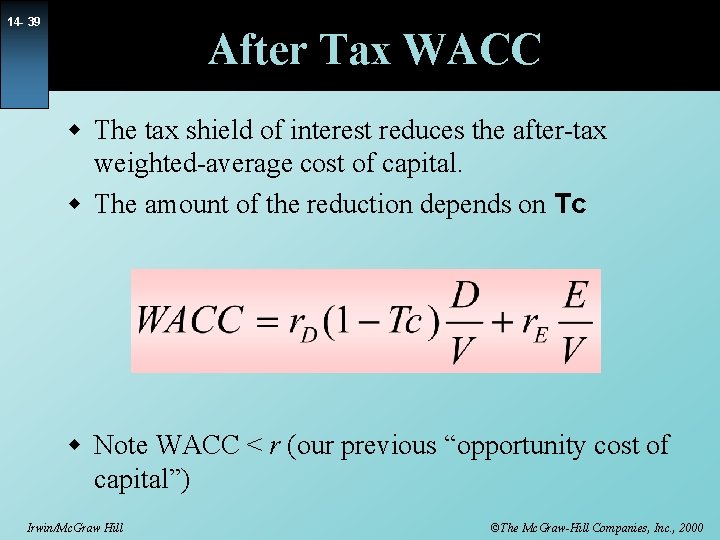
14 - 39 After Tax WACC w The tax shield of interest reduces the after-tax weighted-average cost of capital. w The amount of the reduction depends on Tc w Note WACC < r (our previous “opportunity cost of capital”) Irwin/Mc. Graw Hill ©The Mc. Graw-Hill Companies, Inc. , 2000
14 - 40 After Tax WACC w So WACC incorporates the tax advantages of debt financing in lower discount rate w Note that all variables in WACC refer to whole firm So after-tax WACC gives right discount rate only for new projects that are just like the firm’s “average” Would need to be adjusted for projects whose acceptance would cause a change in the firm’s overall debt ratio (we’ll show later) Would need to be adjusted for safer or riskier projects (we won’t show how) Irwin/Mc. Graw Hill ©The Mc. Graw-Hill Companies, Inc. , 2000
14 - 41 After Tax WACC Example - Sangria Corporation The firm has a marginal tax rate Tc of 35%. The cost of equity is 14. 6% and the pretax cost of debt is 8%. Given the following market value balance sheets, what is the after tax WACC? Irwin/Mc. Graw Hill ©The Mc. Graw-Hill Companies, Inc. , 2000
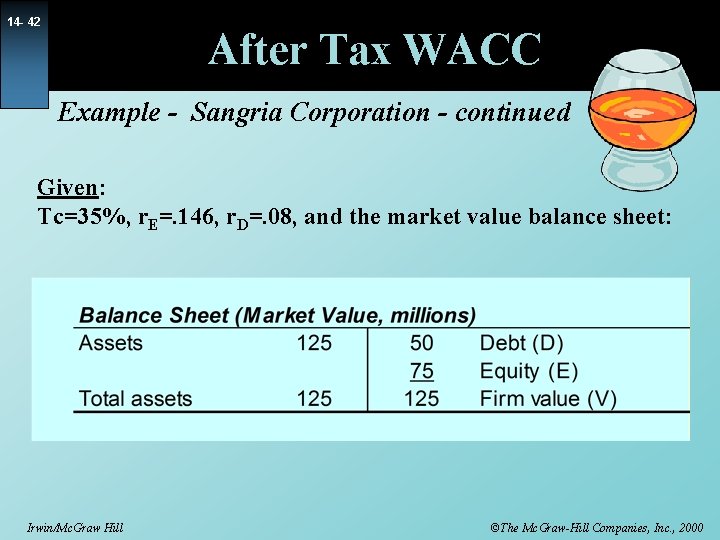
14 - 42 After Tax WACC Example - Sangria Corporation - continued Given: Tc=35%, r. E=. 146, r. D=. 08, and the market value balance sheet: Irwin/Mc. Graw Hill ©The Mc. Graw-Hill Companies, Inc. , 2000
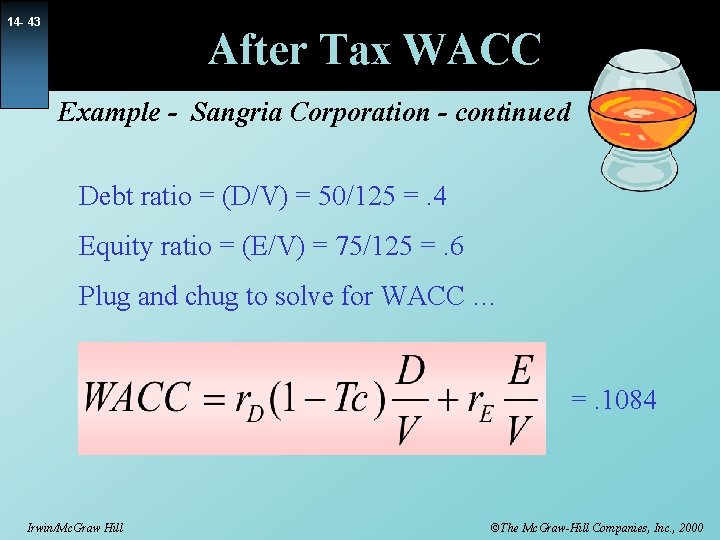
14 - 43 After Tax WACC Example - Sangria Corporation - continued Debt ratio = (D/V) = 50/125 =. 4 Equity ratio = (E/V) = 75/125 =. 6 Plug and chug to solve for WACC … =. 1084 Irwin/Mc. Graw Hill ©The Mc. Graw-Hill Companies, Inc. , 2000
14 - 44 After Tax WACC Example - Sangria Corporation - continued How to use the WACC of 10. 84%? Suppose company has following investment opportunity: can invest in an ice-crushing machine with perpetual, pretax cash flows of $2. 085 million per year. Given an initial investment of $12. 5 million, and assuming that firm will finance it without changing its current debt ratio, what is the value of the opportunity? Irwin/Mc. Graw Hill ©The Mc. Graw-Hill Companies, Inc. , 2000
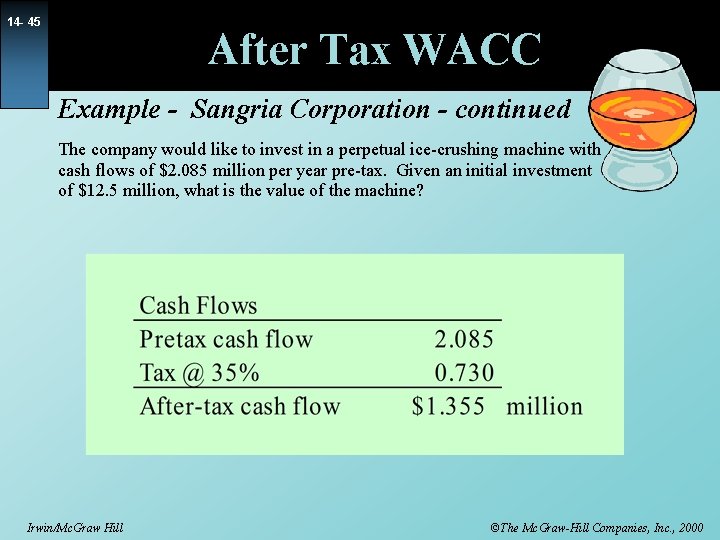
14 - 45 After Tax WACC Example - Sangria Corporation - continued The company would like to invest in a perpetual ice-crushing machine with cash flows of $2. 085 million per year pre-tax. Given an initial investment of $12. 5 million, what is the value of the machine? Irwin/Mc. Graw Hill ©The Mc. Graw-Hill Companies, Inc. , 2000
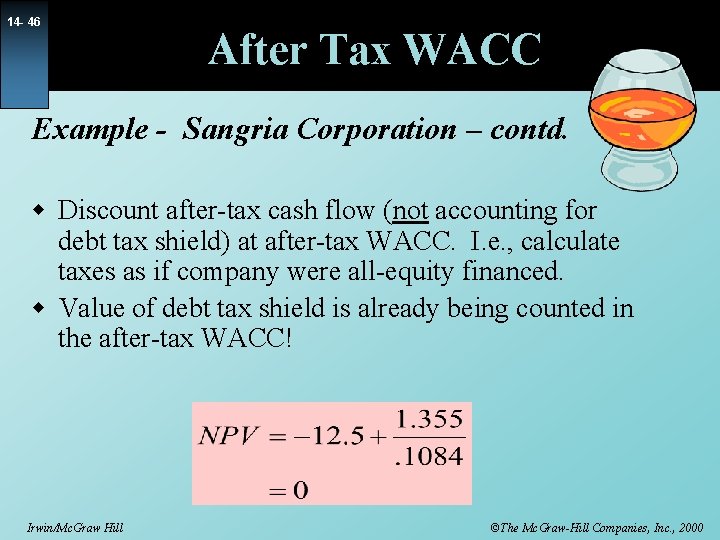
14 - 46 After Tax WACC Example - Sangria Corporation – contd. w Discount after-tax cash flow (not accounting for debt tax shield) at after-tax WACC. I. e. , calculate taxes as if company were all-equity financed. w Value of debt tax shield is already being counted in the after-tax WACC! Irwin/Mc. Graw Hill ©The Mc. Graw-Hill Companies, Inc. , 2000
14 - 47 After Tax WACC w Interim review: After-tax WACC methodology is one way to calculate value when interest is tax-deductible w Required assumptions: 1. Project’s business risks are same as firm average 2. Project supports the same fraction of D/V as overall firm Irwin/Mc. Graw Hill ©The Mc. Graw-Hill Companies, Inc. , 2000
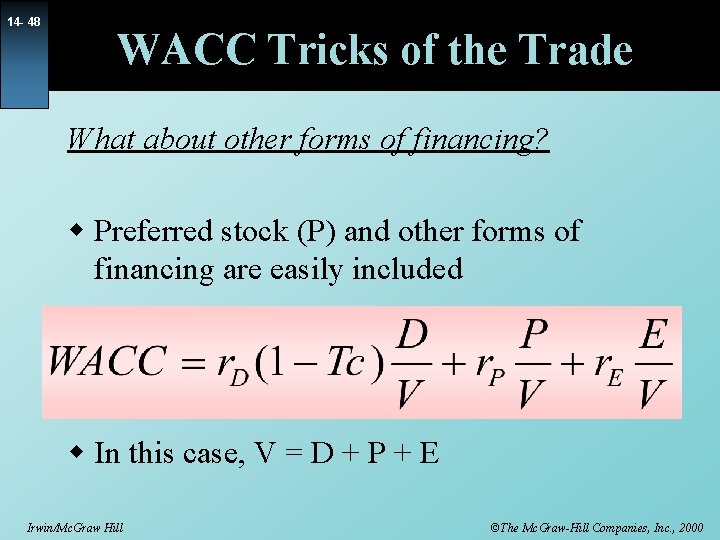
14 - 48 WACC Tricks of the Trade What about other forms of financing? w Preferred stock (P) and other forms of financing are easily included w In this case, V = D + P + E Irwin/Mc. Graw Hill ©The Mc. Graw-Hill Companies, Inc. , 2000
14 - 49 WACC Tricks of the Trade How do you get the inputs? w Can use stock market data to estimate r. E w r. D , debt and equity ratios usually easy … … Unless the debt is junk. If default risk is high, promised yield overstates true cost, true expected return No easy solution. (Try sensitivity analysis, see if your choice makes a difference. ) Irwin/Mc. Graw Hill ©The Mc. Graw-Hill Companies, Inc. , 2000
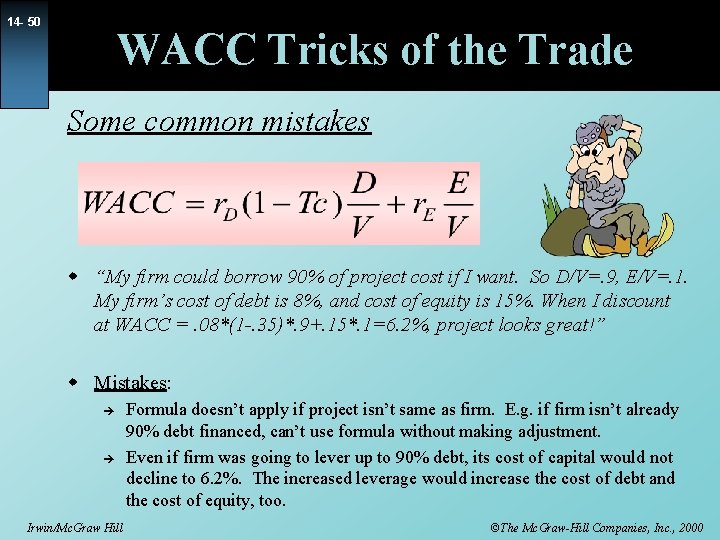
14 - 50 WACC Tricks of the Trade Some common mistakes w “My firm could borrow 90% of project cost if I want. So D/V=. 9, E/V=. 1. My firm’s cost of debt is 8%, and cost of equity is 15%. When I discount at WACC =. 08*(1 -. 35)*. 9+. 15*. 1=6. 2%, project looks great!” w Mistakes: Irwin/Mc. Graw Hill Formula doesn’t apply if project isn’t same as firm. E. g. if firm isn’t already 90% debt financed, can’t use formula without making adjustment. Even if firm was going to lever up to 90% debt, its cost of capital would not decline to 6. 2%. The increased leverage would increase the cost of debt and the cost of equity, too. ©The Mc. Graw-Hill Companies, Inc. , 2000
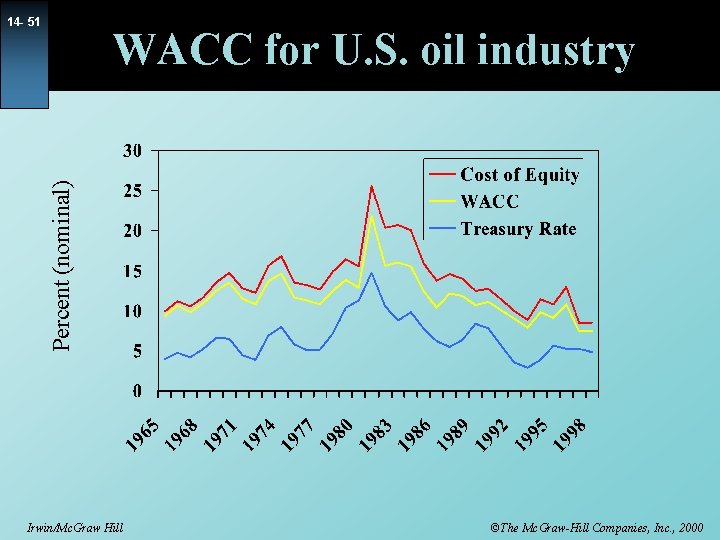
14 - 51 Percent (nominal) WACC for U. S. oil industry Irwin/Mc. Graw Hill ©The Mc. Graw-Hill Companies, Inc. , 2000
14 - 52 WACC(y? ) adjustments What if project is not financed at same D/E proportions as firm? • Can’t just plow ahead with regular WACC. Need to adjust. • Three-step process: 1. Calculate opportunity cost of capital using firm debt ratio 1. r = r. D(D/V) + r. E (E/V) 2. Estimate project cost of debt r. D at project debt-equity ratio, and then use this and r to calculate project cost of equity r. E = r + (r - r. D)(D/E) 3. Recalculate WACC at project r. D , r. E , debt ratio Irwin/Mc. Graw Hill ©The Mc. Graw-Hill Companies, Inc. , 2000
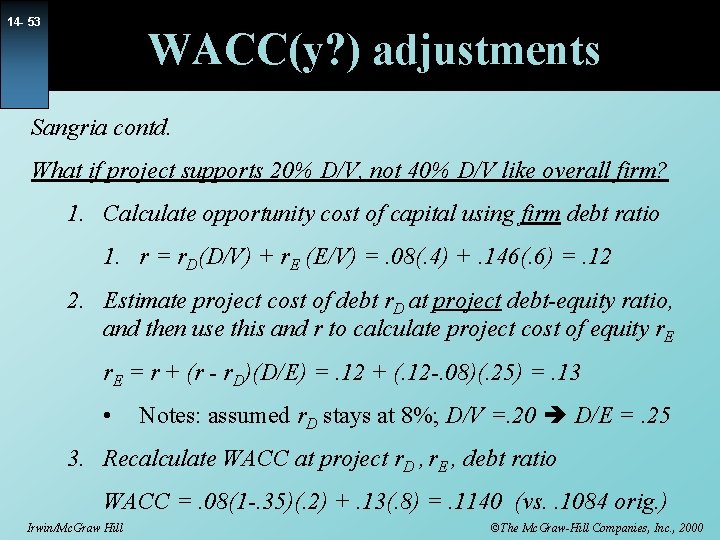
14 - 53 WACC(y? ) adjustments Sangria contd. What if project supports 20% D/V, not 40% D/V like overall firm? 1. Calculate opportunity cost of capital using firm debt ratio 1. r = r. D(D/V) + r. E (E/V) =. 08(. 4) +. 146(. 6) =. 12 2. Estimate project cost of debt r. D at project debt-equity ratio, and then use this and r to calculate project cost of equity r. E = r + (r - r. D)(D/E) =. 12 + (. 12 -. 08)(. 25) =. 13 • Notes: assumed r. D stays at 8%; D/V =. 20 D/E =. 25 3. Recalculate WACC at project r. D , r. E , debt ratio WACC =. 08(1 -. 35)(. 2) +. 13(. 8) =. 1140 (vs. . 1084 orig. ) Irwin/Mc. Graw Hill ©The Mc. Graw-Hill Companies, Inc. , 2000
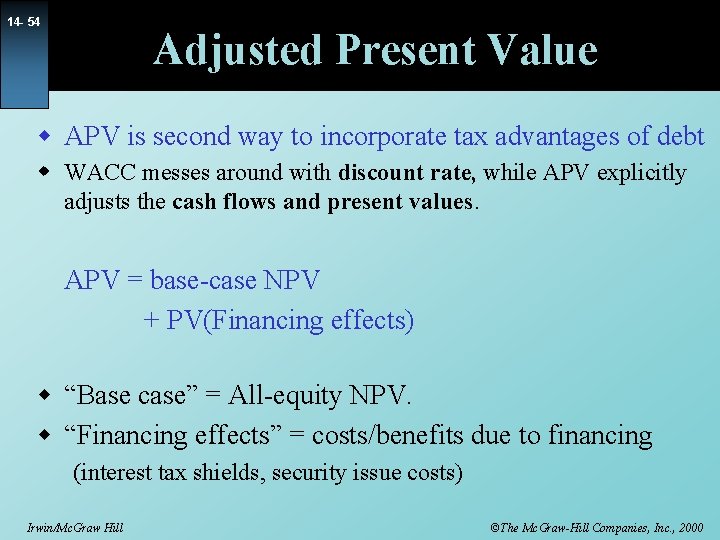
14 - 54 Adjusted Present Value w APV is second way to incorporate tax advantages of debt w WACC messes around with discount rate, while APV explicitly adjusts the cash flows and present values. APV = base-case NPV + PV(Financing effects) w “Base case” = All-equity NPV. w “Financing effects” = costs/benefits due to financing (interest tax shields, security issue costs) Irwin/Mc. Graw Hill ©The Mc. Graw-Hill Companies, Inc. , 2000
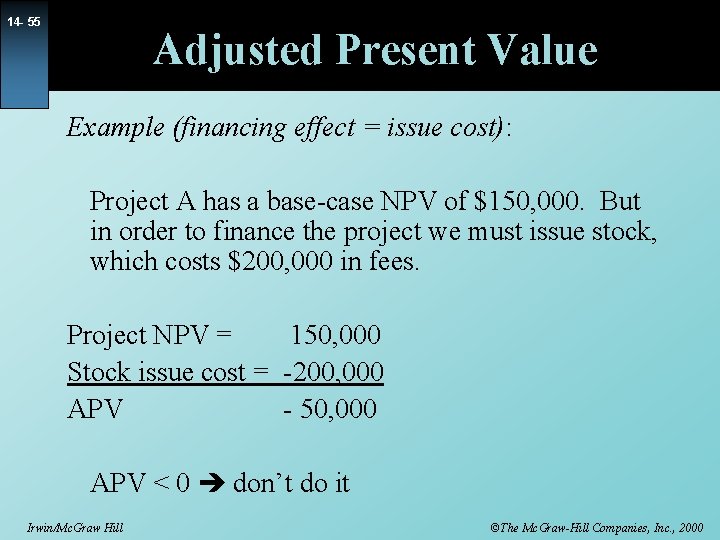
14 - 55 Adjusted Present Value Example (financing effect = issue cost): Project A has a base-case NPV of $150, 000. But in order to finance the project we must issue stock, which costs $200, 000 in fees. Project NPV = 150, 000 Stock issue cost = -200, 000 APV - 50, 000 APV < 0 don’t do it Irwin/Mc. Graw Hill ©The Mc. Graw-Hill Companies, Inc. , 2000
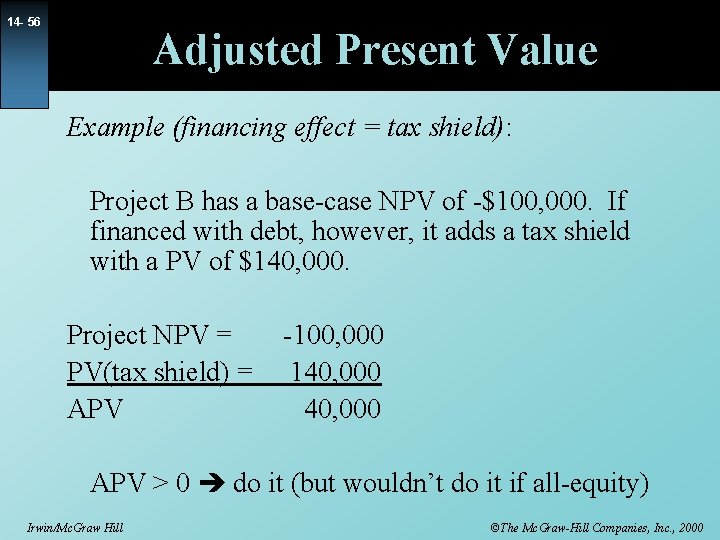
14 - 56 Adjusted Present Value Example (financing effect = tax shield): Project B has a base-case NPV of -$100, 000. If financed with debt, however, it adds a tax shield with a PV of $140, 000. Project NPV = PV(tax shield) = APV -100, 000 140, 000 APV > 0 do it (but wouldn’t do it if all-equity) Irwin/Mc. Graw Hill ©The Mc. Graw-Hill Companies, Inc. , 2000
14 - 57 After-Tax WACC vs. APV w With consistent assumptions, get same answer. w WACC assumes constant debt ratio , but then don’t have to value tax shield explicitly w APV lets tax shields vary over time , but have to calculate them yourself . APV more flexible: can handle other financing effects besides interest tax shields Irwin/Mc. Graw Hill ©The Mc. Graw-Hill Companies, Inc. , 2000
- Slides: 57