
13950827 1 Approach to febrile convulsion Prepared by
1395/08/27 1
Approach to febrile convulsion Prepared by: Dr Mostafavi N Department Of Pediatric Infectious Disease Isfahan University Of Medical Sciences 1395/08/27 2
Case 1 �A 13 mo. old girl brought to emergency department with complaint of abnormal repetitive movement 30 minute ago for 5 min. Her temperature is 39. 5°C. What do you do? 1395/08/27 3
Questions �Had the child a seizure? �Is there any need to Admission? �Which Lab data should be requested? �Is lumbar puncture should be performed? �Is there any need to emergency brain CT scan? �Is there any need to outpatient brain MRI? �When EEG should be performed? �When prophylactic treatment with intermittent diazepam or continuous phenobarbital is needed? �When diazepam rectal gel should be advised? �Which measures could be educated to parents for probable future seizures? 1395/08/27 4
Case 1 �Benzodiazepines is not necessary: onset of action 1 -3 min. and last for 10 min �Antipyretic: acetaminophen 15 mg/kg+ cooling blanket 1395/08/27 5
Differentiating seizure from shaking child 1395/08/27 6
Shaking chills �Repetitive rhythmic or single jerky movements about a joint �Rarely facial or respiratory muscles �Usually both sides of the body simultaneously �No loss of consciousness �Not be suppressible by touch 1395/08/27 7
Criteria for febrile seizures �T> 38°C �seizure �Age 3 mo. - 5 yr. �No CNS infection �No metabolic disorder( BS, Na, Ca, Mg) �No previous afebrile seizures 1395/08/27 8
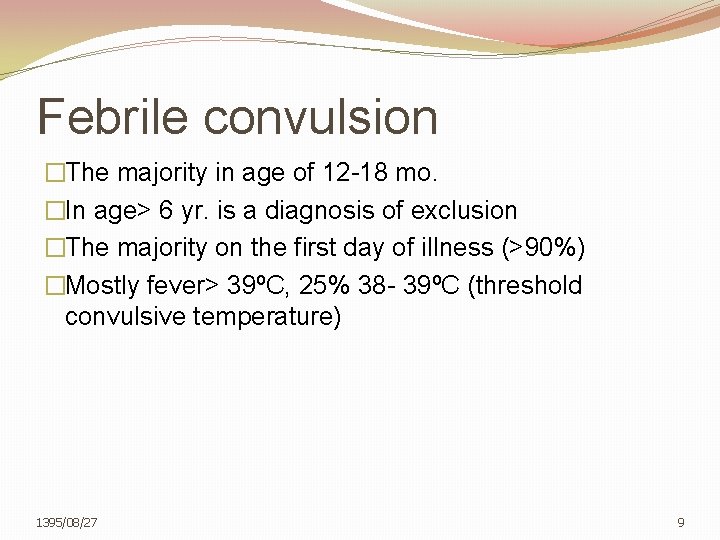
Febrile convulsion �The majority in age of 12 -18 mo. �In age> 6 yr. is a diagnosis of exclusion �The majority on the first day of illness (>90%) �Mostly fever> 39ºC, 25% 38 - 39ºC (threshold convulsive temperature) 1395/08/27 9
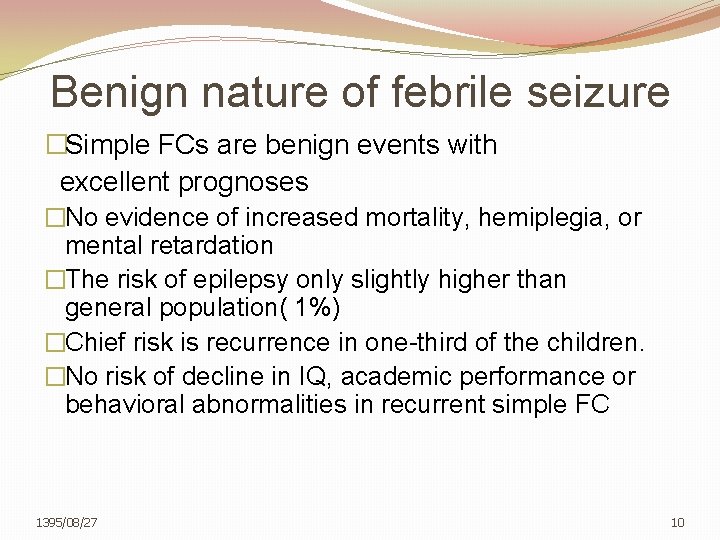
Benign nature of febrile seizure �Simple FCs are benign events with excellent prognoses �No evidence of increased mortality, hemiplegia, or mental retardation �The risk of epilepsy only slightly higher than general population( 1%) �Chief risk is recurrence in one-third of the children. �No risk of decline in IQ, academic performance or behavioral abnormalities in recurrent simple FC 1395/08/27 10
Need to Admission in febrile seizure 1395/08/27 11
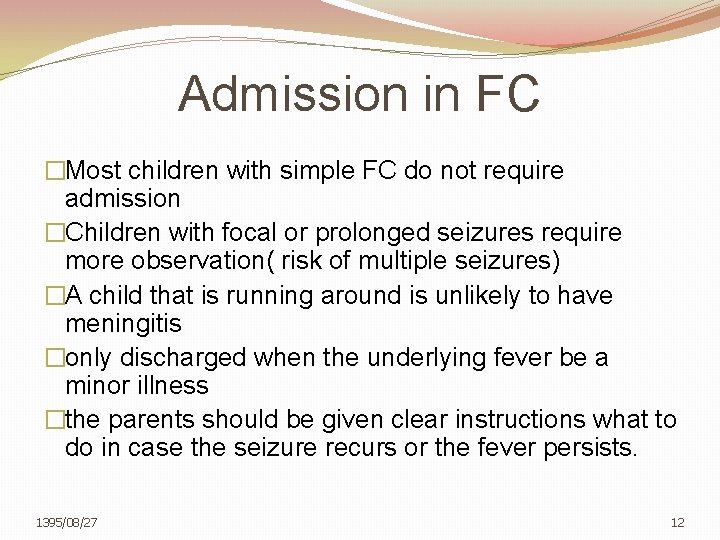
Admission in FC �Most children with simple FC do not require admission �Children with focal or prolonged seizures require more observation( risk of multiple seizures) �A child that is running around is unlikely to have meningitis �only discharged when the underlying fever be a minor illness �the parents should be given clear instructions what to do in case the seizure recurs or the fever persists. 1395/08/27 12
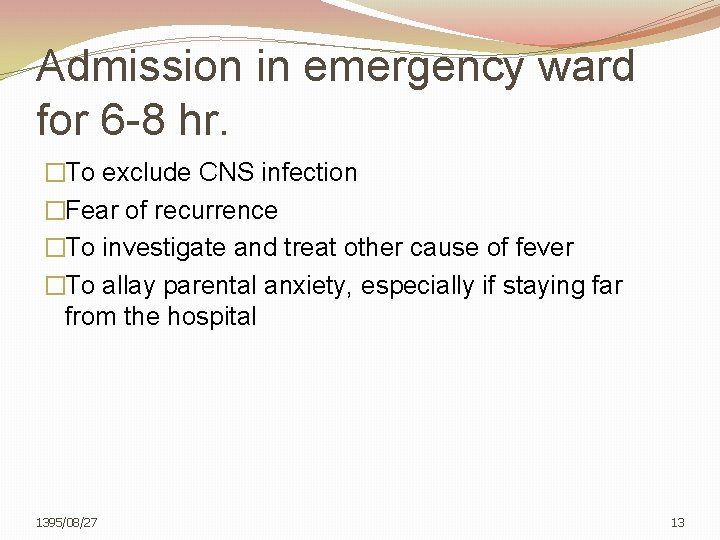
Admission in emergency ward for 6 -8 hr. �To exclude CNS infection �Fear of recurrence �To investigate and treat other cause of fever �To allay parental anxiety, especially if staying far from the hospital 1395/08/27 13
Laboratory evaluation of children with simple FC 1395/08/27 14
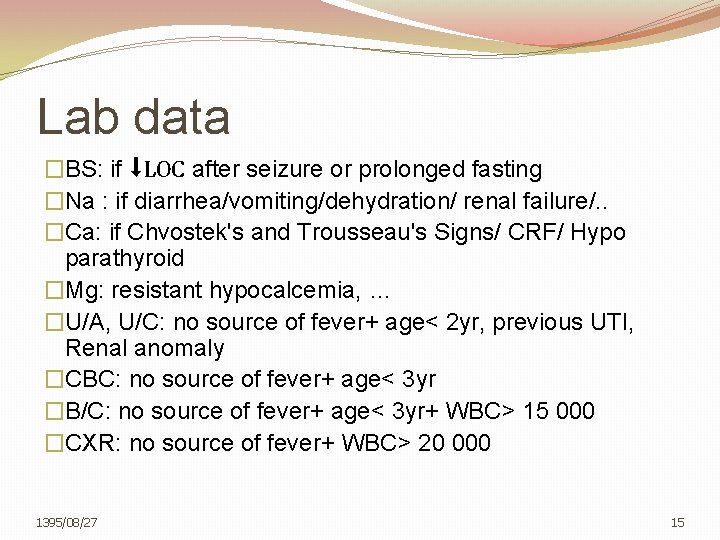
Lab data �BS: if ⬇LOC after seizure or prolonged fasting �Na : if diarrhea/vomiting/dehydration/ renal failure/. . �Ca: if Chvostek's and Trousseau's Signs/ CRF/ Hypo parathyroid �Mg: resistant hypocalcemia, … �U/A, U/C: no source of fever+ age< 2 yr, previous UTI, Renal anomaly �CBC: no source of fever+ age< 3 yr �B/C: no source of fever+ age< 3 yr+ WBC> 15 000 �CXR: no source of fever+ WBC> 20 000 1395/08/27 15
Indications of lumbar puncture in FC 1395/08/27 16
Lumbar puncture �Should be performed : �Meningeal signs �Other features of meningitis (nonresponsive, bulging fontanel, altered consciousness, Petechial rash, focal seizures, recurrent seizures, not well) �Should be considered : �Age 6 -12 mon. �When the patient is on antibiotics �When FC occur after the second day of illness �Febrile status epilepticus �May be considered: �Age of 12 -18 mo and no source of fever �Complex FC 1395/08/27 17
Complex FC �Focal �> 15 min �> Once in 24 hr. 1395/08/27 18
Indication for emergent neuroimaging in FC 1395/08/27 19
Emergency CT scan �Abnormally large head �Abnormal neurologic examination, particularly with focal features �Signs of ↑ ICP 1395/08/27 20
Indication for outpatient neuroimaging in f/u of FC 1395/08/27 21
Outpatient MRI and EEG �Focal FC �Prolonged FC �Especially if delay development 1395/08/27 22
Indication for EEG in FC 1395/08/27 23
EEG in FC �Focal FC �Prolonged FC �abnormal development �family history of epilepsy �Recurrent FC 1395/08/27 24
Anticonvulsant prophylaxis in FC 1395/08/27 25
Prophylactic treatment? �Moderate or high risk for epilepsy �Intermittent diazepam 0. 33 mg/kg/dose orally or 0. 5 mg/kg/dose rectally every 8 hour for first 48 hour of fever �In exceptional case that seizure recures continuous phenobarbital 1395/08/27 26
Risk of epilepsy �Delay in development: 33% �Focal complex FC: 29% �Family history of idiopathic epilepsy: 18% �Other complex FC: 6% �Recurrent (> 3 ) simple FC: 4% 1395/08/27 27
Indications for providing rectal diazepam for further prolonged seizures 1395/08/27 28
Provision of home benzodiazepines �In prolonged febrile seizure(> 15 min) or > 3 risk factor: 1. 2. 3. 4. 5. 6. 7. 8. age< 15 mo. Epilepsy in a first degree relative Febrile fits in a first degree relative Fever <40ºC during first febrile fit Brief duration between onset of fever and initial seizure Delay in development Complex FC Recurrent (> 3 ) simple FC �Diazepam rectal gel (0. 5 mg/kg) by parents at home if seizure > 5 min. 1395/08/27 29
Parent education for recurrence of seizure 1395/08/27 30
Parent education for recurrence of seizure �Remains calm. Note time of onset �Loosen the child’s clothing �Left lateral position with the head lower �Wipe any vomitus or secretion �Not insert any object into the mouth �Not give any fluids or drugs �Stay near the child until the seizure is over �If more than 3 risk factors, rectal diazepam 0. 5 mg/kg if > 5 min �If seizure not aborted, seek urgent medical help �If the seizure is aborted, seek medical advise for the cause of the fever 1395/08/27 31
References �Nelson textbook of pediatrics 2016 �Japanese guideline for febrile convulsion �Up to date 2016 1395/08/27 32

1395/08/27 33
- Slides: 33