
133 Topic 2 2 Nonlinear Panel Data Models


- Slides: 23
1/33: Topic 2. 2 – Nonlinear Panel Data Models Microeconometric Modeling William Greene Stern School of Business New York University New York NY USA 2. 2 Nonlinear Panel Data Models
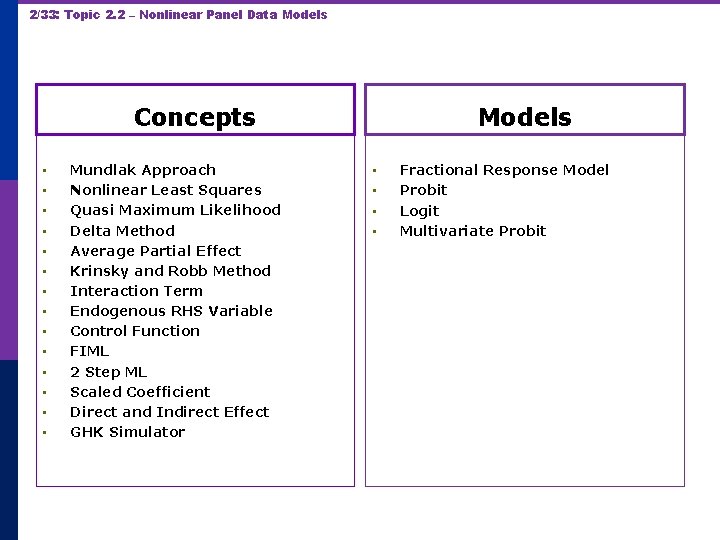
2/33: Topic 2. 2 – Nonlinear Panel Data Models Concepts • • • • Mundlak Approach Nonlinear Least Squares Quasi Maximum Likelihood Delta Method Average Partial Effect Krinsky and Robb Method Interaction Term Endogenous RHS Variable Control Function FIML 2 Step ML Scaled Coefficient Direct and Indirect Effect GHK Simulator Models • • Fractional Response Model Probit Logit Multivariate Probit
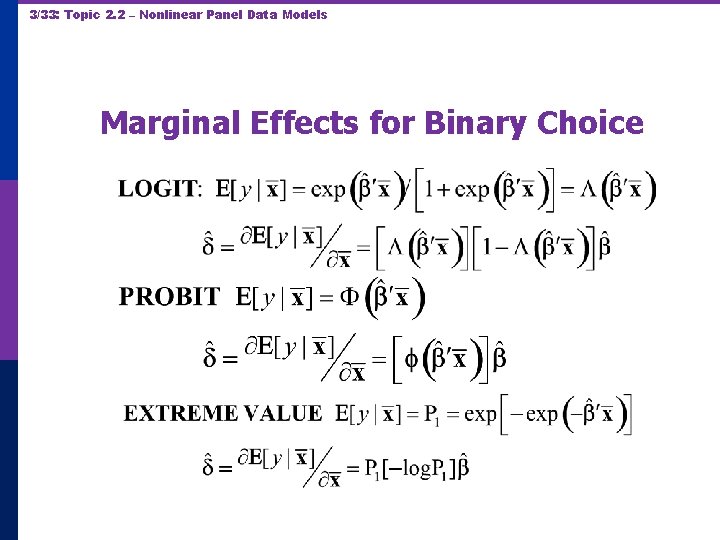
3/33: Topic 2. 2 – Nonlinear Panel Data Models Marginal Effects for Binary Choice
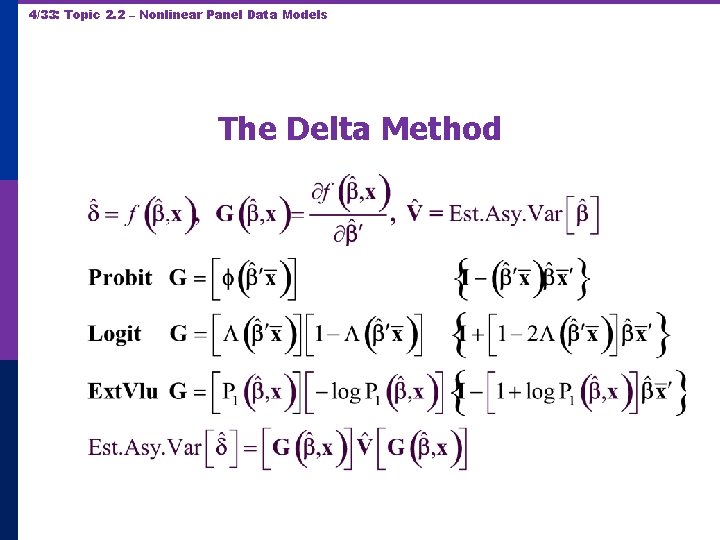
4/33: Topic 2. 2 – Nonlinear Panel Data Models The Delta Method
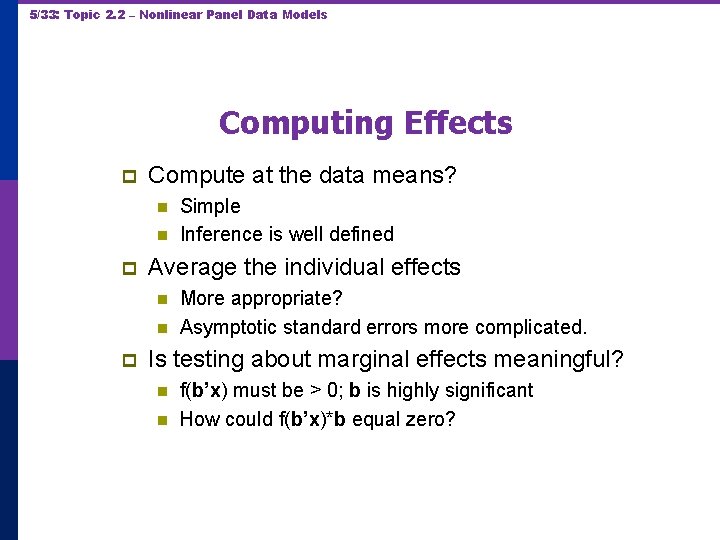
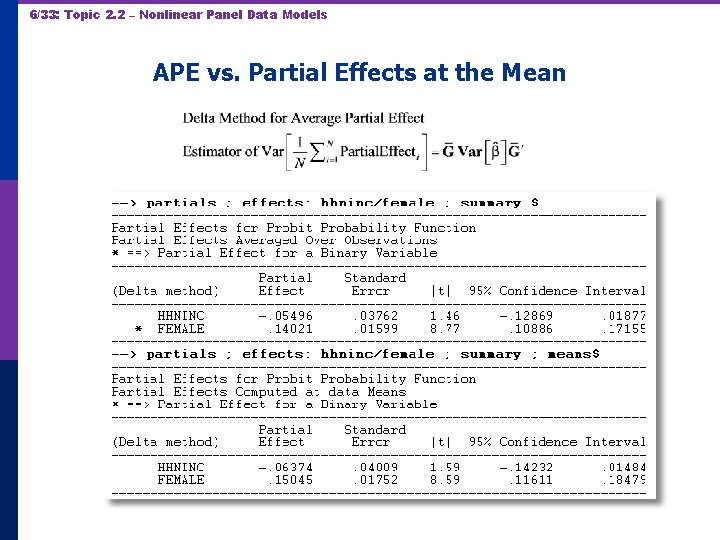
5/33: Topic 2. 2 – Nonlinear Panel Data Models Computing Effects p Compute at the data means? n n p Average the individual effects n n p Simple Inference is well defined More appropriate? Asymptotic standard errors more complicated. Is testing about marginal effects meaningful? n n f(b’x) must be > 0; b is highly significant How could f(b’x)*b equal zero?
6/33: Topic 2. 2 – Nonlinear Panel Data Models APE vs. Partial Effects at the Mean
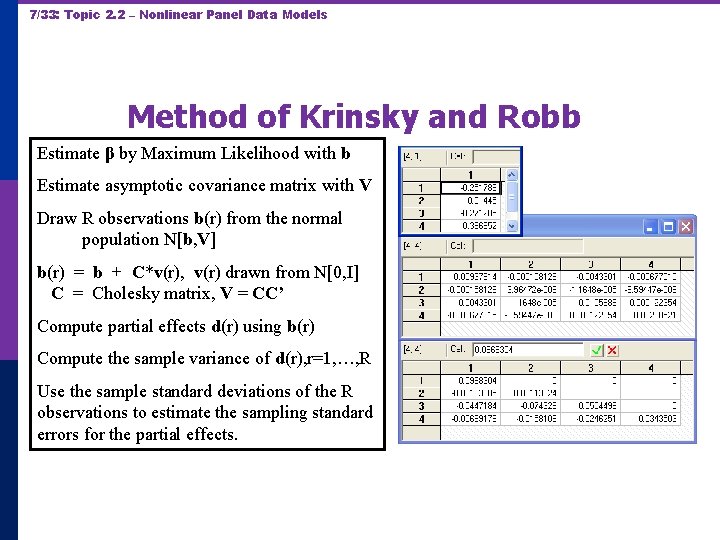
7/33: Topic 2. 2 – Nonlinear Panel Data Models Method of Krinsky and Robb Estimate β by Maximum Likelihood with b Estimate asymptotic covariance matrix with V Draw R observations b(r) from the normal population N[b, V] b(r) = b + C*v(r), v(r) drawn from N[0, I] C = Cholesky matrix, V = CC’ Compute partial effects d(r) using b(r) Compute the sample variance of d(r), r=1, …, R Use the sample standard deviations of the R observations to estimate the sampling standard errors for the partial effects.
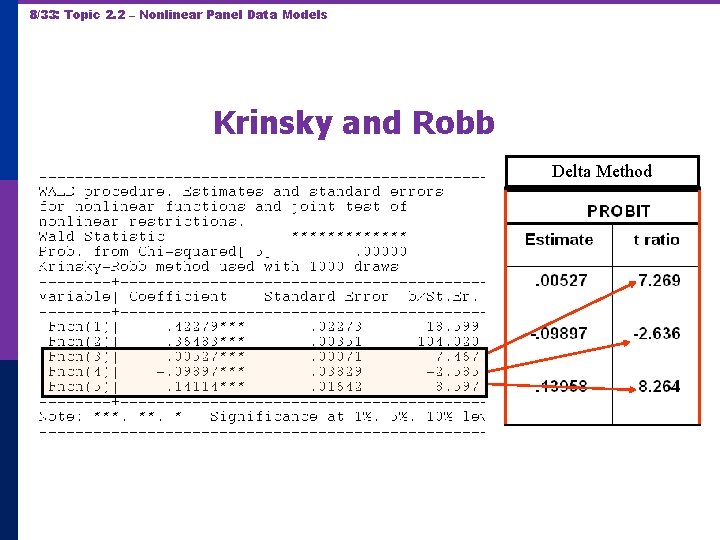
8/33: Topic 2. 2 – Nonlinear Panel Data Models Krinsky and Robb Delta Method
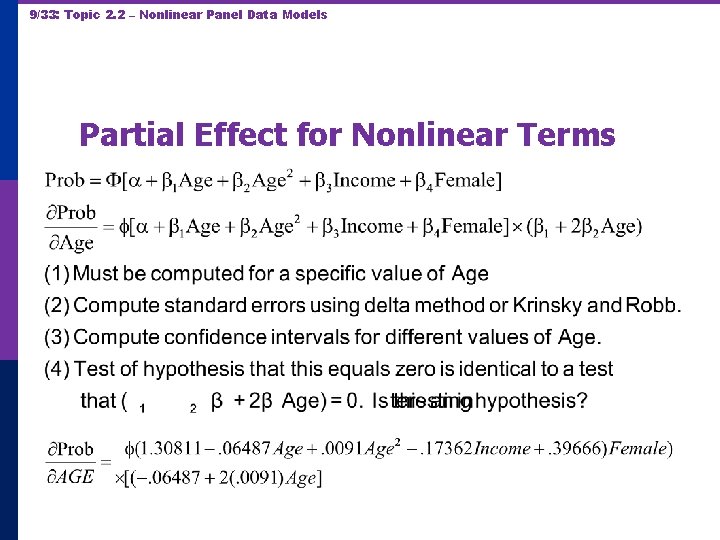
9/33: Topic 2. 2 – Nonlinear Panel Data Models Partial Effect for Nonlinear Terms
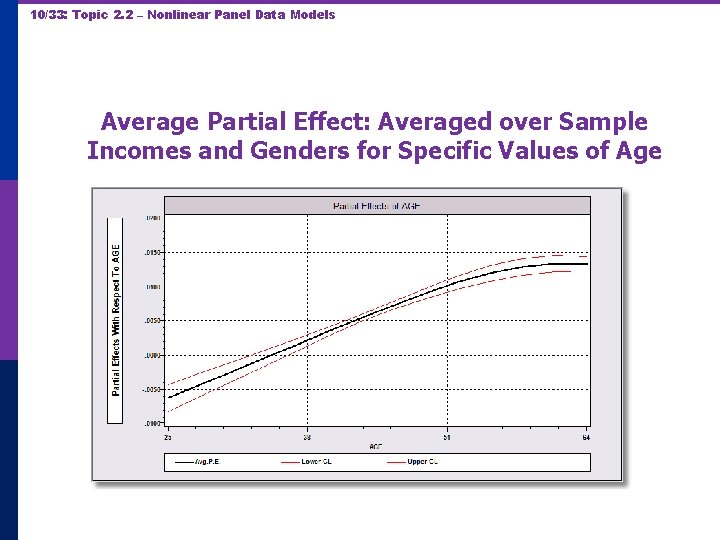
10/33: Topic 2. 2 – Nonlinear Panel Data Models Average Partial Effect: Averaged over Sample Incomes and Genders for Specific Values of Age
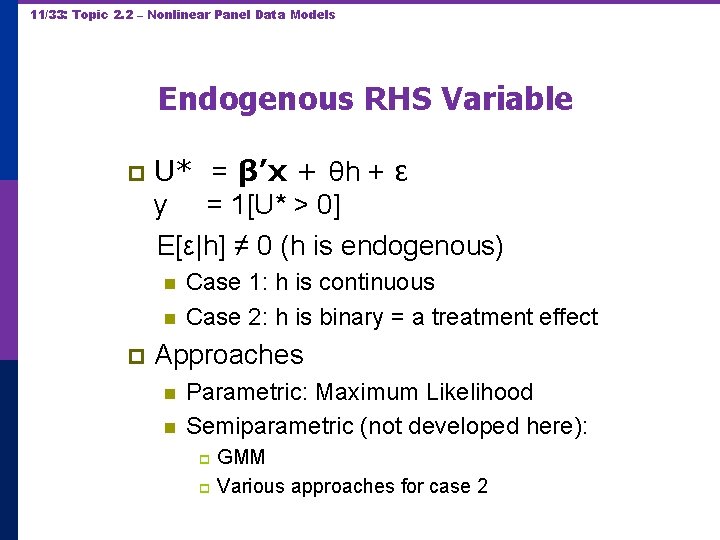
11/33: Topic 2. 2 – Nonlinear Panel Data Models Endogenous RHS Variable p U* = β’x + θh + ε y = 1[U* > 0] E[ε|h] ≠ 0 (h is endogenous) n n p Case 1: h is continuous Case 2: h is binary = a treatment effect Approaches n n Parametric: Maximum Likelihood Semiparametric (not developed here): GMM p Various approaches for case 2 p
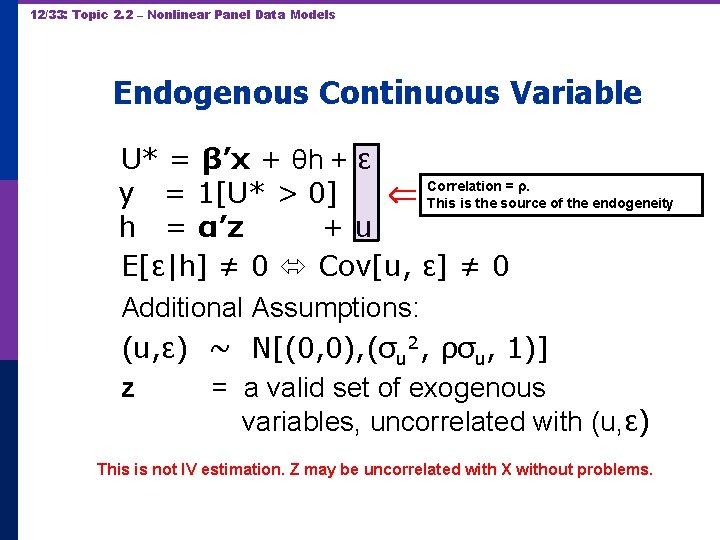
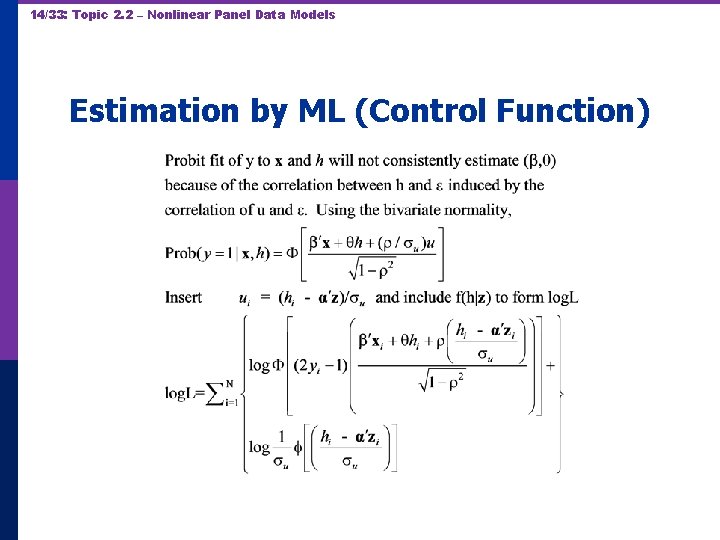
12/33: Topic 2. 2 – Nonlinear Panel Data Models Endogenous Continuous Variable U* = β’x + θh + ε = ρ. y = 1[U* > 0] Correlation This is the source of the endogeneity h = α’z +u E[ε|h] ≠ 0 Cov[u, ε] ≠ 0 Additional Assumptions: (u, ε) ~ N[(0, 0), (σu 2, ρσu, 1)] z = a valid set of exogenous variables, uncorrelated with (u, ε) This is not IV estimation. Z may be uncorrelated with X without problems.
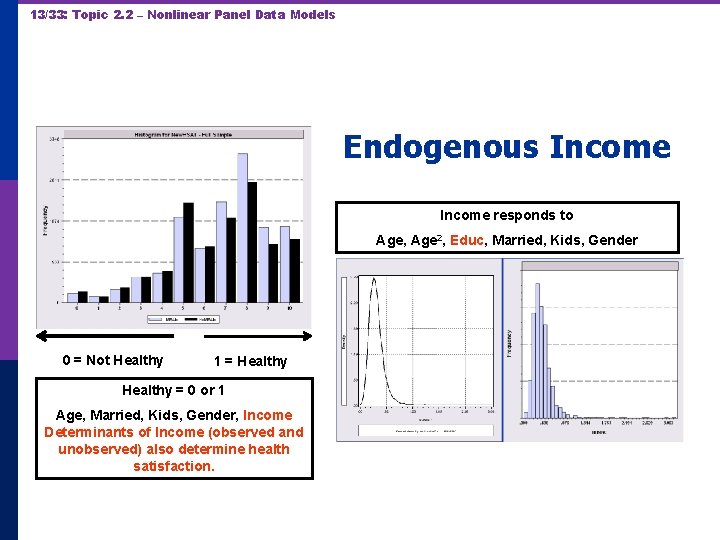
13/33: Topic 2. 2 – Nonlinear Panel Data Models Endogenous Income responds to Age, Age 2, Educ, Married, Kids, Gender 0 = Not Healthy 1 = Healthy = 0 or 1 Age, Married, Kids, Gender, Income Determinants of Income (observed and unobserved) also determine health satisfaction.
14/33: Topic 2. 2 – Nonlinear Panel Data Models Estimation by ML (Control Function)
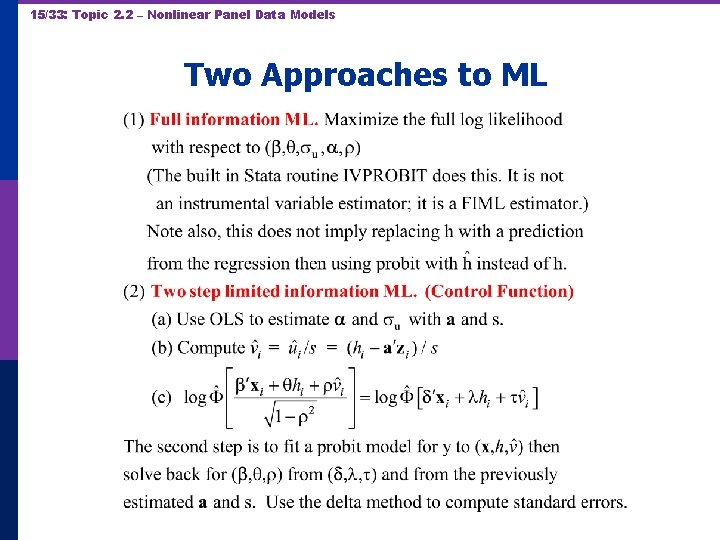
15/33: Topic 2. 2 – Nonlinear Panel Data Models Two Approaches to ML
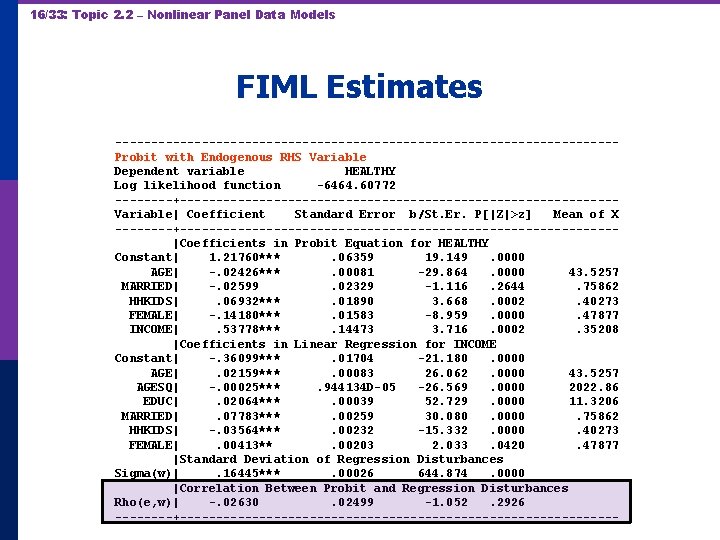
16/33: Topic 2. 2 – Nonlinear Panel Data Models FIML Estimates -----------------------------------Probit with Endogenous RHS Variable Dependent variable HEALTHY Log likelihood function -6464. 60772 ----+------------------------------Variable| Coefficient Standard Error b/St. Er. P[|Z|>z] Mean of X ----+------------------------------|Coefficients in Probit Equation for HEALTHY Constant| 1. 21760***. 06359 19. 149. 0000 AGE| -. 02426***. 00081 -29. 864. 0000 43. 5257 MARRIED| -. 02599. 02329 -1. 116. 2644. 75862 HHKIDS|. 06932***. 01890 3. 668. 0002. 40273 FEMALE| -. 14180***. 01583 -8. 959. 0000. 47877 INCOME|. 53778***. 14473 3. 716. 0002. 35208 |Coefficients in Linear Regression for INCOME Constant| -. 36099***. 01704 -21. 180. 0000 AGE|. 02159***. 00083 26. 062. 0000 43. 5257 AGESQ| -. 00025***. 944134 D-05 -26. 569. 0000 2022. 86 EDUC|. 02064***. 00039 52. 729. 0000 11. 3206 MARRIED|. 07783***. 00259 30. 080. 0000. 75862 HHKIDS| -. 03564***. 00232 -15. 332. 0000. 40273 FEMALE|. 00413**. 00203 2. 033. 0420. 47877 |Standard Deviation of Regression Disturbances Sigma(w)|. 16445***. 00026 644. 874. 0000 |Correlation Between Probit and Regression Disturbances Rho(e, w)| -. 02630. 02499 -1. 052. 2926 ----+-------------------------------
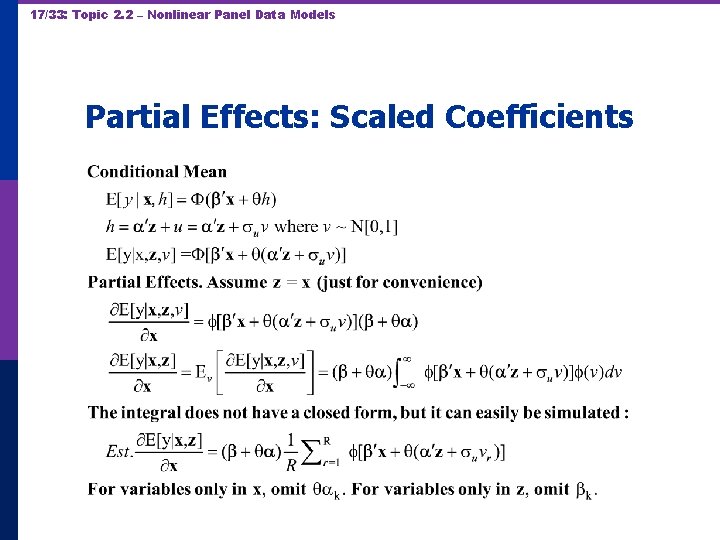
17/33: Topic 2. 2 – Nonlinear Panel Data Models Partial Effects: Scaled Coefficients
18/33: Topic 2. 2 – Nonlinear Panel Data Models Partial Effects θ = 0. 53778 The scale factor is computed using the model coefficients, means of the variables and 35, 000 draws from the standard normal population.
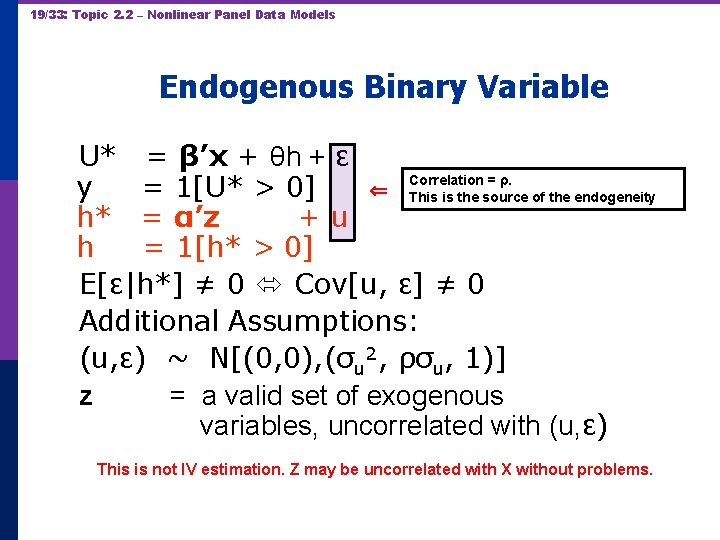
19/33: Topic 2. 2 – Nonlinear Panel Data Models Endogenous Binary Variable U* = β’x + θh + ε Correlation = ρ. This is the source of the endogeneity y = 1[U* > 0] h* = α’z +u h = 1[h* > 0] E[ε|h*] ≠ 0 Cov[u, ε] ≠ 0 Additional Assumptions: (u, ε) ~ N[(0, 0), (σu 2, ρσu, 1)] z = a valid set of exogenous variables, uncorrelated with (u, ε) This is not IV estimation. Z may be uncorrelated with X without problems.
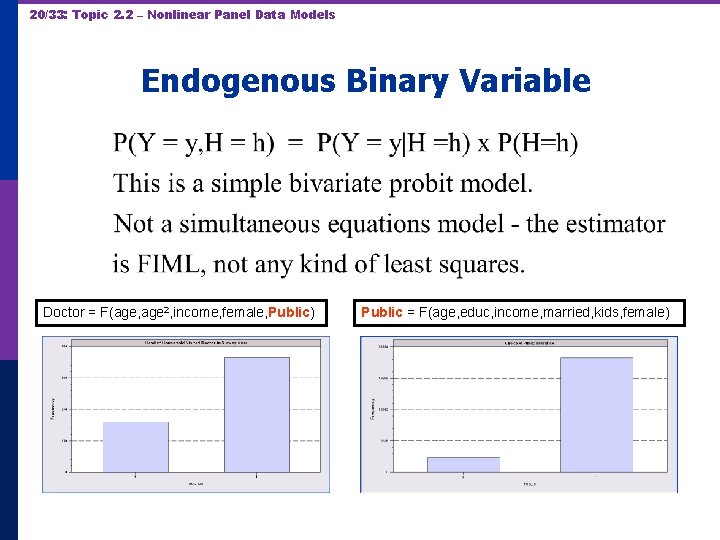
20/33: Topic 2. 2 – Nonlinear Panel Data Models Endogenous Binary Variable Doctor = F(age, age 2, income, female, Public) Public = F(age, educ, income, married, kids, female)
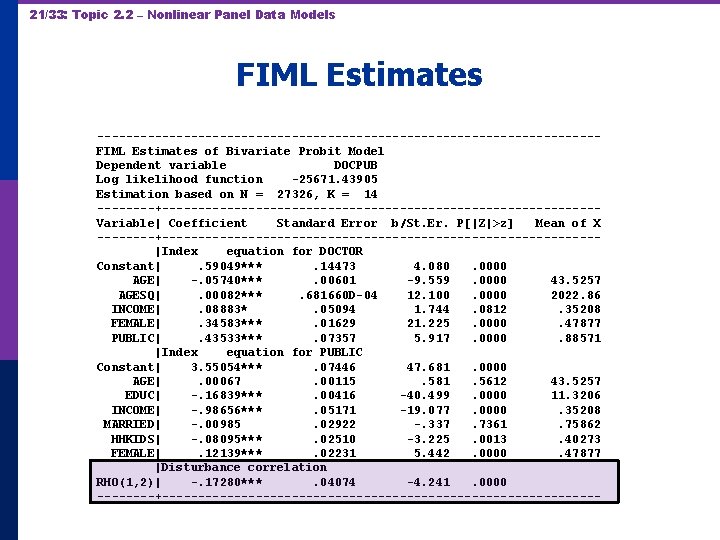
21/33: Topic 2. 2 – Nonlinear Panel Data Models FIML Estimates -----------------------------------FIML Estimates of Bivariate Probit Model Dependent variable DOCPUB Log likelihood function -25671. 43905 Estimation based on N = 27326, K = 14 ----+------------------------------Variable| Coefficient Standard Error b/St. Er. P[|Z|>z] Mean of X ----+------------------------------|Index equation for DOCTOR Constant|. 59049***. 14473 4. 080. 0000 AGE| -. 05740***. 00601 -9. 559. 0000 43. 5257 AGESQ|. 00082***. 681660 D-04 12. 100. 0000 2022. 86 INCOME|. 08883*. 05094 1. 744. 0812. 35208 FEMALE|. 34583***. 01629 21. 225. 0000. 47877 PUBLIC|. 43533***. 07357 5. 917. 0000. 88571 |Index equation for PUBLIC Constant| 3. 55054***. 07446 47. 681. 0000 AGE|. 00067. 00115. 581. 5612 43. 5257 EDUC| -. 16839***. 00416 -40. 499. 0000 11. 3206 INCOME| -. 98656***. 05171 -19. 077. 0000. 35208 MARRIED| -. 00985. 02922 -. 337. 7361. 75862 HHKIDS| -. 08095***. 02510 -3. 225. 0013. 40273 FEMALE|. 12139***. 02231 5. 442. 0000. 47877 |Disturbance correlation RHO(1, 2)| -. 17280***. 04074 -4. 241. 0000 ----+-------------------------------
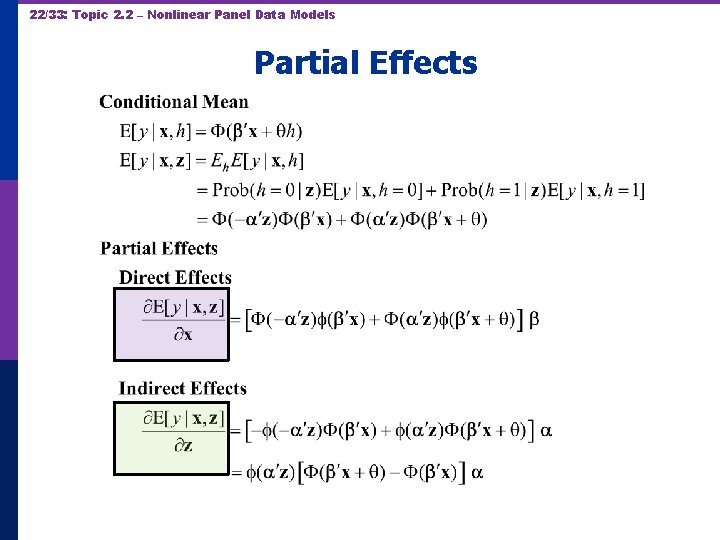
22/33: Topic 2. 2 – Nonlinear Panel Data Models Partial Effects
23/33: Topic 2. 2 – Nonlinear Panel Data Models Identification Issues p p Exclusions are not needed for estimation Identification is, in principle, by “functional form” Researchers usually have a variable in the treatment equation that is not in the main probit equation “to improve identification” A fully simultaneous model n n n y 1 = f(x 1, y 2), y 2 = f(x 2, y 1) Not identified even with exclusion restrictions (Model is “incoherent”)