
13 TREASURY AND WORKING CAPITAL MANAGEMENT OHT 13

- Slides: 44
13 TREASURY AND WORKING CAPITAL MANAGEMENT OHT 13. 1 LEARNING OBJECTIVES • Describe the main roles of a treasury department and the key concerns of managers when dealing with working capital • Comment on the factors influencing the balance of the different types of debt in terms of maturity, currency and interest rates • Show awareness of the importance of the relationship between the firm and the financial community • Demonstrate how the treasurer might reduce risk for the firm, perhaps through the use of derivative products • Understand the working capital cycle, the cash conversion cycle and an inventory model Glen Arnold: Corporate Financial Management, Second edition © Pearson Education Limited 2002
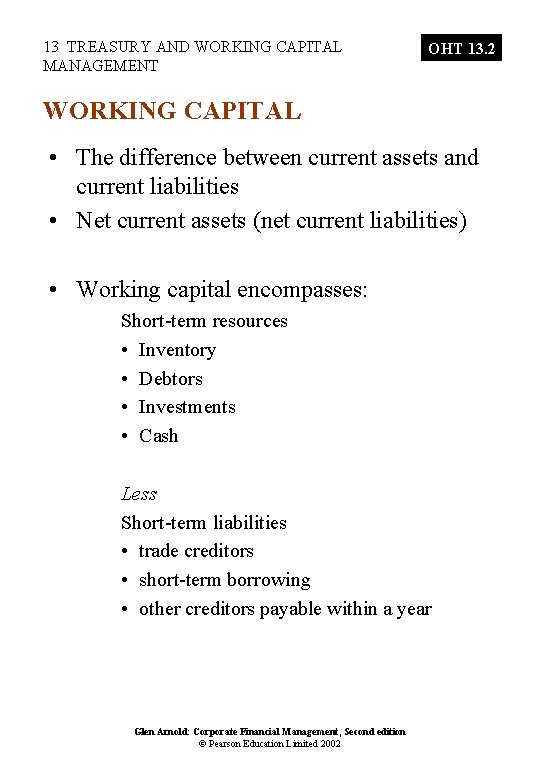
13 TREASURY AND WORKING CAPITAL MANAGEMENT OHT 13. 2 WORKING CAPITAL • The difference between current assets and current liabilities • Net current assets (net current liabilities) • Working capital encompasses: Short-term resources • Inventory • Debtors • Investments • Cash Less Short-term liabilities • trade creditors • short-term borrowing • other creditors payable within a year Glen Arnold: Corporate Financial Management, Second edition © Pearson Education Limited 2002
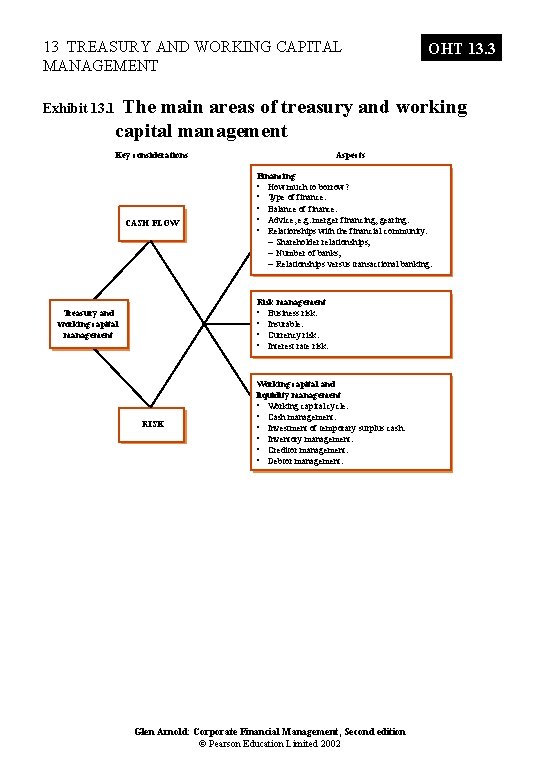
13 TREASURY AND WORKING CAPITAL MANAGEMENT OHT 13. 3 The main areas of treasury and working capital management Exhibit 13. 1 Key considerations CASH FLOW Aspects Financing • How much to borrow? • Type of finance. • Balance of finance. • Advice, e. g. merger financing, gearing. • Relationships with the financial community: – Shareholder relationships; – Number of banks; – Relationships versus transactional banking. Risk management • Business risk. • Insurable. • Currency risk. • Interest rate risk. Treasury and working capital management RISK Working capital and liquidity management • Working capital cycle. • Cash management. • Investment of temporary surplus cash. • Inventory management. • Creditor management. • Debtor management. Glen Arnold: Corporate Financial Management, Second edition © Pearson Education Limited 2002
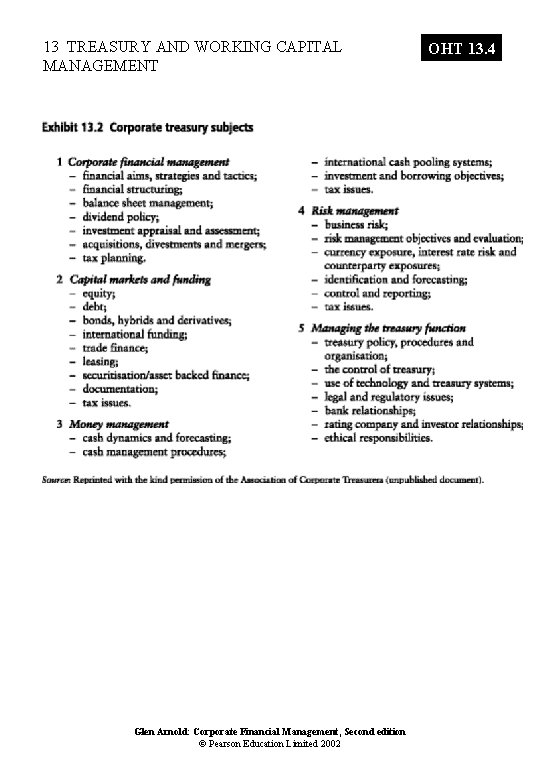
13 TREASURY AND WORKING CAPITAL MANAGEMENT Glen Arnold: Corporate Financial Management, Second edition © Pearson Education Limited 2002 OHT 13. 4
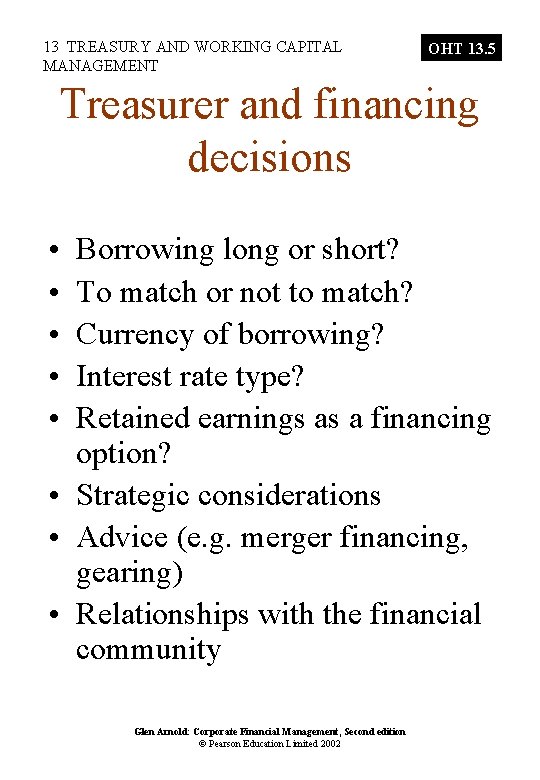
13 TREASURY AND WORKING CAPITAL MANAGEMENT OHT 13. 5 Treasurer and financing decisions • • • Borrowing long or short? To match or not to match? Currency of borrowing? Interest rate type? Retained earnings as a financing option? • Strategic considerations • Advice (e. g. merger financing, gearing) • Relationships with the financial community Glen Arnold: Corporate Financial Management, Second edition © Pearson Education Limited 2002
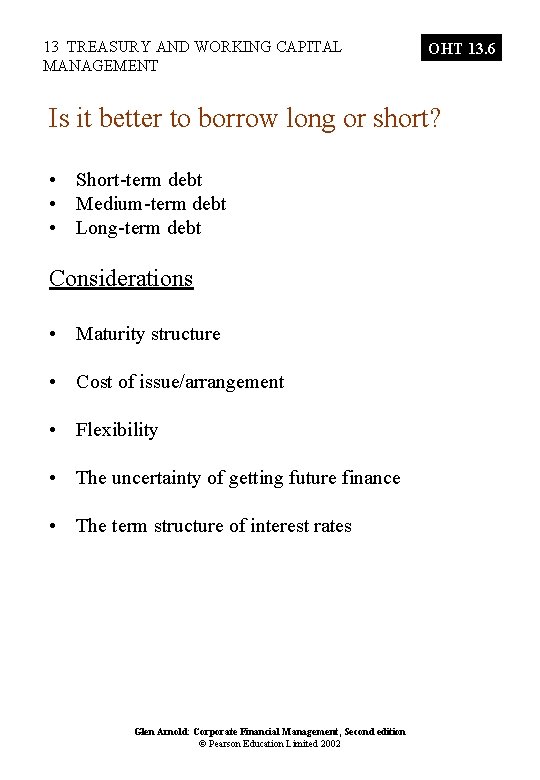
13 TREASURY AND WORKING CAPITAL MANAGEMENT OHT 13. 6 Is it better to borrow long or short? • Short-term debt • Medium-term debt • Long-term debt Considerations • Maturity structure • Cost of issue/arrangement • Flexibility • The uncertainty of getting future finance • The term structure of interest rates Glen Arnold: Corporate Financial Management, Second edition © Pearson Education Limited 2002
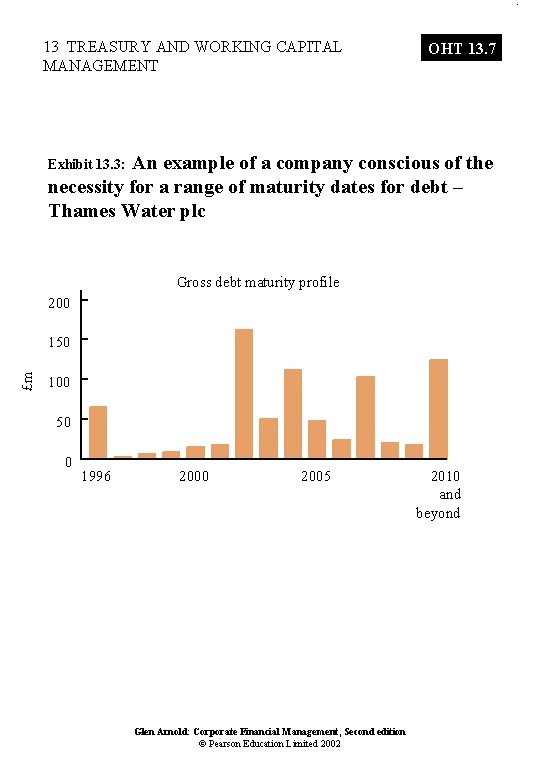
£m 13 TREASURY AND WORKING CAPITAL MANAGEMENT OHT 13. 7 An example of a company conscious of the necessity for a range of maturity dates for debt – Thames Water plc Exhibit 13. 3: Gross debt maturity profile 200 £m 150 100 50 0 1996 2000 2005 Glen Arnold: Corporate Financial Management, Second edition © Pearson Education Limited 2002 2010 and beyond
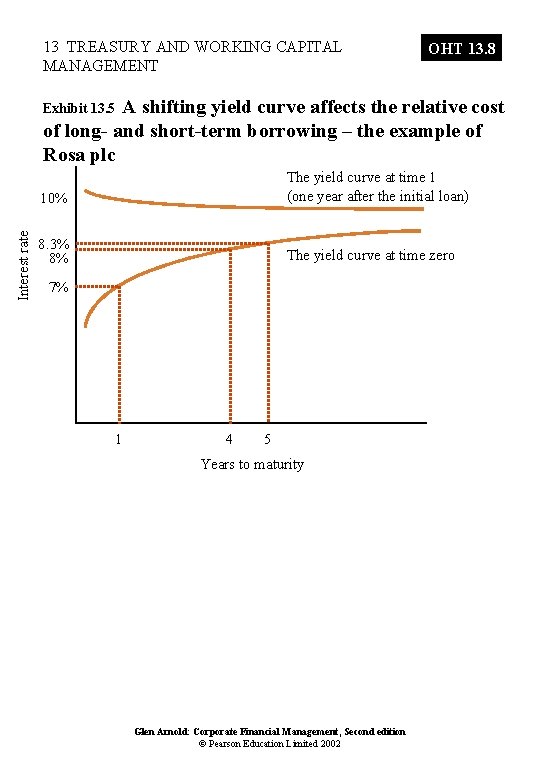
Interest rate 13 TREASURY AND WORKING CAPITAL MANAGEMENT OHT 13. 8 A shifting yield curve affects the relative cost of long- and short-term borrowing – the example of Rosa plc Interest rate Exhibit 13. 5 10% The yield curve at time 1 (one year after the initial loan) 8. 3% 8% The yield curve at time zero 7% 1 4 5 Years to maturity Glen Arnold: Corporate Financial Management, Second edition © Pearson Education Limited 2002
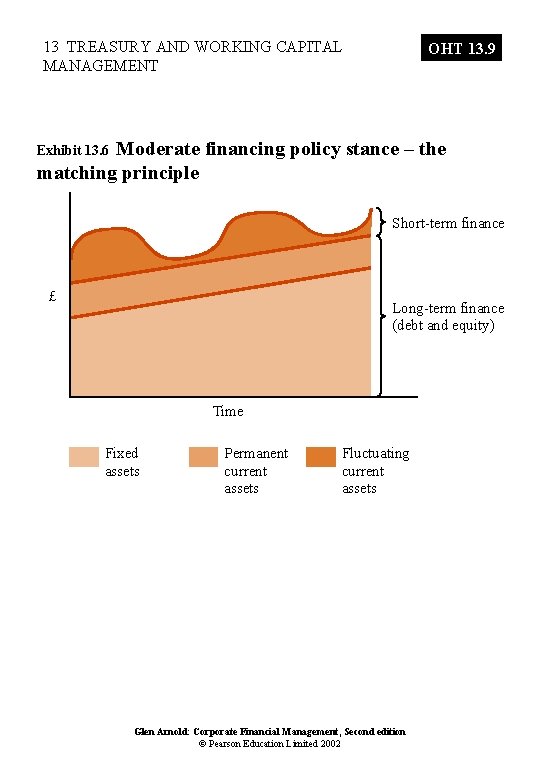
13 TREASURY AND WORKING CAPITAL MANAGEMENT OHT 13. 9 Moderate financing policy stance – the matching principle Exhibit 13. 6 Short-term finance £ Long-term finance (debt and equity) Time Fixed assets Permanent current assets Fluctuating current assets Glen Arnold: Corporate Financial Management, Second edition © Pearson Education Limited 2002
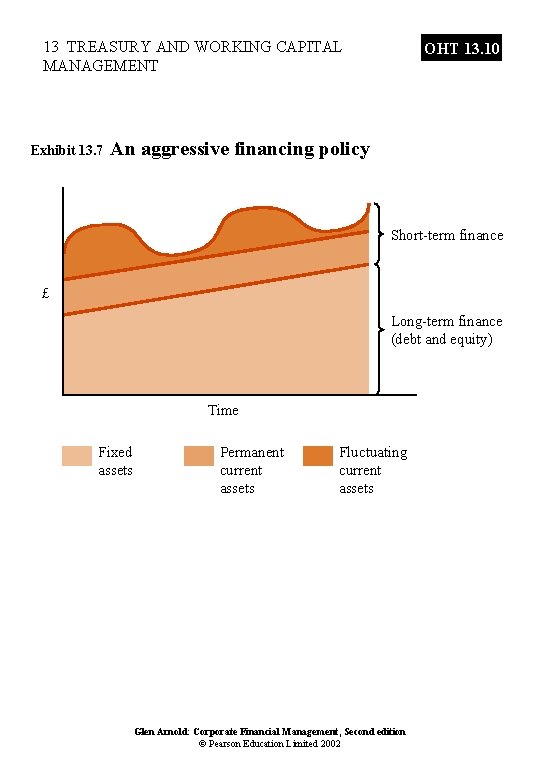
13 TREASURY AND WORKING CAPITAL MANAGEMENT Exhibit 13. 7 OHT 13. 10 An aggressive financing policy Short-term finance £ Long-term finance (debt and equity) Time Fixed assets Permanent current assets Fluctuating current assets Glen Arnold: Corporate Financial Management, Second edition © Pearson Education Limited 2002
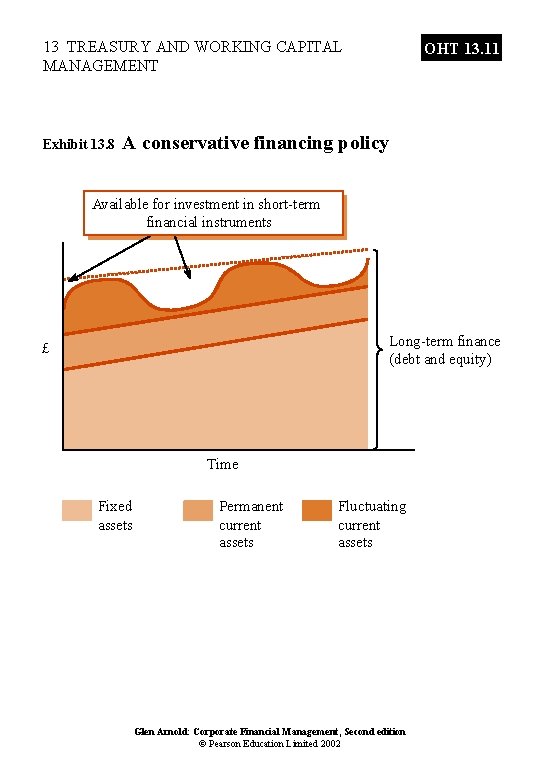
13 TREASURY AND WORKING CAPITAL MANAGEMENT Exhibit 13. 8 OHT 13. 11 A conservative financing policy Available for investment in short-term financial instruments Long-term finance (debt and equity) £ Time Fixed assets Permanent current assets Fluctuating current assets Glen Arnold: Corporate Financial Management, Second edition © Pearson Education Limited 2002
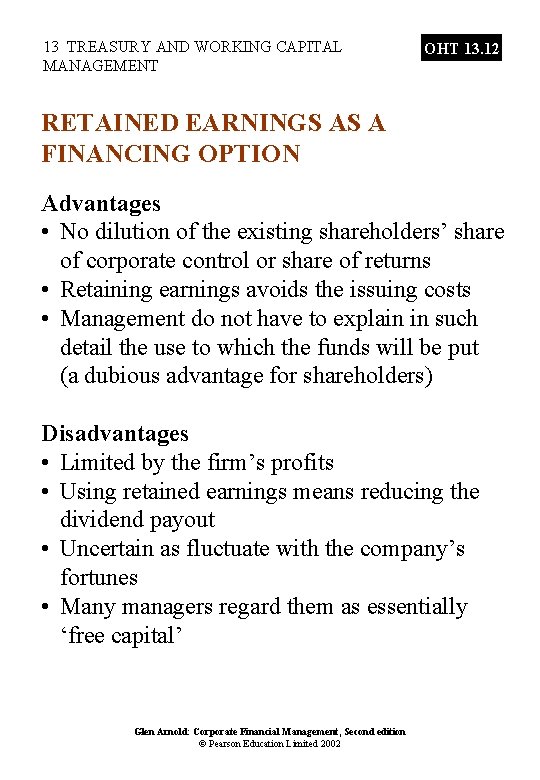
13 TREASURY AND WORKING CAPITAL MANAGEMENT OHT 13. 12 RETAINED EARNINGS AS A FINANCING OPTION Advantages • No dilution of the existing shareholders’ share of corporate control or share of returns • Retaining earnings avoids the issuing costs • Management do not have to explain in such detail the use to which the funds will be put (a dubious advantage for shareholders) Disadvantages • Limited by the firm’s profits • Using retained earnings means reducing the dividend payout • Uncertain as fluctuate with the company’s fortunes • Many managers regard them as essentially ‘free capital’ Glen Arnold: Corporate Financial Management, Second edition © Pearson Education Limited 2002
13 TREASURY AND WORKING CAPITAL MANAGEMENT OHT 13. 13 Relationships with the financial community • Planned, sustained effort to maintain mutual understanding between shareholders and company • Banking relationships – Multiple banks – Transaction banking vs. relationship banking Glen Arnold: Corporate Financial Management, Second edition © Pearson Education Limited 2002
13 TREASURY AND WORKING CAPITAL MANAGEMENT OHT 13. 14 RISK MANAGEMENT Three reasons firms sacrifice some potential profits in order to reduce the impact of adverse events: 1 It helps financial planning 2 Reduces the fear of financial distress 3 Some risks are not rewarded Glen Arnold: Corporate Financial Management, Second edition © Pearson Education Limited 2002
13 TREASURY AND WORKING CAPITAL MANAGEMENT TYPES OF RISK • Business risk • Insurable risk • Currency risk • Interest-rate risk Glen Arnold: Corporate Financial Management, Second edition © Pearson Education Limited 2002 OHT 13. 15
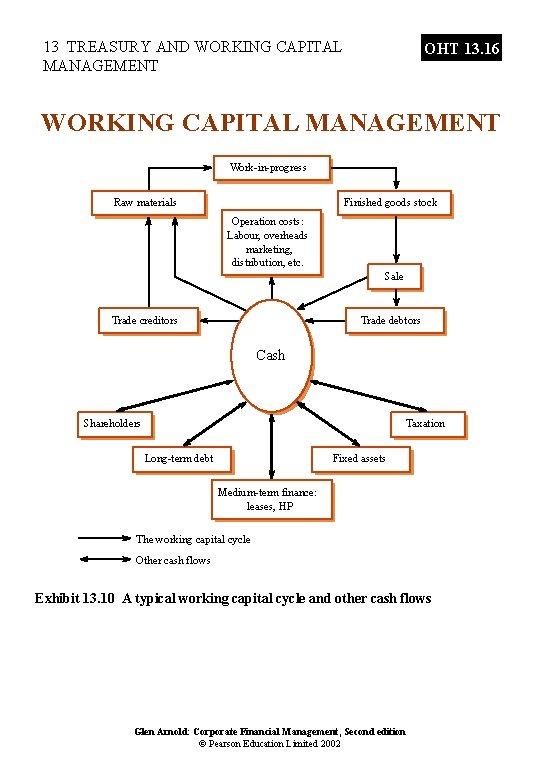
13 TREASURY AND WORKING CAPITAL MANAGEMENT OHT 13. 16 WORKING CAPITAL MANAGEMENT Work-in-progress Raw materials Finished goods stock Operation costs: Labour, overheads marketing, distribution, etc. Sale Trade creditors Trade debtors Cash Shareholders Taxation Long-term debt Fixed assets Medium-term finance: leases, HP The working capital cycle Other cash flows Exhibit 13. 10 A typical working capital cycle and other cash flows Glen Arnold: Corporate Financial Management, Second edition © Pearson Education Limited 2002
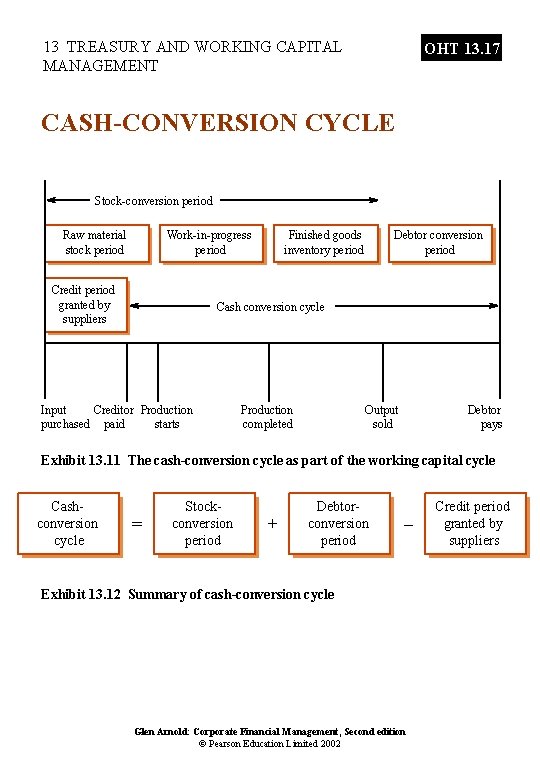
13 TREASURY AND WORKING CAPITAL MANAGEMENT OHT 13. 17 CASH-CONVERSION CYCLE Stock-conversion period Raw material stock period Work-in-progress period Credit period granted by suppliers Finished goods inventory period Debtor conversion period Cash conversion cycle Input Creditor Production purchased paid starts Production completed Output sold Debtor pays Exhibit 13. 11 The cash-conversion cycle as part of the working capital cycle Cashconversion cycle = Stockconversion period + Debtorconversion period – Exhibit 13. 12 Summary of cash-conversion cycle Glen Arnold: Corporate Financial Management, Second edition © Pearson Education Limited 2002 Credit period granted by suppliers
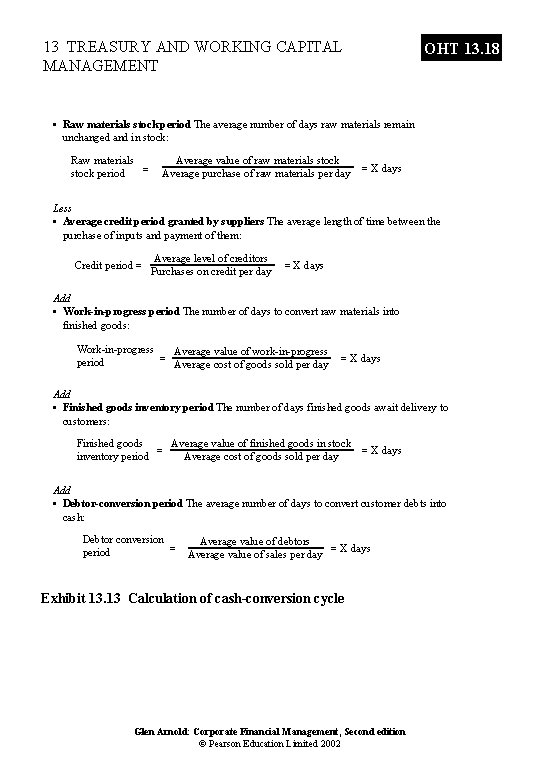
13 TREASURY AND WORKING CAPITAL MANAGEMENT OHT 13. 18 • Raw materials stock period The average number of days raw materials remain unchanged and in stock: Raw materials = stock period Average value of raw materials stock Average purchase of raw materials per day = X days Less • Average credit period granted by suppliers The average length of time between the purchase of inputs and payment of them: Credit period = Average level of creditors Purchases on credit per day = X days Add • Work-in-progress period The number of days to convert raw materials into finished goods: Work-in-progress Average value of work-in-progress = period Average cost of goods sold per day = X days Add • Finished goods inventory period The number of days finished goods await delivery to customers: Finished goods Average value of finished goods in stock = = X days inventory period Average cost of goods sold per day Add • Debtor-conversion period The average number of days to convert customer debts into cash: Debtor conversion = period Average value of debtors = X days Average value of sales per day Exhibit 13. 13 Calculation of cash-conversion cycle Glen Arnold: Corporate Financial Management, Second edition © Pearson Education Limited 2002
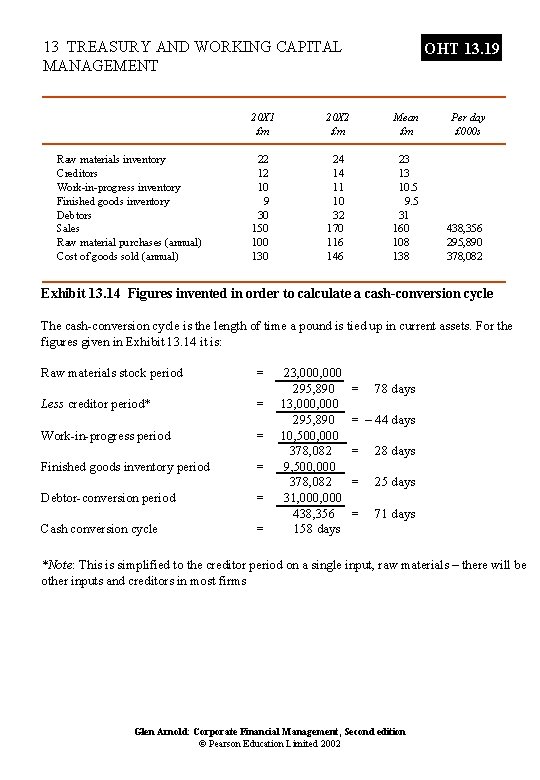
13 TREASURY AND WORKING CAPITAL MANAGEMENT Raw materials inventory Creditors Work-in-progress inventory Finished goods inventory Debtors Sales Raw material purchases (annual) Cost of goods sold (annual) OHT 13. 19 20 X 1 £m 20 X 2 £m Mean £m 22 12 10 9 30 150 100 130 24 14 11 10 32 170 116 146 23 13 10. 5 9. 5 31 160 108 138 Per day £ 000 s 438, 356 295, 890 378, 082 Exhibit 13. 14 Figures invented in order to calculate a cash-conversion cycle The cash-conversion cycle is the length of time a pound is tied up in current assets. For the figures given in Exhibit 13. 14 it is: Raw materials stock period = Less creditor period* = Work-in-progress period = Finished goods inventory period Debtor-conversion period Cash conversion cycle = = = 23, 000, 000 295, 890 10, 500, 000 378, 082 9, 500, 000 378, 082 31, 000 438, 356 158 days = 78 days = – 44 days = 28 days = 25 days = 71 days *Note: This is simplified to the creditor period on a single input, raw materials – there will be other inputs and creditors in most firms Glen Arnold: Corporate Financial Management, Second edition © Pearson Education Limited 2002
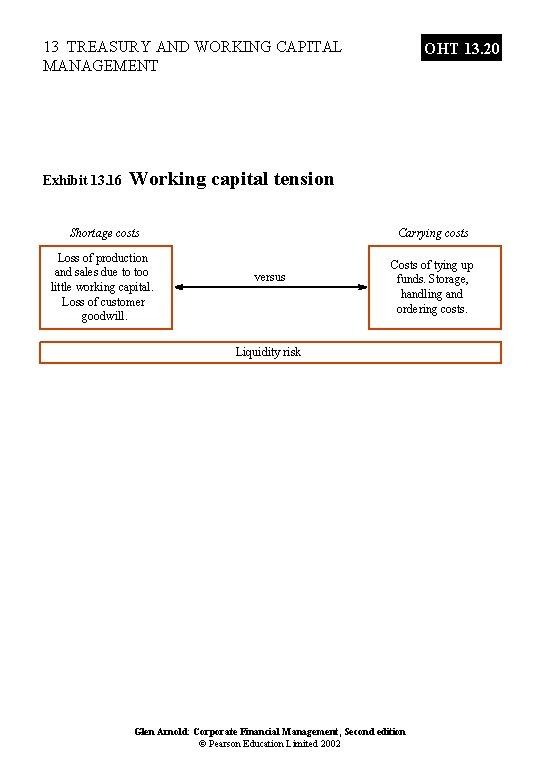
13 TREASURY AND WORKING CAPITAL MANAGEMENT Exhibit 13. 16 OHT 13. 20 Working capital tension Shortage costs Loss of production and sales due to too little working capital. Loss of customer goodwill. Carrying costs versus Costs of tying up funds. Storage, handling and ordering costs. Liquidity risk Glen Arnold: Corporate Financial Management, Second edition © Pearson Education Limited 2002
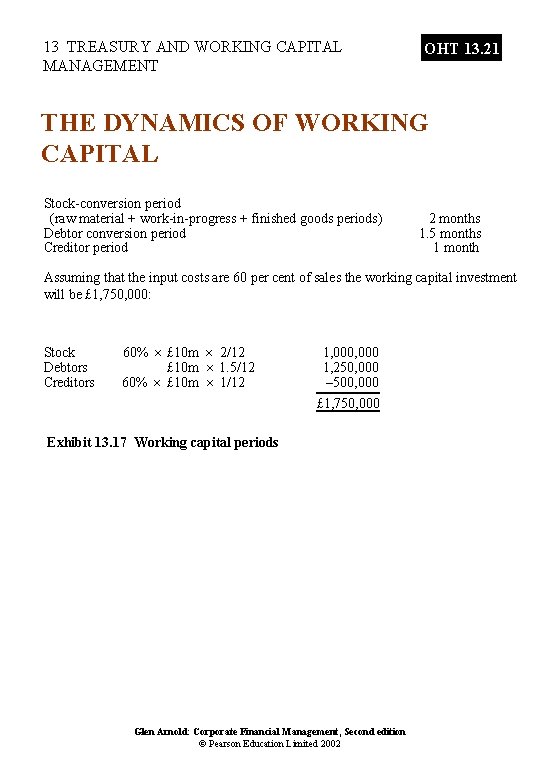
13 TREASURY AND WORKING CAPITAL MANAGEMENT OHT 13. 21 THE DYNAMICS OF WORKING CAPITAL Stock-conversion period (raw material + work-in-progress + finished goods periods) Debtor conversion period Creditor period 2 months 1. 5 months 1 month Assuming that the input costs are 60 per cent of sales the working capital investment will be £ 1, 750, 000: Stock Debtors Creditors 60% ´ £ 10 m ´ 2/12 £ 10 m ´ 1. 5/12 60% ´ £ 10 m ´ 1/12 1, 000 1, 250, 000 – 500, 000 £ 1, 750, 000 Exhibit 13. 17 Working capital periods Glen Arnold: Corporate Financial Management, Second edition © Pearson Education Limited 2002
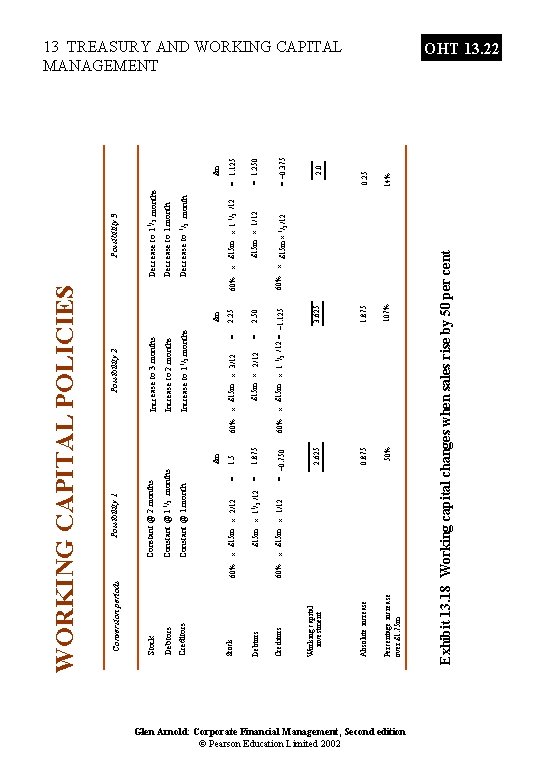
£m 1. 875 = Glen Arnold: Corporate Financial Management, Second edition © Pearson Education Limited 2002 14% 107% 50% Percentage increase over £ 1. 75 m Exhibit 13. 18 Working capital changes when sales rise by 50 per cent 0. 25 1. 875 0. 875 Absolute increase 2. 0 = – 0. 375 = 1. 125 60% ´ £ 15 m ´ 1/ /12 2 /12 60% ´ £ 15 m ´ 1 1/2 /12 = – 1. 125 2 = 1. 250 60% ´ £ 15 m ´ 1/12 = £ 15 m ´ 2/12 2. 25 £m 2. 50 = 60% ´ £ 15 m ´ 3/12 1/ 3. 625 = – 0. 750 1. 5 = £m Decrease to 1/2 month 2. 625 60% ´ £ 15 m ´ 1/12 £ 15 m ´ 11/2 /12 60% ´ £ 15 m ´ 2/12 months Decrease to 1 month Decrease to 1 1/2 months Possibility 3 Working capital investment Creditors Debtors Stock 2 Constant @ 1 month Creditors Increase to 1 Increase to 2 months Constant @ 1 1/2 months Debtors 1/ Increase to 3 months Possibility 2 Constant @ 2 months Possibility 1 Stock Conversion periods WORKING CAPITAL POLICIES 13 TREASURY AND WORKING CAPITAL MANAGEMENT OHT 13. 22
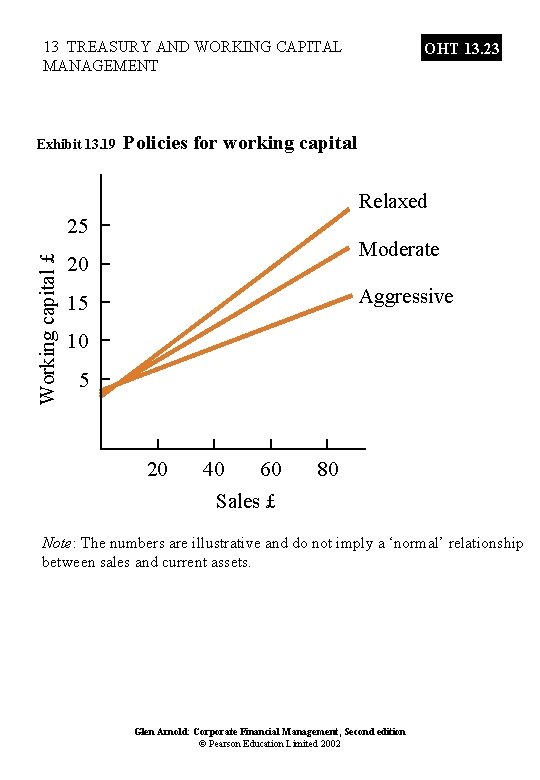
13 TREASURY AND WORKING CAPITAL MANAGEMENT Exhibit 13. 19 OHT 13. 23 Policies for working capital Relaxed Working capital £ 25 Moderate 20 Aggressive 15 10 5 20 40 60 80 Sales £ Note: The numbers are illustrative and do not imply a ‘normal’ relationship between sales and current assets. Glen Arnold: Corporate Financial Management, Second edition © Pearson Education Limited 2002
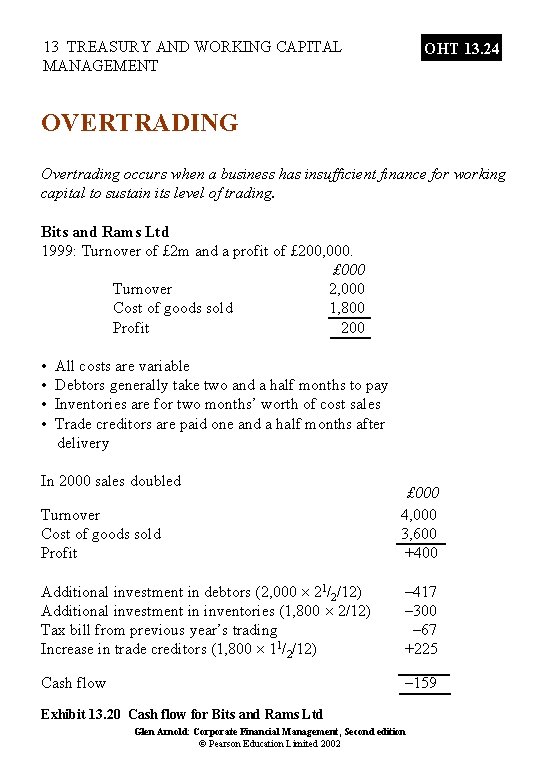
13 TREASURY AND WORKING CAPITAL MANAGEMENT OHT 13. 24 OVERTRADING Overtrading occurs when a business has insufficient finance for working capital to sustain its level of trading. Bits and Rams Ltd 1999: Turnover of £ 2 m and a profit of £ 200, 000. £ 000 Turnover 2, 000 Cost of goods sold 1, 800 Profit 200 • • All costs are variable Debtors generally take two and a half months to pay Inventories are for two months’ worth of cost sales Trade creditors are paid one and a half months after delivery In 2000 sales doubled Turnover Cost of goods sold Profit £ 000 4, 000 3, 600 +400 Additional investment in debtors (2, 000 ´ 21/2/12) Additional investment in inventories (1, 800 ´ 2/12) Tax bill from previous year’s trading Increase in trade creditors (1, 800 ´ 11/2/12) – 417 – 300 – 67 +225 Cash flow – 159 Exhibit 13. 20 Cash flow for Bits and Rams Ltd Glen Arnold: Corporate Financial Management, Second edition © Pearson Education Limited 2002
13 TREASURY AND WORKING CAPITAL MANAGEMENT OHT 13. 25 WHY IS CASH SO IMPORTANT? 1 Transaction motive 2 Precautionary motive 3 Speculative motive Glen Arnold: Corporate Financial Management, Second edition © Pearson Education Limited 2002
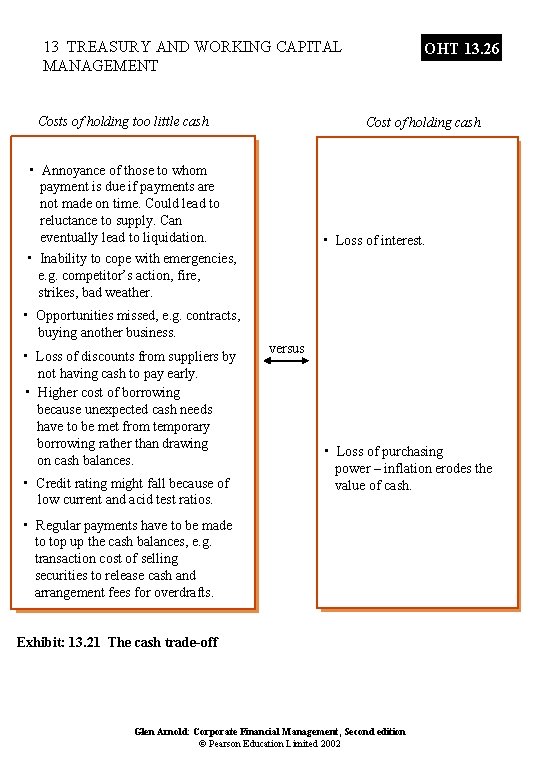
13 TREASURY AND WORKING CAPITAL MANAGEMENT Costs of holding too little cash OHT 13. 26 Cost of holding cash • Annoyance of those to whom payment is due if payments are not made on time. Could lead to reluctance to supply. Can eventually lead to liquidation. • Inability to cope with emergencies, . e. g. competitor’s action, fire, strikes, bad weather. • Loss of interest. • Opportunities missed, e. g. contracts, buying another business. • Loss of discounts from suppliers by not having cash to pay early. • Higher cost of borrowing because unexpected cash needs have to be met from temporary borrowing rather than drawing on cash balances. • Credit rating might fall because of low current and acid test ratios. versus • Loss of purchasing power – inflation erodes the value of cash. • Regular payments have to be made to top up the cash balances, e. g. transaction cost of selling securities to release cash and arrangement fees for overdrafts. Exhibit: 13. 21 The cash trade-off Glen Arnold: Corporate Financial Management, Second edition © Pearson Education Limited 2002
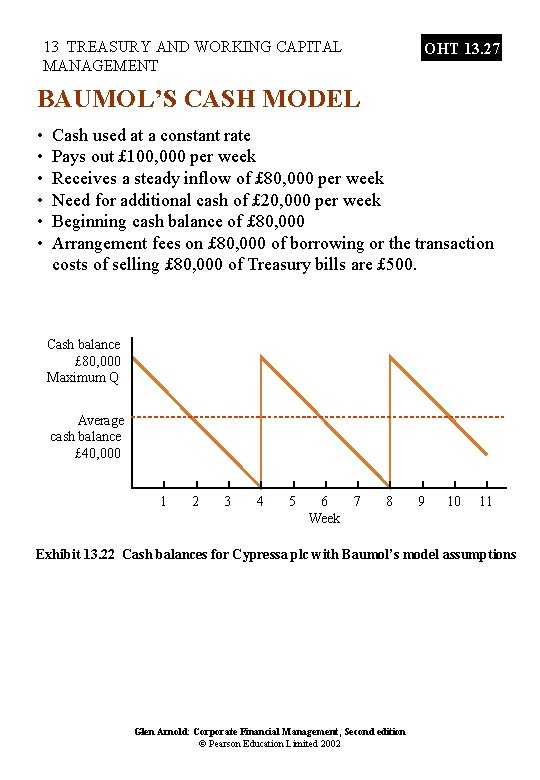
13 TREASURY AND WORKING CAPITAL MANAGEMENT OHT 13. 27 BAUMOL’S CASH MODEL • • • Cash used at a constant rate Pays out £ 100, 000 per week Receives a steady inflow of £ 80, 000 per week Need for additional cash of £ 20, 000 per week Beginning cash balance of £ 80, 000 Arrangement fees on £ 80, 000 of borrowing or the transaction costs of selling £ 80, 000 of Treasury bills are £ 500. Cash balance £ 80, 000 Maximum Q Average cash balance £ 40, 000 1 2 3 4 5 6 7 Week 8 9 10 11 Exhibit 13. 22 Cash balances for Cypressa plc with Baumol’s model assumptions Glen Arnold: Corporate Financial Management, Second edition © Pearson Education Limited 2002
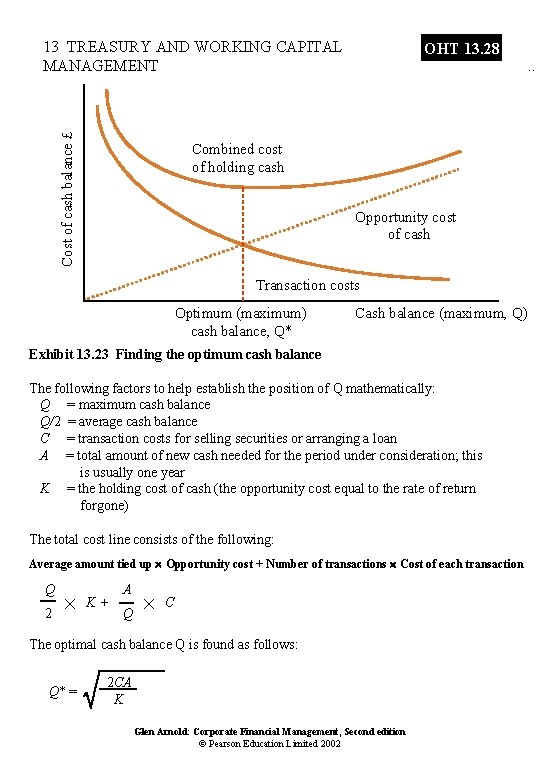
Cost of cash balance £ 13 TREASURY AND WORKING CAPITAL MANAGEMENT OHT 13. 28 Cost of cash balance £ Combined cost of holding cash Opportunity cost of cash Transaction costs Optimum (maximum) cash balance, Q* Cash balance (maximum, Q) Exhibit 13. 23 Finding the optimum cash balance The following factors to help establish the position of Q mathematically: Q = maximum cash balance Q/2 = average cash balance C = transaction costs for selling securities or arranging a loan A = total amount of new cash needed for the period under consideration; this is usually one year K = the holding cost of cash (the opportunity cost equal to the rate of return forgone) The total cost line consists of the following: Average amount tied up ´ Opportunity cost + Number of transactions ´ Cost of each transaction Q 2 ´ K + A Q ´ C The optimal cash balance Q is found as follows: Q* = 2 CA K Glen Arnold: Corporate Financial Management, Second edition © Pearson Education Limited 2002
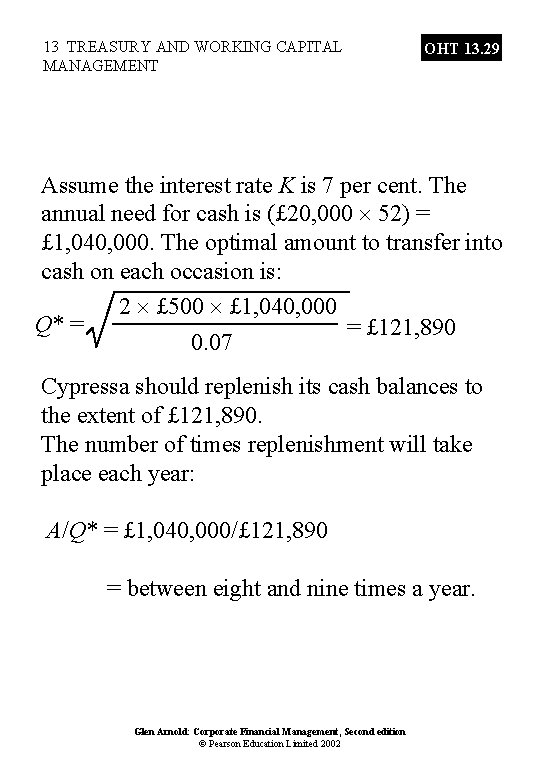
13 TREASURY AND WORKING CAPITAL MANAGEMENT OHT 13. 29 Assume the interest rate K is 7 per cent. The annual need for cash is (£ 20, 000 ´ 52) = £ 1, 040, 000. The optimal amount to transfer into cash on each occasion is: 2 ´ £ 500 ´ £ 1, 040, 000 Q* = = £ 121, 890 0. 07 Cypressa should replenish its cash balances to the extent of £ 121, 890. The number of times replenishment will take place each year: A/Q* = £ 1, 040, 000/£ 121, 890 = between eight and nine times a year. Glen Arnold: Corporate Financial Management, Second edition © Pearson Education Limited 2002
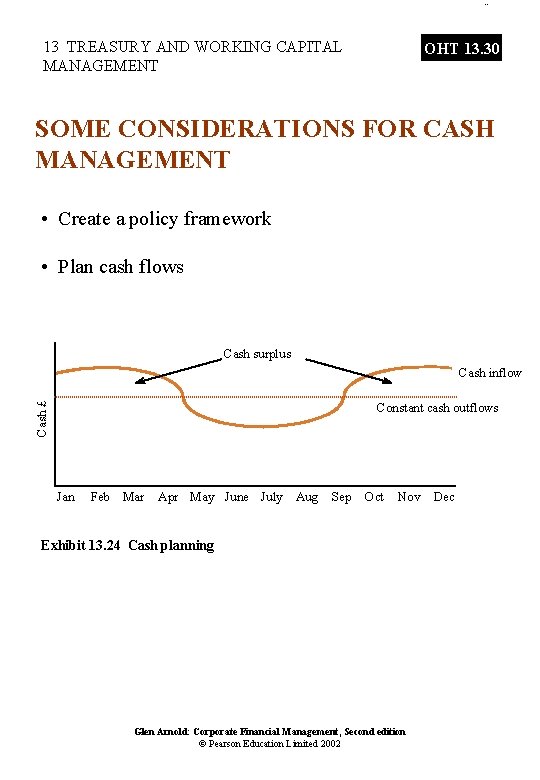
Cash £ 13 TREASURY AND WORKING CAPITAL MANAGEMENT OHT 13. 30 SOME CONSIDERATIONS FOR CASH MANAGEMENT • Create a policy framework • Plan cash flows Cash surplus Cash inflow Cash £ Constant cash outflows Jan Feb Mar Apr May June July Aug Sep Oct Nov Exhibit 13. 24 Cash planning Glen Arnold: Corporate Financial Management, Second edition © Pearson Education Limited 2002 Dec
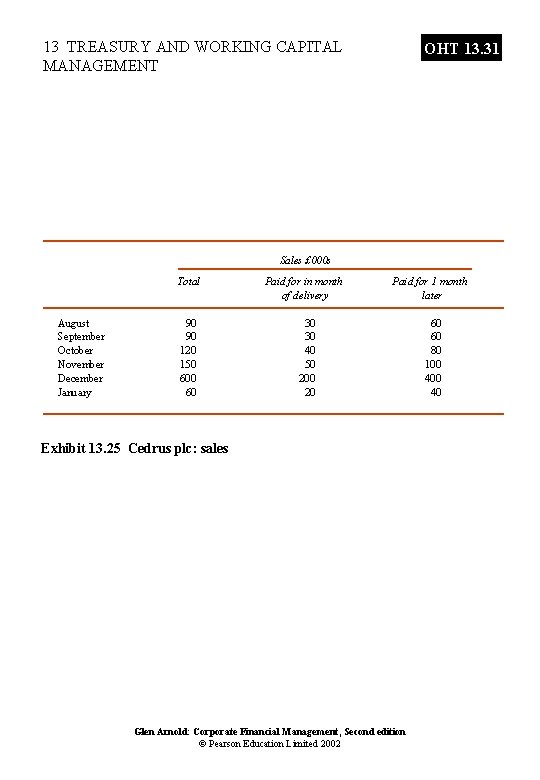
13 TREASURY AND WORKING CAPITAL MANAGEMENT OHT 13. 31 Sales £ 000 s Total August September October November December January 90 90 120 150 60 Paid for in month of delivery Paid for 1 month later 30 30 40 50 20 Exhibit 13. 25 Cedrus plc: sales Glen Arnold: Corporate Financial Management, Second edition © Pearson Education Limited 2002 60 60 80 100 40
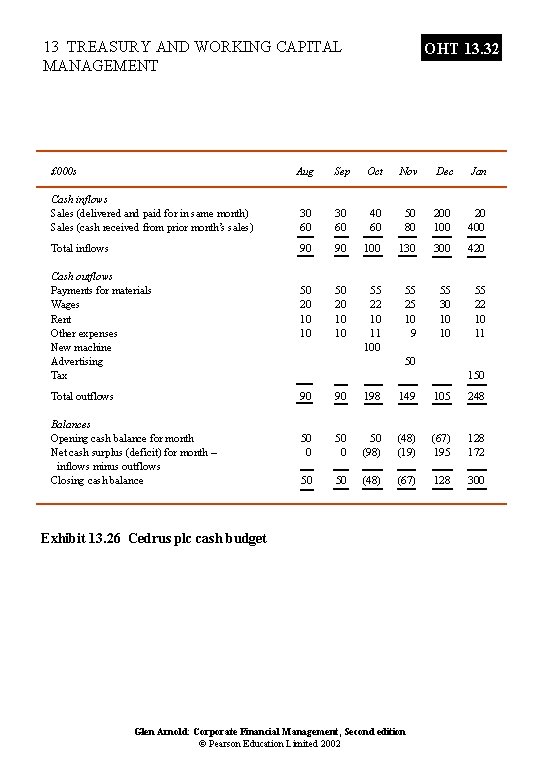
13 TREASURY AND WORKING CAPITAL MANAGEMENT £ 000 s OHT 13. 32 Aug Sep Oct Nov Cash inflows Sales (delivered and paid for in same month) Sales (cash received from prior month’s sales) 30 60 40 60 Total inflows 90 90 50 20 10 10 Cash outflows Payments for materials Wages Rent Other expenses New machine Advertising Tax Total outflows Balances Opening cash balance for month Net cash surplus (deficit) for month – inflows minus outflows Closing cash balance Dec Jan 50 80 200 100 20 400 130 300 420 55 22 10 11 100 55 25 10 9 55 30 10 10 55 22 10 11 50 150 90 90 198 149 105 248 50 0 50 (98) (48) (19) (67) 195 128 172 50 50 (48) (67) 128 300 Exhibit 13. 26 Cedrus plc cash budget Glen Arnold: Corporate Financial Management, Second edition © Pearson Education Limited 2002
13 TREASURY AND WORKING CAPITAL MANAGEMENT OHT 13. 33 CONTROL CASH FLOWS • Set in place a co-ordinating system to ensure that funds are transferred from where there is surplus to where they are needed • Funnel money to the centre • Cash flow synchronisation • Cash budget • Delays in the cheque-clearing system • The float Glen Arnold: Corporate Financial Management, Second edition © Pearson Education Limited 2002
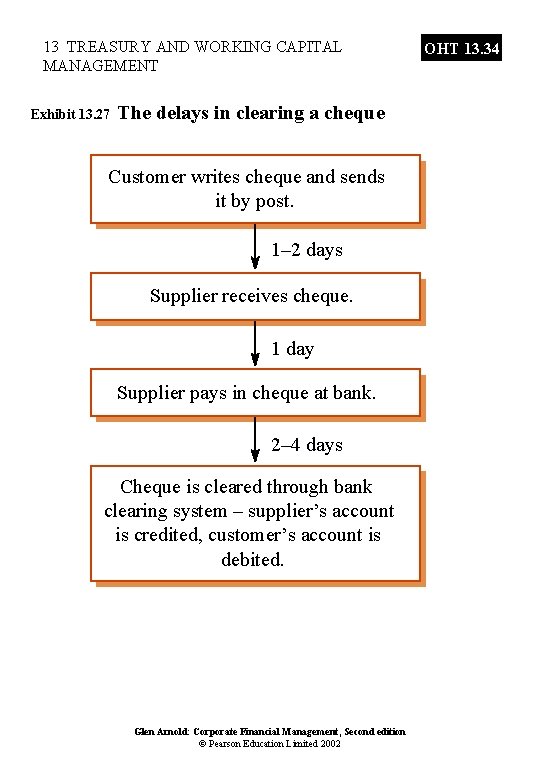
13 TREASURY AND WORKING CAPITAL MANAGEMENT Exhibit 13. 27 The delays in clearing a cheque Customer writes cheque and sends it by post. 1– 2 days Supplier receives cheque. 1 day Supplier pays in cheque at bank. 2– 4 days Cheque is cleared through bank clearing system – supplier’s account is credited, customer’s account is debited. Glen Arnold: Corporate Financial Management, Second edition © Pearson Education Limited 2002 OHT 13. 34
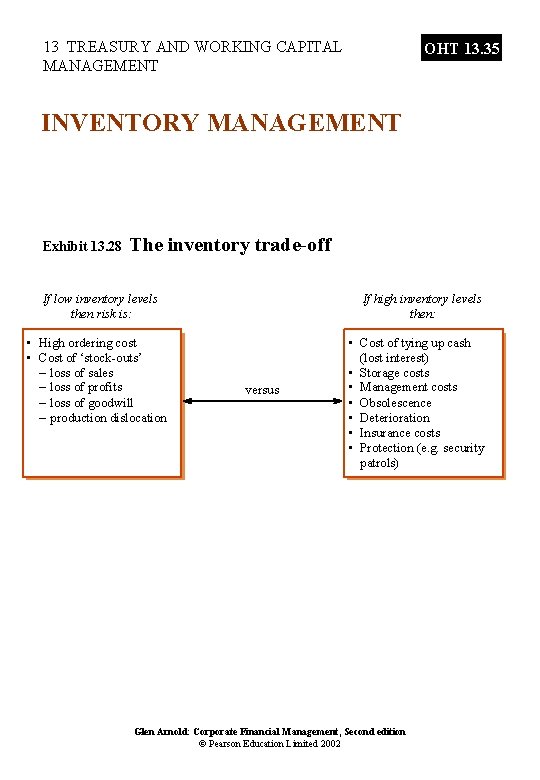
13 TREASURY AND WORKING CAPITAL MANAGEMENT OHT 13. 35 INVENTORY MANAGEMENT Exhibit 13. 28 The inventory trade-off If low inventory levels then risk is: • High ordering cost • Cost of ‘stock-outs’ – loss of sales – loss of profits – loss of goodwill – production dislocation If high inventory levels then: versus • Cost of tying up cash (lost interest) • Storage costs • Management costs • Obsolescence • Deterioration • Insurance costs • Protection (e. g. security patrols) Glen Arnold: Corporate Financial Management, Second edition © Pearson Education Limited 2002
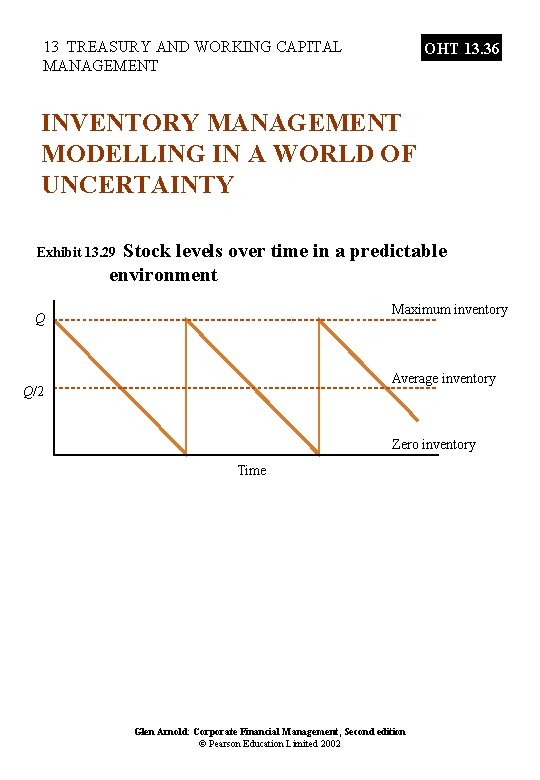
13 TREASURY AND WORKING CAPITAL MANAGEMENT OHT 13. 36 INVENTORY MANAGEMENT MODELLING IN A WORLD OF UNCERTAINTY Stock levels over time in a predictable environment Exhibit 13. 29 Maximum inventory Q Average inventory Q/2 Zero inventory Time Glen Arnold: Corporate Financial Management, Second edition © Pearson Education Limited 2002
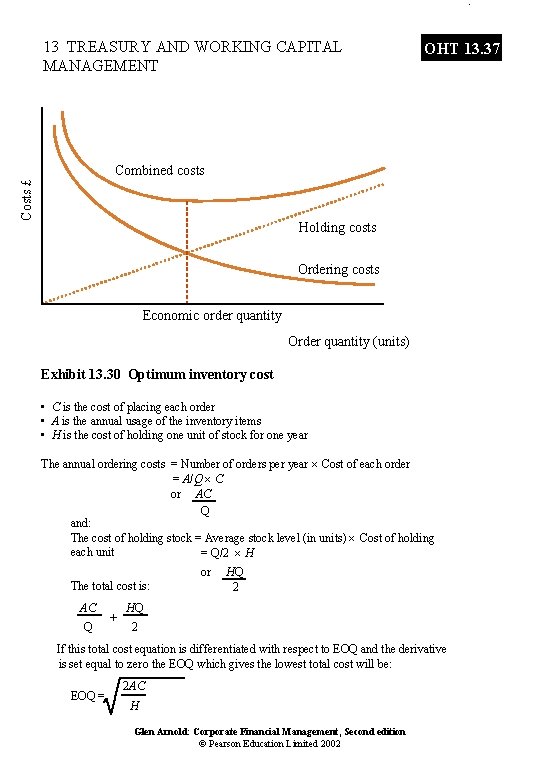
Costs £ 13 TREASURY AND WORKING CAPITAL MANAGEMENT OHT 13. 37 Costs £ Combined costs Holding costs Ordering costs Economic order quantity Order quantity (units) Exhibit 13. 30 Optimum inventory cost • C is the cost of placing each order • A is the annual usage of the inventory items • H is the cost of holding one unit of stock for one year The annual ordering costs = Number of orders per year ´ Cost of each order = A/Q ´ C or AC Q and: The cost of holding stock = Average stock level (in units) ´ Cost of holding each unit = Q/2 ´ H The total cost is: AC Q + or HQ 2 If this total cost equation is differentiated with respect to EOQ and the derivative is set equal to zero the EOQ which gives the lowest total cost will be: EOQ = 2 AC H Glen Arnold: Corporate Financial Management, Second edition © Pearson Education Limited 2002
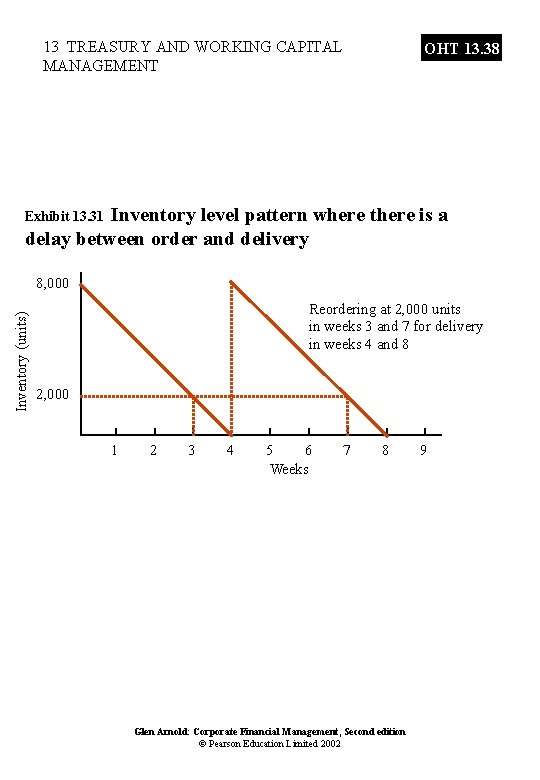
Inventory (units) 13 TREASURY AND WORKING CAPITAL MANAGEMENT OHT 13. 38 Inventory level pattern where there is a delay between order and delivery Exhibit 13. 31 Inventory (units) 8, 000 Reordering at 2, 000 units in weeks 3 and 7 for delivery in weeks 4 and 8 2, 000 1 2 3 4 5 6 Weeks 7 8 Glen Arnold: Corporate Financial Management, Second edition © Pearson Education Limited 2002 9
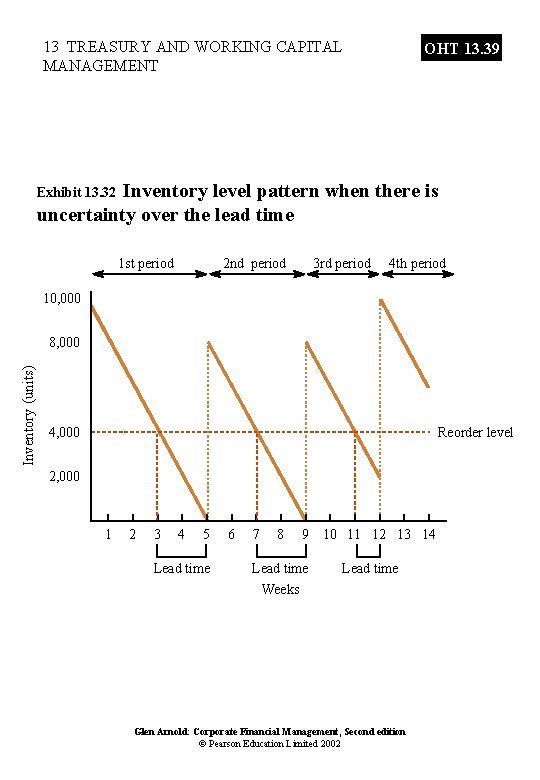
Inventory (units) 13 TREASURY AND WORKING CAPITAL MANAGEMENT OHT 13. 39 Inventory level pattern when there is uncertainty over the lead time Exhibit 13. 32 1 st period 2 nd period 3 rd period 4 th period 10, 000 Inventory (units) 8, 000 4, 000 Reorder level 2, 000 1 2 3 4 5 Lead time 6 7 8 9 10 11 12 13 14 Lead time Weeks Lead time Glen Arnold: Corporate Financial Management, Second edition © Pearson Education Limited 2002
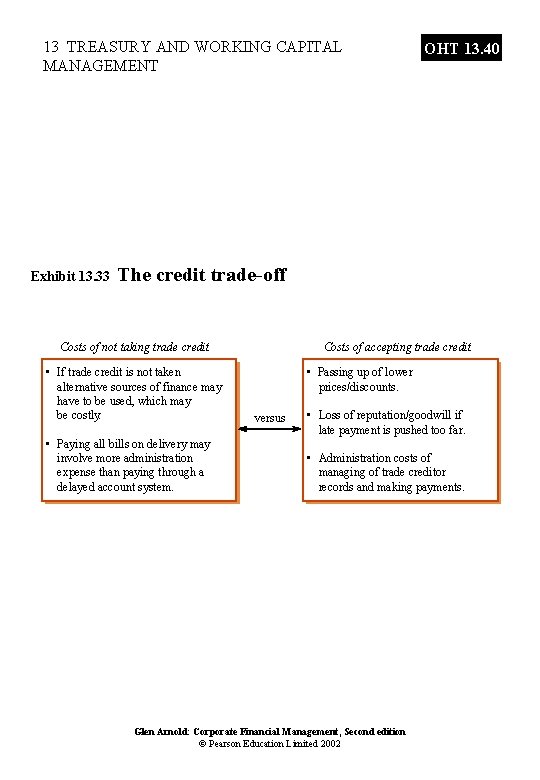
13 TREASURY AND WORKING CAPITAL MANAGEMENT Exhibit 13. 33 OHT 13. 40 The credit trade-off Costs of not taking trade credit • If trade credit is not taken alternative sources of finance may have to be used, which may be costly. • Paying all bills on delivery may involve more administration expense than paying through a delayed account system. Costs of accepting trade credit • Passing up of lower prices/discounts. versus • Loss of reputation/goodwill if late payment is pushed too far. . • Administration costs of managing of trade creditor records and making payments. Glen Arnold: Corporate Financial Management, Second edition © Pearson Education Limited 2002
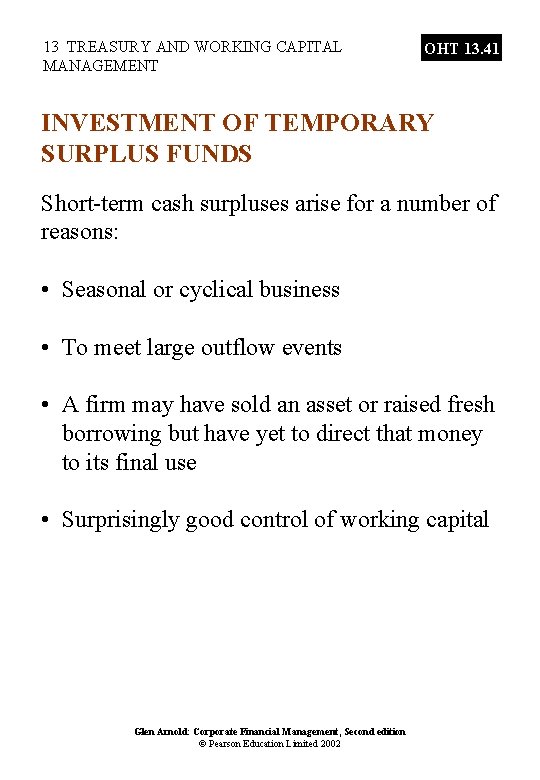
13 TREASURY AND WORKING CAPITAL MANAGEMENT OHT 13. 41 INVESTMENT OF TEMPORARY SURPLUS FUNDS Short-term cash surpluses arise for a number of reasons: • Seasonal or cyclical business • To meet large outflow events • A firm may have sold an asset or raised fresh borrowing but have yet to direct that money to its final use • Surprisingly good control of working capital Glen Arnold: Corporate Financial Management, Second edition © Pearson Education Limited 2002
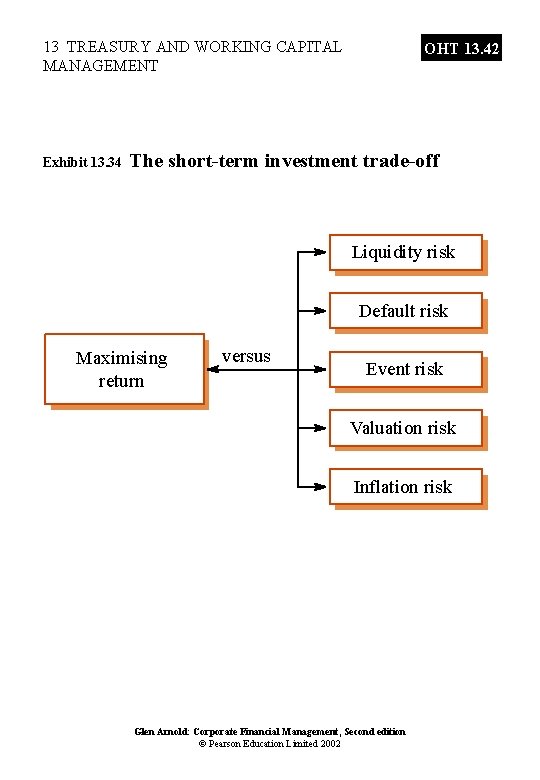
13 TREASURY AND WORKING CAPITAL MANAGEMENT Exhibit 13. 34 OHT 13. 42 The short-term investment trade-off Liquidity risk Default risk Maximising return versus Event risk Valuation risk Inflation risk Glen Arnold: Corporate Financial Management, Second edition © Pearson Education Limited 2002
13 TREASURY AND WORKING CAPITAL MANAGEMENT INVESTMENT POLICY 1 Defining the investable funds 2 Acceptable investment 3 Limits on holdings Glen Arnold: Corporate Financial Management, Second edition © Pearson Education Limited 2002 OHT 13. 43
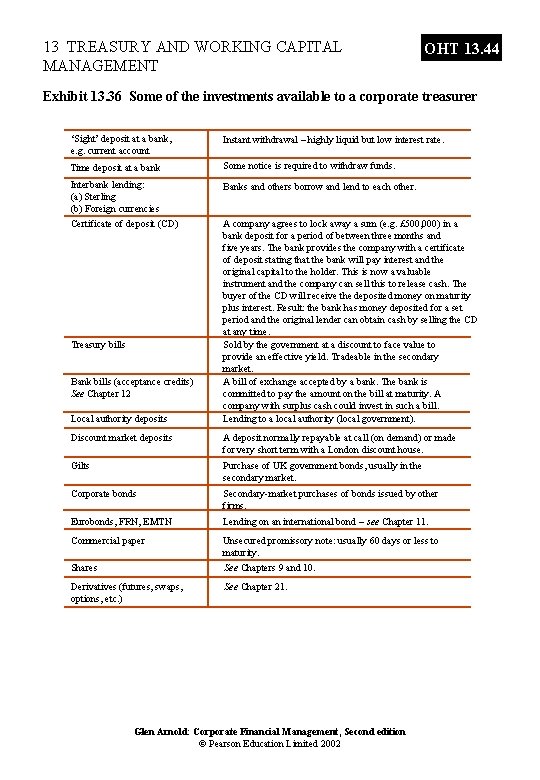
13 TREASURY AND WORKING CAPITAL MANAGEMENT OHT 13. 44 Exhibit 13. 36 Some of the investments available to a corporate treasurer ‘Sight’ deposit at a bank, e. g. current account Instant withdrawal – highly liquid but low interest rate. Time deposit at a bank Some notice is required to withdraw funds. Interbank lending: (a) Sterling (b) Foreign currencies Banks and others borrow and lend to each other. Certificate of deposit (CD) A company agrees to lock away a sum (e. g. £ 500, 000) in a bank deposit for a period of between three months and five years. The bank provides the company with a certificate of deposit stating that the bank will pay interest and the original capital to the holder. This is now a valuable instrument and the company can sell this to release cash. The buyer of the CD will receive the deposited money on maturity plus interest. Result: the bank has money deposited for a set period and the original lender can obtain cash by selling the CD at any time. Sold by the government at a discount to face value to provide an effective yield. Tradeable in the secondary market. A bill of exchange accepted by a bank. The bank is committed to pay the amount on the bill at maturity. A company with surplus cash could invest in such a bill. Lending to a local authority (local government). Treasury bills Bank bills (acceptance credits) See Chapter 12 Local authority deposits Discount market deposits A deposit normally repayable at call (on demand) or made for very short term with a London discount house. Gilts Purchase of UK government bonds, usually in the secondary market. Corporate bonds Secondary-market purchases of bonds issued by other firms. Eurobonds, FRN, EMTN Lending on an international bond – see Chapter 11. Commercial paper Unsecured promissory note: usually 60 days or less to maturity. Shares See Chapters 9 and 10. Derivatives (futures, swaps, options, etc. ) See Chapter 21. Glen Arnold: Corporate Financial Management, Second edition © Pearson Education Limited 2002