
13 PART B The Respiratory System Power Point
13 PART B The Respiratory System Power. Point® Lecture Slide Presentation by Jerry L. Cook, Sam Houston University ESSENTIALS OF HUMAN ANATOMY & PHYSIOLOGY EIGHTH EDITION ELAINE N. MARIEB Copyright © 2006 Pearson Education, Inc. , publishing as Benjamin Cummings
Respiratory Sounds § Sounds are monitored with a stethoscope § Bronchial sounds – produced by air rushing through trachea and bronchi § Vesicular breathing sounds – soft sounds of air filling alveoli Copyright © 2006 Pearson Education, Inc. , publishing as Benjamin Cummings
External Respiration § Oxygen movement into the blood § The alveoli always has more oxygen than the blood § Oxygen moves by diffusion towards the area of lower concentration § Pulmonary capillary blood gains oxygen Copyright © 2006 Pearson Education, Inc. , publishing as Benjamin Cummings
External Respiration § Carbon dioxide movement out of the blood § Blood returning from tissues has higher concentrations of carbon dioxide than air in the alveoli § Pulmonary capillary blood gives up carbon dioxide § Blood leaving the lungs is oxygen-rich and carbon dioxide-poor Copyright © 2006 Pearson Education, Inc. , publishing as Benjamin Cummings
Gas Transport in the Blood § Oxygen transport in the blood § Inside red blood cells attached to hemoglobin (oxyhemoglobin [Hb. O 2]) § A small amount is carried dissolved in the plasma Copyright © 2006 Pearson Education, Inc. , publishing as Benjamin Cummings
Gas Transport in the Blood § Carbon dioxide transport in the blood § Most is transported in the plasma as bicarbonate ion (HCO 3–) § A small amount is carried inside red blood cells on hemoglobin, but at different binding sites than those of oxygen Copyright © 2006 Pearson Education, Inc. , publishing as Benjamin Cummings
Internal Respiration § Exchange of gases between blood and body cells § An opposite reaction to what occurs in the lungs § Carbon dioxide diffuses out of tissue to blood § Oxygen diffuses from blood into tissue Copyright © 2006 Pearson Education, Inc. , publishing as Benjamin Cummings
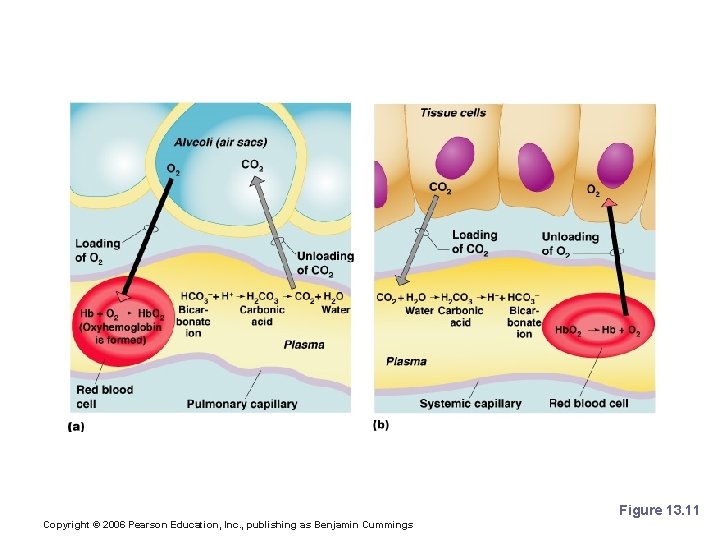
Internal Respiration Figure 13. 11 Copyright © 2006 Pearson Education, Inc. , publishing as Benjamin Cummings
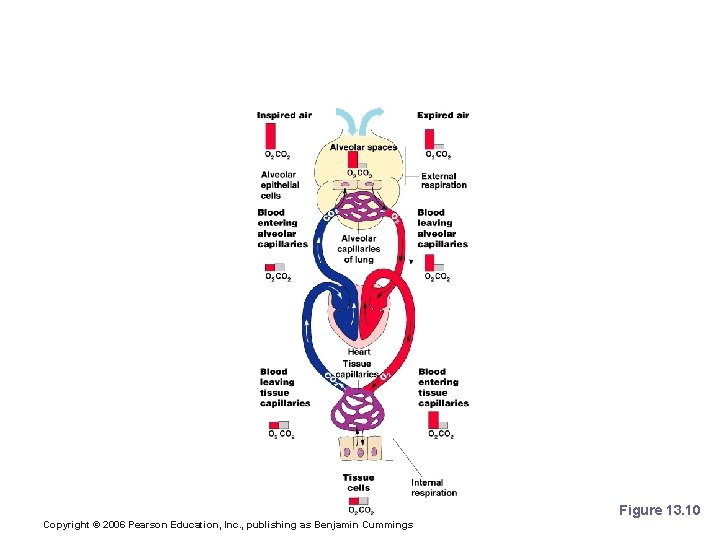
External Respiration, Gas Transport, and Internal Respiration Summary Figure 13. 10 Copyright © 2006 Pearson Education, Inc. , publishing as Benjamin Cummings
Neural Regulation of Respiration § Activity of respiratory muscles is transmitted to the brain by the phrenic and intercostal nerves § Neural centers that control rate and depth are located in the medulla § The pons appears to smooth out respiratory rate § Normal respiratory rate (eupnea) is 12– 15 respirations per minute § Hypernia is increased respiratory rate often due to extra oxygen needs Copyright © 2006 Pearson Education, Inc. , publishing as Benjamin Cummings
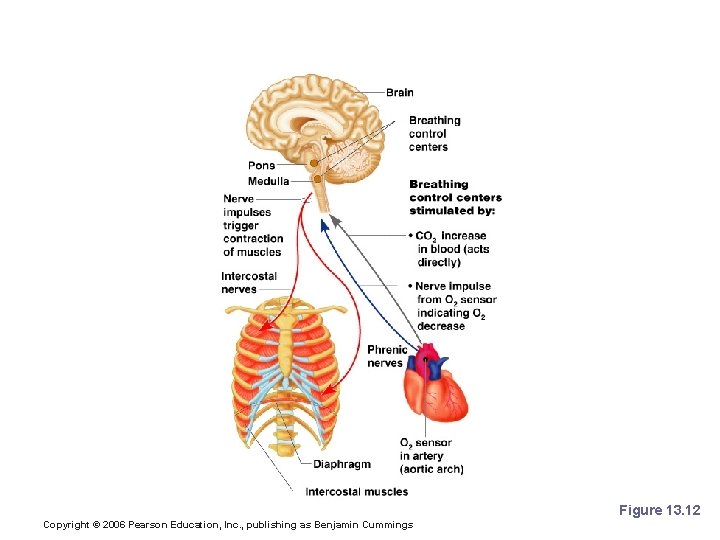
Neural Regulation of Respiration Figure 13. 12 Copyright © 2006 Pearson Education, Inc. , publishing as Benjamin Cummings
Factors Influencing Respiratory Rate and Depth § Physical factors § Increased body temperature § Exercise § Talking § Coughing § Volition (conscious control) § Emotional factors Copyright © 2006 Pearson Education, Inc. , publishing as Benjamin Cummings
Factors Influencing Respiratory Rate and Depth § Chemical factors § Carbon dioxide levels § Level of carbon dioxide in the blood is the main regulatory chemical for respiration § Increased carbon dioxide increases respiration § Changes in carbon dioxide act directly on the medulla oblongata Copyright © 2006 Pearson Education, Inc. , publishing as Benjamin Cummings
Factors Influencing Respiratory Rate and Depth § Chemical factors (continued) § Oxygen levels § Changes in oxygen concentration in the blood are detected by chemoreceptors in the aorta and carotid artery § Information is sent to the medulla oblongata Copyright © 2006 Pearson Education, Inc. , publishing as Benjamin Cummings
Respiratory Disorders: Chronic Obstructive Pulmonary Disease (COPD) § Exemplified by chronic bronchitis and emphysema § Major causes of death and disability in the United States Copyright © 2006 Pearson Education, Inc. , publishing as Benjamin Cummings
Respiratory Disorders: Chronic Obstructive Pulmonary Disease (COPD) § Features of these diseases § Patients almost always have a history of smoking § Labored breathing (dyspnea) becomes progressively more severe § Coughing and frequent pulmonary infections are common Copyright © 2006 Pearson Education, Inc. , publishing as Benjamin Cummings
Respiratory Disorders: Chronic Obstructive Pulmonary Disease (COPD) § Features of these diseases (continued) § Most victimes retain carbon dioxide, are hypoxic and have respiratory acidosis § Those infected will ultimately develop respiratory failure Copyright © 2006 Pearson Education, Inc. , publishing as Benjamin Cummings
Emphysema § Alveoli enlarge as adjacent chambers break through § Chronic inflammation promotes lung fibrosis § Airways collapse during expiration § Patients use a large amount of energy to exhale § Overinflation of the lungs leads to a permanently expanded barrel chest § Cyanosis appears late in the disease Copyright © 2006 Pearson Education, Inc. , publishing as Benjamin Cummings
Chronic Bronchitis § Mucosa of the lower respiratory passages becomes severely inflamed § Mucus production increases § Pooled mucus impairs ventilation and gas exchange § Risk of lung infection increases § Pneumonia is common § Hypoxia and cyanosis occur early Copyright © 2006 Pearson Education, Inc. , publishing as Benjamin Cummings
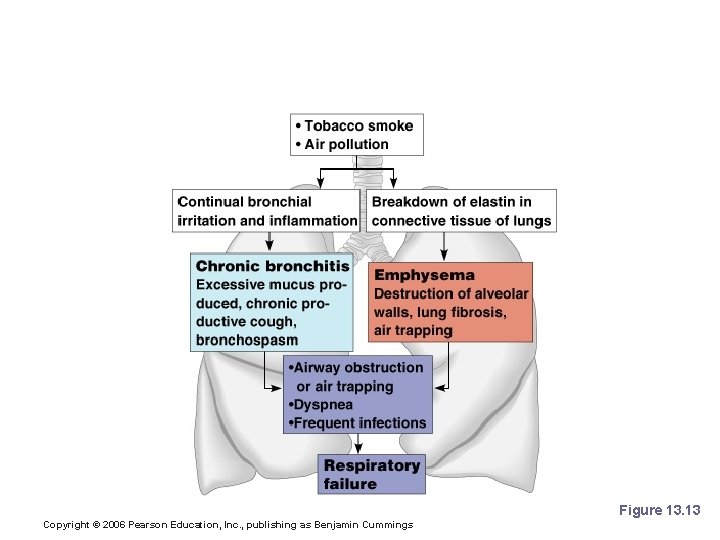
Chronic Obstructive Pulmonary Disease (COPD) Figure 13. 13 Copyright © 2006 Pearson Education, Inc. , publishing as Benjamin Cummings
Lung Cancer § Accounts for 1/3 of all cancer deaths in the United States § Increased incidence associated with smoking § Three common types § Squamous cell carcinoma § Adenocarcinoma § Small cell carcinoma Copyright © 2006 Pearson Education, Inc. , publishing as Benjamin Cummings
Sudden Infant Death syndrome (SIDS) § Apparently healthy infant stops breathing and dies during sleep § Some cases are thought to be a problem of the neural respiratory control center § One third of cases appear to be due to heart rhythm abnormalities Copyright © 2006 Pearson Education, Inc. , publishing as Benjamin Cummings
Asthma § Chronic inflamed hypersensitive bronchiole passages § Response to irritants with dyspnea, coughing, and wheezing Copyright © 2006 Pearson Education, Inc. , publishing as Benjamin Cummings
Developmental Aspects of the Respiratory System § Lungs are filled with fluid in the fetus § Lungs are not fully inflated with air until two weeks after birth § Surfactant that lowers alveolar surface tension is not present until late in fetal development and may not be present in premature babies Copyright © 2006 Pearson Education, Inc. , publishing as Benjamin Cummings
Developmental Aspects of the Respiratory System § Important birth defects § Cystic fibrosis – oversecretion of thick mucus clogs the respiratory system § Cleft palate Copyright © 2006 Pearson Education, Inc. , publishing as Benjamin Cummings
Aging Effects § Elasticity of lungs decreases § Vital capacity decreases § Blood oxygen levels decrease § Stimulating effects of carbon dioxide decreases § More risks of respiratory tract infection Copyright © 2006 Pearson Education, Inc. , publishing as Benjamin Cummings
Respiratory Rate Changes Throughout Life § Newborns – 40 to 80 respirations per minute § Infants – 30 respirations per minute § Age 5 – 25 respirations per minute § Adults – 12 to 18 respirations per minute § Rate often increases somewhat with old age Copyright © 2006 Pearson Education, Inc. , publishing as Benjamin Cummings
- Slides: 27