
13 nave questions about test process deconstruction and

13 naïve questions about test process deconstruction and other paranormal activities by André Cloutier, M. Sc. , PSM, SA

#1 Who am I?
#1 Ok. . . Who am I, really?
#2 Why am I doing this presentation?
Culture, Context and Agility Culture and Context has a huge impact on how agility is lived and understood Inertia (explicit or implicit processes rules, power games, etc. ) is stronger than the Sunny Ways of the Transformation Forces… It’s not different for test activities What can we do? What is acceptable? What about “Agile” purity?
Deconstruction definitions “A way of uncovering the questions behind the answers of a text or tradition” (Paul Ricoeur) (more generally) Analytic examination of something to reveal its inadequacy
Deconstruction. . . exposes core complexities. . . doesn’t always lead to unconditional validation of best practices (aka what-theysay-in-the-book-or-blog-or-youtube). . . is Agile in essence (as Agile practices are themselves countermeasures). . . seeks the counter-intuitive. . . shows that culture of the enterprise just cannot be ignored (as it may inhibit the value of orthodox practices)
Software is Complex (allow enabling constraints) not Complicated (require governing constraints). Dave Snowden - Cynefin “If you don’t understand why, you can’t adapt” Dave Snowden - Cynefin
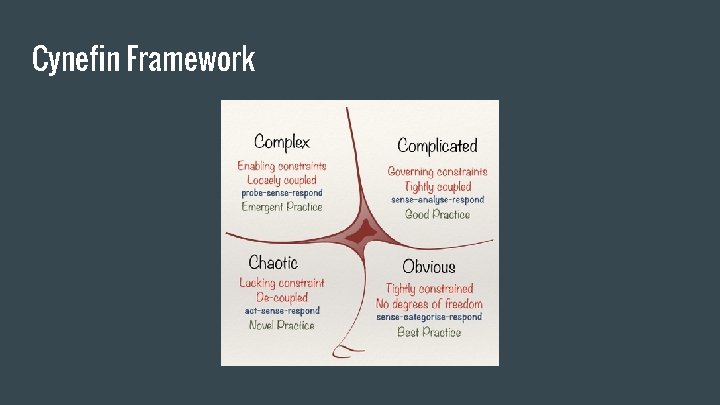
Cynefin Framework
#3 Chris, why do you write all those Story Tests upfront ?
Orthodoxy If you are going to test something and document those tests, it costs no more to document the tests up front than it does to document them at the end. But these are more than just tests (Pugh) Sutherland considers ATDD doubles productivity
Some considerations ATDD Hypothesis: Quality (through better specs) is higher, so waste is avoided Assumes high collaboration How much time could be saved otherwise though? Working Software “Often, you don’t really know exactly what you want until you can see, feel, touch and use it. “ (Crispin and Gregory) [Manifesto] Working Product over Comprehensive Documentation Variability Product can change during the sprint (e. g. analogy on a different scale with BDUF)
Conclusions Orthodox Consider Acceptance Tests as a way to increase communication with the Customer (“Triad”) Lean - Transparency Mature culture without silos gets the full benefits Push System for authoring Heretic Focus to the extreme on Exploratory testing, become an expert (through empirical experience) on the feature, write only the optimal set of regression tests after See ATDD as BDUF!
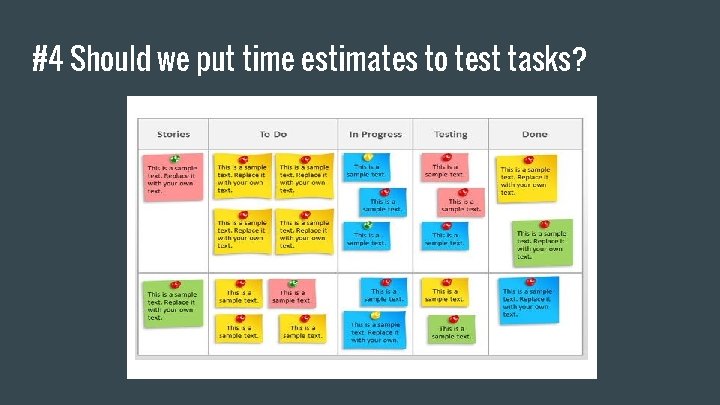
#4 Should we put time estimates to test tasks?

Orthodoxy Testing is just a “state” isn’t it?
Some considerations For teams using time estimates for development tasks Frequent complaints about dysfunctional accumulation of the functional test effort at the end of the sprint, especially if stories tend to be big For burndown charts based on dev hours Subtasks have time estimates Subtask ownership issue Bottlenecks are frequent (and hard to predict or avoid), so blocking time for testing may. . . help sprint delivery. . . protect QA teams’ weekends
Conclusions If testing is a Task, not just a State Burndown Red Flags come earlier Bottlenecks are easier to identify Acting upon unrealistic plans can be done quicker Basically all tasks (dev + qa) are estimated independently
#5 Can Automation of a Product itself be a Product?

Orthodoxy No
#5 (retry) … or “Managed like a different product”?
Orthodoxy No, you keep asking weird questions. I hate you.
Heterodox argumentation For Stories Sx and Sy Effort for Sx: Is Automation > Dev ? Priority for Sx: Is Automation != Dev ? Quality Risk: Sx > Sy ? “Productish” then? Requires planning and prioritization (project and product management) Helps eliminating noise What do you do if you can’t keep the pace imposed by dev?
Conclusions Options Synchronous (Push) - within Story / Sprint Asynchronous (Pull) - within Sprint / Release Put devs to work (Pull) Maintenance anyone? When needs for fixing older tests collides with newer ones Prioritization gets messy (and not even visible) You can easily get overwhelmed
#6 Should Automation be on Stories or Features?
Orthodoxy For functional tests, automation is at the Story level. Timebox is the Sprint. Some non-functional tests may fit better at the Program level, so more likely outside the scope of the Story.
Some considerations Wait or Waste. . . The feature keeps evolving across Sprints Will those tests still be valid later? What is the Cost of Delay? What is the cost of simply not doing it? It could happen if the priority is very low or relatively low Key point: flexibility in planning (not advocating laziness!) “done” for the Release instead of the “Sprint”
Conclusions Story’s scope is the sprint (e. g. 2 weeks) Feature’s scope is the release (e. g. 3 months) Different Do. Ds! Flexibility and Pull
#7 “A Test Case is a Test Case”. . . What? ?
Orthodoxy Of course a Test Case is a Test Case! You write the test case, then you automate it, and then you check the box that says “automated”. Easy. You eventually reach 100% and get a bonus if you do so. No. . . you should not automate everything. You know. . . some stuff is hard. But, you should automate a lot of your Test Cases though.
Some considerations I’ve heard way too many times that a Manual Test case and it’s Automated counterpart are “equivalent”, with all the weird consequences it can bring You automate your test and add the checkbox “automated” In practice, a lot of implicit checks are made in manual testing Problems that are naturally Data-driven. Cannot be “translated” directly from a manual TC The source of Automated TCs can not be the Manual TCs
Conclusions Two independent suites with different goals where duplication is tolerable No need to be manichean. . . No need to choose between Good (Automation) and Evil (Manual) Occasional grooming is good enough What if. . . your automation works poorly and you don’t have anything in your manual regression? you want/need to outsource your manual regression? Can you guarantee that the automated tests are a valid replacement?
#8 What is your automation coverage (in %)?
Orthodoxy I think your M. Sc. in Mathematics was illegally obtained. So… “A / (M+A) * 100. 0” Bingo. . .
Some considerations Different Missions require different Workflows How many fruits? Like counting and comparing apples and blackberries. . . Data-Driven tests may have lots of individual cases and create distortion Anti-pattern: “Management by objectives”
Conclusions It’s a dumb metric It implies that both Manual and Automated TC are in the same pool, on the same scale, on the same planet. . . It’s pervert… It doesn’t value quality of the selection of tests It causes “automation blitz” to occur to get quickly to a higher percentage It favors “quantity” over “quality” Replacements?
#9 How can the resources efficiency be maximized?
(Agile Principle) Simplicity—the art of maximizing the amount of work not done—is essential.
Basically. . . Test the implemented stories Practice dissection on everything else Put all remaining work in queues! Keep it visible, where higher/lower priority is clearly distinguishable
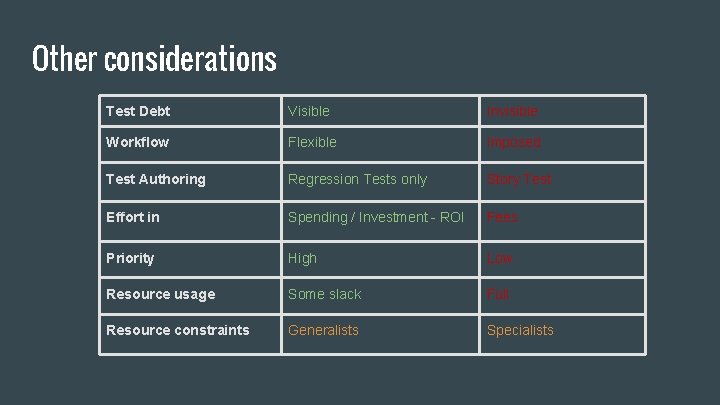
Other considerations Test Debt Visible Invisible Workflow Flexible Imposed Test Authoring Regression Tests only Story Test Effort in Spending / Investment - ROI Fees Priority High Low Resource usage Some slack Full Resource constraints Generalists Specialists
#10 Do. D of Sprint or Release?
QA fully owns the last hour of the sprint… Sprint boundaries are working well for development, but puts artificial pressure on QA. Scrum is cool, but the transaction cost of closing the sprint makes QA suboptimal in both manual and automated testing activities. Fixing the boundary to the Sprint excludes certain flexible workflows Do. D of Story or Feature? Similar question. Do before or do after? Synchronous or asynchronous?
#11 Does it smell like conclusion is coming ?
Beware of anti-patterns (smells)! Creativity is not limited, but supervised when you are aware of anti-patterns Anti-pattern examples Big Design Up Front (BDUF) - false sense of security Not Invented Here - false sense of independence One Size Fits All - false sense of control Ask yourself if you are anti-patterning!
Rules I try to follow Don’t do things differently just to do differently (avoid chaos of egos) Do things differently just to do differently (avoid fatigue, you dig? ) If orthodoxy is costly, useless or sub-optimal: adapt rationally with coherence Other smart people have usually thought about this problem before. . .
Fundamentally. . . Use independent queues for all aspects of the work where it’s possible Cut the work in independent pieces to see where the time is spent (where time can be saved!) Unless you release at every sprint, consider the transaction cost of closing all your testing tasks at every sprint, targeting the release may significantly improve the productivity
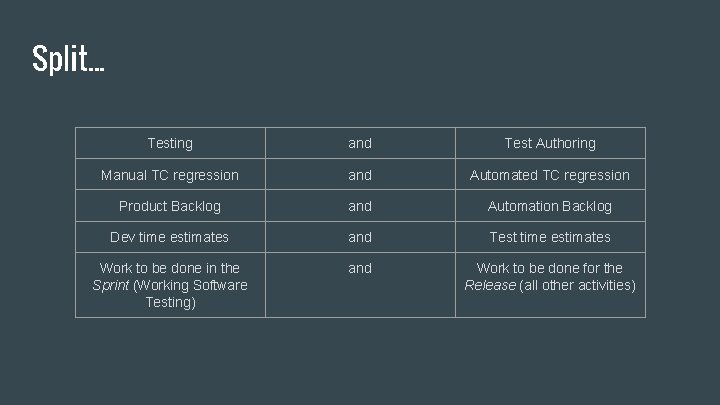
Split. . . Testing and Test Authoring Manual TC regression and Automated TC regression Product Backlog and Automation Backlog Dev time estimates and Test time estimates Work to be done in the Sprint (Working Software Testing) and Work to be done for the Release (all other activities)
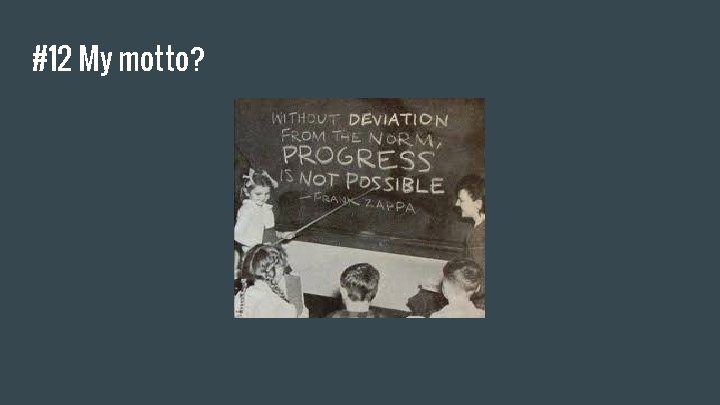
#12 My motto?
#13 Questions? Thank you!
- Slides: 48