
13 Colonies and the Revolutionary War 13 Colonies





- Slides: 34
13 Colonies and the Revolutionary War
13 Colonies and the Revolutionary War Essential Questions: What brings people to revolution? How was the war for independence inevitable*? What are the responsibilities of government to the people?
Essential Vocabulary Revolution: an uprising of a group to forcibly overthrow a government or social order Boycotts: a refusal to buy or handle (goods) as a protest Territories: an area of land under the rule of another country, state, or rulerdepend on another government but has some freedoms of their own Debt: Parliament: Prime Minister:
Vocabulary Continued Revenue: Repeal: Representation: Settlement: Treaty:
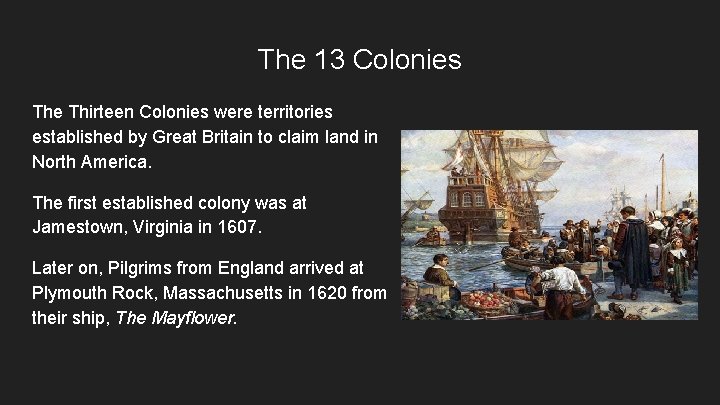
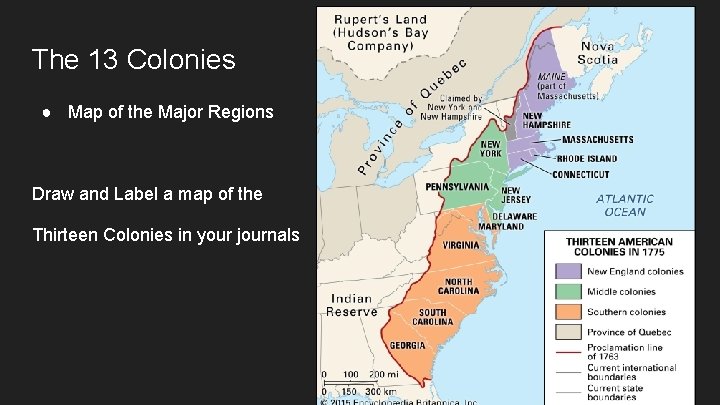
The 13 Colonies The Thirteen Colonies were territories established by Great Britain to claim land in North America. The first established colony was at Jamestown, Virginia in 1607. Later on, Pilgrims from England arrived at Plymouth Rock, Massachusetts in 1620 from their ship, The Mayflower.
The 13 Colonies ● Map of the Major Regions Draw and Label a map of the Thirteen Colonies in your journals
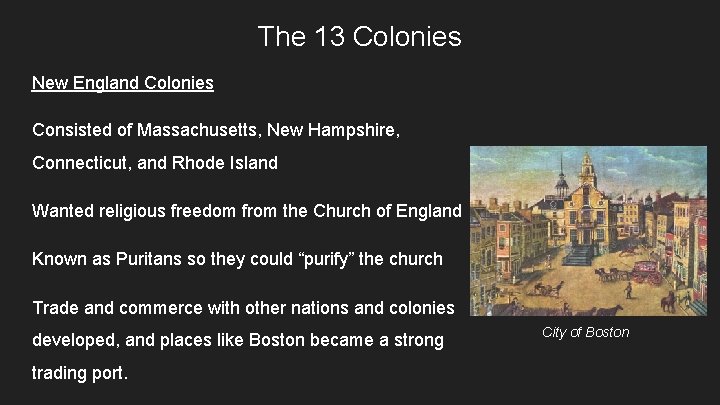
The 13 Colonies New England Colonies Consisted of Massachusetts, New Hampshire, Connecticut, and Rhode Island Wanted religious freedom from the Church of England Known as Puritans so they could “purify” the church Trade and commerce with other nations and colonies developed, and places like Boston became a strong trading port. City of Boston
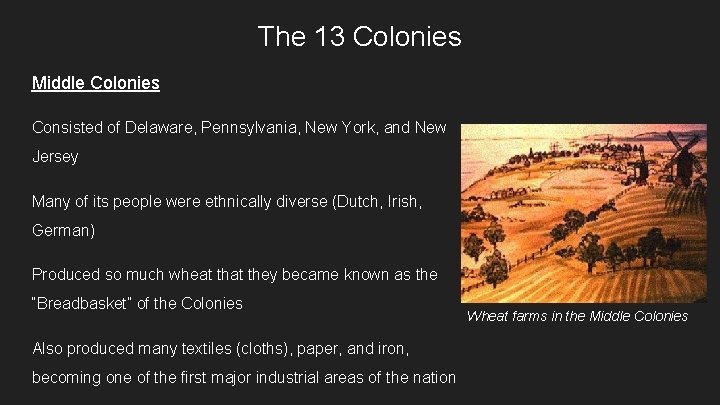
The 13 Colonies Middle Colonies Consisted of Delaware, Pennsylvania, New York, and New Jersey Many of its people were ethnically diverse (Dutch, Irish, German) Produced so much wheat they became known as the “Breadbasket” of the Colonies Also produced many textiles (cloths), paper, and iron, becoming one of the first major industrial areas of the nation Wheat farms in the Middle Colonies
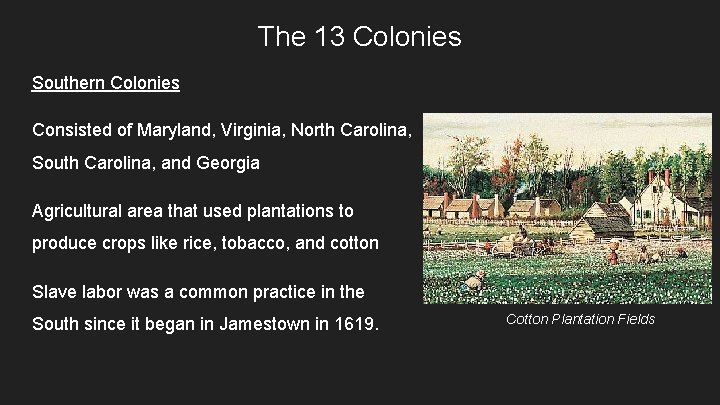
The 13 Colonies Southern Colonies Consisted of Maryland, Virginia, North Carolina, South Carolina, and Georgia Agricultural area that used plantations to produce crops like rice, tobacco, and cotton Slave labor was a common practice in the South since it began in Jamestown in 1619. Cotton Plantation Fields
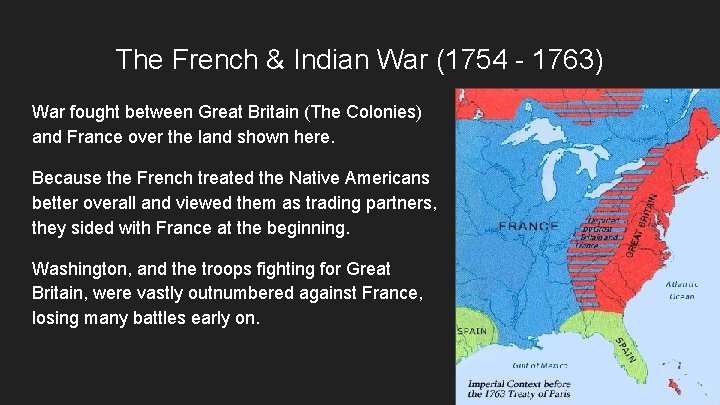
The French & Indian War (1754 - 1763) War fought between Great Britain (The Colonies) and France over the land shown here. Because the French treated the Native Americans better overall and viewed them as trading partners, they sided with France at the beginning. Washington, and the troops fighting for Great Britain, were vastly outnumbered against France, losing many battles early on.
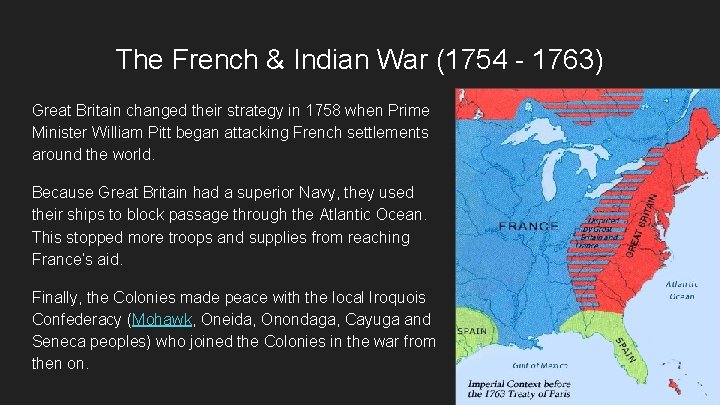
The French & Indian War (1754 - 1763) Great Britain changed their strategy in 1758 when Prime Minister William Pitt began attacking French settlements around the world. Because Great Britain had a superior Navy, they used their ships to block passage through the Atlantic Ocean. This stopped more troops and supplies from reaching France’s aid. Finally, the Colonies made peace with the local Iroquois Confederacy (Mohawk, Oneida, Onondaga, Cayuga and Seneca peoples) who joined the Colonies in the war from then on.
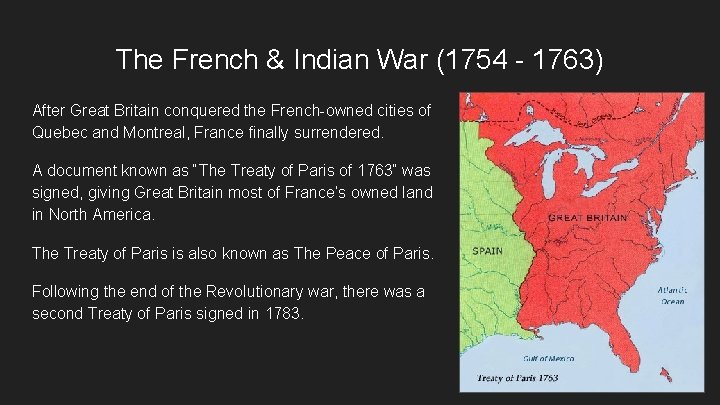
The French & Indian War (1754 - 1763) After Great Britain conquered the French-owned cities of Quebec and Montreal, France finally surrendered. A document known as “The Treaty of Paris of 1763” was signed, giving Great Britain most of France’s owned land in North America. The Treaty of Paris is also known as The Peace of Paris. Following the end of the Revolutionary war, there was a second Treaty of Paris signed in 1783.
Causes of the Revolutionary War King George III of Britain had an enormous debt to pay off because of the French and Indian War. Different taxes like the Quartering, Townshend, Stamp, Sugar, and Tea Act were placed on the Colonies specifically to help pay off the war. More importantly, the Colonies had no one to represent them in British Parliament when these laws and taxes were created.
Sugar Act of 1764 Increased taxes on Sugar, Molasses, and many other imports brought into the Colonies Imports: Trading goods/materials that are brought in from other areas around the world to a single place like the Colonies. Although the impact of the Sugar Act was low, many Colonists began to protest Britain’s decision to place taxes on them without their knowing or say so. The phrase “No Taxation Without Representation” was coined in 1750 and adapted by James Otis to say, “Taxation Without Representation is Tyranny!”
Stamp Act of 1765 Increased taxes on nearly every piece of printed paper used by the Colonists, including playing cards, licenses, newspapers, and other legal documents. In addition to complaining to British Parliament about the taxes, some Colonists used physical violence to keep the tax money from being collected. The Stamp Act was considered a lost cause and repealed in 1766.
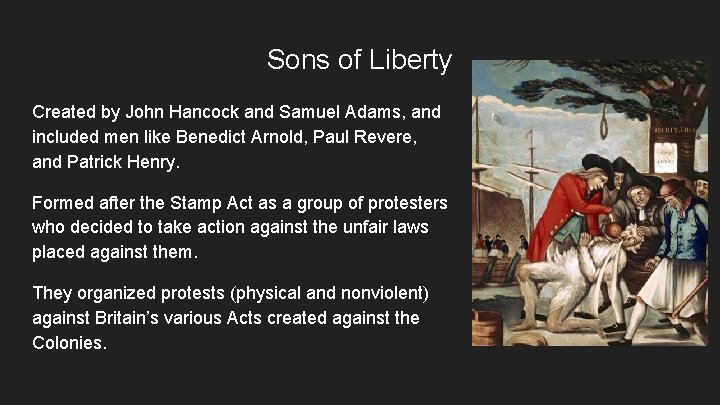
Sons of Liberty Created by John Hancock and Samuel Adams, and included men like Benedict Arnold, Paul Revere, and Patrick Henry. Formed after the Stamp Act as a group of protesters who decided to take action against the unfair laws placed against them. They organized protests (physical and nonviolent) against Britain’s various Acts created against the Colonies.
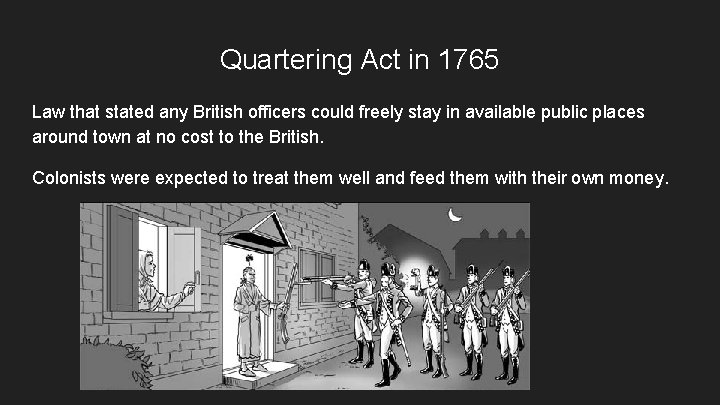
Quartering Act in 1765 Law that stated any British officers could freely stay in available public places around town at no cost to the British. Colonists were expected to treat them well and feed them with their own money.
Townshend Act of 1767 Established by Charles Townshend, the man in charge of collecting British money from the places that owed Britain money. This act taxed essential goods to the Colonies such as paint, paper, glass, lead, and tea. The money collected would be used to pay for the jobs of British Governors. After more protests and suspicion, almost every part of the Townshend Act was repealed except for the tax on tea.
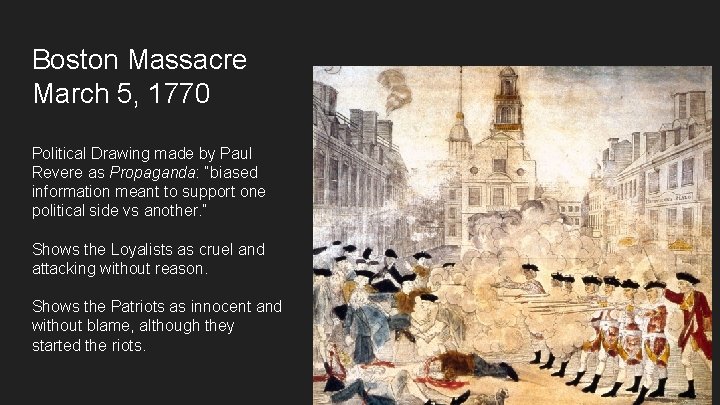
Boston Massacre March 5, 1770 Began as 2, 000 British soldiers occupied Boston’s town of 16, 000 Colonists. Brief arguments and fights between the Patriots (Colonists) and British (Loyalists) were becoming more common - The Sons of Liberty were also stirring up trouble as well. During this riot, things went too far, and British soldiers fired on the Colonists, killing 5 and wounding 6 others. Both sides later wrote their own versions of the story, one by a British officer who was there and the other by Paul Revere. History Channel - Boston Massacre (Video and Article)
Boston Massacre March 5, 1770 Political Drawing made by Paul Revere as Propaganda: “biased information meant to support one political side vs another. ” Shows the Loyalists as cruel and attacking without reason. Shows the Patriots as innocent and without blame, although they started the riots.
Tea Act of 1773 An act that gave the East India Company, a private trade group with strong ties to England, the chance to go straight to the Colonies and sell tea for very cheap. Although it was meant to help Britain’s trading partner, this Act should have had the result of making the Colonists happy while also saving the E. I. C. from going bankrupt (having no more money to use in their business). However, because the East India Company could sell tea so cheaply, local merchants who sold their own tea (remember it’s still taxed) in the Colonies were now losing even more business. This Act, combined with the Boston Massacre, largely inspired the Boston Tea Party.
Boston Tea Party December 16, 1773 Took place at Griffin’s Wharf aboard the three ships the Dartmouth, Beaver, and Eleanor. The Sons of Liberty dressed themselves in disguise as Native Americans during the night and spent nearly three hours emptying the tea into Boston Harbor. The chests held more than 90, 000 lbs. (45 tons) of tea, which would cost nearly $1, 000 dollars today.
Boston Tea Party December 16, 1773 Although the Sons of Liberty’s actions pleased many of the Colonists, some like George Washington and Benjamin Franklin thought the East India Company should be refunded for the tea that was lost. Although no one was hurt, King George III was furious, and created a new law known as the Coercive Acts, also known later on as the Intolerable Acts.
Coercive Acts of 1774 5 Different Acts combined in one meant as retaliation for the Boston Tea Party. Boston Port Act - closed Boston Harbor until all the tea was paid for. Massachusetts Government Act - Massachusetts could no longer choose their own leaders; a loyal, British governor was now put in place. Administration of Justice Act - Any trials would be handled only by the British. Quartering Act - Similar to the old Quartering Act, except now Colonists would be forced to make their personal homes available whenever needed. Quebec Act - British territory is expanded into the Ohio Valley where Catholicism is made an official religion.
First Continental Congress Because of the Coercive Acts, a second Boston Tea Party event happened, although with much smaller impacts. Other similar events happened in Maryland, New York, and South Carolina. The Acts also led to Colonists uniting in what became known as the First Continental Congress. On September 5, 1774, chosen members from most of the Colonies met in Philadelphia for the First Continental Congress to figure out how to resist the British government.
First Continental Congress Major leaders like the soon-to-be Presidents George Washington and John Adams attended. The members gave all participants equal treating, and after long debates decided they would still be loyal to Britain but only if Britain ended their taxes. It was decided that the Colonies would stop importing British goods if the Coercive Acts were not repealed soon. They agreed to meet again on May 10, 1775 to decide future actions.
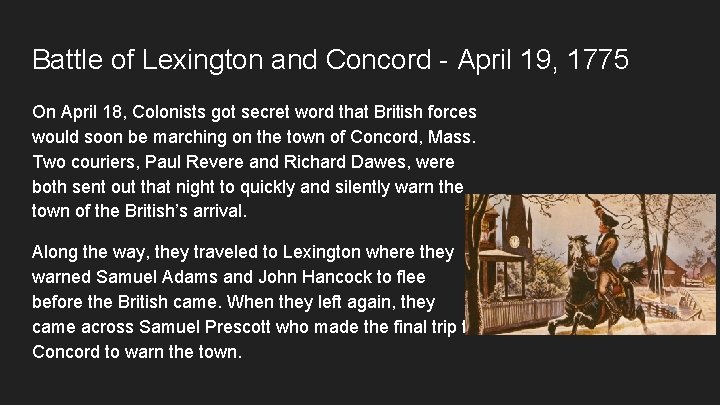
Battle of Lexington and Concord - April 19, 1775 On April 18, Colonists got secret word that British forces would soon be marching on the town of Concord, Mass. Two couriers, Paul Revere and Richard Dawes, were both sent out that night to quickly and silently warn the town of the British’s arrival. Along the way, they traveled to Lexington where they warned Samuel Adams and John Hancock to flee before the British came. When they left again, they came across Samuel Prescott who made the final trip to Concord to warn the town.
Battle of Lexington and Concord - April 19, 1775 By the time 700 British officers stormed into Concord, there were roughly 77 Minutemen (civilian soldiers) waiting to attack. Nobody knows who fired the first shot, but after the first round of gunfire, 8 Minutemen were dead, 9 wounded, and only a single British soldier was down. “Shot Heard ‘Round the World” was the official start of the Revolutionary War. Despite this, the Minutemen kept fighting, and more joined them throughout the day, ambushing the British as they tried to return to Boston. By the end of the day, the Colonists had won with 250 British soldiers down compared to only 90 Colonists. History Channel - Battle of Lexington and Concord (video)
Second Continental Congress
Battle at Saratoga Considered largely the turning point of the Revolutionary War France decides to aid the Colonies against Britain
Kings Mountain
Battle at Yorktown
Women and Minorities Daughters of Liberty
Famous Leaders George Washington - First President of the United States of America. Famous for his role in the Revolutionary War. Benjamin Franklin King George III - British King known for imposing many of the taxes against the Colonies and leading the British during the Revolutionary War. Patrick Henry Samuel Adams Paul Revere - Famous for his ride and giving warning that the British were soon to arrive.