
13 Acquiring Information Systems and Applications 1 Discuss
- Slides: 29
13 Acquiring Information Systems and Applications
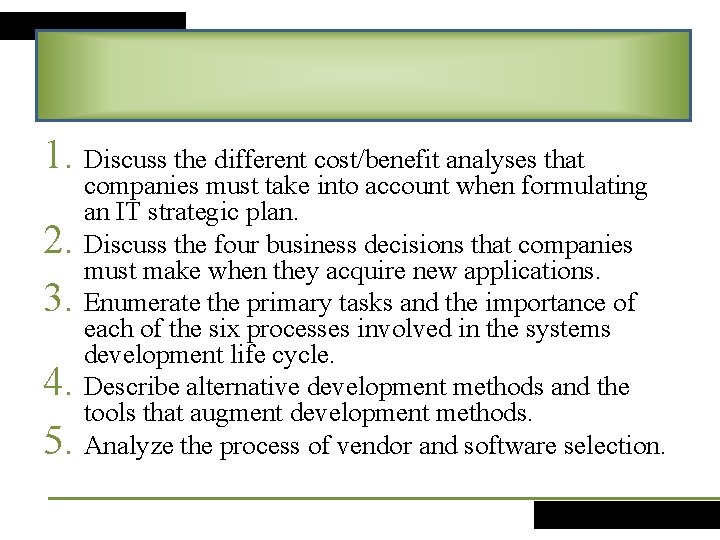
1. Discuss the different cost/benefit analyses that 2. 3. 4. 5. companies must take into account when formulating an IT strategic plan. Discuss the four business decisions that companies must make when they acquire new applications. Enumerate the primary tasks and the importance of each of the six processes involved in the systems development life cycle. Describe alternative development methods and the tools that augment development methods. Analyze the process of vendor and software selection.
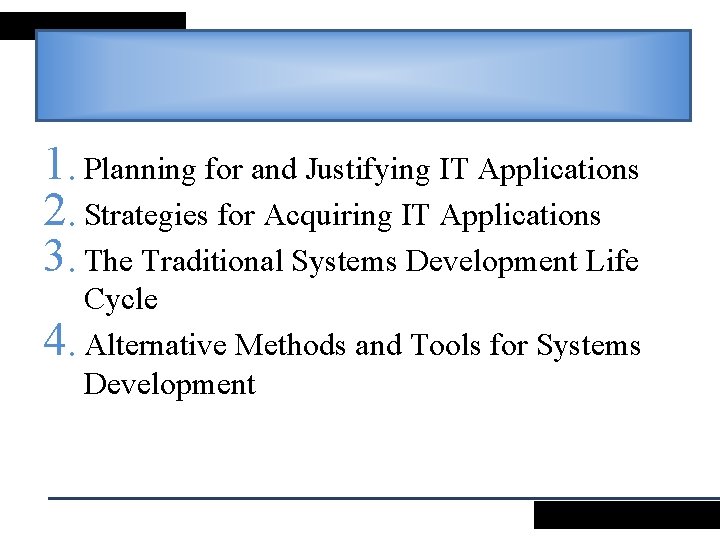
1. Planning for and Justifying IT Applications 2. Strategies for Acquiring IT Applications 3. The Traditional Systems Development Life Cycle 4. Alternative Methods and Tools for Systems Development
[ Opening Case Tweak or Trash ] • • The Problem The Solution The Results What We Learned from This Case
[about business] 13. 1 Anniston Orthopedics and Greenway Medical Technologies
13. 1 Planning for and Justifying IT Applications • IT Planning • Evaluating and Justifying IT Investment: Benefits, Costs, and Issues
IT Planning • Organizational Strategic Plan • IT Architecture • IT Strategic Plan
IT Strategic Plan • Must meet three main objectives – It must be aligned with the organization’s strategic plan – It must provide for an IT architecture that seamlessly networks users, applications, and databases – It must efficiently allocate IS development resources among competing projects so the projects can be completed on time an within budget and still have the required functionality • • IT Steering Committee Typical IS Operational Plan Contains the Following Elements: – – – Mission IS environment Objectives of the IS Function Constraints of the IS Function The application portfolio Resource allocation and project management
Three Main Objectives of IT Strategic Plan • It must be aligned with the organization’s strategic plan • It must provide for an IT architecture that seamlessly networks users, applications, and databases • It must efficiently allocate IS development resources among competing projects so the projects can be completed on time an within budget and still have the required functionality
A Typical IS Operational Plan Includes: • • • Mission Statement IS environment Objectives of the IS Function Constraints of the IS Function The application portfolio Resource allocation and project management
Evaluating and Justifying IT Investment: Benefits, Costs, and Issues • Assessing the Costs • Assessing the Benefits • Conducting the Cost-Benefit Analysis
Four Common Approaches to Cost-Benefit Analysis • • Analysts use the net present value (NPV) Return on Investment (ROI) Breakeven analysis Business case approach
13. 2 Strategies for Acquiring IT Applications • Fundamental Decisions in Acquiring IT Applications • Purchase a Prewritten Application • Customize a Prewritten Application • Lease the Application • Application Service Providers and Software-as-a. Service Vendors • Use Open-Source Software • Outsourcing • Employ Custom Development
Fundamental Decisions in Acquiring IT Applications • How much computer code does the company want to write? • How will the company pay for the application? • Where will the application run? • Where will the application originate?
Application Service Providers and Software-as-a-Service • Application service provider (ASP) • Software-as-a-service (Saa. S)
[about business] 13. 2 A Disastrous Development Project
[about business] 13. 3 General Motors Insources Its Information Technology Function
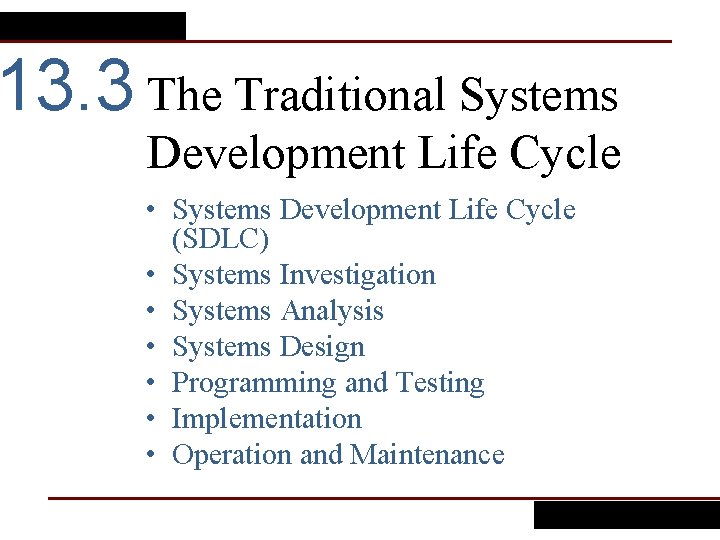
13. 3 The Traditional Systems Development Life Cycle • Systems Development Life Cycle (SDLC) • Systems Investigation • Systems Analysis • Systems Design • Programming and Testing • Implementation • Operation and Maintenance
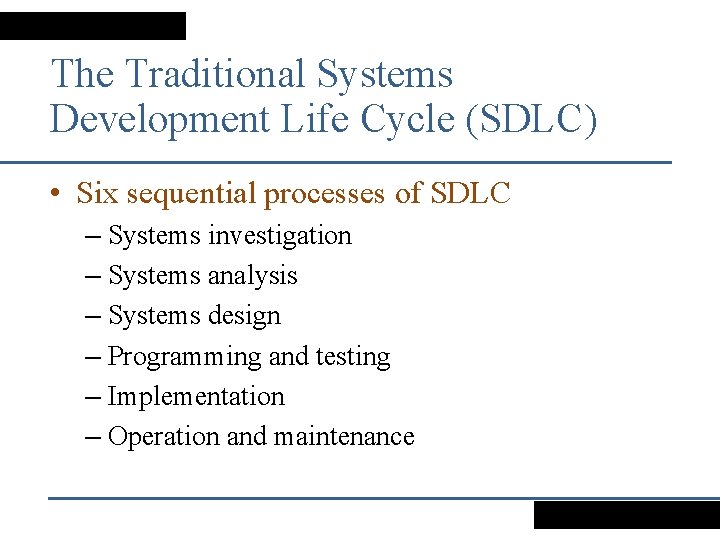
The Traditional Systems Development Life Cycle (SDLC) • Six sequential processes of SDLC – Systems investigation – Systems analysis – Systems design – Programming and testing – Implementation – Operation and maintenance
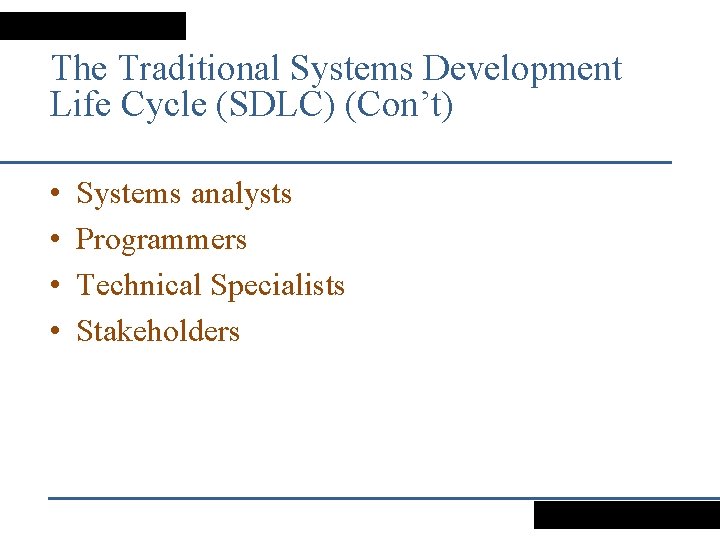
The Traditional Systems Development Life Cycle (SDLC) (Con’t) • • Systems analysts Programmers Technical Specialists Stakeholders
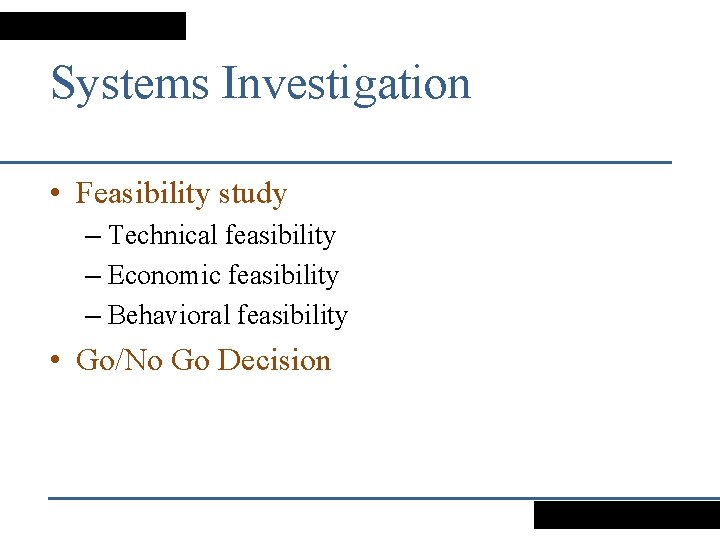
Systems Investigation • Feasibility study – Technical feasibility – Economic feasibility – Behavioral feasibility • Go/No Go Decision
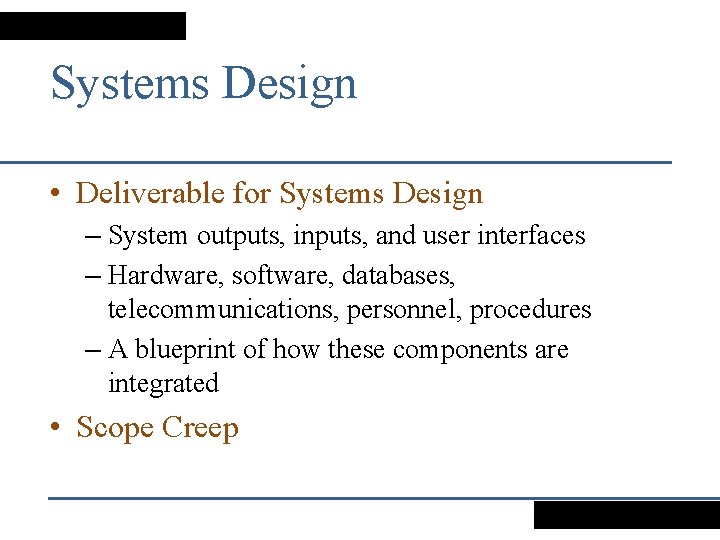
Systems Design • Deliverable for Systems Design – System outputs, inputs, and user interfaces – Hardware, software, databases, telecommunications, personnel, procedures – A blueprint of how these components are integrated • Scope Creep
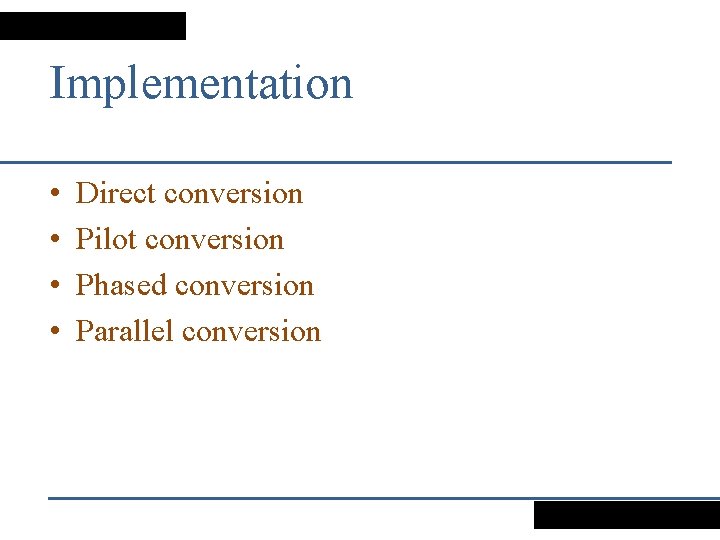
Implementation • • Direct conversion Pilot conversion Phased conversion Parallel conversion
[about business] 13. 4 Atlassian Helps Manage Large
[about business] 13. 5 Virgin America Has Problems Converting to a New Reservation System
Methods and Tools 13. 4 Alternative for Systems Development • Joint Application Design (JAD) • Rapid Application Development (RAD) • Agile Development • End-User Development • Tools for Systems Development
Tools for Systems Development • Prototyping • Integrated Computer-Assisted Software Engineering Tools (CASE) • Component-Based Development • Object-Oriented Development
[about business] 13. 6 GE Healthcare Switches from Waterfall to Agile
[ Closing Case Putting It All Together ] • The Problem • The Solution • The Results