
13 2 Forces and Pressure in Fluids The

- Slides: 20
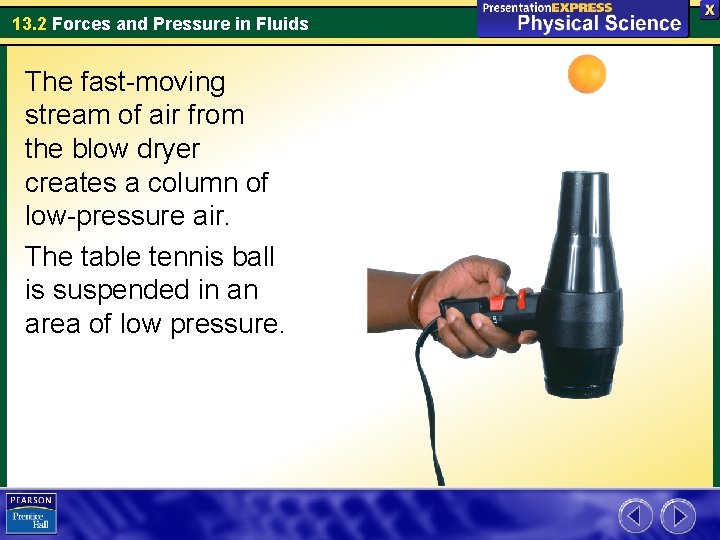
13. 2 Forces and Pressure in Fluids The fast-moving stream of air from the blow dryer creates a column of low-pressure air. The table tennis ball is suspended in an area of low pressure.
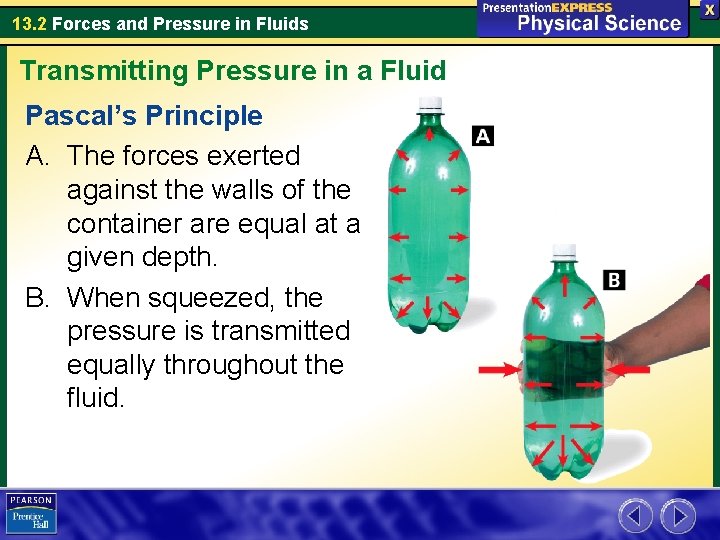
13. 2 Forces and Pressure in Fluids Transmitting Pressure in a Fluid How does Pascal’s principle describe the transmission of pressure through a fluid? According to Pascal’s principle, a change in pressure at any point in a fluid is transmitted equally and unchanged in all directions throughout the fluid.
13. 2 Forces and Pressure in Fluids Transmitting Pressure in a Fluid Pascal’s Principle A. The forces exerted against the walls of the container are equal at a given depth. B. When squeezed, the pressure is transmitted equally throughout the fluid.
13. 2 Forces and Pressure in Fluids Transmitting Pressure in a Fluid At any given depth, equal pressures act against all points on the inside of the bottle. When the bottle is squeezed, the pressure still increases with depth. The pressure increases equally throughout the water.
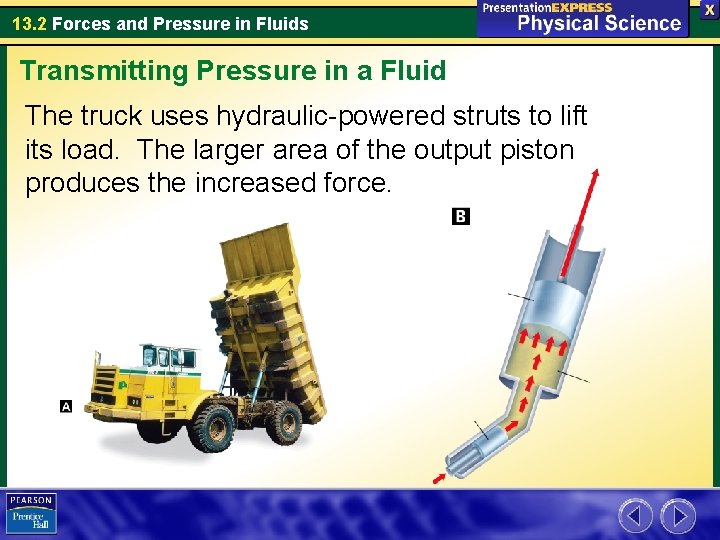
13. 2 Forces and Pressure in Fluids Transmitting Pressure in a Fluid Hydraulic Systems How does a hydraulic system work? A hydraulic system is a device that uses pressurized fluid acting on pistons of different sizes to change a force. In a hydraulic lift system, an increased output force is produced because a constant fluid pressure is exerted on the larger area of the output piston.
13. 2 Forces and Pressure in Fluids Transmitting Pressure in a Fluid The truck uses hydraulic-powered struts to lift its load. The larger area of the output piston produces the increased force.
13. 2 Forces and Pressure in Fluids Transmitting Pressure in a Fluid When an input force is applied to the small piston in a hydraulic system, the piston pushes against the fluid sealed in the system. • The pressure produced by the small piston is transmitted through the fluid to the large piston. • The pressure on both pistons is the same. • Because the output pressure acts on a much larger area, the output force is larger.
13. 2 Forces and Pressure in Fluids Bernoulli’s Principle How is the speed of a fluid related to the pressure within the fluid? According to Bernoulli’s principle, as the speed of a fluid increases, the pressure within the fluid decreases.
13. 2 Forces and Pressure in Fluids Bernoulli’s Principle Try this simple experiment. • Hold a sheet of paper by its top corners. • Position the paper directly in front of your mouth. • Blow over the top surface of the paper. • The far end of the paper lifts upward.
13. 2 Forces and Pressure in Fluids Bernoulli’s Principle As the air blows across the top of the paper, the pressure exerted by the air decreases. • The motionless air below the paper exerts a greater pressure. • The difference in pressure forces the paper upward.
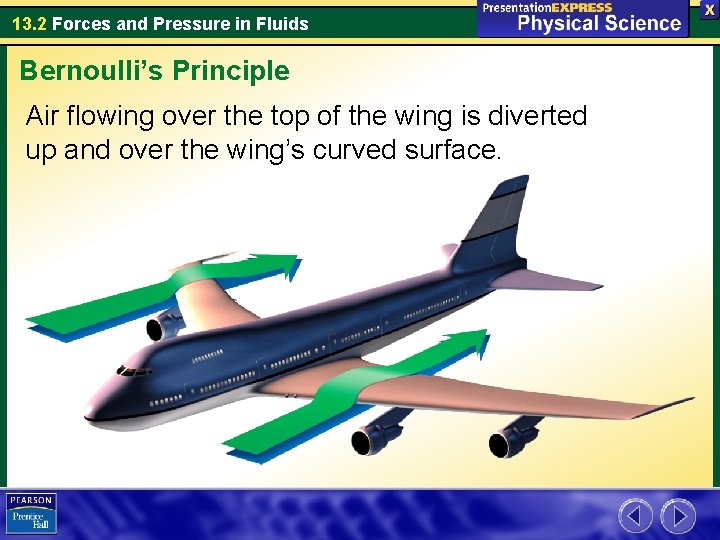
13. 2 Forces and Pressure in Fluids Bernoulli’s Principle Wings and Lift Bernoulli’s principle explains the ability of birds and airplanes to fly. • Air traveling over the top of an airplane wing moves faster than the air passing underneath. • The pressure difference between the top and the bottom of the wing creates an upward force known as lift.
13. 2 Forces and Pressure in Fluids Bernoulli’s Principle Air flowing over the top of the wing is diverted up and over the wing’s curved surface.
13. 2 Forces and Pressure in Fluids Bernoulli’s Principle The wings of birds produce lift in much the same way as an airplane wing. Unlike airplane wings, birds can flap their wings to produce forward movement and some lift. The downward force created by the spoiler on a race car pushes the tires down onto the road, giving the car better traction.
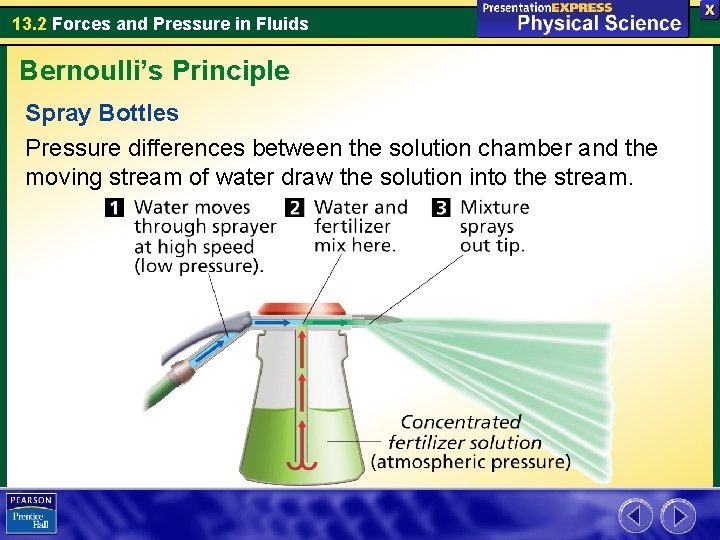
13. 2 Forces and Pressure in Fluids Bernoulli’s Principle Spray Bottles Pressure differences between the solution chamber and the moving stream of water draw the solution into the stream.
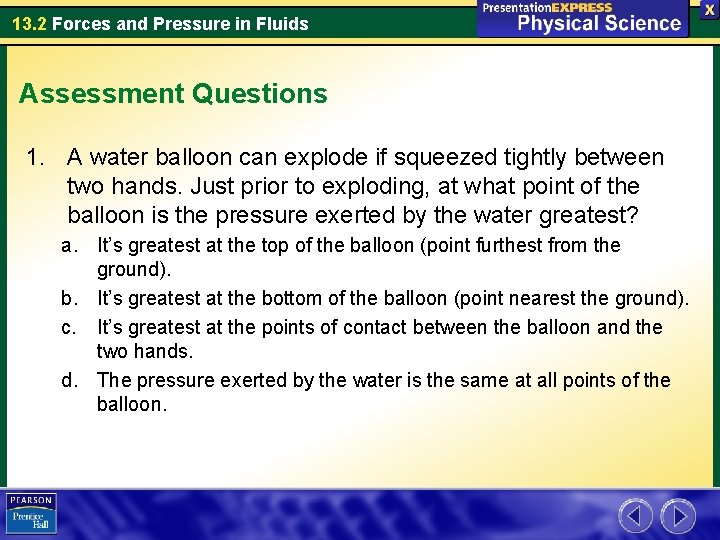
13. 2 Forces and Pressure in Fluids Assessment Questions 1. A water balloon can explode if squeezed tightly between two hands. Just prior to exploding, at what point of the balloon is the pressure exerted by the water greatest? a. It’s greatest at the top of the balloon (point furthest from the ground). b. It’s greatest at the bottom of the balloon (point nearest the ground). c. It’s greatest at the points of contact between the balloon and the two hands. d. The pressure exerted by the water is the same at all points of the balloon.
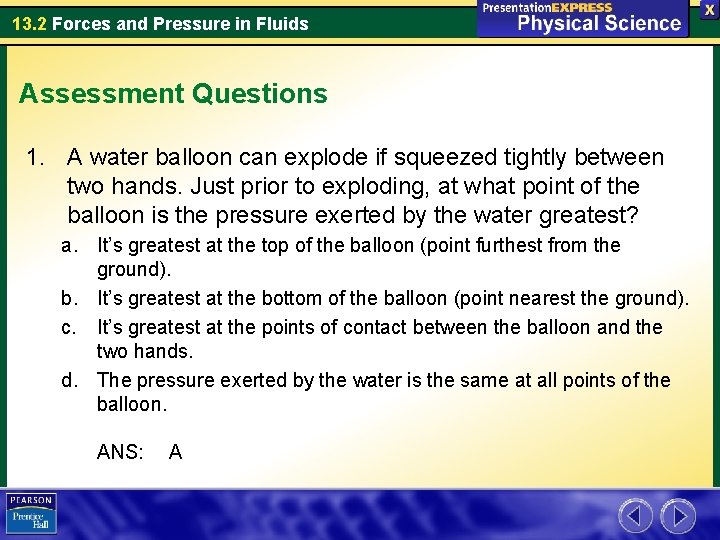
13. 2 Forces and Pressure in Fluids Assessment Questions 1. A water balloon can explode if squeezed tightly between two hands. Just prior to exploding, at what point of the balloon is the pressure exerted by the water greatest? a. It’s greatest at the top of the balloon (point furthest from the ground). b. It’s greatest at the bottom of the balloon (point nearest the ground). c. It’s greatest at the points of contact between the balloon and the two hands. d. The pressure exerted by the water is the same at all points of the balloon. ANS: A
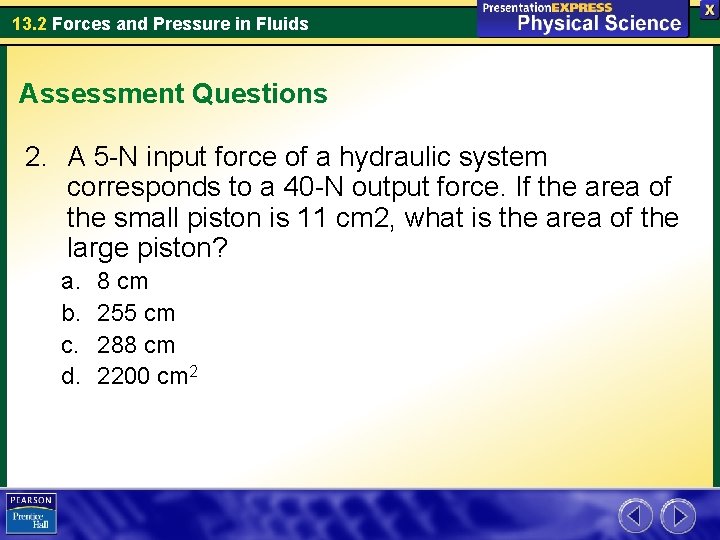
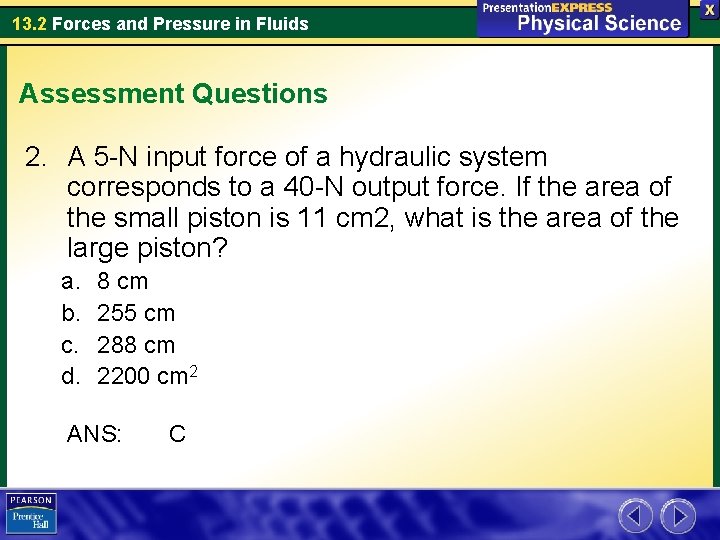
13. 2 Forces and Pressure in Fluids Assessment Questions 2. A 5 -N input force of a hydraulic system corresponds to a 40 -N output force. If the area of the small piston is 11 cm 2, what is the area of the large piston? a. b. c. d. 8 cm 255 cm 288 cm 2200 cm 2
13. 2 Forces and Pressure in Fluids Assessment Questions 2. A 5 -N input force of a hydraulic system corresponds to a 40 -N output force. If the area of the small piston is 11 cm 2, what is the area of the large piston? a. b. c. d. 8 cm 255 cm 288 cm 2200 cm 2 ANS: C
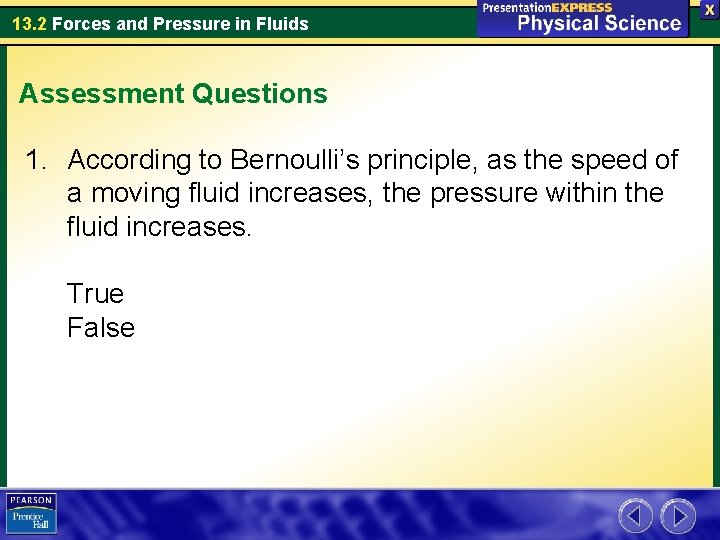
13. 2 Forces and Pressure in Fluids Assessment Questions 1. According to Bernoulli’s principle, as the speed of a moving fluid increases, the pressure within the fluid increases. True False
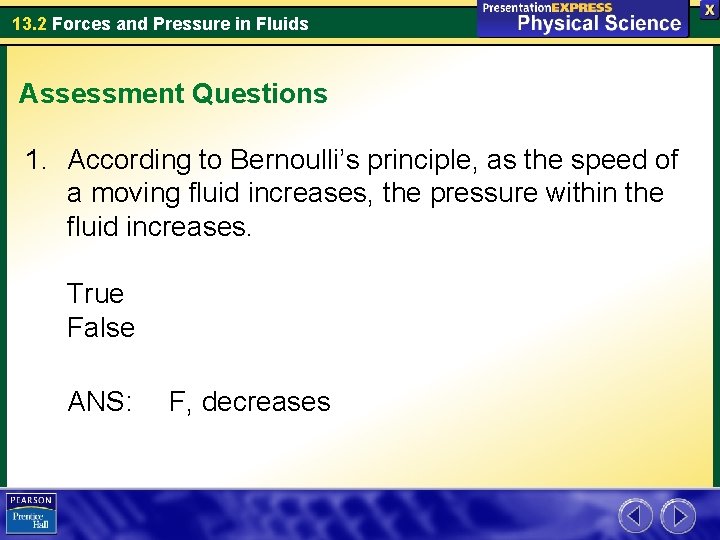
13. 2 Forces and Pressure in Fluids Assessment Questions 1. According to Bernoulli’s principle, as the speed of a moving fluid increases, the pressure within the fluid increases. True False ANS: F, decreases