
13 1 Ecologists Study Relationships Chapter 18 Viruses
- Slides: 46
13. 1 Ecologists Study Relationships Chapter 18 Viruses and Bacteria
18. 1 Studying Viruses and Prokaryotes What do you think? Are viruses alive? Give evidence to support this opinion: YES NO
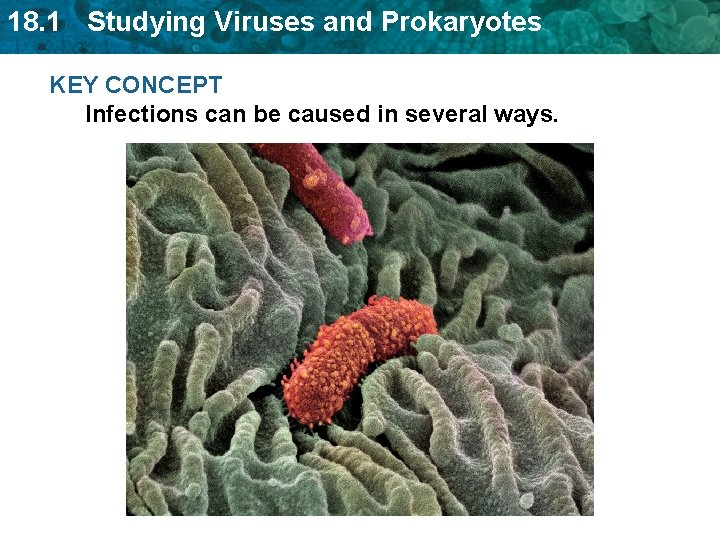
18. 1 Studying Viruses and Prokaryotes KEY CONCEPT Infections can be caused in several ways.
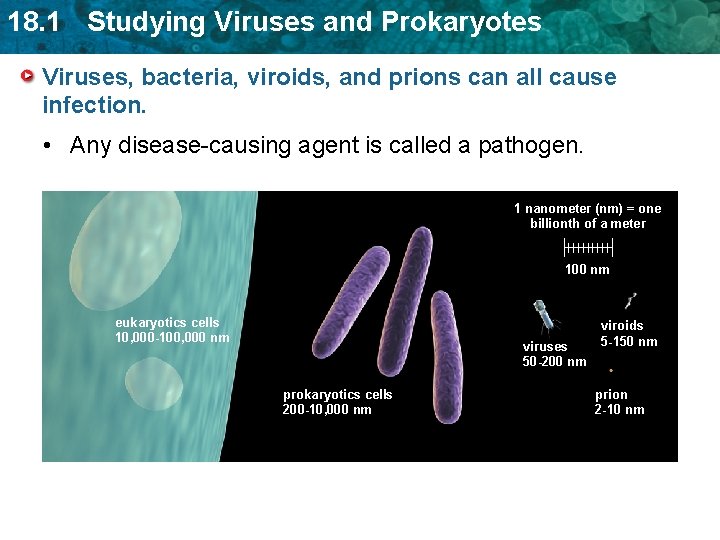
18. 1 Studying Viruses and Prokaryotes Viruses, bacteria, viroids, and prions can all cause infection. • Any disease-causing agent is called a pathogen. 1 nanometer (nm) = one billionth of a meter 100 nm eukaryotics cells 10, 000 -100, 000 nm viruses 50 -200 nm prokaryotics cells 200 -10, 000 nm viroids 5 -150 nm prion 2 -10 nm
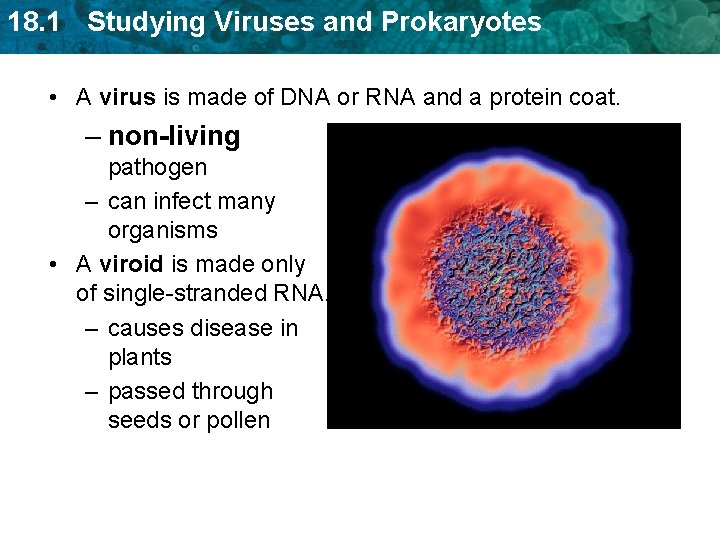
18. 1 Studying Viruses and Prokaryotes • A virus is made of DNA or RNA and a protein coat. – non-living pathogen – can infect many organisms • A viroid is made only of single-stranded RNA. – causes disease in plants – passed through seeds or pollen
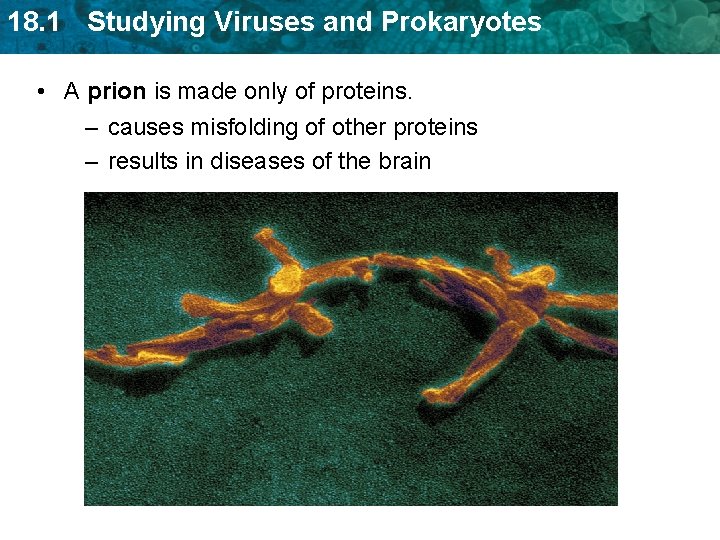
18. 1 Studying Viruses and Prokaryotes • A prion is made only of proteins. – causes misfolding of other proteins – results in diseases of the brain
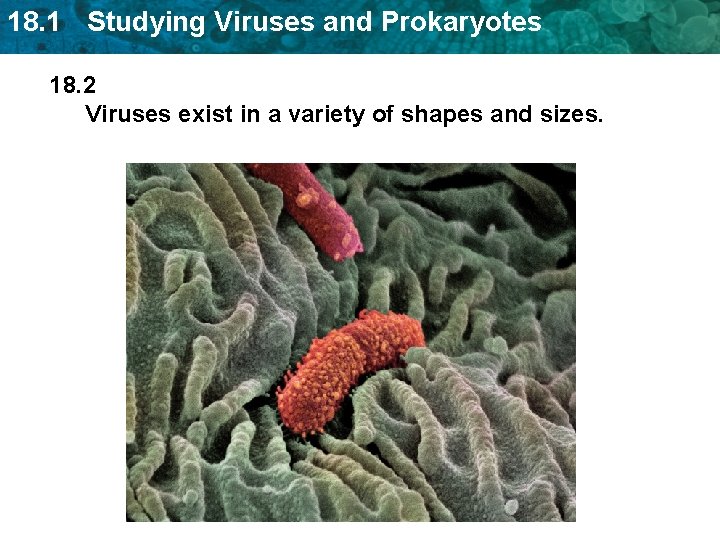
18. 1 Studying Viruses and Prokaryotes 18. 2 Viruses exist in a variety of shapes and sizes.
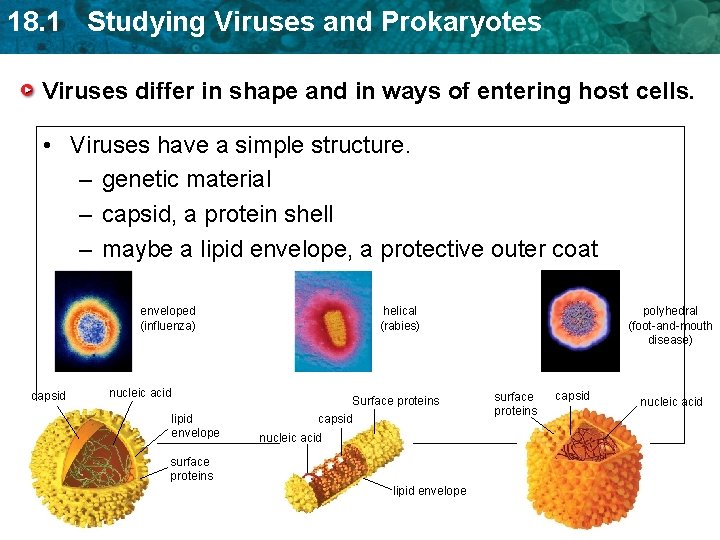
18. 1 Studying Viruses and Prokaryotes Viruses differ in shape and in ways of entering host cells. • Viruses have a simple structure. – genetic material – capsid, a protein shell – maybe a lipid envelope, a protective outer coat enveloped (influenza) capsid nucleic acid lipid envelope helical (rabies) Surface proteins capsid nucleic acid surface proteins lipid envelope polyhedral (foot-and-mouth disease) surface proteins capsid nucleic acid
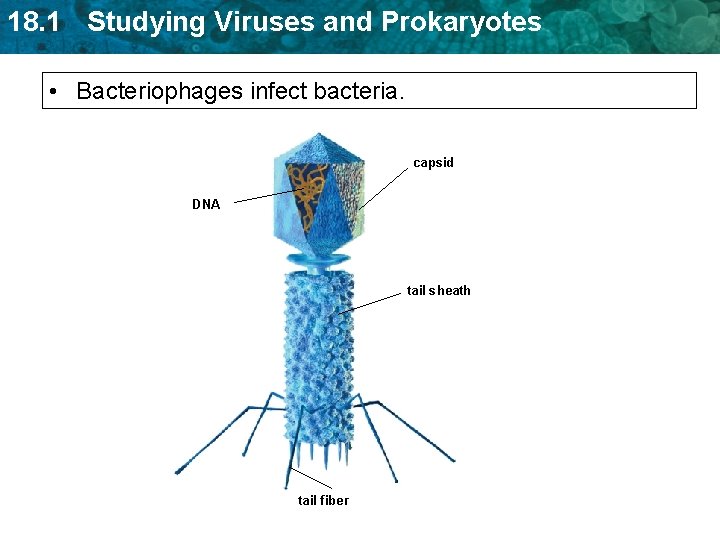
18. 1 Studying Viruses and Prokaryotes • Bacteriophages infect bacteria. capsid DNA tail sheath tail fiber
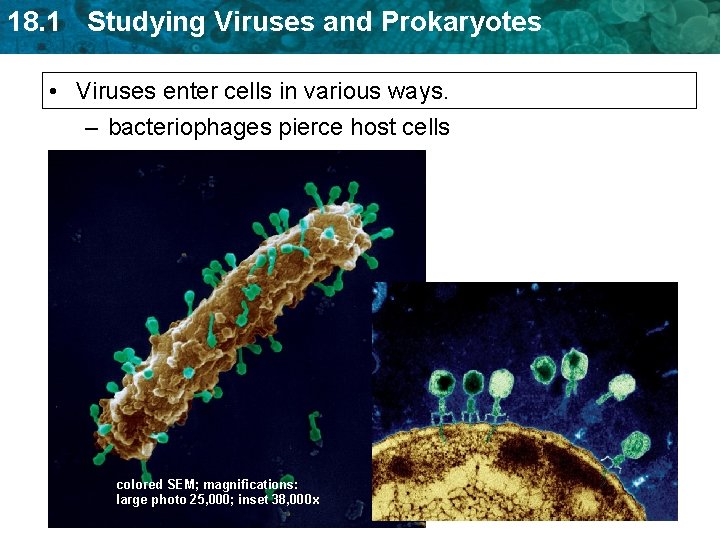
18. 1 Studying Viruses and Prokaryotes • Viruses enter cells in various ways. – bacteriophages pierce host cells colored SEM; magnifications: large photo 25, 000; inset 38, 000 x
18. 1 Studying Viruses and Prokaryotes • Viruses enter cells in various ways. – viruses of eukaryotes enter by endocytosis
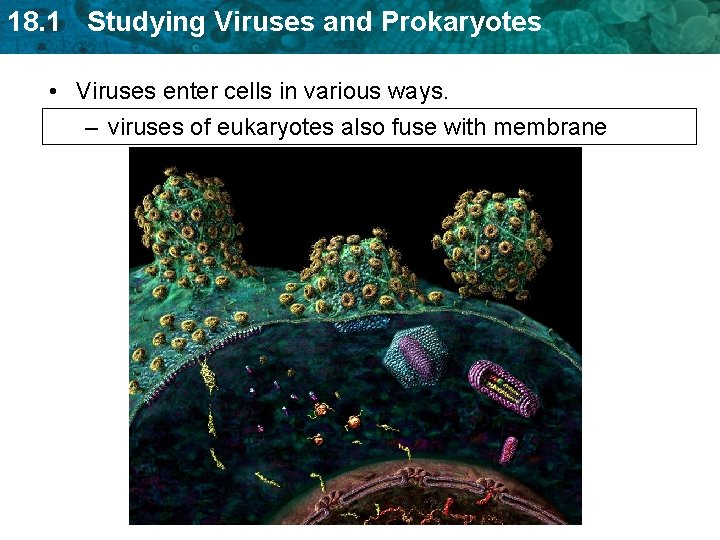
18. 1 Studying Viruses and Prokaryotes • Viruses enter cells in various ways. – viruses of eukaryotes also fuse with membrane
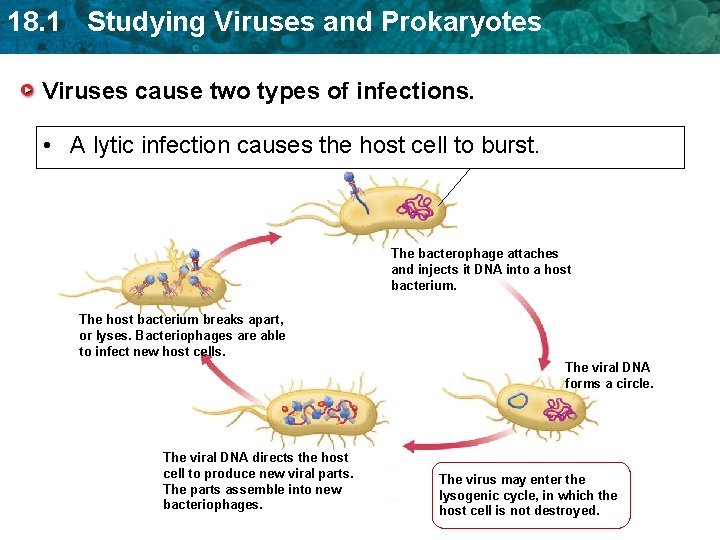
18. 1 Studying Viruses and Prokaryotes Viruses cause two types of infections. • A lytic infection causes the host cell to burst. host bacterium The bacterophage attaches and injects it DNA into a host bacterium. The host bacterium breaks apart, or lyses. Bacteriophages are able to infect new host cells. The viral DNA forms a circle. The viral DNA directs the host cell to produce new viral parts. The parts assemble into new bacteriophages. The virus may enter the lysogenic cycle, in which the host cell is not destroyed.
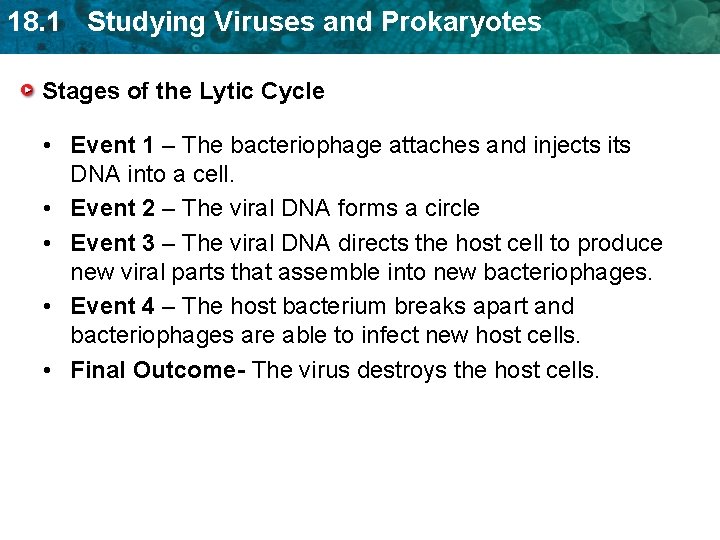
18. 1 Studying Viruses and Prokaryotes Stages of the Lytic Cycle • Event 1 – The bacteriophage attaches and injects its DNA into a cell. • Event 2 – The viral DNA forms a circle • Event 3 – The viral DNA directs the host cell to produce new viral parts that assemble into new bacteriophages. • Event 4 – The host bacterium breaks apart and bacteriophages are able to infect new host cells. • Final Outcome- The virus destroys the host cells.
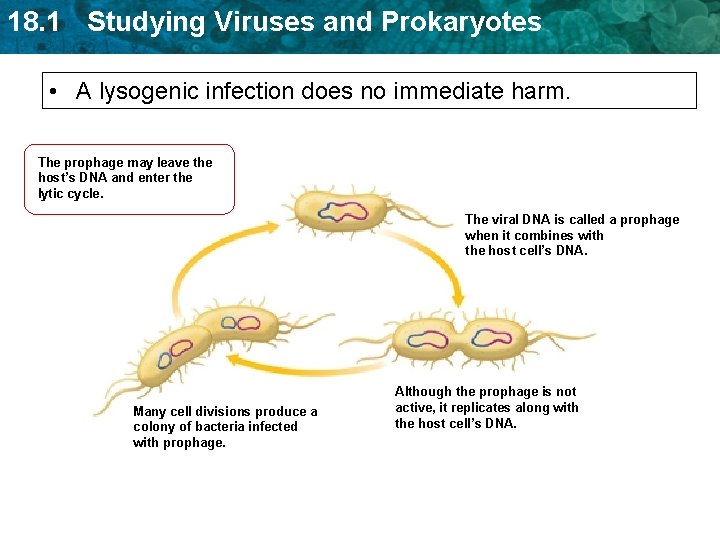
18. 1 Studying Viruses and Prokaryotes • A lysogenic infection does no immediate harm. The prophage may leave the host’s DNA and enter the lytic cycle. The viral DNA is called a prophage when it combines with the host cell’s DNA. Many cell divisions produce a colony of bacteria infected with prophage. Although the prophage is not active, it replicates along with the host cell’s DNA.
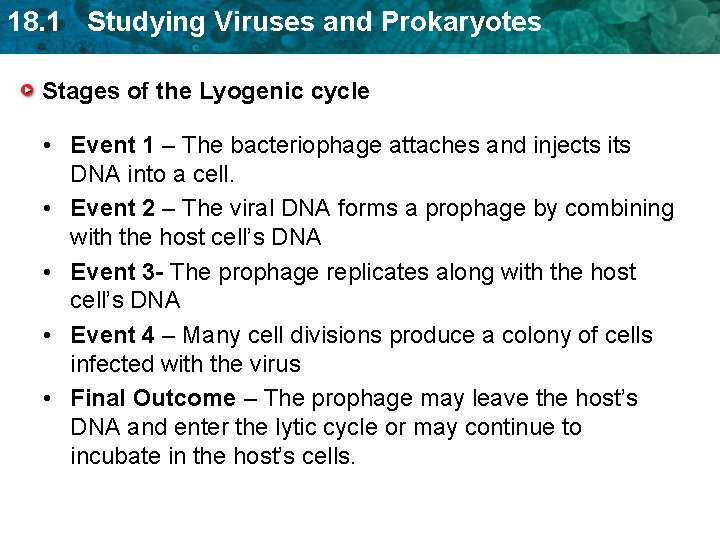
18. 1 Studying Viruses and Prokaryotes Stages of the Lyogenic cycle • Event 1 – The bacteriophage attaches and injects its DNA into a cell. • Event 2 – The viral DNA forms a prophage by combining with the host cell’s DNA • Event 3 - The prophage replicates along with the host cell’s DNA • Event 4 – Many cell divisions produce a colony of cells infected with the virus • Final Outcome – The prophage may leave the host’s DNA and enter the lytic cycle or may continue to incubate in the host’s cells.
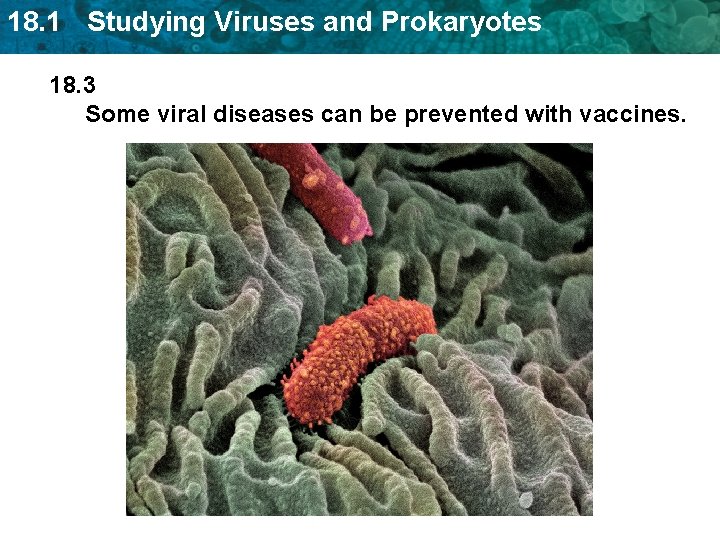
18. 1 Studying Viruses and Prokaryotes 18. 3 Some viral diseases can be prevented with vaccines.
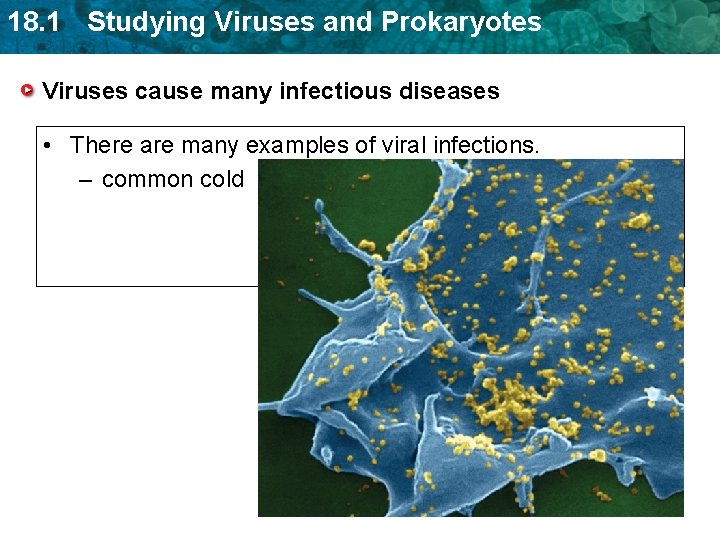
18. 1 Studying Viruses and Prokaryotes Viruses cause many infectious diseases • There are many examples of viral infections. – common cold
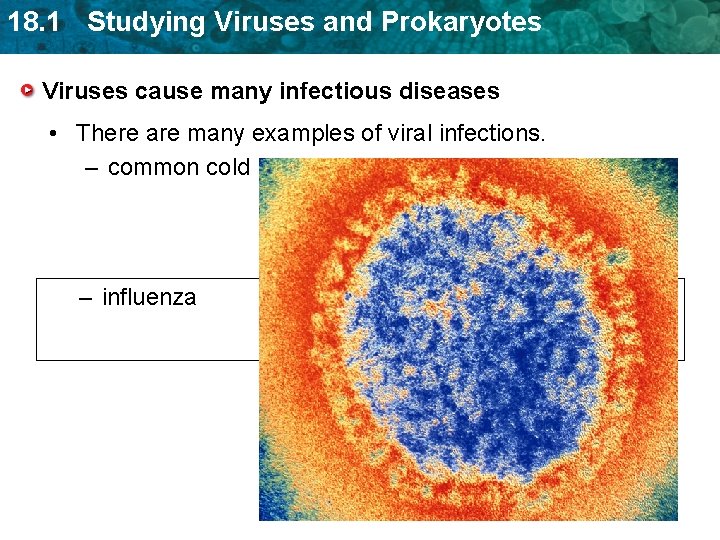
18. 1 Studying Viruses and Prokaryotes Viruses cause many infectious diseases • There are many examples of viral infections. – common cold – influenza
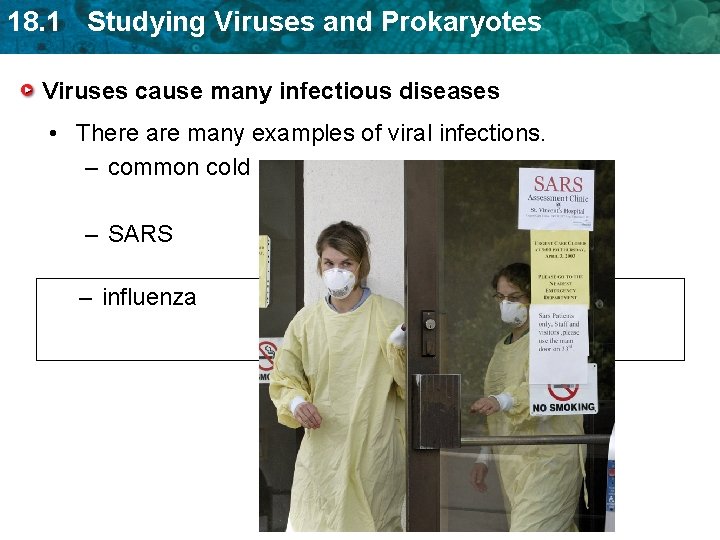
18. 1 Studying Viruses and Prokaryotes Viruses cause many infectious diseases • There are many examples of viral infections. – common cold – SARS – influenza
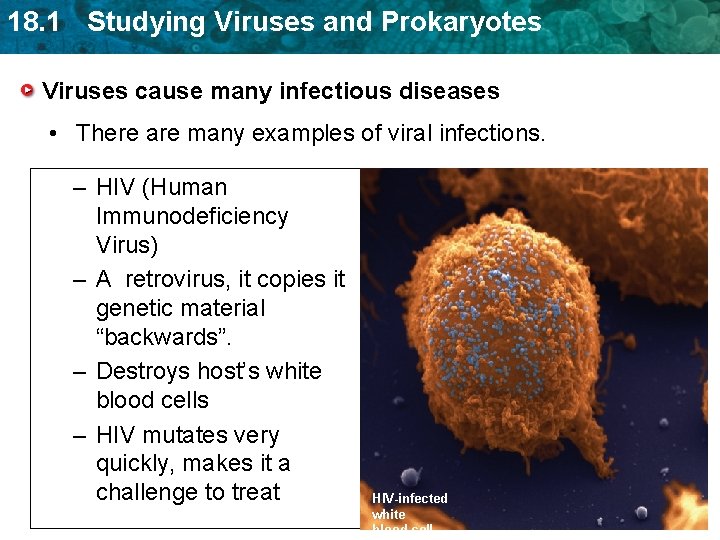
18. 1 Studying Viruses and Prokaryotes Viruses cause many infectious diseases • There are many examples of viral infections. – HIV (Human Immunodeficiency Virus) – A retrovirus, it copies it genetic material “backwards”. – Destroys host’s white blood cells – HIV mutates very quickly, makes it a challenge to treat HIV-infected white blood cell
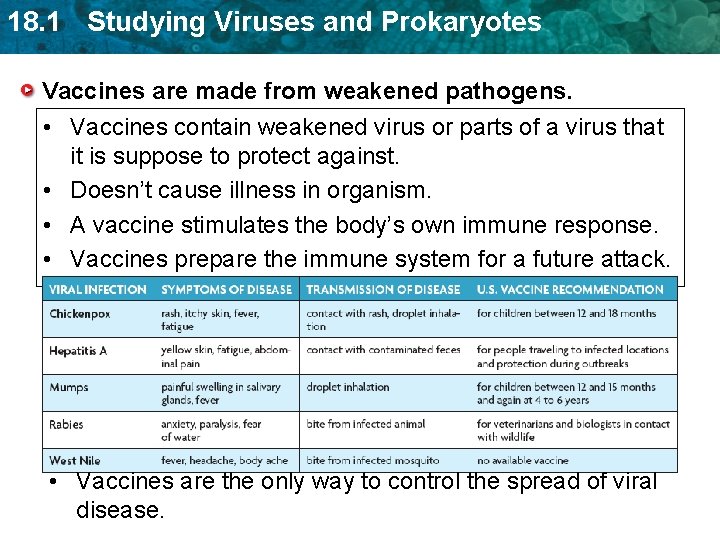
18. 1 Studying Viruses and Prokaryotes Vaccines are made from weakened pathogens. • Vaccines contain weakened virus or parts of a virus that it is suppose to protect against. • Doesn’t cause illness in organism. • A vaccine stimulates the body’s own immune response. • Vaccines prepare the immune system for a future attack. • Vaccines are the only way to control the spread of viral disease.
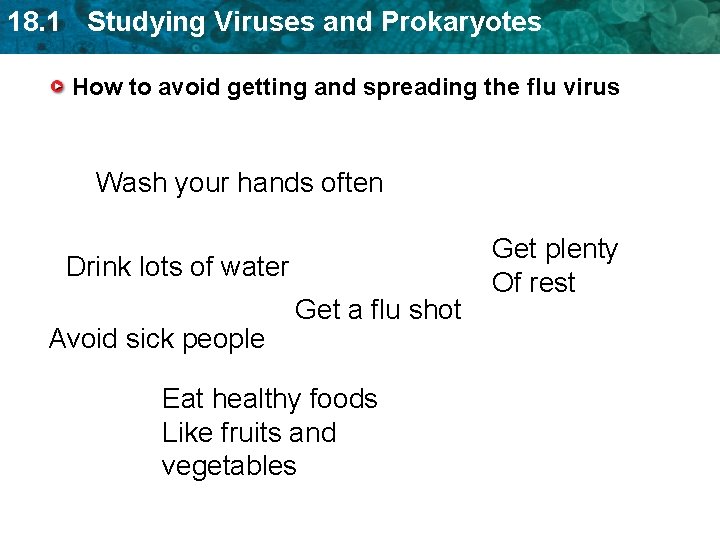
18. 1 Studying Viruses and Prokaryotes How to avoid getting and spreading the flu virus Wash your hands often Drink lots of water Avoid sick people Get a flu shot Eat healthy foods Like fruits and vegetables Get plenty Of rest
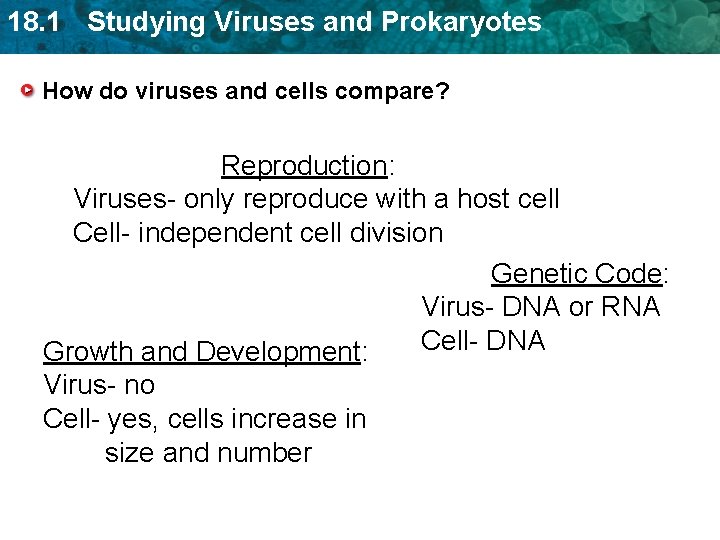
18. 1 Studying Viruses and Prokaryotes How do viruses and cells compare? Reproduction: Viruses- only reproduce with a host cell Cell- independent cell division Genetic Code: Virus- DNA or RNA Cell- DNA Growth and Development: Virus- no Cell- yes, cells increase in size and number
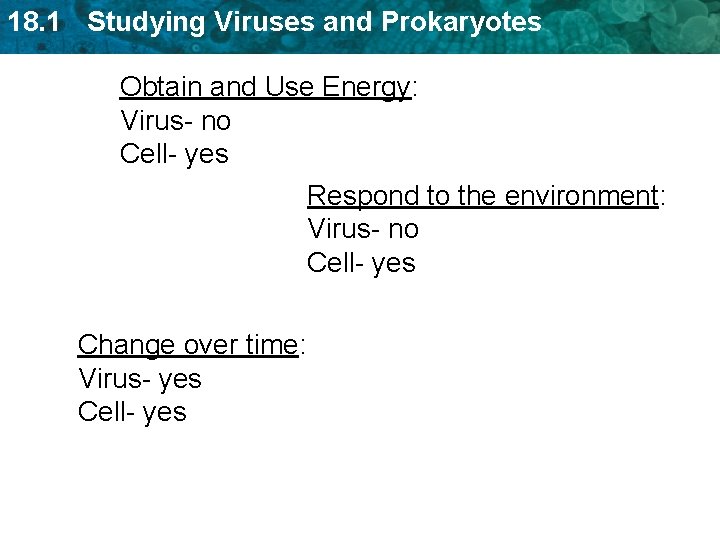
18. 1 Studying Viruses and Prokaryotes Obtain and Use Energy: Virus- no Cell- yes Respond to the environment: Virus- no Cell- yes Change over time: Virus- yes Cell- yes
18. 1 Studying Viruses and Prokaryotes What do you think? Are viruses alive? Give evidence to support this opinion: YES NO
18. 1 Studying Viruses and Prokaryotes Bacteria sections 18. 4 – 18. 6
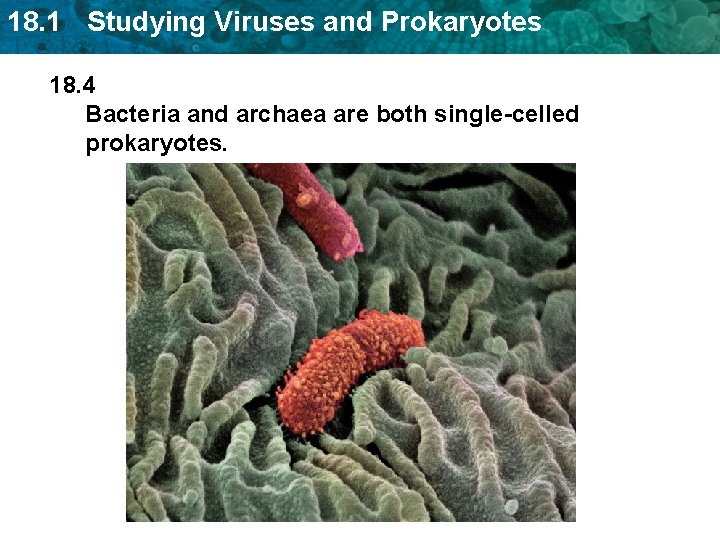
18. 1 Studying Viruses and Prokaryotes 18. 4 Bacteria and archaea are both single-celled prokaryotes.
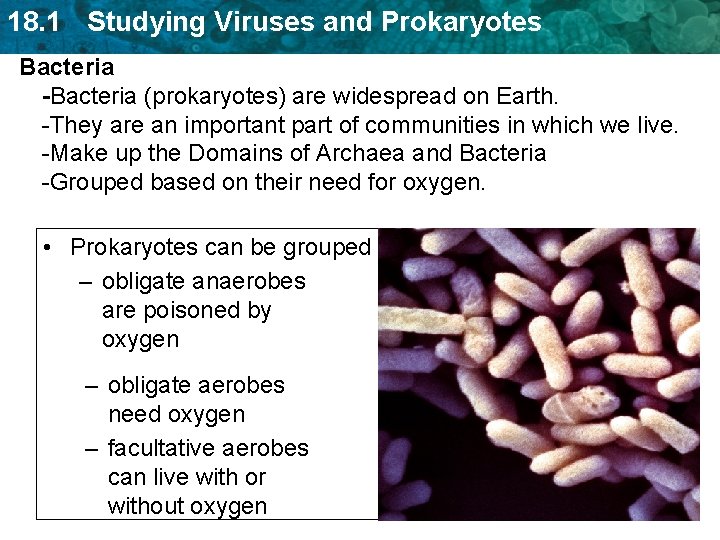
18. 1 Studying Viruses and Prokaryotes Bacteria -Bacteria (prokaryotes) are widespread on Earth. -They are an important part of communities in which we live. -Make up the Domains of Archaea and Bacteria -Grouped based on their need for oxygen. • Prokaryotes can be grouped by their need for oxygen. – obligate anaerobes are poisoned by oxygen – obligate aerobes need oxygen – facultative aerobes can live with or without oxygen
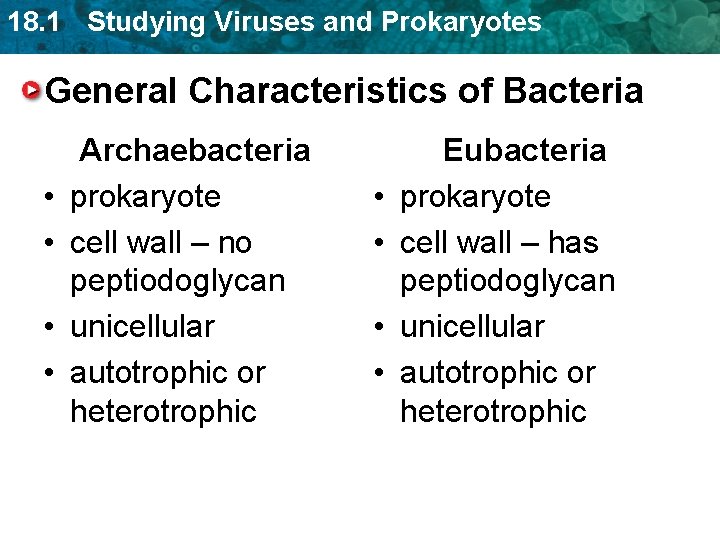
18. 1 Studying Viruses and Prokaryotes General Characteristics of Bacteria • • Archaebacteria prokaryote cell wall – no peptiodoglycan unicellular autotrophic or heterotrophic • • Eubacteria prokaryote cell wall – has peptiodoglycan unicellular autotrophic or heterotrophic
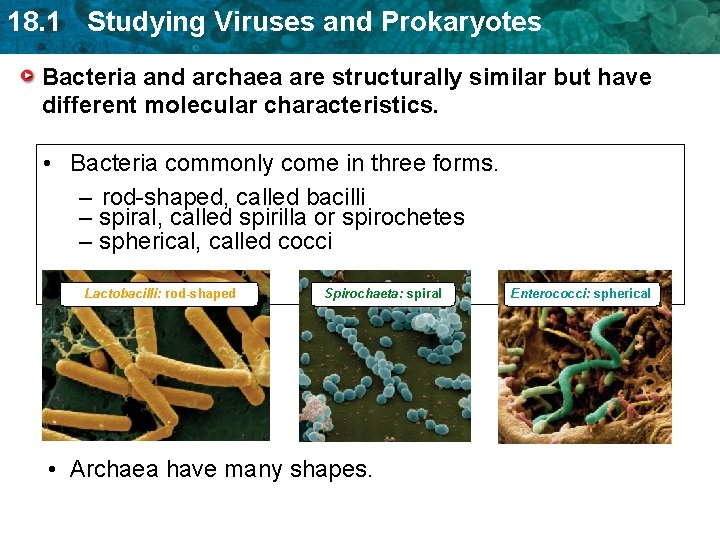
18. 1 Studying Viruses and Prokaryotes Bacteria and archaea are structurally similar but have different molecular characteristics. • Bacteria commonly come in three forms. – rod-shaped, called bacilli – spiral, called spirilla or spirochetes – spherical, called cocci Lactobacilli: rod-shaped Spirochaeta: spiral • Archaea have many shapes. Enterococci: spherical
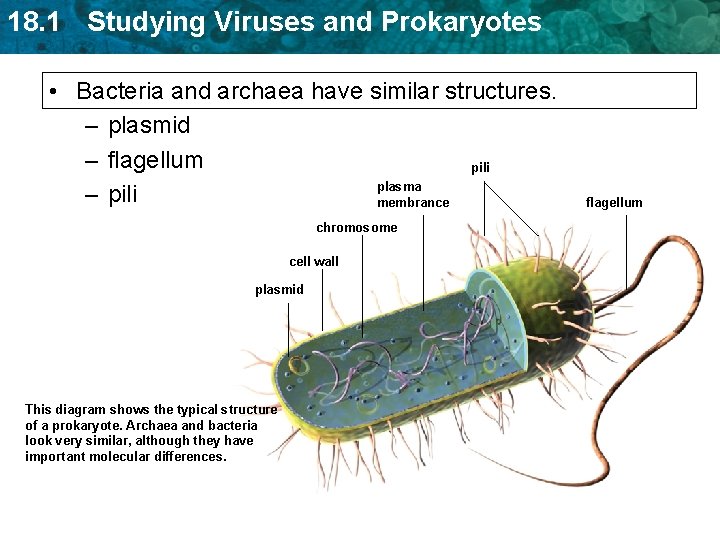
18. 1 Studying Viruses and Prokaryotes • Bacteria and archaea have similar structures. – plasmid – flagellum pili plasma – pili membrance chromosome cell wall plasmid This diagram shows the typical structure of a prokaryote. Archaea and bacteria look very similar, although they have important molecular differences. flagellum
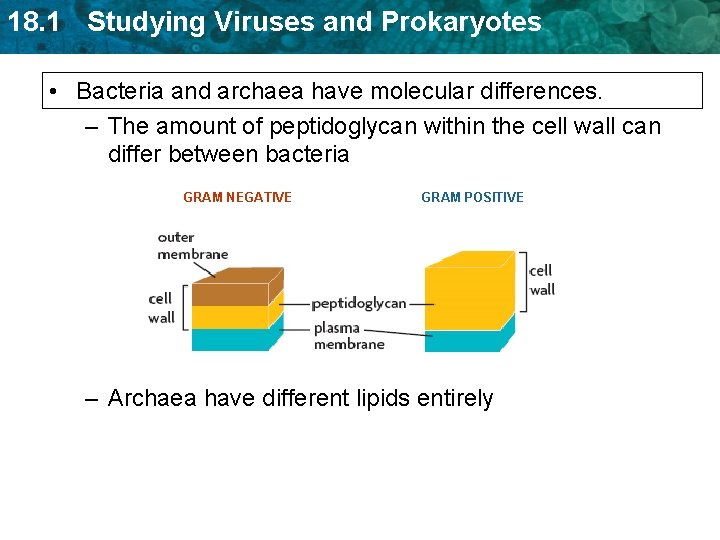
18. 1 Studying Viruses and Prokaryotes • Bacteria and archaea have molecular differences. – The amount of peptidoglycan within the cell wall can differ between bacteria GRAM NEGATIVE GRAM POSITIVE – Archaea have different lipids entirely
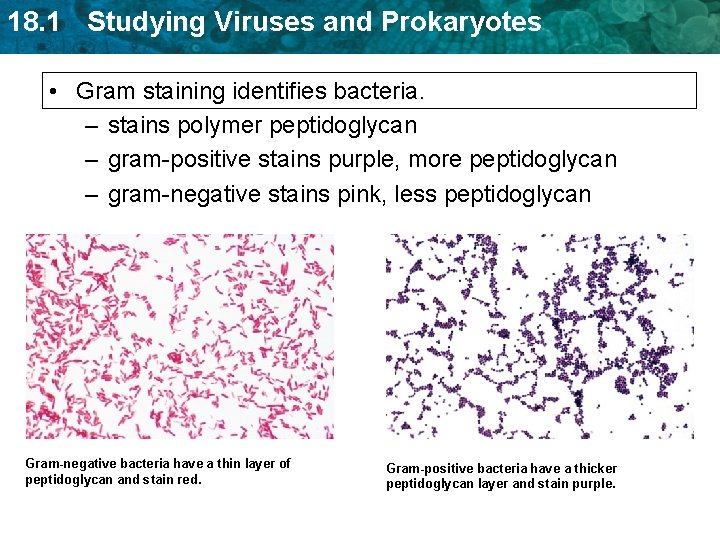
18. 1 Studying Viruses and Prokaryotes • Gram staining identifies bacteria. – stains polymer peptidoglycan – gram-positive stains purple, more peptidoglycan – gram-negative stains pink, less peptidoglycan Gram-negative bacteria have a thin layer of peptidoglycan and stain red. Gram-positive bacteria have a thicker peptidoglycan layer and stain purple.
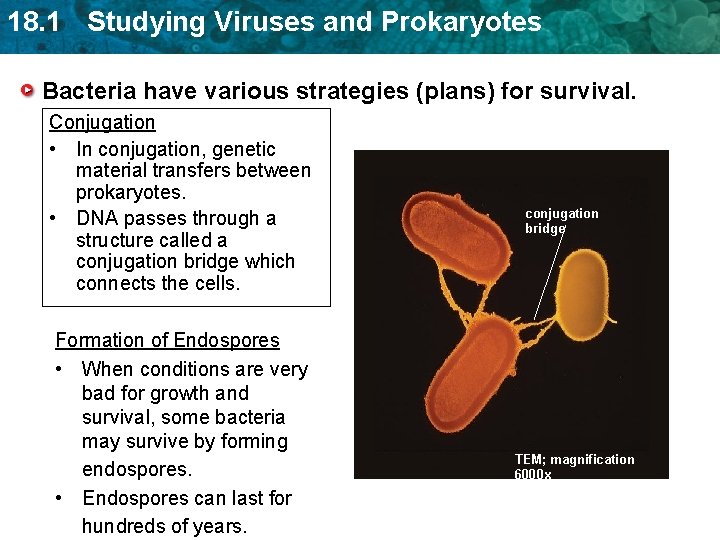
18. 1 Studying Viruses and Prokaryotes Bacteria have various strategies (plans) for survival. Conjugation • In conjugation, genetic material transfers between prokaryotes. • DNA passes through a structure called a conjugation bridge which connects the cells. Formation of Endospores • When conditions are very bad for growth and survival, some bacteria may survive by forming endospores. • Endospores can last for hundreds of years. conjugation bridge TEM; magnification 6000 x
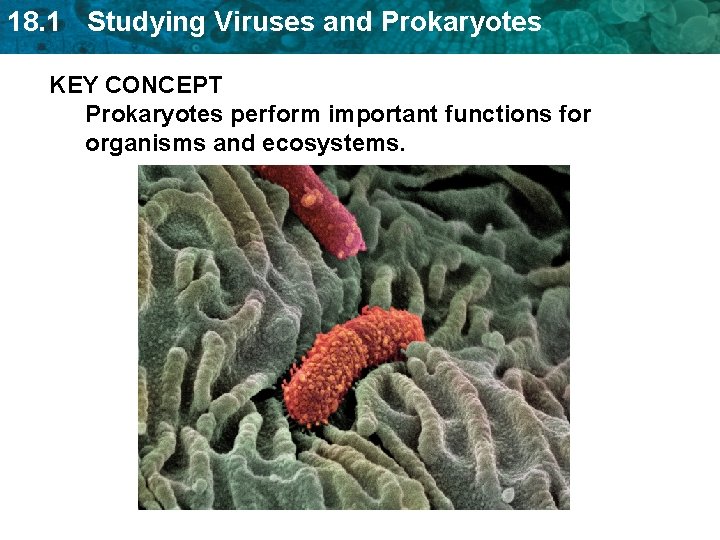
18. 1 Studying Viruses and Prokaryotes KEY CONCEPT Prokaryotes perform important functions for organisms and ecosystems.
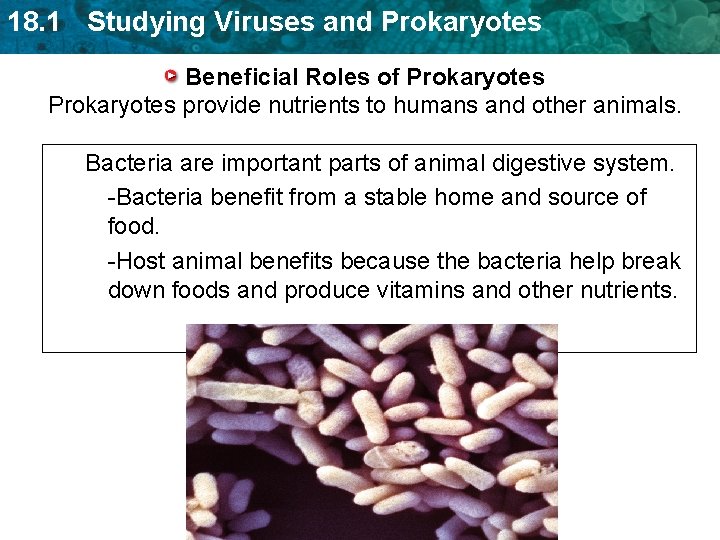
18. 1 Studying Viruses and Prokaryotes Beneficial Roles of Prokaryotes provide nutrients to humans and other animals. Bacteria are important parts of animal digestive system. -Bacteria benefit from a stable home and source of food. -Host animal benefits because the bacteria help break down foods and produce vitamins and other nutrients.
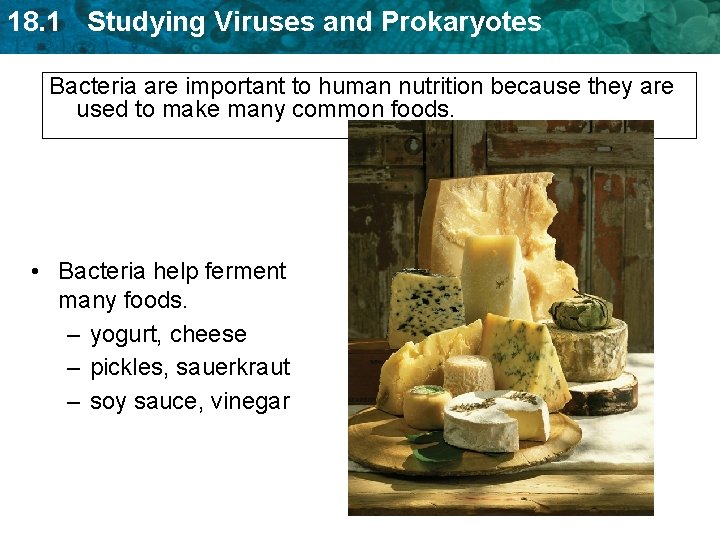
18. 1 Studying Viruses and Prokaryotes Bacteria are important to human nutrition because they are used to make many common foods. • Bacteria help ferment many foods. – yogurt, cheese – pickles, sauerkraut – soy sauce, vinegar
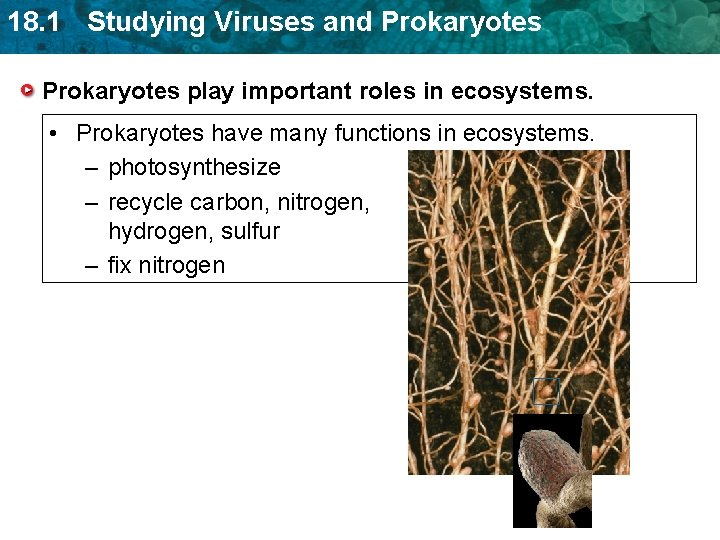
18. 1 Studying Viruses and Prokaryotes play important roles in ecosystems. • Prokaryotes have many functions in ecosystems. – photosynthesize – recycle carbon, nitrogen, hydrogen, sulfur – fix nitrogen
18. 1 Studying Viruses and Prokaryotes • Bioremediation uses prokaryotes to break down pollutants. – oil spills – biodegradable materials
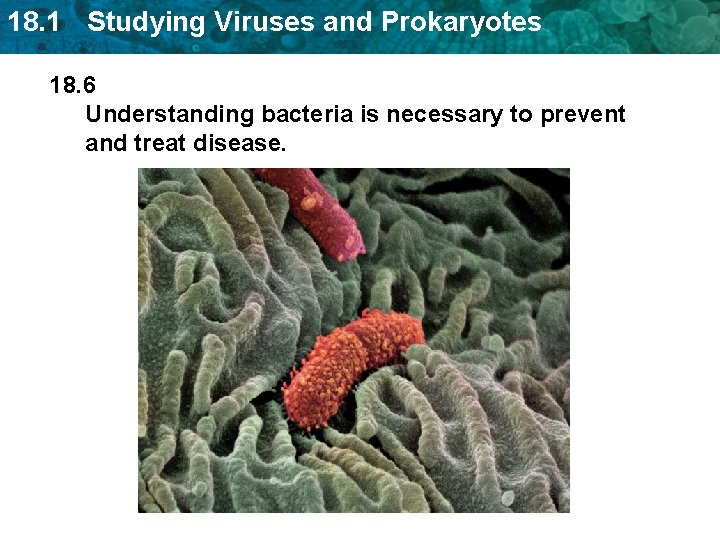
18. 1 Studying Viruses and Prokaryotes 18. 6 Understanding bacteria is necessary to prevent and treat disease.
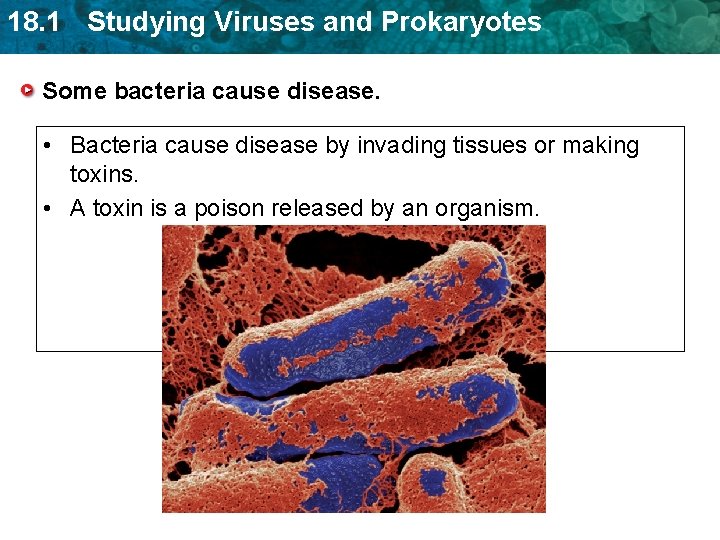
18. 1 Studying Viruses and Prokaryotes Some bacteria cause disease. • Bacteria cause disease by invading tissues or making toxins. • A toxin is a poison released by an organism.
18. 1 Studying Viruses and Prokaryotes Bacterial Diseases and Antibiotics Some Bacteria can cause disease in plants and animals. Bacteria can cause illness in 2 basic ways. 1. Bacteria can attack the cells in one of the body’s tissues. Ex. Tuberculosis (TB) – caused by bacteria that invade the lungs and use the tissues for nutrients. 2. Bacteria can make poisons called toxins that can be carried in the blood to other parts of the body. ex. Food poisoning – toxins released by a type of bacteria.
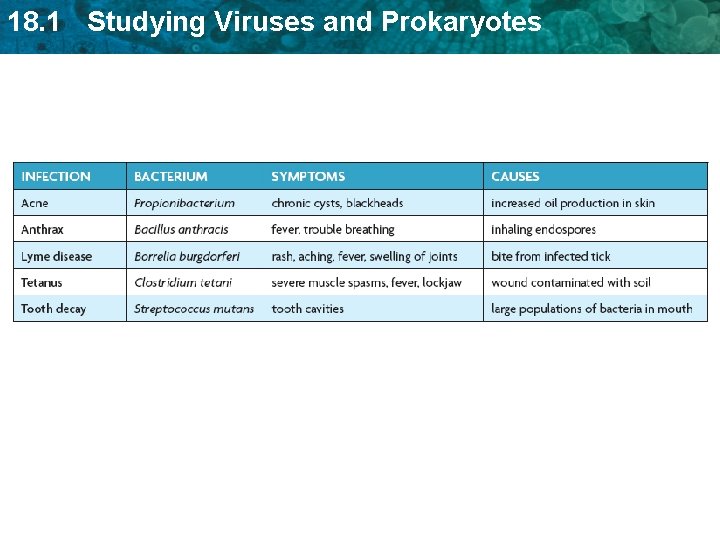
18. 1 Studying Viruses and Prokaryotes
18. 1 Studying Viruses and Prokaryotes Antibiotics are used to fight bacterial disease. • Antibiotics may stop bacterial cell wall formation. • Antibiotics do not work on viruses. • Prevention is best method to fight bacterial disease.
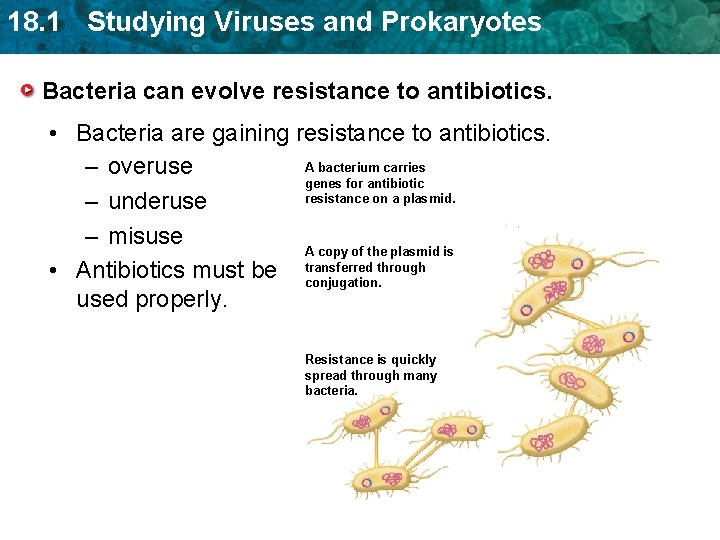
18. 1 Studying Viruses and Prokaryotes Bacteria can evolve resistance to antibiotics. • Bacteria are gaining resistance to antibiotics. A bacterium carries – overuse genes for antibiotic resistance on a plasmid. – underuse – misuse A copy of the plasmid is through • Antibiotics must be transferred conjugation. used properly. Resistance is quickly spread through many bacteria.