
126 Based on Rosen Discrete Mathematics Its Applications
1/26 Based on Rosen, Discrete Mathematics & Its Applications, 5 e Prepared by (c)2001 -2004 Michael P. Frank Modified by (c) 2004 -2005 Haluk Bingöl Module #7 - Complexity Bogazici University Department of Computer Engineering Cmp. E 220 Discrete Mathematics 07. Algorithmic Complexity Haluk Bingöl
2/26 Based on Rosen, Discrete Mathematics & Its Applications, 5 e Prepared by (c)2001 -2004 Michael P. Frank Modified by (c) 2004 -2005 Haluk Bingöl Module #7 - Complexity Module #7: Algorithmic Complexity Rosen 5 th ed. , § 2. 3 ~24 slides, ~1 lecture
Module #7 - Complexity Based on Rosen, Discrete Mathematics & Its Applications, 5 e Prepared by (c)2001 -2004 Michael P. Frank Modified by (c) 2004 -2005 Haluk Bingöl 3/26 What is complexity? The word complexity has a variety of different technical meanings in different research fields. There is a field of complex systems, which studies complicated, difficult-to-analyze nonlinear and chaotic natural & artificial systems. Another concept: Informational or descriptional complexity: The amount of information needed to completely describe an object. As studied by Kolmogorov, Chaitin, Bennett, others… In this course, we will study algorithmic or computational complexity.
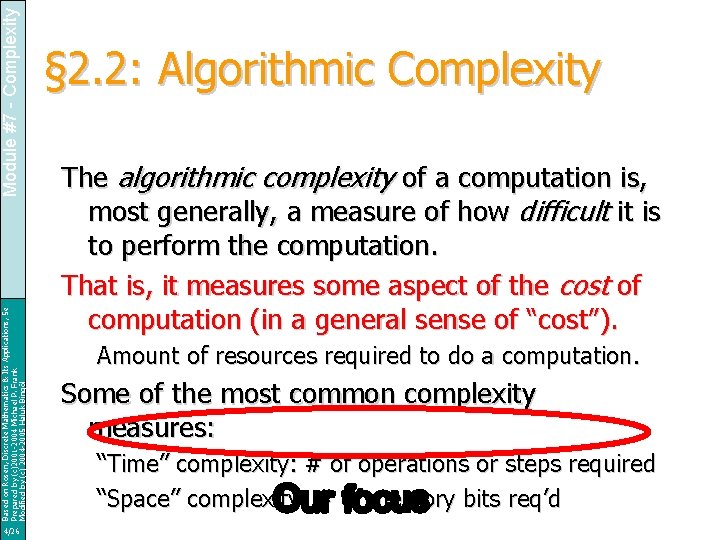
Module #7 - Complexity Based on Rosen, Discrete Mathematics & Its Applications, 5 e Prepared by (c)2001 -2004 Michael P. Frank Modified by (c) 2004 -2005 Haluk Bingöl 4/26 § 2. 2: Algorithmic Complexity The algorithmic complexity of a computation is, most generally, a measure of how difficult it is to perform the computation. That is, it measures some aspect of the cost of computation (in a general sense of “cost”). Amount of resources required to do a computation. Some of the most common complexity measures: “Time” complexity: # of operations or steps required “Space” complexity: # of memory bits req’d
Module #7 - Complexity An interesting aside. . . Another, increasingly important measure of complexity for computing is energy complexity – How much total physical energy is used up (rendered unavailable) as a result of performing the computation? Based on Rosen, Discrete Mathematics & Its Applications, 5 e Prepared by (c)2001 -2004 Michael P. Frank Modified by (c) 2004 -2005 Haluk Bingöl Motivations: 5/26 Battery life, electricity cost, computer overheating! Computer performance within power constraints. I research & develop reversible circuits & algorithms which reuse energy, trading off energy complexity against spacetime complexity.
Module #7 - Complexity Depends on Input Most algorithms have different complexities for inputs of different sizes. Based on Rosen, Discrete Mathematics & Its Applications, 5 e Prepared by (c)2001 -2004 Michael P. Frank Modified by (c) 2004 -2005 Haluk Bingöl E. g. searching a long list typically takes more 6/26 time than searching a short one. Therefore, complexity is usually expressed as a function of the input length. This function usually gives the complexity for the worst-case input of any given length.
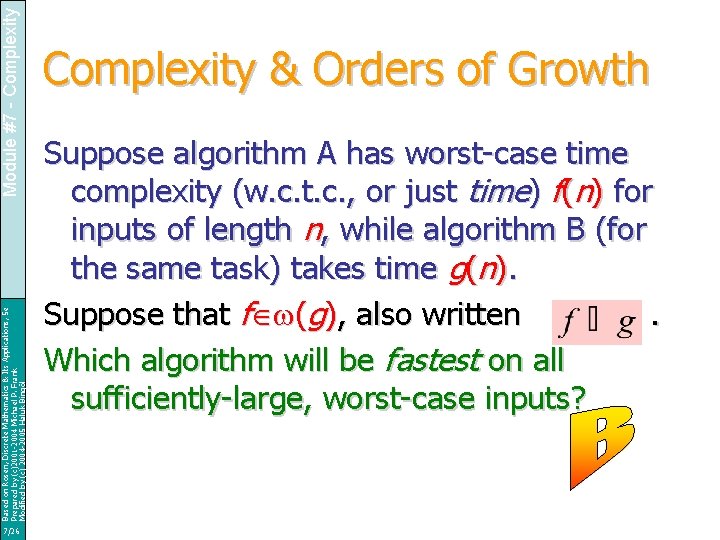
Module #7 - Complexity Based on Rosen, Discrete Mathematics & Its Applications, 5 e Prepared by (c)2001 -2004 Michael P. Frank Modified by (c) 2004 -2005 Haluk Bingöl 7/26 Complexity & Orders of Growth Suppose algorithm A has worst-case time complexity (w. c. t. c. , or just time) f(n) for inputs of length n, while algorithm B (for the same task) takes time g(n). Suppose that f (g), also written. Which algorithm will be fastest on all sufficiently-large, worst-case inputs?
Module #7 - Complexity Based on Rosen, Discrete Mathematics & Its Applications, 5 e Prepared by (c)2001 -2004 Michael P. Frank Modified by (c) 2004 -2005 Haluk Bingöl 8/26 Example 1: Max algorithm Problem: Find the simplest form of the exact order of growth ( ) of the worstcase time complexity (w. c. t. c. ) of the max algorithm, assuming that each line of code takes some constant time every time it is executed (with possibly different times for different lines of code).
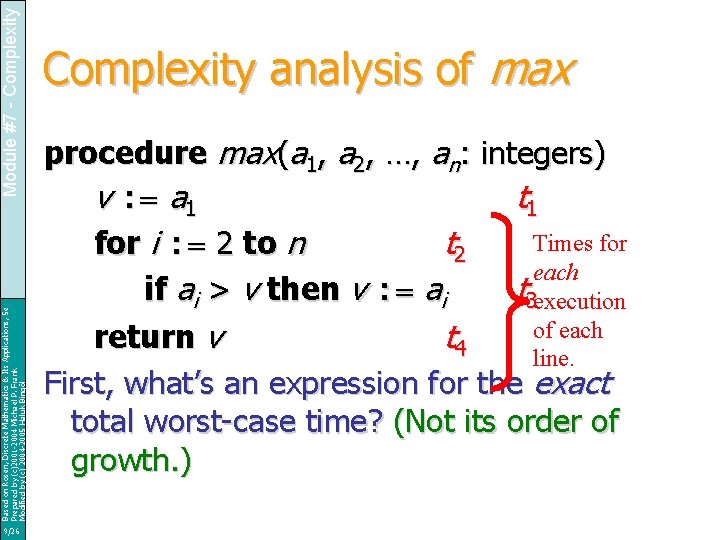
Module #7 - Complexity Based on Rosen, Discrete Mathematics & Its Applications, 5 e Prepared by (c)2001 -2004 Michael P. Frank Modified by (c) 2004 -2005 Haluk Bingöl 9/26 Complexity analysis of max procedure max(a 1, a 2, …, an: integers) v : = a 1 t 1 Times for i : = 2 to n t 2 each if ai > v then v : = ai t 3 execution of each return v t 4 line. First, what’s an expression for the exact total worst-case time? (Not its order of growth. )
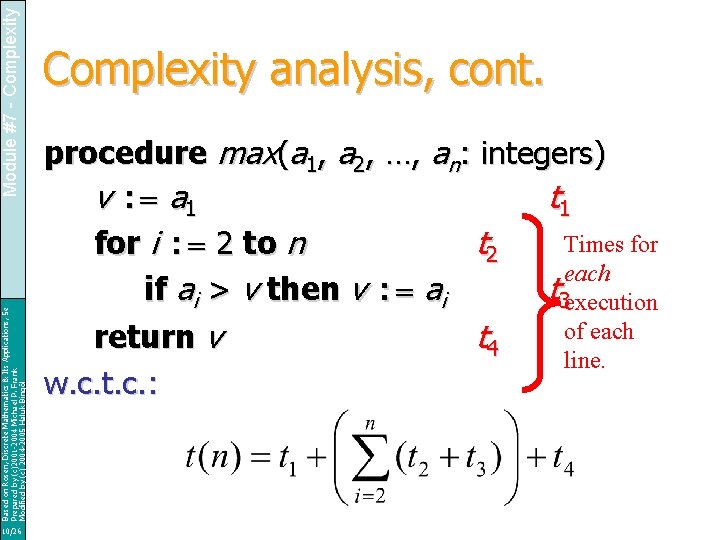
Module #7 - Complexity Based on Rosen, Discrete Mathematics & Its Applications, 5 e Prepared by (c)2001 -2004 Michael P. Frank Modified by (c) 2004 -2005 Haluk Bingöl 10/26 Complexity analysis, cont. procedure max(a 1, a 2, …, an: integers) v : = a 1 t 1 Times for i : = 2 to n t 2 each if ai > v then v : = ai t 3 execution of each return v t 4 line. w. c. t. c. :
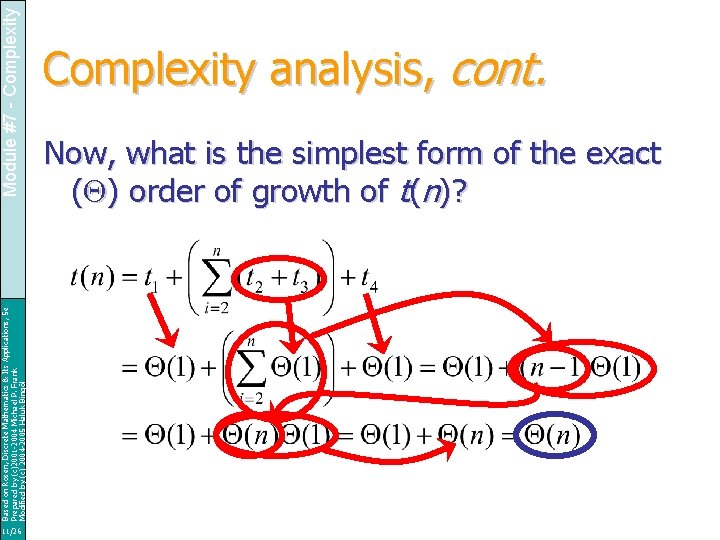
11/26 Based on Rosen, Discrete Mathematics & Its Applications, 5 e Prepared by (c)2001 -2004 Michael P. Frank Modified by (c) 2004 -2005 Haluk Bingöl Module #7 - Complexity analysis, cont. Now, what is the simplest form of the exact ( ) order of growth of t(n)?
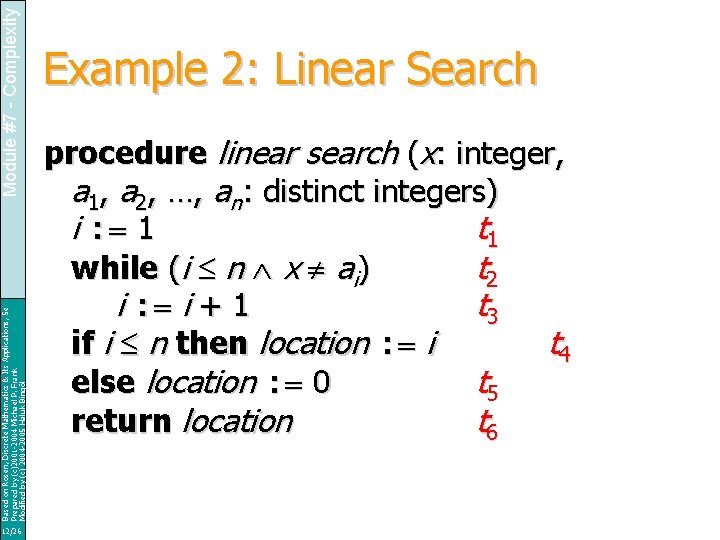
Module #7 - Complexity Based on Rosen, Discrete Mathematics & Its Applications, 5 e Prepared by (c)2001 -2004 Michael P. Frank Modified by (c) 2004 -2005 Haluk Bingöl 12/26 Example 2: Linear Search procedure linear search (x: integer, a 1, a 2, …, an: distinct integers) i : = 1 t 1 while (i n x ai) t 2 i : = i + 1 t 3 if i n then location : = i t 4 else location : = 0 t 5 return location t 6
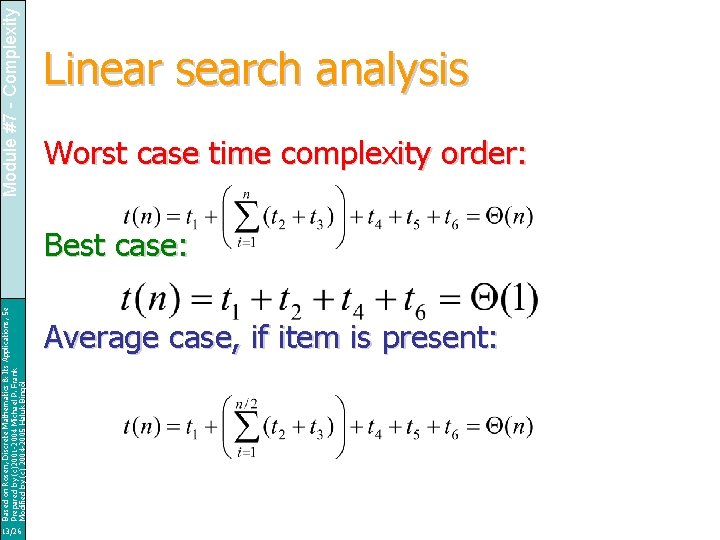
13/26 Based on Rosen, Discrete Mathematics & Its Applications, 5 e Prepared by (c)2001 -2004 Michael P. Frank Modified by (c) 2004 -2005 Haluk Bingöl Module #7 - Complexity Linear search analysis Worst case time complexity order: Best case: Average case, if item is present:
Module #7 - Complexity Review § 2. 2: Complexity Algorithmic complexity = cost of computation. Focus on time complexity for our course. Based on Rosen, Discrete Mathematics & Its Applications, 5 e Prepared by (c)2001 -2004 Michael P. Frank Modified by (c) 2004 -2005 Haluk Bingöl Although space & energy are also important. 14/26 Characterize complexity as a function of input size: Worst-case, best-case, or average-case. Use orders-of-growth notation to concisely summarize the growth properties of complexity functions.
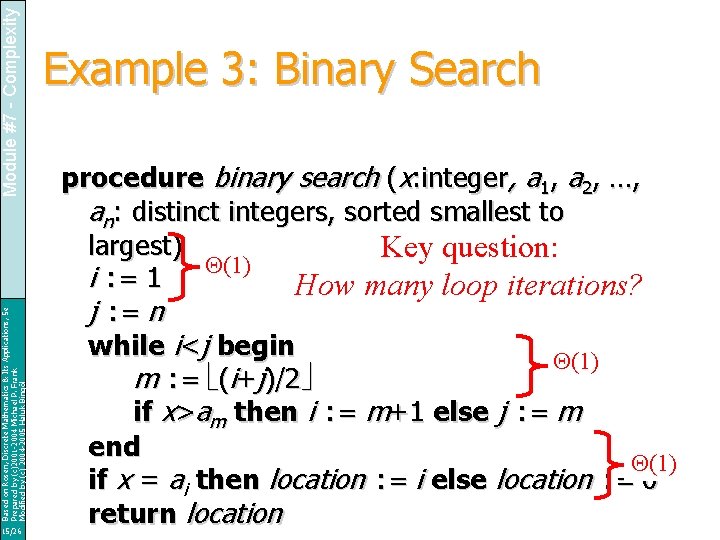
Module #7 - Complexity Based on Rosen, Discrete Mathematics & Its Applications, 5 e Prepared by (c)2001 -2004 Michael P. Frank Modified by (c) 2004 -2005 Haluk Bingöl 15/26 Example 3: Binary Search procedure binary search (x: integer, a 1, a 2, …, an: distinct integers, sorted smallest to largest) Key question: i : = 1 (1) How many loop iterations? j : = n while i<j begin (1) m : = (i+j)/2 if x>am then i : = m+1 else j : = m end (1) if x = ai then location : = i else location : = 0 return location
Module #7 - Complexity Based on Rosen, Discrete Mathematics & Its Applications, 5 e Prepared by (c)2001 -2004 Michael P. Frank Modified by (c) 2004 -2005 Haluk Bingöl 16/26 Binary search analysis Suppose that n is a power of 2, i. e. , k: n=2 k. Original range from i=1 to j=n contains n items. Each iteration: Size j i+1 of range is cut in ~half. Loop terminates when size of range is 1=20 (i=j). Therefore, the number of iterations is: k = log 2 n = (log 2 n)= (log n) Even for n 2 k (not an integral power of 2), time complexity is still (log 2 n) = (log n).
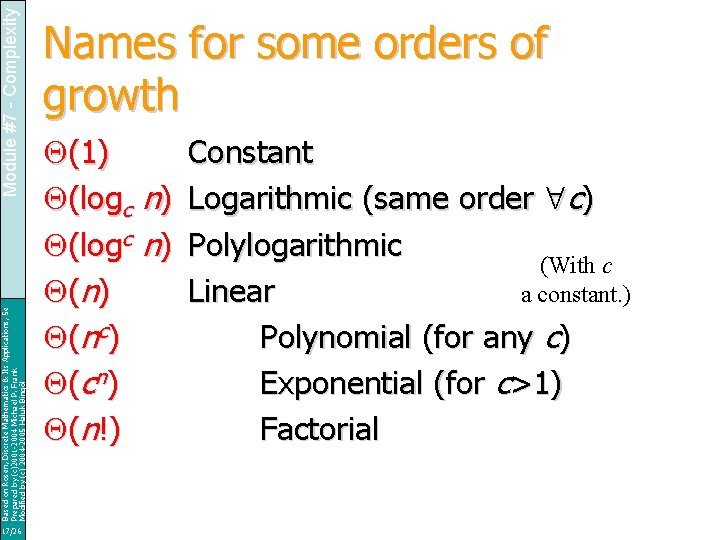
Module #7 - Complexity Based on Rosen, Discrete Mathematics & Its Applications, 5 e Prepared by (c)2001 -2004 Michael P. Frank Modified by (c) 2004 -2005 Haluk Bingöl 17/26 Names for some orders of growth (1) (logc n) ( n c ) ( c n ) (n!) Constant Logarithmic (same order c) Polylogarithmic (With c a constant. ) Linear Polynomial (for any c) Exponential (for c>1) Factorial
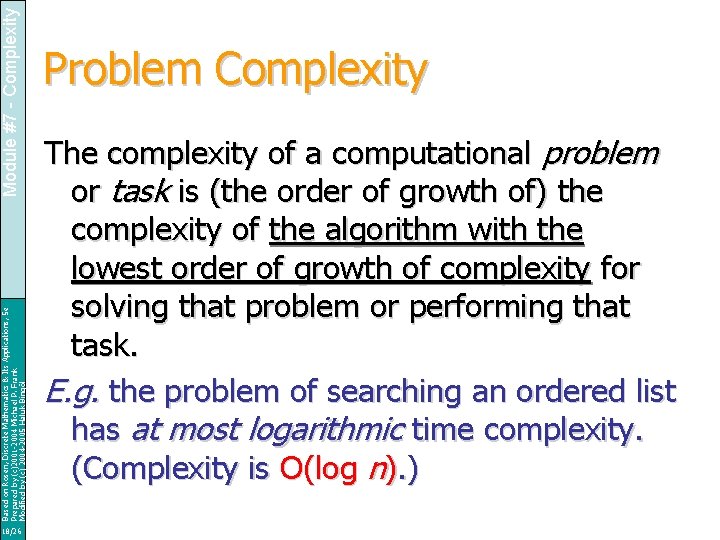
Module #7 - Complexity Based on Rosen, Discrete Mathematics & Its Applications, 5 e Prepared by (c)2001 -2004 Michael P. Frank Modified by (c) 2004 -2005 Haluk Bingöl 18/26 Problem Complexity The complexity of a computational problem or task is (the order of growth of) the complexity of the algorithm with the lowest order of growth of complexity for solving that problem or performing that task. E. g. the problem of searching an ordered list has at most logarithmic time complexity. (Complexity is O(log n). )
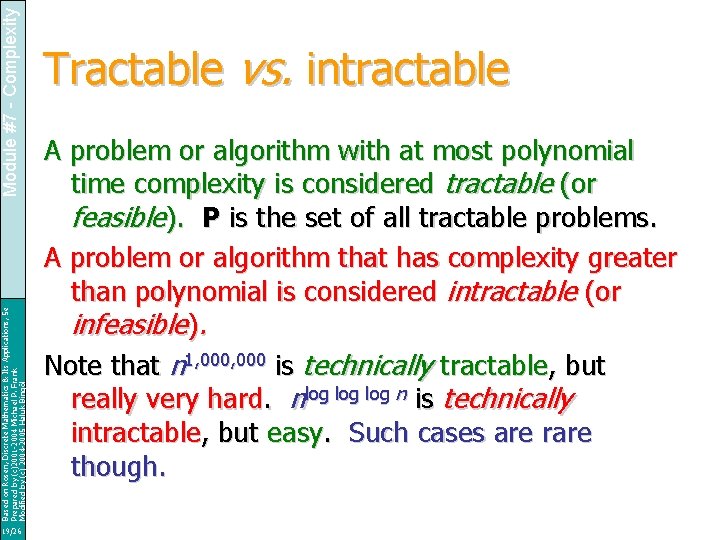
Module #7 - Complexity Based on Rosen, Discrete Mathematics & Its Applications, 5 e Prepared by (c)2001 -2004 Michael P. Frank Modified by (c) 2004 -2005 Haluk Bingöl 19/26 Tractable vs. intractable A problem or algorithm with at most polynomial time complexity is considered tractable (or feasible). P is the set of all tractable problems. A problem or algorithm that has complexity greater than polynomial is considered intractable (or infeasible). Note that n 1, 000 is technically tractable, but really very hard. nlog log n is technically intractable, but easy. Such cases are rare though.
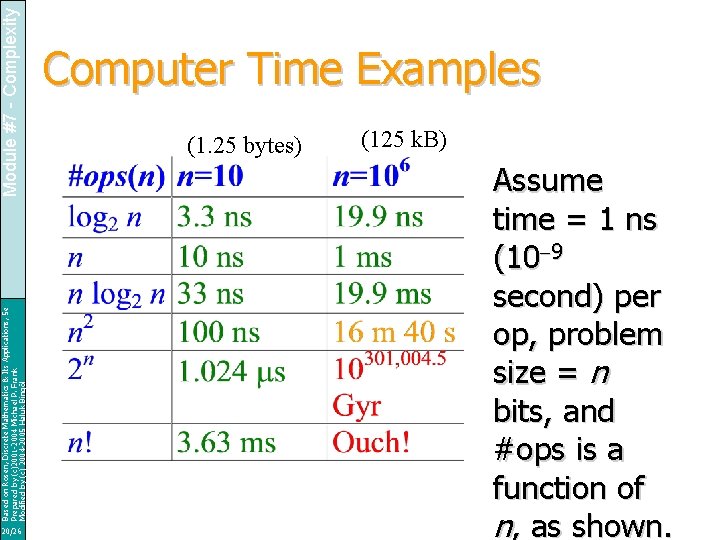
20/26 Based on Rosen, Discrete Mathematics & Its Applications, 5 e Prepared by (c)2001 -2004 Michael P. Frank Modified by (c) 2004 -2005 Haluk Bingöl Module #7 - Complexity Computer Time Examples (1. 25 bytes) (125 k. B) Assume time = 1 ns (10 9 second) per op, problem size = n bits, and #ops is a function of n, as shown.
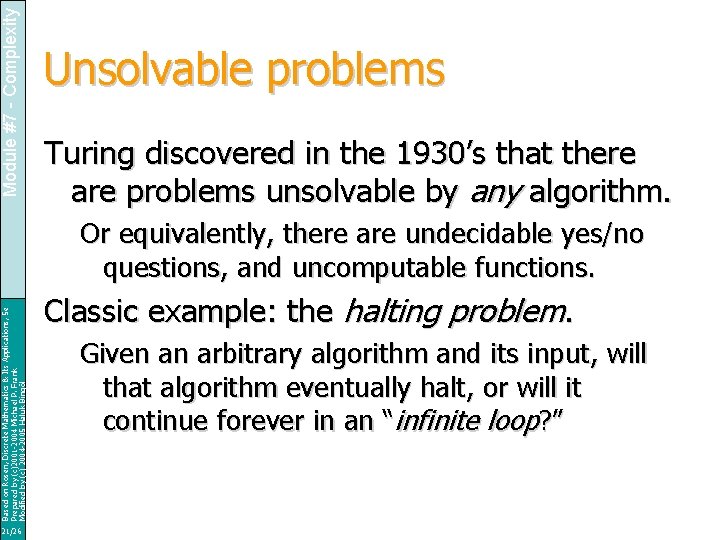
Module #7 - Complexity Unsolvable problems Turing discovered in the 1930’s that there are problems unsolvable by any algorithm. Based on Rosen, Discrete Mathematics & Its Applications, 5 e Prepared by (c)2001 -2004 Michael P. Frank Modified by (c) 2004 -2005 Haluk Bingöl Or equivalently, there are undecidable yes/no questions, and uncomputable functions. 21/26 Classic example: the halting problem. Given an arbitrary algorithm and its input, will that algorithm eventually halt, or will it continue forever in an “infinite loop? ”
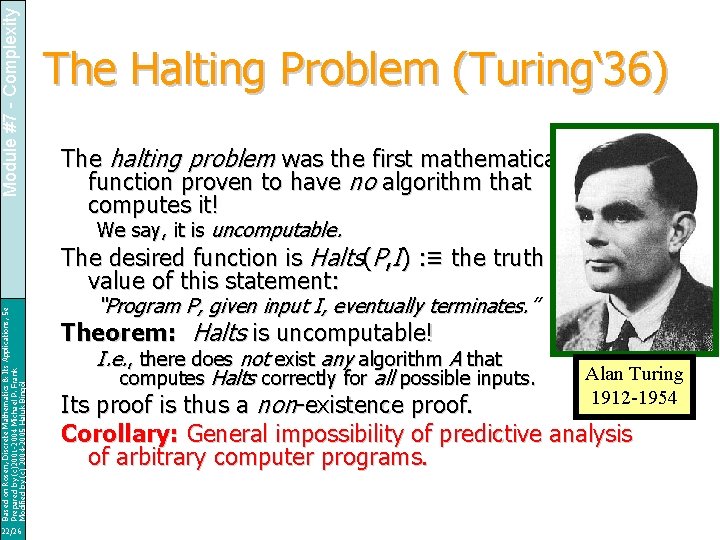
Module #7 - Complexity The Halting Problem (Turing‘ 36) The halting problem was the first mathematical function proven to have no algorithm that computes it! We say, it is uncomputable. Based on Rosen, Discrete Mathematics & Its Applications, 5 e Prepared by (c)2001 -2004 Michael P. Frank Modified by (c) 2004 -2005 Haluk Bingöl The desired function is Halts(P, I) : ≡ the truth value of this statement: 22/26 “Program P, given input I, eventually terminates. ” Theorem: Halts is uncomputable! I. e. , there does not exist any algorithm A that computes Halts correctly for all possible inputs. Alan Turing 1912 -1954 Its proof is thus a non-existence proof. Corollary: General impossibility of predictive analysis of arbitrary computer programs.
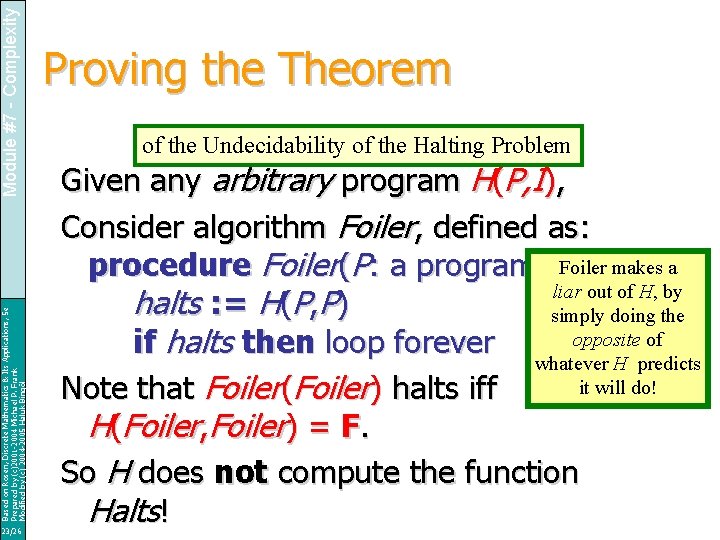
Module #7 - Complexity Based on Rosen, Discrete Mathematics & Its Applications, 5 e Prepared by (c)2001 -2004 Michael P. Frank Modified by (c) 2004 -2005 Haluk Bingöl 23/26 Proving the Theorem of the Undecidability of the Halting Problem Given any arbitrary program H(P, I), Consider algorithm Foiler, defined as: procedure Foiler(P: a program) Foiler makes a liar out of H, by halts : = H(P, P) simply doing the opposite of if halts then loop forever whatever H predicts it will do! Note that Foiler(Foiler) halts iff H(Foiler, Foiler) = F. So H does not compute the function Halts!
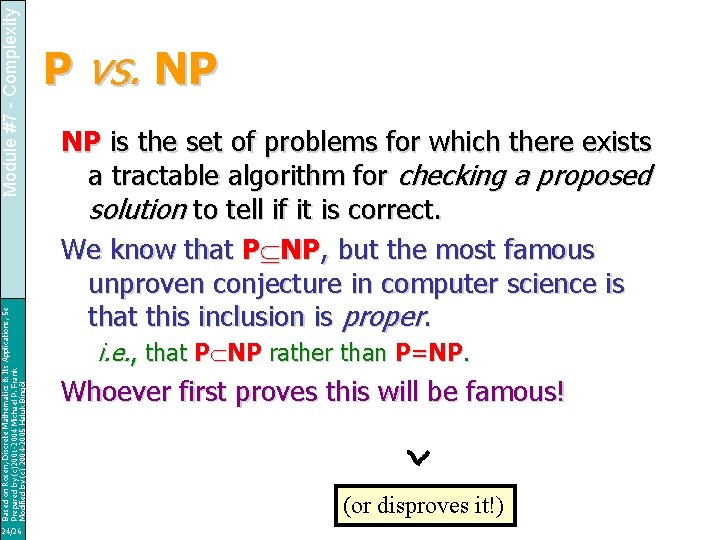
Module #7 - Complexity Based on Rosen, Discrete Mathematics & Its Applications, 5 e Prepared by (c)2001 -2004 Michael P. Frank Modified by (c) 2004 -2005 Haluk Bingöl 24/26 P vs. NP NP is the set of problems for which there exists a tractable algorithm for checking a proposed solution to tell if it is correct. We know that P NP, but the most famous unproven conjecture in computer science is that this inclusion is proper. i. e. , that P NP rather than P=NP. Whoever first proves this will be famous! (or disproves it!)
Module #7 - Complexity Based on Rosen, Discrete Mathematics & Its Applications, 5 e Prepared by (c)2001 -2004 Michael P. Frank Modified by (c) 2004 -2005 Haluk Bingöl 25/26 Key Things to Know Definitions of algorithmic complexity, time complexity, worst-case time complexity. Names of specific orders of growth of complexity. How to analyze the worst case, best case, or average case order of growth of time complexity for simple algorithms.
26/26 Based on Rosen, Discrete Mathematics & Its Applications, 5 e Prepared by (c)2001 -2004 Michael P. Frank Modified by (c) 2004 -2005 Haluk Bingöl Module #7 - Complexity References • Rosen Discrete Mathematics and its Applications, 5 e Mc Graw. Hill, 2003
- Slides: 26