
1252020 COCS 222 Discrete Structures 1 By first
12/5/2020 COCS 222 - Discrete Structures 1
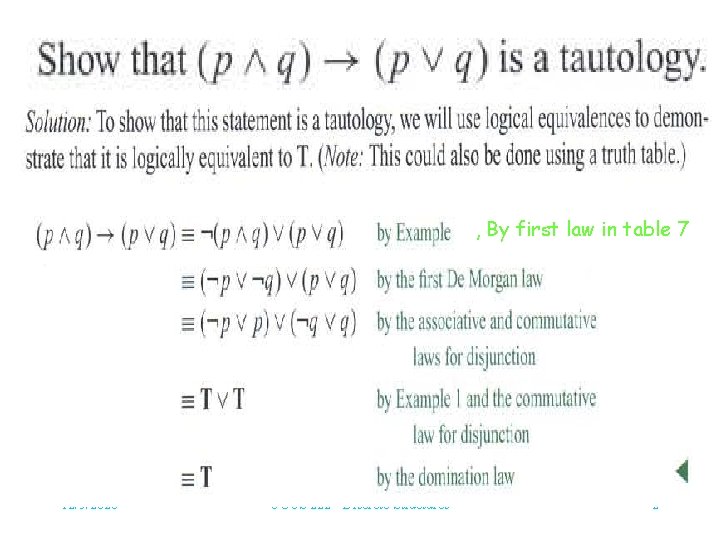
, By first law in table 7 12/5/2020 COCS 222 - Discrete Structures 2
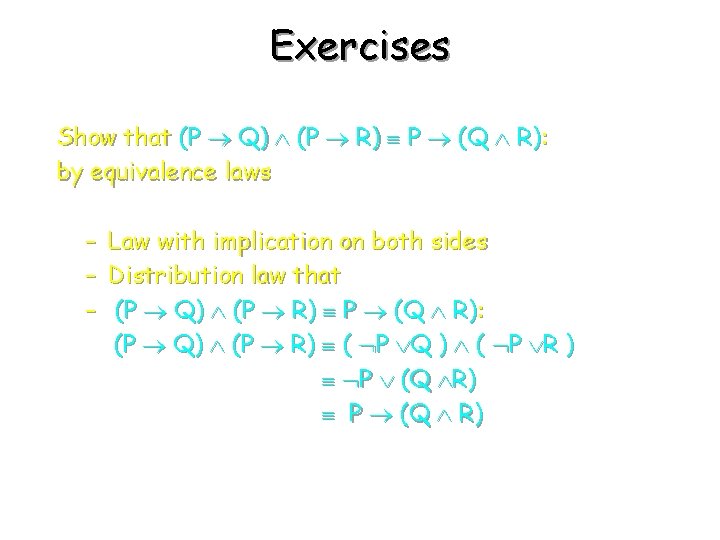
Exercises Show that (P Q) (P R) P (Q R): by equivalence laws – – – Law with implication on both sides Distribution law that (P Q) (P R) P (Q R): (P Q) (P R) ( P Q ) ( P R ) P (Q R) P (Q R)
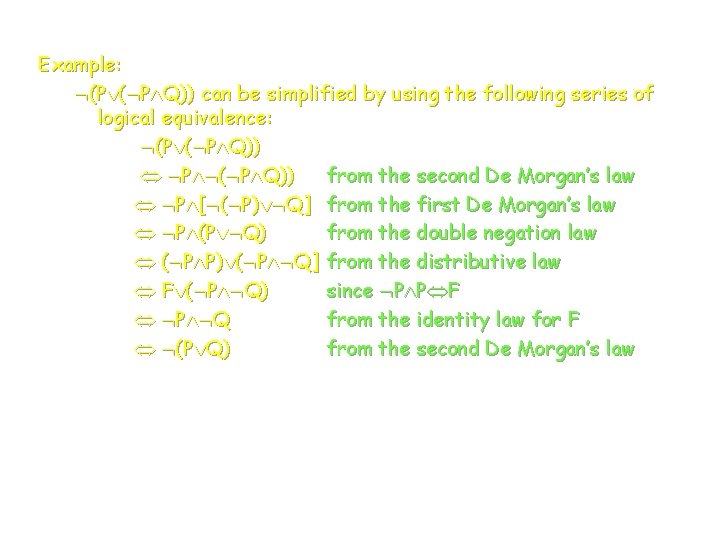
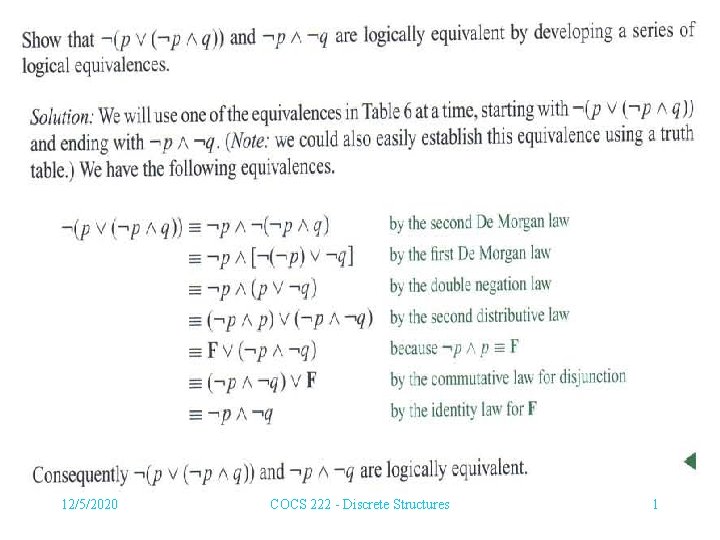
Example: (P ( P Q)) can be simplified by using the following series of logical equivalence: (P ( P Q)) from the second De Morgan’s law P [ ( P) Q] from the first De Morgan’s law P (P Q) from the double negation law ( P P) ( P Q] from the distributive law F ( P Q) since P P F P Q from the identity law for F (P Q) from the second De Morgan’s law
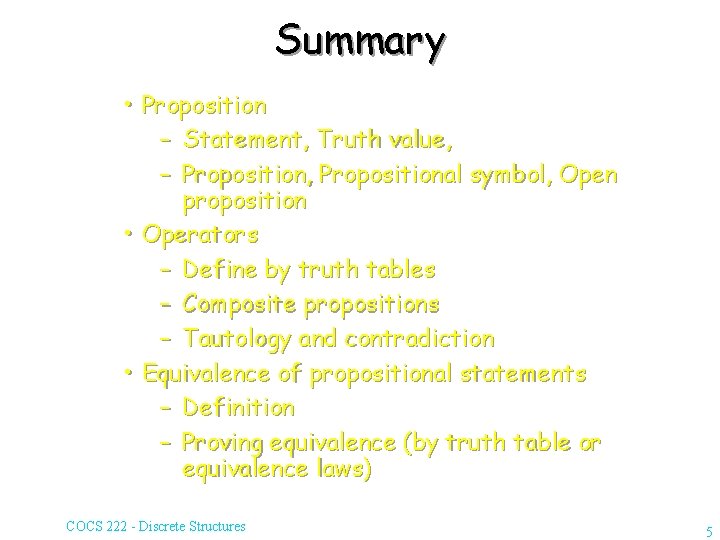
Summary • Proposition – Statement, Truth value, – Proposition, Propositional symbol, Open proposition • Operators – Define by truth tables – Composite propositions – Tautology and contradiction • Equivalence of propositional statements – Definition – Proving equivalence (by truth table or equivalence laws) COCS 222 - Discrete Structures 5
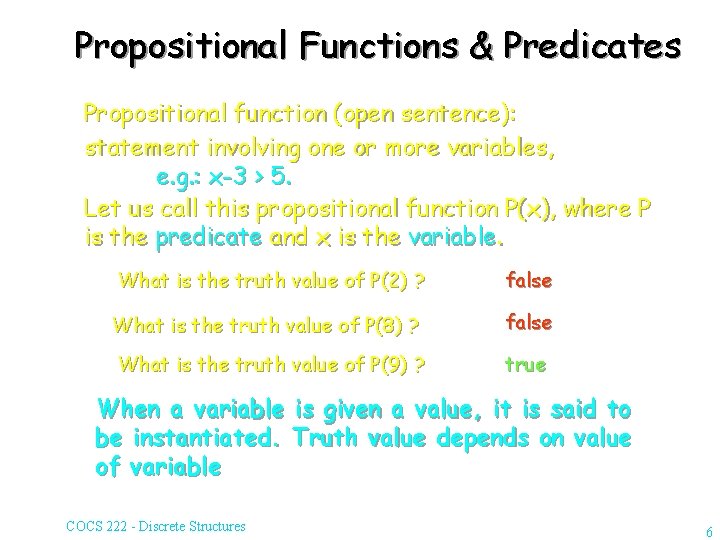
Propositional Functions & Predicates Propositional function (open sentence): statement involving one or more variables, e. g. : x-3 > 5. Let us call this propositional function P(x), where P is the predicate and x is the variable. What is the truth value of P(2) ? false What is the truth value of P(8) ? false What is the truth value of P(9) ? true When a variable is given a value, it is said to be instantiated. Truth value depends on value of variable COCS 222 - Discrete Structures 6
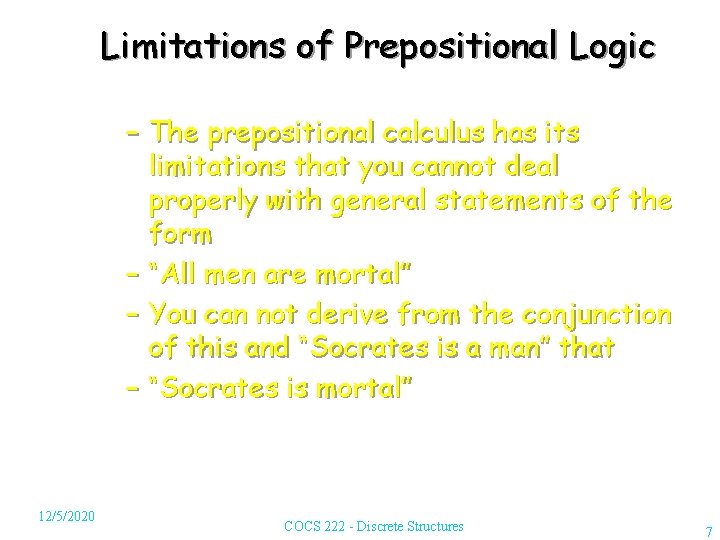
Limitations of Prepositional Logic – The prepositional calculus has its limitations that you cannot deal properly with general statements of the form – “All men are mortal” – You can not derive from the conjunction of this and “Socrates is a man” that – “Socrates is mortal” 12/5/2020 COCS 222 - Discrete Structures 7
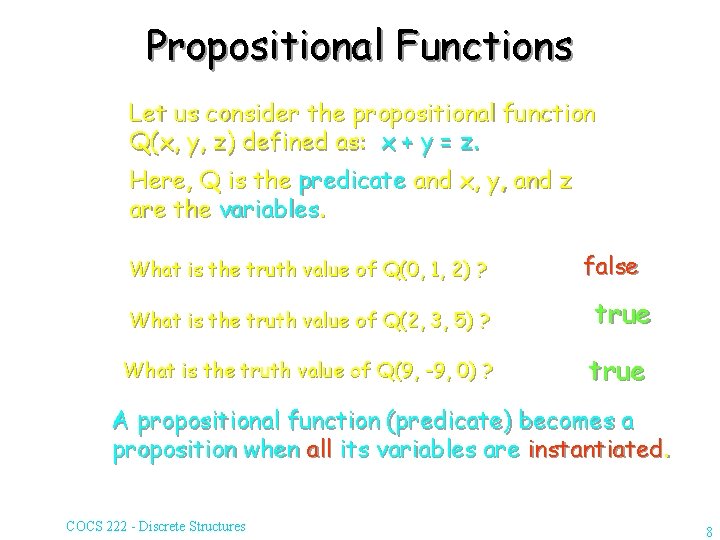
Propositional Functions Let us consider the propositional function Q(x, y, z) defined as: x + y = z. Here, Q is the predicate and x, y, and z are the variables. What is the truth value of Q(0, 1, 2) ? false What is the truth value of Q(2, 3, 5) ? true What is the truth value of Q(9, -9, 0) ? true A propositional function (predicate) becomes a proposition when all its variables are instantiated. COCS 222 - Discrete Structures 8
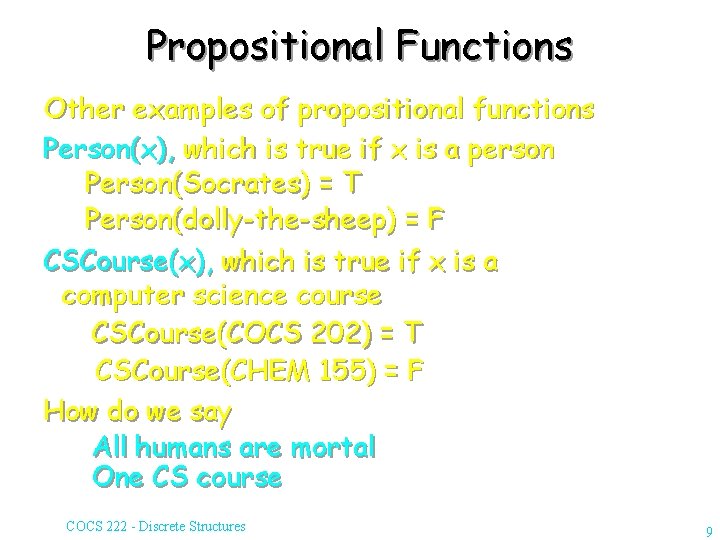
Propositional Functions Other examples of propositional functions Person(x), which is true if x is a person Person(Socrates) = T Person(dolly-the-sheep) = F CSCourse(x), which is true if x is a computer science course CSCourse(COCS 202) = T CSCourse(CHEM 155) = F How do we say All humans are mortal One CS course COCS 222 - Discrete Structures 9
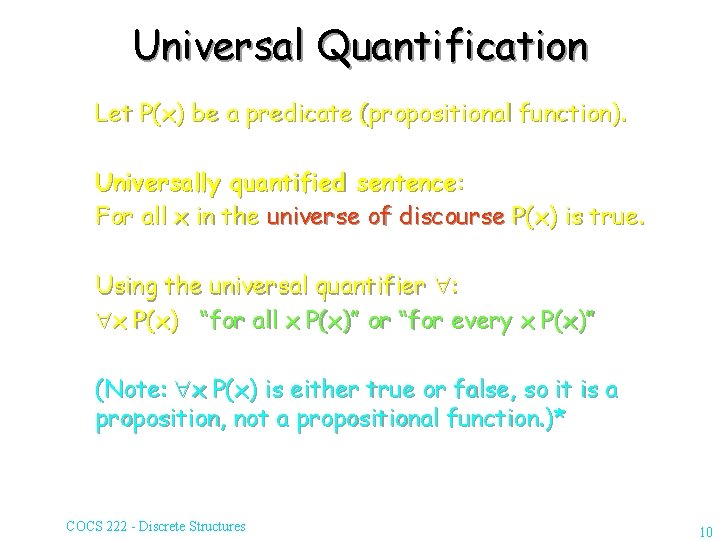
Universal Quantification Let P(x) be a predicate (propositional function). Universally quantified sentence: For all x in the universe of discourse P(x) is true. Using the universal quantifier : x P(x) “for all x P(x)” or “for every x P(x)” (Note: x P(x) is either true or false, so it is a proposition, not a propositional function. )* COCS 222 - Discrete Structures 10
- Slides: 10